
Exodus 30:12

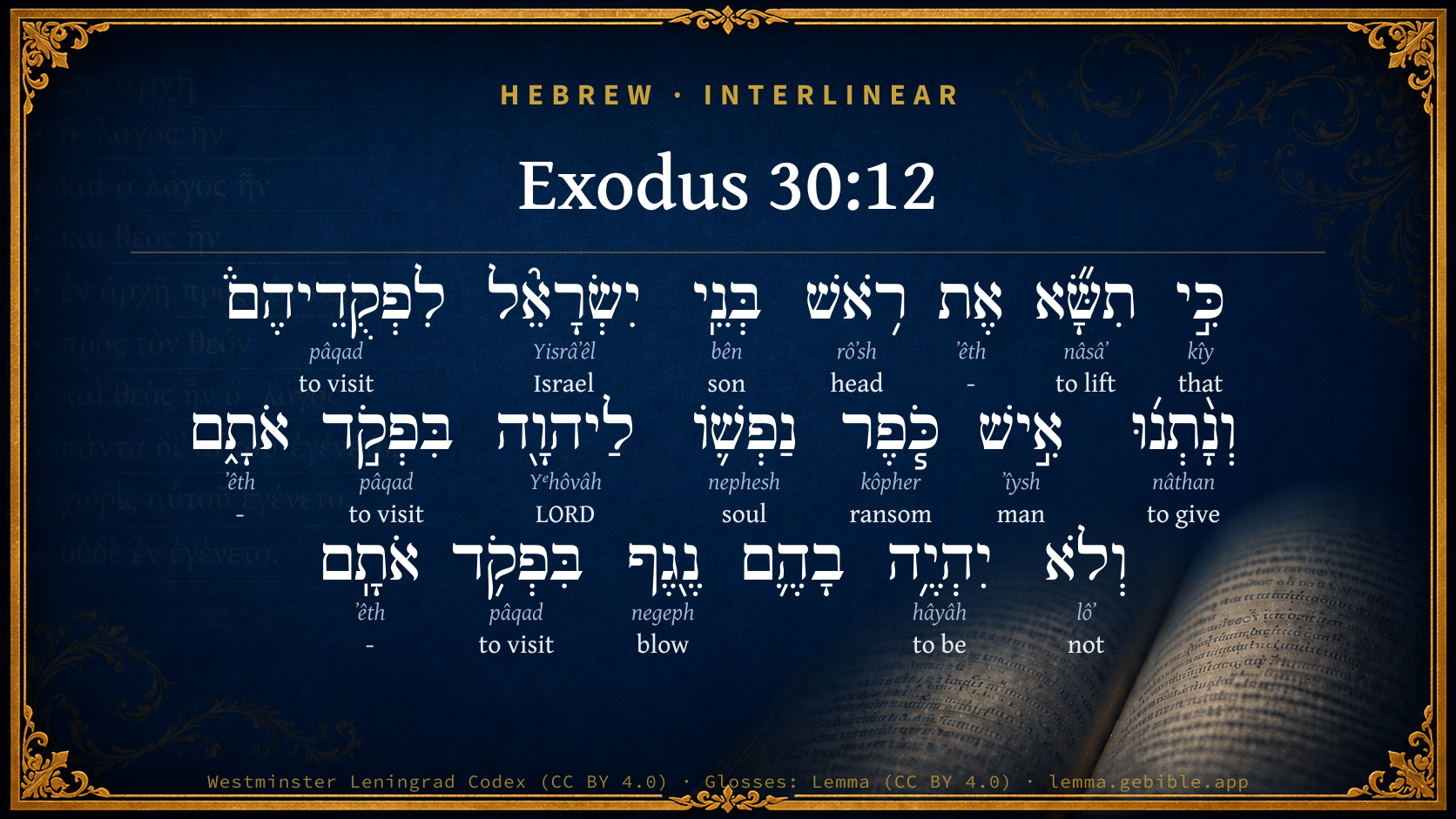
Hebrew (Westminster Leningrad Codex) Exodus 30:12 appears in the Hebrew Old Testament. The text above is from the Westminster Leningrad Codex. Each word links to its Strong’s number, a concise gloss, and parsing drawn from the Open Scriptures Hebrew Bible morphology. Click any word for its full Brown-Driver-Briggs (BDB) entry.
Download image
Cite this verse

Exodus 30:12 (World English Bible). Public Domain. Lemma interlinear Bible study tool, https://lemma.gebible.app/v/exodus/30/12.

Show BibTeX & RIS
BibTeX
RIS
English Translation
"When you take a census of the children of Israel, according to those who are numbered among them, then each man shall give a ransom for his soul to Yahweh, when you number them; that there be no plague among them when you number them.
World English Bible · Public Domain
Download a study sheet

One document with this verse’s original text, its word-by-word gloss line, the meaning frame, cross-references with their text, attributed commentary, and full source and license credits — printable, and it pastes into notes with its structure intact.

This verse Autodidact and up

Study sheet (.html) Plain text (.txt)

A passage Seminary Student

Up to 50 verses in one chapter. A passage sheet keeps up to 6 commentary sources and 12 cross-references per verse, in the order this page ranks them, and says so on the sheet whenever that leaves anything out. Ask for a single verse and you get the Autodidact verse sheet above.

Everything on this page stays free to read, with no account — the sheet is a download of what is already on screen, not access to it.

Want to remove ads? Support Godless Engineer
Compare translations 3

The same verse in 3 English versions, stacked beneath the original-language interlinear above. Click any original word for its lexicon entry.

Each is an independent rendering of the whole verse — the interlinear is not word-aligned to these translations.

Highlighted words mark where these versions differ — a whole-verse word diff, not a word-by-word alignment.

  • World English Bible Public Domain
    "When you take a census of the children of Israel, according to those who are numbered among them, then each man shall give a ransom for his soul to Yahweh, when you number them; that there be no plague among them when you number them.
  • King James Version Public Domain
    When thou takest the sum of the children of Israel after their number, then shall they give every man a ransom for his soul unto the LORD, when thou numberest them; that there be no plague among them, when thou numberest them.
  • unfoldingWord Literal Text CC BY-SA 4.0
    “When you lift up the head of the sons of Israel to count them, then each man shall give the ransom of his life to Yahweh when counting them. And there will not be a plague among them when counting them.

unfoldingWord Literal Text — © unfoldingWord, licensed CC BY-SA 4.0. Word-aligned USFM3 via Door43 (git.door43.org/unfoldingWord/en_ult).

Versions to compare (up to 4)

3 of 4 selected

Show all 18 translations

Every available English version of this verse, each an independent rendering of the whole verse.

  • World English Bible Public Domain
    "When you take a census of the children of Israel, according to those who are numbered among them, then each man shall give a ransom for his soul to Yahweh, when you number them; that there be no plague among them when you number them.
  • Berean Standard Bible Public Domain
    “When you take a census of the Israelites to number them, each man must pay the LORD a ransom for his life when he is counted. Then no plague will come upon them when they are numbered.
  • Majority Standard Bible Public Domain
    “When you take a census of the Israelites to number them, each man must pay the LORD a ransom for his life when he is counted. Then no plague will come upon them when they are numbered.
  • King James Version Public Domain
    When thou takest the sum of the children of Israel after their number, then shall they give every man a ransom for his soul unto the LORD, when thou numberest them; that there be no plague among them, when thou numberest them.
  • American Standard Version (1901) Public Domain
    When thou takest the sum of the children of Israel, according to those that are numbered of them, then shall they give every man a ransom for his soul unto Jehovah, when thou numberest them; that there be no plague among them, when thou numberest them.
  • Revised Version (1885) Public Domain
    When thou takest the sum of the children of Israel, according to those that are numbered of them, then shall they give every man a ransom for his soul unto the LORD, when thou numberest them; that there be no plague among them, when thou numberest them.
  • Geneva Bible (1599) Public Domain
    When thou takest the summe of the children of Israel after their nomber, then they shall giue euery man a redemption of his life vnto the Lord, when thou tellest them, that there bee no plague among the when thou countest them.
  • Douay-Rheims (1899) Public Domain
    When thou shalt take the sum of the children of Israel according to their number, every one of them shall give a price for their souls to the Lord, and there shall be no scourge among them, when they shall be reckoned.
  • Young's Literal Translation Public Domain
    `When thou takest up the sum of the sons of Israel for their numbers, then they have given each an atonement `for' his soul to Jehovah in their being numbered, and there is no plague among them in their being numbered.
  • Literal Standard Version CC BY-SA 4.0
    “When you take up the census of the sons of Israel for their numbers, then they have each given an atonement [for] his soul to YHWH in their being numbered, and there is no plague among them in their being numbered.
  • Unlocked Literal Bible CC BY-SA 4.0
    “When you take a census of the Israelites, then each person must give a ransom for his life to Yahweh. You must do this after you count them, so that there will be no plague among them when you count them.
  • unfoldingWord Literal Text CC BY-SA 4.0
    “When you lift up the head of the sons of Israel to count them, then each man shall give the ransom of his life to Yahweh when counting them. And there will not be a plague among them when counting them.
  • Darby Bible Public Domain
    When thou shalt take the sum of the children of Israel according to those of them that are numbered, then shall they give every man a ransom for his soul to Jehovah on their being numbered, that there be no plague among them on their being numbered.
  • World Messianic Bible Public Domain
    “When you take a census of the children of Israel, according to those who are counted among them, then each man shall give a ransom for his soul to the LORD when you count them, that there be no plague among them when you count them.
  • Webster's Bible Public Domain
    When thou takest the sum of the children of Israel after their number, then shall they give every man a ransom for his soul to the LORD, when thou numberest them: that there may be no plague among them, when thou numberest them.
  • Free Bible Version CC BY-SA 4.0
    “When you take a census of the Israelites, each man must pay the Lord to buy back his life when he's counted. Then they won't suffer from the plague when they're counted.
  • Bible in Basic English Public Domain
    When you are taking the number of the children of Israel, let every man who is numbered give to the Lord a price for his life, so that no disease may come on them when they are numbered.
  • JPS Tanakh (1917) Public Domain
    'When thou takest the sum of the children of Israel, according to their number, then shall they give every man a ransom for his soul unto the LORD, when thou numberest them; that there be no plague among them, when thou numberest them.

Literal Standard Version (2020), Covenant Press — licensed CC BY-SA 4.0. Text via the HelloAO Bible API (eBible.org). Unlocked Literal Bible (unfoldingWord) — licensed CC BY-SA 4.0. Text via the HelloAO Bible API (eBible.org). unfoldingWord Literal Text — © unfoldingWord, licensed CC BY-SA 4.0. Word-aligned USFM3 via Door43 (git.door43.org/unfoldingWord/en_ult). Free Bible Version, Dr. Jonathan Gallagher — licensed CC BY-SA 4.0. Text via the HelloAO Bible API (eBible.org).

Word by word

More ways to search: Search by grammar → Find every occurrence → Compare this word →

Practice this passage: Drill this verse → Learn its vocabulary →

נֶ֖גֶף
negeph
H5063
“blow”
Noun, Common, Masculine, Singular, Absolute
Part of Speech
Noun
Type
Common
Gender
Masculine
Number
Singular
State
Absolute
Full BDB Definition

Origin: from H5062

TWOT: 1294a

blow, striking, plague - blow, plague (fatal) - striking
  1. כִּ֣י kîy H3588 “that” Conjunction
  2. תִשָּׂ֞א nâsâʼ H5375 “to lift” Verb, Qal, Imperfect, 2nd Person, Masculine, Singular
  3. אֶת ʼêth H853 “-” Particle, Direct Object
  4. רֹ֥אשׁ rôʼsh H7218 “head of” Noun, Common, Masculine, Singular, Construct
  5. בְּנֵֽי bên H1121 “sons of” Noun, Common, Masculine, Plural, Construct
  6. יִשְׂרָאֵ֘ל Yisrâʼêl H3478 “Israel” Noun, Proper
  7. לִפְקֻדֵיהֶם֒ pâqad H6485 “to/for · visited · them” Preposition + Verb, Qal, Participle Passive, Masculine, Plural, Construct + Suffix, Personal, 3rd Person, Masculine, Plural
  8. וְנָ֨תְנ֜וּ nâthan H5414 “and · to give” Conjunction + Verb, Qal, Sequential Perfect, 3rd Person, Common, Plural
  9. אִ֣ישׁ ʼîysh H376 “man” Noun, Common, Masculine, Singular, Absolute
  10. כֹּ֧פֶר kôpher H3724 “ransom of” Noun, Common, Masculine, Singular, Construct
  11. נַפְשׁ֛וֹ nephesh H5315 “soul · his” Noun, Common, Both, Singular, Construct + Suffix, Personal, 3rd Person, Masculine, Singular
  12. לַיהוָ֖ה Yᵉhôvâh H3068 “to/for · LORD” Preposition + Noun, Proper
  13. בִּפְקֹ֣ד pâqad H6485 “in/at · to visit” Preposition + Verb, Qal, Infinitive Construct
  14. אֹתָ֑ם ʼêth H853 “- · them” Particle, Direct Object + Suffix, Personal, 3rd Person, Masculine, Plural
  15. וְלֹא lôʼ H3808 “and · not” Conjunction + Particle, Negative
  16. יִהְיֶ֥ה hâyâh H1961 “to be” Verb, Qal, Imperfect, 3rd Person, Masculine, Singular
  17. בִּפְקֹ֥ד pâqad H6485 “in/at · to visit” Preposition + Verb, Qal, Infinitive Construct
  18. אֹתָֽם ʼêth H853 “- · them” Particle, Direct Object + Suffix, Personal, 3rd Person, Masculine, Plural

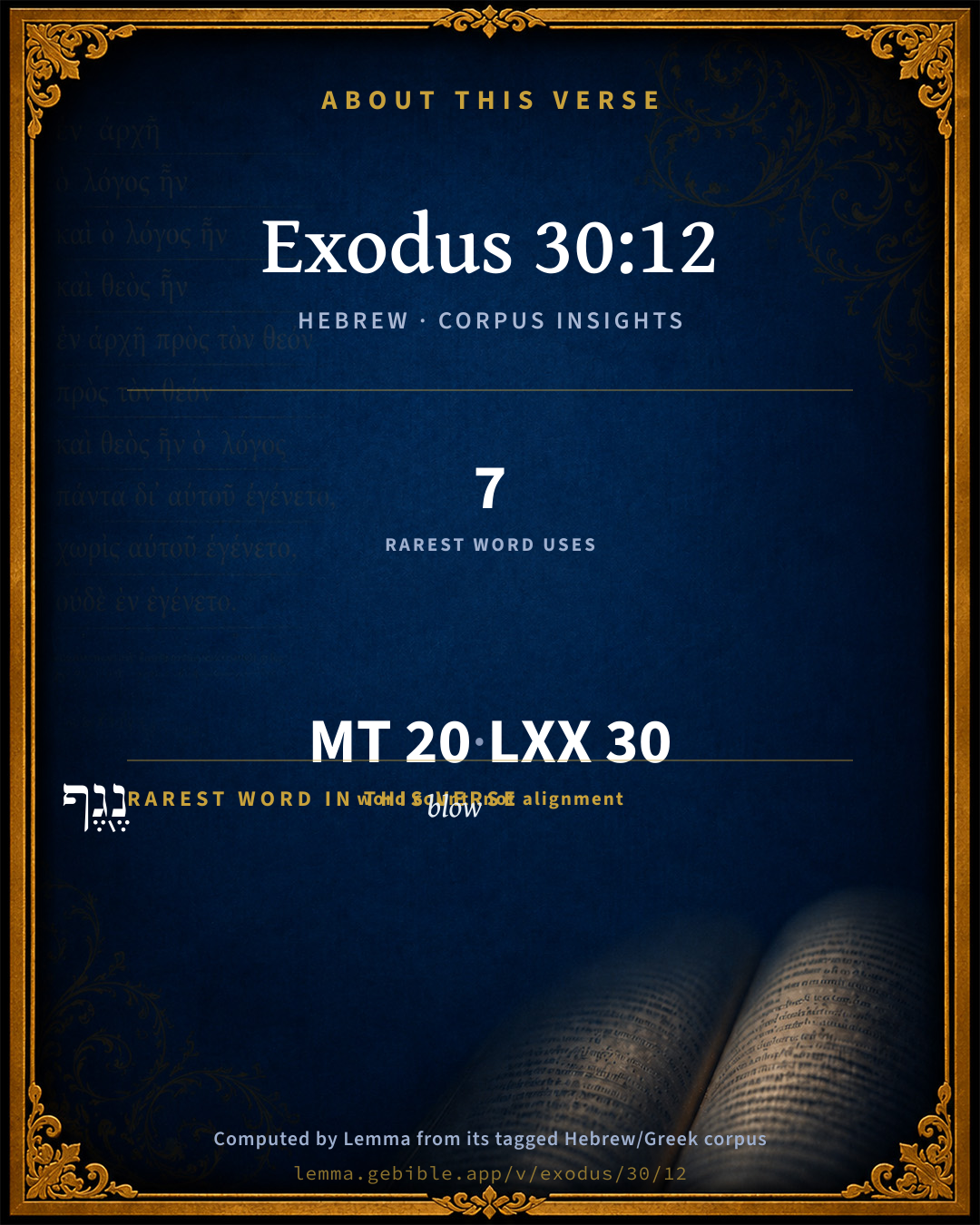
About this verse

These counts appear in no published source. They are computed here, from the morphology-tagged text and Lemma’s own curated glosses. What Lemma adds →

20
words
15
distinct lemmas
Pentateuch
section

Notable vocabulary

The rarest word here is נֶ֖גֶף blow H5063 — appearing just 7 times in the whole Hebrew Bible.

Shared distinctive vocabulary

נֶ֖גֶף blow H5063 occurs in 7 verses of the Hebrew Bible. Also found in:

Grammatical profile

  • 6 verbs
  • 8 nouns
  • 1 preposition
  • 1 conjunction
  • 4 particles

Verb forms

  • תִשָּׂ֞א Qal · Imperfect
  • לִפְקֻדֵיהֶם֒ Qal · Participle Passive
  • וְנָ֨תְנ֜וּ Qal · Sequential Perfect
  • בִּפְקֹ֣ד Qal · Infinitive Construct
  • יִהְיֶ֥ה Qal · Imperfect
  • בִּפְקֹ֥ד Qal · Infinitive Construct

Repetition

A word recurs within this verse — often emphatic in Hebrew:

  • לִפְקֻדֵיהֶם֒ to visit H6485 ×3

Hebrew & Septuagint length

In English translation the verse runs 45 words from the Hebrew and 42 from the Septuagint (LXX English) — closely comparable.

A rough comparison of the two English renderings, which tokenize alike — not a word-level alignment.

Word counts can differ between the Hebrew and the Greek without any difference in meaning — e.g. the Hebrew direct-object marker אֵת has no separate Greek word, and Greek often adds the article ὁ.

In the original languages it is 20 Hebrew tokens and 30 Greek tokens — but the two are counted differently (Hebrew bundles its prefixes and suffixes into one token; the Greek is in lemma form), so that isn’t a like-for-like length.

Cross-references

16

Topical passages linked to Exodus 30:12 in the Treasury of Scripture Knowledge — connected by theme and wording, ordered by reader-vote popularity; previews shown in the World English Bible.

  • Numbers 31:50 We have brought Yahweh's offering, what every man has gotten, of jewels of gold, ankle-chains, and bracelets, signet-rings, ear-rings, and armlets, to make atonement for our souls before Yahweh.
  • Exodus 38:25–26 The silver of those who were numbered of the congregation was one hundred talents, and one thousand seven hundred seventy-five shekels, after the shekel of the sanctuary:
  • 1 Chronicles 27:24 Joab the son of Zeruiah began to number, but didn't finish; and there came wrath for this on Israel; neither was the number put into the account in the chronicles of king David.
  • 1 Peter 1:18–19 knowing that you were redeemed, not with corruptible things, with silver or gold, from the useless way of life handed down from your fathers,
  • Psalms 49:7 None of them can by any means redeem his brother, Nor give God a ransom for him.
  • Matthew 20:28 even as the Son of Man came not to be served, but to serve, and to give his life as a ransom for many."
  • Numbers 1:2–5 "Take a census of all the congregation of the children of Israel, by their families, by their fathers' houses, according to the number of the names, every male, one by one;
  • Numbers 26:2–4 Take the sum of all the congregation of the children of Israel, from twenty years old and upward, by their fathers' houses, all who are able to go forth to war in Israel.
  • 2 Samuel 24:1–15 Again the anger of Yahweh was kindled against Israel, and he moved David against them, saying, Go, number Israel and Judah.
  • 1 Chronicles 21:12 either three years of famine; or three months to be consumed before your foes, while the sword of your enemies overtakes you; or else three days the sword of Yahweh, even pestilence in the land, and the angel of Yahweh destroying throughout all the borders of Israel. Now therefore consider what answer I shall return to him who sent me.
  • 1 Chronicles 21:14 So Yahweh sent a pestilence on Israel; and there fell of Israel seventy thousand men.
  • 2 Chronicles 24:6 The king called for Jehoiada the chief, and said to him, Why haven't you required of the Levites to bring in out of Judah and out of Jerusalem the tax of Moses the servant of Yahweh, and of the assembly of Israel, for the tent of the testimony?
  • Job 33:24 Then God is gracious to him, and says, 'Deliver him from going down to the pit, I have found a ransom.'
  • Job 36:18 Don't let riches entice you to wrath, Neither let the great size of a bribe turn you aside.
  • Mark 10:45 For the Son of Man also came not to be served, but to serve, and to give his life as a ransom for many."
  • 1 Timothy 2:6 who gave himself as a ransom for all; the testimony in its own times;

Cross-references courtesy of OpenBible.info (CC BY 4.0).

Hebrew and Greek witnesses Masoretic Hebrew ↔ Greek Septuagint

The same verse in the two great witnesses to the Old Testament, shown verse-for-verse.

These are two independent witnesses, not word-aligned to each other, and the Septuagint is shown in lemma (dictionary) form.

Hebrew Exodus 30:12 Masoretic · Westminster Leningrad Codex

כִּ֣י תִשָּׂ֞א אֶת רֹ֥אשׁ בְּנֵֽי יִשְׂרָאֵ֘ל לִפְקֻדֵיהֶם֒ וְנָ֨תְנ֜וּ אִ֣ישׁ כֹּ֧פֶר נַפְשׁ֛וֹ לַיהוָ֖ה בִּפְקֹ֣ד אֹתָ֑ם וְלֹא יִהְיֶ֥ה בָהֶ֛ם נֶ֖גֶף בִּפְקֹ֥ד אֹתָֽם

"When you take a census of the children of Israel, according to those who are numbered among them, then each man shall give a ransom for his soul to Yahweh, when you number them; that there be no plague among them when you number them.

World English Bible · Public Domain

Greek LXX Exodus 30:12 Septuagint · lemma form

ἐάν λαμβάνω ὁ συλλογισμός ὁ υἱός ἰσραήλ ἐν ὁ ἐπισκοπή αὐτός καί δίδωμι ἕκαστος λύτρον ὁ ψυχή αὐτός ὁ κύριος καί οὐ εἰμί ἐν αὐτός πτῶσις ἐν ὁ ἐπισκοπή αὐτός

If you take account of the children of Israel in the surveying of them, and they shall give every one a ransom for his soul to the Lord, then there shall not be among them a destruction in the visiting of them.

LXX2012 (modern English Septuagint) · Public Domain

On this verse, John Gill's Exposition discusses the Septuagint’s reading. Read the note in Commentary ↓

Hebrew: Westminster Leningrad Codex (CC BY 4.0). Greek: Septuagint (public domain); English from LXX2012 (modern English Septuagint) (Public Domain). How the Septuagint differs from the Hebrew →

Targum (Aramaic paraphrase)

2

The Targum is the ancient Jewish Aramaic paraphrase of the Hebrew Scriptures — an interpretive translation, not the Hebrew text itself. Onkelos (literal) and Pseudo-Jonathan (expansive) render the Torah, and Jonathan the Prophets. Coverage is partial: where no permissively-licensed English translation exists for a verse, only the Aramaic is shown. This is verse-level text, not a word-by-word alignment to the Hebrew.

  1. Targum Onkelos Torah (Genesis–Deuteronomy)
    אֲרֵי תְקַבֵּל יָת חֻשְׁבַּן בְּנֵי יִשְׂרָאֵל לְמִנְיָנֵיהוֹן וְיִתְּנוּן גְבַר פֻּרְקַן נַפְשֵׁהּ קֳדָם יְיָ כַּד תִּמְנֵי יָתְהוֹן וְלָא יְהֵי בְהוֹן מוֹתָא כַּד תִּמְנֵי יָתְהוֹן:

    (no public-domain English translation for this verse)

    Targum Onkelos — Aramaic: “Onkelos Genesis” (public domain); “Onkelos Exodus” (public domain); “Onkelos Leviticus” (public domain); “Onkelos Numbers” (public domain); “Onkelos Deuteronomy” (public domain). English: “Sefaria Community Translation” (CC0 1.0 (public-domain dedication)); “J.W. Etheridge. The Targums of Onkelos and Jonathan Ben Uzziel on the Pentateuch. London: Longmans, Green, 1862” (public domain). Text via Sefaria.

  2. Targum Pseudo-Jonathan Torah (Genesis–Deuteronomy)
    אֲרוּם תְּקַבֵּל יַת חוּשְׁבַּן בְּנֵי יִשְרָאֵל לְמִנְיָינֵיהוֹן וְיִתְּנוּן גְּבַר פּוּרְקַן נַפְשֵׁיהּ קֳדָם יְיָ כַּד תִּמְנֵי יַתְהוֹן וְלָא יְהֵי בְּהוֹן נִזְקָא דְמוֹתָא כַּד תִּמְנֵי יַתְהוֹן

    When thou takest the sum of the sons of Israel according to their number, they shall give every man the ransom of their souls before the Lord when thou numberest them; that there may not be among them the calamity of death when thou dost number them.

    Targum Pseudo-Jonathan — Aramaic: “Targum Jonathan on Genesis” (public domain); “Targum Jonathan on Exodus” (public domain); “Targum Jonathan on Leviticus” (public domain); “Targum Jonathan on Numbers” (public domain); “Targum Jonathan on Deuteronomy” (public domain). English: “The Targum of Jonathan ben Uzziel, trans. J. W. Etheridge, London, 1862” (public domain). Text via Sefaria.

Commentary

Notes on Exodus 30:12 from classic Christian and Jewish commentators (each source and its license shown beneath its notes). The classic Christian expositions comment on the surrounding passage and are grouped to its opening verse, so a note may address several verses; the Jewish commentaries on the Tanakh (Rashi and others) are per-verse, so they appear only where the commentator wrote on this verse.

Lemma curates 59 commentaries, every one of them public domain or Creative Commons licensed, each selected and text-cleaned for this edition rather than reprinted as found. About our sources →

Adam Clarke's Commentary

Verse 12. Then shall they give every man a ransom for his soul] This was a very important ordinance, and should be seriously considered. See the following verse (Ex 30:12).

Adam Clarke's Commentary on the Bible (1810–1826) — public domain. Text from a community e-Sword/MySword module.

Trapp's Complete Commentary

John Trapp

Exo 30:12 When thou takest the sum of the children of Israel after their number, then shall they give every man a ransom for his soul unto the LORD, when thou numberest them; that there be no plague among them, when [thou] numberest them.

Ver. 12. That there be no plague.] David, in numbering the people, neglected this duty; thence the plague.

John Trapp, A Commentary or Exposition upon All the Books of the Old and New Testament (1647–1656) — public domain. Text from a community e-Sword module.

The Biblical Illustrator

Joseph S. Exell

Exo_30:12

A ransom for his soul.

The ransom for the life

The word which is here rendered ransom is afterwards rendered atonement. The atonement covered or removed what displeased God, and thus sanctified for His service. Our notion of atonement under the law should ordinarily be limited to the removal of the temporal consequences of moral or ceremonial defilement. The sum of half a shekel was the tax that every man had to pay as his ransom, and as this is the single instance in the Jewish law in which an offering of money is commanded, it seems highly probable that it was not a ransom for the soul so much as a ransom for the life which the Israelite made when he paid his half-shekel. On all occasions in which the soul, the immortal principle, is undeniably concerned, the appointed offerings are strictly sacrificial. Consider:

I. The ransom for the life. Our human lives are forfeited to God; we have not accomplished the great end of our being, and therefore we deserve every moment to die. The Israelites paid their tax as a confession that life had been forfeited, and as an acknowledgment that its continuance depended wholly on God. We cannot give the half-shekel payment, but we should have before us the practical remembrance that in Gods hand is the soul of every living thing.

II. The rich and the poor were to pay just the same sum. This was a clear and unqualified declaration that in the sight of God the distinctions of rank and estate are altogether as nothing; that, whilst He gathers the whole human race under His guardianship, there is no difference in the watchfulness which extends itself to the several individuals.

III. If we understand the word soul in the ordinary sense, the text is a clear indication that God values at the same rate the souls of all human beings. Every soul has been redeemed at the price of the blood of Gods Son. Rich and poor must offer the same atonement for the soul. (H. Melvill, B. D.)

The soul-ransom

I. Divinely appointed. The Lord spake, etc. Who else had a right to speak on this matter? How would it have been had man spoken? God mercifully prevents confusion by Himself speaking. So, in our case. I have found a ransom.

II. Universally enforced. They shall give every man a ransom for his soul. No moral man shall, in the pride of his self-righteousness, conclude that he needs no ransom; nor shall any vile sinner, in utter despair, conclude that a ransom will in his case be useless. He gave Himself a Ransom for all. How if we neglect so great salvation?

III. Equally distributed. The rich shall not give more, and the poor shall not give less. There should be no excuse for misrepresenting their circumstances. They were taught that the soul, and not wealth, was the thing considered. Men spiritually on one level (Lev_19:15). The rich and the poor might be sundered by circumstances in the tent, but were on an equality in the Tabernacle. In the house of God the rich and the poor meet together, etc. Each went with his half-shekel to Him who respecteth not the person of any man.

IV. Mercifully measured. An half-shekel shall be the offering of the Lord. In other matters there was a difference (see Lev_5:7; see marg.; Lev_12:8; Lev_14:21-22; Lev_14:30-31). The poor were always treated with special consideration. It was a mercy to the rich to humble him, and to the poor to inculcate proper self-respect. A mercy to all, to inculcate the habit of giving as a means of grace. Learn--

1. That in soul matters men are equal before God.

2. That our ransom is paid for us.

3. That we are not redeemed with corruptible things, etc. (J. C. Gray.)

Silver sockets: or, redemption the foundation

1. Observe that this redemption, without which no man might rightly be numbered among the children of Israel lest a plague should break out among them, must be personal and individual. You must each one bring Christ unto the Father, taking Him into your hands by simple faith. No other price must be there; but that price must be brought by every individual, or else there is no acceptable coming to God.

2. It was absolutely essential that each one should bring the half-shekel of redemption money; for redemption is the only way in which you and I can be accepted of God. There were many, no doubt, in the camp of Israel who were men of station and substance; but they must bring the ransom money, or die amid their wealth. Others were wise-hearted and skilful in the arts, yet must they be redeemed or die. Rank could not save the princes, nor office spare the elders: every man of Israel must be redeemed; and no man could pass the muster-roll without his half-shekel, whatever he might say, or do, or be.

3. Note well that every Israelitish man must be alike redeemed, and redeemed with the like, nay, with the same redemption. The rich shall not give more, and the poor shall not give less than half a shekel.

4. And it must be a redemption that meets the Divine demand, because, you see, the Lord not only says that they must each bring half a shekel, no more, no less, but it must be the shekel of the sanctuary--not the shekel of commerce, which might be debased in quality or diminished by wear and tear, but the coin must be according to the standard shekel laid up in the holy place.

I. I want you to view this illustration as teaching us something about God in relation to man. The tent in the wilderness was typical of Gods coming down to man to hold intercourse with him. The Lord seems to teach us, in relation to His dealing with men, that He will meet man in the way of grace only on the footing of redemption. He treats with man concerning love and grace within His holy shrine; but the basis of that shrine must be atonement.

II. I think we may apply this illustration to Christ in His Divine Person. The Tabernacle was the type of our Lord Jesus Christ, for God dwells among men in Christ. He tabernacled among us, and we beheld His glory, In whom dwelleth all the fulness of the Godhead bodily. Our Lord is thus the Tabernacle which the Lord hath pitched and not man; and our first and fundamental idea of Him must be in His character as Redeemer. Our Lord does come to us in other characters, and in them all He is right glorious; but unless we receive Him as Redeemer we have missed the essence of His character, the foundation idea of Him.

III. The Tabernacle was a type of the Church of God as the place of Divine indwelling. What and where is the Church of God? The true Church is founded upon redemption.

1. Christ is a sure Foundation.

2. An invariable Foundation.

IV. I think this Tabernacle in the wilderness may be viewed as a type of the gospel, for the gospel is the revelation of God to man. Now, as that old gospel in the wilderness was, such must ours be, and I want to say just two or three things very plainly, and have done. Redemption must be the foundation of our theology--doctrinal, practical, and experimental. Ah, and not only our theology but our personal hope. The only gospel that I have to preach is that which I have to rest upon myself--Who His own self bare our sins in His own body on the tree. This is henceforth the burden of our service, and the glory of our life. Those silver sockets were very precious, but very weighty. I dare say the men who had to move them sometimes thought so. Four tons and more of silver make up a great load. O blessed, blissful draught, to have to put the shoulder to the collar to draw the burden of the Lord--the glorious weight of redemption. (C. H. Spurgeon.)

The atonement money

The atonement money preached a very clear and blessed gospel. It told out the great truth, that birth in the flesh availed nothing. Every man must give a ransom for his soul. The price was fixed by God Himself. Each man, whether poor or rich, must bring the same. One could not pay for another. Each person was estimated by God at the same price. Salvation must be an individual, personal matter, between the soul and God. Every man has to bring his own half-shekel. The half-shekel was to be of silver; the unalloyed, unadulterated metal. Three things are probably here presented in type: the Lord Jesus as God--as the pure and spotless One--and as giving His life a ransom for many. The silver, being a solid, imperishable, precious metal, may have this first aspect; its chaste whiteness representing the second; and its being ordinarily employed as money or price may point out its fitness as a type of the third. (H. W. Soltau.)

Universal equality

Why, under these circumstances, the ransom of half a shekel? Everybody when he went over to the official group was called specifically as a man of twenty years of age and upward. Let us see. Strip away wealth. Strip away learning. Strip away rank. Strip away fame. Reduce us to our natural nakedness. What is left? Nothing but a sinful man. There are four moments in our ecclesiastical life when we are all reduced to this naked simplicity, to this fundamental similarity. At the moment of our baptism. The minister receives into his arms, literally following the example of our Lord--this child, not this prince or this peasant. Again, at the moment of our marriage. I remember that many years ago, when the Prince of Wales was married, and I was a mere boy, I was struck by the fact that the Archbishop of Canterbury turned to the Prince of Wales and said, Wilt thou have this woman to be thy wedded wife? not this Princess of Denmark. And then to the woman he said in effect, we know nothing of the heir to the British throne in the house of God,--wilt thou have this man to be thy wedded husband? I was struck even then at the way in which the most exalted were reduced to their simple humanity. Then, again, at the Holy Communion, all men are absolutely equal. One table for rich and poor. I remember a beautiful incident in the life of the Duke of Wellington when he was Lord Warden of the Cinque Ports, a position held by the late Earl Granville, whose death we all so much lament. The Iron Duke was in church, and was going to receive the Lords Supper, when a peasant, who had not noticed the duke, kneeled by his side. Discovering who he was, and being much terrified, he was getting up, when the duke put his hand on his shoulder, and said, Dont move, we are all equal here. Wisely said, profoundly true. There is one other moment when we are all equal--at the moment of death. If any mighty monarch is fortunate enough to be a Christian, the utmost the Christian minister will say at his burial is this, We commit the body of our dear brother to the dust. Our brother, nothing more. As there are four moments in our ecclesiastical history when we are reduced to our common humanity and to our absolute similarity, so there is one moment in our civic history, and that moment is to-night, perhaps the only time in your life when you will be absolutely on an equal with the greatest in the land. This is why in that old theocracy every man who was numbered in the census had to pay a tribute to the Tabernacle. When nothing is left except our common humanity surely then we must make our common confession, All we like sheep have gone astray; we have turned every one to his own way; and the Lord hath laid on Him the iniquity of us all. You may be a duke. You may be an Oxford graduate. You may be a millionaire. But all these are superficial distinctions. At bottom you are a sinful man needing the mercy of God as much as the rest of us. Therefore, when for one moment all social, artificial distinctions ceased, each man paid his half-shekel to the Tabernacle as an acknowledgment of his obligation to sue for the mercy of heaven and to do the will of God. (Hugh Price Hughes, M. A.)

The Biblical Illustrator, edited by Joseph S. Exell (c. 1880s–1900s) — public domain. Text from a community e-Sword module.

Joseph Benson's Commentary

Exo 30:12. Every man a ransom for his soul — Some think this refers only to the first numbering of them, when the tabernacle was set up, and that this tax was to make up what was wanting in the voluntary contributions.

Others think it was to be always when the people were numbered; and that David offended in not demanding it when he numbered the people. But many of the Jewish writers are of opinion it was to be an annual tribute; only it was begun when Moses first numbered the people. This was that tribute-money which Christ paid, lest he should offend his adversaries. The tribute to be paid was half a shekel, about fifteen pence of our money. In other offerings men were to give according to their ability; but this, which was the ransom of the soul, must be alike for all; for the rich have as much need of Christ as the poor, and the poor are as welcome to him as the rich. And this was to be paid a ransom of the soul, that there might be no plague among them — Hereby they acknowledged that they received their lives from God, that they had forfeited their lives to him, and that they depended upon his power and patience for the continuance of them; and thus they did homage to the God of their lives, and deprecated those plagues which their sins had deserved. This money was employed in the service of the tabernacle; with it they bought sacrifices, flour, incense, wine, oil, fuel, salt, priests’ garments, and all other things which the whole congregation was interested in.

Joseph Benson's Commentary on the Old and New Testaments (1811–1818) — public domain. Text from a community e-Sword module.

MacLaren's Expositions of Holy Scripture

Alexander MacLaren

Exodus

RANSOM FOR SOULS-I.

Exo 30:12.

This remarkable provision had a religious intention. Connect it with the tax-money which Peter found in the fish’s mouth.

I. Its meaning. Try to realise an Israelite’s thoughts at the census. ‘I am enrolled among the people and army of God: am I worthy? What am I, to serve so holy a God?’ The payment was meant-

{a} To excite the sense of sin. This should be present in all approach to God, in all service; accompanying the recognition of our Christian standing. Our sense of sin is far too slight and weak; this defect is at the root of much feebleness in popular religion. The sense of sin must embrace not outward acts only, but inner spirit also.

{b} To suggest the possibility of expiation. It was ‘ransom’ i.e. ‘covering,’ something paid that guilt might be taken away and sin regarded as non-existent. This is, of course, obviously, only a symbol. No tax could satisfy God for sin. The very smallness of the amount shows that it is symbolical only. ‘Not with corruptible things as silver’ is man redeemed.

II. Its identity for all. Rich or poor, high or low, all men are equal in sin. There are surface differences and degrees, but a deep identity beneath. So on the same principle all souls are of the same value. Here is the true democracy of Christianity. So there is one ransom for all, for the need of all is identical.

III. Its use. It was melted down for use in the sanctuary, so as to be a ‘memorial’ permanently present to God when His people met with Him. The greater portion was made into bases for the boards of the sanctuary. That is, God’s dwelling with men and our communion with Him all rest on the basis of ransom. We are ‘brought nigh by the blood of Christ.’

Alexander MacLaren, Expositions of Holy Scripture (1904–1910) — public domain. Text from a community e-Sword module.

Tyndale Open Study Notes

Tyndale Open Resources

30:12 no plague: Cp. 2 Sam 24, when a plague followed upon David’s unauthorized census. Perhaps a census was often taken for reasons of pride and domination. Here the people are giving God a ransom for themselves. This standard payment would go into the Tabernacle treasury and initially be used in the construction of the Tabernacle (see Exod 38:25-26).

Tyndale Open Study Notes — © Tyndale Open Resources, licensed CC BY-SA 4.0. Text via the HelloAO Bible API.

Geneva Bible (1599)

Geneva Bible translators

Whereby he testified that he redeemed his life which he had forfeit, as is declared by David, 2 Sam. 24:1.

Geneva Bible (1599) marginal notes — public domain. Text via Bolls.life.

Ellicott's Commentary for English Readers

THE RANSOM OF SOULS.

(12) When thou takest the sum of the children of Israel.—A formal enrolment and registration seems to be intended. Hitherto, nothing but a rough estimate of the number had been attempted (Exo_12:37); now that a covenant had been made with God, an exact account of those who were within the covenant was needed. Moses, apparently, was contemplating such an exact enumeration when the command contained in this text was given him. It would be natural for one trained in Egyptian habits to desire such exact statistical knowledge. (For the minuteness and fulness of the Egyptian statistics of the time, see Records of the Past, vol. ii., pp. 19-28; vol. iv. pp. 46, 47; vol. vi. pp. 35-69, &c.)

Then shall they give every man a ransom for his soul.—On being formally enrolled among the people of God, it would be brought home to every man how unworthy he was of such favour, how necessary it was that atonement should in some way or other be made for him. God therefore appointed a way—the same way for all—in order to teach strongly that all souls were of equal value in His sight, and that unworthiness, whatever its degree, required the same expiation.

That there be no plague among them.—If a man did not feel his need of “ransom,” and gladly pay the small sum at which the ransom was fixed, he would show himself so proud and presumptuous that he might well provoke a Divine “plague,” or punishment.

A Bible Commentary for English Readers, edited by Charles John Ellicott (1878–1897) — public domain. Text from a community e-Sword module.

The Cambridge Bible for Schools and Colleges

gen. ed. J. J. S. Perowne

12. takest the sum] so Num_1:2; Num_1:49.

numbered … numberest] The verb means lit. to visit (viz. to see how many they are), i.e. to review, muster, inspect. So vv. 13, 14, Num_1:3; Num_1:19, and often in Nu. 1.–4, 26; 2Sa_18:1; 2Sa_24:2.

a ransom for his soul] i.e. for his life (‘soul’ as the seat of life, as Exo_21:23; Exo_21:30, and constantly): ‘ransom’ (kôpher), in the sense of price for a life, as Exo_21:30, where see the note.

that there be no plague (Exo_12:13) &c.] cf. Num_8:19.

The Cambridge Bible for Schools and Colleges (gen. ed. J. J. S. Perowne; Cambridge University Press, 1878–1918) — public domain. Text from a community e-Sword module.

John Gill's Exposition

When thou takest the sum of the children of Israel, after their number,.... An account of them, how many they are; which was sometimes done, and was proper to be done, especially in time of war; though the present case seems to be for the sake of raising money for the tabernacle and the service of it:

then shall they give every man a ransom for his soul unto the Lord, when thou numberest them; which was not done yearly, nor was it perpetual; we have but two instances of it after this until the times of David, Num 1:2 yet it seems to have been a yearly tax or tribute, in the times of Christ; see Gill on Mat 17:24, Mat 21:12; and in the Misnah is a whole treatise called "Shekalim", in which an account is given of the time and manner of collecting this ransom money, and for what uses, and who were obliged to pay it, and who not; on the first of Adar (or February) they proclaimed concerning the payment of it, on the fifteenth the tables were set for that purpose, and on the twenty fifth the proper persons sat in the sanctuary to receive it (w): this was typical of the ransom of souls by Christ, who are not all the world, for they are ransomed out of it, but Israelites, the whole mystical Israel of God, and are a numbered people; their names are written in the book of life, they are told into the hands of Christ, are exactly known by God and Christ; and these are many and even numberless to men:

that there be no plague amongst them when thou numberest them; as there was when David numbered them; which some have thought was owing to the non-payment of the ransom money after mentioned; the Septuagint version is, "no fall", the ransom of souls by Christ preserves them from a total and final fall by sin into everlasting ruin and destruction; or, "no death" as the Targum of Onkelos, for redemption by Christ secures from the second death, and even from a corporeal death as a penal evil.

(w) Misn. Shekalim, c. 1. sect. 1, 3.

John Gill's Exposition of the Whole Bible (1746–1763) — public domain (CC PDM 1.0). Text via the HelloAO Bible API.

Haydock's Catholic Bible Commentary

Sum. David perhaps neglected this injunction. (2 Kings xxiv; Josephus, Antiquities vii. 10.) Yet we do not read that Moses took the half sicle when he numbered the people, Numbers i. Whence others gather, that this sum was to be paid every year, as it was done in our Saviour’s time, for the support of the temple, Matthew xvii. 23. Vespasian ordered the Jews to pay the same money for the capitol. (Josephus, Jewish Wars vii. 13.) After the captivity, the third part of a sicle was demanded, 2 Esdras x. 32. (Calmet)

George Leo Haydock (1774–1849), Haydock's Catholic Family Bible and Commentary, 1859 edition — public domain. Excludes Psalms (Douay-Rheims chapter numbering differs from Protestant) and Deuterocanonical books (Catholic canon only).

Matthew Poole's English Annotations

A ransom for his soul; a certain price for the redemption of their lives; whereby they acknowledge the right and power which God had over their lives, and that they had forfeited them by their sins, and that it was God’s mercy to continue their lives to them.

When thou numberest them, to wit, upon any just occasion, either now in the wilderness, or afterwards. It may seem that this payment was neither to be made at this time only, as some would have it; nor yet every year, as Josephus and others affirm, because it is not said to be a perpetual statute, as other things of constant observance are, but upon any eminent occasions, when the service of the tabernacle (which is the end and use of this collection) or temple required it, as may he gathered from 2Ki 12:4, compared with 2Ch 24:6. Compare Neh 10:32; Mat 17:24. And as now it was employed in the building of the tabernacle, so afterwards it might be laid out upon the repairs or other services of it.

Matthew Poole's English Annotations on the Holy Bible (1683–1685) — public domain. Text from a community e-Sword/MySword module.

Whedon's Commentary on the Bible

Daniel D. Whedon

12. That there be no plague — A failure to contribute this poll tax exposed to the judgment of God. Such failure would imply a serious want of interest in the worship of Israel, if not open contempt.

Daniel D. Whedon (gen. ed.), Commentary on the Old and New Testaments (1874–1909) — public domain. Text from a community e-Sword module.

The Pulpit Commentary

When thou takest the sum. The sum had been taken roughly at the time of the exodus. (Exo_12:37) Moses was now, it would seem, about to take it again, more accurately. No command had ever been given that the people should riot be numbered; and the Egyptian habit of compiling exact statistics naturally clung to one who had had an Egyptian training. (See the "Statistical Tables of Karnak," in the Records of the Past," vol. 2. pp. 19-28.) A ransom. Rather "an expiation," "an atonement (as in Exo_29:33, Exo_29:36) something to show that he was conscious of sin, and of his not deserving to be numbered among God"s people. That there was no plague. "That they be not punished for undue pride and presumption. There is no thought of such a plague as was provoked by David"s numbering. (2Sa_24:15)

Vers. 12-16. The atonement money.

Remark three things:

I THE ATONEMENT MONEY WAS REQUIRED OF ALL. "All have sinned, and come short of the glory of God". (Rom_3:23) "If we say that we have no sin, we deceive ourselves, and the truth is not in us". (1Jn_1:8) There was to be no exemption. Moses and Aaron were to bring their half-shekel no less than the others; the priests had to make the offering, just the same as the laity; the rulers, as much as the common people. The lesson taught was, that every soul was guilty before God all unclean in his sight, who "is of purer eyes than to behold iniquity all in need of pardon and cleansing. So far there was certainly "no difference". (Rom_3:22) "Every mouth was stopped" (ib, 19). Boasting was excluded the right attitude of the soul towards God shown to be one of humility, deprecation, penitence.

II THE SAME ATONEMENT MONEY WAS REQUIRED OF EACH. It is true to say, that all men equally are guilty in God"s sight; but it would not be true to say that all are equally guilty. Yet the same atonement was required of all. "The rich shall not give more, and the poor shall not give less." This marks that one and the same atonement is required, whatever be the degree of a man"s guilt, whether he be (so far as is possible) "a just man needing no repentance," or "the chief of sinners." On the man"s part is required in every case "repentance and faith;" these, however, cannot atone. The true "atonement money," the true "redemption," the real "ransom of souls," is the death of Christ one and the same for all necessary for all not too much for the least, not too little for the most guilty; but "a full, perfect, and sufficient sacrifice for the sins of the whole world." it saves all that trust in it saves them from wrath and death saves them from sin atones for them puts them "at one" with the Father.

III THE ATONEMENT WAS TO BE KEPT IN MEND, TO BE FOR A PERPETUAL MEMORIAL. There are those who are content to acknowledge that Christ has died for them, and has saved them, who yet object to giving the fact, what they call, undue prominency. They would acknowledge it once for all, and then have done with it. But this is not the general teaching of the Bible, nor is it that of the present passage. The "atonement money" was to be so employed as to be "a memorial unto the children of Israel before the Lord" perpetually. They were to have the shapes of silver, into which it had been cast, ever before their eyes. And assuredly there is nothing in the whole range of spiritual facts which deserves such continual remembrance, such constant dwelling upon in thought, as the atonement made for us by Christ. Herein alone have we hope, trust, confidence. Hereby alone are we saved. The cross of Christ should be ever before the Christian"s eye, mind, heart. He should not for a moment forget it, much less be ashamed of it.

The Pulpit Commentary (1880–1919), ed. H.D.M. Spence-Jones & Joseph S. Exell — public domain. Text from a community e-Sword module.

John Wesley's Explanatory Notes

Some think this refers only to the first numbering of them, when the tabernacle was set up, and that this tax was to make up what was wanting in the voluntary contributions. Others think it was to be always when the people were numbered; and that David offended in not demanding it when he numbered the people. But many of the Jewish writers are of opinion, it was to be an annual tribute; only it was begun when Moses first numbered the people. This was that tribute-money which Christ paid lest he should offend his adversaries. The tribute to be paid was half a shekel, about fifteen-pence of our money. In other offerings men were to give according to their ability, but this, which was the ransom of the soul, must be alike for all; for the rich have as much need of Christ as the poor, and the poor are as welcome to him as the rich. And this was to be paid as a ransom of the soul, that there might be no plague among them - Hereby they acknowledged that they received their lives from God, that they had forfeited their lives to him, and that they depended upon his power and patience for the continuance of them; and thus they did homage to the God of their lives, and deprecated those plagues which their sins had deserved. This money was employed in the service of the tabernacle; with it they bought sacrifices, flour, incense wine, oil, fuel, salt, priests garments, and all other things which the whole congregation was interested in.

John Wesley, Explanatory Notes Upon the Whole Bible (1754–1765) — public domain. Text via the GEBible commentary corpus.

Rashi

Rabbi Shlomo Yitzchaki (Rashi)

כי תשא This has the meaning of obtaining: WHEN THOU TAKEST [THE SUM], (not of “lifting up” as in Genesis 40:13); as the Targum has it, תקבל. The sense is: when you wish to obtain the sum total of their number — to know how many they are — do not take their census by their polls but each of them shall give half a shekel, and you shall count these, and so ascertain their number.

ולא יהיה בהם נגף THAT THERE BE NO CALAMITY AMONG THEM — for numbers (i. e. things that have been numbered) are subject to the influence of the “evil eye”, and therefore if you count them by their polls pestilence may befall them, as we find happened, in the days of David (II Samuel 24:10 and 15).

Rashi on the Tanakh — English translations: “The Judaica Press complete Tanach with Rashi, translated by A. J. Rosenberg” (CC BY 4.0); “Pentateuch with Rashi's commentary by M. Rosenbaum and A.M. Silbermann, 1929-1934” (public domain); “The Metsudah Tanach series, Lakewood, N.J” (CC BY 4.0); and “The Book of Joshua, Metsudah Publications, 1997” (CC BY 4.0). Text via Sefaria.

Ramban (Nachmanides)

Rabbi Moshe ben Nachman (Ramban / Nachmanides)

The Holy One, blessed be He, commanded Moses that when he takes a census of the children of Israel, they should each give a soul’s ransom — half a shekel; and He further told him, And thou shalt take the atonement-money mentioned, and shalt give it for the service of the Tent of Meeting. From this Moses would understand that he was to count them now. And so indeed he did, as Scripture says, And the silver of them that were numbered of the congregation was a hundred talents etc. It was thus not necessary to state at length, “and now you should take their census and give the silver for the service of the Tent of Meeting,” for it is self-understood that he should count them now. The reason that He generalized the commandment — saying “when you will take their census you should do it in the prescribed way” — is in order to include in this general principle any time when a census was decided upon.It appears to me that now [at this census, Moses] did not have to come to the people’s tents and count them, as he did in the census spoken of in the Book of Numbers, 16). Ramban is here suggesting that the same was done with the other tribes as well. but he did it as our Rabbis have said through the [half] shekels they brought for the sacrifices; for he commanded them that all who know themselves to be from twenty years old and upward should give that sum, and they brought him the ransom as a voluntary offering together with all the other voluntary offerings every morning. That is why He said only, And thou shalt take the atonement-money, that is to say, “Behold, I have commanded you that when you count them they shall give their ransom, and now they will voluntarily give it and you should appoint it for the service of the Tent of Meeting.” This is the reason why it was not necessary now that Aaron and the princes [of the tribes] be present with Moses [at the taking of the half-shekels, as was required in the census spoken of in the Book of Numbers ]. Do not object on account of the verse, This they shall give, every one that passeth among them that are numbered [from which you might think that here too, Moses actually counted the people], for the meaning thereof is “those that are eligible to pass.”Now because it has not been explained here whether this is a commandment binding for all time or only for that particular period of when Moses was in the wilderness, David erred and counted the people without shekels, and on account of this a plague broke out amongst them. He confessed about this [sin], as it is said, And David said unto G-d, I have sinned greatly, in that I have done this thing. Our Rabbis have derived from the many expressions [of “offering”] mentioned here, (Verse 13); he shall give the offering of the Eternal (Verse 14); when they give the offering of the Eternal (Verse 15). [an indication] that there were three [separate] offerings. And so it appears from what Scripture says, [And the king called for Jehoiada the chief, and said unto him:] ‘Why hast thou not required of the Levites to bring in out of Judah and out of Jerusalem the tax of Moses the servant of the Eternal, and of the congregation of Israel, for the Tent of Testimony?’ From this it would appear that the tax of Moses was enjoined for all time — and that it was to be brought for the repair of the Temple even though no census was to be taken. Likewise the offering for [buying the public] sacrifices [was enjoined for all time] as the Sages have said, and it is so written [of Ezra and Nehemiah]: Also we made ordinances for us to charge ourselves yearly with the third part of a shekel for the service of the house of our G-d; for the showbread, and for the continual meal-offering and for the continual burnt-offering, of the Sabbaths, of the New Moons, for the appointed reasons, and for the holy things, and for the sin-offerings to make atonement for Israel, and for all the work of the house of our G-d. Here it is clearly stated that they used to bring shekels every year for the sacrifices and for the Temple repair. Scripture states that the levy was the third part of a shekel [whereas here it is stated that it is to be half a shekel]; this was because in the days of Ezra they added to the value of a shekel, so that the third of a shekel was then ten gerahs [the equivalent of a half a shekel in the days of Moses]. (Verse 13). In the days of Ezra a shekel was worth thirty gerahs; hence a third was ten gerahs.In Tractate Shekalim we are taught: “When Israel came up from [the Babylonian] exile they used to pay the [half-] shekel in darics [a Persian silver coin, each one giving one daric, as will be explained further]. Then they changed, and paid it in s’laim [each one giving one sela]. Again they changed and paid the shekel in tibin [each one giving one tiba], and they finally sought to pay it in denars [but these were not accepted of them].” The meaning of this Mishnah is as follows: When Israel came up from the exile and large funds were needed for the Temple repair, they paid the shekel in darics, which were larger than the s’laim, each one giving one daric. Then they changed and began paying in whole s’laim [each one giving one sela — since there was a decrease in the needs of the Temple repair]. Again they changed it to tibin — in the Yerushalmi it is explained that a tiba is half a sela. was the exact equivalent of the shekel that was in the days of Moses. Hence a tiba which is half a sela is the same as the half-shekel which the Torah commanded to be given by each Israelite. When they sought to pay it in denars [each one giving one denar] to a shekel [or sela]. Hence to give one denar only would be half of a half-shekel, and as will be explained further on that less than a half-shekel cannot be given. they did not accept it of them, for although the public can increase the levy to more than half a sela, provided only that everyone pays alike, as we have been taught in the Mishnah of Tractate Shekalim, yet no one is permitted to decrease it and give less than half of a sela, be it one person or many people, for “the ransom of a soul” is not less than that [i.e. a half-sela], as it is written, This they shall give etc. In the Yerushalmi the Rabbis have said with reference to what is written [that in the days of Ezra and Nehemiah they ordained that each one is to give] the third part of a shekel, “from here you learn that a person is responsible for shekels three times a year. each third part of the year with the shekel mentioned in the Torah.” For by law of the Torah they were enjoined to give it only once; but because the needs for the Temple repair were so great [as explained above], they took it voluntarily upon themselves to donate it three times a year. Since three s’laim [or shekels of the Torah] make one daric, it is now clear why the Mishnah quoted above states that when Israel came up from the exile they paid the shekel in darics, and as Ramban clearly states, “each one giving a daric” which was equivalent to three shekels of the Torah. From here you also learn that we must not impose on the public more than three times a year” [for the Temple treasury].Now Rashi wrote: “there are three offerings hinted at here (Verse 13); he shall give the offering of the Eternal (Verse 14); when they give the offering of the Eternal (Verse 15). — one was for the making of the sockets, for Moses counted them when they began to contribute towards the building of the Tabernacle after the Day of Atonement in the first year [of the exodus], — each one giving half of a shekel, and the total amounting to a hundred talents, as it is said, And the silver of them that were numbered was a hundred talents etc. The second [offering] was also levied through a census, for he counted them after the Tabernacle was erected, this being the census referred to in the Book of Numbers: on the first day of the second month in the second year, each one giving a half-shekel for purchasing the public sacrifices. And if you ask: How is it possible that on both of these occasions the number of Israelites was exactly the same — 603,550? Were these two censuses not taken in two [different] years; year of the exodus]. The second census — on the first day of Iyar — was seven months later. But since we calculated the beginning of a new year [in the count after the exodus] with Nisan, the second census was therefore in the second year. Thus the two censuses were in two years! thus it is impossible that there were no people aged nineteen at the time of the first census, [who accordingly were not counted], who became twenty years old [by the time the second census was taken, and thus must have added to the total]! The reply to this question is as follows: As far as the years of people’s ages are concerned, the two censuses were taken in one year, but counting from the exodus from Egypt, they were held in two years. For when we count from the exodus from Egypt, we calculate from Nisan, but when we count the years of man’s ages we count according to the era of the creation of the world, which begins with Tishri. In that way, the two censuses were in one year: the first census was in Tishri after the Day of Atonement, when the Holy One, blessed be He, became reconciled to Israel and they were commanded about the construction of the Tabernacle, and the second census took place [in the same year] on the first day of Iyar.” All these are the Rabbi’s words.But I wonder! How is it possible that the number of deaths amongst such a great assemblage of people in a period of half a year did not run to the hundreds and thousands! For according to the words of the Rabbi [Rashi], they remained for about seven months [from about the middle of Tishri to the beginning of Iyar] without one fatality, and yet it is written, But there were certain men, who were unclean by the dead body of a man. I have also another difficulty: The years of men’s ages are not counted according to the era of the creation of the world which begins with Tishri, but are counted in astronomical years beginning with the day of one’s birth. It is for this reason that it says with reference to the people counted, that they are to be from twenty years old and upward, 1:3. meaning that they are to be a full twenty years old. Similarly, all countings of the Torah with respect to people’s ages are calculated in astronomical years, just as the Rabbis have said in Tractate Arakhin: “The ‘year’ mentioned in connection with the hallowed offerings, (Leviticus 12:6). and dwelling-houses in a walled city, the two ‘years’ mentioned in connection with a field which is the owner’s by inheritance [which, if sold, he may not redeem until after two years], the six ‘years’ mentioned in connection with a Hebrew servant, a son and daughter [explained further on], are all reckoned in astronomical years. Whence do we know this of the hallowed offerings? Scripture says, keves ben shnatho (Leviticus 12:6). [literally: “a lamb of his year”] — his year, and not the year counted according to the era of the creation of the world etc.” Then [the Gemara] explains there: “In connection with what law does this principle affect ‘the son and daughter’ [mentioned above]? Said Rav Gidal, It is in connection with Valuations.” And the reason for this is because [in the case of Valuations] it says, and upward, and in all censuses of the wilderness it is also written and upward.. Similarly, ibid., 26:2. The calculation of years in the census taken in the wilderness was thus alike in every respect to the calculation in the Valuations, as the Rabbis have said in [Tractate] Baba Bathra: “The analogy is established on the basis of the identical phrase and upward [which is stated in the censuses taken in the wilderness, and its precise meaning is] derived from that mentioned in the law of Valuations.” And if so, all people born between Tishri and Iyar completed an astronomical year in the interim, thus between the two censuses there was bound to be a great number of people added to the total! But it would be more correct if we were to say that it so happened that the Israelites at the time of the first census [in Tishri] were 603,550 people, and in the following seven months many of them died, as is natural, and those who were twenty years old completed their twentieth year between Tishri and Iyar, and it so happened that their number corresponded exactly to that of those who died.In my opinion, however, these identical numbers [of the two censuses] present no difficulty at all. For in the first census the tribe of Levi was counted together with the other tribes, since they had not yet been selected and were therefore not separated from the people, but at the second census Moses was told, Only thou shalt not number the tribe of Levi, and neither take the sum of them among the children of Israel. Now the number of those whose twentieth year was completed between the two censuses was close to twenty thousand, 3:39). But since they were numbered from the age of a month upward, Ramban rightly assumes that the Levites who were twenty years old and upward were “approximate to twenty thousand.” Their numbers [not included in the figures of the second census], were made up by those Israelites who completed their twentieth year between the two censuses. [thus making up for the tribe of Levi which was not counted in the second general census]. This is clearly established [that the tribe of Levi was counted in the first census]. For since Scripture found it necessary to say at the second census, Only thou shalt not number the tribe of Levi, and neither take the sum of them, it is proof that until then they were counted with the other tribes of Israel; and only now was the tribe of Levi selected and numbered by itself, in order to become “the legion of the King.” Now when Israel left Egypt they were ‘about’ six hundred thousand ‘g’varim’ (men) on foot — not “six hundred thousand;” of these there died a number of people corresponding to the number of young men whose twentieth year was completed [in the next six months between the exodus, which was in the middle of Nisan, and the first census which was taken in the middle of Tishri, when the number was 603,550]. Perhaps the term g’varim does not denote men of twenty years of age, but all those who had reached puberty — including all those from thirteen years old upwards — and that term [g’varim] is only used in order to exclude women and children, as it says, beside little ones. It also appears to me that of the three offerings here alluded to, the one designed for purchasing the public sacrifices is not the one taken through a census and mentioned in the Book of Numbers, as the Rabbi [Rashi] said, for there it is said, Only thou shalt not count the tribe of Levi, and all the Sages agree that the Levites too were liable to give the shekels for the sacrifices; and in accordance with the words of the Sages, even the priests had to give it, and such is the established law as is explained in Tractate Shekalim. Moreover, the duty of giving the [half-] shekel for the sacrifices was not dependent upon a man being twenty years old or more, [as is mentioned in the case of the second census], but as soon as he could produce two [bottom] hairs he became liable to give the shekel. It is so clearly stated there [in Tractate Shekalim]., 1:3. See also my Hebrew commentary p. 491. Rather, Scripture commanded that they bring for the work of the Tabernacle an offering of a half-shekel, every one that passeth among them that are numbered, from twenty years old and upward, and it hinted: The rich shall not give more, and the poor shall not give less, than the half-shekel… to make atonement for your soul, for all who need atonement — that is, all who have reached the stage of being obligated to observe the commandments [which is at thirteen years and a day, corresponding to the period of puberty], shall being one half-shekel for the sacrifices [in addition to the half-shekel given for the work of the Tabernacle].

Ramban (Nachmanides) on the Tanakh — English translation: “Commentary on the Torah by Ramban (Nachmanides). Translated and annotated by Charles B. Chavel. New York, Shilo Pub. House, 1971-1976” (CC BY 4.0). Text via Sefaria.

Lesson kit

Teaching starters — assembled from the data on this page, not authored interpretation. Every prompt links to the verse data it draws on. Edit before teaching.

Exodus, in the Pentateuch, opens this verse with 20 words (15 distinct Hebrew lemmas). Its most distinctive word is negeph (“blow”). A historical commentator’s framing appears above. Read the whole chapter for the surrounding context.

Discussion questions

  1. How does “blow” (negeph) shape what this verse is saying?
  2. Exodus 12:13 shares the word «blow» with this verse. How do the two illuminate each other?
  3. “to visit” occurs 3× in this one verse. What is the effect of the repetition?
  4. These translations render this verse differently. What is at stake in choosing one wording over another?
  5. The verb «תִשָּׂ֞א» is Qal Imperfect. How does its form color the action?
  6. Reading how Adam Clarke's Commentary and Trapp's Complete Commentary read this verse, where do the two commentators agree and where do they part?

Things to notice

Reading settings

Reading text

Shown beneath each verse's original-language words.

Old Testament
Old Testament edition

Read the OT as the Masoretic Hebrew (MT) or the Greek Septuagint (LXX).

English shown for the Greek Septuagint (in the Hebrew ↔ Greek comparison).

Comparing translations? Open the Compare panel on any verse page to stack up to four side by side.