Exodus 29:17

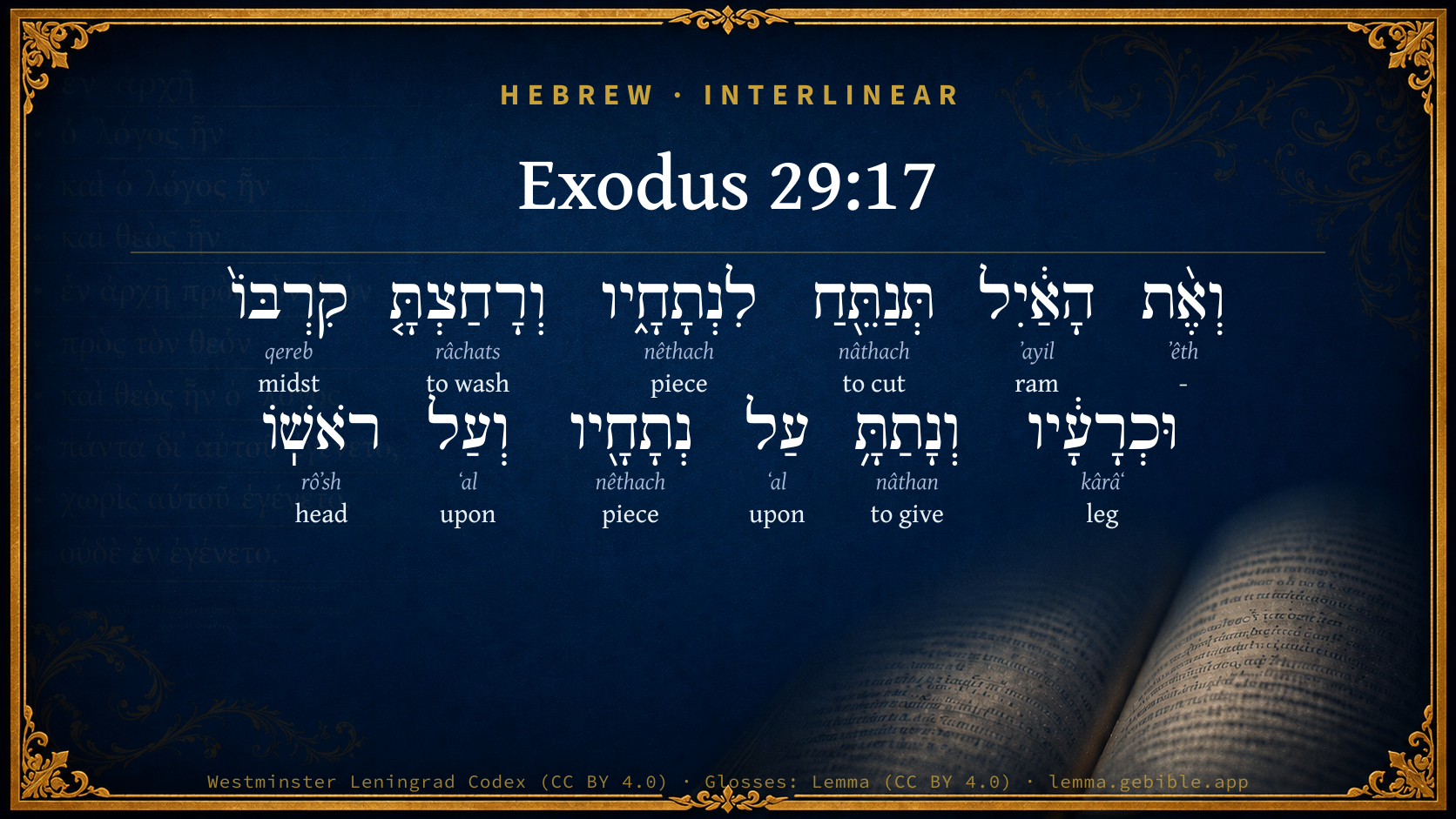
Hebrew (Westminster Leningrad Codex) Exodus 29:17 appears in the Hebrew Old Testament. The text above is from the Westminster Leningrad Codex. Each word links to its Strong’s number, a concise gloss, and parsing drawn from the Open Scriptures Hebrew Bible morphology. Click any word for its full Brown-Driver-Briggs (BDB) entry.
Download image
Cite this verse

Exodus 29:17 (World English Bible). Public Domain. Lemma interlinear Bible study tool, https://lemma.gebible.app/v/exodus/29/17.

Show BibTeX & RIS
BibTeX
RIS
English Translation
You shall cut the ram into its pieces, and wash its innards, and its legs, and put them with its pieces, and with its head.
World English Bible · Public Domain
Highlights
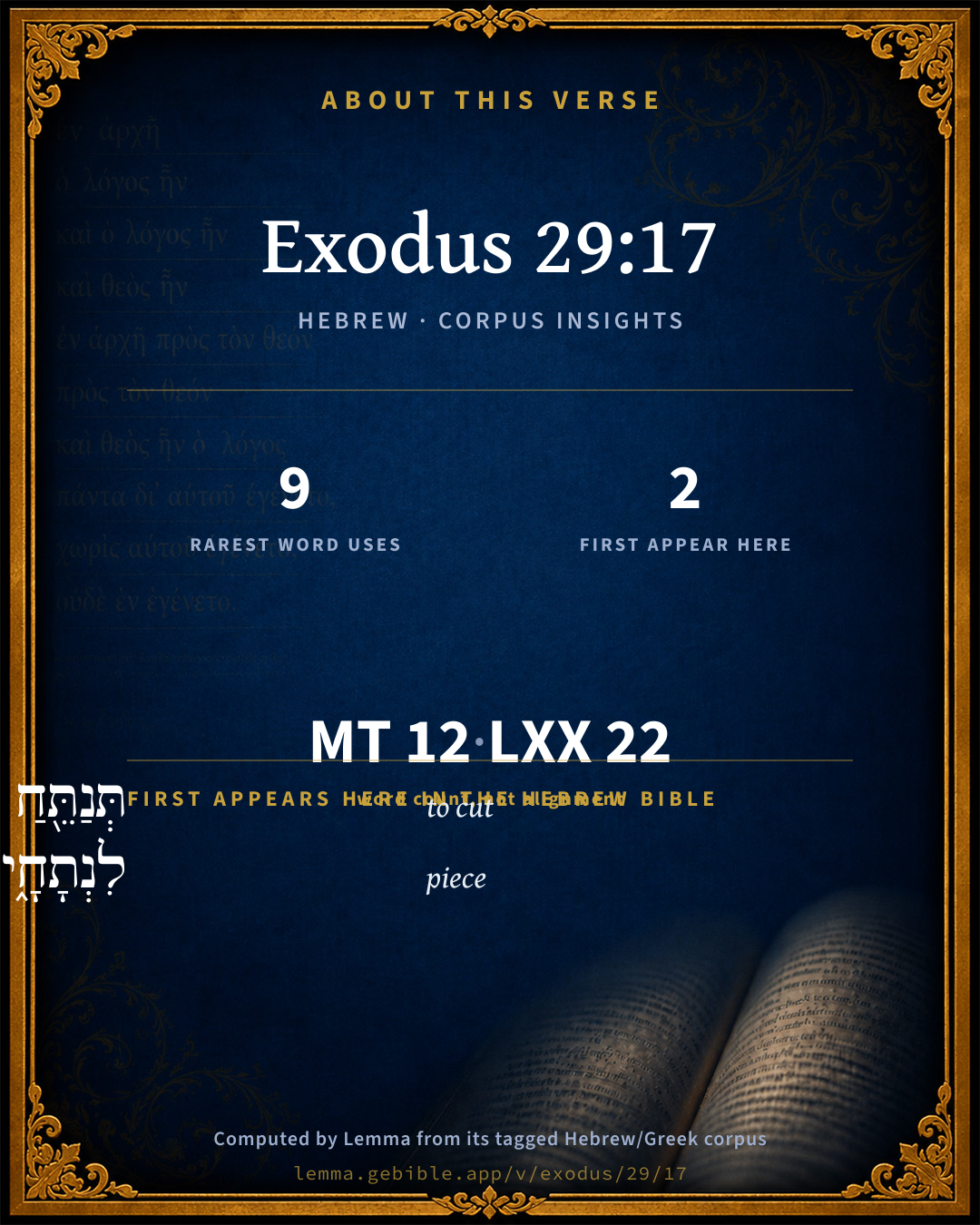
  • 2 first appearances in the Hebrew Bible
Full analysis ↓
Download a study sheet

One document with this verse’s original text, its word-by-word gloss line, the meaning frame, cross-references with their text, attributed commentary, and full source and license credits — printable, and it pastes into notes with its structure intact.

This verse Autodidact and up

Study sheet (.html) Plain text (.txt)

A passage Seminary Student

Up to 50 verses in one chapter. A passage sheet keeps up to 6 commentary sources and 12 cross-references per verse, in the order this page ranks them, and says so on the sheet whenever that leaves anything out. Ask for a single verse and you get the Autodidact verse sheet above.

Everything on this page stays free to read, with no account — the sheet is a download of what is already on screen, not access to it.

Want to remove ads? Support Godless Engineer
Compare translations 3

The same verse in 3 English versions, stacked beneath the original-language interlinear above. Click any original word for its lexicon entry.

Each is an independent rendering of the whole verse — the interlinear is not word-aligned to these translations.

Highlighted words mark where these versions differ — a whole-verse word diff, not a word-by-word alignment.

  • World English Bible Public Domain
    You shall cut the ram into its pieces, and wash its innards, and its legs, and put them with its pieces, and with its head.
  • King James Version Public Domain
    And thou shalt cut the ram in pieces, and wash the inwards of him, and his legs, and put them unto his pieces, and unto his head.
  • unfoldingWord Literal Text CC BY-SA 4.0
    And you shall cut the ram into pieces and wash its entrails and its legs and put them on its pieces and on its head,

unfoldingWord Literal Text — © unfoldingWord, licensed CC BY-SA 4.0. Word-aligned USFM3 via Door43 (git.door43.org/unfoldingWord/en_ult).

Versions to compare (up to 4)

3 of 4 selected

Show all 18 translations

Every available English version of this verse, each an independent rendering of the whole verse.

  • World English Bible Public Domain
    You shall cut the ram into its pieces, and wash its innards, and its legs, and put them with its pieces, and with its head.
  • Berean Standard Bible Public Domain
    Cut the ram into pieces, wash the entrails and legs, and place them with its head and other pieces.
  • Majority Standard Bible Public Domain
    Cut the ram into pieces, wash the entrails and legs, and place them with its head and other pieces.
  • King James Version Public Domain
    And thou shalt cut the ram in pieces, and wash the inwards of him, and his legs, and put them unto his pieces, and unto his head.
  • American Standard Version (1901) Public Domain
    And thou shalt cut the ram into its pieces, and wash its inwards, and its legs, and put them with its pieces, and with its head.
  • Revised Version (1885) Public Domain
    And thou shalt cut the ram into its pieces, and wash its inwards, and its legs, and put them with its pieces, and with its head.
  • Geneva Bible (1599) Public Domain
    And thou shalt cut the ramme in pieces, and wash the inwards of him and his legges, and shalt put them vpon the pieces thereof, and vpon his head.
  • Douay-Rheims (1899) Public Domain
    And thou shalt cut the ram in pieces, and having washed his entrails and feet, thou shalt put them upon the flesh that is cut in pieces, and upon his head.
  • Young's Literal Translation Public Domain
    and the ram thou dost cut into its pieces, and hast washed its inwards, and its legs, and hast put `them' on its pieces, and on its head;
  • Literal Standard Version CC BY-SA 4.0
    and you cut the ram into its pieces, and have washed its innards, and its legs, and have put [them] on its pieces, and on its head;
  • Unlocked Literal Bible CC BY-SA 4.0
    You must cut the ram into pieces and wash its inner parts and its legs, and you must put the inner parts, together with its pieces and with its head,
  • unfoldingWord Literal Text CC BY-SA 4.0
    And you shall cut the ram into pieces and wash its entrails and its legs and put them on its pieces and on its head,
  • Darby Bible Public Domain
    And thou shalt cut up the ram into its pieces, and wash its inwards, and its legs, and put [them] upon its pieces, and upon its head;
  • World Messianic Bible Public Domain
    You shall cut the ram into its pieces, and wash its innards, and its legs, and put them with its pieces, and with its head.
  • Webster's Bible Public Domain
    And thou shalt cut the ram in pieces, and wash the inwards of him, and his legs, and put them to his pieces, and to his head.
  • Free Bible Version CC BY-SA 4.0
    Cut the ram in pieces, wash the intestines and legs, and put them with the other pieces and the head.
  • Bible in Basic English Public Domain
    Then the sheep is to be cut up into its parts, and after washing its legs and its inside parts, you are to put them with the parts and the head,
  • JPS Tanakh (1917) Public Domain
    And thou shalt cut the ram into its pieces, and wash its inwards, and its legs, and put them with its pieces, and with its head.

Literal Standard Version (2020), Covenant Press — licensed CC BY-SA 4.0. Text via the HelloAO Bible API (eBible.org). Unlocked Literal Bible (unfoldingWord) — licensed CC BY-SA 4.0. Text via the HelloAO Bible API (eBible.org). unfoldingWord Literal Text — © unfoldingWord, licensed CC BY-SA 4.0. Word-aligned USFM3 via Door43 (git.door43.org/unfoldingWord/en_ult). Free Bible Version, Dr. Jonathan Gallagher — licensed CC BY-SA 4.0. Text via the HelloAO Bible API (eBible.org).

Word by word

More ways to search: Search by grammar → Find every occurrence → Compare this word →

Practice this passage: Drill this verse → Learn its vocabulary →

תְּנַתֵּ֖חַ
nâthach
H5408
“to cut”
Verb, Piel, Imperfect, 2nd Person, Masculine, Singular
Part of Speech
Verb
Stem
Piel
Form
Imperfect
Person
2nd Person
Gender
Masculine
Number
Singular
Full BDB Definition

Origin: a primitive root

TWOT: 1441

to cut, cut up, cut in pieces, divide - (Piel) to cut up, cut in pieces, divide by joints
  1. וְאֶ֨ת ʼêth H853 “and · -” Conjunction + Particle, Direct Object
  2. הָאַ֔יִל ʼayil H352 “the · ram” Particle, Definite Article + Noun, Common, Masculine, Singular, Absolute
  3. לִנְתָחָ֑יו nêthach H5409 “to/for · pieces · his” Preposition + Noun, Common, Masculine, Plural, Construct + Suffix, Personal, 3rd Person, Masculine, Singular
  4. וְרָחַצְתָּ֤ râchats H7364 “and · to wash” Conjunction + Verb, Qal, Sequential Perfect, 2nd Person, Masculine, Singular
  5. קִרְבּוֹ֙ qereb H7130 “midst · his” Noun, Common, Masculine, Singular, Construct + Suffix, Personal, 3rd Person, Masculine, Singular
  6. וּכְרָעָ֔יו kârâʻ H3767 “and · legs · his” Conjunction + Noun, Common, Both, Dual, Construct + Suffix, Personal, 3rd Person, Masculine, Singular
  7. וְנָתַתָּ֥ nâthan H5414 “and · to give” Conjunction + Verb, Qal, Sequential Perfect, 2nd Person, Masculine, Singular
  8. עַל ʻal H5921 “upon” Preposition
  9. נְתָחָ֖יו nêthach H5409 “pieces · his” Noun, Common, Masculine, Plural, Construct + Suffix, Personal, 3rd Person, Masculine, Singular
  10. וְעַל ʻal H5921 “and · upon” Conjunction + Preposition
  11. רֹאשֽׁוֹ rôʼsh H7218 “head · his” Noun, Common, Masculine, Singular, Construct + Suffix, Personal, 3rd Person, Masculine, Singular

About this verse

These counts appear in no published source. They are computed here, from the morphology-tagged text and Lemma’s own curated glosses. What Lemma adds →

12
words
10
distinct lemmas
Pentateuch
section

Notable vocabulary

The rarest word here is תְּנַתֵּ֖חַ to cut H5408 — appearing just 9 times in the whole Hebrew Bible.

First appearance in Scripture

These words make their first canonical appearance in the Hebrew Bible here:

  • תְּנַתֵּ֖חַ to cut H5408
  • לִנְתָחָ֑יו piece H5409

Shared distinctive vocabulary

תְּנַתֵּ֖חַ to cut H5408 occurs in 9 verses of the Hebrew Bible. Also found in:

Grammatical profile

  • 3 verbs
  • 6 nouns
  • 2 prepositions
  • 1 particle

Verb forms

  • תְּנַתֵּ֖חַ Piel · Imperfect
  • וְרָחַצְתָּ֤ Qal · Sequential Perfect
  • וְנָתַתָּ֥ Qal · Sequential Perfect

Repetition

Words recur within this verse — often emphatic in Hebrew:

  • לִנְתָחָ֑יו piece H5409 ×2
  • עַל upon H5921 ×2

Hebrew & Septuagint length

In English translation the verse runs 25 words from the Hebrew and 34 from the Septuagint (LXX English) — closely comparable.

A rough comparison of the two English renderings, which tokenize alike — not a word-level alignment.

Word counts can differ between the Hebrew and the Greek without any difference in meaning — e.g. the Hebrew direct-object marker אֵת has no separate Greek word, and Greek often adds the article ὁ.

In the original languages it is 12 Hebrew tokens and 22 Greek tokens — but the two are counted differently (Hebrew bundles its prefixes and suffixes into one token; the Greek is in lemma form), so that isn’t a like-for-like length.

Cross-references

6

Topical passages linked to Exodus 29:17 in the Treasury of Scripture Knowledge — connected by theme and wording, ordered by reader-vote popularity; previews shown in the World English Bible.

  • Leviticus 1:9 but its innards and its legs he shall wash with water. The priest shall burn the whole on the altar, for a burnt offering, an offering made by fire, of a sweet savor to Yahweh.
  • Leviticus 1:13 but the innards and the legs he shall wash with water. The priest shall offer the whole, and burn it on the altar. It is a burnt offering, an offering made by fire, of a sweet savor to Yahweh.
  • Leviticus 8:21 He washed the innards and the legs with water; and Moses burned the whole ram on the altar. It was a burnt offering for a sweet savor. It was an offering made by fire to Yahweh; as Yahweh commanded Moses.
  • Leviticus 9:14 He washed the innards and the legs, and burned them on the burnt offering on the altar.
  • Jeremiah 4:14 Jerusalem, wash your heart from wickedness, that you may be saved. How long shall your evil thoughts lodge within you?
  • Matthew 23:26 You blind Pharisee, first clean the inside of the cup and of the platter, that the outside of it may become clean also.

Cross-references courtesy of OpenBible.info (CC BY 4.0).

Hebrew and Greek witnesses Masoretic Hebrew ↔ Greek Septuagint

The same verse in the two great witnesses to the Old Testament, shown verse-for-verse.

These are two independent witnesses, not word-aligned to each other, and the Septuagint is shown in lemma (dictionary) form.

Hebrew Exodus 29:17 Masoretic · Westminster Leningrad Codex

וְאֶ֨ת הָאַ֔יִל תְּנַתֵּ֖חַ לִנְתָחָ֑יו וְרָחַצְתָּ֤ קִרְבּוֹ֙ וּכְרָעָ֔יו וְנָתַתָּ֥ עַל נְתָחָ֖יו וְעַל רֹאשֽׁוֹ

You shall cut the ram into its pieces, and wash its innards, and its legs, and put them with its pieces, and with its head.

World English Bible · Public Domain

Greek LXX Exodus 29:17 Septuagint · lemma form

καί ὁ κριός διχοτομέω κατά μέλος καί πλύνω ὁ ἐνδόσθιον καί ὁ πούς ὕδωρ καί ἐπιτίθημι ἐπί ὁ διχοτόμημα σύν ὁ κεφαλή

And you shall divide the ram by his several limbs, and you shall wash the inward parts and the feet with water, and you shall put them on the divided parts with the head.

LXX2012 (modern English Septuagint) · Public Domain

Hebrew: Westminster Leningrad Codex (CC BY 4.0). Greek: Septuagint (public domain); English from LXX2012 (modern English Septuagint) (Public Domain). How the Septuagint differs from the Hebrew →

Targum (Aramaic paraphrase)

2

The Targum is the ancient Jewish Aramaic paraphrase of the Hebrew Scriptures — an interpretive translation, not the Hebrew text itself. Onkelos (literal) and Pseudo-Jonathan (expansive) render the Torah, and Jonathan the Prophets. Coverage is partial: where no permissively-licensed English translation exists for a verse, only the Aramaic is shown. This is verse-level text, not a word-by-word alignment to the Hebrew.

  1. Targum Onkelos Torah (Genesis–Deuteronomy)
    וְיָת דִכְרָא תְּפַלֵג לְאֵבָרוֹהִי וּתְחַלִיל גַּוֵהּ וּכְרָעוֹהִי וְתִתֵּן עַל אֵבָרוֹהִי וְעַל רֵישֵׁהּ:

    (no public-domain English translation for this verse)

    Targum Onkelos — Aramaic: “Onkelos Genesis” (public domain); “Onkelos Exodus” (public domain); “Onkelos Leviticus” (public domain); “Onkelos Numbers” (public domain); “Onkelos Deuteronomy” (public domain). English: “Sefaria Community Translation” (CC0 1.0 (public-domain dedication)); “J.W. Etheridge. The Targums of Onkelos and Jonathan Ben Uzziel on the Pentateuch. London: Longmans, Green, 1862” (public domain). Text via Sefaria.

  2. Targum Pseudo-Jonathan Torah (Genesis–Deuteronomy)
    וְיַת דִּכְרָא תַפְסִיג לְפִסְגוֹי וּתְחַלֵּיל בְּנֵי גַוָאָה וּכְרָעוֹי וּתְסַדֵּר עַל אֵיבָרוֹי וְעַל רֵישֵׁיהּ

    And the ram shalt thou divide according to his members (dividings), and wash his inwards and his legs, and set them in order upon his members, and upon his head.

    Targum Pseudo-Jonathan — Aramaic: “Targum Jonathan on Genesis” (public domain); “Targum Jonathan on Exodus” (public domain); “Targum Jonathan on Leviticus” (public domain); “Targum Jonathan on Numbers” (public domain); “Targum Jonathan on Deuteronomy” (public domain). English: “The Targum of Jonathan ben Uzziel, trans. J. W. Etheridge, London, 1862” (public domain). Text via Sefaria.

Commentary

Notes on Exodus 29:17 from classic Christian and Jewish commentators (each source and its license shown beneath its notes). The classic Christian expositions comment on the surrounding passage and are grouped to its opening verse, so a note may address several verses; the Jewish commentaries on the Tanakh (Rashi and others) are per-verse, so they appear only where the commentator wrote on this verse.

Lemma curates 59 commentaries, every one of them public domain or Creative Commons licensed, each selected and text-cleaned for this edition rather than reprinted as found. About our sources →

Trapp's Complete Commentary

John Trapp

Exo 29:17 And thou shalt cut the ram in pieces, and wash the inwards of him, and his legs, and put [them] unto his pieces, and unto his head.

Ver. 17. Wash the inwards of him.] This signified that entire holiness, that thorough sanctification. {1Th 5:23}

John Trapp, A Commentary or Exposition upon All the Books of the Old and New Testament (1647–1656) — public domain. Text from a community e-Sword module.

Ellicott's Commentary for English Readers

(17) Thou shalt cut the ram in pieces.—This was the ordinary practice, not only among the Hebrews, but also among other nations, as the Egyptians (Herod. ii. 40), the Greeks, the Romans, and others. It was probably found to facilitate the burning of the animal, which was with difficulty consumed entire. The shoulder, thigh, head, ribs, rump, heart, and kidneys appear separate in the representations of sacrifices on Egyptian altars.

A Bible Commentary for English Readers, edited by Charles John Ellicott (1878–1897) — public domain. Text from a community e-Sword module.

The Cambridge Bible for Schools and Colleges

gen. ed. J. J. S. Perowne

17. cut … into its pieces] i.e. divide it by its joints. So Lev_1:6 al.

and wash, &c.] Lev_1:9; Lev_1:13.

and put them, &c.] viz. on the altar: cf. v. 18, and Lev_1:8 f., 12 f.

The Cambridge Bible for Schools and Colleges (gen. ed. J. J. S. Perowne; Cambridge University Press, 1878–1918) — public domain. Text from a community e-Sword module.

John Gill's Exposition

And thou shalt cut the ram in pieces,.... For the better convenience of laying it upon the wood on the altar, that it might be burnt; for it was to be a whole burnt offering:

and wash the inwards of him, and his legs; denoting the purity of the sacrifice of Christ, and that when his people give up themselves to God as a whole burnt offering, in the flames of love and zeal, their affections should be pure and sincere:

and put them unto his pieces, and unto his head; lay them together, so that they might be entirely consumed at once; signifying that Christ was both in soul and body an offering and a sacrifice of a sweet smelling savour to God; zeal for the honour of whose house, and the glory of his name, ate him up, as well as the fire of divine wrath; and so our whole souls, bodies and spirits, should be presented to the Lord as a holy, living, and acceptable sacrifice to him, which is more strongly suggested in the next verse.

John Gill's Exposition of the Whole Bible (1746–1763) — public domain (CC PDM 1.0). Text via the HelloAO Bible API.

The Pulpit Commentary

Thou shalt cut the ram in pieces. Literally, "into its pieces," which Kalisch supposes to mean "into its natural limbs." Egyptian sculptures show us animals thus cut up, and offered at sacrificial feasts to ancestors. Wash its inwardsi.e. , its "intestines probably the stomach and bowels only. Its legs. The lower joints of the leg, with the foot, to which it was likely that dust might attach. Put them unto his piecesi.e. , "replace them after washing with the other pieces," or joints, into which the animal had been cut.

The Pulpit Commentary (1880–1919), ed. H.D.M. Spence-Jones & Joseph S. Exell — public domain. Text from a community e-Sword module.

Rashi

Rabbi Shlomo Yitzchaki (Rashi)

על נתחיו [AND PUT THEM] TO ITS PIECES — i. e. together with (על) its pieces — added to the other pieces.

Rashi on the Tanakh — English translations: “The Judaica Press complete Tanach with Rashi, translated by A. J. Rosenberg” (CC BY 4.0); “Pentateuch with Rashi's commentary by M. Rosenbaum and A.M. Silbermann, 1929-1934” (public domain); “The Metsudah Tanach series, Lakewood, N.J” (CC BY 4.0); and “The Book of Joshua, Metsudah Publications, 1997” (CC BY 4.0). Text via Sefaria.

Lesson kit

Teaching starters — assembled from the data on this page, not authored interpretation. Every prompt links to the verse data it draws on. Edit before teaching.

Exodus, in the Pentateuch, opens this verse with 12 words (10 distinct Hebrew lemmas). Its most distinctive word is nâthach (“to cut”). A historical commentator’s framing appears above. Read the whole chapter for the surrounding context.

Discussion questions

  1. What does “to cut” (nâthach) contribute to the verse as a whole?
  2. 2 words make their first appearance in Scripture here. What does this debut establish?
  3. How does Leviticus 1:6, which shares the word «to cut», read alongside this verse?
  4. What does the repetition of “piece” (2× in this one verse) do in this verse?
  5. These translations render this verse differently. What is at stake in choosing one wording over another?
  6. «תְּנַתֵּ֖חַ» is a Piel Imperfect verb. How does that grammatical form shape the action described?
  7. Compare how Trapp's Complete Commentary and Ellicott's Commentary for English Readers read this verse. Where do they agree or differ?

Things to notice

Reading settings

Reading text

Shown beneath each verse's original-language words.

Old Testament
Old Testament edition

Read the OT as the Masoretic Hebrew (MT) or the Greek Septuagint (LXX).

English shown for the Greek Septuagint (in the Hebrew ↔ Greek comparison).

Comparing translations? Open the Compare panel on any verse page to stack up to four side by side.