Genesis 15:10

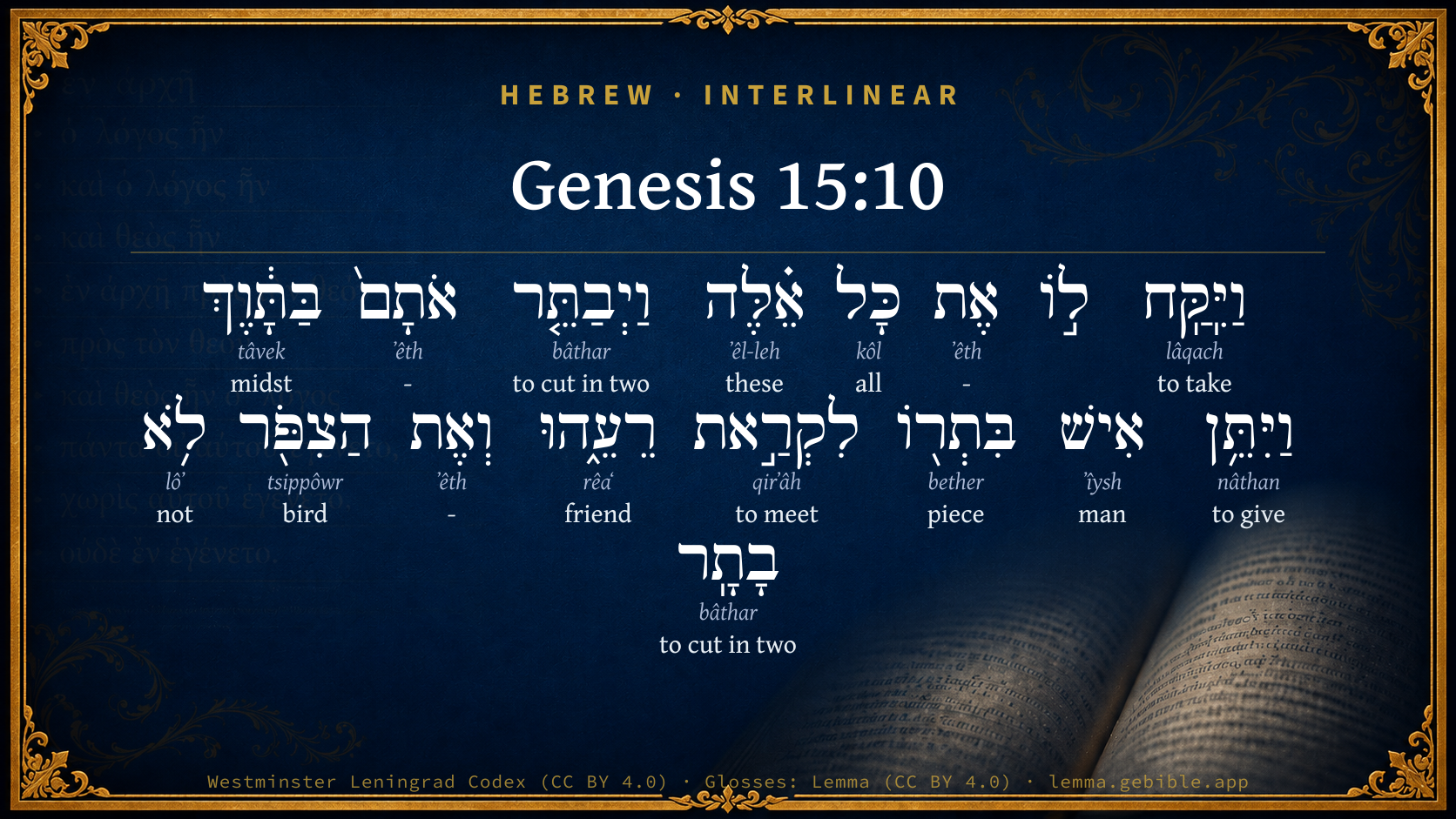
Hebrew (Westminster Leningrad Codex) Genesis 15:10 appears in the Hebrew Old Testament. The text above is from the Westminster Leningrad Codex. Each word links to its Strong’s number, a concise gloss, and parsing drawn from the Open Scriptures Hebrew Bible morphology. Click any word for its full Brown-Driver-Briggs (BDB) entry.
Download image
Cite this verse

Genesis 15:10 (World English Bible). Public Domain. Lemma interlinear Bible study tool, https://lemma.gebible.app/v/genesis/15/10.

Show BibTeX & RIS
BibTeX
RIS
English Translation
He took him all these, and divided them in the middle, and laid each half opposite the other; but he didn't divide the birds.
World English Bible · Public Domain
Highlights
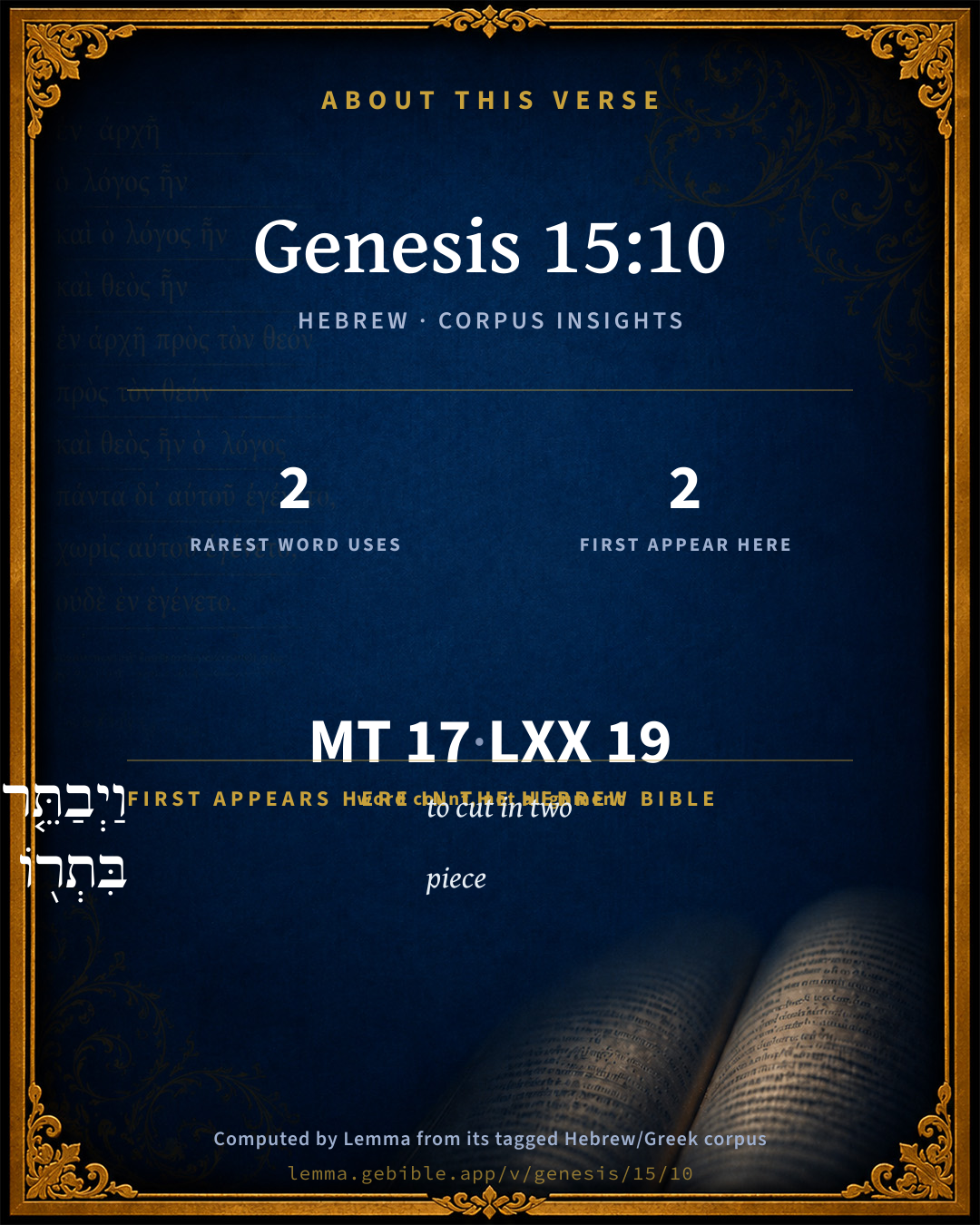
  • 2 first appearances in the Hebrew Bible
Full analysis ↓
Download a study sheet

One document with this verse’s original text, its word-by-word gloss line, the meaning frame, cross-references with their text, attributed commentary, and full source and license credits — printable, and it pastes into notes with its structure intact.

This verse Autodidact and up

Study sheet (.html) Plain text (.txt)

A passage Seminary Student

Up to 50 verses in one chapter. A passage sheet keeps up to 6 commentary sources and 12 cross-references per verse, in the order this page ranks them, and says so on the sheet whenever that leaves anything out. Ask for a single verse and you get the Autodidact verse sheet above.

Everything on this page stays free to read, with no account — the sheet is a download of what is already on screen, not access to it.

Want to remove ads? Support Godless Engineer
Compare translations 3

The same verse in 3 English versions, stacked beneath the original-language interlinear above. Click any original word for its lexicon entry.

Each is an independent rendering of the whole verse — the interlinear is not word-aligned to these translations.

Highlighted words mark where these versions differ — a whole-verse word diff, not a word-by-word alignment.

  • World English Bible Public Domain
    He took him all these, and divided them in the middle, and laid each half opposite the other; but he didn't divide the birds.
  • King James Version Public Domain
    And he took unto him all these, and divided them in the midst, and laid each piece one against another: but the birds divided he not.
  • unfoldingWord Literal Text CC BY-SA 4.0
    So he brought all those to him. Then he cut them in two down the middle and laid the halves opposite to each other, but the birds he did not cut in two.

unfoldingWord Literal Text — © unfoldingWord, licensed CC BY-SA 4.0. Word-aligned USFM3 via Door43 (git.door43.org/unfoldingWord/en_ult).

Versions to compare (up to 4)

3 of 4 selected

Show all 18 translations

Every available English version of this verse, each an independent rendering of the whole verse.

  • World English Bible Public Domain
    He took him all these, and divided them in the middle, and laid each half opposite the other; but he didn't divide the birds.
  • Berean Standard Bible Public Domain
    So Abram brought all these to Him, split each of them down the middle, and laid the halves opposite each other. The birds, however, he did not cut in half.
  • Majority Standard Bible Public Domain
    So Abram brought all these to Him, split each of them down the middle, and laid the halves opposite each other. The birds, however, he did not cut in half.
  • King James Version Public Domain
    And he took unto him all these, and divided them in the midst, and laid each piece one against another: but the birds divided he not.
  • American Standard Version (1901) Public Domain
    And he took him all these, and divided them in the midst, and laid each half over against the other: but the birds divided he not.
  • Revised Version (1885) Public Domain
    And he took him all these, and divided them in the midst, and laid each half over against the other: but the birds divided he not.
  • Geneva Bible (1599) Public Domain
    So he tooke all these vnto him, and deuided them into the middes, and laid euery piece one against an other: but the birdes deuided he not.
  • Douay-Rheims (1899) Public Domain
    And he took all these, and divided them in the midst, and laid the two pieces of each one against the other; but the birds he divided not.
  • Young's Literal Translation Public Domain
    and he taketh to him all these, and separateth them in the midst, and putteth each piece over against its fellow, but the bird he hath not divided;
  • Literal Standard Version CC BY-SA 4.0
    and he takes all these to Him, and separates them in the midst, and puts each piece opposite its fellow, but the bird he has not divided;
  • Unlocked Literal Bible CC BY-SA 4.0
    He brought him all these, and cut them in two, and placed each half opposite the other, but he did not divide the birds.
  • unfoldingWord Literal Text CC BY-SA 4.0
    So he brought all those to him. Then he cut them in two down the middle and laid the halves opposite to each other, but the birds he did not cut in two.
  • Darby Bible Public Domain
    And he took all these, and divided them in the midst, and laid the half of each opposite its fellow; but the birds he did not divide.
  • World Messianic Bible Public Domain
    He brought him all these, and divided them in the middle, and laid each half opposite the other; but he didn’t divide the birds.
  • Webster's Bible Public Domain
    And he took to him all these, and divided them in the midst, and laid each piece one against another: but the birds he did not divide.
  • Free Bible Version CC BY-SA 4.0
    So Abram took and killed the three animals. Then he cut them in half, and placed each half opposite the other. However, he didn't cut the birds in half.
  • Bible in Basic English Public Domain
    All these he took, cutting them in two and putting one half opposite the other, but not cutting the birds in two.
  • JPS Tanakh (1917) Public Domain
    And he took him all these, and divided them in the midst, and laid each half over against the other; but the birds divided he not.

Literal Standard Version (2020), Covenant Press — licensed CC BY-SA 4.0. Text via the HelloAO Bible API (eBible.org). Unlocked Literal Bible (unfoldingWord) — licensed CC BY-SA 4.0. Text via the HelloAO Bible API (eBible.org). unfoldingWord Literal Text — © unfoldingWord, licensed CC BY-SA 4.0. Word-aligned USFM3 via Door43 (git.door43.org/unfoldingWord/en_ult). Free Bible Version, Dr. Jonathan Gallagher — licensed CC BY-SA 4.0. Text via the HelloAO Bible API (eBible.org).

Word by word

More ways to search: Search by grammar → Find every occurrence → Compare this word →

Practice this passage: Drill this verse → Learn its vocabulary →

וַיְבַתֵּ֤ר
bâthar
H1334
“and · to cut in two”
Conjunction + Verb, Piel, Sequential Imperfect, 3rd Person, Masculine, Singular
Part of Speech
Conjunction + Verb
Stem
Piel
Form
Sequential Imperfect
Person
3rd Person
Gender
Masculine
Number
Singular
Full BDB Definition

Origin: a primitive root

TWOT: 297

to cut in two - (Qal) to cut in two - (Piel) to cut in two
  1. וַיִּֽקַּֽח lâqach H3947 “and · to take” Conjunction + Verb, Qal, Sequential Imperfect, 3rd Person, Masculine, Singular
  2. אֶת ʼêth H853 “-” Particle, Direct Object
  3. כָּל kôl H3605 “all of” Noun, Common, Masculine, Singular, Construct
  4. אֵ֗לֶּה ʼêl-leh H428 “these” Pronoun, Demonstrative, Common, Plural
  5. אֹתָם֙ ʼêth H853 “- · them” Particle, Direct Object + Suffix, Personal, 3rd Person, Masculine, Plural
  6. בַּתָּ֔וֶךְ tâvek H8432 “in/at the · midst” Preposition, Determined + Noun, Common, Masculine, Singular, Absolute
  7. וַיִּתֵּ֥ן nâthan H5414 “and · to give” Conjunction + Verb, Qal, Sequential Imperfect, 3rd Person, Masculine, Singular
  8. אִישׁ ʼîysh H376 “man” Noun, Common, Masculine, Singular, Absolute
  9. בִּתְר֖וֹ bether H1335 “piece · his” Noun, Common, Masculine, Singular, Construct + Suffix, Personal, 3rd Person, Masculine, Singular
  10. לִקְרַ֣את qirʼâh H7125 “to meet” Preposition + Verb, Qal, Infinitive Construct
  11. רֵעֵ֑הוּ rêaʻ H7453 “friend · his” Noun, Common, Masculine, Singular, Construct + Suffix, Personal, 3rd Person, Masculine, Singular
  12. וְאֶת ʼêth H853 “and · -” Conjunction + Particle, Direct Object
  13. הַצִפֹּ֖ר tsippôwr H6833 “the · bird” Particle, Definite Article + Noun, Common, Both, Singular, Absolute
  14. לֹ֥א lôʼ H3808 “not” Particle, Negative
  15. בָתָֽר bâthar H1334 “to cut in two” Verb, Qal, Perfect, 3rd Person, Masculine, Singular

About this verse

These counts appear in no published source. They are computed here, from the morphology-tagged text and Lemma’s own curated glosses. What Lemma adds →

17
words
13
distinct lemmas
Pentateuch
section

Notable vocabulary

The rarest word here is וַיְבַתֵּ֤ר to cut in two H1334 — appearing just 2 times in the whole Hebrew Bible.

First appearance in Scripture

These words make their first canonical appearance in the Hebrew Bible here:

  • וַיְבַתֵּ֤ר to cut in two H1334
  • בִּתְר֖וֹ piece H1335

Grammatical profile

  • 5 verbs
  • 6 nouns
  • 1 pronoun
  • 1 preposition
  • 4 particles

Verb forms

  • וַיִּֽקַּֽח Qal · Sequential Imperfect
  • וַיְבַתֵּ֤ר Piel · Sequential Imperfect
  • וַיִּתֵּ֥ן Qal · Sequential Imperfect
  • לִקְרַ֣את Qal · Infinitive Construct
  • בָתָֽר Qal · Perfect

Repetition

A word recurs within this verse — often emphatic in Hebrew:

  • וַיְבַתֵּ֤ר to cut in two H1334 ×2

Hebrew & Septuagint length

In English translation the verse runs 24 words from the Hebrew and 27 from the Septuagint (LXX English) — closely comparable.

A rough comparison of the two English renderings, which tokenize alike — not a word-level alignment.

Word counts can differ between the Hebrew and the Greek without any difference in meaning — e.g. the Hebrew direct-object marker אֵת has no separate Greek word, and Greek often adds the article ὁ.

In the original languages it is 17 Hebrew tokens and 19 Greek tokens — but the two are counted differently (Hebrew bundles its prefixes and suffixes into one token; the Greek is in lemma form), so that isn’t a like-for-like length.

Cross-references

3

Topical passages linked to Genesis 15:10 in the Treasury of Scripture Knowledge — connected by theme and wording, ordered by reader-vote popularity; previews shown in the World English Bible.

  • Leviticus 1:17 He shall tear it by its wings, but shall not divide it apart. The priest shall burn it on the altar, on the wood that is on the fire. It is a burnt offering, an offering made by fire, of a sweet savor to Yahweh.
  • Jeremiah 34:18–19 I will give the men who have transgressed my covenant, who have not performed the words of the covenant which they made before me, when they cut the calf in two and passed between the parts of it;
  • Genesis 15:17 It came to pass that, when the sun went down, and it was dark, behold, a smoking furnace, and a flaming torch passed between these pieces.

Cross-references courtesy of OpenBible.info (CC BY 4.0).

Hebrew and Greek witnesses Masoretic Hebrew ↔ Greek Septuagint

The same verse in the two great witnesses to the Old Testament, shown verse-for-verse.

These are two independent witnesses, not word-aligned to each other, and the Septuagint is shown in lemma (dictionary) form.

Hebrew Genesis 15:10 Masoretic · Westminster Leningrad Codex

וַיִּֽקַּֽח ל֣וֹ אֶת כָּל אֵ֗לֶּה וַיְבַתֵּ֤ר אֹתָם֙ בַּתָּ֔וֶךְ וַיִּתֵּ֥ן אִישׁ בִּתְר֖וֹ לִקְרַ֣את רֵעֵ֑הוּ וְאֶת הַצִפֹּ֖ר לֹ֥א בָתָֽר

He took him all these, and divided them in the middle, and laid each half opposite the other; but he didn't divide the birds.

World English Bible · Public Domain

Greek LXX Genesis 15:10 Septuagint · lemma form

λαμβάνω δέ αὐτός πᾶς οὗτος καί διααἱρέω αὐτός μέσος καί τίθημι αὐτός ἀντιπρόσωπος ἀλλήλω ὁ δέ ὄρνεον οὐ διααἱρέω

So he took to him all these, and divided them in the midst, and set them opposite to each other, but the birds he did not divide.

LXX2012 (modern English Septuagint) · Public Domain

On this verse, John Gill's Exposition discusses the Septuagint’s reading. Read the note in Commentary ↓

Hebrew: Westminster Leningrad Codex (CC BY 4.0). Greek: Septuagint (public domain); English from LXX2012 (modern English Septuagint) (Public Domain). How the Septuagint differs from the Hebrew →

Targum (Aramaic paraphrase)

2

The Targum is the ancient Jewish Aramaic paraphrase of the Hebrew Scriptures — an interpretive translation, not the Hebrew text itself. Onkelos (literal) and Pseudo-Jonathan (expansive) render the Torah, and Jonathan the Prophets. Coverage is partial: where no permissively-licensed English translation exists for a verse, only the Aramaic is shown. This is verse-level text, not a word-by-word alignment to the Hebrew.

  1. Targum Onkelos Torah (Genesis–Deuteronomy)
    וְקָרֵב קֳדָמוֹהִי יָת כָּל אִלֵין וּפַלִיג יָתְהוֹן בְּשָׁוֶה וִיהַב פַּלְגַיָא פִּלוּג לָקֳבֵיל חַבְרֵיהּ וְיָת עוֹפָא לָא פַּלִיג

    (no public-domain English translation for this verse)

    Targum Onkelos — Aramaic: “Onkelos Genesis” (public domain); “Onkelos Exodus” (public domain); “Onkelos Leviticus” (public domain); “Onkelos Numbers” (public domain); “Onkelos Deuteronomy” (public domain). English: “Sefaria Community Translation” (CC0 1.0 (public-domain dedication)); “J.W. Etheridge. The Targums of Onkelos and Jonathan Ben Uzziel on the Pentateuch. London: Longmans, Green, 1862” (public domain). Text via Sefaria.

  2. Targum Pseudo-Jonathan Torah (Genesis–Deuteronomy)
    וְקָרִיב קוֹמוֹי יַת כָּל אִילֵן וּפְסַג יַתְהוֹן בִּמְצִיעָא וְסָדַר פַּסְגָא דְחַד כָּל קְבֵיל חַבְרֵיהּ וְיַת עוֹפָא לָא פָּסָג

    And he brought all these before Him, and divided them in the midst, and set in order every division over against its fellow; but the fowl he divided not.

    Targum Pseudo-Jonathan — Aramaic: “Targum Jonathan on Genesis” (public domain); “Targum Jonathan on Exodus” (public domain); “Targum Jonathan on Leviticus” (public domain); “Targum Jonathan on Numbers” (public domain); “Targum Jonathan on Deuteronomy” (public domain). English: “The Targum of Jonathan ben Uzziel, trans. J. W. Etheridge, London, 1862” (public domain). Text via Sefaria.

Commentary

Notes on Genesis 15:10 from classic Christian and Jewish commentators (each source and its license shown beneath its notes). The classic Christian expositions comment on the surrounding passage and are grouped to its opening verse, so a note may address several verses; the Jewish commentaries on the Tanakh (Rashi and others) are per-verse, so they appear only where the commentator wrote on this verse.

Lemma curates 59 commentaries, every one of them public domain or Creative Commons licensed, each selected and text-cleaned for this edition rather than reprinted as found. About our sources →

Trapp's Complete Commentary

John Trapp

Gen 15:10 And he took unto him all these, and divided them in the midst, and laid each piece one against another: but the birds divided he not.

Ver. 10. Divided them in the midst.] In signum exitii foedifrago eventuri . This was the federal rite both among Jews {Jer 34:18-19} and Gentiles, as it is to be seen in Virgil, {a} describing the covevant of Romulus and Tatius. God also threateneth to cut the evil servant in twain (διχοτομησει) that forgetteth the covenant of his God. {Mat 24:51} These dissected creatures are the oppressed Israelites; the parts laid each against other signify, that God will make them up again, though dissected; the fowls that came down upon them, are the Egyptians; Abram’s chasing them away, is their deliverance by Moses after four hundred years, signified by those four kinds of creatures, as Luther interpreteth.

{a} Aeneid., lib. viii.

John Trapp, A Commentary or Exposition upon All the Books of the Old and New Testament (1647–1656) — public domain. Text from a community e-Sword module.

Tyndale Open Study Notes

Tyndale Open Resources

15:10 Obeying God’s instructions, Abram gathered three herd animals for the ceremony and cut them in half. Cutting the animals symbolized the oath, indicating that the covenant maker staked his own life on his word (Jer 34:18).

Tyndale Open Study Notes — © Tyndale Open Resources, licensed CC BY-SA 4.0. Text via the HelloAO Bible API.

Geneva Bible (1599)

Geneva Bible translators

This was the old custom in making covenants, Jer. 34:18, to the which God added these conditions, that Abram’s posterity should be as torn in pieces, but after they should be coupled together: also that it should be assaulted, but yet delivered.

Geneva Bible (1599) marginal notes — public domain. Text via Bolls.life.

Adam Clarke's Commentary

Verse 10. Divided them in the midst] The ancient method of making covenants. as well as the original word, have been already alluded to, and in a general way explained. See Ge 6:18. The word covenant from con, together, and venio, I come, signifies an agreement, association, or meeting between two or more parties; for it is impossible that a covenant can be made between an individual and himself, whether God or man. This is a theological absurdity into which many have run; there must be at least two parties to contract with each other. And often there was a third party to mediate the agreement, and to witness it when made. Rabbi Solomon Jarchi says, "It was a custom with those who entered into covenant with each other to take a heifer and cut it in two, and then the contracting parties passed between the pieces." See this and the scriptures to which it refers particularly explained, Ge 6:18. A covenant always supposed one of these four things:

1. That the contracting parties had been hitherto unknown to each other, and were brought by the covenant into a state of acquaintance.

2. That they had been previously in a state of hostility or enmity, and were brought by the covenant into a state of pacification and friendship.

3. Or that, being known to each other, they now agree to unite their counsels, strength, property, c., for the accomplishment of a particular purpose, mutually subservient to the interests of both. Or,

4. It implies an agreement to succour and defend a third party in cases of oppression and distress.

For whatever purpose a covenant was made, it was ever ratified by a sacrifice offered to God and the passing between the divided parts of the victim appears to have signified that each agreed, if they broke their engagements, to submit to the punishment of being cut asunder; which we find from Mt 24:51; Lu 12:46, was an ancient mode of punishment. This is farther confirmed by Herodotus, who says that Sabacus, king of Ethiopia, had a vision, in which he was ordered μεσουσ διατεμειν, to cut in two, all the Egyptian priests; lib. ii. We find also from the same author, lib. vii., that Xerxes ordered one of the sons of Pythius μεσον διατεμειν, to be cut in two, and one half to be placed on each side of the way, that his army might pass through between them. That this kind of punishment was used among the Persians we have proof from Da 2:5; Da 3:29. Story of Susanna, verses 55, 59. See farther, 2Sa 12:31, and 1Ch 20:3. These authorities may be sufficient to show that the passing between the parts of the divided victims signified the punishment to which those exposed themselves who broke their covenant engagements. And that covenant sacrifices were thus divided, even from the remotest antiquity, we learn from Homer, Il. A., v. 460.

Μηρους τ' εξεταμον κατα τε κνισοῃ εκαλυψαν,

Διπτυχα ποιησαντες, επ' αυτων δ' ωμοθετησαν.

"They cut the quarters, and cover them with the fat; dividing them into two, they place the raw flesh upon them."

But this place may be differently understood.

St. Cyril, in his work against Julian, shows that passing between the divided parts of a victim was used also among the Chaldeans and other people. As the sacrifice was required to make an atonement to God, so the death of the animal was necessary to signify to the contracting parties the punishment to which they exposed themselves, should they prove unfaithful.

Livy preserves the form of the imprecation used on such occasions, in the account he gives of the league made between the Romans and Albans. When the Romans were about to enter into some solemn league or covenant, they sacrificed a hog; and, on the above occasion, the priest, or pater patratus, before he slew the animal, stood, and thus invoked Jupiter: Audi, Jupiter! Si prior defecerit publico consilio dolo malo, tum illo die, Diespiter, Populum Romanum sic ferito, ut ego hune porcum hic hodie feriam; tantoque magis ferito, quanto magis potes pollesque! Livii Hist., lib. i., chap. 24.

"Hear, O Jupiter! Should the Romans in public counsel, through any evil device, first transgress these laws, in that same day, O Jupiter, thus smite the Roman people, as I shall at this time smite this hog; and smite them with a severity proportioned to the greatness of thy power and might!"

But the birds divided he not.] According to the law, Le 1:17, fowls were not to be divided asunder but only cloven for the purpose of taking out the intestines.

Adam Clarke's Commentary on the Bible (1810–1826) — public domain. Text from a community e-Sword/MySword module.

John Calvin's Commentaries

10. And divided them in the midst. That no part of this sacrifice may be without mystery, certain interpreters weary themselves in the fabrication of subtleties; but it is our business, as I have often declared, to cultivate sobriety. I confess I do not know why he was commanded to take three kinds of animals besides birds; unless it were, that by this variety itself, it was declared, that all the posterity of Abram, of whatever rank they might be, should be offered up in sacrifice, so that the whole people, and each individual, should constitute one sacrifice. There are also some things, concerning which, if any one curiously seeks the reason, I shall not be ashamed to acknowledge my ignorance, because I do not choose to wander in uncertain speculations. Moreover, this, in my opinion, is the sum of the whole: That God, in commanding the animals to be killed, shows what will be the future condition of the Church. Abram certainly wished to be assured of the promised inheritance of the land. Now he is taught that it would take its commencement from death; that is that he and his children must die before they should enjoy the dominion over the land. In commanding the slaughtered animals to be cut in parts, it is probable that he followed the ancient rite in forming covenants whether they were entering into any alliance, or were mustering an army, a practice which also passed over to the Gentiles. Now, the allies or the soldiers passed between the severed parts, that, being enclosed together within the sacrifice, they might be the more sacredly united in one body. That this method was practiced by the Jews, Jeremiah bears witness, (Jeremiah 34:18,) where he introduces God as saying, ‘They have violated my covenant, when they cut the calf in two parts, and passed between the divisions of it, as well the princes of Judas, and the nobles of Jerusalem, and the whole people of the land.’ Nevertheless, there appears to me to have been this special reason for the act referred to; that the Lord would indeed admonish the race of Abram, not only that it should be like a dead carcass, but even like one torn and dissected. For the servitude with which they were oppressed for a time, was more intolerable than simple death; yet because the sacrifice is offered to God, death itself is immediately turned into new life. And this is the reason why Abram, placing the parts of the sacrifice opposite to each other, fits them one to the other, because they were again to be gathered together from their dispersion. But how difficult is the restoration of the Church and what troubles are involved in it, is shown by the horror with which Abram was seized. We see, therefore, that two things were illustrated; namely, the hard servitude, with which the sons of Abram were to be pressed almost to laceration and destruction; and then their redemption, which was to be the signal pledge of divine adoption; and in the same mirror the general condition of the Church is represented to us, as it is the peculiar province of God to create it out of nothing, and to raise it from death.

John Calvin's Commentaries (1540-1563) — public domain. Text from the Calvin Translation Society English edition (1840s-50s) via the Christian Classics Ethereal Library (ccel.org). Calvin's coverage is partial (roughly two-thirds of the Bible); uncommented books and verses are honest gaps, never fabricated. The 19th-century editor's footnotes and remarks are omitted so the notes are faithfully Calvin's own voice.

John Gill's Exposition

And when the fowls came down upon the carcasses,.... Upon the birds, as Aben Ezra and Ben Melech interpret it, whose carcasses were whole; or rather upon the divided carcasses of the animals, and indeed on both: this is to be understood of birds of prey, as eagles, vultures, kites, crows, &c. and are an emblem of the Egyptians chiefly, and other enemies of Israel, who came upon them to devour them; so the Targum of Jonathan,"and the idolatrous nations descended, who were like to an unclean fowl, to spoil the goods of the Israelites;''and likewise the Targum of Jerusalem,"this unclean fowl are the idolatrous kingdoms of the earth:"

Abram drove them away: that they might not settle upon the carcasses, and devour them: the Septuagint version is, "Abram sat with them"; he sat by the carcasses and watched them, that no hurt came to them, and to take notice of them, and consider and learn what they were an emblem of. The Jews (l) also observe, that"Abram sat and waved over them with his napkin or handkerchief, that the birds might not have power over them until the evening.''This may respect not the merit of Abram, as the above Targums, by which his posterity were protected, and the designs of their enemies frustrated; but the effectual fervent prayer of Abram, his prayer of faith for them, in answer to which they were delivered out of the hands of the Egyptians, and other enemies, whom Abram foresaw they would be distressed with.

(l) Pirke Eliezer, ut supra. (c. 28)

John Gill's Exposition of the Whole Bible (1746–1763) — public domain (CC PDM 1.0). Text via the HelloAO Bible API.

Matthew Poole's English Annotations

And he, i.e. Abram, who by Divine instinct and precept did all this which here follows,

divided them in the midst, into two equal parts. This was done for two reasons.

1. To represent the torn and distracted condition in which his seed was to lie for a season.

2. To ratify God's covenant with Abram and his seed; for this was a rite used in making covenants, as appears both from Scripture, Jer 34:18, and other authors.

Laid each piece one against another, partly to encourage hope, that God would in his time put those parts together, and unite those dry bones, (to which the Israelites are compared, Eze 37:1-28), and clothe them with flesh; and partly that the persons entering into covenant might pass between those parts, and so testify their union and conjunction in one and the same sacrifice.

The birds divided he not, either because there were two birds, and the one was laid against the other, which answered to the division of the larger creatures; or because they belonged not to the ceremony of the covenant, but were for the use of sacrifice, wherein they were to be offered whole, as afterwards was prescribed, Lev 1:15,17.

Matthew Poole's English Annotations on the Holy Bible (1683–1685) — public domain. Text from a community e-Sword/MySword module.

Whedon's Commentary on the Bible

Daniel D. Whedon

10. Divided them in the midst — Cut them into two halves, and placed the portions opposite to each other, with space enough for one to walk between. This explains the Hebrew expression כרת ברית, to cut a covenant. See Gen_15:18. The two parts of the victim seem to have represented the two parties to the covenant; and when the two parties thus covenanting passed between the pieces, their union was represented as sealed by the blood of life. Comp. Jer_34:18, and see further on Gen_15:17.

Birds divided he not — So also the Mosaic law, Lev_1:17. Probably Abram laid the dove on one side and the pigeon on the other, as if they were two pieces.

Daniel D. Whedon (gen. ed.), Commentary on the Old and New Testaments (1874–1909) — public domain. Text from a community e-Sword module.

The Pulpit Commentary

And he took unto him all these, and divided (a word occurring only here in Genesis, and supposed by Michaelis to have been taken by Moses from the ancient document from which he transcribed this portion of his work. The word is afterwards found in Son_2:17, and (Jer_34:18) them in the midst, mesa (LXX); in equal parts (Onkelos)and laid each piece one against another: but the birds divided he not. So afterwards in the Mosaic legislation. (Lev_1:7) Wordsworth detects in the non-dividing of the birds an emblem of "the Holy Spirit, the Spirit of peace and love; which is a Spirit of unity, and of "Christ"s human spirit, which was not divisible." Kalisch, with more probability, recognizes as the reason of their not being divided the fact that such division was not required, both fowls being regarded as one part of the sacrifice only, and each, as the half, being placed opposite the other. Wordsworth numbers seven parts in the sacrifice, and sees a symbol of completeness and finality, the number seven being the root of shaba, to swear (Gesenius, p. 802); Kalisch reckons four, which he regards as "denoting perfection, but rather the external perfection of form than the internal one of the mind," and pointing "to the perfect possession of the Holy Land." The ritual here described is the same which was afterwards observed among the Hebrews in the formation of covenants, (cf. Gen_34:18) and appears to have extensively prevailed among heathen nations (cf. "Iliad," b. 124, "orkia pistantev;" and the Latin phrase, foedus icere").

The Pulpit Commentary (1880–1919), ed. H.D.M. Spence-Jones & Joseph S. Exell — public domain. Text from a community e-Sword module.

Rashi

Rabbi Shlomo Yitzchaki (Rashi)

ויבתר אתם AND HE SPLIT THEM — He divided each into two portions. This verse does not lose its literal meaning although there are various Midrashic explanations of it. Since He was making a covenant with him to keep His promise to give the land as an inheritance to his children — as it is written (Genesis 15:18), “In that day the Lord made a covenant with Abram, saying …” — and as it was the custom for parties to a covenant to divide an animal and to pass between its parts, as it is said elsewhere (Jeremiah 34:19) “who passed between the parts of the calf”, so also here the smoking furnace and the flaming torch which passed between the pieces (Genesis 15:17) were representative of the Divine Shechinah which is spoken of as fire.

ואת הצפור לא בתר BUT THE BIRDS SPLIT HE NOT — Because other nations are compared to bulls, rams and goats, as it is said (Psalms 22:13) “Many bulls have encompassed me”, and it says, (Daniel 8:20) “The ram which thou sawest having two horns, they are the kings of Media and Persia” and it further says, (Daniel 8:21) “And the rough he-goat is the king of Greece” — and Israel is compared to young doves, as it is written, (Song 2:14) ‘‘O my dove that art in the clefts of the rock” — he therefore divided the animals indicating that other nations will gradually perish, ואת הצפור לא בתר but “the birds split he not”, suggesting thereby that Israel will live forever (Pirkei D'Rabbi Eliezer 28).

Rashi on the Tanakh — English translations: “The Judaica Press complete Tanach with Rashi, translated by A. J. Rosenberg” (CC BY 4.0); “Pentateuch with Rashi's commentary by M. Rosenbaum and A.M. Silbermann, 1929-1934” (public domain); “The Metsudah Tanach series, Lakewood, N.J” (CC BY 4.0); and “The Book of Joshua, Metsudah Publications, 1997” (CC BY 4.0). Text via Sefaria.

Ramban (Nachmanides)

Rabbi Moshe ben Nachman (Ramban / Nachmanides)

AND HE DIVIDED THEM IN THE MIDST. This he did in order that He make the covenant with him, to pass between these parts.He thereby alluded to Abraham that all sacrifices of cattle and fowl will be from these species since the gozeil (young pigeon) mentioned here is identical with the ben yonah (young pigeon) mentioned in the Book of Leviticus. Here it is called gozeil to indicate that only the young of this specie are fit for sacrifices. Now even though all young fowl are called gozlim — as it is said, As an eagle that stirreth up her nest, hovereth over ‘gozalav’ (his young ones) — Abraham understood on his own that the command of the Eternal applied to the kind which was to be selected [by the Torah, namely, young pigeons]. It may be that Abraham followed his own will in offering a young pigeon, and Scripture selected forever the specie which the patriarch had offered.Thus did Abraham know that the sacrifices would be of these species and that all of them would be divided into parts: the Whole-offering into its pieces, the Peace-offering into the breast, shoulder and fats, 7:30-32 and the Sin-offering and the Guilt-offering into their fats., 4:31; 7:2-5.

BUT THE BIRD HE DID NOT SPLIT. He placed the turtle-dove and the young pigeon opposite each other for they too were in the covenant, but Abraham did not split them in the middle since concerning all fowl offered on the altar it says, He shall not separate it., 1:17. In Bereshith Rabbah the Sages said, “The Holy One, blessed be He, indicated to him that in a bird Whole-offering, the ministering-priest severs both the gullet and the windpipe, but in a bird Sin-offering he does not sever” [the head from the body, as he must cut one and not both of the organs]. [hatzipor — singular] he did not split? This is to indicate that of the two kinds of sacrifices to be brought from fowl, namely, the Sin-offering and the Whole-offering, only one would be subject to the injunction not to separate it, and Scripture later specifies that this is the bird Sin-offering. (Leviticus 5:8.)

Ramban (Nachmanides) on the Tanakh — English translation: “Commentary on the Torah by Ramban (Nachmanides). Translated and annotated by Charles B. Chavel. New York, Shilo Pub. House, 1971-1976” (CC BY 4.0). Text via Sefaria.

Radak

Rabbi David Kimhi (Radak)

ויבתר אותם בתוך, both what he cut in half and what he did not cut was at the command of G’d, even though the Torah did not mention this specifically, The reason for cutting something in half was to show that G’d was making a covenant with Avram, as we already explained on verse 9. G’d hinted to Avram, by means of these carcasses being cut in half, that all the nations exiling the Jewish people, would suffer a fate as that suffered by these sacrificial animals. They would successively fight wars, the younger one against the older one, one wiping out the other eventually. All those nations represented different cultures, both in their secular outlook as well as in their religious orientation. All of this would be caused due their competitive spirit, each nation trying to achieve dominance over the others. Such behaviour is not typical of the Jewish people, although, for a brief period in our history, the tribe of Ephrayim competed violently with the tribe of Yehudah for pre-eminence among the 12 tribes of the Jewish people. Even during such periods, these tribes would not remain divided culturally or religiously. (compare Isaiah 11,13) אפרים לא יקנא את יהודה ויהודה לא יצר את אפרים, “Ephrayim will not be jealous of Yehudah, nor will Yehudah oppress Ephrayim.” To signify this difference between competition among the gentile nations, and tribal warfare in Israel, G’d told Avram not to cut the bird in half, seeing that it represented the nation that would emerge with Avram as their founding father. Therefore, the Torah reported ואת הצפור לא בתר, that Avram did not cut the bird in half. The word הצפור includes both the pigeon and the turtle dove, תור וגוזל, seeing that the Jewish people are scattered in the four directions of the globe and have yet remained a single people, clinging to their Torah and their faith in spite of being scattered all over the world. The people of Israel did not trade their religion for another in spite of the heavy burden involved in enduring exile.

Radak on the Tanakh — English translations: “Sefaria Community Translation” (CC0 1.0 (public-domain dedication)); “Eliyahu Munk, HaChut Hameshulash” (CC BY 4.0); “Rabbi Mike Feuer, Jerusalem Anthology” (CC BY 4.0); and “R. David Kimhi on the first book of Psalms, Translated by R.G. Finch, London, 1919” (public domain). Text via Sefaria.

Lesson kit

Teaching starters — assembled from the data on this page, not authored interpretation. Every prompt links to the verse data it draws on. Edit before teaching.

Genesis, in the Pentateuch, opens this verse with 17 words (13 distinct Hebrew lemmas). Its most distinctive word is bâthar (“to cut in two”). A historical commentator’s framing appears above. Read the whole chapter for the surrounding context.

Discussion questions

  1. The word bâthar carries the sense “to cut in two.” How does it shape the verse?
  2. 2 words make their first appearance in Scripture here. What does this debut establish?
  3. How does Leviticus 1:17, which shares this passage’s theme, read alongside this verse?
  4. What does the repetition of “to cut in two” (2× in this one verse) do in this verse?
  5. These translations render this verse differently; the difference is in the English rendering, not the original. What questions does that raise?
  6. «וַיִּֽקַּֽח» is a Qal Sequential Imperfect verb. How does that grammatical form shape the action described?
  7. Compare how Trapp's Complete Commentary and Tyndale Open Study Notes read this verse. Where do they agree or differ?

Things to notice

Reading settings

Reading text

Shown beneath each verse's original-language words.

Old Testament
Old Testament edition

Read the OT as the Masoretic Hebrew (MT) or the Greek Septuagint (LXX).

English shown for the Greek Septuagint (in the Hebrew ↔ Greek comparison).

Comparing translations? Open the Compare panel on any verse page to stack up to four side by side.