

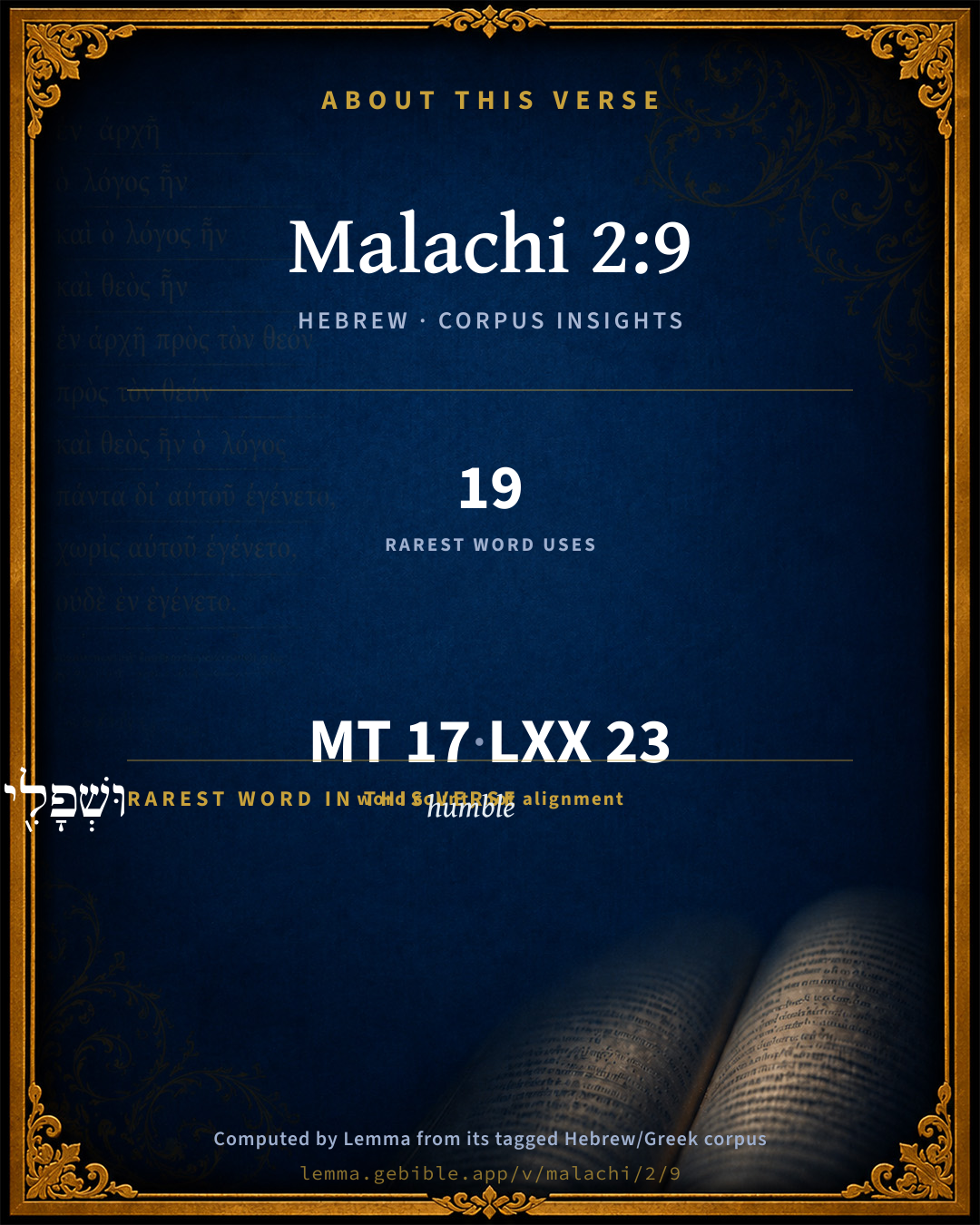
Malachi 2:9

Hebrew (Westminster Leningrad Codex) Malachi 2:9 appears in the Hebrew Old Testament. The text above is from the Westminster Leningrad Codex. Each word links to its Strong’s number, a concise gloss, and parsing drawn from the Open Scriptures Hebrew Bible morphology. Click any word for its full Brown-Driver-Briggs (BDB) entry.
Download image
Cite this verse

Malachi 2:9 (World English Bible). Public Domain. Lemma interlinear Bible study tool, https://lemma.gebible.app/v/malachi/2/9.

Show BibTeX & RIS
BibTeX
RIS
English Translation
"Therefore I have also made you contemptible and base before all the people, according to the way you have not kept my ways, but have had respect for persons in the law.
World English Bible · Public Domain
Download a study sheet

One document with this verse’s original text, its word-by-word gloss line, the meaning frame, cross-references with their text, attributed commentary, and full source and license credits — printable, and it pastes into notes with its structure intact.

This verse Autodidact and up

Study sheet (.html) Plain text (.txt)

A passage Seminary Student

Up to 50 verses in one chapter. A passage sheet keeps up to 6 commentary sources and 12 cross-references per verse, in the order this page ranks them, and says so on the sheet whenever that leaves anything out. Ask for a single verse and you get the Autodidact verse sheet above.

Everything on this page stays free to read, with no account — the sheet is a download of what is already on screen, not access to it.

Want to remove ads? Support Godless Engineer
Compare translations 3

The same verse in 3 English versions, stacked beneath the original-language interlinear above. Click any original word for its lexicon entry.

Each is an independent rendering of the whole verse — the interlinear is not word-aligned to these translations.

Highlighted words mark where these versions differ — a whole-verse word diff, not a word-by-word alignment.

  • World English Bible Public Domain
    "Therefore I have also made you contemptible and base before all the people, according to the way you have not kept my ways, but have had respect for persons in the law.
  • King James Version Public Domain
    Therefore have I also made you contemptible and base before all the people, according as ye have not kept my ways, but have been partial in the law.
  • unfoldingWord Literal Text CC BY-SA 4.0
    “So I myself have also made you despised and humiliated before all the people, because you not keeping my ways and lifting faces regarding the instruction.”

unfoldingWord Literal Text — © unfoldingWord, licensed CC BY-SA 4.0. Word-aligned USFM3 via Door43 (git.door43.org/unfoldingWord/en_ult).

Versions to compare (up to 4)

3 of 4 selected

Show all 18 translations

Every available English version of this verse, each an independent rendering of the whole verse.

  • World English Bible Public Domain
    "Therefore I have also made you contemptible and base before all the people, according to the way you have not kept my ways, but have had respect for persons in the law.
  • Berean Standard Bible Public Domain
    “So I in turn have made you despised and humiliated before all the people, because you have not kept My ways, but have shown partiality in matters of the law.”
  • Majority Standard Bible Public Domain
    “So I in turn have made you despised and humiliated before all the people, because you have not kept My ways, but have shown partiality in matters of the law.”
  • King James Version Public Domain
    Therefore have I also made you contemptible and base before all the people, according as ye have not kept my ways, but have been partial in the law.
  • American Standard Version (1901) Public Domain
    Therefore have I also made you contemptible and base before all the people, according as ye have not kept my ways, but have had respect of persons in the law.
  • Revised Version (1885) Public Domain
    Therefore have I also made you contemptible and base before all the people, according as ye have not kept my ways, but have had respect of persons in the law.
  • Geneva Bible (1599) Public Domain
    Therefore haue I also made you to be despised, and vile before all the people, because yee kept not my wayes, but haue beene partiall in the Lawe.
  • Douay-Rheims (1899) Public Domain
    Therefore have I also made you contemptible, and base before all people, as you have not kept my ways, and have accepted persons in the law.
  • Young's Literal Translation Public Domain
    And I also, I have made you despised and low before all the people, Because ye are not keeping My ways, And are accepting persons in the law.
  • Literal Standard Version CC BY-SA 4.0
    “And I also, I have made you despised and low before all the people, || Because you are not keeping My ways, || And are accepting by superficial things in the Law.”
  • Unlocked Literal Bible CC BY-SA 4.0
    “So I also, I have made you contemptible and vile before all the people, because you have not kept my ways, but have instead shown partiality with regard to the instruction.”
  • unfoldingWord Literal Text CC BY-SA 4.0
    “So I myself have also made you despised and humiliated before all the people, because you not keeping my ways and lifting faces regarding the instruction.”
  • Darby Bible Public Domain
    And I also have made you contemptible and base before all the people, because ye have not kept my ways, but have respect of persons in [administering] the law.
  • World Messianic Bible Public Domain
    “Therefore I have also made you contemptible and wicked before all the people, according to the way you have not kept my ways, but have had respect for persons in the law.
  • Webster's Bible Public Domain
    Therefore have I also made you contemptible and base before all the people, according as ye have not kept my ways, but have been partial in the law.
  • Free Bible Version CC BY-SA 4.0
    So I have destroyed any respect you had, and humiliated you before all the people. For you have not kept my ways, and have shown favoritism in what you teach.
  • Bible in Basic English Public Domain
    And so I have taken away your honour and made you low before all the people, even as you have not kept my ways, and have given no thought to me in using the law.
  • JPS Tanakh (1917) Public Domain
    Therefore have I also made you contemptible and base before all the people, according as ye have not kept My ways, but have had respect of persons in the law.

Literal Standard Version (2020), Covenant Press — licensed CC BY-SA 4.0. Text via the HelloAO Bible API (eBible.org). Unlocked Literal Bible (unfoldingWord) — licensed CC BY-SA 4.0. Text via the HelloAO Bible API (eBible.org). unfoldingWord Literal Text — © unfoldingWord, licensed CC BY-SA 4.0. Word-aligned USFM3 via Door43 (git.door43.org/unfoldingWord/en_ult). Free Bible Version, Dr. Jonathan Gallagher — licensed CC BY-SA 4.0. Text via the HelloAO Bible API (eBible.org).

Word by word

More ways to search: Search by grammar → Find every occurrence → Compare this word →

Practice this passage: Drill this verse → Learn its vocabulary →

וּשְׁפָלִ֖ים
shâphâl
H8217
“and · humble”
Conjunction + Adjective, Adjective, Masculine, Plural, Absolute
Part of Speech
Conjunction + Adjective
Type
Adjective
Gender
Masculine
Number
Plural
State
Absolute
Full BDB Definition

Origin: from H8213

TWOT: 2445c

low, humble - low (in height) - low (in station), humble (of condition or spirit) - humiliated - lowly (as subst)
  1. וְגַם gam H1571 “and · also” Conjunction + Particle, Accusative
  2. אֲנִ֞י ʼănîy H589 “I” Pronoun, Personal, 1st Person, Common, Singular
  3. נָתַ֧תִּי nâthan H5414 “to give” Verb, Qal, Perfect, 1st Person, Common, Singular
  4. אֶתְכֶ֛ם ʼêth H853 “- · you” Particle, Direct Object + Suffix, Personal, 2nd Person, Masculine, Plural
  5. נִבְזִ֥ים bâzâh H959 “despised” Verb, Niphal, Participle Passive, Masculine, Plural, Absolute
  6. לְכָל kôl H3605 “to/for · all of” Preposition + Noun, Common, Masculine, Singular, Construct
  7. הָעָ֑ם ʻam H5971 “the · people” Particle, Definite Article + Noun, Common, Masculine, Singular, Absolute
  8. כְּפִ֗י peh H6310 “like/as · mouth of” Preposition + Noun, Common, Masculine, Singular, Construct
  9. אֲשֶׁ֤ר ʼăsher H834 “which” Particle, Relative
  10. אֵֽינְכֶם֙ ʼayin H369 “nothing · you” Particle, Negative + Suffix, Personal, 2nd Person, Masculine, Plural
  11. שֹׁמְרִ֣ים shâmar H8104 “keeping” Verb, Qal, Participle Active, Masculine, Plural, Absolute
  12. אֶת ʼêth H853 “-” Particle, Direct Object
  13. דְּרָכַ֔י derek H1870 “ways · my” Noun, Common, Both, Plural, Construct + Suffix, Personal, 1st Person, Common, Singular
  14. וְנֹשְׂאִ֥ים nâsâʼ H5375 “and · lifting” Conjunction + Verb, Qal, Participle Active, Masculine, Plural, Absolute
  15. פָּנִ֖ים pânîym H6440 “face(s)” Noun, Common, Both, Plural, Absolute
  16. בַּתּוֹרָֽה tôwrâh H8451 “in/at the · law” Preposition, Determined + Noun, Common, Feminine, Singular, Absolute

About this verse

These counts appear in no published source. They are computed here, from the morphology-tagged text and Lemma’s own curated glosses. What Lemma adds →

17
words
16
distinct lemmas
Prophets
section

Notable vocabulary

The rarest word here is וּשְׁפָלִ֖ים humble H8217 — appearing just 19 times in the whole Hebrew Bible.

Shared distinctive vocabulary

וּשְׁפָלִ֖ים humble H8217 occurs in 18 verses of the Hebrew Bible. Also found in:

Grammatical profile

  • 4 verbs
  • 6 nouns
  • 1 adjective
  • 1 pronoun
  • 5 particles

Verb forms

  • נָתַ֧תִּי Qal · Perfect
  • נִבְזִ֥ים Niphal · Participle Passive
  • שֹׁמְרִ֣ים Qal · Participle Active
  • וְנֹשְׂאִ֥ים Qal · Participle Active

Hebrew & Septuagint length

In English translation the verse runs 32 words from the Hebrew and 27 from the Septuagint (LXX English) — closely comparable.

A rough comparison of the two English renderings, which tokenize alike — not a word-level alignment.

Word counts can differ between the Hebrew and the Greek without any difference in meaning — e.g. the Hebrew direct-object marker אֵת has no separate Greek word, and Greek often adds the article ὁ.

In the original languages it is 17 Hebrew tokens and 23 Greek tokens — but the two are counted differently (Hebrew bundles its prefixes and suffixes into one token; the Greek is in lemma form), so that isn’t a like-for-like length.

Cross-references

25

Topical passages linked to Malachi 2:9 in the Treasury of Scripture Knowledge — connected by theme and wording, ordered by reader-vote popularity; previews shown in the World English Bible.

  • Deuteronomy 1:17 You shall not show partiality in judgment; you shall hear the small and the great alike; you shall not be afraid of the face of man; for the judgment is God's: and the cause that is too hard for you, you shall bring to me, and I will hear it.
  • 1 Samuel 2:30 Therefore Yahweh, the God of Israel, says, I said indeed that your house, and the house of your father, should walk before me forever: but now Yahweh says, Be it far from me; for those who honor me I will honor, and those who despise me shall be lightly esteemed.
  • Luke 11:42 But woe to you Pharisees! For you tithe mint and rue and every herb, but you bypass justice and the love of God. You ought to have done these, and not to have left the other undone.
  • 1 Kings 22:28 Micaiah said, If you return at all in peace, Yahweh has not spoken by me. He said, Hear, you peoples, all of you.
  • Ezekiel 13:12–16 Behold, when the wall is fallen, shall it not be said to you, Where is the daubing with which you have daubed it?
  • Ezekiel 13:21 Your kerchiefs also will I tear, and deliver my people out of your hand, and they shall be no more in your hand to be hunted; and you shall know that I am Yahweh.
  • Micah 3:6–7 "Therefore night is over you, with no vision, And it is dark to you, that you may not divine; And the sun will go down on the prophets, And the day will be black over them.
  • Malachi 2:8 But you have turned aside out of the way. You have caused many to stumble in the law. You have corrupted the covenant of Levi," says Yahweh of Hosts.
  • Matthew 5:33–37 "Again you have heard that it was said to them of old time, 'You shall not make false vows, but shall perform to the Lord your vows,'
  • Matthew 5:43–44 "You have heard that it was said, 'You shall love your neighbor, and hate your enemy.'
  • Matthew 19:17–18 He said to him, "Why do you call me good? No one is good but one, that is, God. But if you want to enter into life, keep the commandments."
  • Mark 7:8–14 "For you set aside the commandment of God, and hold tightly to the tradition of men--the washing of pitchers and cups, and you do many other such things."
  • Luke 10:29 But he, desiring to justify himself, asked Jesus, "Who is my neighbor?"
  • Galatians 2:6 But from those who were reputed to be important (whatever they were, it makes no difference to me; God doesn't show partiality to man)--they, I say, who were respected imparted nothing to me,
  • Proverbs 10:7 The memory of the righteous is blessed, But the name of the wicked will rot.
  • Jeremiah 28:15–16 Then said the prophet Jeremiah to Hananiah the prophet, Hear now, Hananiah: Yahweh has not sent you; but you make this people to trust in a lie.
  • Jeremiah 29:20–22 Hear you therefore the word of Yahweh, all you of the captivity, whom I have sent away from Jerusalem to Babylon.
  • Jeremiah 29:31–32 Send to all them of the captivity, saying, Thus says Yahweh concerning Shemaiah the Nehelamite: Because Shemaiah has prophesied to you, and I didn't send him, and he has caused you to trust in a lie;
  • Daniel 12:2–3 Many of those who sleep in the dust of the earth shall awake, some to everlasting life, and some to shame and everlasting contempt.
  • Malachi 2:3 Behold, I will rebuke your seed, and will spread dung on your faces, even the dung of your feasts; and you will be taken away with it.
  • Matthew 5:21–22 "You have heard that it was said to the ancient ones, 'You shall not murder;' and 'Whoever shall murder shall be in danger of the judgment.'
  • Matthew 5:27–28 "You have heard that it was said, 'You shall not commit adultery;'
  • Matthew 23:16–24 "Woe to you, you blind guides, who say, 'Whoever swears by the temple, it is nothing; but whoever swears by the gold of the temple, he is obligated.'
  • Luke 20:45–47 In the hearing of all the people, he said to his disciples,
  • Romans 7:7–10 What shall we say then? Is the law sin? May it never be! However, I wouldn't have known sin, except through the law. For I wouldn't have known coveting, unless the law had said, "You shall not covet."

Cross-references courtesy of OpenBible.info (CC BY 4.0).

Hebrew and Greek witnesses Masoretic Hebrew ↔ Greek Septuagint

The same verse in the two great witnesses to the Old Testament, shown verse-for-verse.

These are two independent witnesses, not word-aligned to each other, and the Septuagint is shown in lemma (dictionary) form.

Hebrew Malachi 2:9 Masoretic · Westminster Leningrad Codex

וְגַם אֲנִ֞י נָתַ֧תִּי אֶתְכֶ֛ם נִבְזִ֥ים וּשְׁפָלִ֖ים לְכָל הָעָ֑ם כְּפִ֗י אֲשֶׁ֤ר אֵֽינְכֶם֙ שֹׁמְרִ֣ים אֶת דְּרָכַ֔י וְנֹשְׂאִ֥ים פָּנִ֖ים בַּתּוֹרָֽה

"Therefore I have also made you contemptible and base before all the people, according to the way you have not kept my ways, but have had respect for persons in the law.

World English Bible · Public Domain

Greek LXX Malachi 2:9 Septuagint · lemma form

καΐἐγώ δίδωμι σύ ἐξουδενόω καί παραἵημι εἰς πᾶς ὁ ἔθνος ἀντί ὅς σύ οὐ φυλάσσω ὁ ὁδός ἐγώ ἀλλά λαμβάνω πρόσωπον ἐν νόμος

And I have made you despised and cast out among all the people, because you⌃ have not kept my ways, but have been partial in the law.

LXX2012 (modern English Septuagint) · Public Domain

Hebrew: Westminster Leningrad Codex (CC BY 4.0). Greek: Septuagint (public domain); English from LXX2012 (modern English Septuagint) (Public Domain). How the Septuagint differs from the Hebrew →

Targum (Aramaic paraphrase)

1

The Targum is the ancient Jewish Aramaic paraphrase of the Hebrew Scriptures — an interpretive translation, not the Hebrew text itself. Onkelos (literal) and Pseudo-Jonathan (expansive) render the Torah, and Jonathan the Prophets. Coverage is partial: where no permissively-licensed English translation exists for a verse, only the Aramaic is shown. This is verse-level text, not a word-by-word alignment to the Hebrew.

  1. Targum Jonathan Prophets (Joshua–Malachi)
    וְאַף אֲנָא יְהַבֵית יַתְכוֹן בְּסִירִין וְחַלָשִׁין לְכָל עַמָא כְּמָא דְלֵיתֵכוֹן נָטְרִין יַת אוֹרְחָן דְתַקְנָן קֳדָמַי וְנָסְבִין אַפִּין בְּאוֹרַיְתָא:

    (no public-domain English translation for this verse)

    Targum Jonathan — Aramaic: “Mikraot Gedolot” (public domain). English: “Sefaria Community Translation” (CC0 1.0 (public-domain dedication)); “London "Chaldee Paraphrase," 1871” (public domain). Text via Sefaria.

Commentary

Notes on Malachi 2:9 from classic Christian and Jewish commentators (each source and its license shown beneath its notes). The classic Christian expositions comment on the surrounding passage and are grouped to its opening verse, so a note may address several verses; the Jewish commentaries on the Tanakh (Rashi and others) are per-verse, so they appear only where the commentator wrote on this verse.

Lemma curates 59 commentaries, every one of them public domain or Creative Commons licensed, each selected and text-cleaned for this edition rather than reprinted as found. About our sources →

Trapp's Complete Commentary

John Trapp

Mal 2:9 Therefore have I also made you contemptible and base before all the people, according as ye have not kept my ways, but have been partial in the law.

Ver. 9. Therefore have I also made you contemptible, and base] And so have cried quittance with you and returned you your own with usury. God loves to retaliate, and to proportion jealousy to jealousy, provocation to provocation, Deu 32:21, frowardness to frowardness, Psa 18:26, contrariety to contrariety, Lev 26:18; Lev 26:21, contempt to contempt, 1Sa 2:30, and here. How these unworthy priests had slighted God, and exposed his name and service to contempt and obloquy, hath been before set forth sufficiently. And now it is come home to them. It was threatened before, Mal 2:3, {See Trapp on "Mal 2:3"} and now it is executed. Graceless men are apt to imagine that God threateneth in terrorem in fear only; and are ready, with those miscreants in the Gospel, to say, God forbid; we hope he will be better than his word, and not be so unmerciful as the preachers would make him. They believe the predictions of Scripture but as they believe the predictions of an almanack, which saith, such a day will be rain, and such a day wind; men think it may come to pass, and it may be not. But shall God say the word, and not see it fulfilled? Is not his dicere to say his facere? do do, his word his deed? Yea, doth be not sometimes, dicto citius, by saying more quickly, break out upon his enemies, as he did upon Nadab and Abihu, Nebuchadnezzar, Herod, &c. God had poured contempt already upon these degenerate priests. And the like he had threatened to those, Jer 23:40 : see Mic 3:7 Zec 13:4. Ribera upon this text bewails the business in their Romish clergy, now become despicable by reason of their evil manners. Petrarch complained long before that the stench of that sink, the court of Rome, was come up to heaven. Erasmus laid them open in their colours, and did them more mischief iocando, by his jeering and jesting at them, than Luther did stomachando, by dry blows and invectives, as one well observeth. He made the world look up that had been long lulled asleep, and take notice of the truth of that which Chrysostom had long before discovered and lamented: Multi sacerdotes, et pauci sacerdotes; multi in nomine, pauci in opera. There are many priests, and yet but few many so in name, few so indeed. Fie on such rascal ribalds, {a} said the excommunicated barons in King John’s time (in their declaration), concerning the Pope and his Cardinals, and yet they were no Protestants. No more are the Venetians; and yet how they slight their Pope (who is now, like the cuckoo in June, heard, but not regarded, by them) is sufficiently manifested by their manifestos to the Christian world. In Biscany (anciently Cantabria), a province of Spain, they admit no bishops to come among them; such a hatred they have taken against that order of men. And when King Ferdinand came in progress thither, accompanied, among others, by the Bishop of Pampeluna, the people arose in arms, drove back the bishop, and, gathering all the dust on the which they thought he had trodden, flung it into the sea. What our bishops did in Queen Mary’s days we all know; that bloody Bonner especially, buried at length in a dunghill (too good a grave for him). Sure it was an unhappy proverb that was then learned, The bishop’s foot hath trodden here. They are now utterly cashiered, and lie wrapped up in the sheet of shame for this sin (among others) here charged upon these priests, their dishonouring God’s great name, his services and servants. For it was come to that height of wickedness among us, a little before the late troubles, as to cast odium in religionis professores tanquam in adversaries, an evil report upon the professors of religion, as so many adversaries, as Redo saith the ancient Britons did immediately before their destruction by the Saxons. He that would not be an Arminian was therefore accounted a practical Puritan. He that was not for the iure divino by divine law of episcopacy, was little better than a public enemy. If the ministry of England be under any abuses at present, as they are through the iniquity of the times, and the overflow of errors and atheism, let it serve to humble them for their desire of vain glory, and not seeking the honour that cometh from God only, Joh 5:44; let it also work in them a greater care to approve themselves to God, that they may be glorious in his eyes and to his people, who dare not but honour such as fear the Lord, Psa 15:4, and have his ministers in singular esteem for their work’s sake, 1Th 5:13.

According as ye have not kept my ways] q.d. Your dignity is decayed, like as your duty hath been neglected; you are fallen out of the hearts of good people, and are aviled by all. Neither is it any wonder; for a vicious life breeds vileness of estimation; but virtue is a thousand escutcheons. Hence that close connection, "If there be any virtue, if any praise," Php 4:8; this treads upon the heels of that, as it were; follows it as close as the shadow doth the body. When Adam stood in innocence the savage beasts did him reverence. And the same God which did at first put an awe of man in the fiercest creatures, hath stamped in the cruelest hearts a reverent respect to his own image in his faithful ministers, as in Saul to Samuel, Herod to John Baptist, those gallants of Israel to that mad fellow, as they were pleased to call the prophet that came to anoint Jehu; upon whose words (as mad as they made of him) they will presently adventure their lives, and change the crown. God’s image (as God’s name, Psa 111:9) is holy and reverend; and they that would have good repute and report among men must carefully keep (or, as the word here used may be rendered) watch God’s ways. He shall have enough that will watch for his halting, and take any little occasion to revile him with open mouth, as Shimei did David, when he had declined God’s ways. It is therefore excellent counsel that Solomon gives, and worthy of all acceptation, Pro 4:25-27 "Let thine eyes look right on, and let thine eyelids look straight before thee. Ponder the path of thy feet, and let all thy ways be established. Turn not to the right hand nor to the left: remove thy foot from evil." Lo, this is the ready road to honour and estimation. Do worthily in Ephrata, and so be famous in Bethlehem, Rth 4:11. Sic famam extendere factis, Hoc virtutis opus. But those Balaams that, persuaded by their Balaks, seek for honour by evil doing, these seek the living among the dead, figs of thistles, heaven in hell, &c.

But have been partial in the law] Heb. Ye have accepted, or acknowledged, faces in the law, i.e. you accept persons; you deal partially in expounding and applying the law, making it pinch the poor and favour the rich. The Church hath ever been pestered with such Aretalogi, story tellers, such parasitic preachers, whose practice hath been, like Ahab’s prophets, to speak magis ad voluntatem quam ad veritatem, more to please than to profit. And there is a very great sympathy between great ones that have first flattered themselves, and these false flatterers, who prove a fit helve for such hatchet, and meet lettuce for such lips. Such a one was Uriah, the high priest, to Ahaz, 2Ki 16:15-16. His motto seems to have been Mihi placet quicquid regi placet. It please me whatever pleases the king. Such were those dirt daubers for the devil in Ezekiel’s days, Eze 13:10-11, &c., the Herodians, the Arians, the Arminians, Utenbogardus, &c., the Queen of Navarre’s preachers, who persuaded her, out of political respects, to consent to that unhappy match that gave opportunity for the Parisian massacre. The apostle chargeth his son Timothy to do nothing of popularity or partiality, by tilting the balance on the one side, as the word signifieth; {1Ti 5:21, κατα προσκλισιν} but as a just law is a heart without affection, an eye without lust, a mind without passion, a treasurer which keepeth for every man that he hath, and distributeth to every man that he ought to have; so should a minister be; remembering that of Job 13:10 "He will surely reprove you, if you secretly accept persons," that is, he will chide you, smite you, curse you for it, and so set it on, as no creature shall be able to take it off. If you reprove meaner men, and wink at the faults of great ones, reproving he will reprove you, he will not do it to halves; no, he will rather do it double; you shall have it both surely and severely. Let your resolution, therefore, be that of Elihu, Job 32:21-22, I will not now accept the person of any man, neither will I give flattering titles to man. For I may not give flattering titles, lest my Maker should suddenly take me away; lest my Master, whose steward I am, finding me unfaithful in the disposal of his mysteries, should confound me before you, Jer 1:17. Nisi fideliter dixerim, vobis erit damnosum, mihi periculosum, If I should not deal faithfully and freely with you, it would be to your loss, but to mine utter undoing, Timeo itaque damnum vestrum, timeo damnationem meam (Bern.).

{a} A person of abandoned character; a wicked, dissolute, or licentious person. ŒD

John Trapp, A Commentary or Exposition upon All the Books of the Old and New Testament (1647–1656) — public domain. Text from a community e-Sword module.

The Biblical Illustrator

Joseph S. Exell

Mal_2:9

I also made you contemptible.

Pulpits sinking into popular contempt

The priesthood of Israel is referred to. No greater calamity could happen to a community than this.

I. A calamity to all parties.

1. To the priests. Few things are more painful to man than social contempt. It divests a man of esteem, confidence, and influence.

2. To the community. The highest educational instrumentality in a country is that which religious ministers are appointed to employ. In every way they are to cultivate the spiritual natures of their contemporaries. When they become socially contemptible, they are stripped of all power for this. The hearts of the people recoil from them with disgust.

II. A calamity to which the religious ministry is liable. There are moral elements at work amongst the clergy of all denominations which have a tendency to bring about this lamentable state of things.

1. Ignorance.

2. Greed.

3. Bigotry.

4. Sycophancy.

III. A calamity that is manifestly transpiring in our country. The decrease in the numbers of those who attend churches: the growth of a literature in thorough antagonism to the spirit and aims of Christianity: and the fact that the great bulk of the reading and thinking men of England stand aloof from all churches, plainly show that the pulpit of England is sinking into popular contempt. The salt of the pulpit has lost its savour, and it is being trodden under foot with disdain and contempt. (Homilist.)

A ministers inconsistency

A minister of Christ had been preaching in a country village very earnestly and fervently. In his congregation was s young man who had been deeply impressed with a sense of sin under the sermon. When the service was over, he sought the minister as he went out, in the hope of walking home with him. They walked together till they came to a friends house. On the way the minister talked about everything except the subject about which he had been preaching, though he had preached very earnestly, even with tears in his eyes. The young man thought within himself, O! I wish I could unburden my heart and speak to him; but I cannot. He does not say anything now about what he spoke so fervently in the pulpit. When they were at supper that evening, the conversation was very far from what it should have been; and the minister indulged in all kinds of jokes and fight sayings. The young man had gone into the house with eyes filled with tears, feeling as a sinner should feel; but as soon as he got outside he stamped his foot on the ground and cried out: It is a lie from beginning to end! That man has preached like an angel, and now he has talked like a devil! Some years after, the young man was taken suddenly ill and sent for that same minister to visit him. The minister did not remember him. Do you remember preaching at the village of-- said the young man. I do. Your sermon was very deeply laid on my heart. Thank God for that, said the minister. Do not be so quick about thanking God, said the young man. Do you know what you talked of that evening, afterwards, when I went to supper with you? Sir, I shall be damned; and I shall charge you, before Gods throne, with being the cause of my damnation. Oh, that night I did feel my sin, but you were the means of scattering all my impressions and driving me into a deeper darkness than I had ever been in before! Minister of Christ! this is a true narrative. It is a common sin. In how many thousands of cases the testimony of the pulpit has been undone by the after conversation by the way, or at the dinner or supper table, only the day will declare! O! the account that we ministers will have to render for the light, frivolous, frothy conversation on such occasions, by which immortal souls have been sent further from God or altogether lost! What eyes have been upon us, secretly taking note of all and receiving from us a deadly influence! What opportunities for God presented and lost by our unwatchfulness and frivolity! Minister of Christ, aim to live out of the pulpit what you have preached in it. If you preach Christ, live Christ. What men hear in the pulpit let them see at the dinner table and the visit. (F. Whitfield.)

Partial in the law.

An evil partiality

The possession of the law was the strength and glory of the Jewish priesthood. They had in it a Divine standard of human action, and it was their duty to maintain its authority, and enforce its requirements. Being selfish and corrupt they made their exalted position the means of gratifying their avarice; the vices of the rich were unreproved, the faults of the poor were severely dealt with. They knew faces (Hebrews). They were misrepresenting the character of God, bringing the law of God into contempt, and ruining the nation.

I. There may be partiality in the law on the part of those who administer it to the people. All righteous law is Divine. The principles of the decalogue underlie all just legislation. Administrators of righteous laws should feel that they are revealing and enforcing Divine, universal, and eternal realities. There should be no respect of persons. Partiality leads to--

1. Loss of confidence in constituted authorities.

2. Rebellion and anarchy.

3. The increase of crime.

Every Christian minister has to bring Gods law into contact with public vices and personal sins. This must be done fearlessly, faithfully, firmly, and impartially. He must not adapt it to mens humours. He must not modify it to hinder its application to offenders of any social grade. He must present it as Gods unalterable standard, not his own. If he is partial in the law--

(1) He will confirm men in their sins.

(2) He will deceive and mislead them.

(3) He will be accounted responsible for their destruction.

(4) He will at last be rejected by God, and condemned by the people.

II. There may be partiality in the law in the estimates of men in social circles. The world is a court of justice. Society is always testing reputations and giving judgments. Men are oftener governed by prejudice than b; the desire to judge righteously. Society often applies Gods law according to its prejudices. Sometimes our application of the law is partial.

1. Because the person judged is, or is not, of the same religious persuasion as ourselves:

2. Because it is our interest either to hide or expose his faults.

3. Because we are already prejudiced favourably or otherwise towards him.

4. Because of his elevated or degraded social condition. This partiality leads to erroneous impressions, misrepresentations, unjust actions, and bitter feelings.

III. There may be partiality in the law in its application to ourselves. Men deal tenderly with their own sins. They hold the mirror of the law so as not to reveal them. They are willing to apply those commandments that do not condemn their particular vices. Faithful application of the law is seldom made. This is the cause of much ignorance of ourselves, much vanity and self-conceit, much folly and self-deception, much cherishing of sin, and persistence in it. By an impartial application of the law our sins are discovered, and we are led to Christ that they may be taken away. (W. Osborne Lilley.)

The Biblical Illustrator, edited by Joseph S. Exell (c. 1880s–1900s) — public domain. Text from a community e-Sword module.

Tyndale Open Study Notes

Tyndale Open Resources

2:9 shown favoritism (literally lifted up the face): The expression is also found in 1:8 (“see how pleased he is”). The priests should have administered the law with kindness and fairness, but they had not done so. It was ridiculous for the priests to suppose that God would show them favor when they had shown partiality in discharging the prescribed duties of their office.

Tyndale Open Study Notes — © Tyndale Open Resources, licensed CC BY-SA 4.0. Text via the HelloAO Bible API.

Jamieson, Fausset & Brown

Robert Jamieson, A. R. Fausset & David Brown

Because ye do not keep the condition of the covenant, I will not fulfil the promise.

partial in the law--having respect to persons rather than to truth in the interpretation and administration of the law (Lev 19:15).

Jamieson, Fausset & Brown — Commentary Critical and Explanatory on the Whole Bible (1871) — public domain (CC PDM 1.0). Text via the HelloAO Bible API.

Adam Clarke's Commentary

Verse 9. Therefore have I also made you contemptible] The people despised you because they saw that you acted contrary to your functions. This has happened repeatedly since, to several classes of priests. Not maintaining, by purity of life and soundness of doctrine, the dignity of the ministerial function, they became contemptible before the people; their meager preaching was disregarded, and their persons at last cast out as a general loathing to the universe! See what happened to the truly abominable priesthood of France and Rome 1796-8. They were the sole cause of that infidelity that brought about the revolution. They are now partially restored; and are endeavouring to supply by grimace, paltry superstition, and jesuitical cunning, what they want in purity of morals, soundness of doctrine, and unction from God. They must mend, or look for another revolution. Mankind will no longer put up with the chaff of puerile and fanatical ceremonies in place of the wheat of God's word and worship.

Adam Clarke's Commentary on the Bible (1810–1826) — public domain. Text from a community e-Sword/MySword module.

John Calvin's Commentaries

The Prophet draws this conclusion — that the priests in vain gloried in the honor of their office, for they had ceased to be the priests of God. We may now return to the main point.

We perceive what the subject is which the Prophet handles here: as the priests sought by a peculiar privilege to exempt themselves from all reproof, he assails them in particular; for teaching would have been useless as to the common people, except the priests themselves were brought to order. The priests no doubt flattered the people, and thus attempted to deprive the Prophets of every respect, in order that their doctrine might produce no effect. This is the reason why our Prophet so sharply reproves them. But we must consider the state of the case. The priests said that they had been set, by divine authority, over the whole Church, and that they could not be deprived of that honor which they had received from God. They however took only but one part of the covenant, and yet sought to deprive God of his right. The Prophet here answers them — that God had indeed favored them with no common honor in appointing them the priests of his Church, but that the compact, which included a mutual stipulation, was at the same time to be considered; for God had not simply appointed them the guides of his Church, but had also added a condition.

We hence see that the hinge of the matter was, that the priests presumptuously and absurdly laid hold on what favored only their own cause, and at the same time passed by and cunningly overlooked the chief thing — that the priesthood was connected with the worship of God. Now had they attained what they wished, there would have been no God in the Church, but they would have exercised over it a tyrannical power. But it has ever been, and is still the will of God, to retain the supreme power over mortals in his own hand.

Having now seen the design of the Prophet, we may easily perceive the import of the whole subject. But before we proceed farther, we must first observe, that we have here described to us the character of true and legitimate priests; for the Prophet not only speaks of the office of priests, but sets before us a living image in which we cannot be deceived: and hence all who are engaged in the pastoral office may know what God requires from them. I will only just mention what he first says — that God gave fear to priests; for I have already given a sufficient explanation of this by saying, that priests are not to abuse their right, as though the highest power were granted to them; for God will not have his Church subject to tyranny, but his will is to reign alone in it through the ministry of men. The main thing then to be borne in mind is this — that a rule is prescribed to priests, that though they preside and possess the first rank of honor among the people, it is yet under certain conditions.

We shall now consider only this which the Prophet says — that Levi faithfully and sincerely performed his office, because the law of truth was in his mouth, and no iniquity was found in his lips; to which we ought yet to add the general truth which immediately follows — that the priest’s lips ought to keep knowledge. It is then a law which cannot be abolished, that those who are priests or pastors in the Church are to be teachers. And not unwisely does Gregory apply a custom under the law to this subject; for we know that appended to the priest’s dress were bells; and it is distinctly commanded by Moses, that the priest should not go forth without this sound, (Exodus 28:35.) Gregory, as I have said, accommodated this to teaching — “Woe,” he says, “to us, if we go forth without sound, that is, if we boast that we are pastors, and in the meantime are dumb dogs; for nothing is less tolerable than that he who speaks not in the Church and whose voice is not clearly heard to the edification of the people, should be deemed a pastor.” This is what a Roman Pope has said. Let those who now proudly and confidently boast themselves to be his successors, at least give the sound, and let us hear what they teach: but as their whole power is exercised in cruelty, it is evident how faithfully they keep God’s covenant! But I now return to the words of the Prophet.

He says, that this law has been fixed by God, and that it cannot be nullified by any decrees or customs of men, — that the priest is to keep knowledge in his lips. He farther explains himself by showing that the priest is to be the keeper of knowledge, not that he may reserve it for himself, but that he may teach the whole people: they shall seek, he says, the law from his mouth; and afterwards he confines knowledge to true doctrine, as it was to flow from the law of God, the only true fountain of truth; for he had said, that the law of truth was in the mouth of Levi. It would not then be enough for one to have his mouth open and to be prepared to teach others, except purity of doctrine be retained. We hence see, that not only teaching is required from priests, but pure teaching, derived from the very mouth of God, according to what is said in Ezekiel 3:17,

“Thou shalt receive from my mouth the word, and shalt declare it to them from me.”

God shows there that the Prophets had no such authority as that they could bring forth anything they pleased, or what they thought would be right, but that they were so far faithful teachers as they were his disciples alone: hence he bids him to seek the word from his mouth; and then he adds, “Thou shalt declare it to them from my mouth.” So also it is said in Jeremiah 23:28,

“What is the chaff to the wheat? The Prophet who has a dream, let him declare his dream; but he who has my word, let him declare my word faithfully.”

Here God limits and defines the prophetic right, as though he had said, that the Prophets were not appointed, that they might bring anything indiscriminately, but that each, according to the measure of what was revealed to him, might faithfully dispense, or deliver, as it were from hand to hand, what he had received from heaven: for by mentioning two things, it was God’s design to show that no doctrine is to be allowed, except what he himself has revealed; and he compares to chaff whatever men devise themselves, while the pure doctrine of the law is to be regarded as the wheat. This is then the second thing to be noticed in what the Prophet says in this passage: but we must also consider the last thing — that the priest is the messenger of the God of hosts.

This seems to have been said in honor of the priesthood; but the Prophet means that priests have nothing of their own or separate from God, and that whatever reverence is due to them ought to be referred to God himself, whose ministers they are. I have said that he reasons from the definition itself, as though he had said, that every one who would be a priest must also be a teacher. But we must also observe, that there is an implied comparison between God and priests, as though he had said, “Priests can claim nothing for themselves, but as interpreters of God.” Hence, the plain conclusion is, that the priesthood takes away nothing from God’s authority.

We now see that the Prophet includes in these few words two things of great importance — that there is no priesthood without doctrine or teaching, and no priest except he who faithfully performs his office as a teacher: and secondly, that God resigns not his own right and power when priests are set over the Church; for God commits to them the ministration only, and on this condition, that the authority remains in himself alone; for otherwise the priest would not be the messenger of the God of hosts. Among other things the Prophet requires also this of the priests — that they sincerely perform their duties. We indeed know that many apparently discharge their office, and excel in teaching, and carefully apply to their duties; but ambition stimulates some and avarice others. Hence the Prophet lays down another condition — that they are to walk in uprightness before God; that is, that they are not only to satisfy men, or to catch at the applause of the world, but to discharge their office with a pure conscience.

Thus have I shown that there is here set before our eyes a pattern by which we may know what God requires from us when he makes us pastors over his Church.

Now follows a reprobation of their conduct, for the Prophet says, Ye have departed from the way. Since he so boldly chastises the priests, we hence learn that they were subject to reproof; and nothing is more unreasonable than that the Papal clergy should seek to be exempt from every law and discipline, for the priests are here called to order, that they might know their own faults: Ye have departed, he says, from the way, and then, ye have made many to err in the law. This second thing being added, the priests ought by no means to be spared. When they sin only privately, though they may by bad examples corrupt the Church, yet this may somehow be borne with; but when they corrupt and deprave sound doctrine, when they subvert the order laid down in the law, they deserve no indulgence. This is the reason why Malachi so severely and so boldly reproves them.

He at last adds, Ye have therefore violated the covenant. This third clause may indeed be explained in two ways, — that the Prophet proceeds with his reproof, or that he draws a conclusion from the preceding clauses, — that they were deservedly stripped of all honor, because they stood not to the covenant. Now this latter exposition is the most suitable, according to what I have already stated. He then as I have said, draws this conclusion, that their boasting was foolish, that they in vain said that they were a holy tribe whom God had chosen to be a peculiar possession to himself, for he says that the covenant of Levi had been violated by them; and this clause is set in opposition to the former, in which he says, ye shall know that my covenant was with Levi. We said then that the unfaithful ever contrive some disguise when they are reproved, as though they would deprive God of his right: so the Levitical priests said, that what God had once established could not be made void. Under this pretext, that they were of the holy tribe, they sought to be deemed holy; the Prophet then said to them, ye shall know that God’s covenant is holy, and that ye are not holy. So also in this place, Ye have violated the covenant of Levi, that is, “ye in vain pretend that you have been chosen by God, and that the honor of your priesthood has been confirmed to you; for God intended that his law, laid down by himself, should be kept. As then ye have violated the covenant of Levi, ye are no more Levites; as ye are become degenerated children, your inheritance is rightly taken away from you, and ye are deprived of the honor of the priesthood.

And corresponding with this view is what follows, And I have already rendered (or, will render) you despicable and base to the whole people, as ye have not kept my ways and had respect of persons in the law God first shows that he was now bound by no law, so that he would not cast away these unfaithful priests who had broken his covenant. He also adds, that they had respect to persons in the law, for they coveted gain, and therefore turned to gratify men, and corrupted the whole truth of religion; and this is indeed a necessary consequence, when ambition or avarice bears rule, there can then be no sincerity, and the teaching of true religion will be adulterated. I cannot now finish. We shall consider tomorrow the difference between the ancient priesthood and that of the Christian Church.

John Calvin's Commentaries (1540-1563) — public domain. Text from the Calvin Translation Society English edition (1840s-50s) via the Christian Classics Ethereal Library (ccel.org). Calvin's coverage is partial (roughly two-thirds of the Bible); uncommented books and verses are honest gaps, never fabricated. The 19th-century editor's footnotes and remarks are omitted so the notes are faithfully Calvin's own voice.

Ellicott's Commentary for English Readers

(9) Therefore.—I am no longer bound by the covenant I made with the tribe of Levi, and, instead of “life and peace,” I give you contempt, &c.

In the law—i.e., in the administration of justice. The authority of the priests, Levites, and of the judges of the day, in all matters ceremonial and civil, is expressly inculcated by Deu_17:8-13. It was in accordance with this passage that our Lord said (Mat_23:2): “The scribes and Pharisees sit in Moses’ seat; all, therefore, whatsoever they bid you observe, that observe and do,” &c.

A Bible Commentary for English Readers, edited by Charles John Ellicott (1878–1897) — public domain. Text from a community e-Sword module.

The Cambridge Bible for Schools and Colleges

gen. ed. J. J. S. Perowne

9. been partial] Lit. had respect of persons. R.V.

The Cambridge Bible for Schools and Colleges (gen. ed. J. J. S. Perowne; Cambridge University Press, 1878–1918) — public domain. Text from a community e-Sword module.

John Gill's Exposition

Therefore have I also made you contemptible and base,.... When their city and temple were destroyed by the Romans, and they were carried captive by them, and became a taunt and a proverb in all places where they came:

before all the people; the nations of the world, among whom they were scattered:

according as ye have not kept my ways; neither those which the law directed to, either moral or ceremonial; nor what the Gospel directed to, the ordinances and institutions of Christ, particularly baptism, which the Jews rejected against themselves, Luk 7:30,

but have been partial in the law; in the observance of it, attending to the lesser, and taking no notice of the weightier matters of it, as the Jews are charged by Christ, Mat 23:23 and in the interpretation of it, restraining its sense only to outward actions, for which they are reproved, Mat 5:1 or "received faces", or "accepted persons in the law" (x); in matters of the law they were concerned in, they had respect to the persons of men, by giving the sense of it, and pronouncing judgment, in favour of some, to the prejudice of others, wrongly.

(x) "et accepistis faciem in lege", Pagninus; "assumentes facies", Montanus; "suscipitis faciem", Piscator; "accipitis faciem", Cocceius; "et ferentes faciem in lege", Burkius.

John Gill's Exposition of the Whole Bible (1746–1763) — public domain (CC PDM 1.0). Text via the HelloAO Bible API.

Albert Barnes' Notes on the Bible

Therefore have I made you contemptible - They had said in their hearts Mal 1:7, “The table of the Lord is contemptible.” So God would requite them “measure for measure.” Yet not only so, but in their office as judges, against the repeated protestations in the law Lev 19:15, “Thou shalt not respect the person of the poor, nor honor the person of the mighty, in righteousness shalt thou judge thy neighbor Deu 1:17, ye shall not respect persons in judgment Deu 16:19, thou shall not wrest judgment,” he says,

Ye have accepted persons in the law - You have interpreted the law differently for rich and poor, or have put it in force against the poor, not against the rich. It would include actual bribery; but there are many more direct offences against equal justice. How differently is the like offence against the eighth commandment visited upon the poor who have real temptation to it, and the rich who have none, but the lust of the eyes!

Crows he condones, vexes the simple dove - That contempt which they cast upon God and His law, by wresting it out of respect to persons, that so they might gain favor and respect from them, so honoring them more than Him, and seeking to please them more than Him, will He cast back on them making them contemptible even in the eyes of those, from whom they thought by that means to find respect.

Albert Barnes' Notes on the Bible (1834–1885) — public domain. Text from a community e-Sword/MySword module.

Haydock's Catholic Bible Commentary

People. If priests comply not with these high functions, they are despicable here, and condemned to eternal torments, Jude 11. (Worthington) --- Accepted. Hebrew, "raised up faces," instead of reproving the guilty, Deuteronomy i. 10., and Leviticus xix 15.

George Leo Haydock (1774–1849), Haydock's Catholic Family Bible and Commentary, 1859 edition — public domain. Excludes Psalms (Douay-Rheims chapter numbering differs from Protestant) and Deuterocanonical books (Catholic canon only).

Matthew Poole's English Annotations

Therefore, because you have corrupted the covenant of Levi, and have dishonoured me, and made my sacrifices contemptible,

have I also made you contemptible and base; I have left you under the contempt of the people, who think basely of you, as you deserve; you have dishonoured me, and I have made, and will make, good my word, you shall be lightly esteemed.

Before all the people; there are none but account you an unworthy, unthankful, profane, and unjust generation, neither fit to serve God nor guide man.

According as ye have not kept my ways; your punishment is as your sin; you forsook the law of God, and made his table and his bread contemptible, now I make you contemptible; you were weary of my service, and the people age weary of such priests.

But have been partial in the law; you have perverted the law to please great men, or to favour yourselves; or, to speak all in few words, you have declined the true judgment of God’s law to serve some unworthy design or other. so that none could be sure of a right interpretation, or of a just judgment, or of a safe and sure direction from you.

Matthew Poole's English Annotations on the Holy Bible (1683–1685) — public domain. Text from a community e-Sword/MySword module.

Whedon's Commentary on the Bible

Daniel D. Whedon

9. He must cut them off, though the covenant itself must continue; a priesthood of a different character must be substituted (see on Mal_2:4).

Therefore have I also — The contrast would be brought out more forcibly by rendering, “Therefore I on my part have” (compare Amo_4:6).

Made you contemptible and base — In view of Mal_2:2-3 the tenses should be interpreted as prophetic perfects; Jehovah will surely bring them into contempt by refusing to accept and bless their ministrations (Mal_1:9-10). When people find out that the priests have lost the divine favor they will heap upon them the ignominies described in Mal_2:3. The present attitude of Jehovah is the beginning of the fulfillment of the curse.

Before all the people — Who now look upon them as their spiritual guides.

According as — The judgment will be according to the lex talionis. As they have despised Jehovah (Mal_1:6-7; Mal_1:12), so they will be despised by the people.

Ye have not kept my ways — The ways marked out by Jehovah, which are uprightness in life and teaching (Mal_2:6); from these they have swerved (Mal_2:8).

Have been partial in the law — This is only one of their many crimes (compare Mal_1:6-14). In the law means in the administration or exposition of the law. How this partiality showed itself is not stated, but a passage like Mic_3:11 (compare also Mal_2:5) may suggest how it was done. The same passage makes it also probable that the statements should not be restricted to decisions in legal disputes. Marti, following Torrey, thinks that this last accusation is out of place, since in the chief condemnation (Mal_1:6-14) nothing has been said about partiality in the exposition or administration of the law. By omitting one letter and changing one vowel point he secures a text that may be translated, “and have not had regard for me in the law”; the last two clauses, “according as ye have not kept my ways, nor have had regard for me in the law.” A similar expression occurs in Mal_1:8, translated “accept your persons”=have regard for your persons. The emendation improves the text, but this in itself is not conclusive evidence that it restores the original reading.

Daniel D. Whedon (gen. ed.), Commentary on the Old and New Testaments (1874–1909) — public domain. Text from a community e-Sword module.

The Pulpit Commentary

Contemptible. The glory of the priesthood and the honour that belonged to it (Ecc 45:7, etc.) were now turned into disgrace and contempt, when men compared the actual with the ideal. "Them that honour me I will honour, and they that despise me shall be lightly esteemed". (1Sa_2:30) Have been partial in the law; Revised Version, have had respect of persons in the law; or, in your teaching, as vers. 6, 8. The prophet names one special sin of the priests, and that the most flagrant perversion of judgment, partiality in the administration of the Law. The same complaint is found in Mic_3:11. (comp. 2Ch_19:7)

The Pulpit Commentary (1880–1919), ed. H.D.M. Spence-Jones & Joseph S. Exell — public domain. Text from a community e-Sword module.

John Wesley's Explanatory Notes

Have been partial - You have perverted the law to please great men, or to serve some unworthy design. When we inquire into "the reasons of the contempt of the clergy," ought we to forget this?

John Wesley, Explanatory Notes Upon the Whole Bible (1754–1765) — public domain. Text via the GEBible commentary corpus.

Lesson kit

Teaching starters — assembled from the data on this page, not authored interpretation. Every prompt links to the verse data it draws on. Edit before teaching.

Malachi, in the Prophets, opens this verse with 17 words (16 distinct Hebrew lemmas). Its most distinctive word is shâphâl (“humble”). A historical commentator’s framing appears above. Read the whole chapter for the surrounding context.

Discussion questions

  1. How does “humble” (shâphâl) shape what this verse is saying?
  2. Leviticus 13:20 shares the word «humble» with this verse. How do the two illuminate each other?
  3. These translations render this verse differently. What is at stake in choosing one wording over another?
  4. The verb «נָתַ֧תִּי» is Qal Perfect. How does its form color the action?
  5. Reading how Trapp's Complete Commentary and The Biblical Illustrator read this verse, where do the two commentators agree and where do they part?

Things to notice

Reading settings

Reading text

Shown beneath each verse's original-language words.

Old Testament
Old Testament edition

Read the OT as the Masoretic Hebrew (MT) or the Greek Septuagint (LXX).

English shown for the Greek Septuagint (in the Hebrew ↔ Greek comparison).

Comparing translations? Open the Compare panel on any verse page to stack up to four side by side.