
Genesis 23:13

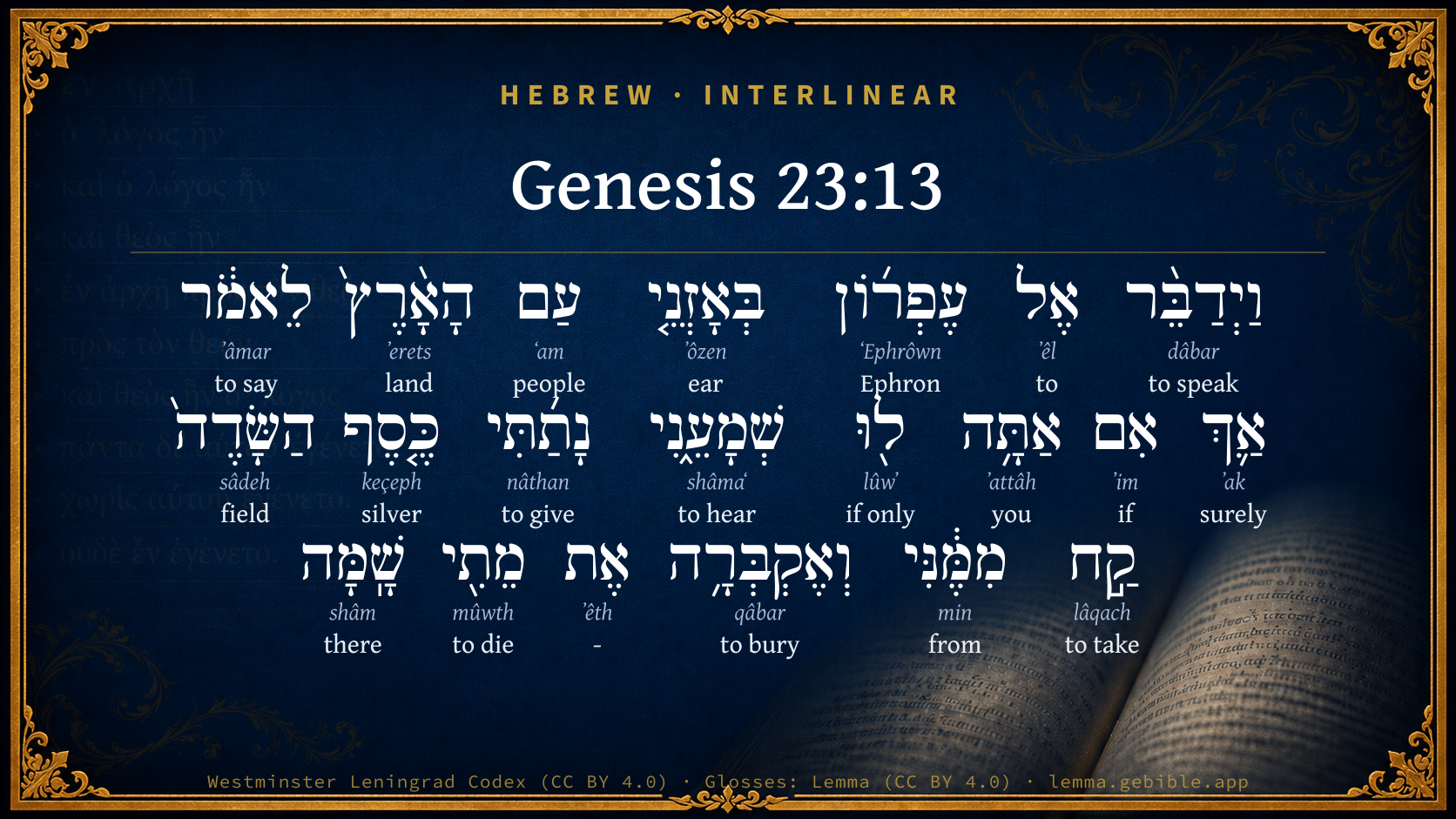
Hebrew (Westminster Leningrad Codex) Genesis 23:13 appears in the Hebrew Old Testament. The text above is from the Westminster Leningrad Codex. Each word links to its Strong’s number, a concise gloss, and parsing drawn from the Open Scriptures Hebrew Bible morphology. Click any word for its full Brown-Driver-Briggs (BDB) entry.
Download image
Cite this verse

Genesis 23:13 (World English Bible). Public Domain. Lemma interlinear Bible study tool, https://lemma.gebible.app/v/genesis/23/13.

Show BibTeX & RIS
BibTeX
RIS
English Translation
He spoke to Ephron in the audience of the people of the land, saying, "But if you will, please hear me. I will give the price of the field. Take it from me, and I will bury my dead there."
World English Bible · Public Domain
Download a study sheet

One document with this verse’s original text, its word-by-word gloss line, the meaning frame, cross-references with their text, attributed commentary, and full source and license credits — printable, and it pastes into notes with its structure intact.

This verse Autodidact and up

Study sheet (.html) Plain text (.txt)

A passage Seminary Student

Up to 50 verses in one chapter. A passage sheet keeps up to 6 commentary sources and 12 cross-references per verse, in the order this page ranks them, and says so on the sheet whenever that leaves anything out. Ask for a single verse and you get the Autodidact verse sheet above.

Everything on this page stays free to read, with no account — the sheet is a download of what is already on screen, not access to it.

Want to remove ads? Support Godless Engineer
Compare translations 3

The same verse in 3 English versions, stacked beneath the original-language interlinear above. Click any original word for its lexicon entry.

Each is an independent rendering of the whole verse — the interlinear is not word-aligned to these translations.

Highlighted words mark where these versions differ — a whole-verse word diff, not a word-by-word alignment.

  • World English Bible Public Domain
    He spoke to Ephron in the audience of the people of the land, saying, "But if you will, please hear me. I will give the price of the field. Take it from me, and I will bury my dead there."
  • King James Version Public Domain
    And he spake unto Ephron in the audience of the people of the land, saying, But if thou wilt give it, I pray thee, hear me: I will give thee money for the field; take it of me, and I will bury my dead there.
  • unfoldingWord Literal Text CC BY-SA 4.0
    and he spoke to Ephron in the ears of the people of the land, saying, “But if you would, please listen to me. I will give the price of the field. Take it from me, and I will bury my dead there.”

unfoldingWord Literal Text — © unfoldingWord, licensed CC BY-SA 4.0. Word-aligned USFM3 via Door43 (git.door43.org/unfoldingWord/en_ult).

Versions to compare (up to 4)

3 of 4 selected

Show all 18 translations

Every available English version of this verse, each an independent rendering of the whole verse.

  • World English Bible Public Domain
    He spoke to Ephron in the audience of the people of the land, saying, "But if you will, please hear me. I will give the price of the field. Take it from me, and I will bury my dead there."
  • Berean Standard Bible Public Domain
    and said to Ephron in their presence, “If you will please listen to me, I will pay you the price of the field. Accept it from me, so that I may bury my dead there.”
  • Majority Standard Bible Public Domain
    and said to Ephron in their presence, “If you will please listen to me, I will pay you the price of the field. Accept it from me, so that I may bury my dead there.”
  • King James Version Public Domain
    And he spake unto Ephron in the audience of the people of the land, saying, But if thou wilt give it, I pray thee, hear me: I will give thee money for the field; take it of me, and I will bury my dead there.
  • American Standard Version (1901) Public Domain
    And he spake unto Ephron in the audience of the people of the land, saying, But if thou wilt, I pray thee, hear me. I will give the price of the field. Take it of me, and I will bury my dead there.
  • Revised Version (1885) Public Domain
    And he spake unto Ephron in the audience of the people of the land, saying, But if thou wilt, I pray thee, hear me: I will give the price of the field; take it of me, and I will bury my dead there.
  • Geneva Bible (1599) Public Domain
    And spake vnto Ephron in the audience of the people of the countrey, saying, Seeing thou wilt giue it, I pray thee, heare me, I will giue the price of the fielde: receiue it of me, and I will bury my dead there.
  • Douay-Rheims (1899) Public Domain
    And he spoke to Ephron, in the presence of the people: I beseech thee to hear me: I will give money for the field: take it, and so I will bury my dead in it.
  • Young's Literal Translation Public Domain
    and speaketh unto Ephron in the ears of the people of the land, saying, `Only -- if thou wouldst hear me -- I have given the money of the field -- accept from me, and I bury my dead there.'
  • Literal Standard Version CC BY-SA 4.0
    and speaks to Ephron in the ears of the people of the land, saying, “Only—if you would hear me—I have given the money of the field—accept from me, and I bury my dead there.”
  • Unlocked Literal Bible CC BY-SA 4.0
    He spoke to Ephron in the hearing of the people of the land, saying, “But if you are willing, please hear me. I will pay for the field. Take the money from me, and I will bury my dead there.”
  • unfoldingWord Literal Text CC BY-SA 4.0
    and he spoke to Ephron in the ears of the people of the land, saying, “But if you would, please listen to me. I will give the price of the field. Take it from me, and I will bury my dead there.”
  • Darby Bible Public Domain
    and he spoke to Ephron, in the ears of the people of the land, saying, But if only thou wouldst listen to me, I give the money for the field: take [it] of me, and I will bury my dead there.
  • World Messianic Bible Public Domain
    He spoke to Ephron in the audience of the people of the land, saying, “But if you will, please hear me. I will give the price of the field. Take it from me, and I will bury my dead there.”
  • Webster's Bible Public Domain
    And he spoke to Ephron in the audience of the people of the land, saying, But if thou wilt give it, I pray thee, hear me: I will give thee money for the field: take it of me, and I will bury my dead there.
  • Free Bible Version CC BY-SA 4.0
    and said to Ephron so everyone could hear, “Please listen to me. I will pay the price for the field. Take the money and let me go and bury my dead there.”
  • Bible in Basic English Public Domain
    And Abraham said to Ephron, in the hearing of the people of the land, If only you will give ear to me, I will give you the price of the field; take it, and let me put my dead to rest there.
  • JPS Tanakh (1917) Public Domain
    And he spoke unto Ephron in the hearing of the people of the land, saying: 'But if thou wilt, I pray thee, hear me: I will give the price of the field; take it of me, and I will bury my dead there.'

Literal Standard Version (2020), Covenant Press — licensed CC BY-SA 4.0. Text via the HelloAO Bible API (eBible.org). Unlocked Literal Bible (unfoldingWord) — licensed CC BY-SA 4.0. Text via the HelloAO Bible API (eBible.org). unfoldingWord Literal Text — © unfoldingWord, licensed CC BY-SA 4.0. Word-aligned USFM3 via Door43 (git.door43.org/unfoldingWord/en_ult). Free Bible Version, Dr. Jonathan Gallagher — licensed CC BY-SA 4.0. Text via the HelloAO Bible API (eBible.org).

Word by word

More ways to search: Search by grammar → Find every occurrence → Compare this word →

Practice this passage: Drill this verse → Learn its vocabulary →

עֶפְר֜וֹן
ʻEphrôwn
H6085
“Ephron”
Noun, Proper
Part of Speech
Noun
Type
Proper
Full BDB Definition

Origin: from the same as H6081

TWOT: None

Ephron = "fawn-like" - a Hittite, son of Zohar and the one from whom Abraham bought the field and cave of Machpelah (noun proper masculine) - a city on the borders of Benjamin (noun proper locative) - a mountain on the northern border of Judah (noun proper locative)
  1. וַיְדַבֵּ֨ר dâbar H1696 “and · to speak” Conjunction + Verb, Piel, Sequential Imperfect, 3rd Person, Masculine, Singular
  2. אֶל ʼêl H413 “to” Preposition
  3. בְּאָזְנֵ֤י ʼôzen H241 “in/at · ears of” Preposition + Noun, Common, Feminine, Dual, Construct
  4. עַם ʻam H5971 “people of” Noun, Common, Masculine, Singular, Construct
  5. הָאָ֨רֶץ֙ ʼerets H776 “the · land” Particle, Definite Article + Noun, Common, Both, Singular, Absolute
  6. לֵאמֹ֔ר ʼâmar H559 “to say” Preposition + Verb, Qal, Infinitive Construct
  7. אַ֛ךְ ʼak H389 “surely” Particle, Accusative
  8. אִם ʼim H518 “if” Conjunction
  9. אַתָּ֥ה ʼattâh H859 “you” Pronoun, Personal, 2nd Person, Masculine, Singular
  10. ל֖וּ lûwʼ H3863 “if only” Conjunction
  11. שְׁמָעֵ֑נִי shâmaʻ H8085 “hear · me” Verb, Qal, Imperative, 2nd Person, Masculine, Singular + Suffix, Personal, 1st Person, Common, Singular
  12. נָתַ֜תִּי nâthan H5414 “to give” Verb, Qal, Perfect, 1st Person, Common, Singular
  13. כֶּ֤סֶף keçeph H3701 “silver of” Noun, Common, Masculine, Singular, Construct
  14. הַשָּׂדֶה֙ sâdeh H7704 “the · field” Particle, Definite Article + Noun, Common, Masculine, Singular, Absolute
  15. קַ֣ח lâqach H3947 “take” Verb, Qal, Imperative, 2nd Person, Masculine, Singular
  16. מִמֶּ֔נִּי min H4480 “from · me” Preposition + Suffix, Personal, 1st Person, Common, Singular
  17. וְאֶקְבְּרָ֥ה qâbar H6912 “and · to bury” Conjunction + Verb, Qal, Cohortative, 1st Person, Common, Singular
  18. אֶת ʼêth H853 “-” Particle, Direct Object
  19. מֵתִ֖י mûwth H4191 “dying · me” Verb, Qal, Participle Active, Masculine, Singular, Construct + Suffix, Personal, 1st Person, Common, Singular
  20. שָֽׁמָּה shâm H8033 “there · toward” Adverb + Suffix, Demonstrative

About this verse

These counts appear in no published source. They are computed here, from the morphology-tagged text and Lemma’s own curated glosses. What Lemma adds →

21
words
21
distinct lemmas
Pentateuch
section

Notable vocabulary

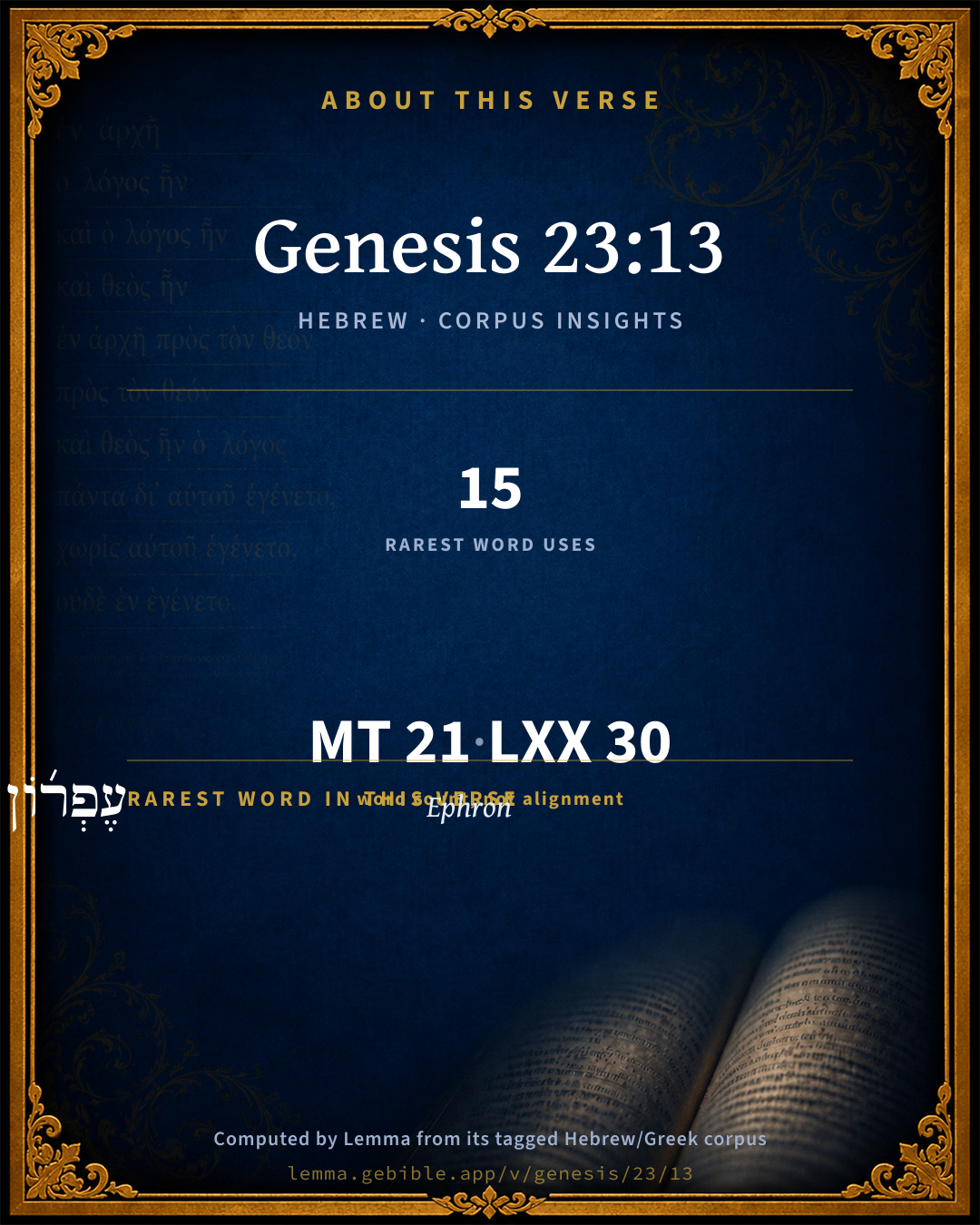
The rarest word here is עֶפְר֜וֹן Ephron H6085 — appearing just 15 times in the whole Hebrew Bible.

Shared distinctive vocabulary

עֶפְר֜וֹן Ephron H6085 occurs in 12 verses of the Hebrew Bible. Also found in:

Grammatical profile

  • 7 verbs
  • 6 nouns
  • 1 pronoun
  • 2 prepositions
  • 2 conjunctions
  • 1 adverb
  • 2 particles

Verb forms

  • וַיְדַבֵּ֨ר Piel · Sequential Imperfect
  • לֵאמֹ֔ר Qal · Infinitive Construct
  • שְׁמָעֵ֑נִי Qal · Imperative
  • נָתַ֜תִּי Qal · Perfect
  • קַ֣ח Qal · Imperative
  • וְאֶקְבְּרָ֥ה Qal · Cohortative
  • מֵתִ֖י Qal · Participle Active

Hebrew & Septuagint length

In English translation the verse runs 40 words from the Hebrew and 37 from the Septuagint (LXX English) — closely comparable.

A rough comparison of the two English renderings, which tokenize alike — not a word-level alignment.

Word counts can differ between the Hebrew and the Greek without any difference in meaning — e.g. the Hebrew direct-object marker אֵת has no separate Greek word, and Greek often adds the article ὁ.

In the original languages it is 21 Hebrew tokens and 30 Greek tokens — but the two are counted differently (Hebrew bundles its prefixes and suffixes into one token; the Greek is in lemma form), so that isn’t a like-for-like length.

Cross-references

7

Topical passages linked to Genesis 23:13 in the Treasury of Scripture Knowledge — connected by theme and wording, ordered by reader-vote popularity; previews shown in the World English Bible.

  • Romans 13:8 Owe no one anything, except to love one another; for he who loves his neighbor has fulfilled the law.
  • Genesis 14:22–23 Abram said to the king of Sodom, "I have lifted up my hand to Yahweh, God Most High, possessor of heaven and earth,
  • 2 Samuel 24:24 The king said to Araunah, No; but I will most assuredly buy it of you at a price. Neither will I offer burnt-offerings to Yahweh my God which cost me nothing. So David bought the threshing floor and the oxen for fifty shekels of silver.
  • Acts 20:35 In all things I gave you an example, that so laboring you ought to help the weak, and to remember the words of the Lord Jesus, that he himself said, 'It is more blessed to give than to receive.'"
  • Philippians 4:5–8 Let your gentleness be known to all men. The Lord is at hand.
  • Colossians 4:5 Walk in wisdom toward those who are outside, redeeming the time.
  • Hebrews 13:5 Be free from the love of money, content with such things as you have, for he has said, "I will in no way leave you, neither will I in any way forsake you."

Cross-references courtesy of OpenBible.info (CC BY 4.0).

Hebrew and Greek witnesses Masoretic Hebrew ↔ Greek Septuagint

The same verse in the two great witnesses to the Old Testament, shown verse-for-verse.

These are two independent witnesses, not word-aligned to each other, and the Septuagint is shown in lemma (dictionary) form.

Hebrew Genesis 23:13 Masoretic · Westminster Leningrad Codex

וַיְדַבֵּ֨ר אֶל עֶפְר֜וֹן בְּאָזְנֵ֤י עַם הָאָ֨רֶץ֙ לֵאמֹ֔ר אַ֛ךְ אִם אַתָּ֥ה ל֖וּ שְׁמָעֵ֑נִי נָתַ֜תִּי כֶּ֤סֶף הַשָּׂדֶה֙ קַ֣ח מִמֶּ֔נִּי וְאֶקְבְּרָ֥ה אֶת מֵתִ֖י שָֽׁמָּה

He spoke to Ephron in the audience of the people of the land, saying, "But if you will, please hear me. I will give the price of the field. Take it from me, and I will bury my dead there."

World English Bible · Public Domain

Greek LXX Genesis 23:13 Septuagint · lemma form

καί εἶπον ὁ εφρων εἰς ὁ οὖς ὁ λαός ὁ γῆ ἐπειδή πρός ἐγώ εἰμί ἀκούω ἐγώ ὁ ἀργύριον ὁ ἀγρός λαμβάνω παρά ἐγώ καί θάπτω ὁ νεκρός ἐγώ ἐκεῖ

And he said in the ears of Ephron before the people of the land, Since you are on my side, hear me; take the price of the field from me, and I will bury my dead there.

LXX2012 (modern English Septuagint) · Public Domain

Hebrew: Westminster Leningrad Codex (CC BY 4.0). Greek: Septuagint (public domain); English from LXX2012 (modern English Septuagint) (Public Domain). How the Septuagint differs from the Hebrew →

Targum (Aramaic paraphrase)

2

The Targum is the ancient Jewish Aramaic paraphrase of the Hebrew Scriptures — an interpretive translation, not the Hebrew text itself. Onkelos (literal) and Pseudo-Jonathan (expansive) render the Torah, and Jonathan the Prophets. Coverage is partial: where no permissively-licensed English translation exists for a verse, only the Aramaic is shown. This is verse-level text, not a word-by-word alignment to the Hebrew.

  1. Targum Onkelos Torah (Genesis–Deuteronomy)
    וּמַלֵּיל עִם עֶפְרוֹן קֳדָם עַמָּא דְאַרְעָא לְמֵימָר בְּרַם אִם אַתְּ עָבֵד לִי טִיבוּ קַבֵּל מִנִּי אֶתֵּן כַּסְפָּא דְמֵי חַקְלָא סַב מִנִּי וְאֶקְבַּר יָת מִיתִי תַּמָּן

    (no public-domain English translation for this verse)

    Targum Onkelos — Aramaic: “Onkelos Genesis” (public domain); “Onkelos Exodus” (public domain); “Onkelos Leviticus” (public domain); “Onkelos Numbers” (public domain); “Onkelos Deuteronomy” (public domain). English: “Sefaria Community Translation” (CC0 1.0 (public-domain dedication)); “J.W. Etheridge. The Targums of Onkelos and Jonathan Ben Uzziel on the Pentateuch. London: Longmans, Green, 1862” (public domain). Text via Sefaria.

  2. Targum Pseudo-Jonathan Torah (Genesis–Deuteronomy)
    וּמַלֵיל עִם עֶפְרוֹן בְּאַנְפֵּי עַמָא דְאַרְעָא לְמֵימַר בְּרַם אִם אַנְתְּ צָבֵי לְמֶעֱבַד לִי טִיבוּ קַבֵּל מִינִי אֶתֵּן כַּסְפָּא דְמֵי חַקְלָא סַב מִנִי וְאֶקְבּוֹר יַת מִיתִי תַּמָן

    And he spake with Ephron before the people of the land, saying, Nevertheless, if thou art willing to do me a favour, hear me: I will give thee in silver the price of the field; take (it) of me, and I will bury my dead there. And

    Targum Pseudo-Jonathan — Aramaic: “Targum Jonathan on Genesis” (public domain); “Targum Jonathan on Exodus” (public domain); “Targum Jonathan on Leviticus” (public domain); “Targum Jonathan on Numbers” (public domain); “Targum Jonathan on Deuteronomy” (public domain). English: “The Targum of Jonathan ben Uzziel, trans. J. W. Etheridge, London, 1862” (public domain). Text via Sefaria.

Commentary

Notes on Genesis 23:13 from classic Christian and Jewish commentators (each source and its license shown beneath its notes). The classic Christian expositions comment on the surrounding passage and are grouped to its opening verse, so a note may address several verses; the Jewish commentaries on the Tanakh (Rashi and others) are per-verse, so they appear only where the commentator wrote on this verse.

Lemma curates 59 commentaries, every one of them public domain or Creative Commons licensed, each selected and text-cleaned for this edition rather than reprinted as found. About our sources →

Trapp's Complete Commentary

John Trapp

Gen 23:13 And he spake unto Ephron in the audience of the people of the land, saying, But if thou [wilt give it], I pray thee, hear me: I will give thee money for the field; take [it] of me, and I will bury my dead there.

Ver. 13. I will give thee money.] Full money, as he had said, {Gen 23:7} or as much money as it is worth. Such is the care of the conscientious, that they had rather lose of their own, than usurp of another’s. And that he gives a just price for the field, was an act of great wisdom; for hereby he provided that his posterity might not hereafter be put beside it.

John Trapp, A Commentary or Exposition upon All the Books of the Old and New Testament (1647–1656) — public domain. Text from a community e-Sword module.

Joseph Benson's Commentary

Gen 23:13. I will give thee money — Abraham was rich in silver and gold, and therefore thought it unjust to take advantage of Ephron’s generosity. Perhaps, also, there may be weight in Le Clerc’s observation: “The orientals,” says he, “seem to have had the same notions about burying- places, which prevailed among the Greeks and Romans, namely, that it was ignominious to be buried in another person’s ground: and therefore every family, the poorer sort excepted, had a sepulchre of their own, in which they would not suffer others to be interred.”

Gen 23:15-16. Four hundred shekels of silver — A shekel is computed to be of about the value of two shillings and four pence farthing; so that the sum mentioned here amounted to about forty-six pounds of our money. What a noble and amiable pattern of a generous behaviour between friends, free from selfishness, have we in Abraham and Ephron! The one earnestly presses to give, while the other as generously declines to receive. Abraham weighed to Ephron the silver — For in those times money (or, more properly, silver or gold, for it was not coined) was paid by weight, (Gen 43:21; Jer 32:10,) and continued to be so till the Babylonish captivity.

Joseph Benson's Commentary on the Old and New Testaments (1811–1818) — public domain. Text from a community e-Sword module.

Adam Clarke's Commentary

Verse 13. If thou wilt give it] Instead of, if thou wilt give it, we should read, But if thou wilt sell it, I will give thee money for the field; כסף keseph, silver, not coined money, for it is not probable that any such was then in use.

Adam Clarke's Commentary on the Bible (1810–1826) — public domain. Text from a community e-Sword/MySword module.

Ellicott's Commentary for English Readers

(13) But if thou wilt give it, I pray thee, hear me.—Heb., But if thou wilt, I pray thee, hear me. It expresses simply a strong desire that Ephron will listen to and grant his next request.

A Bible Commentary for English Readers, edited by Charles John Ellicott (1878–1897) — public domain. Text from a community e-Sword module.

The Cambridge Bible for Schools and Colleges

gen. ed. J. J. S. Perowne

13. But if thou wilt] Abraham answers in short, broken sentences, acknowledging the generous offer, but insisting on the payment of the price. Here, however, he makes an offer for “the field,” not merely for “the cave in the end of the field”; cf. Gen_23:9. He politely declines to notice the suggestion of a gift, but offers to buy.

The Cambridge Bible for Schools and Colleges (gen. ed. J. J. S. Perowne; Cambridge University Press, 1878–1918) — public domain. Text from a community e-Sword module.

John Gill's Exposition

And Ephron answered Abraham, saying unto him. The following words:

And Ephron answered Abraham, saying unto him. The following words:

Genesis 23:15

gen 23:15

gen 23:15

gen 23:15My lord, hearken unto me,.... Since it is your mind to buy the field, and not receive it as a gift, then hear what I have to say as to the value of it:

the land is worth four hundred shekels of silver; which, reckoning a shekel at two shillings and sixpence, comes to fifty pounds of our money:

what is that betwixt thee and me? between two persons so rich, the sum was trifling and inconsiderable, whether the one paid it, and the other received it, or not; or between two such friends it was not worth speaking of, it was no matter whether it was paid or not: or else the sense is, between us both it is honestly worth so much; it is a good bargain, and must be owned to be so, what is it? the sum is so small, and it is so clearly the worth of it, that there needs no more to be said about it:

bury therefore thy dead: in it, and give thyself no more trouble and concern about it.

John Gill's Exposition of the Whole Bible (1746–1763) — public domain (CC PDM 1.0). Text via the HelloAO Bible API.

Matthew Poole's English Annotations

But if thou wilt give it; it is a short speech, and something must be supplied; either if thou wilt give or resign it to me; or, if thou be the man of whom I speak; for though Abraham knew his name, he might not know him by face, nor that he was then present. He prudently chose rather to buy it than to receive it as a gift, partly because it would be the surer to him and his, Gen 23:17,20, and partly because he would not have too great obligations to his pagan neighbours.

Matthew Poole's English Annotations on the Holy Bible (1683–1685) — public domain. Text from a community e-Sword/MySword module.

Whedon's Commentary on the Bible

Daniel D. Whedon

13. But if thou wilt — Hebrews, only if thou — would that thou wouldst hear me. There is a tender emotionality about his words. He is in no mood to parley long.

I will give thee money — Or, I have given thee money; that is, I have purposed in heart to buy the field for money; I will have it in no other way.

Daniel D. Whedon (gen. ed.), Commentary on the Old and New Testaments (1874–1909) — public domain. Text from a community e-Sword module.

John Wesley's Explanatory Notes

I will give thee money for the field - It was not in pride that Abraham refused the gift; but

1. In justice. Abraham was rich in silver and gold, and therefore would not take advantage of Ephron's generosity.

2. In prudence. He would pay for it, lest Ephron, when this good humour was over, should upbraid him with it.

John Wesley, Explanatory Notes Upon the Whole Bible (1754–1765) — public domain. Text via the GEBible commentary corpus.

Rashi

Rabbi Shlomo Yitzchaki (Rashi)

אך אם אתה לו שמעני BUT IF THOU WOULDST ONLY HEAR ME — You tell me to listen to you (verse 11) and to accept it without payment. I do not desire this:

BUT IF THOU WOULDST ONLY HEAR ME!—i.e. I only wish that you would listen to me and do as I ask.

נתתי I GIVE (perfect with present sense) old French donne; English I give. I have the money ready and I only wish that I had already given it to you.

Rashi on the Tanakh — English translations: “The Judaica Press complete Tanach with Rashi, translated by A. J. Rosenberg” (CC BY 4.0); “Pentateuch with Rashi's commentary by M. Rosenbaum and A.M. Silbermann, 1929-1934” (public domain); “The Metsudah Tanach series, Lakewood, N.J” (CC BY 4.0); and “The Book of Joshua, Metsudah Publications, 1997” (CC BY 4.0). Text via Sefaria.

Ramban (Nachmanides)

Rabbi Moshe ben Nachman (Ramban / Nachmanides)

‘LU’ (IF) THOU WILT HEAR ME. This is equivalent to saying, “If you, if you will hear me,” and the purport thereof is like, “if you, if you would hear me,” the redundancy being for the purpose of emphasizing the matter. Similar cases are found in these verses: Turn in, my lord, turn in to me; Art thou any better, better than Balak?, 11:25. And to speak against him, saying; And as for me, whither shall I go?; And I turned myself; And I saw myself;, Verse 13. Seeing all the congregation are all holy. All these are examples of expressions of synonimity. In my opinion, this is also the case in the verse, If from a thread even to a sandal tie, if I take (anything that is thine), which is equivalent to saying, “If, from a thread even to a sandal tie, I take anything that is yours.” It may be that [in the verse here before us the meaning is], “If you are as you have said.” that is, if you are speaking what is in your heart concerning the matter, and if you will listen to me and consummate the sale. A similar usage of a missing word is found in the verse, And their brethren said unto them, What are ye? [which means, “What are you saying?”] In my opinion, a similar case of such usage is the verse, Wherefore am I? [meaning, “Wherefore am I in the world?”] Perhaps this is the opinion of Onkelos who translated here, “if you will do me a favor,” meaning, “if you will do my will as you have said.”

Ramban (Nachmanides) on the Tanakh — English translation: “Commentary on the Torah by Ramban (Nachmanides). Translated and annotated by Charles B. Chavel. New York, Shilo Pub. House, 1971-1976” (CC BY 4.0). Text via Sefaria.

Radak

Rabbi David Kimhi (Radak)

וידבר...אך אם אתה לו שמעני, I wish you would have listened to what I said that

נתתי כסף השדה, I have already prepared the money for the field, if you’ll accept it you will be doing me a favour,

ואקברה, and I will proceed to bury, as the matter does not permit further delay.

Radak on the Tanakh — English translations: “Sefaria Community Translation” (CC0 1.0 (public-domain dedication)); “Eliyahu Munk, HaChut Hameshulash” (CC BY 4.0); “Rabbi Mike Feuer, Jerusalem Anthology” (CC BY 4.0); and “R. David Kimhi on the first book of Psalms, Translated by R.G. Finch, London, 1919” (public domain). Text via Sefaria.

Lesson kit

Teaching starters — assembled from the data on this page, not authored interpretation. Every prompt links to the verse data it draws on. Edit before teaching.

Genesis, in the Pentateuch, opens this verse with 21 words (21 distinct Hebrew lemmas). Its most distinctive word is ʻEphrôwn (“Ephron”). A historical commentator’s framing appears above. Read the whole chapter for the surrounding context.

Discussion questions

  1. What does “Ephron” (ʻEphrôwn) contribute to the verse as a whole?
  2. How does Genesis 23:8, which shares the word «Ephron», read alongside this verse?
  3. These translations render this verse differently. What is at stake in choosing one wording over another?
  4. «וַיְדַבֵּ֨ר» is a Piel Sequential Imperfect verb. How does that grammatical form shape the action described?
  5. Compare how Trapp's Complete Commentary and Joseph Benson's Commentary read this verse. Where do they agree or differ?

Things to notice

Reading settings

Reading text

Shown beneath each verse's original-language words.

Old Testament
Old Testament edition

Read the OT as the Masoretic Hebrew (MT) or the Greek Septuagint (LXX).

English shown for the Greek Septuagint (in the Hebrew ↔ Greek comparison).

Comparing translations? Open the Compare panel on any verse page to stack up to four side by side.