
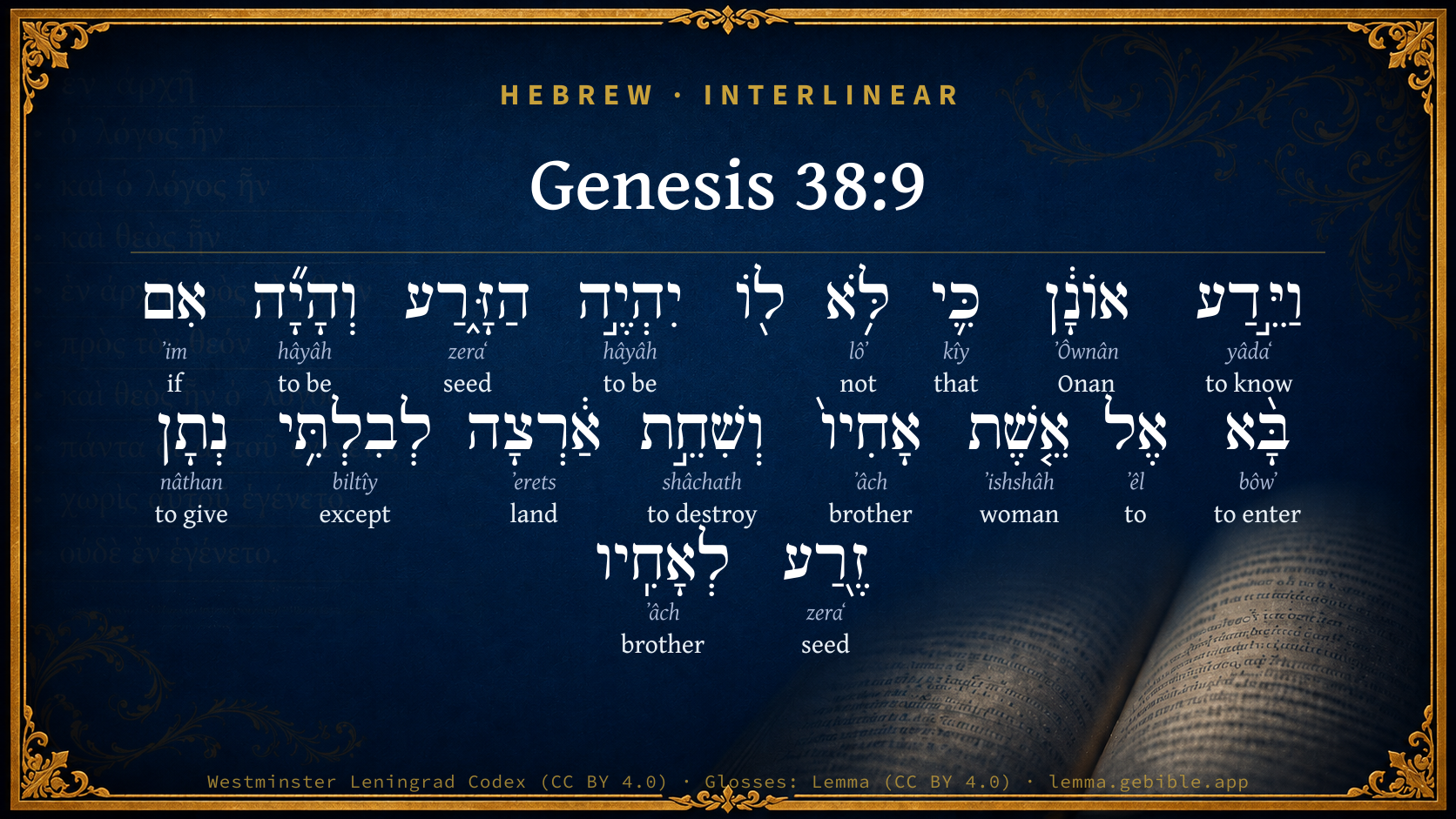
Genesis 38:9

Hebrew (Westminster Leningrad Codex) Genesis 38:9 appears in the Hebrew Old Testament. The text above is from the Westminster Leningrad Codex. Each word links to its Strong’s number, a concise gloss, and parsing drawn from the Open Scriptures Hebrew Bible morphology. Click any word for its full Brown-Driver-Briggs (BDB) entry.
Download image
Cite this verse

Genesis 38:9 (World English Bible). Public Domain. Lemma interlinear Bible study tool, https://lemma.gebible.app/v/genesis/38/9.

Show BibTeX & RIS
BibTeX
RIS
English Translation
Onan knew that the seed wouldn't be his; and it happened, when he went in to his brother's wife, that he spilled it on the ground, lest he should give seed to his brother.
World English Bible · Public Domain
Download a study sheet

One document with this verse’s original text, its word-by-word gloss line, the meaning frame, cross-references with their text, attributed commentary, and full source and license credits — printable, and it pastes into notes with its structure intact.

This verse Autodidact and up

Study sheet (.html) Plain text (.txt)

A passage Seminary Student

Up to 50 verses in one chapter. A passage sheet keeps up to 6 commentary sources and 12 cross-references per verse, in the order this page ranks them, and says so on the sheet whenever that leaves anything out. Ask for a single verse and you get the Autodidact verse sheet above.

Everything on this page stays free to read, with no account — the sheet is a download of what is already on screen, not access to it.

Want to remove ads? Support Godless Engineer
Compare translations 3

The same verse in 3 English versions, stacked beneath the original-language interlinear above. Click any original word for its lexicon entry.

Each is an independent rendering of the whole verse — the interlinear is not word-aligned to these translations.

Highlighted words mark where these versions differ — a whole-verse word diff, not a word-by-word alignment.

  • World English Bible Public Domain
    Onan knew that the seed wouldn't be his; and it happened, when he went in to his brother's wife, that he spilled it on the ground, lest he should give seed to his brother.
  • King James Version Public Domain
    And Onan knew that the seed should not be his; and it came to pass, when he went in unto his brother's wife, that he spilled it on the ground, lest that he should give seed to his brother.
  • unfoldingWord Literal Text CC BY-SA 4.0
    However, Onan knew that the offspring would not be his, so it happened when he went to the wife of his brother, then he spilled on the ground so that he would not give offspring to his brother.

unfoldingWord Literal Text — © unfoldingWord, licensed CC BY-SA 4.0. Word-aligned USFM3 via Door43 (git.door43.org/unfoldingWord/en_ult).

Versions to compare (up to 4)

3 of 4 selected

Show all 18 translations

Every available English version of this verse, each an independent rendering of the whole verse.

  • World English Bible Public Domain
    Onan knew that the seed wouldn't be his; and it happened, when he went in to his brother's wife, that he spilled it on the ground, lest he should give seed to his brother.
  • Berean Standard Bible Public Domain
    But Onan knew that the offspring would not belong to him; so whenever he would sleep with his brother’s wife, he would spill his seed on the ground so that he would not produce offspring for his brother.
  • Majority Standard Bible Public Domain
    But Onan knew that the offspring would not belong to him; so whenever he would sleep with his brother’s wife, he would spill his seed on the ground so that he would not produce offspring for his brother.
  • King James Version Public Domain
    And Onan knew that the seed should not be his; and it came to pass, when he went in unto his brother's wife, that he spilled it on the ground, lest that he should give seed to his brother.
  • American Standard Version (1901) Public Domain
    And Onan knew that the seed would not be his; and it came to pass, when he went in unto his brother's wife, that he spilled it on the ground, lest he should give seed to his brother.
  • Revised Version (1885) Public Domain
    And Onan knew that the seed should not be his; and it came to pass, when he went in unto his brother’s wife, that he spilled it on the ground, lest he should give seed to his brother.
  • Geneva Bible (1599) Public Domain
    And Onan knewe that the seede should not be his: therefore when he went in vnto his brothers wife, he spilled it on the grounde, least he should giue seede vnto his brother.
  • Douay-Rheims (1899) Public Domain
    He knowing that the children should not be his, when he went in to his brother's wife, spilled his seed upon the ground, lest children should be born in his brother's name.
  • Young's Literal Translation Public Domain
    and Onan knoweth that the seed is not `reckoned' his; and it hath come to pass, if he hath gone in unto his brother's wife, that he hath destroyed `it' to the earth, so as not to give seed to his brother;
  • Literal Standard Version CC BY-SA 4.0
    and Onan knows that the seed is not [reckoned] his; and it has come to pass, if he has gone in to his brother’s wife, that he has destroyed [it] to the earth, so as not to give seed to his brother;
  • Unlocked Literal Bible CC BY-SA 4.0
    Onan knew that the child would not be his. Whenever he slept with his brother's wife, he spilled the semen on the ground so he would not have a child for his brother.
  • unfoldingWord Literal Text CC BY-SA 4.0
    However, Onan knew that the offspring would not be his, so it happened when he went to the wife of his brother, then he spilled on the ground so that he would not give offspring to his brother.
  • Darby Bible Public Domain
    But when Onan knew that the seed should not be his own, it came to pass when he went in to his brother's wife, that he spilled [it] on the ground, in order to give no seed to his brother.
  • World Messianic Bible Public Domain
    Onan knew that the offspring wouldn’t be his; and when he went in to his brother’s wife, he spilled his semen on the ground, lest he should give offspring to his brother.
  • Webster's Bible Public Domain
    And Onan knew that the seed would not be his: and it came to pass, when he went in to his brother's wife, that he frustrated the purpose, lest he should give seed to his brother.
  • Free Bible Version CC BY-SA 4.0
    Onan realized that any children he had wouldn't be his own, so whenever he slept with his brother's wife he made sure she wouldn't become pregnant by withdrawing and spilling his semen on the ground. In this way he prevented any children being born on behalf of his brother.
  • Bible in Basic English Public Domain
    But Onan, seeing that the offspring would not be his, went in to his brother's wife, but let his seed go on to the earth, so that he might not get offspring for his brother.
  • JPS Tanakh (1917) Public Domain
    And Onan knew that the seed would not be his; and it came to pass when he went in unto his brother's wife, that he spilled it on the ground, lest he should give seed to his brother.

Literal Standard Version (2020), Covenant Press — licensed CC BY-SA 4.0. Text via the HelloAO Bible API (eBible.org). Unlocked Literal Bible (unfoldingWord) — licensed CC BY-SA 4.0. Text via the HelloAO Bible API (eBible.org). unfoldingWord Literal Text — © unfoldingWord, licensed CC BY-SA 4.0. Word-aligned USFM3 via Door43 (git.door43.org/unfoldingWord/en_ult). Free Bible Version, Dr. Jonathan Gallagher — licensed CC BY-SA 4.0. Text via the HelloAO Bible API (eBible.org).

Word by word

More ways to search: Search by grammar → Find every occurrence → Compare this word →

Practice this passage: Drill this verse → Learn its vocabulary →

אוֹנָ֔ן
ʼÔwnân
H209
“Onan”
Noun, Proper
Part of Speech
Noun
Type
Proper
Full BDB Definition

Origin: a variation of H207

TWOT: None

Onan = "strong" - second son of Judah, slain by God for not fulfilling the levitical requirement to beget a child with the wife of a dead, childless brother
  1. וַיֵּ֣דַע yâdaʻ H3045 “and · to know” Conjunction + Verb, Qal, Sequential Imperfect, 3rd Person, Masculine, Singular
  2. כִּ֛י kîy H3588 “that” Conjunction
  3. לֹּ֥א lôʼ H3808 “not” Particle, Negative
  4. יִהְיֶ֣ה hâyâh H1961 “to be” Verb, Qal, Imperfect, 3rd Person, Masculine, Singular
  5. הַזָּ֑רַע zeraʻ H2233 “the · seed” Particle, Definite Article + Noun, Common, Masculine, Singular, Absolute
  6. וְהָיָ֞ה hâyâh H1961 “and · to be” Conjunction + Verb, Qal, Perfect, 3rd Person, Masculine, Singular
  7. אִם ʼim H518 “if” Conjunction
  8. בָּ֨א bôwʼ H935 “to enter” Verb, Qal, Perfect, 3rd Person, Masculine, Singular
  9. אֶל ʼêl H413 “to” Preposition
  10. אֵ֤שֶׁת ʼishshâh H802 “woman of” Noun, Common, Feminine, Singular, Construct
  11. אָחִיו֙ ʼâch H251 “brother · his” Noun, Common, Masculine, Singular, Construct + Suffix, Personal, 3rd Person, Masculine, Singular
  12. וְשִׁחֵ֣ת shâchath H7843 “and · to destroy” Conjunction + Verb, Piel, Perfect, 3rd Person, Masculine, Singular
  13. אַ֔רְצָה ʼerets H776 “land · toward” Noun, Common, Both, Singular, Absolute + Suffix, Demonstrative
  14. לְבִלְתִּ֥י biltîy H1115 “to/for · except” Preposition + Conjunction
  15. נְתָן nâthan H5414 “to give” Verb, Qal, Infinitive Construct
  16. זֶ֖רַע zeraʻ H2233 “seed” Noun, Common, Masculine, Singular, Absolute
  17. לְאָחִֽיו ʼâch H251 “to/for · brother · his” Preposition + Noun, Common, Masculine, Singular, Construct + Suffix, Personal, 3rd Person, Masculine, Singular

About this verse

These counts appear in no published source. They are computed here, from the morphology-tagged text and Lemma’s own curated glosses. What Lemma adds →

19
words
15
distinct lemmas
Pentateuch
section

Notable vocabulary

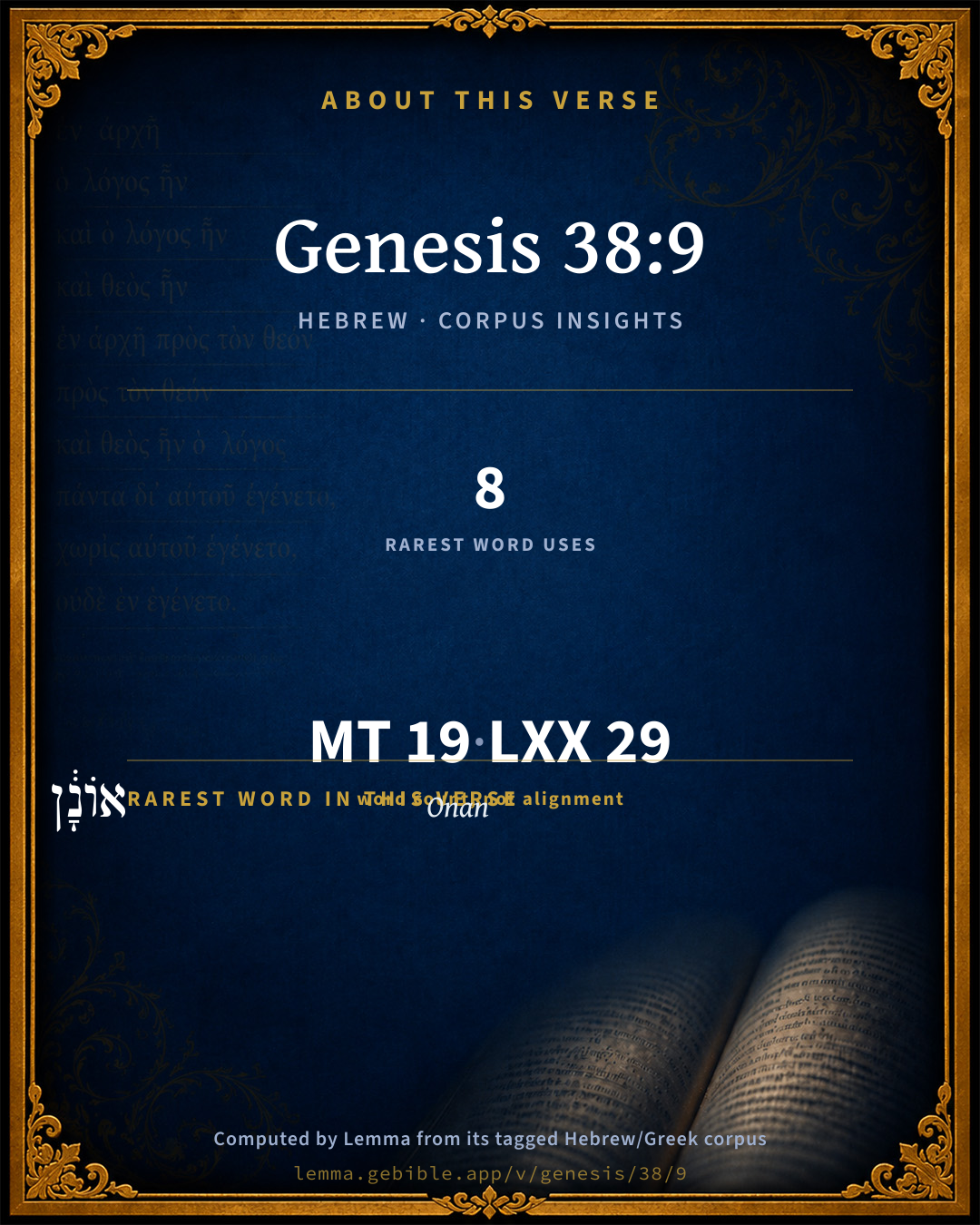
The rarest word here is אוֹנָ֔ן Onan H209 — appearing just 8 times in the whole Hebrew Bible.

Shared distinctive vocabulary

אוֹנָ֔ן Onan H209 occurs in 6 verses of the Hebrew Bible. Also found in:

Grammatical profile

  • 6 verbs
  • 7 nouns
  • 2 prepositions
  • 3 conjunctions
  • 1 particle

Verb forms

  • וַיֵּ֣דַע Qal · Sequential Imperfect
  • יִהְיֶ֣ה Qal · Imperfect
  • וְהָיָ֞ה Qal · Perfect
  • בָּ֨א Qal · Perfect
  • וְשִׁחֵ֣ת Piel · Perfect
  • נְתָן Qal · Infinitive Construct

Repetition

Words recur within this verse — often emphatic in Hebrew:

  • יִהְיֶ֣ה to be H1961 ×2
  • הַזָּ֑רַע seed H2233 ×2
  • אָחִיו֙ brother H251 ×2

Hebrew & Septuagint length

In English translation the verse runs 34 words from the Hebrew and 39 from the Septuagint (LXX English) — closely comparable.

A rough comparison of the two English renderings, which tokenize alike — not a word-level alignment.

Word counts can differ between the Hebrew and the Greek without any difference in meaning — e.g. the Hebrew direct-object marker אֵת has no separate Greek word, and Greek often adds the article ὁ.

In the original languages it is 19 Hebrew tokens and 29 Greek tokens — but the two are counted differently (Hebrew bundles its prefixes and suffixes into one token; the Greek is in lemma form), so that isn’t a like-for-like length.

Cross-references

9

Topical passages linked to Genesis 38:9 in the Treasury of Scripture Knowledge — connected by theme and wording, ordered by reader-vote popularity; previews shown in the World English Bible.

  • Deuteronomy 25:6 It shall be, that the firstborn whom she bears shall succeed in the name of his brother who is dead, that his name not be blotted out of Israel.
  • Titus 3:3 For we were also once foolish, disobedient, deceived, serving various lusts and pleasures, living in malice and envy, hateful, and hating one another.
  • James 3:16 For where jealousy and selfish ambition are, there is confusion and every evil deed.
  • James 4:5 Or do you think that the Scripture says in vain, "The Spirit who lives in us yearns jealously"?
  • Ruth 4:10 Moreover Ruth the Moabitess, the wife of Mahlon, have I purchased to be my wife, to raise up the name of the dead on his inheritance, that the name of the dead not be cut off from among his brothers, and from the gate of his place: you are witnesses this day.
  • Job 5:2 For resentment kills the foolish man, And jealousy kills the simple.
  • Proverbs 27:4 Wrath is cruel, And anger is overwhelming; But who is able to stand before jealousy?
  • James 3:14 But if you have bitter jealousy and selfish ambition in your heart, don't boast and don't lie against the truth.
  • Ruth 1:11 Naomi said, Turn again, my daughters: why will you go with me? have I yet sons in my womb, that they may be your husbands?

Cross-references courtesy of OpenBible.info (CC BY 4.0).

Hebrew and Greek witnesses Masoretic Hebrew ↔ Greek Septuagint

The same verse in the two great witnesses to the Old Testament, shown verse-for-verse.

These are two independent witnesses, not word-aligned to each other, and the Septuagint is shown in lemma (dictionary) form.

Hebrew Genesis 38:9 Masoretic · Westminster Leningrad Codex

וַיֵּ֣דַע אוֹנָ֔ן כִּ֛י לֹּ֥א ל֖וֹ יִהְיֶ֣ה הַזָּ֑רַע וְהָיָ֞ה אִם בָּ֨א אֶל אֵ֤שֶׁת אָחִיו֙ וְשִׁחֵ֣ת אַ֔רְצָה לְבִלְתִּ֥י נְתָן זֶ֖רַע לְאָחִֽיו

Onan knew that the seed wouldn't be his; and it happened, when he went in to his brother's wife, that he spilled it on the ground, lest he should give seed to his brother.

World English Bible · Public Domain

Greek LXX Genesis 38:9 Septuagint · lemma form

γιγνώσκω δέ αυναν ὅτι οὐ αὐτός εἰμί ὁ σπέρμα γίγνομαι ὅταν εἰςἄρχω πρός ὁ γυνή ὁ ἀδελφός αὐτός ἐκχέω ἐπί ὁ γῆ ὁ μή δίδωμι σπέρμα ὁ ἀδελφός αὐτός

And Aunan, knowing that the seed should not be his—it came to pass when he went in to his brother's wife, that he spilled it upon the ground, so that he should not give seed to his brother's wife.

LXX2012 (modern English Septuagint) · Public Domain

Hebrew: Westminster Leningrad Codex (CC BY 4.0). Greek: Septuagint (public domain); English from LXX2012 (modern English Septuagint) (Public Domain). How the Septuagint differs from the Hebrew →

Targum (Aramaic paraphrase)

2

The Targum is the ancient Jewish Aramaic paraphrase of the Hebrew Scriptures — an interpretive translation, not the Hebrew text itself. Onkelos (literal) and Pseudo-Jonathan (expansive) render the Torah, and Jonathan the Prophets. Coverage is partial: where no permissively-licensed English translation exists for a verse, only the Aramaic is shown. This is verse-level text, not a word-by-word alignment to the Hebrew.

  1. Targum Onkelos Torah (Genesis–Deuteronomy)
    וִידַע אוֹנָן אֲרֵי לָא עַל שְׁמֵהּ מִתְקְרֵי זַרְעָא וַהֲוָה כַּד עָלֵיל לְוַת אִתַּת אֲחוּהִי וּמְחַבֵּל אָרְחֵהּ עַל אַרְעָא בְּדִיל דְּלָא לְקַיָּמָא זַרְעָא לַאֲחוּהִי

    (no public-domain English translation for this verse)

    Targum Onkelos — Aramaic: “Onkelos Genesis” (public domain); “Onkelos Exodus” (public domain); “Onkelos Leviticus” (public domain); “Onkelos Numbers” (public domain); “Onkelos Deuteronomy” (public domain). English: “Sefaria Community Translation” (CC0 1.0 (public-domain dedication)); “J.W. Etheridge. The Targums of Onkelos and Jonathan Ben Uzziel on the Pentateuch. London: Longmans, Green, 1862” (public domain). Text via Sefaria.

  2. Targum Pseudo-Jonathan Torah (Genesis–Deuteronomy)
    וִידַע אוֹנָן אֲרוּם לָא עַל שְׁמֵיהּ אִיקְרוֹן בְּנִין וַהֲוָה כַּד הֲוָה עָלֵיל לְוַת אִנְתְּתֵיהּ דְאָחוֹי הֲוָה מִחַבֵּל עוֹבְדוֹי עַל אַרְעָא דְלָא לְמִקְמָה בְּנִין עַל שְׁמֵיהּ דְאָחוֹי

    And Onan knew that they would not call the children after his name, and it was, when he entered to the wife of his brother, that he corrupted his work upon the earth, that he might not raise up children to his brother's name.

    Targum Pseudo-Jonathan — Aramaic: “Targum Jonathan on Genesis” (public domain); “Targum Jonathan on Exodus” (public domain); “Targum Jonathan on Leviticus” (public domain); “Targum Jonathan on Numbers” (public domain); “Targum Jonathan on Deuteronomy” (public domain). English: “The Targum of Jonathan ben Uzziel, trans. J. W. Etheridge, London, 1862” (public domain). Text via Sefaria.

Commentary

Notes on Genesis 38:9 from classic Christian and Jewish commentators (each source and its license shown beneath its notes). The classic Christian expositions comment on the surrounding passage and are grouped to its opening verse, so a note may address several verses; the Jewish commentaries on the Tanakh (Rashi and others) are per-verse, so they appear only where the commentator wrote on this verse.

Lemma curates 59 commentaries, every one of them public domain or Creative Commons licensed, each selected and text-cleaned for this edition rather than reprinted as found. About our sources →

Trapp's Complete Commentary

John Trapp

Gen 38:9 And Onan knew that the seed should not be his; and it came to pass, when he went in unto his brother’s wife, that he spilled [it] on the ground, lest that he should give seed to his brother.

Ver. 9. When he went in unto his brother’s wife.] God, for the respect he bears to his own institution of marriage, is pleased to bear with, cover, and not impute many frailties, follies, vanities, wickednesses that are found between man and wife. Howbeit, there is required of such a holy care and conscience, to preserve between themselves, by a conjugal chastity, the marriage bed undefiled; taking heed of an intemperate or intempestive use of it: which by divines, {a} both ancient and modern, is deemed no better than plain adultery before God. Qui cum uxore sua, quasi eum aliena, concumbit, adulter est, saith that heathen. {b} Onan’s sin here was self-pollution, aggravated much by his envy that moved him to it, expressed in these words, "lest he should give seed to his deceased brother." And the more sinful was this sin of his in spilling his seed; because it should have served for the propagation of the Messiah; therefore the Lord slew him: as also, because he was not warned by his brother’s punishment. {c}

{a} Intemperans in coniugio, uxoris suae adulter est. - Aug. In uxorem alienam omnis amor turpis est, in suam vero nimius. - Hieron.

{b} Seneca.

{c} Hebraei inquiunt perinde ut homicidam, reum esse qui temere semen profundit. - Mercer., in loc.

John Trapp, A Commentary or Exposition upon All the Books of the Old and New Testament (1647–1656) — public domain. Text from a community e-Sword module.

Tyndale Open Study Notes

Tyndale Open Resources

38:9-10 Onan married Tamar, but was not willing to provide an heir for his brother. He would have sex with Tamar but not fulfill his responsibility to his dead brother (38:8).

Tyndale Open Study Notes — © Tyndale Open Resources, licensed CC BY-SA 4.0. Text via the HelloAO Bible API.

Adam Clarke's Commentary

Verse 9. Onan knew that the seed should not be his] That is, that the child begotten of his brother's widow should be reckoned as the child of his deceased brother, and his name, though the real father of it, should not appear in the genealogical tables.

Adam Clarke's Commentary on the Bible (1810–1826) — public domain. Text from a community e-Sword/MySword module.

John Gill's Exposition

And the thing which he did displeased the Lord,.... Being done out of envy to his brother, and through want of affection to the memory of his name; and it may be out of covetousness to get his estate into his own hands, and especially as it frustrated the end of such an usage of marrying a brother's wife; which appears to be according to the will of God, since it afterwards became a known law of his; and it was the more displeasing, as it was not only a check upon the multiplication of Abraham's seed as promised, but since the Messiah was to come from Judah. This was doing all to hinder it that lay in his power:

wherefore he slew him also; in like manner as he had slain his brother, Gen 38:7.

John Gill's Exposition of the Whole Bible (1746–1763) — public domain (CC PDM 1.0). Text via the HelloAO Bible API.

Matthew Poole's English Annotations

Two things are here noted:

1. The sin itself, which is here particularly described by the Holy Ghost, that men might be instructed concerning the nature and the great evil of this sin of self-pollution, which is such that it brought upon the actor of it the extraordinary vengeance of God, and which is condemned not only by Scripture, but even by the light of nature, and the judgment of heathens, who have expressly censured it as a great sin, and as a kind of murder. Of which see my Latin Synopsis. Whereby we may sufficiently understand how wicked and abominable a practice this is amongst Christians, and in the light of the gospel, which lays greater and stricter obligations upon us to purity, and severely forbids all pollution both of flesh and spirit.

2. The cause of this wickedness; which seems to have been either hatred of his brother, or envy at his brother’s name and honour, springing from the pride of his own heart.

Matthew Poole's English Annotations on the Holy Bible (1683–1685) — public domain. Text from a community e-Sword/MySword module.

The Pulpit Commentary

Vers. 9, 10. And Onan knew that the seed should not be his; and it came to pass, when literally, and it was if, i.e. whenever (cf. Ewald, Hebrews Synt., he went in unto his brother"s wife, that he spilled it on the ground (literally, destroyed to the ground), lest that he should (or, so as not to) give seed to his brother. And the thing which he did displeased (literally, was evil in the eyes of) the Lord: the word Jehovah is employed not because the writer was a late interpolator, but because the sin of Onan was an offence against the sanctity and prosperity of the theocratic family (Hengstenberg)wherefore he (i.e. Jehovah) slew him also (vide supra).

The Pulpit Commentary (1880–1919), ed. H.D.M. Spence-Jones & Joseph S. Exell — public domain. Text from a community e-Sword module.

Radak

Rabbi David Kimhi (Radak)

וידע אונן, he realised this only when his father said to him that it was his task to see that his brother’s seed would be perpetuated. ושחת ארצה, he ejaculated outside her vagina, just as we explained in connection with Er.

Radak on the Tanakh — English translations: “Sefaria Community Translation” (CC0 1.0 (public-domain dedication)); “Eliyahu Munk, HaChut Hameshulash” (CC BY 4.0); “Rabbi Mike Feuer, Jerusalem Anthology” (CC BY 4.0); and “R. David Kimhi on the first book of Psalms, Translated by R.G. Finch, London, 1919” (public domain). Text via Sefaria.

Lesson kit

Teaching starters — assembled from the data on this page, not authored interpretation. Every prompt links to the verse data it draws on. Edit before teaching.

Genesis, in the Pentateuch, opens this verse with 19 words (15 distinct Hebrew lemmas). Its most distinctive word is ʼÔwnân (“Onan”). A historical commentator’s framing appears above. Read the whole chapter for the surrounding context.

Discussion questions

  1. The word ʼÔwnân carries the sense “Onan.” How does it shape the verse?
  2. Genesis 38:4 shares the word «Onan» with this verse. How do the two illuminate each other?
  3. “to be” occurs 2× in this one verse. What is the effect of the repetition?
  4. These translations render this verse differently. What is at stake in choosing one wording over another?
  5. The verb «וַיֵּ֣דַע» is Qal Sequential Imperfect. How does its form color the action?
  6. Reading how Trapp's Complete Commentary and Tyndale Open Study Notes read this verse, where do the two commentators agree and where do they part?

Things to notice

Reading settings

Reading text

Shown beneath each verse's original-language words.

Old Testament
Old Testament edition

Read the OT as the Masoretic Hebrew (MT) or the Greek Septuagint (LXX).

English shown for the Greek Septuagint (in the Hebrew ↔ Greek comparison).

Comparing translations? Open the Compare panel on any verse page to stack up to four side by side.