
Exodus 11:3

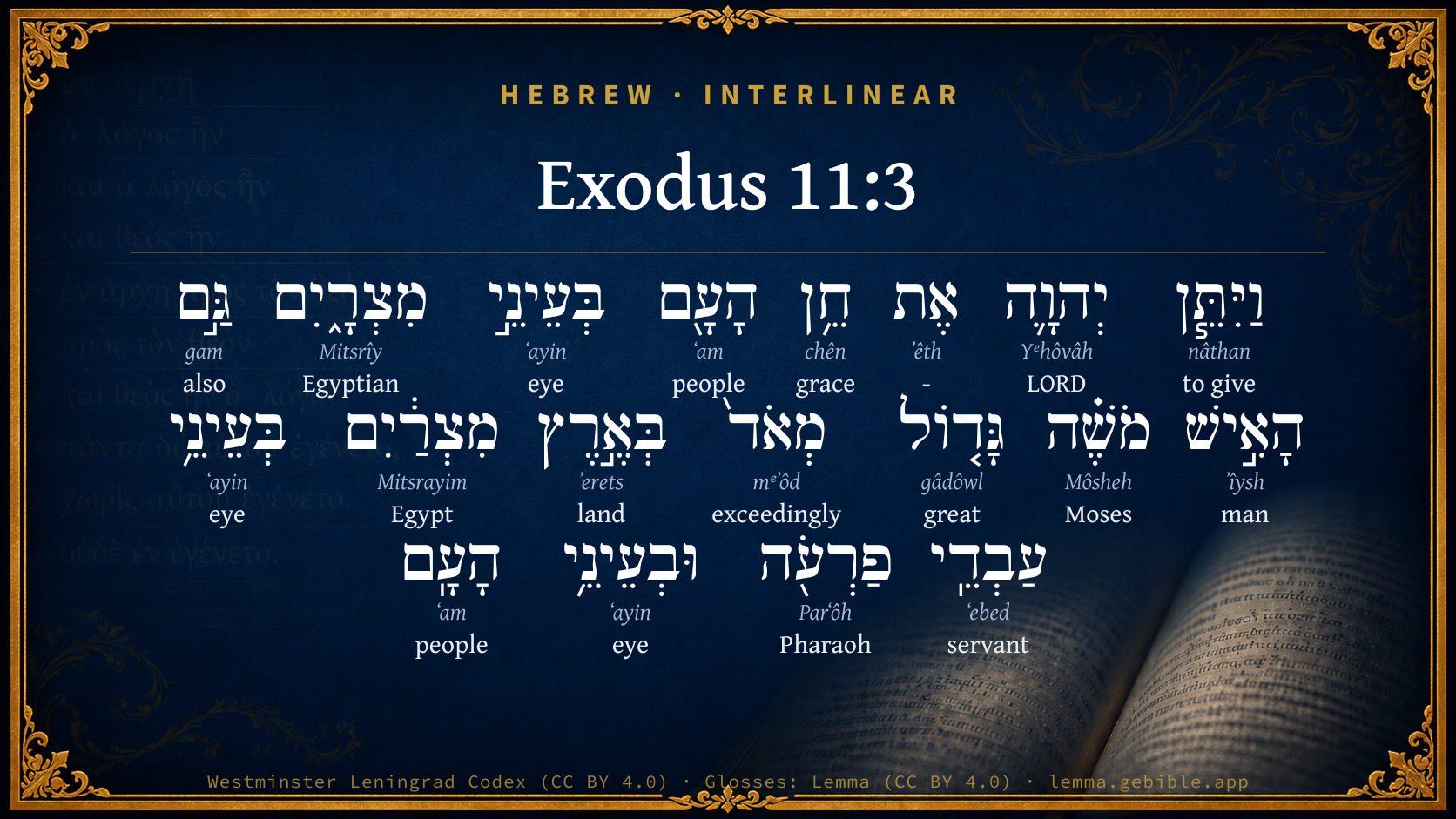
Hebrew (Westminster Leningrad Codex) Exodus 11:3 appears in the Hebrew Old Testament. The text above is from the Westminster Leningrad Codex. Each word links to its Strong’s number, a concise gloss, and parsing drawn from the Open Scriptures Hebrew Bible morphology. Click any word for its full Brown-Driver-Briggs (BDB) entry.
Download image
Cite this verse

Exodus 11:3 (World English Bible). Public Domain. Lemma interlinear Bible study tool, https://lemma.gebible.app/v/exodus/11/3.

Show BibTeX & RIS
BibTeX
RIS
English Translation
Yahweh gave the people favor in the sight of the Egyptians. Moreover the man Moses was very great in the land of Egypt, in the sight of Pharaoh's servants, and in the sight of the people.
World English Bible · Public Domain
Download a study sheet

One document with this verse’s original text, its word-by-word gloss line, the meaning frame, cross-references with their text, attributed commentary, and full source and license credits — printable, and it pastes into notes with its structure intact.

This verse Autodidact and up

Study sheet (.html) Plain text (.txt)

A passage Seminary Student

Up to 50 verses in one chapter. A passage sheet keeps up to 6 commentary sources and 12 cross-references per verse, in the order this page ranks them, and says so on the sheet whenever that leaves anything out. Ask for a single verse and you get the Autodidact verse sheet above.

Everything on this page stays free to read, with no account — the sheet is a download of what is already on screen, not access to it.

Want to remove ads? Support Godless Engineer
Compare translations 3

The same verse in 3 English versions, stacked beneath the original-language interlinear above. Click any original word for its lexicon entry.

Each is an independent rendering of the whole verse — the interlinear is not word-aligned to these translations.

Highlighted words mark where these versions differ — a whole-verse word diff, not a word-by-word alignment.

  • World English Bible Public Domain
    Yahweh gave the people favor in the sight of the Egyptians. Moreover the man Moses was very great in the land of Egypt, in the sight of Pharaoh's servants, and in the sight of the people.
  • King James Version Public Domain
    And the LORD gave the people favor in the sight of the Egyptians. Moreover the man Moses was very great in the land of Egypt, in the sight of Pharaoh's servants, and in the sight of the people.
  • unfoldingWord Literal Text CC BY-SA 4.0
    And Yahweh gave the people favor in the eyes of the Egyptians. Furthermore, the man Moses was very great in the land of Egypt, in the eyes of the servants of Pharaoh and in the eyes of the people.

unfoldingWord Literal Text — © unfoldingWord, licensed CC BY-SA 4.0. Word-aligned USFM3 via Door43 (git.door43.org/unfoldingWord/en_ult).

Versions to compare (up to 4)

3 of 4 selected

Show all 18 translations

Every available English version of this verse, each an independent rendering of the whole verse.

  • World English Bible Public Domain
    Yahweh gave the people favor in the sight of the Egyptians. Moreover the man Moses was very great in the land of Egypt, in the sight of Pharaoh's servants, and in the sight of the people.
  • Berean Standard Bible Public Domain
    And the LORD gave the people favor in the sight of the Egyptians. Moreover, Moses himself was highly regarded in Egypt by Pharaoh’s officials and by the people.
  • Majority Standard Bible Public Domain
    And the LORD gave the people favor in the sight of the Egyptians. Moreover, Moses himself was highly regarded in Egypt by Pharaoh’s officials and by the people.
  • King James Version Public Domain
    And the LORD gave the people favor in the sight of the Egyptians. Moreover the man Moses was very great in the land of Egypt, in the sight of Pharaoh's servants, and in the sight of the people.
  • American Standard Version (1901) Public Domain
    And Jehovah gave the people favor in the sight of the Egyptians. Moreover the man Moses was very great in the land of Egypt, in the sight of Pharaoh's servants, and in the sight of the people.
  • Revised Version (1885) Public Domain
    And the LORD gave the people favour in the sight of the Egyptians. Moreover the man Moses was very great in the land of Egypt, in the sight of Pharaoh’s servants, and in the sight of the people.
  • Geneva Bible (1599) Public Domain
    And the Lord gaue the people fauour in the sight of the Egyptians: also Moses was very great in the land of Egypt, in the sight of Pharaohs seruantes, and in the sight of the people.)
  • Douay-Rheims (1899) Public Domain
    And the Lord will give favour to his people in the sight of the Egyptians. And Moses was a very great man in the land of Egypt, in the sight of Pharao's servants, and of all the people.
  • Young's Literal Translation Public Domain
    And Jehovah giveth the grace of the people in the eyes of the Egyptians; also the man Moses `is' very great in the land of Egypt, in the eyes of the servants of Pharaoh, and in the eyes of the people.
  • Literal Standard Version CC BY-SA 4.0
    And YHWH gives the grace of the people in the eyes of the Egyptians; also the man Moses [is] very great in the land of Egypt, in the eyes of the servants of Pharaoh, and in the eyes of the people.
  • Unlocked Literal Bible CC BY-SA 4.0
    Now Yahweh had made the Egyptians eager to please the Israelites. Moreover, the man Moses was very impressive in the sight of Pharaoh's servants and the people of Egypt.
  • unfoldingWord Literal Text CC BY-SA 4.0
    And Yahweh gave the people favor in the eyes of the Egyptians. Furthermore, the man Moses was very great in the land of Egypt, in the eyes of the servants of Pharaoh and in the eyes of the people.
  • Darby Bible Public Domain
    And Jehovah gave the people favour in the eyes of the Egyptians. Moreover the man Moses was very great in the land of Egypt -- in the eyes of Pharaoh's bondmen, and in the eyes of the people.
  • World Messianic Bible Public Domain
    The LORD gave the people favor in the sight of the Egyptians. Moreover, the man Moses was very great in the land of Egypt, in the sight of Pharaoh’s servants, and in the sight of the people.
  • Webster's Bible Public Domain
    And the LORD gave the people favor in the sight of the Egyptians. Moreover, the man Moses was very great in the land of Egypt, in the sight of Pharaoh's servants, and in the sight of the people.
  • Free Bible Version CC BY-SA 4.0
    The Lord made the Egyptians look favorably on the Israelites. In fact, Moses himself was highly respected in Egypt by both Pharaoh's officials and the ordinary people.
  • Bible in Basic English Public Domain
    And the Lord gave the people grace in the eyes of the Egyptians. For the man Moses was highly honoured in the land of Egypt, by Pharaoh's servants and the people.
  • JPS Tanakh (1917) Public Domain
    And the LORD gave the people favour in the sight of the Egyptians. Moreover the man Moses was very great in the land of Egypt, in the sight of Pharaoh's servants, and in the sight of the people.

Literal Standard Version (2020), Covenant Press — licensed CC BY-SA 4.0. Text via the HelloAO Bible API (eBible.org). Unlocked Literal Bible (unfoldingWord) — licensed CC BY-SA 4.0. Text via the HelloAO Bible API (eBible.org). unfoldingWord Literal Text — © unfoldingWord, licensed CC BY-SA 4.0. Word-aligned USFM3 via Door43 (git.door43.org/unfoldingWord/en_ult). Free Bible Version, Dr. Jonathan Gallagher — licensed CC BY-SA 4.0. Text via the HelloAO Bible API (eBible.org).

Word by word

More ways to search: Search by grammar → Find every occurrence → Compare this word →

Practice this passage: Drill this verse → Learn its vocabulary →

חֵ֥ן
chên
H2580
“grace of”
Noun, Common, Masculine, Singular, Construct
Part of Speech
Noun
Type
Common
Gender
Masculine
Number
Singular
State
Construct
Full BDB Definition

Origin: from H2603

TWOT: TWOT- 694a

favour, grace, charm - favour, grace, elegance - favour, acceptance
  1. וַיִּתֵּ֧ן nâthan H5414 “and · to give” Conjunction + Verb, Qal, Sequential Imperfect, 3rd Person, Masculine, Singular
  2. יְהוָ֛ה Yᵉhôvâh H3068 “LORD” Noun, Proper
  3. אֶת ʼêth H853 “-” Particle, Direct Object
  4. הָעָ֖ם ʻam H5971 “the · people” Particle, Definite Article + Noun, Common, Masculine, Singular, Absolute
  5. בְּעֵינֵ֣י ʻayin H5869 “in/at · eyes of” Preposition + Noun, Common, Both, Dual, Construct
  6. מִצְרָ֑יִם Mitsrîy H4713 “Egyptian” Noun, Proper
  7. גַּ֣ם gam H1571 “also” Particle, Accusative
  8. הָאִ֣ישׁ ʼîysh H376 “the · man” Particle, Definite Article + Noun, Common, Masculine, Singular, Absolute
  9. מֹשֶׁ֗ה Môsheh H4872 “Moses” Noun, Proper
  10. גָּד֤וֹל gâdôwl H1419 “great” Adjective, Adjective, Masculine, Singular, Absolute
  11. מְאֹד֙ mᵉʼôd H3966 “exceedingly” Adverb
  12. בְּאֶ֣רֶץ ʼerets H776 “in/at · land of” Preposition + Noun, Common, Both, Singular, Construct
  13. מִצְרַ֔יִם Mitsrayim H4714 “Egypt” Noun, Proper
  14. בְּעֵינֵ֥י ʻayin H5869 “in/at · eyes of” Preposition + Noun, Common, Both, Dual, Construct
  15. עַבְדֵֽי ʻebed H5650 “servants of” Noun, Common, Masculine, Plural, Construct
  16. פַרְעֹ֖ה Parʻôh H6547 “Pharaoh” Noun, Proper
  17. וּבְעֵינֵ֥י ʻayin H5869 “and · in/at · eyes of” Conjunction + Preposition + Noun, Common, Both, Dual, Construct
  18. הָעָֽם ʻam H5971 “the · people” Particle, Definite Article + Noun, Common, Masculine, Singular, Absolute

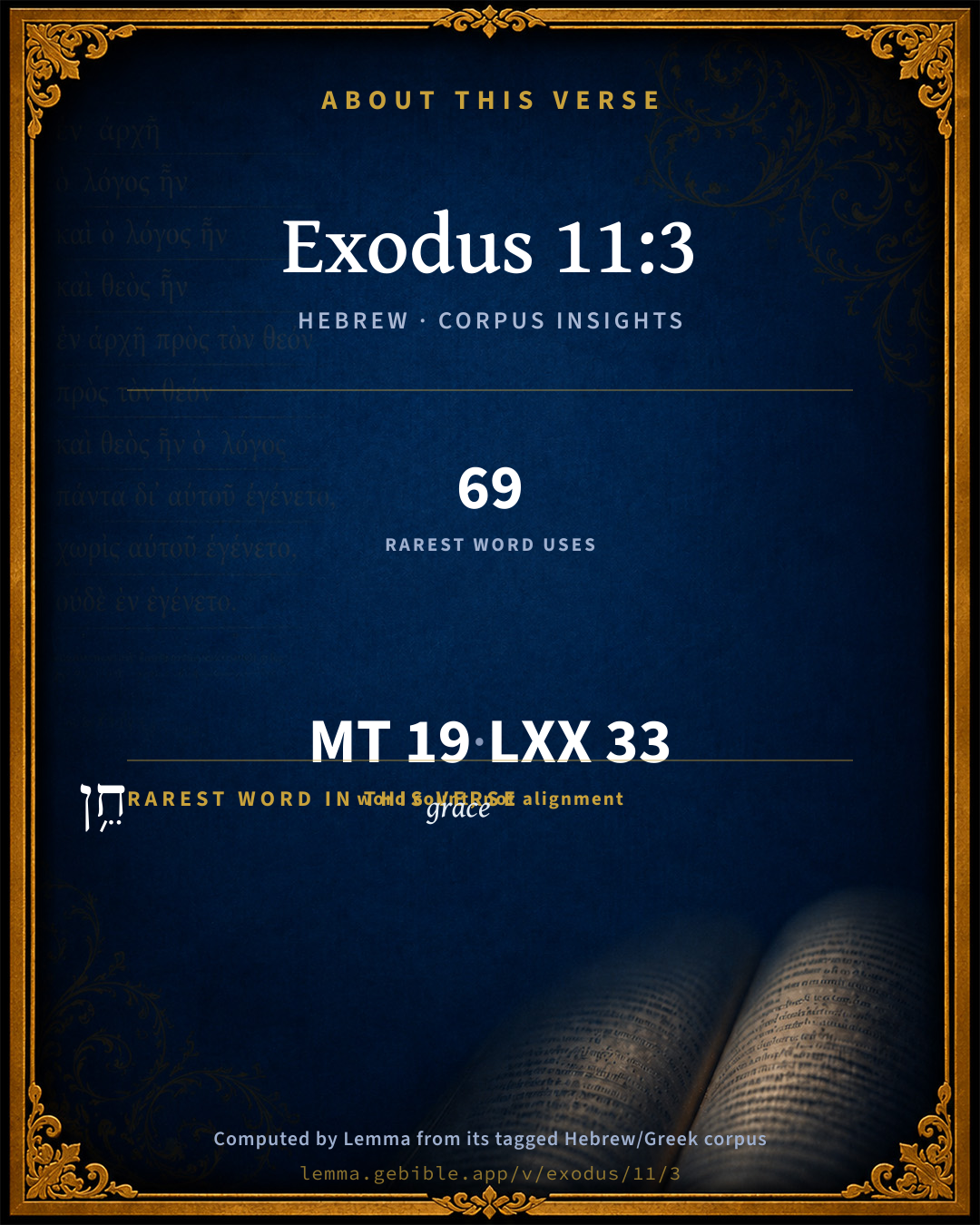
About this verse

These counts appear in no published source. They are computed here, from the morphology-tagged text and Lemma’s own curated glosses. What Lemma adds →

19
words
16
distinct lemmas
Pentateuch
section

Grammatical profile

  • 1 verb
  • 14 nouns
  • 1 adjective
  • 1 adverb
  • 2 particles

Verb forms

  • וַיִּתֵּ֧ן Qal · Sequential Imperfect

Repetition

Words recur within this verse — often emphatic in Hebrew:

  • בְּעֵינֵ֣י eye H5869 ×3
  • הָעָ֖ם people H5971 ×2

Hebrew & Septuagint length

In English translation the verse runs 36 words from the Hebrew and 35 from the Septuagint (LXX English) — closely comparable.

A rough comparison of the two English renderings, which tokenize alike — not a word-level alignment.

Word counts can differ between the Hebrew and the Greek without any difference in meaning — e.g. the Hebrew direct-object marker אֵת has no separate Greek word, and Greek often adds the article ὁ.

In the original languages it is 19 Hebrew tokens and 33 Greek tokens — but the two are counted differently (Hebrew bundles its prefixes and suffixes into one token; the Greek is in lemma form), so that isn’t a like-for-like length.

Cross-references

11

Topical passages linked to Exodus 11:3 in the Treasury of Scripture Knowledge — connected by theme and wording, ordered by reader-vote popularity; previews shown in the World English Bible.

  • Exodus 3:21 I will give this people favor in the sight of the Egyptians, and it will happen that when you go, you shall not go empty-handed.
  • Exodus 12:36 Yahweh gave the people favor in the sight of the Egyptians, so that they let them have what they asked. They despoiled the Egyptians.
  • Genesis 39:21 But Yahweh was with Joseph, and showed kindness to him, and gave him favor in the sight of the keeper of the prison.
  • Psalms 106:46 He made them also to be pitied By all those who carried them captive.
  • Isaiah 60:14 The sons of those who afflicted you shall come bending to you; and all those who despised you shall bow themselves down at the soles of your feet; and they shall call you The city of Yahweh, The Zion of the Holy One of Israel.
  • Revelation 3:9 Behold, I give of the synagogue of Satan, of those who say they are Jews, and they are not, but lie. Behold, I will make them to come and worship before your feet, and to know that I have loved you.
  • Deuteronomy 34:11 in all the signs and the wonders, which Yahweh sent him to do in the land of Egypt, to Pharaoh, and to all his servants, and to all his land,
  • 2 Samuel 7:9 and I have been with you wherever you went, and have cut off all your enemies from before you; and I will make you a great name, like the name of the great ones who are in the earth.
  • Esther 9:4 For Mordecai was great in the king's house, and his fame went forth throughout all the provinces; for the man Mordecai grew greater and greater.
  • Acts 7:22 Moses was instructed in all the wisdom of the Egyptians. He was mighty in his words and works.
  • Genesis 12:2 I will make of you a great nation. I will bless you, and make your name great. You will be a blessing.

Cross-references courtesy of OpenBible.info (CC BY 4.0).

Hebrew and Greek witnesses Masoretic Hebrew ↔ Greek Septuagint

The same verse in the two great witnesses to the Old Testament, shown verse-for-verse.

These are two independent witnesses, not word-aligned to each other, and the Septuagint is shown in lemma (dictionary) form.

Hebrew Exodus 11:3 Masoretic · Westminster Leningrad Codex

וַיִּתֵּ֧ן יְהוָ֛ה אֶת חֵ֥ן הָעָ֖ם בְּעֵינֵ֣י מִצְרָ֑יִם גַּ֣ם הָאִ֣ישׁ מֹשֶׁ֗ה גָּד֤וֹל מְאֹד֙ בְּאֶ֣רֶץ מִצְרַ֔יִם בְּעֵינֵ֥י עַבְדֵֽי פַרְעֹ֖ה וּבְעֵינֵ֥י הָעָֽם

Yahweh gave the people favor in the sight of the Egyptians. Moreover the man Moses was very great in the land of Egypt, in the sight of Pharaoh's servants, and in the sight of the people.

World English Bible · Public Domain

Greek LXX Exodus 11:3 Septuagint · lemma form

κύριος δέ δίδωμι ὁ χάρις ὁ λαός αὐτός ἐναντίον ὁ αἰγύπτιος καί χράω αὐτός καί ὁ ἄνθρωπος μωυσῆς μέγας γίγνομαι σφόδρα ἐναντίον ὁ αἰγύπτιος καί ἐναντίον φαραώ καί ἐναντίον πᾶς ὁ θεράπων αὐτός

And the Lord gave his people favor in the sight of the Egyptians, and they lent to them; and the man Moses was very great before the Egyptians, and before Pharao, and before his servants.

LXX2012 (modern English Septuagint) · Public Domain

On this verse, Haydock's Catholic Bible Commentary discusses the Septuagint’s reading. Read the note in Commentary ↓

Hebrew: Westminster Leningrad Codex (CC BY 4.0). Greek: Septuagint (public domain); English from LXX2012 (modern English Septuagint) (Public Domain). How the Septuagint differs from the Hebrew →

Targum (Aramaic paraphrase)

2

The Targum is the ancient Jewish Aramaic paraphrase of the Hebrew Scriptures — an interpretive translation, not the Hebrew text itself. Onkelos (literal) and Pseudo-Jonathan (expansive) render the Torah, and Jonathan the Prophets. Coverage is partial: where no permissively-licensed English translation exists for a verse, only the Aramaic is shown. This is verse-level text, not a word-by-word alignment to the Hebrew.

  1. Targum Onkelos Torah (Genesis–Deuteronomy)
    וִיהַב יְיָ יָת עַמָא לְרַחֲמִין בְּעֵינֵי מִצְרָיִם אַף גַבְרָא משֶׁה רַב לַחֲדָא בְּאַרְעָא דְמִצְרַיִם בְּעֵינֵי עַבְדֵי פַרְעֹה וּבְעֵינֵי עַמָא:

    (no public-domain English translation for this verse)

    Targum Onkelos — Aramaic: “Onkelos Genesis” (public domain); “Onkelos Exodus” (public domain); “Onkelos Leviticus” (public domain); “Onkelos Numbers” (public domain); “Onkelos Deuteronomy” (public domain). English: “Sefaria Community Translation” (CC0 1.0 (public-domain dedication)); “J.W. Etheridge. The Targums of Onkelos and Jonathan Ben Uzziel on the Pentateuch. London: Longmans, Green, 1862” (public domain). Text via Sefaria.

  2. Targum Pseudo-Jonathan Torah (Genesis–Deuteronomy)
    וִיהַב יְיָ יַת עַמָּא לְרַחֲמִין קֳדָם מִצְרָאֵי אוּף גַּבְרָא משֶׁה רַב לַחֲדָא בְּאַרְעָא דְמִצְרַיִם קֳדָם עַבְדֵי פַרְעה וּקְדָם עַמָּא

    And the Lord gave the people favour before the Mizraee; also the man Mosheh was very great in the land of Mizraim before the servants of Pharoh and before his people.

    Targum Pseudo-Jonathan — Aramaic: “Targum Jonathan on Genesis” (public domain); “Targum Jonathan on Exodus” (public domain); “Targum Jonathan on Leviticus” (public domain); “Targum Jonathan on Numbers” (public domain); “Targum Jonathan on Deuteronomy” (public domain). English: “The Targum of Jonathan ben Uzziel, trans. J. W. Etheridge, London, 1862” (public domain). Text via Sefaria.

Commentary

Notes on Exodus 11:3 from classic Christian and Jewish commentators (each source and its license shown beneath its notes). The classic Christian expositions comment on the surrounding passage and are grouped to its opening verse, so a note may address several verses; the Jewish commentaries on the Tanakh (Rashi and others) are per-verse, so they appear only where the commentator wrote on this verse.

Lemma curates 59 commentaries, every one of them public domain or Creative Commons licensed, each selected and text-cleaned for this edition rather than reprinted as found. About our sources →

Trapp's Complete Commentary

John Trapp

Exo 11:3 And the LORD gave the people favour in the sight of the Egyptians. Moreover the man Moses [was] very great in the land of Egypt, in the sight of Pharaoh’s servants, and in the sight of the people.

Ver. 3. Was very great in the land of Egypt.] Great he was both in gifts and authority; so that for his sake the Israelites might have what they would of the Egyptians. It was not here as once at Rome, Calamitas nostra Magnus est. Sic Mimus olim de Pompeio, plaudente populo Romano tam eleganti soloecismo.

John Trapp, A Commentary or Exposition upon All the Books of the Old and New Testament (1647–1656) — public domain. Text from a community e-Sword module.

Joseph Benson's Commentary

Exo 11:3. The man Moses was very great — The Egyptians all held him in great esteem and veneration, as a person that had an extraordinary power with God. This seems to be mentioned as the reason why Pharaoh did not attempt any thing against his person; and also why he and the Israelites found so much favour in the sight of the Egyptians.

Joseph Benson's Commentary on the Old and New Testaments (1811–1818) — public domain. Text from a community e-Sword module.

Tyndale Open Study Notes

Tyndale Open Resources

11:3 Pharaoh refused to recognize the truth, but the Lord ensured that the rest of Egypt would recognize it.

Tyndale Open Study Notes — © Tyndale Open Resources, licensed CC BY-SA 4.0. Text via the HelloAO Bible API.

Adam Clarke's Commentary

Verse 3. The man Moses was very great] The miracles which Pharaoh and his servants had already seen him work had doubtless impressed them with a high opinion of his wisdom and power. Had he not appeared in their sight as a very extraordinary person, whom it would have been very dangerous to molest, we may naturally conclude that some violence would long ere this have been offered to his person.

Adam Clarke's Commentary on the Bible (1810–1826) — public domain. Text from a community e-Sword/MySword module.

Ellicott's Commentary for English Readers

(3) The Lord gave the people favour—i.e., when the time arrived. (See below, Exo_12:36.)

The man Moses.—At first sight there seems a difficulty in supposing Moses to have written thus of himself. “The man” is not a title by which writers of any time or country are in the habit of speaking of themselves; but it is far more difficult to imagine any one but Moses giving him so bald and poor a designation. To other writers he is a “prophet (Deu_34:10; Luk_24:27; Act_3:22; Act_7:37), or “a man of God” (Deu_33:1; Jos_14:6; Psalms 90, Title; Ezr_3:2), or “the servant of the Lord” (Jos_1:1; Heb_3:5); never simply “the man.”

Very great.—It has been said that this expression does not comport well with the “meekness” of Moses. But it is the mere statement of a fact, and of one necessary to be stated for the proper understanding of the narrative. Moses, in the course of his long contention as an equal with Pharaoh, had come to be regarded, not only by the courtiers, but by the Egyptians generally, as a great personage—a personage almost on a par with the Pharaoh, whom they revered as a god upon earth. The position to which he had thus attained exerted an important influence on the entire Egyptian people at this time, causing them to be well-inclined towards his countrymen, and willing to make sacrifices in order to help them and obtain their good-will.

A Bible Commentary for English Readers, edited by Charles John Ellicott (1878–1897) — public domain. Text from a community e-Sword module.

John Gill's Exposition

And the Lord gave the people favour in the sight of the Egyptians,.... So that they freely and willingly lent them the things they asked of them; which seems to be said by way of anticipation, for this was not done until the following plague was inflicted, see Exo 12:35,

moreover, the man Moses was very great in the land of Egypt; his name was famous throughout the whole land, because of the signs and wonders, and miracles wrought by him; they took him to be a very extraordinary person, as he was, and had him in great esteem, because at his entreaty the plagues were removed from them, when they had been wrought on them; and this made them the more willing to lend the above things to the people of Israel when they asked them of them, because of their great respect to Moses, and whom, if they did not cordially love, yet they feared, and might imagine that if they did not comply with the request of his people, he might resent it, and employ his power against them; and thus he stood, either beloved or feared, or both:

in the sight of Pharaoh's servants; his ministers, courtiers, and counsellors: and in the sight of the people; the common people, the inhabitants of the land of Egypt.

John Gill's Exposition of the Whole Bible (1746–1763) — public domain (CC PDM 1.0). Text via the HelloAO Bible API.

Haydock's Catholic Bible Commentary

The Lord. The Samaritan makes this a continuation of God’s speech, "and I will give this people favour in the sight of the Egyptians, so that they shall give them what they ask. --- ver. 4. For, about midnight, I will go forth into the midst of the land of Egypt. --- ver. 5. And every first-born in the land of Egypt shall die, &c. (as in our fifth verse). --- ver. 6. And there, &c. --- ver. 7. But against any of the children of Israel shall not a dog move his tongue against man, nor even against beast, that thou mayest know that Jehovah doth put a difference between the Egyptians and Israel. --- ver. 8. And thou also shall be greatly honoured in the land of Egypt, in the sight of Pharao’s servants, and in the sight of the people. --- ver. 9. Then said Moses unto Pharao, Thus sayeth Jehovah: Israel is my son, my first-born; and I said unto thee, Let my son go, that he may serve me. --- ver. 10. But thou hast refused to let him go; behold! therefore Jehovah slayeth thy son, thy first-born." --- ver. 11. And Moses said, (as above, ver. 4, 5, 6, 7, 8, 9, 10.) The Jews have retained the parts of the 3rd and 8th verses, which were honourable to their nation, but they have given them as an historical narration. The 9th and 10th verses in the Samaritan copy, record what God had before commanded Moses to declare, chap. iv. 22, 33. As, therefore, all had been once written in the Hebrew text, the transcribers might probably think themselves dispensed from repeating the same things; and thus they might change some passages, and still repel the accusation of any wilful corruption, which seems to be the meaning of Ben Chaim’s preface to Bromberg’s Hebrew Bible; where he acknowledges 13 such alterations made in the copies which were presented to King Ptolemy, and translated by the Septuagint. (Kennicott, Dis. 2 p. 310.) --- Moses. This exaltation of Moses and the people took place only after the slaughter of the first-born, chap. xii. 36. Hence the Septuagint observes here, the Egyptians gave or lent to them (echresan) all. (Haydock) --- The greatness and dignity of Moses, impressed the king with awe, and made the people more willing to assist the Hebrews. (Menochius)

George Leo Haydock (1774–1849), Haydock's Catholic Family Bible and Commentary, 1859 edition — public domain. Excludes Psalms (Douay-Rheims chapter numbering differs from Protestant) and Deuterocanonical books (Catholic canon only).

Matthew Poole's English Annotations

Therefore they complied with their request, not only out of love to the people, but out of fear to Moses, lest he should punish them severely in case of refusal.

Matthew Poole's English Annotations on the Holy Bible (1683–1685) — public domain. Text from a community e-Sword/MySword module.

Whedon's Commentary on the Bible

Daniel D. Whedon

3. And the Lord gave the people favour… the man Moses was very great in the land of Egypt — At this crisis the Egyptians had become so panic-stricken that they gave the Israelites whatever they asked, and Moses, Jehovah’s dread messenger, overwhelmed them with awe and terror. The author does not here refer to any moral or intellectual greatness of Moses, but simply to the impression which he had produced upon the Egyptians.

Daniel D. Whedon (gen. ed.), Commentary on the Old and New Testaments (1874–1909) — public domain. Text from a community e-Sword module.

The Pulpit Commentary

And the Lord gave the people favouri.e. When the time came. See below, Exo_12:36. Moreover the man Moses, etc. It has been supposed that this is an interpolation, and argued that Moses, being so "meek" as he was, (Num_12:3) would not have spoken of himself in the terms here used. But very great here only means "very influential;" and the fact is stated, not to glorify Moses, but to account for the ornaments being so generally given. Moreover, it is highly improbable that any other writer than himself would have so baldly and bluntly designated Moses as the man Moses. (Compare Deu_33:1; Jos_1:1, Jos_1:13, 15 14:6, 7 22:2, 4; etc.) The "greatness" which Moses had now attained was due to the powers which he had shown. First of all, he had confounded the magicians; (Exo_8:18, Exo_8:19) then he had so far impressed the courtiers that a number of them took advantage of one of his warnings and thereby saved their cattle and slaves. (Exo_9:20) Finally, he had forced the entire Court to acknowledge that it lay in his power to destroy or save Egypt. (Exo_10:7) He had after that parleyed with the king very much as an equal (ib. 8-11; 16-18). It is no wonder that the Egyptians, who regarded their king as a "great god," were deeply impressed.

The Pulpit Commentary (1880–1919), ed. H.D.M. Spence-Jones & Joseph S. Exell — public domain. Text from a community e-Sword module.

Ramban (Nachmanides)

Rabbi Moshe ben Nachman (Ramban / Nachmanides)

AND THE ETERNAL GAVE THE PEOPLE FAVOR IN THE SIGHT OF THE EGYPTIANS. The purport thereof is that the Egyptians did not hate them because of the plagues. Instead, they conceived affection for them, and the Israelites found favor in their eyes, the Egyptians acknowledging, “we are the wicked ones. There is violence in our hands, and you merit that G-d be gracious to you.”

MOREOVER, THE MAN MOSES, who brought the plagues upon them, WAS VERY GREAT IN THE ENTIRE LAND OF EGYPT, IN THE SIGHT OF PHARAOH’S SERVANTS — his opponents — AND IN THE SIGHT OF THE PEOPLE, Israel. as referring to the Egyptians. Ramban will refer to this explanation further on. After [the officers of the children of Israel] had said to Moses and Aaron, The Eternal look upon you, and judge, after they hearkened not unto Moses for impatience of spirit, 6:9. he now became very great in their sight when they saw that he was established to be a prophet of the Eternal. And some scholars say that the expression, in the sight of the people, means the Egyptians.The reason Scripture does not state [that Moses was very great] “in the sight of Pharaoh and in the sight of his servants,” [but instead mentions only Pharaoh’s servants], is that G-d made Pharaoh’s heart obstinate towards Moses because he [Pharaoh] had twice spoken to him improperly, ), and ibid., Verse 28 (Get thee from me). and He desired that Pharaoh come to Moses and bow down to him as one comes before his enemy, all this being a sign of the power and achievement of Moses.Now it is impossible to explain the expression, And the Eternal gave the people favor in the sight of the Egyptians, as referring to the favor they found in the eyes of the Egyptians at the time of the borrowing, [mentioned further, 12:36]. In that case, the verse there relates that G-d later fulfilled the promise He made here. If the verse here were establishing the Divine promise, [i.e., that the people will find favor in the sight of the Egyptians and that they will let them have what they asked], the verse here should not have said, And the Eternal gave; it should have said, “And I will give the people favor.” [Hence we must conclude that the intent of the verse here is to be explained as above, i.e., that the Egyptians bore no grudge against the Israelites because of the plagues.] It is further on at the time of the actual event that Scripture says, And the Eternal gave the people favor in the sight of the Egyptians, so that they let them have what they asked.

Ramban (Nachmanides) on the Tanakh — English translation: “Commentary on the Torah by Ramban (Nachmanides). Translated and annotated by Charles B. Chavel. New York, Shilo Pub. House, 1971-1976” (CC BY 4.0). Text via Sefaria.

Lesson kit

Teaching starters — assembled from the data on this page, not authored interpretation. Every prompt links to the verse data it draws on. Edit before teaching.

Exodus, in the Pentateuch, opens this verse with 19 words (16 distinct Hebrew lemmas). Its most distinctive word is chên (“grace”). A historical commentator’s framing appears above. Read the whole chapter for the surrounding context.

Discussion questions

  1. What does “grace” (chên) contribute to the verse as a whole?
  2. How does Exodus 3:21, which shares this passage’s theme, read alongside this verse?
  3. What does the repetition of “eye” (3× in this one verse) do in this verse?
  4. The translations on this page render this verse differently — a whole-verse word diff, not a word-by-word alignment. What might account for the different wordings?
  5. «וַיִּתֵּ֧ן» is a Qal Sequential Imperfect verb. How does that grammatical form shape the action described?
  6. Compare how Trapp's Complete Commentary and Joseph Benson's Commentary read this verse. Where do they agree or differ?

Things to notice

Reading settings

Reading text

Shown beneath each verse's original-language words.

Old Testament
Old Testament edition

Read the OT as the Masoretic Hebrew (MT) or the Greek Septuagint (LXX).

English shown for the Greek Septuagint (in the Hebrew ↔ Greek comparison).

Comparing translations? Open the Compare panel on any verse page to stack up to four side by side.