Genesis 40:3

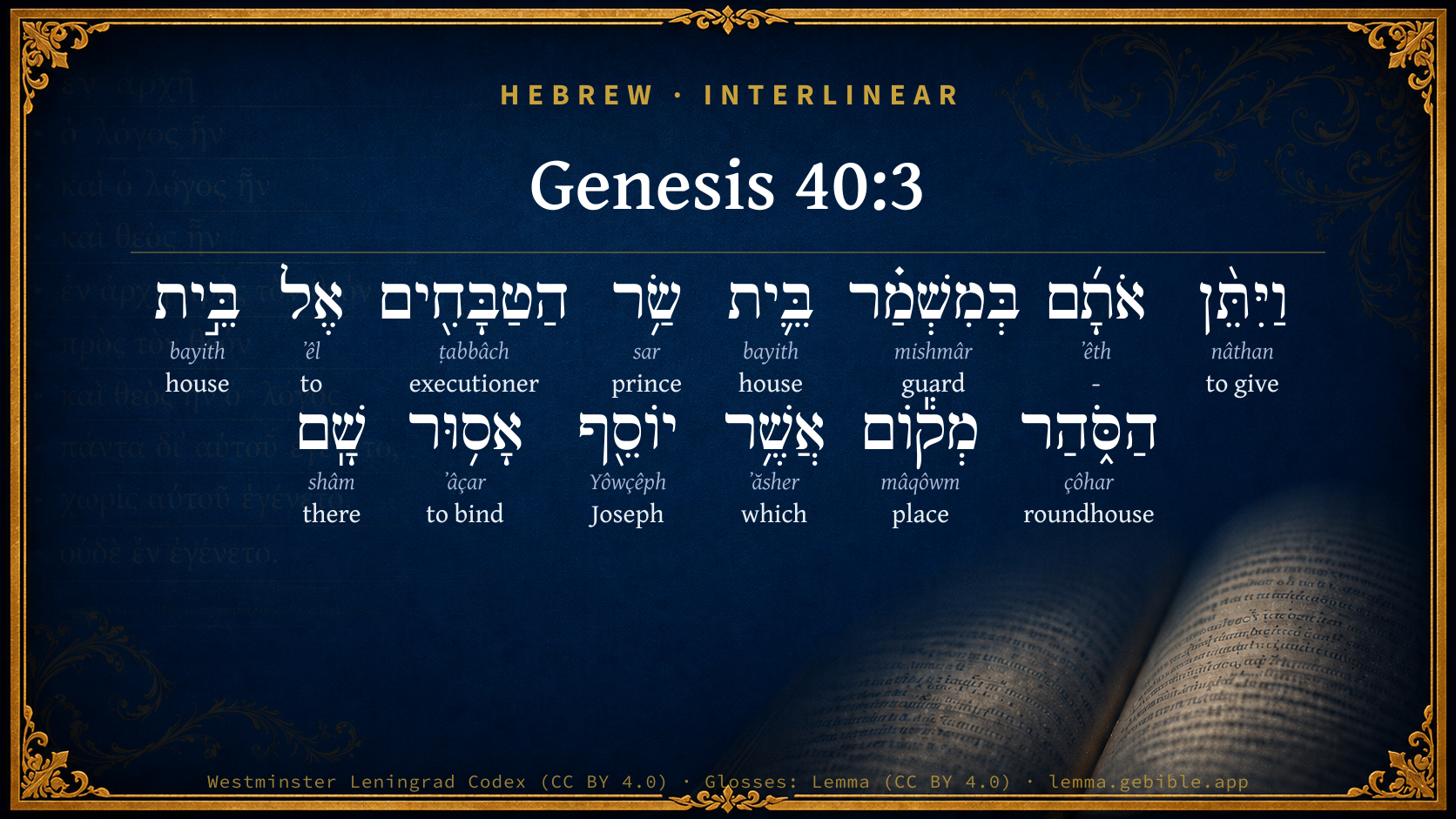
Hebrew (Westminster Leningrad Codex) Genesis 40:3 appears in the Hebrew Old Testament. The text above is from the Westminster Leningrad Codex. Each word links to its Strong’s number, a concise gloss, and parsing drawn from the Open Scriptures Hebrew Bible morphology. Click any word for its full Brown-Driver-Briggs (BDB) entry.
Download image
Cite this verse

Genesis 40:3 (World English Bible). Public Domain. Lemma interlinear Bible study tool, https://lemma.gebible.app/v/genesis/40/3.

Show BibTeX & RIS
BibTeX
RIS
English Translation
He put them in custody in the house of the captain of the guard, into the prison, the place where Joseph was bound.
World English Bible · Public Domain
Highlights
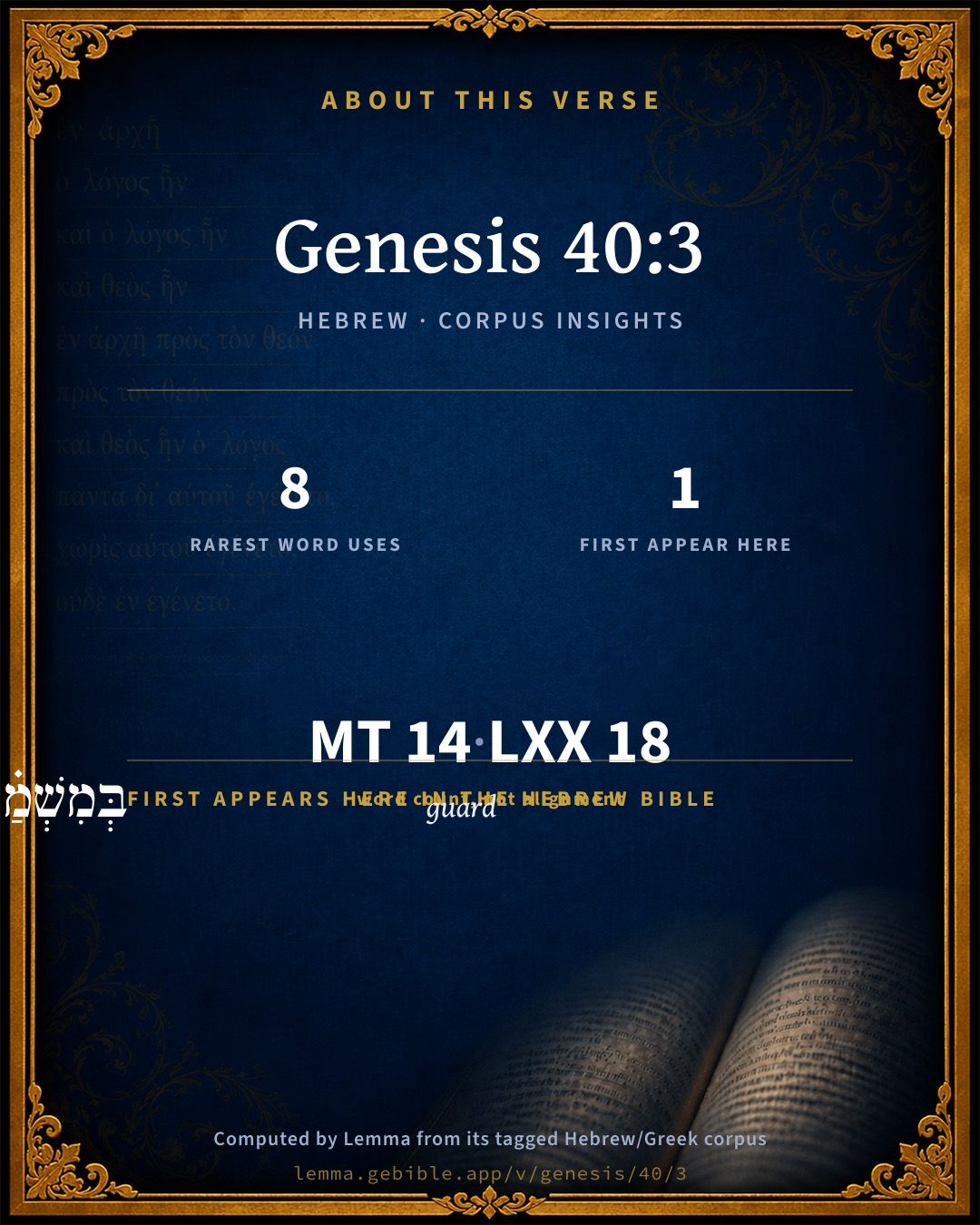
  • 1 first appearance in the Hebrew Bible
Full analysis ↓
Download a study sheet

One document with this verse’s original text, its word-by-word gloss line, the meaning frame, cross-references with their text, attributed commentary, and full source and license credits — printable, and it pastes into notes with its structure intact.

This verse Autodidact and up

Study sheet (.html) Plain text (.txt)

A passage Seminary Student

Up to 50 verses in one chapter. A passage sheet keeps up to 6 commentary sources and 12 cross-references per verse, in the order this page ranks them, and says so on the sheet whenever that leaves anything out. Ask for a single verse and you get the Autodidact verse sheet above.

Everything on this page stays free to read, with no account — the sheet is a download of what is already on screen, not access to it.

Want to remove ads? Support Godless Engineer
Compare translations 3

The same verse in 3 English versions, stacked beneath the original-language interlinear above. Click any original word for its lexicon entry.

Each is an independent rendering of the whole verse — the interlinear is not word-aligned to these translations.

Highlighted words mark where these versions differ — a whole-verse word diff, not a word-by-word alignment.

  • World English Bible Public Domain
    He put them in custody in the house of the captain of the guard, into the prison, the place where Joseph was bound.
  • King James Version Public Domain
    And he put them in ward in the house of the captain of the guard, into the prison, the place where Joseph was bound.
  • unfoldingWord Literal Text CC BY-SA 4.0
    and he put them in custody in the house of the chief of the guards, in the round-house, the place where Joseph was bound.

unfoldingWord Literal Text — © unfoldingWord, licensed CC BY-SA 4.0. Word-aligned USFM3 via Door43 (git.door43.org/unfoldingWord/en_ult).

Versions to compare (up to 4)

3 of 4 selected

Show all 18 translations

Every available English version of this verse, each an independent rendering of the whole verse.

  • World English Bible Public Domain
    He put them in custody in the house of the captain of the guard, into the prison, the place where Joseph was bound.
  • Berean Standard Bible Public Domain
    and imprisoned them in the house of the captain of the guard, the same prison where Joseph was confined.
  • Majority Standard Bible Public Domain
    and imprisoned them in the house of the captain of the guard, the same prison where Joseph was confined.
  • King James Version Public Domain
    And he put them in ward in the house of the captain of the guard, into the prison, the place where Joseph was bound.
  • American Standard Version (1901) Public Domain
    And he put them in ward in the house of the captain of the guard, into the prison, the place where Joseph was bound.
  • Revised Version (1885) Public Domain
    And he put them in ward in the house of the captain of the guard, into the prison, the place where Joseph was bound.
  • Geneva Bible (1599) Public Domain
    Therefore he put them in ward in his chiefe stewardes house, in the prison and place where Ioseph was bound.
  • Douay-Rheims (1899) Public Domain
    He sent them to the prison of the commander of the soldiers, in which Joseph also was prisoner,
  • Young's Literal Translation Public Domain
    and giveth them in charge in the house of the chief of the executioners, unto the round-house, the place where Joseph `is' a prisoner,
  • Literal Standard Version CC BY-SA 4.0
    and puts them in confinement in the house of the chief of the executioners, into the round-house, the place where Joseph [is] a prisoner,
  • Unlocked Literal Bible CC BY-SA 4.0
    He put them in custody in the house of the captain of the guard, in the same prison where Joseph was confined.
  • unfoldingWord Literal Text CC BY-SA 4.0
    and he put them in custody in the house of the chief of the guards, in the round-house, the place where Joseph was bound.
  • Darby Bible Public Domain
    and he put them in custody into the house of the captain of the life-guard, into the tower-house, into the place where Joseph was imprisoned.
  • World Messianic Bible Public Domain
    He put them in custody in the house of the captain of the guard, into the prison, the place where Joseph was bound.
  • Webster's Bible Public Domain
    And he put them in custody in the house of the captain of the guard, into the prison, the place where Joseph was bound.
  • Free Bible Version CC BY-SA 4.0
    and imprisoned them in the house of the commander of the guard, the same prison where Joseph was.
  • Bible in Basic English Public Domain
    And he put them in prison under the care of the captain of the army, in the same prison where Joseph himself was shut up.
  • JPS Tanakh (1917) Public Domain
    And he put them in ward in the house of the captain of the guard, into the prison, the place where Joseph was bound.

Literal Standard Version (2020), Covenant Press — licensed CC BY-SA 4.0. Text via the HelloAO Bible API (eBible.org). Unlocked Literal Bible (unfoldingWord) — licensed CC BY-SA 4.0. Text via the HelloAO Bible API (eBible.org). unfoldingWord Literal Text — © unfoldingWord, licensed CC BY-SA 4.0. Word-aligned USFM3 via Door43 (git.door43.org/unfoldingWord/en_ult). Free Bible Version, Dr. Jonathan Gallagher — licensed CC BY-SA 4.0. Text via the HelloAO Bible API (eBible.org).

Word by word

More ways to search: Search by grammar → Find every occurrence → Compare this word →

Practice this passage: Drill this verse → Learn its vocabulary →

הַסֹּ֑הַר
çôhar
H5470
“the · roundhouse”
Particle, Definite Article + Noun, Common, Masculine, Singular, Absolute
Part of Speech
Particle + Noun
Type
Common
Gender
Masculine
Number
Singular
State
Absolute
Full BDB Definition

Origin: from the same as H5469

TWOT: 1468b

house of roundness, roundhouse, prison - name of a prison
  1. וַיִּתֵּ֨ן nâthan H5414 “and · to give” Conjunction + Verb, Qal, Sequential Imperfect, 3rd Person, Masculine, Singular
  2. אֹתָ֜ם ʼêth H853 “- · them” Particle, Direct Object + Suffix, Personal, 3rd Person, Masculine, Plural
  3. בְּמִשְׁמַ֗ר mishmâr H4929 “in/at · guard of” Preposition + Noun, Common, Masculine, Singular, Construct
  4. בֵּ֛ית bayith H1004 “house of” Noun, Common, Masculine, Singular, Construct
  5. שַׂ֥ר sar H8269 “prince of” Noun, Common, Masculine, Singular, Construct
  6. הַטַבָּחִ֖ים ṭabbâch H2876 “the · executioners” Particle, Definite Article + Noun, Common, Masculine, Plural, Absolute
  7. אֶל ʼêl H413 “to” Preposition
  8. בֵּ֣ית bayith H1004 “house of” Noun, Common, Masculine, Singular, Construct
  9. מְק֕וֹם mâqôwm H4725 “place of” Noun, Common, Masculine, Singular, Construct
  10. אֲשֶׁ֥ר ʼăsher H834 “which” Particle, Relative
  11. יוֹסֵ֖ף Yôwçêph H3130 “Joseph” Noun, Proper
  12. אָס֥וּר ʼâçar H631 “bound” Verb, Qal, Participle Passive, Masculine, Singular, Absolute
  13. שָֽׁם shâm H8033 “there” Adverb

About this verse

These counts appear in no published source. They are computed here, from the morphology-tagged text and Lemma’s own curated glosses. What Lemma adds →

14
words
13
distinct lemmas
Pentateuch
section

Notable vocabulary

The rarest word here is הַסֹּ֑הַר roundhouse H5470 — appearing just 8 times in the whole Hebrew Bible.

First appearance in Scripture

This word makes its first canonical appearance in the Hebrew Bible here:

  • בְּמִשְׁמַ֗ר guard H4929

Shared distinctive vocabulary

הַסֹּ֑הַר roundhouse H5470 occurs in 6 verses of the Hebrew Bible. Also found in:

Grammatical profile

  • 2 verbs
  • 8 nouns
  • 1 preposition
  • 1 adverb
  • 2 particles

Verb forms

  • וַיִּתֵּ֨ן Qal · Sequential Imperfect
  • אָס֥וּר Qal · Participle Passive

Repetition

A word recurs within this verse — often emphatic in Hebrew:

  • בֵּ֛ית house H1004 ×2

Hebrew & Septuagint length

In English translation the verse runs 23 words from the Hebrew and 17 from the Septuagint (LXX English) — closely comparable.

A rough comparison of the two English renderings, which tokenize alike — not a word-level alignment.

Word counts can differ between the Hebrew and the Greek without any difference in meaning — e.g. the Hebrew direct-object marker אֵת has no separate Greek word, and Greek often adds the article ὁ.

In the original languages it is 14 Hebrew tokens and 18 Greek tokens — but the two are counted differently (Hebrew bundles its prefixes and suffixes into one token; the Greek is in lemma form), so that isn’t a like-for-like length.

Cross-references

2

Topical passages linked to Genesis 40:3 in the Treasury of Scripture Knowledge — connected by theme and wording, ordered by reader-vote popularity; previews shown in the World English Bible.

  • Genesis 39:20 Joseph's master took him, and put him into the prison, the place where the king's prisoners were bound, and he was there in custody.
  • Genesis 39:23 The keeper of the prison didn't look after anything that was under his hand, because Yahweh was with him; and that which he did, Yahweh made it prosper.

Cross-references courtesy of OpenBible.info (CC BY 4.0).

Hebrew and Greek witnesses Masoretic Hebrew ↔ Greek Septuagint

The same verse in the two great witnesses to the Old Testament, shown verse-for-verse.

These are two independent witnesses, not word-aligned to each other, and the Septuagint is shown in lemma (dictionary) form.

Hebrew Genesis 40:3 Masoretic · Westminster Leningrad Codex

וַיִּתֵּ֨ן אֹתָ֜ם בְּמִשְׁמַ֗ר בֵּ֛ית שַׂ֥ר הַטַבָּחִ֖ים אֶל בֵּ֣ית הַסֹּ֑הַר מְק֕וֹם אֲשֶׁ֥ר יוֹסֵ֖ף אָס֥וּר שָֽׁם

He put them in custody in the house of the captain of the guard, into the prison, the place where Joseph was bound.

World English Bible · Public Domain

Greek LXX Genesis 40:3 Septuagint · lemma form

καί τίθημι αὐτός ἐν φυλακή παρά ὁ δεσμοφύλαξ εἰς ὁ δεσμωτήριον εἰς ὁ τόπος οὗ ιωσηφ ἀποἄγω ἐκεῖ

And he put them in ward, into the prison, into the place whereinto Joseph had been led.

LXX2012 (modern English Septuagint) · Public Domain

Hebrew: Westminster Leningrad Codex (CC BY 4.0). Greek: Septuagint (public domain); English from LXX2012 (modern English Septuagint) (Public Domain). How the Septuagint differs from the Hebrew →

Targum (Aramaic paraphrase)

2

The Targum is the ancient Jewish Aramaic paraphrase of the Hebrew Scriptures — an interpretive translation, not the Hebrew text itself. Onkelos (literal) and Pseudo-Jonathan (expansive) render the Torah, and Jonathan the Prophets. Coverage is partial: where no permissively-licensed English translation exists for a verse, only the Aramaic is shown. This is verse-level text, not a word-by-word alignment to the Hebrew.

  1. Targum Onkelos Torah (Genesis–Deuteronomy)
    וִיהַב יָתְהוֹן בְּמַטְּרָא בֵּית רַב קָטּוֹלַיָּא לְבֵית אֲסִירֵי אֲתַר דִּי יוֹסֵף אָסִיר תַּמָּן

    (no public-domain English translation for this verse)

    Targum Onkelos — Aramaic: “Onkelos Genesis” (public domain); “Onkelos Exodus” (public domain); “Onkelos Leviticus” (public domain); “Onkelos Numbers” (public domain); “Onkelos Deuteronomy” (public domain). English: “Sefaria Community Translation” (CC0 1.0 (public-domain dedication)); “J.W. Etheridge. The Targums of Onkelos and Jonathan Ben Uzziel on the Pentateuch. London: Longmans, Green, 1862” (public domain). Text via Sefaria.

  2. Targum Pseudo-Jonathan Torah (Genesis–Deuteronomy)
    וִיהַב יַתְהוֹם בְּמַטְרָא בֵּי רַב סְפּוֹקְלַטוֹרְיָא לְבֵית אֲסִירֵי אַתְרָא דְיוֹסֵף אֲסִיר תַּמָן

    And he gave them in ward in the house of the chief executioner, the prison house where Joseph was confined.

    Targum Pseudo-Jonathan — Aramaic: “Targum Jonathan on Genesis” (public domain); “Targum Jonathan on Exodus” (public domain); “Targum Jonathan on Leviticus” (public domain); “Targum Jonathan on Numbers” (public domain); “Targum Jonathan on Deuteronomy” (public domain). English: “The Targum of Jonathan ben Uzziel, trans. J. W. Etheridge, London, 1862” (public domain). Text via Sefaria.

Commentary

Notes on Genesis 40:3 from classic Christian and Jewish commentators (each source and its license shown beneath its notes). The classic Christian expositions comment on the surrounding passage and are grouped to its opening verse, so a note may address several verses; the Jewish commentaries on the Tanakh (Rashi and others) are per-verse, so they appear only where the commentator wrote on this verse.

Lemma curates 59 commentaries, every one of them public domain or Creative Commons licensed, each selected and text-cleaned for this edition rather than reprinted as found. About our sources →

Trapp's Complete Commentary

John Trapp

Gen 40:3 And he put them in ward in the house of the captain of the guard, into the prison, the place where Joseph [was] bound.

Ver. 3. And he put them in ward, &c.] See the slippery estate of courtiers: today in favour, tomorrow in disgrace; as Haman; Sejanus, whom the same senators conducted to the prison, who had accompanied him to the senate. They which sacrificed unto him, as to their god, which kneeled down to adore him, now scoffed at him, seeing him dragged from the temple to the jail, from supreme honour to extreme ignominy. His greatest friends were most passionate against him, &c., they would not once look at him; as men look not after sundials, longer than the sun shines upon them. {a}

The place where Joseph was bound.] Here was a "wheel within a wheel," {Eze 1:16} a sweet providence; that these obnoxious officers should be sent to Joseph’s prison.

{a} Tacit.

John Trapp, A Commentary or Exposition upon All the Books of the Old and New Testament (1647–1656) — public domain. Text from a community e-Sword module.

Geneva Bible (1599)

Geneva Bible translators

God worketh many wonderful means to deliver his.

Geneva Bible (1599) marginal notes — public domain. Text via Bolls.life.

Jamieson, Fausset & Brown

Robert Jamieson, A. R. Fausset & David Brown

Pharaoh put them in ward, &c.--Whatever was their crime, they were committed, until their case could be investigated, to the custody of the captain of the guard, that is, Potiphar, in an outer part of whose house the royal prison was situated.

Jamieson, Fausset & Brown — Commentary Critical and Explanatory on the Whole Bible (1871) — public domain (CC PDM 1.0). Text via the HelloAO Bible API.

Adam Clarke's Commentary

Verse 3. Where Joseph was bound.] The place in which Joseph was now confined; this is what is implied in being bound; for, without doubt, he had his personal liberty. As the butler and. the baker were state criminals they were put in the same prison with Joseph, which we learn from the preceding chapter, Ge 39:20, was the king's prison. All the officers in the employment of the ancient kings of Egypt were, according to Diodorus Siculus, taken from the most illustrious families of the priesthood in the country; no slave or common person being ever permitted to serve in the presence of the king. As these persons, therefore, were of the most noble families, it is natural to expect they would be put, when accused, into the state prison.

Adam Clarke's Commentary on the Bible (1810–1826) — public domain. Text from a community e-Sword/MySword module.

Ellicott's Commentary for English Readers

(3, 4) In the house of the captain of the guard.—That is, of Potiphar. As he is said to have charged Joseph with the care of these two high officials, he must, ere this, have become aware of his innocence. But as the wife in ancient times in Egypt was endowed with all the husband’s property, and was a formidable person, as we learn from many of the records now being translated and published, Potiphar may not have wished to offend her.

He served them.—Used only of light service. (See Note on Gen_39:4.)

A Bible Commentary for English Readers, edited by Charles John Ellicott (1878–1897) — public domain. Text from a community e-Sword module.

The Cambridge Bible for Schools and Colleges

gen. ed. J. J. S. Perowne

3. in ward] Cf. Gen_40:4; Gen_40:7. An old English expression; cf. Shakespeare, 2 Hen. VI, v. i.:

“I know, ere they will have me go to ward,

They’ll pawn their swords for my enfranchisement.”

He committed them for safe keeping, while the enquiry into the charges against them went on.

captain of the guard] See note on Gen_37:36.

the prison] = “the round house,” as in Gen_39:20. This clause seems to have been introduced, in order to harmonize the tradition of Joseph’s position in the house of the “captain of the guard” with the account of his imprisonment in Gen_39:20-23.

According to E, Pharaoh placed his two officials in confinement, but not in the prison, in the keeping of the “captain of the guard.”

The Cambridge Bible for Schools and Colleges (gen. ed. J. J. S. Perowne; Cambridge University Press, 1878–1918) — public domain. Text from a community e-Sword module.

John Gill's Exposition

And he put them in ward in the house of the captain of the guard,.... Who is generally thought to be Potiphar, since this was the office he was in, Gen 39:1; unless he was dead, and there was another put into his room, or there were more than one in the same office:

into the prison, the place where Joseph was bound; that is, where he had been bound, and where he was still a prisoner, though not fettered and in that close confinement he had been in.

John Gill's Exposition of the Whole Bible (1746–1763) — public domain (CC PDM 1.0). Text via the HelloAO Bible API.

Haydock's Catholic Bible Commentary

Commander. Putiphar. (Calmet) --- Prisoner, though his chains were struck off. (Menochius)

George Leo Haydock (1774–1849), Haydock's Catholic Family Bible and Commentary, 1859 edition — public domain. Excludes Psalms (Douay-Rheims chapter numbering differs from Protestant) and Deuterocanonical books (Catholic canon only).

Matthew Poole's English Annotations

The captain of the guard, to wit, Potiphar, Gen 37:36, who being informed by his underkeeper of Joseph’s great care and faithfulness, began to have a better opinion of him, though for his own quiet, and his wife’s reputation, he left him still in the prison.

Where Joseph was bound; was a prisoner, as that word is used, Isa 22:3; for Joseph being now made governor of the prisoners, was doubtless freed from his bonds: or had been bound, and that with irons in a cruel manner, Psa 105:18.

Matthew Poole's English Annotations on the Holy Bible (1683–1685) — public domain. Text from a community e-Sword/MySword module.

Whedon's Commentary on the Bible

Daniel D. Whedon

3. Captain of the guard — Or, chief of the executioners, whose dwelling was within a part of the prison.

Daniel D. Whedon (gen. ed.), Commentary on the Old and New Testaments (1874–1909) — public domain. Text from a community e-Sword module.

The Pulpit Commentary

And he put them in ward (or in custody) in the house of the captain of the guard,i.e. Potiphar (vide Gen_37:36) into the prison, literally, house of enclosure (vide Gen_39:20) the place where Joseph was bound. The word rwsa; from rsa; to make fast by binding, seems to corroborate the Psalmist"s assertion (Psa_105:18) that Joseph had been laid in iron and his feet hurt with fetters; but this could only have been temporarily (vide vers. 4, 6).

The Pulpit Commentary (1880–1919), ed. H.D.M. Spence-Jones & Joseph S. Exell — public domain. Text from a community e-Sword module.

Radak

Rabbi David Kimhi (Radak)

מקום אשר יוסף אסור שם, the Torah had to write this so that we understand how these prisoners came to tell Joseph their dreams, the dreams which became instrumental in Joseph being released from prison, eventually. The word מקום here is in a construct mode to the word אשר. Hence we have only a sheva under the letter מ instead of the full vowel kametz. Similar constructions are found in Job 18,21 מקום לא ידע א-ל, “a place for people who did not know G’d. (no kametz under the מ in the word מקום. The same applies to Isaiah 8,6 ומשוש את רצין, where the word משוש does not have the vowel kametz under the letter מ as it is in a construct mode to רצין בן רמליהו.

Radak on the Tanakh — English translations: “Sefaria Community Translation” (CC0 1.0 (public-domain dedication)); “Eliyahu Munk, HaChut Hameshulash” (CC BY 4.0); “Rabbi Mike Feuer, Jerusalem Anthology” (CC BY 4.0); and “R. David Kimhi on the first book of Psalms, Translated by R.G. Finch, London, 1919” (public domain). Text via Sefaria.

Lesson kit

Teaching starters — assembled from the data on this page, not authored interpretation. Every prompt links to the verse data it draws on. Edit before teaching.

Genesis, in the Pentateuch, opens this verse with 14 words (13 distinct Hebrew lemmas). Its most distinctive word is çôhar (“roundhouse”). A historical commentator’s framing appears above. Read the whole chapter for the surrounding context.

Discussion questions

  1. How does “roundhouse” (çôhar) shape what this verse is saying?
  2. This is the first place “guard” appears in Scripture (first appears here). What does its debut here establish?
  3. How does Genesis 39:20, which shares the word «roundhouse», read alongside this verse?
  4. What does the repetition of “house” (2× in this one verse) do in this verse?
  5. The translations on this page render this verse differently — a whole-verse word diff, not a word-by-word alignment. What might account for the different wordings?
  6. «וַיִּתֵּ֨ן» is a Qal Sequential Imperfect verb. How does that grammatical form shape the action described?
  7. Compare how Trapp's Complete Commentary and Geneva Bible (1599) read this verse. Where do they agree or differ?

Things to notice

Reading settings

Reading text

Shown beneath each verse's original-language words.

Old Testament
Old Testament edition

Read the OT as the Masoretic Hebrew (MT) or the Greek Septuagint (LXX).

English shown for the Greek Septuagint (in the Hebrew ↔ Greek comparison).

Comparing translations? Open the Compare panel on any verse page to stack up to four side by side.