Exodus 13:11

Hebrew (Westminster Leningrad Codex) Exodus 13:11 appears in the Hebrew Old Testament. The text above is from the Westminster Leningrad Codex. Each word links to its Strong’s number, a concise gloss, and parsing drawn from the Open Scriptures Hebrew Bible morphology. Click any word for its full Brown-Driver-Briggs (BDB) entry.
Download image
Cite this verse

Exodus 13:11 (World English Bible). Public Domain. Lemma interlinear Bible study tool, https://lemma.gebible.app/v/exodus/13/11.

Show BibTeX & RIS
BibTeX
RIS
English Translation
"It shall be, when Yahweh shall bring you into the land of the Canaanite, as he swore to you and to your fathers, and shall give it you,
World English Bible · Public Domain
Download a study sheet

One document with this verse’s original text, its word-by-word gloss line, the meaning frame, cross-references with their text, attributed commentary, and full source and license credits — printable, and it pastes into notes with its structure intact.

This verse Autodidact and up

Study sheet (.html) Plain text (.txt)

A passage Seminary Student

Up to 50 verses in one chapter. A passage sheet keeps up to 6 commentary sources and 12 cross-references per verse, in the order this page ranks them, and says so on the sheet whenever that leaves anything out. Ask for a single verse and you get the Autodidact verse sheet above.

Everything on this page stays free to read, with no account — the sheet is a download of what is already on screen, not access to it.

Want to remove ads? Support Godless Engineer
Compare translations 3

The same verse in 3 English versions, stacked beneath the original-language interlinear above. Click any original word for its lexicon entry.

Each is an independent rendering of the whole verse — the interlinear is not word-aligned to these translations.

Highlighted words mark where these versions differ — a whole-verse word diff, not a word-by-word alignment.

  • World English Bible Public Domain
    "It shall be, when Yahweh shall bring you into the land of the Canaanite, as he swore to you and to your fathers, and shall give it you,
  • King James Version Public Domain
    And it shall be when the LORD shall bring thee into the land of the Canaanites, as he sware unto thee and to thy fathers, and shall give it thee,
  • unfoldingWord Literal Text CC BY-SA 4.0
    And it will be, when Yahweh brings you into the land of the Canaanites, as he swore to you and to your fathers, and he gives it to you,

unfoldingWord Literal Text — © unfoldingWord, licensed CC BY-SA 4.0. Word-aligned USFM3 via Door43 (git.door43.org/unfoldingWord/en_ult).

Versions to compare (up to 4)

3 of 4 selected

Show all 18 translations

Every available English version of this verse, each an independent rendering of the whole verse.

  • World English Bible Public Domain
    "It shall be, when Yahweh shall bring you into the land of the Canaanite, as he swore to you and to your fathers, and shall give it you,
  • Berean Standard Bible Public Domain
    And after the LORD brings you into the land of the Canaanites and gives it to you, as He swore to you and your fathers,
  • Majority Standard Bible Public Domain
    And after the LORD brings you into the land of the Canaanites and gives it to you, as He swore to you and your fathers,
  • King James Version Public Domain
    And it shall be when the LORD shall bring thee into the land of the Canaanites, as he sware unto thee and to thy fathers, and shall give it thee,
  • American Standard Version (1901) Public Domain
    And it shall be, when Jehovah shall bring thee into the land of the Canaanite, as he sware unto thee and to thy fathers, and shall give it thee,
  • Revised Version (1885) Public Domain
    And it shall be when the LORD shall bring thee into the land of the Canaanite, as he sware unto thee and to thy fathers, and shall give it thee,
  • Geneva Bible (1599) Public Domain
    And when the Lord shall bring thee into the lande of the Canaanites, as hee sware vnto thee and to thy fathers, and shall giue it thee,
  • Douay-Rheims (1899) Public Domain
    And when the Lord shall have brought thee into the land of the Chanaanite, as he swore to thee and thy fathers, and shall give it thee:
  • Young's Literal Translation Public Domain
    `And it hath been, when Jehovah bringeth thee in unto the land of the Canaanite, as He hath sworn to thee and to thy fathers, and hath given it to thee,
  • Literal Standard Version CC BY-SA 4.0
    And it has been, when YHWH brings you to the land of the Canaanite as He has sworn to you and to your fathers, and has given it to you,
  • Unlocked Literal Bible CC BY-SA 4.0
    When Yahweh brings you into the land of the Canaanites, as he swore to you and to your ancestors to do, and when he gives the land to you,
  • unfoldingWord Literal Text CC BY-SA 4.0
    And it will be, when Yahweh brings you into the land of the Canaanites, as he swore to you and to your fathers, and he gives it to you,
  • Darby Bible Public Domain
    And it shall be when Jehovah hath brought thee into the land of the Canaanites, as he hath sworn to thee and to thy fathers, and hath given it thee,
  • World Messianic Bible Public Domain
    “It shall be, when the LORD brings you into the land of the Canaanite, as he swore to you and to your fathers, and will give it to you,
  • Webster's Bible Public Domain
    And it shall be when the LORD shall bring thee into the land of the Canaanites, as he swore to thee and to thy fathers, and shall give it to thee,
  • Free Bible Version CC BY-SA 4.0
    Once the Lord takes you into the land of the Canaanites and gives it to you, as he promised you and your forefathers,
  • Bible in Basic English Public Domain
    And when the Lord takes you into the land of Canaan, as he made his oath to you and to your fathers, and gives it to you,
  • JPS Tanakh (1917) Public Domain
    And it shall be when the LORD shall bring thee into the land of the Canaanite, as He swore unto thee and to thy fathers, and shall give it thee,

Literal Standard Version (2020), Covenant Press — licensed CC BY-SA 4.0. Text via the HelloAO Bible API (eBible.org). Unlocked Literal Bible (unfoldingWord) — licensed CC BY-SA 4.0. Text via the HelloAO Bible API (eBible.org). unfoldingWord Literal Text — © unfoldingWord, licensed CC BY-SA 4.0. Word-aligned USFM3 via Door43 (git.door43.org/unfoldingWord/en_ult). Free Bible Version, Dr. Jonathan Gallagher — licensed CC BY-SA 4.0. Text via the HelloAO Bible API (eBible.org).

Word by word

More ways to search: Search by grammar → Find every occurrence → Compare this word →

Practice this passage: Drill this verse → Learn its vocabulary →

הַֽכְּנַעֲנִ֔י
Kᵉnaʻanîy
H3669
“the · Canaanite”
Particle, Definite Article + Noun, Gentilic, Masculine, Singular, Absolute
Part of Speech
Particle + Noun
Type
Gentilic
Gender
Masculine
Number
Singular
State
Absolute
Full BDB Definition

Origin: patrial from H3667

TWOT: 1002a , 1002b

Canaanite = see Cana " zealous" - descendant of inhabitant of Canaan (adjective) - descendant or inhabitant of Canaan (noun) - a merchant, trader (noun)
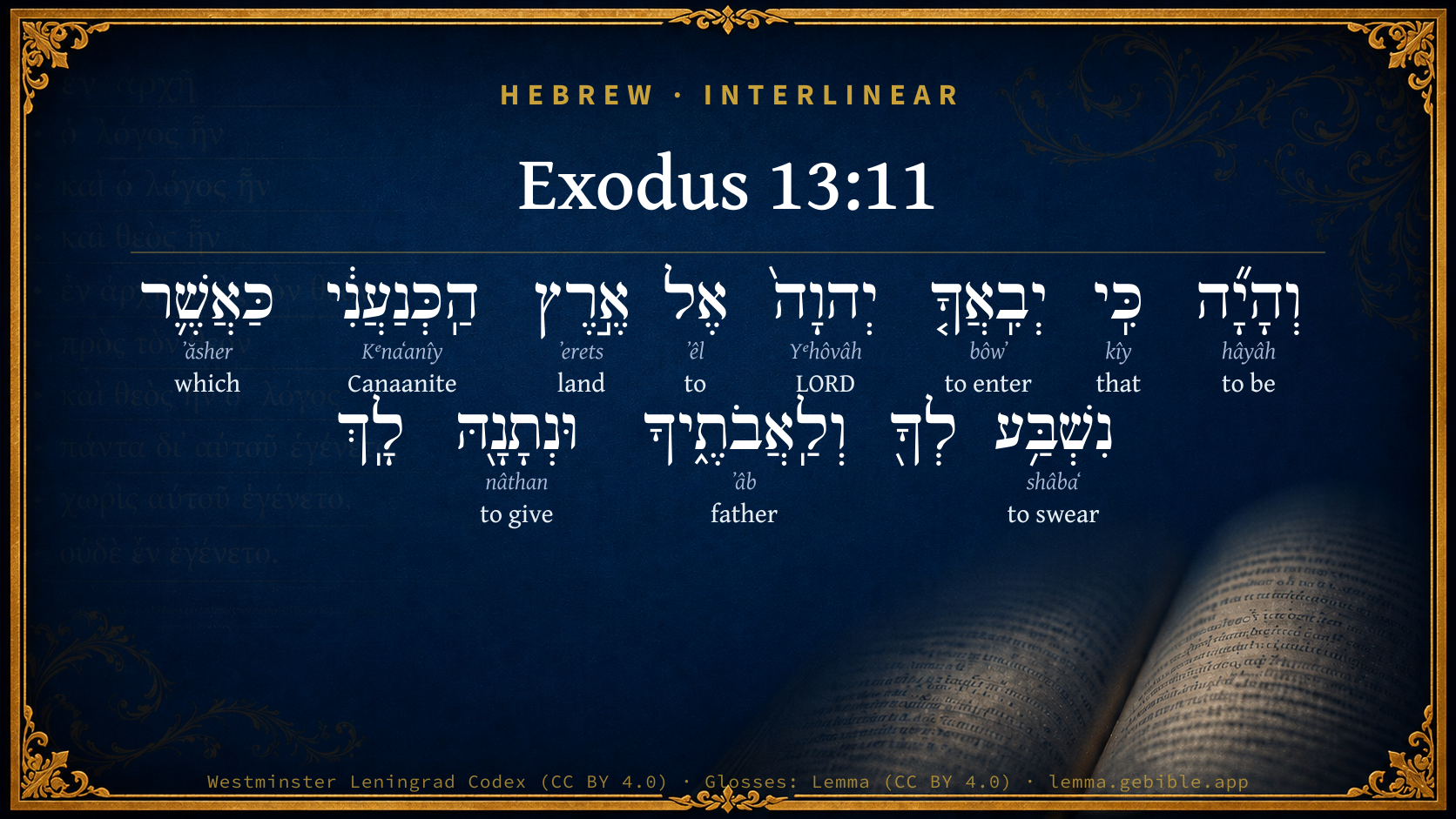
  1. וְהָיָ֞ה hâyâh H1961 “and · to be” Conjunction + Verb, Qal, Sequential Perfect, 3rd Person, Masculine, Singular
  2. כִּֽי kîy H3588 “that” Conjunction
  3. יְבִֽאֲךָ֤ bôwʼ H935 “to enter · you” Verb, Hiphil, Imperfect, 3rd Person, Masculine, Singular + Suffix, Personal, 2nd Person, Masculine, Singular
  4. יְהוָה֙ Yᵉhôvâh H3068 “LORD” Noun, Proper
  5. אֶל ʼêl H413 “to” Preposition
  6. אֶ֣רֶץ ʼerets H776 “land of” Noun, Common, Both, Singular, Construct
  7. כַּאֲשֶׁ֛ר ʼăsher H834 “like/as · which” Preposition + Particle, Relative
  8. נִשְׁבַּ֥ע shâbaʻ H7650 “to swear” Verb, Niphal, Perfect, 3rd Person, Masculine, Singular
  9. וְלַֽאֲבֹתֶ֑יךָ ʼâb H1 “and · to/for · fathers · your” Conjunction + Preposition + Noun, Common, Masculine, Plural, Construct + Suffix, Personal, 2nd Person, Masculine, Singular
  10. וּנְתָנָ֖הּ nâthan H5414 “and · to give · her” Conjunction + Verb, Qal, Sequential Perfect, 3rd Person, Masculine, Singular + Suffix, Personal, 3rd Person, Feminine, Singular

About this verse

These counts appear in no published source. They are computed here, from the morphology-tagged text and Lemma’s own curated glosses. What Lemma adds →

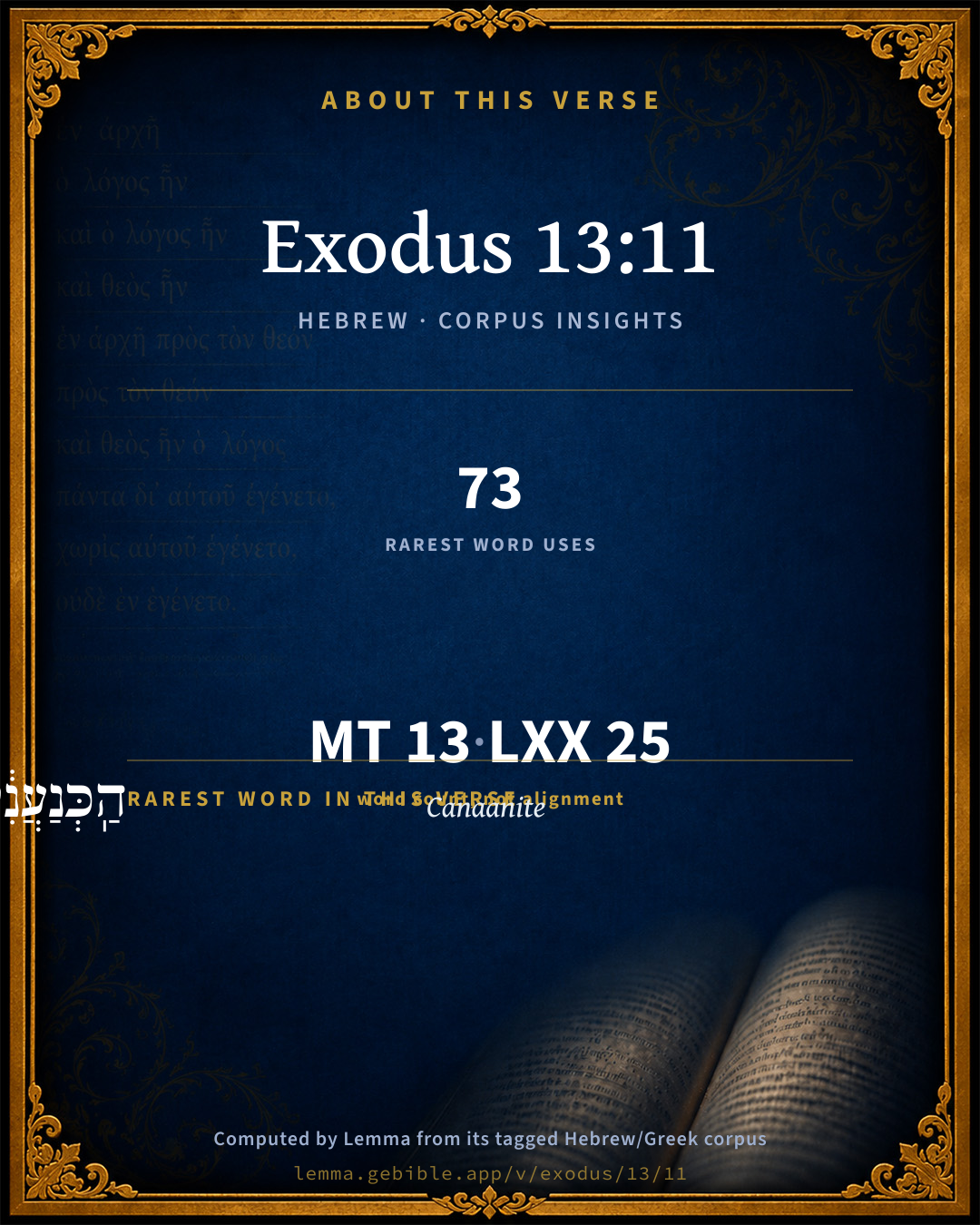
13
words
11
distinct lemmas
Pentateuch
section

Grammatical profile

  • 4 verbs
  • 4 nouns
  • 3 prepositions
  • 1 conjunction
  • 1 particle

Verb forms

  • וְהָיָ֞ה Qal · Sequential Perfect
  • יְבִֽאֲךָ֤ Hiphil · Imperfect
  • נִשְׁבַּ֥ע Niphal · Perfect
  • וּנְתָנָ֖הּ Qal · Sequential Perfect

Hebrew & Septuagint length

In English translation the verse runs 28 words from the Hebrew and 31 from the Septuagint (LXX English) — closely comparable.

A rough comparison of the two English renderings, which tokenize alike — not a word-level alignment.

Word counts can differ between the Hebrew and the Greek without any difference in meaning — e.g. the Hebrew direct-object marker אֵת has no separate Greek word, and Greek often adds the article ὁ.

In the original languages it is 13 Hebrew tokens and 25 Greek tokens — but the two are counted differently (Hebrew bundles its prefixes and suffixes into one token; the Greek is in lemma form), so that isn’t a like-for-like length.

Cross-references

1

Topical passages linked to Exodus 13:11 in the Treasury of Scripture Knowledge — connected by theme and wording, ordered by reader-vote popularity; previews shown in the World English Bible.

  • Exodus 13:5 It shall be, when Yahweh shall bring you into the land of the Canaanite, and the Hittite, and the Amorite, and the Hivite, and the Jebusite, which he swore to your fathers to give you, a land flowing with milk and honey, that you shall keep this service in this month.

Cross-references courtesy of OpenBible.info (CC BY 4.0).

Hebrew and Greek witnesses Masoretic Hebrew ↔ Greek Septuagint

The same verse in the two great witnesses to the Old Testament, shown verse-for-verse.

These are two independent witnesses, not word-aligned to each other, and the Septuagint is shown in lemma (dictionary) form.

Hebrew Exodus 13:11 Masoretic · Westminster Leningrad Codex

וְהָיָ֞ה כִּֽי יְבִֽאֲךָ֤ יְהוָה֙ אֶל אֶ֣רֶץ הַֽכְּנַעֲנִ֔י כַּאֲשֶׁ֛ר נִשְׁבַּ֥ע לְךָ֖ וְלַֽאֲבֹתֶ֑יךָ וּנְתָנָ֖הּ לָֽךְ

"It shall be, when Yahweh shall bring you into the land of the Canaanite, as he swore to you and to your fathers, and shall give it you,

World English Bible · Public Domain

Greek LXX Exodus 13:11 Septuagint · lemma form

καί εἰμί ὡς ἄν εἰςἄγω σύ κύριος ὁ θεός σύ εἰς ὁ γῆ ὁ χαναναῖος ὅς τρόπος ὄμνυμι ὁ πατήρ σύ καί δίδωμι σύ αὐτός

And it shall come to pass when the Lord your God shall bring you into the land of the Chananites, as he swore to your fathers, and shall give it you,

LXX2012 (modern English Septuagint) · Public Domain

Hebrew: Westminster Leningrad Codex (CC BY 4.0). Greek: Septuagint (public domain); English from LXX2012 (modern English Septuagint) (Public Domain). How the Septuagint differs from the Hebrew →

Targum (Aramaic paraphrase)

2

The Targum is the ancient Jewish Aramaic paraphrase of the Hebrew Scriptures — an interpretive translation, not the Hebrew text itself. Onkelos (literal) and Pseudo-Jonathan (expansive) render the Torah, and Jonathan the Prophets. Coverage is partial: where no permissively-licensed English translation exists for a verse, only the Aramaic is shown. This is verse-level text, not a word-by-word alignment to the Hebrew.

  1. Targum Onkelos Torah (Genesis–Deuteronomy)
    וִיהֵי אֲרֵי יָעֵלִנָךְ יְיָ לְאַרְעָא דִכְנַעֲנָאֵי כְּמָא דִי קַיִים לָךְ וְלַאֲבָהָתָךְ וְיִתְּנִנַהּ לָךְ:

    (no public-domain English translation for this verse)

    Targum Onkelos — Aramaic: “Onkelos Genesis” (public domain); “Onkelos Exodus” (public domain); “Onkelos Leviticus” (public domain); “Onkelos Numbers” (public domain); “Onkelos Deuteronomy” (public domain). English: “Sefaria Community Translation” (CC0 1.0 (public-domain dedication)); “J.W. Etheridge. The Targums of Onkelos and Jonathan Ben Uzziel on the Pentateuch. London: Longmans, Green, 1862” (public domain). Text via Sefaria.

  2. Targum Pseudo-Jonathan Torah (Genesis–Deuteronomy)
    וִיהֵי אֲרוּם יָעֵלִינָךְ יְיָ לְאַרְעָא דְכְנַעֲנָאֵי הֵיכְמָא דְקַיֵּים לָךְ וּלְאַבְהָתָךְ וְיִתְּנִינָהּ לָךְ

    And when I the Lord have brought thee into the land of the Kenaanaee, which I have sworn to thee and to thy fathers to give thee,

    Targum Pseudo-Jonathan — Aramaic: “Targum Jonathan on Genesis” (public domain); “Targum Jonathan on Exodus” (public domain); “Targum Jonathan on Leviticus” (public domain); “Targum Jonathan on Numbers” (public domain); “Targum Jonathan on Deuteronomy” (public domain). English: “The Targum of Jonathan ben Uzziel, trans. J. W. Etheridge, London, 1862” (public domain). Text via Sefaria.

Commentary

Notes on Exodus 13:11 from classic Christian and Jewish commentators (each source and its license shown beneath its notes). The classic Christian expositions comment on the surrounding passage and are grouped to its opening verse, so a note may address several verses; the Jewish commentaries on the Tanakh (Rashi and others) are per-verse, so they appear only where the commentator wrote on this verse.

Lemma curates 59 commentaries, every one of them public domain or Creative Commons licensed, each selected and text-cleaned for this edition rather than reprinted as found. About our sources →

Matthew Henry's Commentary

Here we have,

I. Further directions concerning the dedicating of their firstborn to God. 1. The firstlings of their cattle were to be dedicated to God, as part of their possessions. Those of clean beasts - calves, lambs, and kids - if males, were to be sacrificed, Exo 22:30; Num 18:17, Num 18:18. Those of unclean beasts, as colts, were to be redeemed with a lamb, or knocked on the head. For whatsoever is unclean (as we all are by nature), if it be not redeemed, will be destroyed, Exo 13:11, Exo 13:13. 2. The firstborn of their children were to be redeemed, and by no means sacrificed, as the Gentiles sacrificed their children to Moloch. The price of the redemption of the firstborn was fixed by the law (Num 18:16) at five sheckles. We were all obnoxious to the wrath and curse of God; by the blood of Christ we are redeemed, that we may be joined to the church of the firstborn. They were to redeem their children, as well as the firstlings of the unclean beasts, for our children are by nature polluted. Who can bring a clean thing out of an unclean?

II. Further directions concerning the catechising of their children, and all those of the rising generation, from time to time, in this matter. It is supposed that, when they saw all the firstlings thus devoted, they would ask the meaning of it, and their parents and teachers must tell them (Exo 13:14-16) that God's special propriety in their firstborn, and all their firstlings, was founded in his special preservation of them from the sword of the destroying angel. Being thus delivered, they must serve him. Note, 1. Children should be directed and encouraged to ask their parents questions concerning the things of God, a practice which would be perhaps of all others the most profitable way of catechising; and parents must furnish themselves with useful knowledge, that they may be ready always to give an answer to their enquiries. If ever the knowledge of God cover the earth, as the waters do the sea, the fountains of family-instruction must first be broken up. 2. We should all be able to show cause for what we do in religion. As sacraments are sanctified by the word, so they must be explained and understood by it. God's service is reasonable, and it is then acceptable when we perform it intelligently, knowing what we do and why we do it. 3. It must be observed how often it is said in this chapter that by strength of hand (Exo 13:3, Exo 13:14, Exo 13:16), with a strong hand (Exo 13:9), the Lord brought them out of Egypt. The more opposition is given to the accomplishment of God's purposes the more is his power magnified therein. It is a strong hand that conquers hard hearts. Sometimes God is said to work deliverance not by might nor power (Zac 4:6), not by such visible displays of his power as that recorded here. 4. Their posterity that should be born in Canaan are directed to say, The Lord brought us out of Egypt, Exo 13:14, Exo 13:16. Mercies to our fathers are mercies to us; we reap the benefit of them, and therefore must keep up a grateful remembrance of them. We stand upon the bottom of former deliverances, and were in the loins of our ancestors when they were delivered. Much more reason have we to say that in the death and resurrection of Jesus Christ we were redeemed.

Matthew Henry's Commentary on the Whole Bible (1708–1710) — public domain (CC PDM 1.0). Text via the HelloAO Bible API.

Trapp's Complete Commentary

John Trapp

Exo 13:11 And it shall be when the LORD shall bring thee into the land of the Canaanites, as he sware unto thee and to thy fathers, and shall give it thee,

Ver. 11. Land of the Canaanites.] A general name to all those seven accursed nations.

John Trapp, A Commentary or Exposition upon All the Books of the Old and New Testament (1647–1656) — public domain. Text from a community e-Sword module.

The Biblical Illustrator

Joseph S. Exell

Exo_13:11-13

All the firstborn.

Firstborn to be dedicated to God

1. Jehovah is the beginning and end of His own ordinances. He sets them for Himself.

2. The Church must act these duties from God unto God Himself.

3. All that God requires must His people make to pass from them to Him.

4. Firstborn males of beasts God required in the law for special use to Himself (Exo_13:12).

5. Clean and unclean among creatures is a distinction made by God for men, not for Himself.

6. God hath a proprietary in all creatures be they never so unclean.

7. God hath ordered redemption for unclean by putting the clean in their stead.

8. Unclean unredeemed must be destroyed.

9. A price hath God set for mans redemption to gain a Church of the firstborn.

10. The law of the firstborn hath its truth and accomplishment in Christ Jesus, the Firstborn of every creature (Col_1:15; verse 13). (G. Hughes, B. D.)

The Biblical Illustrator, edited by Joseph S. Exell (c. 1880s–1900s) — public domain. Text from a community e-Sword module.

Ellicott's Commentary for English Readers

(11) The land of the Canaanites.—Either their superior importance or their genealogical position (Gen_10:15) caused the term “Canaanites” to be used inclusively of all the Palestinian nations. The land is always “the land of Canaan” (Gen_11:31; Gen_12:5; Gen_13:12, &c).

A Bible Commentary for English Readers, edited by Charles John Ellicott (1878–1897) — public domain. Text from a community e-Sword module.

The Cambridge Bible for Schools and Colleges

gen. ed. J. J. S. Perowne

11. See on v. 5.

The Cambridge Bible for Schools and Colleges (gen. ed. J. J. S. Perowne; Cambridge University Press, 1878–1918) — public domain. Text from a community e-Sword module.

John Gill's Exposition

And it shall be when the Lord shall bring thee into the land of the Canaanites,.... Put for all the rest of the nations:

as he sware unto thee, and to thy fathers, and shall give it thee; to them as they were in their loins, and from thence might certainly conclude it would be given them.

John Gill's Exposition of the Whole Bible (1746–1763) — public domain (CC PDM 1.0). Text via the HelloAO Bible API.

Matthew Poole's English Annotations

The land of the Canaanites, under which general name all the other nations are contained, as being all the children of Canaan.

Matthew Poole's English Annotations on the Holy Bible (1683–1685) — public domain. Text from a community e-Sword/MySword module.

Whedon's Commentary on the Bible

Daniel D. Whedon

11-16. Moses here repeats to Israel the law of the firstborn, given to him in Exo_13:1-2. As in the instance just given, there is here not a mere repetition, but an amplification and enforcement. The ass is mentioned as a representative of unclean animals, which could not be offered in sacrifice. This law for the redemption of an unclean by a clean animal was a temporary arrangement, while as yet the priesthood had not been ordained; but after the consecration of the Levites there was a fixed price of redemption. Lev_27:27. The ransom of the firstborn of man was afterwards fixed at five shekels, the tribe of Levi being taken for the service of the sanctuary instead of the firstborn of the other eleven tribes, man for man, and then the over-plus of the firstborns being ransomed at this rate. Num_3:44-48.

Daniel D. Whedon (gen. ed.), Commentary on the Old and New Testaments (1874–1909) — public domain. Text from a community e-Sword module.

Kretzmann's Popular Commentary

Paul E. Kretzmann

Concerning the First-Born.

v. 11. And it shall be when the Lord shall bring thee into the land of the Canaanites, as He sware unto thee and to thy fathers, and shall give it thee, the Lord here laying special stress upon His faithfulness, which causes Him to keep the promises of His goodness always,

v. 12. that thou shalt set apart unto the Lord all that openeth the matrix, and every firstling that cometh of a beast which thou hast; the males shall be the Lord’s. The female children and the female young were not included in this order, but the male first-born, both of man and beast, was to be offered and consecrated to the Lord. Cf Exo 22:29-30; Deu 15:21.

v. 13. And every firstling of an ass thou shalt redeem with a lamb, clean beasts were to be substituted for the unclean; and if thou wilt not redeem it, then thou shalt break his neck, for the unredeemed animal might not be kept; and all the first-born of man among thy children shalt thou redeem. The Lord later provided special regulations for the redemption of the first-born sons by means of a certain sum of money, Num 3:46-47; Num 18:15-16.

v. 14. And it shall be when thy son asketh thee in time to come, at some time in the future, saying, What is this? that thou shalt say unto him, By strength of hand the Lord brought us out from Egypt, from the house of bondage;

v. 15. and it came to pass, when Pharaoh would hardly let us go, that the Lord slew all the first-born in the land of Egypt, both the first-born of man and the first-born of beast; therefore I sacrifice to the Lord all that openeth the matrix, being males; but all the first-born of my children I redeem. The fathers of Israel are here represented as speaking collectively and as giving individual instruction to their sons, for the Lord did not want a mechanical observation of customs that were no longer understood.

v. 16. And it shall be for a token upon thine hand and for frontlets between thine eyes, they were to keep these facts in remembrance constantly; for by strength of hand the Lord brought us forth out of Egypt. It is well-pleasing to the Lord if His children at all times keep in mind the great acts of deliverance wrought by Him.

Paul E. Kretzmann, Popular Commentary of the Bible (1921–1924) — public domain. Text from a community e-Sword module.

unfoldingWord translationNotes

Door43 World Missions Community

when he gives the land to you

"when he gives the land of the Canaanites to you"

Every firstborn of a donkey

Israel is given a choice to kill the firstborn donkey or buy it back with a lamb.

each of your firstborn males among all your sons

Everyone in Israel who had a firstborn son, must buy him back.

translationWords

Canaan

oath

firstborn

offspring

donkey

lamb

son

unfoldingWord translationNotes — © Distant Shores Media and the Door43 World Missions Community, licensed CC BY-SA 4.0. Source: git.door43.org/Door43/en_tn.

Rashi

Rabbi Shlomo Yitzchaki (Rashi)

והיה כי יביאך AND IT SHALL COME TO PASS WHEN [THE LORD] SHALL BRING THEE … [THOU SHALT SET APART etc.] — There are some of our Rabbis who learned from this statement that the firstborn who were born in the wilderness were not thus hallowed. He who says that these were thus hallowed explains this “coming” (i. e. this verse, which appears to make the hallowing of the firstborn dependent upon their arrival in the land) as follows: if you observe it (this command) in the wilderness, you will be privileged to enter the land and to observe it there (cf. Bekhorot 4b).

נשבע לך HE SWORE UNTO THEE — And where did He swear this unto thee? (Exodus 6:8) “And I will bring you unto the land concerning which I did lift up my hand etc.” (cf. Rashi on this verse where he explains that “lifting up the hand” denotes taking an oath) (Mekhilta).

ונתנה לך AND SHALL GIVE IT TO THEE Let it be in thine eyes (regard it) as though He had given it to thee on that same day (when on each occasion you carry out this command) and do not regard it as an inheritance from your ancestors (Mekhilta).

Rashi on the Tanakh — English translations: “The Judaica Press complete Tanach with Rashi, translated by A. J. Rosenberg” (CC BY 4.0); “Pentateuch with Rashi's commentary by M. Rosenbaum and A.M. Silbermann, 1929-1934” (public domain); “The Metsudah Tanach series, Lakewood, N.J” (CC BY 4.0); and “The Book of Joshua, Metsudah Publications, 1997” (CC BY 4.0). Text via Sefaria.

Ramban (Nachmanides)

Rabbi Moshe ben Nachman (Ramban / Nachmanides)

AND IT SHALL BE WHEN THE ETERNAL SHALL BRING THEE INTO THE LAND OF THE CANAANITES. This is stated because the law of that which “openeth the womb” [mentioned in Verse 12], applied only from the time they came to the Land of Israel. In line with the plain meaning of Scripture, the verse, Sanctify unto Me all the firstborn, [mentioned in Verse 2 above] means all the firstborn living at that time. Since He redeemed them from death when He smote in the land of Egypt, He commanded [in that verse above] that they be sanctified to Him to do the work of G-d, whatever He will command them to do. He did not command them at this time concerning the redemption of the firstborn, but only after He exchanged them for the Levites and He commanded the redemption of the firstborn that were over and above the number of the Levites. But the commandment [as expressed in the verse, Sanctify unto Me all the firstborn], did not apply to the firstborn in the wilderness. Now, [in the verse before us], He commanded that when they shall come into the Land of Israel, the law should apply to the firstborn of both man and beast and the firstling of an ass, and then He commanded the law of their redemption for the generations.

AS HE SWORE UNTO THEE AND TO THY FATHERS. The meaning of it is that “He swore to your fathers to give it to you,” just as it is said above, which He swore unto thy fathers to give thee. It may be that G-d’s word by itself is called “an oath,” for thus He said twice: And I am come down to deliver them out of the hand of the Egyptians, and to bring them up out of that land unto a good land, and again it says, And I will bring you in unto the land concerning which I lifted up My hand., 6:8.

Ramban (Nachmanides) on the Tanakh — English translation: “Commentary on the Torah by Ramban (Nachmanides). Translated and annotated by Charles B. Chavel. New York, Shilo Pub. House, 1971-1976” (CC BY 4.0). Text via Sefaria.

Lesson kit

Teaching starters — assembled from the data on this page, not authored interpretation. Every prompt links to the verse data it draws on. Edit before teaching.

Exodus, in the Pentateuch, opens this verse with 13 words (11 distinct Hebrew lemmas). Its most distinctive word is Kᵉnaʻanîy (“Canaanite”). A historical commentator’s framing appears above. Read the whole chapter for the surrounding context.

Discussion questions

  1. What does “Canaanite” (Kᵉnaʻanîy) contribute to the verse as a whole?
  2. Exodus 13:5 shares this passage’s theme. How do the two illuminate each other?
  3. These translations render this verse differently. What is at stake in choosing one wording over another?
  4. The verb «וְהָיָ֞ה» is Qal Sequential Perfect. How does its form color the action?
  5. Reading how Matthew Henry's Commentary and Trapp's Complete Commentary read this verse, where do the two commentators agree and where do they part?

Things to notice

Reading settings

Reading text

Shown beneath each verse's original-language words.

Old Testament
Old Testament edition

Read the OT as the Masoretic Hebrew (MT) or the Greek Septuagint (LXX).

English shown for the Greek Septuagint (in the Hebrew ↔ Greek comparison).

Comparing translations? Open the Compare panel on any verse page to stack up to four side by side.