
Genesis 24:32

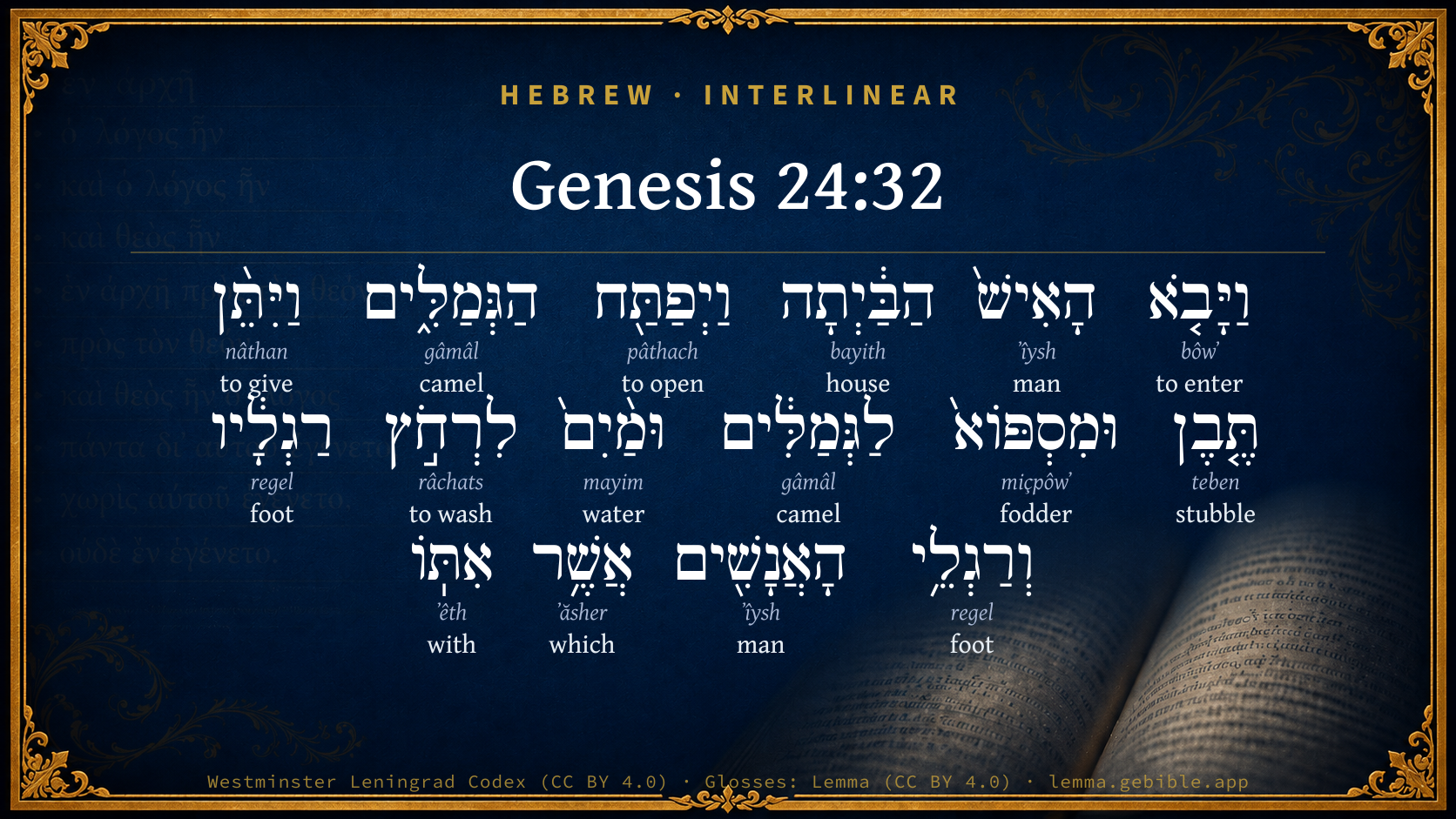
Hebrew (Westminster Leningrad Codex) Genesis 24:32 appears in the Hebrew Old Testament. The text above is from the Westminster Leningrad Codex. Each word links to its Strong’s number, a concise gloss, and parsing drawn from the Open Scriptures Hebrew Bible morphology. Click any word for its full Brown-Driver-Briggs (BDB) entry.
Download image
Cite this verse

Genesis 24:32 (World English Bible). Public Domain. Lemma interlinear Bible study tool, https://lemma.gebible.app/v/genesis/24/32.

Show BibTeX & RIS
BibTeX
RIS
English Translation
The man came into the house, and he unloaded the camels. He gave straw and provender for the camels, and water to wash his feet and the feet of the men who were with him.
World English Bible · Public Domain
Download a study sheet

One document with this verse’s original text, its word-by-word gloss line, the meaning frame, cross-references with their text, attributed commentary, and full source and license credits — printable, and it pastes into notes with its structure intact.

This verse Autodidact and up

Study sheet (.html) Plain text (.txt)

A passage Seminary Student

Up to 50 verses in one chapter. A passage sheet keeps up to 6 commentary sources and 12 cross-references per verse, in the order this page ranks them, and says so on the sheet whenever that leaves anything out. Ask for a single verse and you get the Autodidact verse sheet above.

Everything on this page stays free to read, with no account — the sheet is a download of what is already on screen, not access to it.

Want to remove ads? Support Godless Engineer
Compare translations 3

The same verse in 3 English versions, stacked beneath the original-language interlinear above. Click any original word for its lexicon entry.

Each is an independent rendering of the whole verse — the interlinear is not word-aligned to these translations.

Highlighted words mark where these versions differ — a whole-verse word diff, not a word-by-word alignment.

  • World English Bible Public Domain
    The man came into the house, and he unloaded the camels. He gave straw and provender for the camels, and water to wash his feet and the feet of the men who were with him.
  • King James Version Public Domain
    And the man came into the house: and he ungirded his camels, and gave straw and provender for the camels, and water to wash his feet, and the men's feet that were with him.
  • unfoldingWord Literal Text CC BY-SA 4.0
    So the man went to the house. Then he unloaded the camels and gave straw and fodder to the camels, and water to wash his feet and the feet of the men who with him.

unfoldingWord Literal Text — © unfoldingWord, licensed CC BY-SA 4.0. Word-aligned USFM3 via Door43 (git.door43.org/unfoldingWord/en_ult).

Versions to compare (up to 4)

3 of 4 selected

Show all 18 translations

Every available English version of this verse, each an independent rendering of the whole verse.

  • World English Bible Public Domain
    The man came into the house, and he unloaded the camels. He gave straw and provender for the camels, and water to wash his feet and the feet of the men who were with him.
  • Berean Standard Bible Public Domain
    So the man came to the house, and the camels were unloaded. Straw and feed were brought to the camels, and water to wash his feet and the feet of his companions.
  • Majority Standard Bible Public Domain
    So the man came to the house, and the camels were unloaded. Straw and feed were brought to the camels, and water to wash his feet and the feet of his companions.
  • King James Version Public Domain
    And the man came into the house: and he ungirded his camels, and gave straw and provender for the camels, and water to wash his feet, and the men's feet that were with him.
  • American Standard Version (1901) Public Domain
    And the man came into the house, and he ungirded the camels. And he gave straw and provender for the camels, and water to wash his feet and the feet of the men that were with him.
  • Revised Version (1885) Public Domain
    And the man came into the house, and he ungirded the camels; and he gave straw and provender for the camels, and water to wash his feet and the men’s feet that were with him.
  • Geneva Bible (1599) Public Domain
    Then the man came into the house, and he vnsadled the camels, and brought litter and prouender for the camels, and water to wash his feete, and the mens feete that were with him.
  • Douay-Rheims (1899) Public Domain
    And he brought him in into his lodging: and he unharnessed the camels and gave straw and hay, and water to wash his feet, and the feet of the men that were come with him.
  • Young's Literal Translation Public Domain
    And he bringeth in the man into the house, and looseth the camels, and giveth straw and provender for the camels, and water to wash his feet, and the feet of the men who `are' with him:
  • Literal Standard Version CC BY-SA 4.0
    And he brings in the man into the house, and looses the camels, and gives straw and provender for the camels, and water to wash his feet, and the feet of the men who [are] with him:
  • Unlocked Literal Bible CC BY-SA 4.0
    So the man came to the house and he unloaded the camels. The camels were given straw and feed, and water was provided to wash his feet and the feet of the men who were with him.
  • unfoldingWord Literal Text CC BY-SA 4.0
    So the man went to the house. Then he unloaded the camels and gave straw and fodder to the camels, and water to wash his feet and the feet of the men who with him.
  • Darby Bible Public Domain
    And the man came into the house; and he ungirded the camels, and gave the camels straw and provender, and water to wash his feet, and the feet of the men who were with him.
  • World Messianic Bible Public Domain
    The man came into the house, and he unloaded the camels. He gave straw and feed for the camels, and water to wash his feet and the feet of the men who were with him.
  • Webster's Bible Public Domain
    And the man came into the house: and he ungirded his camels, and gave straw and provender for the camels, and water to wash his feet, and the men's feet that were with him.
  • Free Bible Version CC BY-SA 4.0
    So the man went home with him. Laban unloaded the camels and gave them straw and food to eat. He also provided water for the man to wash his feet, as well as for the men who were with him.
  • Bible in Basic English Public Domain
    Then the man came into the house, and Laban took their cords off the camels and gave them dry grass and food, and he gave to him and the men who were with him water for washing their feet.
  • JPS Tanakh (1917) Public Domain
    And the man came into the house, and he ungirded the camels; and he gave straw and provender for the camels, and water to wash his feet and the feet of the men that were with him.

Literal Standard Version (2020), Covenant Press — licensed CC BY-SA 4.0. Text via the HelloAO Bible API (eBible.org). Unlocked Literal Bible (unfoldingWord) — licensed CC BY-SA 4.0. Text via the HelloAO Bible API (eBible.org). unfoldingWord Literal Text — © unfoldingWord, licensed CC BY-SA 4.0. Word-aligned USFM3 via Door43 (git.door43.org/unfoldingWord/en_ult). Free Bible Version, Dr. Jonathan Gallagher — licensed CC BY-SA 4.0. Text via the HelloAO Bible API (eBible.org).

Word by word

More ways to search: Search by grammar → Find every occurrence → Compare this word →

Practice this passage: Drill this verse → Learn its vocabulary →

וּמִסְפּוֹא֙
miçpôwʼ
H4554
“and · fodder”
Conjunction + Noun, Common, Masculine, Singular, Absolute
Part of Speech
Conjunction + Noun
Type
Common
Gender
Masculine
Number
Singular
State
Absolute
Full BDB Definition

Origin: from an unused root meaning to collect

TWOT: 1529a

fodder, feed
  1. וַיָּבֹ֤א bôwʼ H935 “and · to enter” Conjunction + Verb, Qal, Sequential Imperfect, 3rd Person, Masculine, Singular
  2. הָאִישׁ֙ ʼîysh H376 “the · man” Particle, Definite Article + Noun, Common, Masculine, Singular, Absolute
  3. הַבַּ֔יְתָה bayith H1004 “the · house · toward” Particle, Definite Article + Noun, Common, Masculine, Singular, Absolute + Suffix, Demonstrative
  4. וַיְפַתַּ֖ח pâthach H6605 “and · to open” Conjunction + Verb, Piel, Sequential Imperfect, 3rd Person, Masculine, Singular
  5. הַגְּמַלִּ֑ים gâmâl H1581 “the · camels” Particle, Definite Article + Noun, Common, Masculine, Plural, Absolute
  6. וַיִּתֵּ֨ן nâthan H5414 “and · to give” Conjunction + Verb, Qal, Sequential Imperfect, 3rd Person, Masculine, Singular
  7. תֶּ֤בֶן teben H8401 “stubble” Noun, Common, Masculine, Singular, Absolute
  8. לַגְּמַלִּ֔ים gâmâl H1581 “to/for the · camels” Preposition, Determined + Noun, Common, Masculine, Plural, Absolute
  9. וּמַ֨יִם֙ mayim H4325 “and · water(s)” Conjunction + Noun, Common, Masculine, Plural, Absolute
  10. לִרְחֹ֣ץ râchats H7364 “to wash” Preposition + Verb, Qal, Infinitive Construct
  11. רַגְלָ֔יו regel H7272 “feet · his” Noun, Common, Feminine, Dual, Construct + Suffix, Personal, 3rd Person, Masculine, Singular
  12. וְרַגְלֵ֥י regel H7272 “and · feet of” Conjunction + Noun, Common, Feminine, Dual, Construct
  13. הָאֲנָשִׁ֖ים ʼîysh H376 “the · men” Particle, Definite Article + Noun, Common, Masculine, Plural, Absolute
  14. אֲשֶׁ֥ר ʼăsher H834 “which” Particle, Relative
  15. אִתּֽוֹ ʼêth H854 “with · him” Preposition + Suffix, Personal, 3rd Person, Masculine, Singular

About this verse

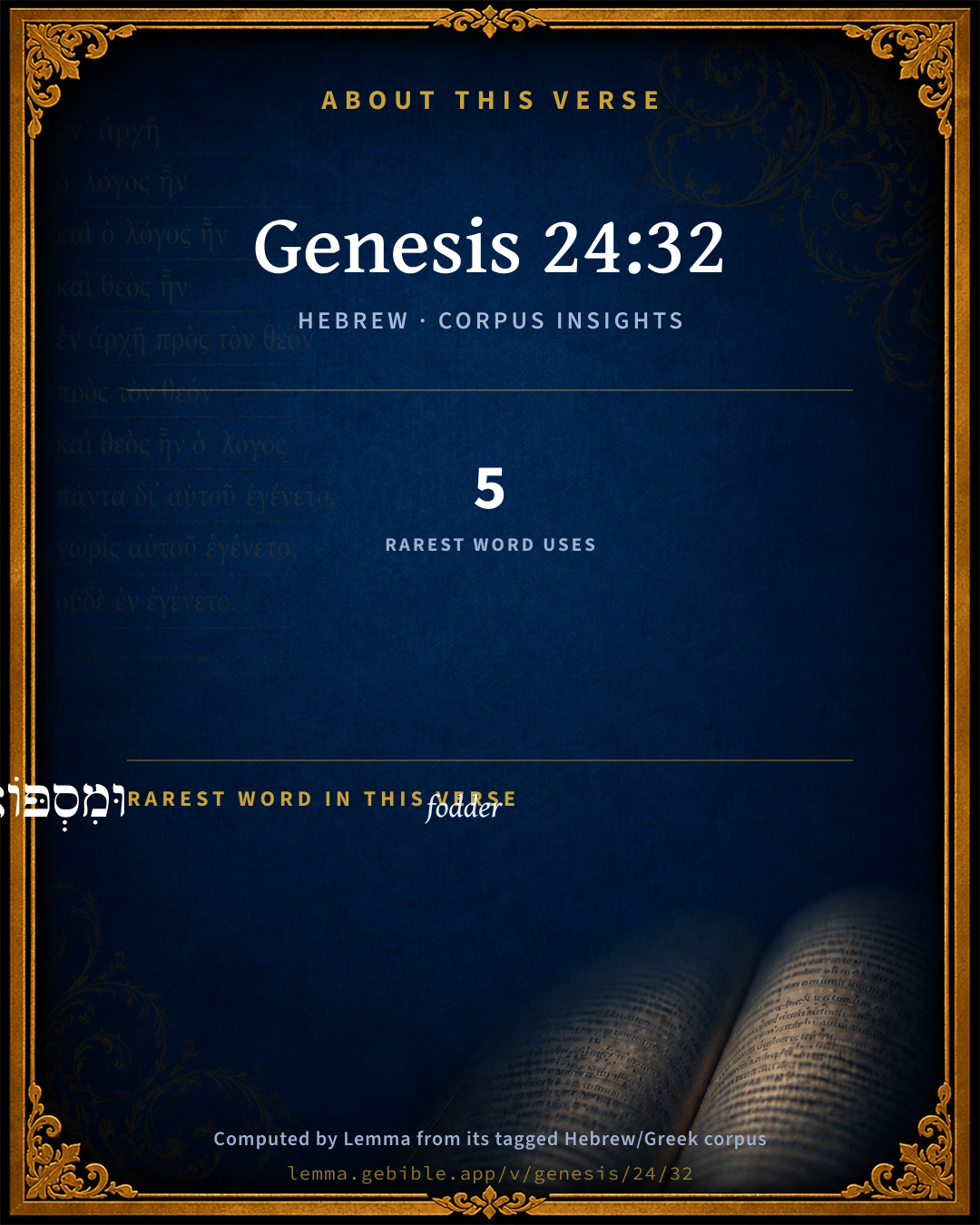
These counts appear in no published source. They are computed here, from the morphology-tagged text and Lemma’s own curated glosses. What Lemma adds →

16
words
13
distinct lemmas
Pentateuch
section

Notable vocabulary

The rarest word here is וּמִסְפּוֹא֙ fodder H4554 — appearing just 5 times in the whole Hebrew Bible.

Shared distinctive vocabulary

וּמִסְפּוֹא֙ fodder H4554 occurs in 5 verses of the Hebrew Bible. Also found in:

Grammatical profile

  • 4 verbs
  • 10 nouns
  • 1 preposition
  • 1 particle

Verb forms

  • וַיָּבֹ֤א Qal · Sequential Imperfect
  • וַיְפַתַּ֖ח Piel · Sequential Imperfect
  • וַיִּתֵּ֨ן Qal · Sequential Imperfect
  • לִרְחֹ֣ץ Qal · Infinitive Construct

Repetition

Words recur within this verse — often emphatic in Hebrew:

  • הָאִישׁ֙ man H376 ×2
  • הַגְּמַלִּ֑ים camel H1581 ×2
  • רַגְלָ֔יו foot H7272 ×2

Hebrew & Septuagint length

In English translation the verse runs 35 words from the Hebrew and 34 from the Septuagint (LXX English) — closely comparable.

A rough comparison of the two English renderings, which tokenize alike — not a word-level alignment.

Word counts can differ between the Hebrew and the Greek without any difference in meaning — e.g. the Hebrew direct-object marker אֵת has no separate Greek word, and Greek often adds the article ὁ.

Cross-references

8

Topical passages linked to Genesis 24:32 in the Treasury of Scripture Knowledge — connected by theme and wording, ordered by reader-vote popularity; previews shown in the World English Bible.

  • Genesis 43:24 The man brought the men into Joseph's house, and gave them water, and they washed their feet. He gave their donkeys fodder.
  • Judges 19:21 So he brought him into his house, and gave the donkeys fodder; and they washed their feet, and ate and drink.
  • Genesis 18:4 Now let a little water be fetched, wash your feet, and rest yourselves under the tree.
  • Genesis 19:2 and he said, "See now, my lords, please turn aside into your servant's house, stay all night, wash your feet, and you will rise up early, and go on your way." They said, "No, but we will stay in the street all night."
  • Luke 7:44 Turning to the woman, he said to Simon, "Do you see this woman? I entered into your house, and you gave me no water for my feet, but she has wet my feet with her tears, and wiped them with the hair of her head.
  • 1 Timothy 5:10 being approved by good works, if she has brought up children, if she has been hospitable to strangers, if she has washed the saints' feet, if she has relieved the afflicted, and if she has diligently followed every good work.
  • 1 Samuel 25:41 She arose, and bowed herself with her face to the earth, and said, Behold, your handmaid is a servant to wash the feet of the servants of my lord.
  • John 13:4–14 arose from supper, and laid aside his outer garments. He took a towel, and wrapped a towel around his waist.

Cross-references courtesy of OpenBible.info (CC BY 4.0).

Hebrew and Greek witnesses Masoretic Hebrew ↔ Greek Septuagint

The same verse in the two great witnesses to the Old Testament, shown verse-for-verse.

These are two independent witnesses, not word-aligned to each other, and the Septuagint is shown in lemma (dictionary) form.

Hebrew Genesis 24:32 Masoretic · Westminster Leningrad Codex

וַיָּבֹ֤א הָאִישׁ֙ הַבַּ֔יְתָה וַיְפַתַּ֖ח הַגְּמַלִּ֑ים וַיִּתֵּ֨ן תֶּ֤בֶן וּמִסְפּוֹא֙ לַגְּמַלִּ֔ים וּמַ֨יִם֙ לִרְחֹ֣ץ רַגְלָ֔יו וְרַגְלֵ֥י הָאֲנָשִׁ֖ים אֲשֶׁ֥ר אִתּֽוֹ

The man came into the house, and he unloaded the camels. He gave straw and provender for the camels, and water to wash his feet and the feet of the men who were with him.

World English Bible · Public Domain

Greek LXX Genesis 24:32 Septuagint · lemma form

εἰςἔρχομαι δέ ὁ ἄνθρωπος εἰς ὁ οἰκία καί ἀποσάττω ὁ κάμηλος καί δίδωμι ἄχυρον καί χόρτασμα ὁ κάμηλος καί ὕδωρ νίπτω ὁ πούς αὐτός καί ὁ πούς ὁ ἀνήρ ὁ μετά αὐτός

And the man entered into the house, and unloaded the camels, and gave the camels straw and provender, and water to wash his feet, and the feet of the men that were with him.

LXX2012 (modern English Septuagint) · Public Domain

Hebrew: Westminster Leningrad Codex (CC BY 4.0). Greek: Septuagint (public domain); English from LXX2012 (modern English Septuagint) (Public Domain). How the Septuagint differs from the Hebrew →

Targum (Aramaic paraphrase)

2

The Targum is the ancient Jewish Aramaic paraphrase of the Hebrew Scriptures — an interpretive translation, not the Hebrew text itself. Onkelos (literal) and Pseudo-Jonathan (expansive) render the Torah, and Jonathan the Prophets. Coverage is partial: where no permissively-licensed English translation exists for a verse, only the Aramaic is shown. This is verse-level text, not a word-by-word alignment to the Hebrew.

  1. Targum Onkelos Torah (Genesis–Deuteronomy)
    וְעַל גַּבְרָא לְבֵיתָא וּשְׁרָא גַּמְלַיָּא וִיהַב תִּבְנָא וְכִסָּתָא לְגַמְלַיָּא וּמַיָּא לְאַסְחָאָה רַגְלוֹהִי וְרַגְלֵי גֻּבְרַיָּא דְּעִמֵּהּ

    (no public-domain English translation for this verse)

    Targum Onkelos — Aramaic: “Onkelos Genesis” (public domain); “Onkelos Exodus” (public domain); “Onkelos Leviticus” (public domain); “Onkelos Numbers” (public domain); “Onkelos Deuteronomy” (public domain). English: “Sefaria Community Translation” (CC0 1.0 (public-domain dedication)); “J.W. Etheridge. The Targums of Onkelos and Jonathan Ben Uzziel on the Pentateuch. London: Longmans, Green, 1862” (public domain). Text via Sefaria.

  2. Targum Pseudo-Jonathan Torah (Genesis–Deuteronomy)
    וְעַל גַבְרָא לְבֵיתָא וְשָׁרֵי זְמָמֵי גַמְלַיָא וִיהַב (לָבָן) תִּבְנָא וְאַסְפַּסְתָּא לְגַמְלַיָא וּמוֹי לְמִשְׁזוּג רַגְלוֹי וְרַגְלֵי גוּבְרַיָא דִי עִמֵיהּ

    And the man entered the house, and Laban undid the gear of the camels, and gave the camels straw and provender; and water (to Eliezer) to wash his feet, and the feet of the men who were with him.

    Targum Pseudo-Jonathan — Aramaic: “Targum Jonathan on Genesis” (public domain); “Targum Jonathan on Exodus” (public domain); “Targum Jonathan on Leviticus” (public domain); “Targum Jonathan on Numbers” (public domain); “Targum Jonathan on Deuteronomy” (public domain). English: “The Targum of Jonathan ben Uzziel, trans. J. W. Etheridge, London, 1862” (public domain). Text via Sefaria.

Commentary

Notes on Genesis 24:32 from classic Christian and Jewish commentators (each source and its license shown beneath its notes). The classic Christian expositions comment on the surrounding passage and are grouped to its opening verse, so a note may address several verses; the Jewish commentaries on the Tanakh (Rashi and others) are per-verse, so they appear only where the commentator wrote on this verse.

Lemma curates 59 commentaries, every one of them public domain or Creative Commons licensed, each selected and text-cleaned for this edition rather than reprinted as found. About our sources →

Trapp's Complete Commentary

John Trapp

Gen 24:32 And the man came into the house: and he ungirded his camels, and gave straw and provender for the camels, and water to wash his feet, and the men’s feet that [were] with him.

Ver. 32. {See Trapp on "Gen 24:31"}

John Trapp, A Commentary or Exposition upon All the Books of the Old and New Testament (1647–1656) — public domain. Text from a community e-Sword module.

The Biblical Illustrator

Joseph S. Exell

Gen_24:32-49

Led me in the right way to take my masters brothers daughter unto his son

The marriage treaty

I.

ITS RELIGIOUS ELEMENT.

1. The sense of instant duty.

2. A recognition of Gods gracious dealings.

3. A solemn sense of responsibility.

(1) To man.

(2) To God.

II. ITS ECONOMIC ELEMENT. The steward gives an account of Abrahams wealth and position (Gen_24:35). He knew that the parents of this well-bred damsel would never consent to give their daughter to a man of mean circumstances and living one hundred miles away, nor to one of ignoble or degraded family. He takes care, therefore, to state that his master is rich, and that the bride would have a suitable home and congenial society. Still, with that pious feeling which marked him hitherto, he takes equal care to note that the riches of his master were righteously gotten. The Lord hath blessed my master greatly (Gen_24:35). He also gave suitable presents (Gen_24:47). He treats her as one who is to enter such a distinguished family. In all this transaction the religious and the economic elements are mixed in due proportion. The men who most believed in the supernatural, and who had most abundant witness of it, were the men who used the most care in the employment of common prudence and skill. This man does not blindly rely upon miracles alone, but uses human means and proprieties to their proper extent and trusts for the blessing of God. (T H. Leale.)

Divine guidance

I. DIVINE GUIDANCE. Gods gracious way of saving sinners is a right way.

II. THE IMMUTABLE CHARACTER OF THE GUIDE.

III. THE DEVOTION OF THE GUIDED MAN. (J. Irons.)

Lessons

1. Fidelity makes servants own and honour their masters in performing their trust, especially in the Church (Gen_24:34).

2. Pious souls know and acknowledge God to be the only author of the prosperity of His servants.

3. Prosperity of believers is Gods blessing. This maketh rich and adds no sorrow (Pro_10:22).

4. God is not strained towards His in outward things, when they are good for them.

5. Greatness of estate and honour sometimes God uniteth unto godliness. So it was here with Abraham (Gen_24:35).

6. Gods miracles should be related when they make to His praise, and His peoples good. So doth he.

7. The heir of promise may be the heir of all things here below. So Isaac. So eminently Christ was.

8. It is but rational in seeking marriage to declare the state in measure which God hath given (Gen_24:36). (G. Hughes, B. D.)

The Biblical Illustrator, edited by Joseph S. Exell (c. 1880s–1900s) — public domain. Text from a community e-Sword module.

The Preacher's Complete Homiletical Commentary

Joseph S. Exell (gen. ed.)

CRITICAL NOTES.—

Gen_24:32. And he ungirded his camels, and gave straw and provender for the camels.] “It is plain that Laban is to be understood as having unsaddled and unloaded the camels, besides furnishing the provender, water, etc. Everything was supplied for their comfort in true Oriental hospitality.” (Jacobus.)

Gen_24:49. That I may turn to the right hand, or to the left.] That is, should they decline his application, he would seek a wife for Isaac among other families of that people.

MAIN HOMILETICS OF THE PARAGRAPH.—Gen_24:32-49

THE MARRIAGE TREATY

I. Its religious element.

1. The sense of instant duty. The steward was intent upon the commission entrusted to him by his master, and refuses to take his food until he has discharged it (Gen_24:33). He felt that he had to perform a duty to God as well as to man; for Abraham was in covenant with God, and he had taken a solemn oath to be faithful to his master in this matter. The pious man regards all duty as having reference to God, and instantly obeys the suggestions of conscience herein. To make haste to obey is an essential mark of godliness.

2. A recognition of God’s gracious dealings. The steward felt that God had greatly blessed his master—had designed to make him a great nation, and for that end had wrought a special act of His power (Gen_24:36). His master had taken all due care to make a holy alliance for his son. He himself had prayed that God might prosper his way. He now recites to this company the things which had befallen him during the course of his journey. He is convinced by the evident favour of Providence that the Lord’s hand had been in the business from the first, and now he confidently commits all his way to the same Divine guidance (Gen_24:48).

3. A solemn sense of responsibility.

(1.) To man. He had a trust committed to him. His master was worthy of that trust. The business itself was right in the sight of God, and most important for the highest welfare of the human race.

(2.) To God. This man had learned that the Lord had intended a great destiny for the family of Abraham, which was to be the hope of the world. He must feel that he was not acting a part in an ordinary history. He has to bring the kingdom of God nigh unto this house. He had come from a family where the fear and worship of Jehovah were known, and which alone had any recent revelation from God, or was marked by the Covenant seal. Truly he is coming to offer to Laban’s household a share in the privileges of Abraham’s calling. He is the bearer of the message of salvation.

II. Its economic element. The steward gives an account of Abraham’s wealth and position (Gen_24:35). He knew that the parents of this well-bred damsel would never consent to give their daughter to a man of mean circumstances, and living one hundred miles away, nor to one of ignoble or degraded family. He takes care, therefore, to state that his master is rich, and that the bride would have a suitable home and congenial society. Still, with that pious feeling which marked him hitherto, he takes equal care to note that the riches of his master were righteously gotten. “The Lord hath blessed my master greatly” (Gen_24:35). He also gave suitable presents (Gen_24:47). He treats her as one who is to enter such a distinguished family. In all this transaction the religious and the economic elements are mixed in due proportion. The men who most believed in the supernatural, and who had most abundant witness of it, were the men who used the most care in the employment of common prudence and skill. This man does not blindly rely upon miracles alone, but uses human means and proprieties to their proper extent and trusts for the blessing of God.

SUGGESTIVE COMMENTS ON THE VERSES

Gen_24:32. Being warmly invited, the man enters the house. Laban is the actor here, and in the following duties of hospitality. It comes out here, incidentally, as it was reasonable to infer from the number of camels, that Abraham’s steward had a retinue of servants with him. The crowning act of an Eastern reception is the presenting of food.—(Murphy).

Thoughtful and seasonable acts of kindness—a worthy feature of those simple times.

Gen_24:33. He meant to act, perhaps, upon some such principle as that laid down by our Lord for the guidance of those whom He sent out as ambassadors. (Luk_10:8-11). He has substantially to set before them the salvation of the Gospel, inviting them to become partakers of it, and to cast in their lot with the people whose God is the Lord. To press for a decision upon this point is his first and chief concern, to which even the supply of his necessary food is altogether subordinate. He is in earnest,—as a far greater Messenger was in earnest, when He too had to deal with the woman whom He met at the well about her spiritual good,—her separation from old connections that she might be the Lord’s handmaid,—and found the task so engrossing as to make him forget his own most pressing wants: (Joh_4:31-34). So, in some corresponding measure, Abraham’s servant felt in reference to the commission with which he was charged. It was his meal also, as it was the Lord’s, to get his commission well executed in obedience to his master and his master’s God; and the execution of it took precedence with him even of his necessary food.—(Candlish).

Gen_24:34-49. Eliezer’s bride-wooing, the first speech in the Bible, a fit beginning for the whole circle of Biblical speeches.—(Lange.)

And how simply does he go about the execution of his commission! He does little more than narrate the Lord’s dealings with Abraham in Canaan, and with himself on his journey thence. As a matter of course, we may be sure that he dwells somewhat more at length on the details of his master’s pilgrimage than the brief summary given in this discourse might indicate. Nor can we doubt that he opens up, at least in part, the fulness of the blessing with which “the Lord had blessed his master greatly,” as having in it a rich store of spiritual as well as temporal benefits. At all events, it is the Lord’s blessing upon Abraham and his seed that this devout and upright man holds out as the chief, and indeed the only recommendation of the suit he has to urge. For, in what remains of his address, beyond a plain recital of the things that had befallen him, with a piousreference throughout to the manifest grace and goodness of the Lord in the leadings of His holy providence—the good man uses no arguments whatever to enforce the proposal he has to make to Laban’s household. Not “with excellency of speech or of wisdom”—not “with enticing words of man’s wisdom does he come to them,” declaring unto them the testimony of God. If his mission is to be successful—if his message is to be believed by them—their “faith is not to stand in the wisdom of men, but in the power of God.” It is to be no triumph of persuasive eloquence; nor is it by any varnish of a subtle and seductive tongue that the maiden’s choice is to be determined and the consent of her family obtained. The Lord’s hand has been in this business from the first; and it must be left in His hand to the last. The servant can but deliver his plain tale, with all plainness of speech, and await such results as the Lord may be pleased to appoint. Such is this honest ambassador’s honest discharge of his embassy.—(Candlish.)

The offer of Abraham’s servant to the house of Nahor is suggestive of the offer of God’s salvation to mankind.

1. Salvation is of the Lord—by His direction and will (Gen_24:48.)

2. Salvation is a miracle of Divine mercy. Isaac—on whose account these things happened—was born by a miracle. Forgiveness of transgressions comes to us out of the ordinary course. Nature teaches no doctrine of forgiveness. Her laws punish all transgressors without remedy. When salvation is brought, God’s own arm is apparent.

3. The consequences of rejecting the offer of salvation are serious. Had this offer made to Nahor’s household been rejected, the steward must have looked in some other direction. They would have lost a distinguished and honourable place in human history. They would have put themselves outside the circle of religious privileges. The rejection of salvation is—to say the least—the rejection of honour and dignity, of a place in the family of God.

“And the Lord hath blessed my master” (Gen_24:35.) Ministers, Christ’s paranymphs, must likewise woo for Christ by setting forth His great wealth, and not to speak one word for Christ and two for themselves, as those did in Php_1:15. John Baptist was no such spokesman. (Joh_3:29.) It is the special office of the ministry to lay Christ open, to hold up the tapestry, and let men see him as He is set forth, (Heb_1:2-3), that they may be sick of love, for otherwise Christ is like to have but a cold suit of it.—(Trapp.)

“And I will put the earring upon her face” (Gen_24:47.) So did Christ put upon His spouse His own comeliness, which was a jewel on her forehead, an earring in her ear, and a beautiful crown upon her head, (Eze_16:12-14);—whence she is called Callah, of the perfection of her beauty and bravery, (Jer_2:32); and Hephzibah, (Isa_62:4), of His delight in her; since He hath purified her as Esther, sanctified her, (Eph_5:26), and so beautified her that now He “rejoiceth over her as a bridegroom doth over his bride.” (Isa_62:5.) Yea, He “resteth in His love,” and will seek no further; He “joyeth over her with singing” as well paid for His choice. (Zep_3:17.)—(Trapp.)

“The Lord, before whom I walk, will send His angel with thee, and prosper thy way” (Gen_24:40.) Eliezer, the earthly messenger of Abraham, in the convoy of the heavenly messengers. A pious diplomat, accompanied by the angel of the Lord. The diplomats of this world are often accompanied by demons.—(Lange.)

The Preacher's Complete Homiletical Commentary (gen. ed. Joseph S. Exell; Funk & Wagnalls, c. 1892) — public domain (pre-1929). A full-Bible homiletical/sermon-outline anthology covering 65 of 66 books (2 John is absent from the source module). Text from a community e-Sword module.

Geneva Bible (1599)

Geneva Bible translators

To wit, Laban.

The gentle entertainment of strangers used among the godly fathers.

Geneva Bible (1599) marginal notes — public domain. Text via Bolls.life.

Jamieson, Fausset & Brown

Robert Jamieson, A. R. Fausset & David Brown

the man came into the house, &c.--What a beautiful picture of piety, fidelity, and disinterestedness in a servant! He declined all attention to his own comforts till he had told his name and his errand.

Jamieson, Fausset & Brown — Commentary Critical and Explanatory on the Whole Bible (1871) — public domain (CC PDM 1.0). Text via the HelloAO Bible API.

Adam Clarke's Commentary

Verse 32. Provender for the camels] These were the first objects of his care; for a good man is merciful to his beast.

Water to wash his feet] Thus it thus appears that he had servants with him; and as the fatigues of the journey must have fallen as heavily upon them as upon himself, so we find no distinction made, but water is provided to wash their feet also.

Adam Clarke's Commentary on the Bible (1810–1826) — public domain. Text from a community e-Sword/MySword module.

The Cambridge Bible for Schools and Colleges

gen. ed. J. J. S. Perowne

32. the man] i.e. Abraham’s servant; he ungirded his own camels, and Laban gave them straw and fodder. The camel is a most valuable possession, but a delicate animal, needing care and attention.

he gave straw] i.e. Laban.

water] Cf. Gen_18:4.

The Cambridge Bible for Schools and Colleges (gen. ed. J. J. S. Perowne; Cambridge University Press, 1878–1918) — public domain. Text from a community e-Sword module.

John Gill's Exposition

And the man came into the house,.... Upon the pressing instance made unto him; for so it may be rendered, "wherefore the man came", &c. (k).

and he ungirded his camels; took off their bridles, which hindered them from eating, as the Targum of Jonathan and Jarchi; or loosed their girts and took off their burdens, that they might have rest: this may be interpreted either of the servant and of his men by his order doing this, it being the first thing that travellers do when they come to an inn to take care of their cattle; or rather of Laban, as what follows must be interpreted of him:

and gave straw and provender for the camels; straw for their litter, and provender to eat; this Laban did, or ordered to be done: the Targum of Jonathan expresses his name, and no doubt he is intended, for who should give these but he?

and water to wash his feet, and the men's feet that were with him: which was usually done to strangers and travellers in those hot countries, see Gen 18:4. The Vulgate Latin version is, "and water to wash the feet of the camels"; which, though it is possible might be done, yet is without any foundation in the text.

(k) "intravit itaque", Tigurine version, Piscator; "quare", Schmidt.

John Gill's Exposition of the Whole Bible (1746–1763) — public domain (CC PDM 1.0). Text via the HelloAO Bible API.

Matthew Poole's English Annotations

Of which custom, see Gen 18:4.

Matthew Poole's English Annotations on the Holy Bible (1683–1685) — public domain. Text from a community e-Sword/MySword module.

The Pulpit Commentary

And the man came into the house: and he (i.e. Laban) ungirded his (literally, the) camels, and gave straw cut up by threshing for fodder (cf. Job_21:18; Isa_11:7 Isa_65:25) and provender for the camels, and water to wash his feet, (cf. Gen_18:4 Gen_19:2) and the men"s feet that were with him the first intimation that any one accompanied the messenger, though that assistants were necessary is obvious from the narrative.

The Pulpit Commentary (1880–1919), ed. H.D.M. Spence-Jones & Joseph S. Exell — public domain. Text from a community e-Sword module.

Rashi

Rabbi Shlomo Yitzchaki (Rashi)

ויפתח HE UNGIRDED — He removed their muzzles, for he had closed their mouths by them so that on the journey they might not graze in other peoples’ fields (Genesis Rabbah 60:8).

Rashi on the Tanakh — English translations: “The Judaica Press complete Tanach with Rashi, translated by A. J. Rosenberg” (CC BY 4.0); “Pentateuch with Rashi's commentary by M. Rosenbaum and A.M. Silbermann, 1929-1934” (public domain); “The Metsudah Tanach series, Lakewood, N.J” (CC BY 4.0); and “The Book of Joshua, Metsudah Publications, 1997” (CC BY 4.0). Text via Sefaria.

Ramban (Nachmanides)

Rabbi Moshe ben Nachman (Ramban / Nachmanides)

AND THE MAN CAME INTO THE HOUSE. Eliezer is the man who entered the house. And he ungirded the camels — this refers to Laban who acted ethically towards his guests, unharnessed their camels and gave them straw and fodder, and he also gave water to wash the feet of Eliezer and the feet of the men that were with him. It must refer to Laban for it would be unlikely that it was Eliezer who gave water to wash his own feet and those of his men. A similar case is the verse, And there passed by Midianites, merchantmen, and they drew and lifted up Joseph out of the pit. The words, and they drew, refer back to the brothers of Joseph mentioned in the preceding verse, and not to the Midianites. And so in the verse, Then said Ziba unto the king [David]: According to all that my lord the king commandeth his servant, so shall thy servant do; but Mephibosheth eateth at my table as one of the king’s sons. [The concluding words, but Mephibosheth eateth], are the words of David and not Ziba. There are many such verses.Now the purport of the expression, and he ungirded the camels, is that he unloosened the bands on their necks, as it was customary to lead them knotted, or perhaps they travelled with saddles girded upon them, just as is expressed in the verses: Let not him that girdeth on his armor boast himself as he that putteth it off, Loose thyself from the band of thy neck. Now Rashi wrote, “He removed their muzzles for he had closed their mouths so that they might not graze in other peoples’ fields.” And in the words of Bereshith Rabbah, “He removed their muzzles. Rabbi Huna and Rabbi Yirmiyah asked Rabbi Chiya the son of Rabbi Aba, ‘Were not the camels of our father Abraham like the ass of Rabbi Pinchas ben Ya’ir, etc.?’” This question is intended to contradict [the interpretation which maintains that the ungirding refers to] the removing of the muzzles for it is impossible that the piety in the house of Rabbi Pinchas been Ya’ir should have been greater than that in the house of our father Abraham, and just as the ass of Rabbi Pinchas ben Ya’ir did not have to be guarded against eating things which its master was forbidden to feed it, all the more so were the camels of our father Abraham. There was thus no need to muzzle them for no injustice befalleth the righteous.

Ramban (Nachmanides) on the Tanakh — English translation: “Commentary on the Torah by Ramban (Nachmanides). Translated and annotated by Charles B. Chavel. New York, Shilo Pub. House, 1971-1976” (CC BY 4.0). Text via Sefaria.

Radak

Rabbi David Kimhi (Radak)

ויבא....ויפתח, Laban released the various straps, etc., of Eliezer’s camels, something that is done when beasts of burden arrive at their destination. According to an aggadic interpretation quoted by Rashi the expression ויפתח applies to the muzzles which Eliezer had placed around the camels’ mouths to prevent them from eating grass or stalks belonging to private individuals along the route they had been traveling. According to our sages (Bereshit Rabbah 60,8) on

ויתן תבן ומספוא, Rabbi Acha concludes that mundane conversation of men such as Avraham’s servant Eliezer is esteemed more highly by G’d (the Torah) than the learned discussion of Torah by the children of the patriarchs; he derives this from the inordinate amount of detail provided by the Torah to the minutiae of the story of Eliezer at the well. On the other hand, basic legislation in the Torah concerning ritual impurity is often only hinted at by a letter here or an extra word elsewhere in the text. The same scholar continues: the washing of the feet of the servants of our patriarchs ranks as more worth reporting than details of the impurities of certain creepers and if the blood of such creepers confers ritual impurity similar to their bodies. This goes so far that the greatest scholars were not able to resolve their understanding of these rules by reference to what is actually written in the text of the Torah.

Radak on the Tanakh — English translations: “Sefaria Community Translation” (CC0 1.0 (public-domain dedication)); “Eliyahu Munk, HaChut Hameshulash” (CC BY 4.0); “Rabbi Mike Feuer, Jerusalem Anthology” (CC BY 4.0); and “R. David Kimhi on the first book of Psalms, Translated by R.G. Finch, London, 1919” (public domain). Text via Sefaria.

Lesson kit

Teaching starters — assembled from the data on this page, not authored interpretation. Every prompt links to the verse data it draws on. Edit before teaching.

Genesis, in the Pentateuch, opens this verse with 16 words (13 distinct Hebrew lemmas). Its most distinctive word is miçpôwʼ (“fodder”). A historical commentator’s framing appears above. Read the whole chapter for the surrounding context.

Discussion questions

  1. What does “fodder” (miçpôwʼ) contribute to the verse as a whole?
  2. How does Genesis 24:25, which shares the word «fodder», read alongside this verse?
  3. What does the repetition of “man” (2× in this one verse) do in this verse?
  4. These translations render this verse differently; the difference is in the English rendering, not the original. What questions does that raise?
  5. «וַיָּבֹ֤א» is a Qal Sequential Imperfect verb. How does that grammatical form shape the action described?
  6. Compare how Trapp's Complete Commentary and The Biblical Illustrator read this verse. Where do they agree or differ?

Things to notice

Reading settings

Reading text

Shown beneath each verse's original-language words.

Old Testament
Old Testament edition

Read the OT as the Masoretic Hebrew (MT) or the Greek Septuagint (LXX).

English shown for the Greek Septuagint (in the Hebrew ↔ Greek comparison).

Comparing translations? Open the Compare panel on any verse page to stack up to four side by side.