Ezekiel 35:7

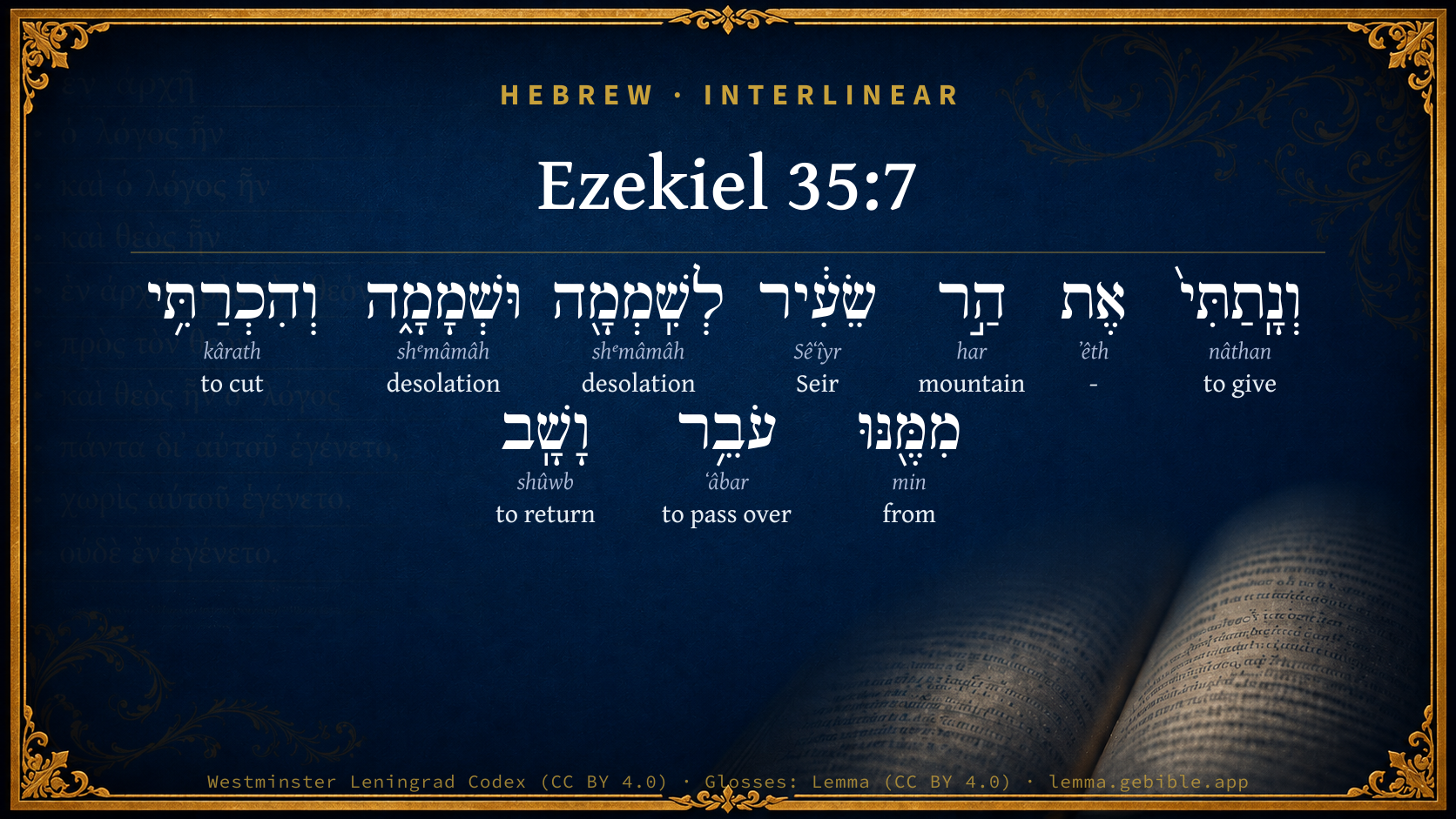
Hebrew (Westminster Leningrad Codex) Ezekiel 35:7 appears in the Hebrew Old Testament. The text above is from the Westminster Leningrad Codex. Each word links to its Strong’s number, a concise gloss, and parsing drawn from the Open Scriptures Hebrew Bible morphology. Click any word for its full Brown-Driver-Briggs (BDB) entry.
Download image
Cite this verse

Ezekiel 35:7 (World English Bible). Public Domain. Lemma interlinear Bible study tool, https://lemma.gebible.app/v/ezekiel/35/7.

Show BibTeX & RIS
BibTeX
RIS
English Translation
Thus will I make Mount Seir an astonishment and a desolation; and I will cut off from it him who passes through and him who returns.
World English Bible · Public Domain
Download a study sheet

One document with this verse’s original text, its word-by-word gloss line, the meaning frame, cross-references with their text, attributed commentary, and full source and license credits — printable, and it pastes into notes with its structure intact.

This verse Autodidact and up

Study sheet (.html) Plain text (.txt)

A passage Seminary Student

Up to 50 verses in one chapter. A passage sheet keeps up to 6 commentary sources and 12 cross-references per verse, in the order this page ranks them, and says so on the sheet whenever that leaves anything out. Ask for a single verse and you get the Autodidact verse sheet above.

Everything on this page stays free to read, with no account — the sheet is a download of what is already on screen, not access to it.

Want to remove ads? Support Godless Engineer
Compare translations 3

The same verse in 3 English versions, stacked beneath the original-language interlinear above. Click any original word for its lexicon entry.

Each is an independent rendering of the whole verse — the interlinear is not word-aligned to these translations.

Highlighted words mark where these versions differ — a whole-verse word diff, not a word-by-word alignment.

  • World English Bible Public Domain
    Thus will I make Mount Seir an astonishment and a desolation; and I will cut off from it him who passes through and him who returns.
  • King James Version Public Domain
    Thus will I make mount Seir most desolate, and cut off from it him that passeth out and him that returneth.
  • unfoldingWord Literal Text CC BY-SA 4.0
    I will make Mount Seir a complete desolation when I cut off from it anyone who passes through and returns again.

unfoldingWord Literal Text — © unfoldingWord, licensed CC BY-SA 4.0. Word-aligned USFM3 via Door43 (git.door43.org/unfoldingWord/en_ult).

Versions to compare (up to 4)

3 of 4 selected

Show all 18 translations

Every available English version of this verse, each an independent rendering of the whole verse.

  • World English Bible Public Domain
    Thus will I make Mount Seir an astonishment and a desolation; and I will cut off from it him who passes through and him who returns.
  • Berean Standard Bible Public Domain
    I will make Mount Seir a desolate waste and will cut off from it those who come and go.
  • Majority Standard Bible Public Domain
    I will make Mount Seir a desolate waste and will cut off from it those who come and go.
  • King James Version Public Domain
    Thus will I make mount Seir most desolate, and cut off from it him that passeth out and him that returneth.
  • American Standard Version (1901) Public Domain
    Thus will I make mount Seir an astonishment and a desolation; and I will cut off from it him that passeth through and him that returneth.
  • Revised Version (1885) Public Domain
    Thus will I make mount Seir an astonishment and a desolation; and I will cut off from it him that passeth through and him that returneth.
  • Geneva Bible (1599) Public Domain
    Thus will I make mount Seir desolate and waste, and cut off from it him that passeth out and him that returneth.
  • Douay-Rheims (1899) Public Domain
    And I will make mount Seir waste and desolate: and I will take away from it him that goeth and him that returneth.
  • Young's Literal Translation Public Domain
    And I have given mount Seir for a desolation and an astonishment, And have cut off from it him who is passing over and him who is returning,
  • Literal Standard Version CC BY-SA 4.0
    And I have given Mount Seir for a desolation and an astonishment, || And have cut off from it him who is passing over and him who is returning,
  • Unlocked Literal Bible CC BY-SA 4.0
    I will make Mount Seir a complete desolation when I cut off from it anyone who passes through and returns again.
  • unfoldingWord Literal Text CC BY-SA 4.0
    I will make Mount Seir a complete desolation when I cut off from it anyone who passes through and returns again.
  • Darby Bible Public Domain
    And I will make mount Seir a desolation and an astonishment, and cut off from it him that passeth out and him that returneth;
  • World Messianic Bible Public Domain
    Thus I will make Mount Seir an astonishment and a desolation. I will cut off from it him who passes through and him who returns.
  • Webster's Bible Public Domain
    Thus will I make mount Seir most desolate, and cut off from it him that passeth out and him that returneth.
  • Free Bible Version CC BY-SA 4.0
    I will turn Mount Seir into a ruined wasteland. I will wipe out anyone who leaves or who tries to return.
  • Bible in Basic English Public Domain
    And I will make Mount Seir a cause for wonder and a waste, cutting off from it all comings and goings.
  • JPS Tanakh (1917) Public Domain
    Thus will I make mount Seir most desolate, and cut off from it him that passeth through and him that returneth.

Literal Standard Version (2020), Covenant Press — licensed CC BY-SA 4.0. Text via the HelloAO Bible API (eBible.org). Unlocked Literal Bible (unfoldingWord) — licensed CC BY-SA 4.0. Text via the HelloAO Bible API (eBible.org). unfoldingWord Literal Text — © unfoldingWord, licensed CC BY-SA 4.0. Word-aligned USFM3 via Door43 (git.door43.org/unfoldingWord/en_ult). Free Bible Version, Dr. Jonathan Gallagher — licensed CC BY-SA 4.0. Text via the HelloAO Bible API (eBible.org).

Word by word

More ways to search: Search by grammar → Find every occurrence → Compare this word →

Practice this passage: Drill this verse → Learn its vocabulary →

שֵׂעִ֔יר
Sêʻîyr
H8165
“Seir”
Noun, Proper
Part of Speech
Noun
Type
Proper
Full BDB Definition

Origin: formed like H8163

TWOT: 2274h , 2274g

Seir = "hairy" or " shaggy" - patriarch of the Horites, the inhabitants of Edom before the descendants of Esau, the Edomites (noun proper masculine) - the land of Edom, south of the Dead Sea (noun proper territorial) - a mountain range in Edom extending from the Dead Sea to the Elanitic Gulf (noun proper mountain) - apparently also called 'Mount Seir' and extending most of the distance of the mountain range itself - a mountain in northern Judah lying westward from Kirjath-jearim (noun proper mountain)
  1. וְנָֽתַתִּי֙ nâthan H5414 “and · to give” Conjunction + Verb, Qal, Sequential Perfect, 1st Person, Common, Singular
  2. אֶת ʼêth H853 “-” Particle, Direct Object
  3. הַ֣ר har H2022 “mountain of” Noun, Common, Masculine, Singular, Construct
  4. לְשִֽׁמְמָ֖ה shᵉmâmâh H8077 “to/for · desolation” Preposition + Noun, Common, Feminine, Singular, Absolute
  5. וּשְׁמָמָ֑ה shᵉmâmâh H8077 “and · desolation” Conjunction + Noun, Common, Feminine, Singular, Absolute
  6. וְהִכְרַתִּ֥י kârath H3772 “and · to cut” Conjunction + Verb, Hiphil, Sequential Perfect, 1st Person, Common, Singular
  7. מִמֶּ֖נּוּ min H4480 “from · us” Preposition + Suffix, Personal, 1st Person, Common, Plural
  8. עֹבֵ֥ר ʻâbar H5674 “passing over” Verb, Qal, Participle Active, Masculine, Singular, Absolute
  9. וָשָֽׁב shûwb H7725 “and · returning” Conjunction + Verb, Qal, Participle Active, Masculine, Singular, Absolute

About this verse

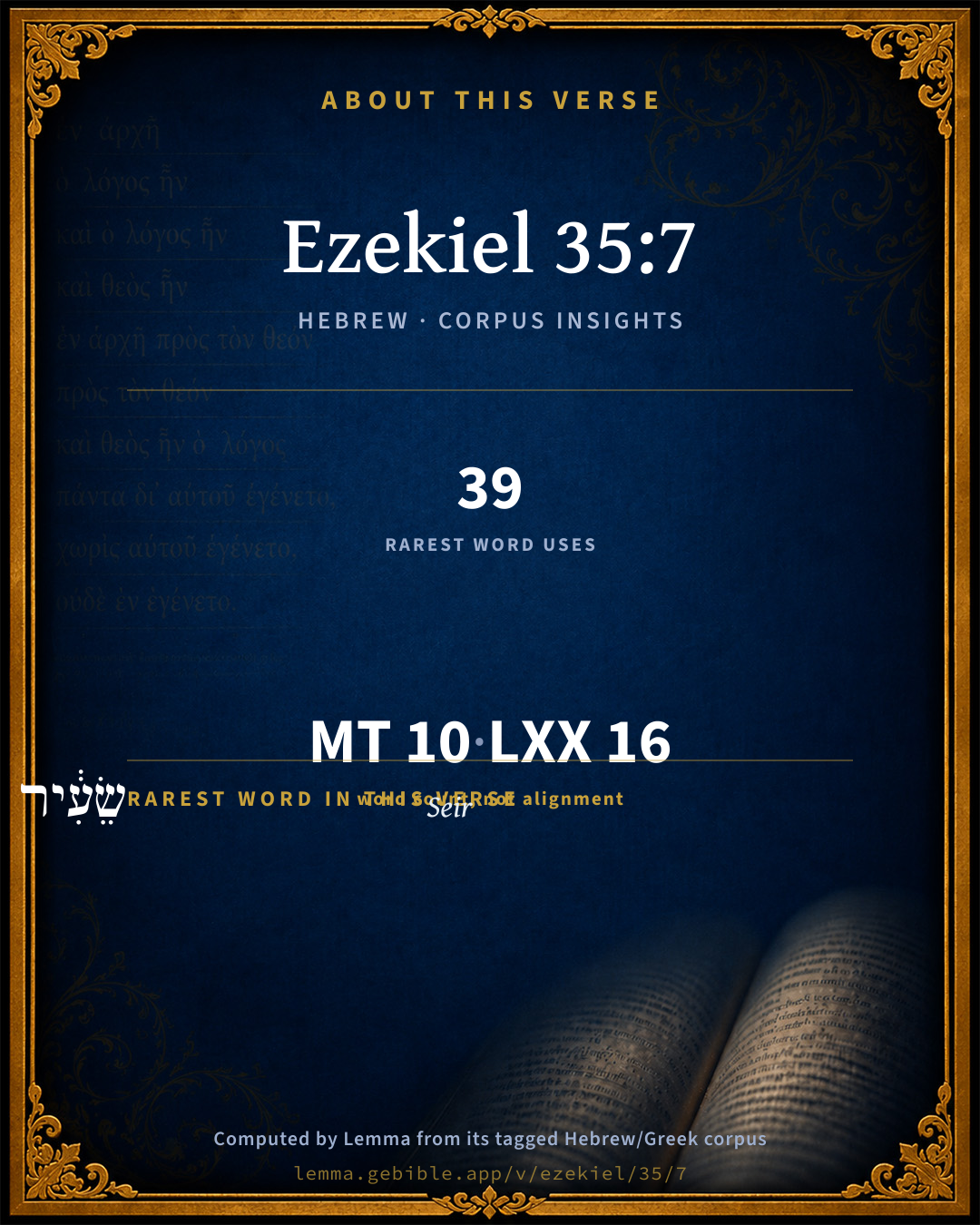
These counts appear in no published source. They are computed here, from the morphology-tagged text and Lemma’s own curated glosses. What Lemma adds →

10
words
9
distinct lemmas
Prophets
section

Shared distinctive vocabulary

שֵׂעִ֔יר Seir H8165 occurs in 38 verses of the Hebrew Bible. Also found in:

Grammatical profile

  • 4 verbs
  • 4 nouns
  • 1 preposition
  • 1 particle

Verb forms

  • וְנָֽתַתִּי֙ Qal · Sequential Perfect
  • וְהִכְרַתִּ֥י Hiphil · Sequential Perfect
  • עֹבֵ֥ר Qal · Participle Active
  • וָשָֽׁב Qal · Participle Active

Repetition

A word recurs within this verse — often emphatic in Hebrew:

  • לְשִֽׁמְמָ֖ה desolation H8077 ×2

Hebrew & Septuagint length

In English translation the verse runs 26 words from the Hebrew and 20 from the Septuagint (LXX English) — closely comparable.

A rough comparison of the two English renderings, which tokenize alike — not a word-level alignment.

Word counts can differ between the Hebrew and the Greek without any difference in meaning — e.g. the Hebrew direct-object marker אֵת has no separate Greek word, and Greek often adds the article ὁ.

In the original languages it is 10 Hebrew tokens and 16 Greek tokens — but the two are counted differently (Hebrew bundles its prefixes and suffixes into one token; the Greek is in lemma form), so that isn’t a like-for-like length.

Cross-references

6

Topical passages linked to Ezekiel 35:7 in the Treasury of Scripture Knowledge — connected by theme and wording, ordered by reader-vote popularity; previews shown in the World English Bible.

  • Judges 5:6–7 In the days of Shamgar the son of Anath, In the days of Jael, the highways were unoccupied, The travelers walked through byways.
  • Ezekiel 29:11 No foot of man shall pass through it, nor foot of animal shall pass through it, neither shall it be inhabited forty years.
  • Ezekiel 35:3 and tell it, Thus says the Lord Yahweh: Behold, I am against you, Mount Seir, and I will stretch out my hand against you, and I will make you a desolation and an astonishment.
  • 2 Chronicles 15:5–6 In those times there was no peace to him who went out, nor to him who came in; but great vexations were on all the inhabitants of the lands.
  • Ezekiel 33:28 I will make the land a desolation and an astonishment; and the pride of her power shall cease; and the mountains of Israel shall be desolate, so that none shall pass through.
  • Ezekiel 35:9 I will make you a perpetual desolation, and your cities shall not be inhabited; and you shall know that I am Yahweh.

Cross-references courtesy of OpenBible.info (CC BY 4.0).

Hebrew and Greek witnesses Masoretic Hebrew ↔ Greek Septuagint

The same verse in the two great witnesses to the Old Testament, shown verse-for-verse.

These are two independent witnesses, not word-aligned to each other, and the Septuagint is shown in lemma (dictionary) form.

Hebrew Ezekiel 35:7 Masoretic · Westminster Leningrad Codex

וְנָֽתַתִּי֙ אֶת הַ֣ר שֵׂעִ֔יר לְשִֽׁמְמָ֖ה וּשְׁמָמָ֑ה וְהִכְרַתִּ֥י מִמֶּ֖נּוּ עֹבֵ֥ר וָשָֽׁב

Thus will I make Mount Seir an astonishment and a desolation; and I will cut off from it him who passes through and him who returns.

World English Bible · Public Domain

Greek LXX Ezekiel 35:7 Septuagint · lemma form

καί δίδωμι ὁ ὄρος σηιρ εἰς ἔρημος καί ἐρημόω καί ἀποὀλλύω ἀπό αὐτός ἄνθρωπος καί κτῆνος

And I will make mount Seir a waste, and desolate, and I will destroy from off it men and cattle:

LXX2012 (modern English Septuagint) · Public Domain

On this verse, The Cambridge Bible for Schools and Colleges discusses the Septuagint’s reading. Read the note in Commentary ↓

Hebrew: Westminster Leningrad Codex (CC BY 4.0). Greek: Septuagint (public domain); English from LXX2012 (modern English Septuagint) (Public Domain). How the Septuagint differs from the Hebrew →

Targum (Aramaic paraphrase)

1

The Targum is the ancient Jewish Aramaic paraphrase of the Hebrew Scriptures — an interpretive translation, not the Hebrew text itself. Onkelos (literal) and Pseudo-Jonathan (expansive) render the Torah, and Jonathan the Prophets. Coverage is partial: where no permissively-licensed English translation exists for a verse, only the Aramaic is shown. This is verse-level text, not a word-by-word alignment to the Hebrew.

  1. Targum Jonathan Prophets (Joshua–Malachi)
    וְאֶתֵּן יַת טוּרָא דְשֵׂעִיר לְצָדוּ וּלְאִשְׁתְּמָמוּ וֶאֱשֵׁיצֵי מִנֵיהּ דְעָדֵי וּדְתָאֵיב:

    (no public-domain English translation for this verse)

    Targum Jonathan — Aramaic: “Mikraot Gedolot” (public domain). English: “Sefaria Community Translation” (CC0 1.0 (public-domain dedication)); “London "Chaldee Paraphrase," 1871” (public domain). Text via Sefaria.

Commentary

Notes on Ezekiel 35:7 from classic Christian and Jewish commentators (each source and its license shown beneath its notes). The classic Christian expositions comment on the surrounding passage and are grouped to its opening verse, so a note may address several verses; the Jewish commentaries on the Tanakh (Rashi and others) are per-verse, so they appear only where the commentator wrote on this verse.

Lemma curates 59 commentaries, every one of them public domain or Creative Commons licensed, each selected and text-cleaned for this edition rather than reprinted as found. About our sources →

Trapp's Complete Commentary

John Trapp

Eze 35:7 Thus will I make mount Seir most desolate, and cut off from it him that passeth out and him that returneth.

Ver. 7. Most desolate.] See Eze 35:3. Iterum repetit, ne excidisse videatur. I am in good earnest.

John Trapp, A Commentary or Exposition upon All the Books of the Old and New Testament (1647–1656) — public domain. Text from a community e-Sword module.

Joseph Benson's Commentary

Eze 35:7-12. Thus will I make mount Seir most desolate — Hebrew, לשׁממה ושׁממה, a desolation and a desolation, or, a desolation and an astonishment, as Bishop Newton renders it, following the reading of several MSS. And cut off from it him that passeth out, &c. — No travellers shall go forward or backward in it with safety: see the margin. And thy cities shall not return — Thy cities shall not be restored to thee again. This was exactly fulfilled; for the Nabatheans having driven the Edomites out of their ancient habitations, in the time of the Babylonish captivity, they settled themselves in the southern part of Judea, where they were afterward conquered by Hyrcanus, and obliged to embrace the Jewish religion, and so became at length incorporated with that nation. — Dr. Prideaux. Because thou hast said, These two nations, &c., shall be mine — The two nations and countries here spoken of mean the two kingdoms of Israel and Judah. The Edomites had settled themselves in part of Judea, and hoped to have got possession both of the land of Judah and the land of Israel in time. The Ammonites had the same design, as appears from Jer 49:1. Whereas, or although, the Lord was there — Was still with his ancient people, and had not yet entirely abandoned them, or withdrawn his protection from their country, and given it up to be laid waste. These Edomites, it seems, did not believe that God had placed his name in Judea, had chosen it for the place of his peculiar residence, and would never quite relinquish his property in it. Therefore I will even do according to thine anger — As thou out of anger and envy didst hurt them, so will I hurt thee. I will make myself known among them — I will make my people see that I have not quite cast them off, by the punishments I will bring upon thee on account of the evil thou hast done to them. And thou shalt know that I am the Lord — Thou shalt then be convinced that I am the sovereign Lord of all things.

Joseph Benson's Commentary on the Old and New Testaments (1811–1818) — public domain. Text from a community e-Sword module.

Jamieson, Fausset & Brown

Robert Jamieson, A. R. Fausset & David Brown

cut off . . . him that passeth--that is, every passer to and fro; "the highways shall be unoccupied" (Eze 29:11; Jdg 5:6).

Jamieson, Fausset & Brown — Commentary Critical and Explanatory on the Whole Bible (1871) — public domain (CC PDM 1.0). Text via the HelloAO Bible API.

Ellicott's Commentary for English Readers

(7) Him that passeth out.—The cutting off of the traveller is a striking feature in the doom of Edom, for her nomadic tribes had been the great carriers between India and the East and Egypt, and she had grown rich by this commerce. The fierceness of the few tribes now wandering over the land make even the occasional visit of the curious traveller a matter of difficulty and danger.

A Bible Commentary for English Readers, edited by Charles John Ellicott (1878–1897) — public domain. Text from a community e-Sword module.

The Cambridge Bible for Schools and Colleges

gen. ed. J. J. S. Perowne

7. passeth out … returneth] A phrase like “shut up and free,” used to denote all classes, cf. “the shod and the barefoot” in Arab. LXX. has altered into “man and beast,” the usual phrase after “cut off,” e.g. Eze_25:13.

The Cambridge Bible for Schools and Colleges (gen. ed. J. J. S. Perowne; Cambridge University Press, 1878–1918) — public domain. Text from a community e-Sword module.

John Gill's Exposition

Thus will I make Mount Seir most desolate,.... By shedding the blood of the inhabitants of it; and as Rome will be, when it will be utterly burnt with fire, as that city will, and the flesh of the whore also, and made desolate; and when all the vials shall be poured out on the antichristian states under her jurisdiction, Rev 16:1,

and cut off from it him that passeth out and him that returneth: every traveller that passeth to and fro; it shall no more be frequented by merchants; nor will there be any merchandise any more in it, Rev 18:11.

John Gill's Exposition of the Whole Bible (1746–1763) — public domain (CC PDM 1.0). Text via the HelloAO Bible API.

Matthew Poole's English Annotations

All travellers that go to or from Edom’s country, or his cities; or possibly it may intimate the close sieges with which his cities should be so begirt, that none should attempt to go out or go in, but it should cost them their life: so Jericho close besieged, none went in or out, Jos 6:1.

Matthew Poole's English Annotations on the Holy Bible (1683–1685) — public domain. Text from a community e-Sword/MySword module.

The Pulpit Commentary

Thus will I make Mount Seir most desolate; literally, desolation and a desolation (hmmvW hMm) or, as in the Revised Version, an astonishment and a desolation; changing hmm into hMvm, for which, however, there is no sufficient warrant. And I will out off him that passeth out (or, through) and him that returneth. No more should traders or travelers pass through the land of Edom or go to and return from it. (cf. Eze_33:28; Zec_7:1-5 Zec_9:8, Zec_9:10)

The Pulpit Commentary (1880–1919), ed. H.D.M. Spence-Jones & Joseph S. Exell — public domain. Text from a community e-Sword module.

John Wesley's Explanatory Notes

That passeth out - All travelers that go to or from Edom.

John Wesley, Explanatory Notes Upon the Whole Bible (1754–1765) — public domain. Text via the GEBible commentary corpus.

unfoldingWord translationNotes

Door43 World Missions Community

General Information:

This continues the message that Ezekiel is to speak to Mount Seir. The message is for all the people of Edom.

when I cut off from it anyone who passes through and returns again

Possible meanings are 1) "cut off" is a metaphor that means to destroy. AT: "I will destroy anyone who enters it or leaves it" or 2) "cut off" is a metaphor that means to stop someone from doing something. AT: "I will make it so that people do not travel back and forth through it" (See: Metaphor)

those who were killed by the sword

Here "sword" represents enemies who fought them in battle. This can be stated in active form. See how you translated this in Ezekiel 31:17. AT: "those whom enemies have killed with swords" or "those who have died in battle" (See: Active or Passive and Metonymy)

a perpetual desolation

"desolate forever." This may be an exaggeration to emphasize the destruction. (See: Hyperbole and Generalization)

Your cities will not be inhabited

This can be stated in active form. This may be an exaggeration for emphasis. AT: "People will not live in your cities" (See: Active or Passive and Hyperbole and Generalization)

but you will know

Here "you" is plural. God is speaking to the people of Mount Seir, rather than to a single mountain. (See: Forms of You)

translationWords

desolate

cut off

Yahweh

unfoldingWord translationNotes — © Distant Shores Media and the Door43 World Missions Community, licensed CC BY-SA 4.0. Source: git.door43.org/Door43/en_tn.

Lesson kit

Teaching starters — assembled from the data on this page, not authored interpretation. Every prompt links to the verse data it draws on. Edit before teaching.

Ezekiel, in the Prophets, opens this verse with 10 words (9 distinct Hebrew lemmas). Its most distinctive word is Sêʻîyr (“Seir”). A historical commentator’s framing appears above. Read the whole chapter for the surrounding context.

Discussion questions

  1. How does “Seir” (Sêʻîyr) shape what this verse is saying?
  2. Genesis 14:6 shares the word «Seir» with this verse. How do the two illuminate each other?
  3. “desolation” occurs 2× in this one verse. What is the effect of the repetition?
  4. The translations on this page render this verse differently — a whole-verse word diff, not a word-by-word alignment. What might account for the different wordings?
  5. The verb «וְנָֽתַתִּי֙» is Qal Sequential Perfect. How does its form color the action?
  6. Reading how Trapp's Complete Commentary and Joseph Benson's Commentary read this verse, where do the two commentators agree and where do they part?

Things to notice

Reading settings

Reading text

Shown beneath each verse's original-language words.

Old Testament
Old Testament edition

Read the OT as the Masoretic Hebrew (MT) or the Greek Septuagint (LXX).

English shown for the Greek Septuagint (in the Hebrew ↔ Greek comparison).

Comparing translations? Open the Compare panel on any verse page to stack up to four side by side.