
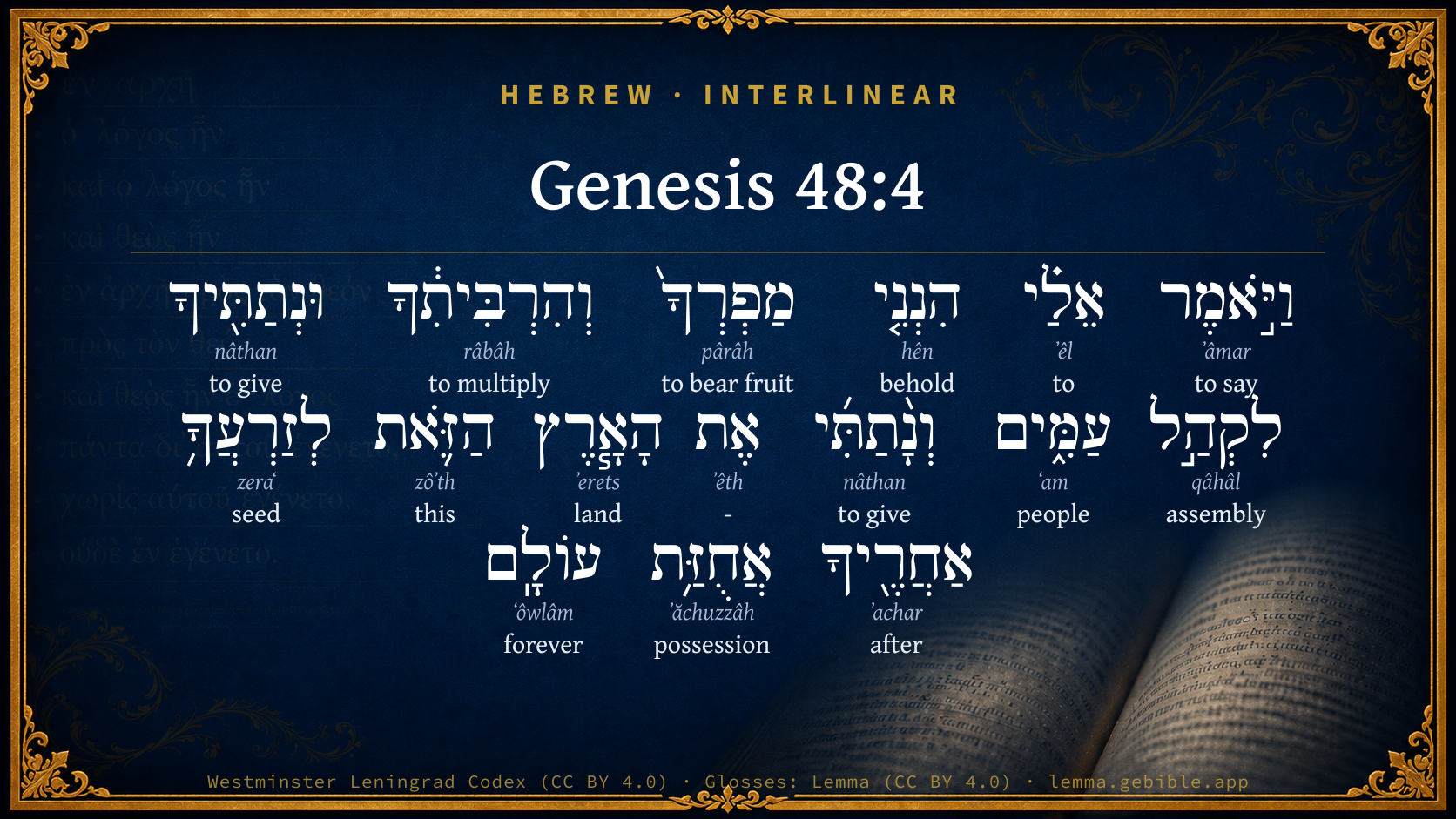
Genesis 48:4

Hebrew (Westminster Leningrad Codex) Genesis 48:4 appears in the Hebrew Old Testament. The text above is from the Westminster Leningrad Codex. Each word links to its Strong’s number, a concise gloss, and parsing drawn from the Open Scriptures Hebrew Bible morphology. Click any word for its full Brown-Driver-Briggs (BDB) entry.
Download image
Cite this verse

Genesis 48:4 (World English Bible). Public Domain. Lemma interlinear Bible study tool, https://lemma.gebible.app/v/genesis/48/4.

Show BibTeX & RIS
BibTeX
RIS
English Translation
and said to me, 'Behold, I will make you fruitful, and multiply you, and I will make of you a company of peoples, and will give this land to your seed after you for an everlasting possession.'
World English Bible · Public Domain
Download a study sheet

One document with this verse’s original text, its word-by-word gloss line, the meaning frame, cross-references with their text, attributed commentary, and full source and license credits — printable, and it pastes into notes with its structure intact.

This verse Autodidact and up

Study sheet (.html) Plain text (.txt)

A passage Seminary Student

Up to 50 verses in one chapter. A passage sheet keeps up to 6 commentary sources and 12 cross-references per verse, in the order this page ranks them, and says so on the sheet whenever that leaves anything out. Ask for a single verse and you get the Autodidact verse sheet above.

Everything on this page stays free to read, with no account — the sheet is a download of what is already on screen, not access to it.

Want to remove ads? Support Godless Engineer
Compare translations 3

The same verse in 3 English versions, stacked beneath the original-language interlinear above. Click any original word for its lexicon entry.

Each is an independent rendering of the whole verse — the interlinear is not word-aligned to these translations.

Highlighted words mark where these versions differ — a whole-verse word diff, not a word-by-word alignment.

  • World English Bible Public Domain
    and said to me, 'Behold, I will make you fruitful, and multiply you, and I will make of you a company of peoples, and will give this land to your seed after you for an everlasting possession.'
  • King James Version Public Domain
    And said unto me, Behold, I will make thee fruitful, and multiply thee, and I will make of thee a multitude of people; and will give this land to thy seed after thee for an everlasting possession.
  • unfoldingWord Literal Text CC BY-SA 4.0
    and said to me, ‘Behold, I am making you fruitful, and I will multiply you and make you into an assembly of peoples. And I will give this land to your offspring after you an everlasting possession.’

unfoldingWord Literal Text — © unfoldingWord, licensed CC BY-SA 4.0. Word-aligned USFM3 via Door43 (git.door43.org/unfoldingWord/en_ult).

Versions to compare (up to 4)

3 of 4 selected

Show all 18 translations

Every available English version of this verse, each an independent rendering of the whole verse.

  • World English Bible Public Domain
    and said to me, 'Behold, I will make you fruitful, and multiply you, and I will make of you a company of peoples, and will give this land to your seed after you for an everlasting possession.'
  • Berean Standard Bible Public Domain
    and told me, ‘Behold, I will make you fruitful and multiply you; I will make you a multitude of peoples, and will give this land to your descendants after you as an everlasting possession.’
  • Majority Standard Bible Public Domain
    and told me, ‘Behold, I will make you fruitful and multiply you; I will make you a multitude of peoples, and will give this land to your descendants after you as an everlasting possession.’
  • King James Version Public Domain
    And said unto me, Behold, I will make thee fruitful, and multiply thee, and I will make of thee a multitude of people; and will give this land to thy seed after thee for an everlasting possession.
  • American Standard Version (1901) Public Domain
    and said unto me, Behold, I will make thee fruitful, and multiply thee, and I will make of thee a company of peoples, and will give this land to thy seed after thee for an everlasting possession.
  • Revised Version (1885) Public Domain
    and said unto me, Behold, I will make thee fruitful, and multiply thee, and I will make of thee a company of peoples; and will give this land to thy seed after thee for an everlasting possession.
  • Geneva Bible (1599) Public Domain
    And he sayde vnto me, Behold, I wil make thee fruitefull, and will multiplie thee, and will make a great number of people of thee, and will giue this lande vnto thy seede after thee for an euerlasting possession.
  • Douay-Rheims (1899) Public Domain
    And he said: I will cause thee to increase and multiply, and I will make of thee a multitude of people: and I will give this land to thee, and to thy seed after thee for an everlasting possession.
  • Young's Literal Translation Public Domain
    and saith unto me, Lo, I am making thee fruitful, and have multiplied thee, and given thee for an assembly of peoples, and given this land to thy seed after thee, a possession age-during.
  • Literal Standard Version CC BY-SA 4.0
    and says to me, Behold, I am making you fruitful, and have multiplied you, and given you for an assembly of peoples, and given this land to your seed after you, a continuous possession.
  • Unlocked Literal Bible CC BY-SA 4.0
    and said to me, 'Behold, I will make you fruitful, and multiply you. I will make of you an assembly of nations. I will give this land to your descendants as an everlasting possession.'
  • unfoldingWord Literal Text CC BY-SA 4.0
    and said to me, ‘Behold, I am making you fruitful, and I will multiply you and make you into an assembly of peoples. And I will give this land to your offspring after you an everlasting possession.’
  • Darby Bible Public Domain
    and he said to me, Behold, I will make thee fruitful and multiply thee, and I will make of thee a company of peoples; and will give this land to thy seed after thee [for] an everlasting possession.
  • World Messianic Bible Public Domain
    and said to me, ‘Behold, I will make you fruitful, and multiply you, and I will make of you a company of peoples, and will give this land to your offspring after you for an everlasting possession.’
  • Webster's Bible Public Domain
    And said to me, Behold I will make thee fruitful, and multiply thee, and I will make of thee a multitude of people; and will give this land to thy seed after thee, for an everlasting possession.
  • Free Bible Version CC BY-SA 4.0
    He told me, ‘Listen! I will make you prosperous and make your descendants so numerous that you will become the ancestor of many nations, and I will give this land to your descendants to own forever.’
  • Bible in Basic English Public Domain
    And said to me, Truly, I will make you fertile and give you increase and will make of you a great family of nations: and I will give this land to your seed after you to be their heritage for ever.
  • JPS Tanakh (1917) Public Domain
    and said unto me: Behold, I will make thee fruitful, and multiply thee, and I will make of thee a company of peoples; and will give this land to thy seed after thee for an everlasting possession.

Literal Standard Version (2020), Covenant Press — licensed CC BY-SA 4.0. Text via the HelloAO Bible API (eBible.org). Unlocked Literal Bible (unfoldingWord) — licensed CC BY-SA 4.0. Text via the HelloAO Bible API (eBible.org). unfoldingWord Literal Text — © unfoldingWord, licensed CC BY-SA 4.0. Word-aligned USFM3 via Door43 (git.door43.org/unfoldingWord/en_ult). Free Bible Version, Dr. Jonathan Gallagher — licensed CC BY-SA 4.0. Text via the HelloAO Bible API (eBible.org).

Word by word

More ways to search: Search by grammar → Find every occurrence → Compare this word →

Practice this passage: Drill this verse → Learn its vocabulary →

מַפְרְךָ֙
pârâh
H6509
“bearing fruit · you”
Verb, Hiphil, Participle Active, Masculine, Singular, Construct + Suffix, Personal, 2nd Person, Masculine, Singular
Part of Speech
Verb
Stem
Hiphil
Form
Participle Active
Gender
Masculine
Number
Singular
State
Construct
Full BDB Definition

Origin: a primitive root

TWOT: 1809

to bear fruit, be fruitful, branch off - (Qal) to bear fruit, be fruitful - (Hiphil) - to cause to bear fruit - to make fruitful - to show fruitfulness, bear fruit
  1. וַיֹּ֣אמֶר ʼâmar H559 “and · to say” Conjunction + Verb, Qal, Sequential Imperfect, 3rd Person, Masculine, Singular
  2. אֵלַ֗י ʼêl H413 “to · me” Preposition + Suffix, Personal, 1st Person, Common, Singular
  3. הִנְנִ֤י hên H2005 “behold · me” Particle, Demonstrative + Suffix, Personal, 1st Person, Common, Singular
  4. וְהִרְבִּיתִ֔ךָ râbâh H7235 “and · to multiply · you” Conjunction + Verb, Hiphil, Sequential Perfect, 1st Person, Common, Singular + Suffix, Personal, 2nd Person, Masculine, Singular
  5. וּנְתַתִּ֖יךָ nâthan H5414 “and · to give · you” Conjunction + Verb, Qal, Sequential Perfect, 1st Person, Common, Singular + Suffix, Personal, 2nd Person, Masculine, Singular
  6. לִקְהַ֣ל qâhâl H6951 “to/for · assembly of” Preposition + Noun, Common, Masculine, Singular, Construct
  7. עַמִּ֑ים ʻam H5971 “peoples” Noun, Common, Masculine, Plural, Absolute
  8. וְנָ֨תַתִּ֜י nâthan H5414 “and · to give” Conjunction + Verb, Qal, Sequential Perfect, 1st Person, Common, Singular
  9. אֶת ʼêth H853 “-” Particle, Direct Object
  10. הָאָ֧רֶץ ʼerets H776 “the · land” Particle, Definite Article + Noun, Common, Both, Singular, Absolute
  11. הַזֹּ֛את zôʼth H2063 “the · this” Particle, Definite Article + Pronoun, Demonstrative, Feminine, Singular
  12. לְזַרְעֲךָ֥ zeraʻ H2233 “to/for · seed · your” Preposition + Noun, Common, Masculine, Singular, Construct + Suffix, Personal, 2nd Person, Masculine, Singular
  13. אַחֲרֶ֖יךָ ʼachar H310 “after · you” Preposition + Suffix, Personal, 2nd Person, Masculine, Singular
  14. אֲחֻזַּ֥ת ʼăchuzzâh H272 “possession of” Noun, Common, Feminine, Singular, Construct
  15. עוֹלָֽם ʻôwlâm H5769 “forever” Noun, Common, Masculine, Singular, Absolute

About this verse

These counts appear in no published source. They are computed here, from the morphology-tagged text and Lemma’s own curated glosses. What Lemma adds →

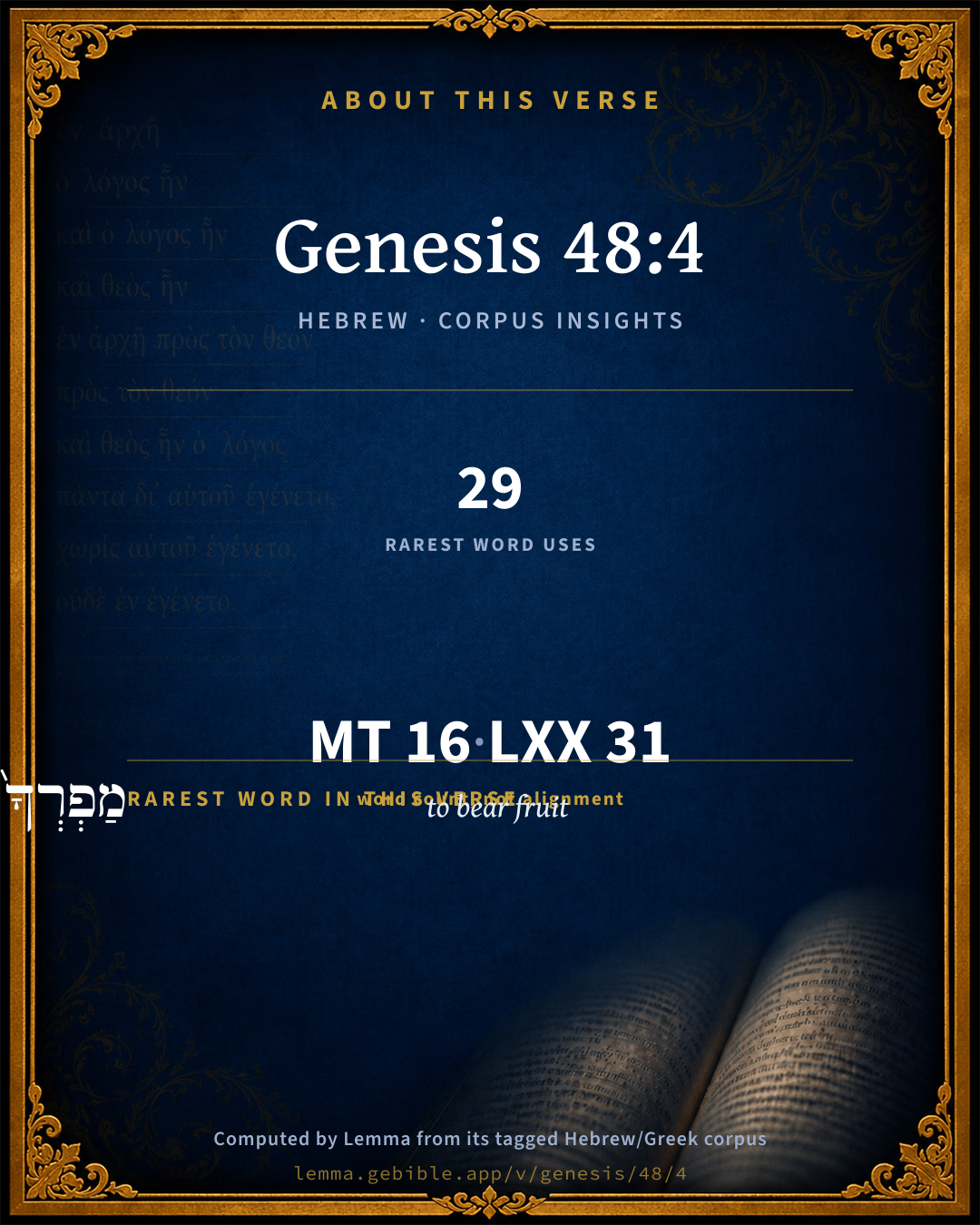
16
words
15
distinct lemmas
Pentateuch
section

Shared distinctive vocabulary

מַפְרְךָ֙ to bear fruit H6509 occurs in 28 verses of the Hebrew Bible. Also found in:

Grammatical profile

  • 5 verbs
  • 6 nouns
  • 1 pronoun
  • 2 prepositions
  • 2 particles

Verb forms

  • וַיֹּ֣אמֶר Qal · Sequential Imperfect
  • מַפְרְךָ֙ Hiphil · Participle Active
  • וְהִרְבִּיתִ֔ךָ Hiphil · Sequential Perfect
  • וּנְתַתִּ֖יךָ Qal · Sequential Perfect
  • וְנָ֨תַתִּ֜י Qal · Sequential Perfect

Repetition

A word recurs within this verse — often emphatic in Hebrew:

  • וּנְתַתִּ֖יךָ to give H5414 ×2

Hebrew & Septuagint length

In English translation the verse runs 37 words from the Hebrew and 38 from the Septuagint (LXX English) — closely comparable.

A rough comparison of the two English renderings, which tokenize alike — not a word-level alignment.

Word counts can differ between the Hebrew and the Greek without any difference in meaning — e.g. the Hebrew direct-object marker אֵת has no separate Greek word, and Greek often adds the article ὁ.

In the original languages it is 16 Hebrew tokens and 31 Greek tokens — but the two are counted differently (Hebrew bundles its prefixes and suffixes into one token; the Greek is in lemma form), so that isn’t a like-for-like length.

Cross-references

16

Topical passages linked to Genesis 48:4 in the Treasury of Scripture Knowledge — connected by theme and wording, ordered by reader-vote popularity; previews shown in the World English Bible.

  • Genesis 17:8 I will give to you, and to your seed after you, the land where you are traveling, all the land of Canaan, for an everlasting possession. I will be their God."
  • Genesis 35:11 God said to him, "I am God Almighty. Be fruitful and multiply. A nation and a company of nations will be from you, and kings will come out of your loins.
  • Genesis 12:2 I will make of you a great nation. I will bless you, and make your name great. You will be a blessing.
  • Genesis 13:15–16 for all the land which you see, I will give to you, and to your offspring forever.
  • Genesis 17:13 He who is born in your house, and he who is bought with your money, must be circumcised. My covenant will be in your flesh for an everlasting covenant.
  • Genesis 22:17 that in blessing I will bless you, and in multiplying I will multiply your seed as the stars of the heavens, and as the sand which is on the seashore. Your seed will possess the gate of his enemies.
  • Genesis 26:4 I will multiply your seed as the stars of the sky, and will give to your seed all these lands. In your seed will all the nations of the earth be blessed,
  • Genesis 28:3 May God Almighty bless you, and make you fruitful, and multiply you, that you may be a company of peoples,
  • Genesis 28:13–15 Behold, Yahweh stood above it, and said, "I am Yahweh, the God of Abraham your father, and the God of Isaac. The land whereon you lie, to you will I give it, and to your seed.
  • Genesis 32:12 You said, 'I will surely do you good, and make your seed as the sand of the sea, which can't be numbered because there are so many.'"
  • Genesis 46:3 He said, "I am God, the God of your father. Don't be afraid to go down into Egypt; for there I will make of you a great nation.
  • Genesis 47:27 Israel lived in the land of Egypt, in the land of Goshen; and they got themselves possessions therein, and were fruitful, and multiplied exceedingly.
  • Exodus 1:7 The children of Israel were fruitful, and increased abundantly, and multiplied, and grew exceedingly mighty; and the land was filled with them.
  • Deuteronomy 32:8 When the Most High gave to the nations their inheritance, When he separated the children of men, He set the bounds of the peoples According to the number of the children of Israel.
  • Amos 9:14–15 I will bring back the captivity of my people Israel, And they will rebuild the ruined cities, and inhabit them; and they will plant vineyards, and drink wine from them. They shall also make gardens, And eat the fruit of them.
  • Exodus 1:11 Therefore they set taskmasters over them to afflict them with their burdens. They built storage cities for Pharaoh: Pithom and Raamses.

Cross-references courtesy of OpenBible.info (CC BY 4.0).

Hebrew and Greek witnesses Masoretic Hebrew ↔ Greek Septuagint

The same verse in the two great witnesses to the Old Testament, shown verse-for-verse.

These are two independent witnesses, not word-aligned to each other, and the Septuagint is shown in lemma (dictionary) form.

Hebrew Genesis 48:4 Masoretic · Westminster Leningrad Codex

וַיֹּ֣אמֶר אֵלַ֗י הִנְנִ֤י מַפְרְךָ֙ וְהִרְבִּיתִ֔ךָ וּנְתַתִּ֖יךָ לִקְהַ֣ל עַמִּ֑ים וְנָ֨תַתִּ֜י אֶת הָאָ֧רֶץ הַזֹּ֛את לְזַרְעֲךָ֥ אַחֲרֶ֖יךָ אֲחֻזַּ֥ת עוֹלָֽם

and said to me, 'Behold, I will make you fruitful, and multiply you, and I will make of you a company of peoples, and will give this land to your seed after you for an everlasting possession.'

World English Bible · Public Domain

Greek LXX Genesis 48:4 Septuagint · lemma form

καί εἶπον ἐγώ ἰδού ἐγώ αὐξάνω σύ καί πληθύνω σύ καί ποιέω σύ εἰς συναγωγή ἔθνος καί δίδωμι σύ ὁ γῆ οὗτος καί ὁ σπέρμα σύ μετά σύ εἰς κατάσχεσις αἰώνιος

and said to me, Behold, I will increase you, and multiply you, and will make of you multitudes of nations; and I will give this land to you, and to your seed after you, for an everlasting possession.

LXX2012 (modern English Septuagint) · Public Domain

Hebrew: Westminster Leningrad Codex (CC BY 4.0). Greek: Septuagint (public domain); English from LXX2012 (modern English Septuagint) (Public Domain). How the Septuagint differs from the Hebrew →

Targum (Aramaic paraphrase)

2

The Targum is the ancient Jewish Aramaic paraphrase of the Hebrew Scriptures — an interpretive translation, not the Hebrew text itself. Onkelos (literal) and Pseudo-Jonathan (expansive) render the Torah, and Jonathan the Prophets. Coverage is partial: where no permissively-licensed English translation exists for a verse, only the Aramaic is shown. This is verse-level text, not a word-by-word alignment to the Hebrew.

  1. Targum Onkelos Torah (Genesis–Deuteronomy)
    וַאֲמַר לִי הָא אֲנָא מַפְשִׁינָךְ וְאַסְגִּנָּךְ וְאֶתְּנִנָּךְ לְכִנְשַׁת שִׁבְטִין וְאֶתֵּן יָת אַרְעָא הָדָא לִבְנָיךְ בַּתְרָךְ אַחֲסָנַת עֲלָם

    (no public-domain English translation for this verse)

    Targum Onkelos — Aramaic: “Onkelos Genesis” (public domain); “Onkelos Exodus” (public domain); “Onkelos Leviticus” (public domain); “Onkelos Numbers” (public domain); “Onkelos Deuteronomy” (public domain). English: “Sefaria Community Translation” (CC0 1.0 (public-domain dedication)); “J.W. Etheridge. The Targums of Onkelos and Jonathan Ben Uzziel on the Pentateuch. London: Longmans, Green, 1862” (public domain). Text via Sefaria.

  2. Targum Pseudo-Jonathan Torah (Genesis–Deuteronomy)
    וַאֲמַר לִי הָא נָא מַפִּישׁ לָךְ וּמַסְגִי לָךְ וְאִיתְּנִינָךְ לְכִנְשַׁת שִׁבְטִין וְאֶתֵּן יַת אַרְעָא הָדָא לִבְרָךְ בַּתְרָךְ אַחְסָנַת עֲלָם

    And He said to me, Behold, I will increase thee and multiply thee, and make thee an assemblage of tribes, and will give this land to thy sons after thee for an everlasting inheritance.

    Targum Pseudo-Jonathan — Aramaic: “Targum Jonathan on Genesis” (public domain); “Targum Jonathan on Exodus” (public domain); “Targum Jonathan on Leviticus” (public domain); “Targum Jonathan on Numbers” (public domain); “Targum Jonathan on Deuteronomy” (public domain). English: “The Targum of Jonathan ben Uzziel, trans. J. W. Etheridge, London, 1862” (public domain). Text via Sefaria.

Commentary

Notes on Genesis 48:4 from classic Christian and Jewish commentators (each source and its license shown beneath its notes). The classic Christian expositions comment on the surrounding passage and are grouped to its opening verse, so a note may address several verses; the Jewish commentaries on the Tanakh (Rashi and others) are per-verse, so they appear only where the commentator wrote on this verse.

Lemma curates 59 commentaries, every one of them public domain or Creative Commons licensed, each selected and text-cleaned for this edition rather than reprinted as found. About our sources →

Trapp's Complete Commentary

John Trapp

Gen 48:4 And said unto me, Behold, I will make thee fruitful, and multiply thee, and I will make of thee a multitude of people; and will give this land to thy seed after thee [for] an everlasting possession.

Ver. 4. For an everlasting possession.] This is fully made good to the Israel of God, those heirs of heaven.

John Trapp, A Commentary or Exposition upon All the Books of the Old and New Testament (1647–1656) — public domain. Text from a community e-Sword module.

Joseph Benson's Commentary

Gen 48:4. For an everlasting possession — His natural seed should long inherit Canaan, and his spiritual seed enjoy the heavenly inheritance typified by Canaan, for ever.

Joseph Benson's Commentary on the Old and New Testaments (1811–1818) — public domain. Text from a community e-Sword module.

Geneva Bible (1599)

Geneva Bible translators

Which is true in the carnal Israel unto the coming of Christ, and in the spiritual forever.

Geneva Bible (1599) marginal notes — public domain. Text via Bolls.life.

Jamieson, Fausset & Brown

Robert Jamieson, A. R. Fausset & David Brown

Behold, I will make thee fruitful--This is a repetition of the covenant (Gen 28:13-15; Gen 35:12). Whether these words are to be viewed in a limited sense, as pointing to the many centuries during which the Jews were occupiers of the Holy Land, or whether the words bear a wider meaning and intimate that the scattered tribes of Israel are to be reinstated in the land of promise, as their "everlasting possession," are points that have not yet been satisfactorily determined.

Jamieson, Fausset & Brown — Commentary Critical and Explanatory on the Whole Bible (1871) — public domain (CC PDM 1.0). Text via the HelloAO Bible API.

Ellicott's Commentary for English Readers

(4) A multitude of people.—In Gen_35:11 the words are “a congregation (or church) of nations;” here “a congregation (same word) of peoples.” (See Note there.)

A Bible Commentary for English Readers, edited by Charles John Ellicott (1878–1897) — public domain. Text from a community e-Sword module.

John Gill's Exposition

And said unto me, behold, I will make thee fruitful,.... In a spiritual sense, in grace and good works; in a literal sense, in an increase of worldly substance, and especially of children:

and multiply thee; make his posterity numerous as the sand of the sea:

and I will make of thee a multitude of people; a large nation, consisting of many tribes, even a company of nations, as the twelve tribes of Israel were:

and I will give this land unto thy seed after thee, for an everlasting possession; the land of Canaan, they were to possess as long as they were the people of God, and obedient to his law; by which obedience they held the land, even unto the coming of the Messiah, whom they rejected, and then they were cast out, and a "Loammi" (i.e. not my people, Hos 1:9) written upon them, and their civil polity, as well as church state, at an end: and besides, Canaan was a type of the eternal inheritance of the saints in heaven, the spiritual Israel of God, which will be possessed by them to all eternity.

John Gill's Exposition of the Whole Bible (1746–1763) — public domain (CC PDM 1.0). Text via the HelloAO Bible API.

Haydock's Catholic Bible Commentary

Possession. He makes mention of this first vision of God to him, to shew that he had a right to Chanaan, and to adopt the two children of Joseph, who were each to have as much as his own children. (Haydock) --- Jacob’s posterity enjoyed that land till the Messias came, with some few interruptions. But his spiritual children inherit a much better country, (of which this was a figure) an eternal kingdom in heaven. (Calmet)

George Leo Haydock (1774–1849), Haydock's Catholic Family Bible and Commentary, 1859 edition — public domain. Excludes Psalms (Douay-Rheims chapter numbering differs from Protestant) and Deuterocanonical books (Catholic canon only).

Whedon's Commentary on the Bible

Daniel D. Whedon

4. An everlasting possession — “The great family promise absorbs Jacob’s soul. He is identified with the nation which is to spring from his loins, whose home is to be Canaan, whence blessings are to flow down all ages and to all lands. He sets this sublime mission before Joseph as a far higher dignity for his children than princedoms in Egypt, and so claims for himself Ephraim and Manasseh.” — Newhall.

Daniel D. Whedon (gen. ed.), Commentary on the Old and New Testaments (1874–1909) — public domain. Text from a community e-Sword module.

Rashi

Rabbi Shlomo Yitzchaki (Rashi)

ונתתיך לקהל עמים AND I WILL MAKE OF THEE AN ASSEMBLY OF PEOPLES — He announced to me that there were yet to issue from me an assembly of peoples (i.e. at least two more tribes). Now, it is true that He then said to me, (Genesis 35:11) “A nation and an assembly of nations [shall be of thee]”, but when He said “a nation” He intended it to refer to Benjamin who was not yet born, and this promise of “a nation” has been fulfilled by the birth of Benjamin, and for that reason I do not mention it now. “An assembly of nations [shall be of thee]”, however, presupposes that two more would descend from me besides Benjamin. Consequently, since no other son besides Benjamin was born to me, He was really telling me that one of my tribes (i.e. the tribe formed by one of my sons) would be divided so as to constitute at least two tribes, thus giving that son more importance, and that privilege I confer upon you (Genesis Rabbah 82:4; Pesikta Rabbati 3).

Rashi on the Tanakh — English translations: “The Judaica Press complete Tanach with Rashi, translated by A. J. Rosenberg” (CC BY 4.0); “Pentateuch with Rashi's commentary by M. Rosenbaum and A.M. Silbermann, 1929-1934” (public domain); “The Metsudah Tanach series, Lakewood, N.J” (CC BY 4.0); and “The Book of Joshua, Metsudah Publications, 1997” (CC BY 4.0). Text via Sefaria.

Radak

Rabbi David Kimhi (Radak)

הנני מפרך, we have explained this term on 35,11 as having been a necessary introduction leading up to taking possession of the land of Canaan in due course. Yaakov explains that in view of the fact that his sons will be the ones according to whom the keys in the distribution of that land will be determined, he wanted now already to establish that both of Joseph’s sons will rank equally with Joseph’s brothers in this respect.

Radak on the Tanakh — English translations: “Sefaria Community Translation” (CC0 1.0 (public-domain dedication)); “Eliyahu Munk, HaChut Hameshulash” (CC BY 4.0); “Rabbi Mike Feuer, Jerusalem Anthology” (CC BY 4.0); and “R. David Kimhi on the first book of Psalms, Translated by R.G. Finch, London, 1919” (public domain). Text via Sefaria.

Lesson kit

Teaching starters — assembled from the data on this page, not authored interpretation. Every prompt links to the verse data it draws on. Edit before teaching.

Genesis, in the Pentateuch, opens this verse with 16 words (15 distinct Hebrew lemmas). Its most distinctive word is pârâh (“to bear fruit”). A historical commentator’s framing appears above. Read the whole chapter for the surrounding context.

Discussion questions

  1. The word pârâh carries the sense “to bear fruit.” How does it shape the verse?
  2. Genesis 1:22 shares the word «to bear fruit» with this verse. How do the two illuminate each other?
  3. “to give” occurs 2× in this one verse. What is the effect of the repetition?
  4. These translations render this verse differently; the difference is in the English rendering, not the original. What questions does that raise?
  5. The verb «וַיֹּ֣אמֶר» is Qal Sequential Imperfect. How does its form color the action?
  6. Reading how Trapp's Complete Commentary and Joseph Benson's Commentary read this verse, where do the two commentators agree and where do they part?

Things to notice

Reading settings

Reading text

Shown beneath each verse's original-language words.

Old Testament
Old Testament edition

Read the OT as the Masoretic Hebrew (MT) or the Greek Septuagint (LXX).

English shown for the Greek Septuagint (in the Hebrew ↔ Greek comparison).

Comparing translations? Open the Compare panel on any verse page to stack up to four side by side.