
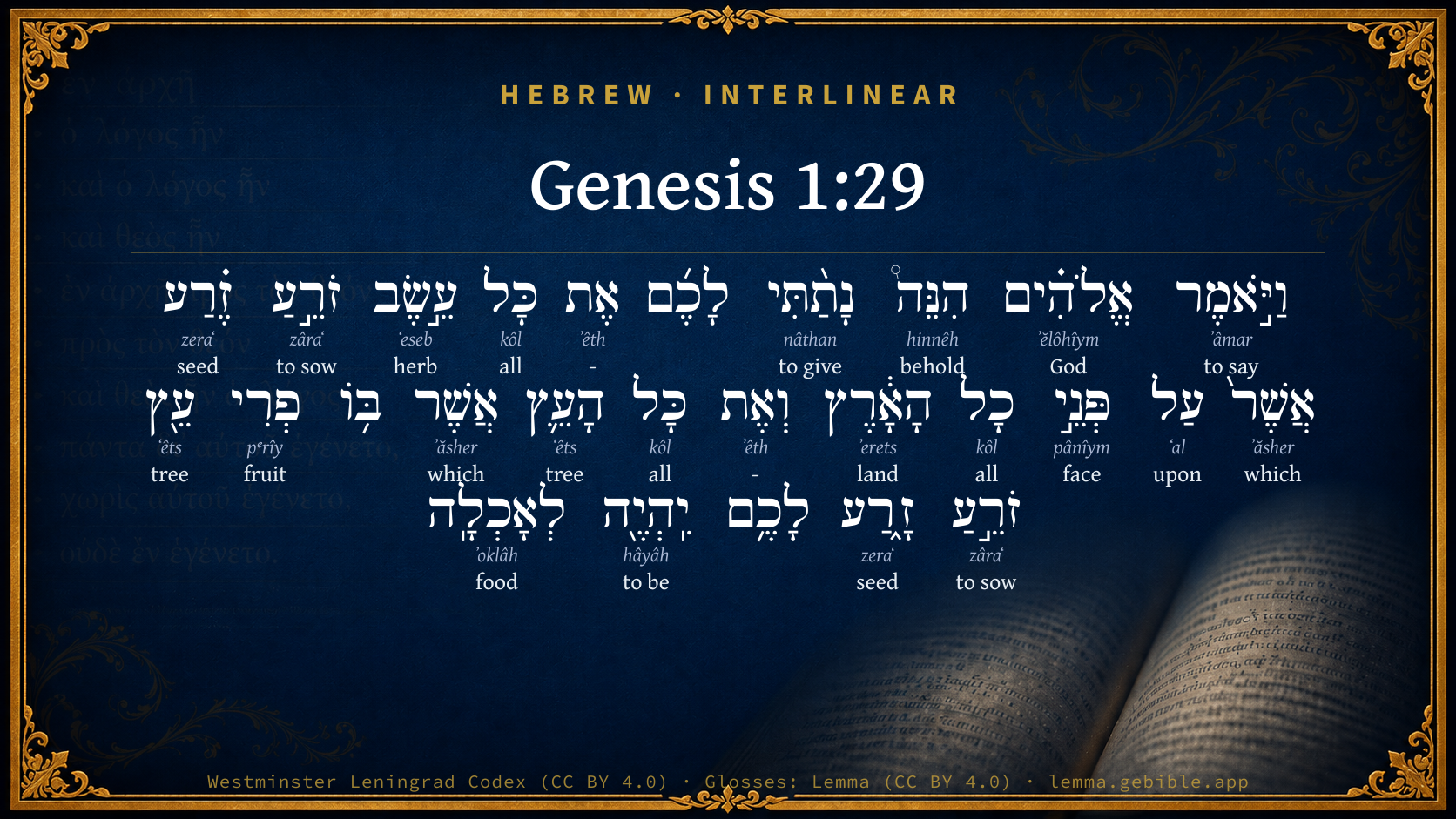
Genesis 1:29

Hebrew (Westminster Leningrad Codex) Genesis 1:29 appears in the Hebrew Old Testament. The text above is from the Westminster Leningrad Codex. Each word links to its Strong’s number, a concise gloss, and parsing drawn from the Open Scriptures Hebrew Bible morphology. Click any word for its full Brown-Driver-Briggs (BDB) entry.
Download image
Cite this verse

Genesis 1:29 (World English Bible). Public Domain. Lemma interlinear Bible study tool, https://lemma.gebible.app/v/genesis/1/29.

Show BibTeX & RIS
BibTeX
RIS
English Translation
God said, "Behold, I have given you every herb yielding seed, which is on the surface of all the earth, and every tree, which bears fruit yielding seed. It will be your food.
World English Bible · Public Domain
Highlights
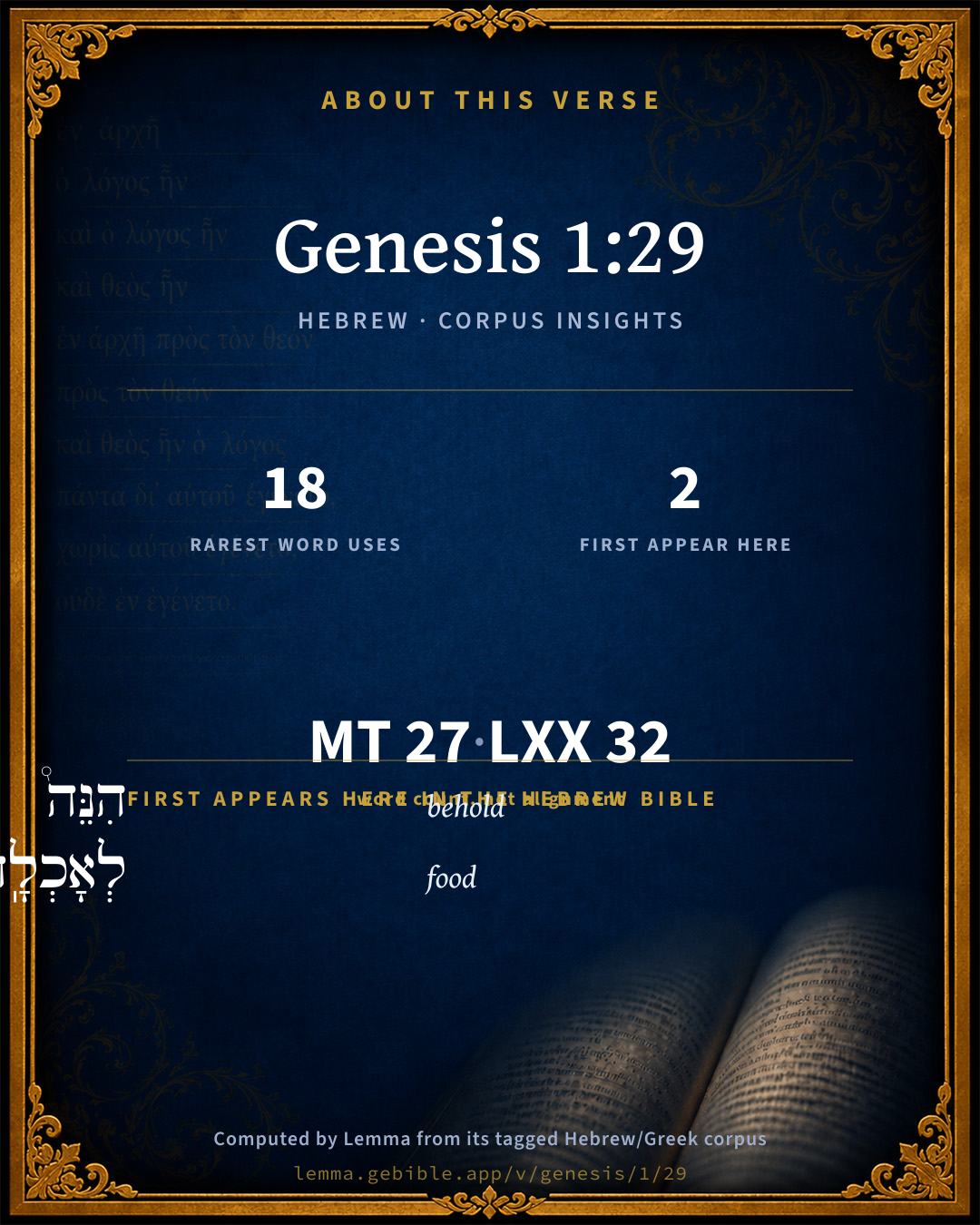
  • 2 first appearances in the Hebrew Bible
Full analysis ↓
Download a study sheet

One document with this verse’s original text, its word-by-word gloss line, the meaning frame, cross-references with their text, attributed commentary, and full source and license credits — printable, and it pastes into notes with its structure intact.

This verse Autodidact and up

Study sheet (.html) Plain text (.txt)

A passage Seminary Student

Up to 50 verses in one chapter. A passage sheet keeps up to 6 commentary sources and 12 cross-references per verse, in the order this page ranks them, and says so on the sheet whenever that leaves anything out. Ask for a single verse and you get the Autodidact verse sheet above.

Everything on this page stays free to read, with no account — the sheet is a download of what is already on screen, not access to it.

Want to remove ads? Support Godless Engineer
Compare translations 3

The same verse in 3 English versions, stacked beneath the original-language interlinear above. Click any original word for its lexicon entry.

Each is an independent rendering of the whole verse — the interlinear is not word-aligned to these translations.

Highlighted words mark where these versions differ — a whole-verse word diff, not a word-by-word alignment.

  • World English Bible Public Domain
    God said, "Behold, I have given you every herb yielding seed, which is on the surface of all the earth, and every tree, which bears fruit yielding seed. It will be your food.
  • King James Version Public Domain
    And God said, Behold, I have given you every herb bearing seed, which is upon the face of all the earth, and every tree, in the which is the fruit of a tree yielding seed; to you it shall be for meat.
  • unfoldingWord Literal Text CC BY-SA 4.0
    Then God said, “Behold, I have given to you every plant yields seed that on the surface of the whole earth and every tree that tree fruit yields seed inside it. They will be yours for food.

unfoldingWord Literal Text — © unfoldingWord, licensed CC BY-SA 4.0. Word-aligned USFM3 via Door43 (git.door43.org/unfoldingWord/en_ult).

Versions to compare (up to 4)

3 of 4 selected

Show all 18 translations

Every available English version of this verse, each an independent rendering of the whole verse.

  • World English Bible Public Domain
    God said, "Behold, I have given you every herb yielding seed, which is on the surface of all the earth, and every tree, which bears fruit yielding seed. It will be your food.
  • Berean Standard Bible Public Domain
    Then God said, “Behold, I have given you every seed-bearing plant on the face of all the earth, and every tree whose fruit contains seed. They will be yours for food.
  • Majority Standard Bible Public Domain
    Then God said, “Behold, I have given you every seed-bearing plant on the face of all the earth, and every tree whose fruit contains seed. They will be yours for food.
  • King James Version Public Domain
    And God said, Behold, I have given you every herb bearing seed, which is upon the face of all the earth, and every tree, in the which is the fruit of a tree yielding seed; to you it shall be for meat.
  • American Standard Version (1901) Public Domain
    And God said, Behold, I have given you every herb yielding seed, which is upon the face of all the earth, and every tree, in which is the fruit of a tree yielding seed; to you it shall be for food:
  • Revised Version (1885) Public Domain
    And God said, Behold, I have given you every herb yielding seed, which is upon the face of all the earth, and every tree, in the which is the fruit of a tree yielding seed; to you it shall be for meat:
  • Geneva Bible (1599) Public Domain
    And God said, Beholde, I haue giuen vnto you euery herbe bearing seede, which is vpon al the earth, and euery tree, wherein is the fruite of a tree bearing seede: that shall be to you for meate.
  • Douay-Rheims (1899) Public Domain
    And God said: Behold I have given you every herb bearing seed upon the earth, and all trees that have in themselves seed of their own kind, to be your meat:
  • Young's Literal Translation Public Domain
    And God saith, `Lo, I have given to you every herb sowing seed, which `is' upon the face of all the earth, and every tree in which `is' the fruit of a tree sowing seed, to you it is for food;
  • Literal Standard Version CC BY-SA 4.0
    And God says, “Behold, I have given to you every herb sowing seed, which [is] on the face of all the earth, and every tree in which [is] the fruit of a tree sowing seed, to you it is for food;
  • Unlocked Literal Bible CC BY-SA 4.0
    God said, “See, I have given you every plant yielding seed which is upon the surface of all the earth, and every tree with fruit which has seed in it. They will be food to you.
  • unfoldingWord Literal Text CC BY-SA 4.0
    Then God said, “Behold, I have given to you every plant yields seed that on the surface of the whole earth and every tree that tree fruit yields seed inside it. They will be yours for food.
  • Darby Bible Public Domain
    And God said, Behold, I have given you every herb producing seed that is on the whole earth, and every tree in which is the fruit of a tree producing seed: it shall be food for you;
  • World Messianic Bible Public Domain
    God said, “Behold, I have given you every herb yielding seed, which is on the surface of all the earth, and every tree, which bears fruit yielding seed. It will be your food.
  • Webster's Bible Public Domain
    And God said, Behold, I have given you every herb bearing seed, which is upon the face of all the earth, and every tree, in which is the fruit of a tree yielding seed; to you it shall be for food.
  • Free Bible Version CC BY-SA 4.0
    God said, “Look, I'm giving you as your food every seed-bearing plant anywhere on earth, and every tree that produces fruit with seeds.
  • Bible in Basic English Public Domain
    And God said, See, I have given you every plant producing seed, on the face of all the earth, and every tree which has fruit producing seed: they will be for your food:
  • JPS Tanakh (1917) Public Domain
    And God said: 'Behold, I have given you every herb yielding seed, which is upon the face of all the earth, and every tree, in which is the fruit of a tree yielding seed — to you it shall be for food;

Literal Standard Version (2020), Covenant Press — licensed CC BY-SA 4.0. Text via the HelloAO Bible API (eBible.org). Unlocked Literal Bible (unfoldingWord) — licensed CC BY-SA 4.0. Text via the HelloAO Bible API (eBible.org). unfoldingWord Literal Text — © unfoldingWord, licensed CC BY-SA 4.0. Word-aligned USFM3 via Door43 (git.door43.org/unfoldingWord/en_ult). Free Bible Version, Dr. Jonathan Gallagher — licensed CC BY-SA 4.0. Text via the HelloAO Bible API (eBible.org).

Word by word

More ways to search: Search by grammar → Find every occurrence → Compare this word →

Practice this passage: Drill this verse → Learn its vocabulary →

לְאָכְלָֽה
ʼoklâh
H402
“to/for · food”
Preposition + Noun, Common, Feminine, Singular, Absolute
Part of Speech
Preposition + Noun
Type
Common
Gender
Feminine
Number
Singular
State
Absolute
Full BDB Definition

Origin: from H401

TWOT: 85b

food - food, eating - object of devouring, consuming - by wild beasts (figurative) - in fire - of judgment (figurative)
  1. וַיֹּ֣אמֶר ʼâmar H559 “and · to say” Conjunction + Verb, Qal, Sequential Imperfect, 3rd Person, Masculine, Singular
  2. אֱלֹהִ֗ים ʼĕlôhîym H430 “God(s)” Noun, Common, Masculine, Plural, Absolute
  3. הִנֵּה֩ hinnêh H2009 “behold” Particle, Demonstrative
  4. נָתַ֨תִּי nâthan H5414 “to give” Verb, Qal, Perfect, 1st Person, Common, Singular
  5. אֶת ʼêth H853 “-” Particle, Direct Object
  6. כָּל kôl H3605 “all of” Noun, Common, Masculine, Singular, Construct
  7. עֵ֣שֶׂב ʻeseb H6212 “herb” Noun, Common, Masculine, Singular, Absolute
  8. זֹרֵ֣עַ zâraʻ H2232 “sowing” Verb, Qal, Participle Active, Masculine, Singular, Absolute
  9. זֶ֗רַע zeraʻ H2233 “seed” Noun, Common, Masculine, Singular, Absolute
  10. אֲשֶׁר֙ ʼăsher H834 “which” Particle, Relative
  11. עַל ʻal H5921 “upon” Preposition
  12. פְּנֵ֣י pânîym H6440 “face(s) of” Noun, Common, Both, Plural, Construct
  13. כָל kôl H3605 “all of” Noun, Common, Masculine, Singular, Construct
  14. הָאָ֔רֶץ ʼerets H776 “the · land” Particle, Definite Article + Noun, Common, Both, Singular, Absolute
  15. וְאֶת ʼêth H853 “and · -” Conjunction + Particle, Direct Object
  16. כָּל kôl H3605 “all of” Noun, Common, Masculine, Singular, Construct
  17. הָעֵ֛ץ ʻêts H6086 “the · tree” Particle, Definite Article + Noun, Common, Masculine, Singular, Absolute
  18. אֲשֶׁר ʼăsher H834 “which” Particle, Relative
  19. פְרִי pᵉrîy H6529 “fruit of” Noun, Common, Masculine, Singular, Construct
  20. עֵ֖ץ ʻêts H6086 “tree” Noun, Common, Masculine, Singular, Absolute
  21. זֹרֵ֣עַ zâraʻ H2232 “sowing” Verb, Qal, Participle Active, Masculine, Singular, Absolute
  22. זָ֑רַע zeraʻ H2233 “seed” Noun, Common, Masculine, Singular, Absolute
  23. יִֽהְיֶ֖ה hâyâh H1961 “to be” Verb, Qal, Imperfect, 3rd Person, Masculine, Singular

About this verse

These counts appear in no published source. They are computed here, from the morphology-tagged text and Lemma’s own curated glosses. What Lemma adds →

27
words
17
distinct lemmas
Pentateuch
section

Notable vocabulary

The rarest word here is לְאָכְלָֽה food H402 — appearing just 18 times in the whole Hebrew Bible.

First appearance in Scripture

These words make their first canonical appearance in the Hebrew Bible here:

  • הִנֵּה֩ behold H2009
  • לְאָכְלָֽה food H402

Shared distinctive vocabulary

לְאָכְלָֽה food H402 occurs in 18 verses of the Hebrew Bible. Also found in:

Grammatical profile

  • 5 verbs
  • 13 nouns
  • 4 prepositions
  • 5 particles

Verb forms

  • וַיֹּ֣אמֶר Qal · Sequential Imperfect
  • נָתַ֨תִּי Qal · Perfect
  • זֹרֵ֣עַ Qal · Participle Active
  • זֹרֵ֣עַ Qal · Participle Active
  • יִֽהְיֶ֖ה Qal · Imperfect

Repetition

Words recur within this verse — often emphatic in Hebrew:

  • כָּל all H3605 ×3
  • זֹרֵ֣עַ to sow H2232 ×2
  • זֶ֗רַע seed H2233 ×2
  • הָעֵ֛ץ tree H6086 ×2
  • אֲשֶׁר֙ which H834 ×2

Hebrew & Septuagint length

In English translation the verse runs 33 words from the Hebrew and 41 from the Septuagint (LXX English) — closely comparable.

A rough comparison of the two English renderings, which tokenize alike — not a word-level alignment.

Word counts can differ between the Hebrew and the Greek without any difference in meaning — e.g. the Hebrew direct-object marker אֵת has no separate Greek word, and Greek often adds the article ὁ.

In the original languages it is 27 Hebrew tokens and 32 Greek tokens — but the two are counted differently (Hebrew bundles its prefixes and suffixes into one token; the Greek is in lemma form), so that isn’t a like-for-like length.

Cross-references

20

Topical passages linked to Genesis 1:29 in the Treasury of Scripture Knowledge — connected by theme and wording, ordered by reader-vote popularity; previews shown in the World English Bible.

  • Genesis 9:3 Every moving thing that lives will be food for you. As the green herb, I have given everything to you.
  • Psalms 104:14–15 He causes the grass to grow for the cattle, And plants for man to cultivate, That he may bring forth food out of the earth:
  • Psalms 145:15–16 The eyes of all wait for you. You give them their food in due season.
  • Psalms 104:27–28 These all wait for you, That you may give them their food in due season.
  • Psalms 147:9 He provides food for the cattle, And for the young ravens when they call.
  • Acts 14:17 Yet he didn't leave himself without witness, in that he did good and gave you rains from the sky and fruitful seasons, filling our hearts with food and gladness."
  • Job 36:31 For by these he judges the people. He gives food in abundance.
  • Psalms 24:1 The earth is Yahweh's, with its fullness; The world, and those who dwell therein.
  • Matthew 6:11 Give us today our daily bread.
  • Matthew 6:25–26 Therefore, I tell you, don't be anxious for your life: what you will eat, or what you will drink; nor yet for your body, what you will wear. Isn't life more than food, and the body more than clothing?
  • Genesis 2:16 Yahweh God commanded the man, saying, "Of every tree of the garden you may freely eat:
  • Psalms 115:16 The heavens are the heavens of Yahweh; But the earth has he given to the children of men.
  • Acts 17:28 'For in him we live, and move, and have our being.' As some of your own poets have said, 'For we are also his offspring.'
  • Psalms 111:5 He has given food to those who fear him. He always remembers his covenant.
  • Psalms 136:25 Who gives food to every creature; For his loving kindness endures forever.
  • Psalms 146:7 Who executes justice for the oppressed; Who gives food to the hungry. Yahweh frees the prisoners.
  • Isaiah 33:16 He shall dwell on high; his place of defense shall be the munitions of rocks; his bread shall be given [him]; his waters shall be sure.
  • Hosea 2:8 For she did not know that I gave her the grain, the new wine, and the oil, And multiplied to her silver and gold, which they used for Baal.
  • 1 Timothy 6:17 Charge those who are rich in this present world that they not be haughty, nor have their hope set on the uncertainty of riches, but on the living God, who richly provides us with everything to enjoy;
  • Acts 17:24–25 The God who made the world and all things in it, he, being Lord of heaven and earth, doesn't dwell in temples made with hands,

Cross-references courtesy of OpenBible.info (CC BY 4.0).

Hebrew and Greek witnesses Masoretic Hebrew ↔ Greek Septuagint

The same verse in the two great witnesses to the Old Testament, shown verse-for-verse.

These are two independent witnesses, not word-aligned to each other, and the Septuagint is shown in lemma (dictionary) form.

Hebrew Genesis 1:29 Masoretic · Westminster Leningrad Codex

וַיֹּ֣אמֶר אֱלֹהִ֗ים הִנֵּה֩ נָתַ֨תִּי לָכֶ֜ם אֶת כָּל עֵ֣שֶׂב זֹרֵ֣עַ זֶ֗רַע אֲשֶׁר֙ עַל פְּנֵ֣י כָל הָאָ֔רֶץ וְאֶת כָּל הָעֵ֛ץ אֲשֶׁר בּ֥וֹ פְרִי עֵ֖ץ זֹרֵ֣עַ זָ֑רַע לָכֶ֥ם יִֽהְיֶ֖ה לְאָכְלָֽה

God said, "Behold, I have given you every herb yielding seed, which is on the surface of all the earth, and every tree, which bears fruit yielding seed. It will be your food.

World English Bible · Public Domain

Greek LXX Genesis 1:29 Septuagint · lemma form

καί εἶπον ὁ θεός ἰδού δίδωμι σύ πᾶς χόρτος σπόριμος σπείρω σπέρμα ὅς εἰμί ἐπάνω πᾶς ὁ γῆ καί πᾶς ξύλον ὅς ἔχω ἐν ἑαυτοῦ καρπός σπέρμα σπόριμος σύ εἰμί εἰς βρῶσις

And God said, Behold I have given to you every seed-bearing herb sowing seed which is upon all the earth, and every tree which has in itself the fruit of seed that is sown, to you it shall be for food.

LXX2012 (modern English Septuagint) · Public Domain

Hebrew: Westminster Leningrad Codex (CC BY 4.0). Greek: Septuagint (public domain); English from LXX2012 (modern English Septuagint) (Public Domain). How the Septuagint differs from the Hebrew →

Targum (Aramaic paraphrase)

2

The Targum is the ancient Jewish Aramaic paraphrase of the Hebrew Scriptures — an interpretive translation, not the Hebrew text itself. Onkelos (literal) and Pseudo-Jonathan (expansive) render the Torah, and Jonathan the Prophets. Coverage is partial: where no permissively-licensed English translation exists for a verse, only the Aramaic is shown. This is verse-level text, not a word-by-word alignment to the Hebrew.

  1. Targum Onkelos Torah (Genesis–Deuteronomy)
    וַאֲמַר יְיָ הָא יְהָבִית לְכוֹן יָת כָּל עִסְבָּא דְּבַר זַרְעֵהּ מִזְדְּרַע דִּי עַל אַפֵּי כָל אַרְעָא וְיָת כָּל אִילָנָא דִּי בֵהּ פֵּירֵי אִילָנָא דְּבַר זַרְעֵהּ מִזְדְּרָע לְכוֹן יְהֵא לְמֵיכָל

    (no public-domain English translation for this verse)

    Targum Onkelos — Aramaic: “Onkelos Genesis” (public domain); “Onkelos Exodus” (public domain); “Onkelos Leviticus” (public domain); “Onkelos Numbers” (public domain); “Onkelos Deuteronomy” (public domain). English: “Sefaria Community Translation” (CC0 1.0 (public-domain dedication)); “J.W. Etheridge. The Targums of Onkelos and Jonathan Ben Uzziel on the Pentateuch. London: Longmans, Green, 1862” (public domain). Text via Sefaria.

  2. Targum Pseudo-Jonathan Torah (Genesis–Deuteronomy)
    וַאֲמַר יְיָ הָא יְהָבִית לְכוֹן יַת כָּל עִיסְבָּא דְבִיזְרֵיהּ מִזְדְרַע דְעִילוֹי אַנְפֵּי כָּל אַרְעָא וְיַת כָּל אִילָנֵי סְרָקָא לִצְרוֹךְ בִּנְיָינָא וּלְאַסָקוּתָא וּדְבֵיהּ פֵּירֵיהּ אִלָנָא דְבִזְרֵיהּ מִזְדְרַע לְכוֹן יְהֵי לְמֵיכָל

    And the Lord said, Behold, I have given you every herb whose seed seedeth upon the face of all the earth, and every unfruitful tree for the need of building and for burning; and the tree in which is fruit seeding after its kind, to you it shall be for food.

    Targum Pseudo-Jonathan — Aramaic: “Targum Jonathan on Genesis” (public domain); “Targum Jonathan on Exodus” (public domain); “Targum Jonathan on Leviticus” (public domain); “Targum Jonathan on Numbers” (public domain); “Targum Jonathan on Deuteronomy” (public domain). English: “The Targum of Jonathan ben Uzziel, trans. J. W. Etheridge, London, 1862” (public domain). Text via Sefaria.

Commentary

Notes on Genesis 1:29 from classic Christian and Jewish commentators (each source and its license shown beneath its notes). The classic Christian expositions comment on the surrounding passage and are grouped to its opening verse, so a note may address several verses; the Jewish commentaries on the Tanakh (Rashi and others) are per-verse, so they appear only where the commentator wrote on this verse.

Lemma curates 59 commentaries, every one of them public domain or Creative Commons licensed, each selected and text-cleaned for this edition rather than reprinted as found. About our sources →

Matthew Henry's Commentary

We have here the third part of the sixth day's work, which was not any new creation, but a gracious provision of food for all flesh, Psa 136:25. He that made man and beast thus took care to preserve both, Psa 36:6. Here is,

I. Food provided for man, Gen 1:29. Herbs and fruits must be his meat, including corn and all the products of the earth; these were allowed him, but (it should seem) not flesh, till after the flood, Gen 9:3. And before the earth was deluged, much more before it was cursed for man's sake, its fruits, no doubt, were more pleasing to the taste and more strengthening and nourishing to the body than marrow and fatness, and all the portion of the king's meat, are now. See here, 1. That which should make us humble. As we were made out of the earth, so we are maintained out of it. Once indeed men did eat angels' food, bread from heaven; but they died (Joh 6:49); it was to them but as food out of the earth, Psa 104:14. There is meat that endures to everlasting life; the Lord evermore give us this. 2. That which should make us thankful. The Lord is for the body; from him we receive all the supports and comforts of this life, and to him we must give thanks. He gives us all things richly to enjoy, not only for necessity, but plenty, plenty, dainties, and varieties, for ornament and delight. How much are we indebted! How careful should we be, as we live upon God's bounty, to live to his glory! 3. That which should make us temperate and content with our lot. Though Adam had dominion given him over fish and fowl, yet God confined him, in his food, to herbs and fruits; and he never complained of it. Though afterwards he coveted forbidden fruit, for the sake of the wisdom and knowledge he promised himself from it, yet we never read that he coveted forbidden flesh. If God give us food for our lives, let us not, with murmuring Israel, ask food for our lusts, Psa 78:18; see Dan 1:15.

II. Food provided for the beasts, Gen 1:30. Doth God take care for oxen? Yes, certainly, he provides food convenient for them, and not for oxen only, which were used in his sacrifices and man's service, but even the young lions and the young ravens are the care of his providence; they ask and have their meat from God. Let us give to God the glory of his bounty to the inferior creatures, that all are fed, as it were, at his table, every day. He is a great housekeeper, a very rich and bountiful one, that satisfies the desire of every living thing. Let this encourage God's people to cast their care upon him, and not to be solicitous respecting what they shall eat and what they shall drink. He that provided for Adam without his care, and still provides for all the creatures without their care, will not let those that trust him want any good thing, Mat 6:26. He that feeds his birds will not starve his babes.

Matthew Henry's Commentary on the Whole Bible (1708–1710) — public domain (CC PDM 1.0). Text via the HelloAO Bible API.

Trapp's Complete Commentary

John Trapp

Gen 1:29 And God said, Behold, I have given you every herb bearing seed, which [is] upon the face of all the earth, and every tree, in the which [is] the fruit of a tree yielding seed; to you it shall be for meat.

Ver. 29. Behold, I have given you.] By this "behold," God stirs up them and us to confidence, thankfulness, {Psa 16:1-11} and obedience to so liberal a Lord, so bountiful a benefactor. And surely as iron put into the fire seems to be nothing but fire, so Adam, thus beloved of God, was turned into a lump of love, and bethinks himself what to do by way of retribution. All other creatures also willingly submitted to God’s ordinance and man’s service, well apaid of God’s provision, that great housekeeper of the world, that hath continually so many millions at bed and board. This is intimated in that last clause.

John Trapp, A Commentary or Exposition upon All the Books of the Old and New Testament (1647–1656) — public domain. Text from a community e-Sword module.

The Biblical Illustrator

Joseph S. Exell

Gen_1:29-30

To you it shall be for meat

The universe Gods gift to man

I.

THE GIFT.

1. Extensive.

2. Valuable.

3. Increasing.

Every day becoming better known and more thoroughly appreciated. All the gifts of God are productive; time unfolds their measure, discloses their meaning, and demonstrates their value.

II. THE PURPOSE.

1. To evince love. One of the great objects of creation was to manifest the love of God to the human race, which was shortly to be brought into existence. The light, the sun, the stars, and the creation of man; all these were the love tokens of God. These were designed, not to display His creative power--His wisdom, but His desire for the happiness of man.

2. To teach truth. The world is a great school. It is well supplied with teachers. It will teach an attentive student great lessons. All the Divine gifts are instructive.

3. To sustain life. God created man without means, but it was not His will to preserve him without; hence He tells him where he is to seek his food. We must make use of such creatures as God has designed for the preservation of our life. God has provided for the preservation of all life. Let us learn to trust God for the necessities of life in times of adversity. Men who have the greatest possessions in the world must receive their daily food from the hand of God. (J. S. Exell, M. A.)

Dependence on God

I. LET EVERYONE DEPEND UPON GOD FOR THE NECESSARIES OF LIFE.

1. Asking them by prayer.

2. Acknowledging our own beggary.

3. Trusting Him by faith.

4. Remembering His promise.

5. Obedient to His will.

II. LET US SERVE HIM FAITHFULLY AT WHOSE TABLE WE ARE FED.

1. Else we are ungrateful.

2. Else we deserve famine. All the provisions that God allows man for food are drawn out of the earth. The homeliness of the provision on which God intended man to feed. (J. S. Exell, M. A.)

Let no man be discontented with mean fare

1. It is as good as the body it nourishes.

2. It is better than we deserve.

3. It is more than we are able to procure of ourselves.

4. It is more profitable for health.

5. It is free from the temptation to excess. God gives us not all our provisions at once, but a daily supply of them.

(1) To manifest His Fatherly care.

(2) To make us dependent on Him.

(3) To exercise our faith.

(4) To teach economy. God makes provision for all the creatures He hath made. Man was not only a good creature but a blessed one. (J. S. Exell, M. A.)

Food

1. It exerts an influence on the disposition of man. A hungry man always feels the risings of cruelty, however they may be conquered by nobler principles. When you think of the cruelty of an Indian you should always think of his famished condition.

2. It indicates the civilized condition of man. You are told that a people are a wheat-eating people. Of course they must raise it; they must have the plough and the ploughshare; they must command iron, or, at least, some hard metal; they must understand the process of mining and smelting; they must have fields and fences; they must have foresight to sow and patience to wait for a crop; and, finally, they must be protected by law, for no one will lend the labour who is not assured of protection.

3. It contributes to extensive social changes. The introduction of sugar, for example, has changed the whole face of society. It was found to be one of the purest and least cloying sweets ever discovered. It was handed from the Arabs to the Spaniards; it was cultivated first in the Madeira Islands; then it was given to all the European nations; was raised in the West Indies on an immense scale. Then came rum, brandy, and all the alcoholic drinks, slavery and all its consequences, until now it is a debated problem whether the sweet cane was a blessing or a curse. At any rate this single article of food, so unimportant and neglected in its origin, changed the whole face of society.

4. It indicates the general refinement of the mind. Nay, we are instructed not to be totally indifferent to the kind of food, for discrimination here is connected with other discrimination, and indicates improvement in the taste. We will not take advantage of Dr. Johnsons remark, who held that he who did not mind his dinner would scarcely mind anything else. Suffice it to say, that taste in food and taste in dress, science, and literature, always go together. He that feeds grossly will judge grossly.

5. It is essential in order to the higher pursuits of life. Take away from the astronomer his food, and he will soon cease to lift his telescope to the stars. The saint, the martyr, the moralist, and the poet, all pursue their sublime occupations through the vigour and animation of the body. In a word, as the sweetest blossom on the highest tree, though it seems to be fed by the very air which it decorates, is nourished by the dirt and manure around the roots of the tree, so the sublimest mind is supplied by the food of the body. (Bib. Sacra.)

Mans proper food

Remark here, that when God assigned to man, while still innocent, his proper food, he gave him only the fruits of the field; and it was not till after the earth had been twice cursed because of sin that he was permitted to eat the flesh of animals. Upon this point also, says

M. de Rougemont, in his interesting History of the Earth,--upon this point, as well as others, science has arrived, by long, circuitous ways, and painful study, at the very same truths which are plainly revealed to us in Genesis. It is a question, says M. Flourens, which has much perplexed physiologists, and which they have not yet been able to determine, what was the natural and primitive food of man. Now, thanks to comparative anatomy, it is very easy to see that man was originally neither herbivorous nor carnivorous, but frugivorous. It was not till after the curse had been brought on the earth by sin that man began to feed on the birds of the air and the beasts of the field. Before he sinned he had a dominion over the creatures, which he lost in a great measure, and which he only keeps in a degree by force and violence; but at first they did not flee from him, and he did not eat them. Doubtless, before man sinned, the productions of the earth were richer and better than they are now, and offered a much greater variety of food and nourishment to man. But at the fall the nature of the soil and of its vegetable productions must have been in some way altered. Probably God greatly reduced the number of food-producing plants, and the earth brought forth instead those bearing useless thorns, and even some whose fruits or juices cause death. (Prof. Gaussen.)

The miracle of nourishment

Perhaps it may appear to you a very natural thing that corn, strawberries, cherries, grapes, figs, dates, peaches, pineapples, and all the various and delicious fruits of our orchards and of other climates, should feed and nourish you; but think of the miracle which must be wrought in your body--in your stomach, your lungs, your heart, your veins, your glands, your arteries, and all the various parts within you--before these fruits, or any other food that you eat, can be prepared inyour stomach, changed into a kind of milky substance, and conveyed in your veins, and passed with your blood through one of the ventricles of your heart, and thence into your lungs, to be burned and purified there, and return again as perfect blood into the other ventricle, and thence be driven by a rapid movement into your arteries, and to the very extremities of your body, in order that it may reproduce, without your interference, your skin, your flesh, your bones, your nerves, your nails, and the thousands and thousands of the hairs of your head. It is a miracle wrought by God, that any kind of food, whether leaves, seeds, fruits, or bread should serve as food and nourishment to me at all; it is a mystery and a wonder how it is changed into a part of my body, so as to make it grow, repair it, and renew its waste: and therefore it was a work of almighty power when God appointed mans food, and said of the trees and plants, To you it shall be for meat. What is bread? It is a paste composed of ground corn, water, and salt, baked after it has begun to ferment. But how does it happen that the corn and the salt should nourish me? Corn, we are told, is composed of carbon and the two gases which form water. Now, how can carbon or charcoal nourish me? Try to eat a bit of charcoal, and you will find it like taking a mouthful of sand. Think how wonderfully these substances, of which corn is composed, must be transformed by Divine power to produce the corn, and then still further changed to become a part of our bodies. Then salt is composed of two substances which separately would hurt me, and yet combined they are wholesome, and help to cause the corn and other things to nourish me. If I were to take two phials, one filled with sodium and the other with hydrochloric acid, and if I were to mix them in a glass, they would combine and form salt at the bottom of the glass; and yet, separately, each of these phials would contain a destructive poison. If I were to swallow the hydrochloric acid, it would burn my stomach; and if I were to pour it into the palm of my hand and hold it there, it would soon burn a hole right through my hand; and yet this dreadful poison, when combined with sodium, forms salt, which is so wholesome and so necessary for our health. (Prof. Gaussen.)

Nature productive

The botanist Ray tells us that he counted 2,000 grains of maize on a single plant of maize sprung from one seed, 4,000 seeds on one plant of sunflower, 32,000 seeds on a single poppy plant, and 36,000 seeds on one plant of tobacco. Pliny tells us that a Roman governor in Africa sent to the Emperor Augustus a single plant of corn with 340 stems, bearing 340 ears--that is to say, at least 60,000 grains of corn had been produced from a single seed. In modern times, 12,780 grains have been produced by a single grain of the famous corn of Smyrna. In eight years, as much corn might spring from one seed as to supply all mankind with bread for a year and a half. (Prof. Gaussen.)

The Biblical Illustrator, edited by Joseph S. Exell (c. 1880s–1900s) — public domain. Text from a community e-Sword module.

Joseph Benson's Commentary

Gen 1:29-30. I have given you every herb — It does not appear that liberty was given to men to eat animal food before the flood. Indeed, there seems to have been no need of it, as before the deluge, and more especially before the earth was cursed for the sin of man, undoubtedly its fruits were not only brought forth in greater abundance, but were both more pleasant to the taste, and more strengthening and nourishing to the body, than they were after these events. And to every beast — Thus the great Lord of all took care for oxen, and every living creature that he had created, and made ample and continued provision for their subsistence.

Joseph Benson's Commentary on the Old and New Testaments (1811–1818) — public domain. Text from a community e-Sword module.

The Preacher's Complete Homiletical Commentary

Joseph S. Exell (gen. ed.)

MAIN HOMILETICS OF THE PARAGRAPH.—Gen_1:29-31

THE UNIVERSE GOD’S GIFT TO MAN

I. The Gift.

1. Extensive. The Universe is a Divine gift to man. It was designed for the occupation of man. The home, with all its furniture, was presented to him. Nature, from its highest manifestations to its lowest, was to minister to his happiness and need.

2. Valuable. The smallest things in nature are valuable. Who can tell the value of the tree, of the herb, of the grass of the field? Diamonds are not more valuable than these; yet they are the constant and everyday gift of God to man.

3. Increasing. Every day the gift is increasing in value. It becomes more expansive. It is better known, and more thoroughly appreciated. Scientific research is giving man to see the richness of the Creator’s gift. All the gifts of God are productive; time unfolds their measure, discloses their meaning, and demonstrates their value.

II. The purpose.

1. To evince love. One of the great objects of creation was to manifest the love of God to the human race, which was shortly to be brought into existence. The light, the sun, the stars, and the creation of man; all these were the love-tokens of God. These were designed, not to display His creative power—His wisdom, but His desire for the happiness of man.

2. To teach truth. The world is a great school. It is well supplied with teachers. It will teach an attentive student great lessons. All the Divine gifts are instructive.

3. To sustain life. God created man without means, but it was not His will to preserve him without; hence He tells him where he is to seek his food. We must make use of such creatures as God has designed for the preservation of our life. God has provided for the preservation of all life. Let us learn to trust God for the necessities of life in times of adversity. Men who have the greatest possessions in the world must receive their daily food from the hand of God.

SUGGESTIVE COMMENTS ON THE VERSES

Gen_1:29-31.

I. Let every one depend upon God for the necessaries of life.

1. Asking them by prayer.

2. Acknowledging our own beggary.

3. Trusting Him by faith.

4. Remembering His promise.

5. Obedient to His will.

II. Let us serve Him faithfully at whose table we are fed.

1. Else we are ungrateful.

2. Else we deserve famine.

All the provisions that God allows man for food are drawn out of the earth.

The homeliness of the provision on which God intended man to feed.

Let no man be discontented with mean fare:—

1. It is as good as the body it nourishes.

2. It is better than we deserve.

3. It is more than we are able to procure of ourselves.

4. It is more profitable for health.

5. It is free from the temptation to excess.

God gives us not all our provisions at once, but a daily supply of them:—

1. To manifest His fatherly care.

2. To make us dependent on Him.

3. To exercise our faith.

4. To teach economy.

God makes provision for all the creatures He hath made.

Man was not only a good creature, but a blessed one.

SUGGESTIVE ILLUSTRATIONS

Man’s Spirit! Gen_1:27. As a missionary in India was catechizing the children of his school, a Brahmin interrupted him by saying that the spirit of man and the spirit of God were one. In order to show him the absurdity of such a declaration, the missionary called upon the boys to refute it by stating the difference between the spirit of man and God. They readily, so Arvine says, gave the following answers:—The spirit of man is created; God is its creator. The spirit of man is full of sin; God is a pure spirit. The spirit of man is subject to grief; God is incapable of suffering. Therefore, they can never be one. And yet the spirit of the one dwells in the spirit of the other. This is a great mystery:—

“And when the dread enigma presseth sore,

Thy patient voice saith: ‘Watch with me one hour;’

As sinks the moaning river in the sea,

In silver peace, so sinks my soul in Thee.”—Howe.

Man! Gen_1:27. As the ancients kept their temples pure and undefiled, so we should preserve our “bodies” free from all unholy words and actions. In some of the heathen temples, the Vestals cherished a flame on their altar perpetually. So should we maintain the flame of truth on the altars of our hearts. Within their temple walls were their helpless deities, and there thronged the myriads of votaries to pay homage and worship. We should worship the Father, and cultivate the companionship of the Holy Ghost in our bodies.

Apex! Gen_1:29. As Agassiz points out, it is evident that there is a manifest progress in the succession of beings on the surface of the earth. This progress consists in an increasing similarity to the living fauna, and among the vertebrates, especially in their increasing resemblance to man. But this connection is not the consequence of a direct lineage between the fauna of different ages. The link by which creation is connected is of a high and immaterial nature; and their connection is to be sought in the view of the Creator Himself, whose aim in forming the earth was to introduce man upon the surface of our globe. Man is the end towards which all the animal creation has tended from the first appearance of the first Palæozoic fishes. When all was complete—

“A creature of a more exalted kind

Was wanting yet, and then was man designed;

Conscious of thought, of more capacious breast,

For empire formed, and fit to rule the rest.”—Ovid.

Divine Gifts! Gen_1:29. As the artist delights in exercising his talent in depicting the landscape—as the poet finds pleasure in creating, out of human experiences and the bright scenes of nature, a new world of beauty and passion, so God—the Great Artist and Poet—delights in the scenes and objects of nature, in the formation of which He has exercised His Divine skill and power; and to this Divine feeling the Son of God gave frequent expression. He revealed to us His own most perfect understanding and enjoyment of the beauty of nature—how God regarded the creation which He had pronounced to be very good. But they were formed for man’s special enjoyment. The great whole world—to use the figure of an eminent writer—is decked with beauty for man’s pleasure. Beautiful is the lily-work that forms the capitals of its stony and massive pillars; rich is the flowerage that adorns its barge-laden streams, which bear up and along the works of life. Everything that is useful to man has some bright and beautiful thing connected with it, which, like the settling of a brilliant butterfly upon the open page of a dreary tome, or the falling of a rosy gleam upon some homely task, seems to speak of the fact that this verse is true—

“Our cup runneth over, our life is so bright,

So brimming with mercy and love,

It seems just a springtime of sunshine and light,

Blest foretastes of better above.”

God! Gen_1:31. His works proclaim His being, power, wisdom, goodness. Some years ago there was a German prince, a good christian man, who lived in a fine old castle on the banks of the Rhine. He had a son, who was beloved by all around for his princely virtues; and on one occasion, while he was absent from home, a French gentleman became the nobleman’s guest. This visitor did not believe in God, and never thought of trusting to Him for anything. One day, when the baron and his friend were conversing, he said something which grieved the baron very much, and led him to exclaim: “Are you not afraid to offend God by speaking in such a way?” But the Frenchman replied that he had never seen God, knew nothing of Him, cared nothing for Him. His host remained silent, and resolved to seize the first opportunity afforded him of shewing to his guest the fallacy of his reasoning. So the next morning he conducted the doubter around his castle and grounds to see many beauties. Amongst other things he showed him some very beautiful pictures, which the visitor admired, and of which the prince said: “These are my son’s.” The garden had been chastely and magnificently laid out by his son. The cottages in the village, all neatly and substantially built, had been designed by his son. When the gentleman had seen all, he exclaimed: “What a happy man you must be to have such a son;” but the prince abruptly enquired how he knew that he had so good a son? “By his works,” was the response. “But you have not seen him.” “No; but I know him very well, because I judge of him by his works.” God’s works teach us:

“And every wild and hidden dell,

Where human footsteps never trod,

Is wafting songs of joy which tell

The praises of their Maker—God!

Creation Good! Gen_1:31. Did that goodness which Jehovah saw evidence itself in the joy of universal adoration? For after all, is there not joy in every aspect of Nature? Could Adam not see it; could Jehovah himself not see this joy of goodness in the purity of virgin morning, in the sombre grey of a day of clouds, in the solemn pomp and majesty of night? Was it not visible in the chaste lines of the crystal, the waving outlines of distant hills, the minute petals of the fringed daisy, or the overhanging form of Eden’s mysterious glades? Could Jehovah not say in even deeper grandeur, sense, and force, than Adam,

“What throbbings of deep joy

Pulsate through all I see; from the full bud

Whose unctuous sheath is glittering in the moon,

Up through the system of created things,

Even to the flaming ranks of seraphim.”—Alford.

The Preacher's Complete Homiletical Commentary (gen. ed. Joseph S. Exell; Funk & Wagnalls, c. 1892) — public domain (pre-1929). A full-Bible homiletical/sermon-outline anthology covering 65 of 66 books (2 John is absent from the source module). Text from a community e-Sword module.

Tyndale Open Study Notes

Tyndale Open Resources

1:29-30 These verses highlight the extent (throughout the earth) and variety (every seed-bearing plant . . . all the fruit trees) of God’s provision for humans, animals, and birds.

Tyndale Open Study Notes — © Tyndale Open Resources, licensed CC BY-SA 4.0. Text via the HelloAO Bible API.

Geneva Bible (1599)

Geneva Bible translators

God’s great liberality to man, taketh away all excuse of his ingratitude.

Geneva Bible (1599) marginal notes — public domain. Text via Bolls.life.

Adam Clarke's Commentary

Verse 29. I have given you every herb - for meat.] It seems from this, says an eminent philosopher, that man was originally intended to live upon vegetables only; and as no change was made In the structure of men's bodies after the flood, it is not probable that any change was made in the articles of their food. It may also be inferred from this passage that no animal whatever was originally designed to prey on others; for nothing is here said to be given to any beast of the earth besides green herbs.-Dr. Priestley. Before sin entered into the world, there could be, at least, no violent deaths, if any death at all. But by the particular structure of the teeth of animals God prepared them for that kind of aliment which they were to subsist on after the FALL.

Adam Clarke's Commentary on the Bible (1810–1826) — public domain. Text from a community e-Sword/MySword module.

Ellicott's Commentary for English Readers

(29) Every herb bearing seed . . . every tree.—Of the three classes of plants enumerated in Gen_1:11, the two most perfect kinds are given to man for his food; while in Gen_1:30 the birds and animals have not merely the cryptogamous plants of the first class, but every green herb granted to them for their sustenance. We are not to suppose that they did not eat seeds and fruits, but that the fundamental supply for the maintenance of animal life was the blade and leaf, and that of human life the perfected seed and ripe fruit. Man is thus from the first pointed out as of a higher organisation than the animal; and the fact that his food is such as requires preparation and cooking has been the basis, not merely of most of the refinements of life, but even of the close union of the family. For what would become of it without the common meal?

But undoubtedly the food originally assigned to man was vegetable; nor was express leave given to eat flesh until after the flood. Nevertheless the dominion given to man, in Gen_1:28, over fish, bird, and animal, made it lawful for him to use them for his food; and the skins with which Adam and Eve were clothed on their expulsion from Paradise prove that animals had been already killed. After the fall, Abel’s sacrifice of the firstlings of his flock, and of the fat thereof, leads irresistibly to the conclusion that the flesh was eaten by the offerer and his family. In ancient times this was the rule. Flesh was not the staple of man’s diet, but the eating of it was a religious ceremony, at which certain portions were offered to God and burnt on His altar, and the rest consumed by man as the Deity’s guests. So we may well believe that until the flood the descendants of Seth partook of flesh rarely, and only at a sacrifice, but that after the flood a more free use of it was permitted.

A Bible Commentary for English Readers, edited by Charles John Ellicott (1878–1897) — public domain. Text from a community e-Sword module.

The Cambridge Bible for Schools and Colleges

gen. ed. J. J. S. Perowne

29. Provision of Food

In this verse God gives food to mankind consisting of the seed-bearing herbs and the fruit of trees. By comparison with Gen_9:3, we see that the writer believed that, until after the Flood, mankind subsisted upon a purely vegetable diet. It may be asked how, if this were the case, man had the opportunity of exercising his dominion over fish, birds, and beasts: if he did not wish to eat them, neither would he wish to kill them. The truth seems to be that, according to the P version of Hebrew tradition, the first generations of mankind were intended to live, without bloodshed or violence, in an ideal condition, like that predicted by Isaiah (Gen_11:6-9), “they shall not hurt nor destroy in all my holy mountain.” The prophet’s words, “a little child shall lead them,” imply a dominion over the animal world which does not rest upon force.

The Cambridge Bible for Schools and Colleges (gen. ed. J. J. S. Perowne; Cambridge University Press, 1878–1918) — public domain. Text from a community e-Sword module.

John Gill's Exposition

And God said,.... That is, to Adam and Eve, whom he had made in his image and likeness, and to whom he had given the dominion of the earth and sea, and all things in them:

behold, I have given you every herb bearing seed, which is upon the face of all the earth; every herb or plant which had a seed in it, by which it sowed itself again; or being taken off, might be sown by man, even everyone that was wholesome, healthful, and nourishing, without any exception; whatever grew in any part of the earth, be it where it would:

and every tree, in which is the fruit of a tree yielding seed; all but the tree of knowledge, of good and evil, afterwards excepted; and both these take in all kind of vegetables, all herbs, plants, roots, even corn, wheat, barley, pease, beans, &c. and the various fruits of all sorts of trees, but that before mentioned:

to you it shall be for meat: which is generally thought to be the food of the antediluvians (n), it not being proper, at least very soon, to kill any of the animals, until they were multiplied and increased, lest their species should be destroyed; though here is no prohibition of eating flesh; nor is it said that this only should be for meat, which is before mentioned; and by the early employment of some in keeping sheep, and by the sacrifice of creatures immediately after the fall, part of which used to be eaten by the offerers; and by the distinction of clean and unclean creatures before the flood, it looks probable that flesh might be eaten: and Bochart (o) refers this clause to what goes before in the preceding verse, as well as to what is in this, and takes the sense to be, that the fishes of the sea, and fowls of the air, and every living creature man had dominion over, as well as herbs and fruits, were given him for his food: but the Jews (p) are of opinion, that the first man might not eat flesh, but it was granted to the sons of Noah. (From Rom 5:12 there was no death before Adam's sin, hence up until at least the fall, man did not eat meat. Ed.) (n) "Panis erant primus virides Mortalibus Herbae", Ovid. Fast. l. 4. (o) Hierozoic. par. 1. l. 1. c. 2. col. 11. (p) T. Bab. Sanhedrin, fol. 59. 2.

John Gill's Exposition of the Whole Bible (1746–1763) — public domain (CC PDM 1.0). Text via the HelloAO Bible API.

Haydock's Catholic Bible Commentary

Every herb, &c. As God does not here express leave to eat flesh-meat, which he did after the deluge, it is supposed that the more religious part of mankind, at least, abstained from it, and from wine, till after that event, when they became more necessary to support decayed nature. (Haydock) (Menochius) --- In the golden age, spontaneous fruits were the food of happy mortals. (Calmet)

George Leo Haydock (1774–1849), Haydock's Catholic Family Bible and Commentary, 1859 edition — public domain. Excludes Psalms (Douay-Rheims chapter numbering differs from Protestant) and Deuterocanonical books (Catholic canon only).

Matthew Poole's English Annotations

It is neither affirmed nor denied that flesh also was granted to the first men for food, and therefore we may safely be ignorant of it. It is sufficient for us that it was expressly allowed, Gen 9:3.

Matthew Poole's English Annotations on the Holy Bible (1683–1685) — public domain. Text from a community e-Sword/MySword module.

The Pulpit Commentary

Provision for the sustenance of the newly-appointed monarch and his subjects is next made. And God said, Behold, I have given you every herb bearing seed, which is upon the face of all the earth, and every tree, in the which is the fruit of a tree yielding seed; to you it shall be for meat. Of the three classes into which the vegetable creation was divided, grass, herbs, and trees (ver. 12), the two last were assigned to man for food. Macdonald thinks that without this express conveyance man would have been warranted to partake of them for nourishment, warranted by the necessities of his nature. The same reasoning, however, would have entitled him to kill the lower animals if he judged them useful for his support. Murphy with more truth remarks, "Of two things proceeding from the same creative hand, neither has any original or inherent right to interfere in any way with the other. The absolute right to each lies in the Creator alone. The one, it is true, may need the other to support its life, as fruit is needful to man; and, therefore, the just Creator cannot make one creature dependent for subsistence on another without granting to it the use of that other. But this is a matter between Creator and creature, and not by any means between creature and creature." The primitive charter of man"s common property in the earth, and all that it contains, is the present section of this ancient document. Among other reasons for the formal conveyance to man of the herbs and trees may be noted a desire to keep him mindful of his dependent condition. Though lord of the creation, he was yet to draw the means of his subsistence from the creature which he ruled. Whether man was a vegetarian prior to the fall is debated. On the one hand it is contended that the original grant does not formally exclude the animals, and, in fact, says nothing about man"s relation to the animals (Macdonald); that we cannot positively affirm that man"s dominion over the animals did not involve the use of them for food (Murphy); and that as men offered sacrifices from their flocks, it.is probable they ate the flesh of the victims (Calvin), On the other hand it is argued that the Divine language cannot be held as importing morn than it really says, arid that Gen_9:3 distinctly teaches that man"s right to the animal creation dates from the time of Noah (Kalisch, Knobel, Alford, &c.) Almost all nations have traditions of a golden age of innocence, when men abstained from killing animals (cf. Ovid, "Met.," 1:103-106). Scripture alone anticipates a. time when such shall again be a characteristic of earth"s inhabitants. ; (Isa_11:7 Isa_65:25)

The Pulpit Commentary (1880–1919), ed. H.D.M. Spence-Jones & Joseph S. Exell — public domain. Text from a community e-Sword module.

John Wesley's Explanatory Notes

We have here the third part of the sixth day's work, which was not any new creation, but a gracious provision of food for all flesh, Psalm 1xxxvi, 25.-Here is,

1. Food provided for man, ver. 29. herbs and fruits must be his meat, including corn, and all the products of the earth. And before the earth was deluged, much more before it was cursed for man's sake, its fruits no doubt, were more pleasing to the taste, and more strengthening and nourishing to the body.

2. Food provided for the beasts, ver. 30. Doth God take care of oxen? Yes, certainly, he provides food convenient for them; and not for oxen only that were used in his sacrifices, and man's service, but even the young lions and the young ravens are the care of his providence, they ask and have their meat from God. See note at "ver. 29"

John Wesley, Explanatory Notes Upon the Whole Bible (1754–1765) — public domain. Text via the GEBible commentary corpus.

Rashi

Rabbi Shlomo Yitzchaki (Rashi)

ולכל חית הארץ AND TO EVERY BEAST OF THE EARTH — Scripture places cattle and beasts on a level with them (human beings: that is, it places all alike in the same category) with regard to food, and did not permit Adam to kill any creature and eat its flesh, but all alike were to eat herbs. But when the era of the “Sons of Noah” began He permitted them to eat meat, for it is said, (Genesis 9:3) “every moving thing that lives should be for food for yourselves … “even as the herb” that I permitted to the first man, so do “I give to you everything” (Sanhedrin 59b).

Rashi on the Tanakh — English translations: “The Judaica Press complete Tanach with Rashi, translated by A. J. Rosenberg” (CC BY 4.0); “Pentateuch with Rashi's commentary by M. Rosenbaum and A.M. Silbermann, 1929-1934” (public domain); “The Metsudah Tanach series, Lakewood, N.J” (CC BY 4.0); and “The Book of Joshua, Metsudah Publications, 1997” (CC BY 4.0). Text via Sefaria.

Ramban (Nachmanides)

Rabbi Moshe ben Nachman (Ramban / Nachmanides)

BEHOLD, I HAVE GIVEN YOU EVERY HERB YIELDING SEED. He did not permit Adam and his wife to kill any creature and eat its meat, but all alike were to eat herbs. But when the era of “the sons of Noah” came, He permitted them to eat meat, as it is said, Every moving thing that liveth shall be for food for you; as the green herb have I given you all; even as the green herb that I permitted to the first man, so do I permit you everything. Thus is the language of Rashi. And so did the Rabbi explain it in Tractate Sanhedrin: “And to every beast of the earth — to you and to the beasts I have given the herbs and the fruits of the trees, and every green herb for food.” But if so, then we must explain the expression, every green herb for food, to mean “and every green herb.” and concludes with every green herb for food, are to be understood as one command since both man and beast were permitted the same food. In that case, Verse 30 should read: “and every green herb,” that is, in addition to every herb yielding seed… and every tree, in which is the fruit of a tree yielding seed mentioned in Verse 29, they could also eat every green herb. But this is not so. Rather, He gave to man and his wife every herb yielding seed and all fruit of the trees [as mentioned in Verse 29], and to the beasts of the earth and the fowl of the heaven He gave all green herb [as mentioned in Verse 30] but neither the fruit of the tree nor the seeds. The food of all of them was thus not the same. However, meat was not permitted to them until the time of the “sons of Noah,” as is the opinion of our Rabbis. And this is the plain meaning of the verse.The reason for this [prohibition of eating meat] was that creatures possessing a moving soul have a certain superiority as regards their soul, resembling in a way those who possess the rational soul: they have the power of choice affecting their welfare and their food, and they flee from pain and death. And Scripture says: Who knoweth the spirit of man whether it goeth upward, and the spirit of the beast whether it goes downward to the earth? But when they sinned, and all flesh had corrupted its way upon the earth, and it was decreed that they die in the flood, and for the sake of Noah He saved some of them to preserve the species, He gave the sons of Noah permission to slaughter and eat them since their existence was for his sake. sake,” a reference to all three sons of Noah who were also righteous. See Ramban further, 2:3, where he discusses the profounder meanings of the elements created on the second day, and he writes that they symbolize Noah and his sons as all having been tzadikim (righteous men). Yet with all this, He did not give them permission regarding the soul thereof, and He prohibited them from eating a limb cut off from a living animal, and in addition He gave us [the children of Israel] the commandment prohibiting the eating of all blood because it is the basis of the soul, as it is written: For the life of all flesh, the blood thereof is all one with the life thereof; therefore I said to the children of Israel: Ye shall eat the blood of no manner of flesh; for the life of all flesh is the blood thereof. Thus He has permitted the eating of the body of dumb animals after death, but not the soul itself.This indeed is the reason for the commandment of killing [animals in the prescribed manner before eating their flesh], and for the saying of the Rabbis: “The duty of relieving the suffering of beasts is a Biblical requirement.” And this is the meaning behind the benediction which we make before killing animals: “[Blessed art Thou, O Eternal our G-d, king of the universe] Who hast sanctified us by His commandments and commanded us concerning the killing [of animals].” I will yet discuss the purport of the commandment prohibiting the eating of blood when I reach thereto, if G-d will reward me.The meaning of the expression, every herb yielding seed… and every tree, in which is the fruit of a tree yielding seed; to you it shall be for food, is that they should eat the seeds of herbs, such as the grains of wheat, barley, beans, and the like, and that they should eat all fruits of the tree; but the tree itself was not given to them for food, nor was the herb itself until man was cursed and he was told, And thou shalt eat the herb of the field.

Ramban (Nachmanides) on the Tanakh — English translation: “Commentary on the Torah by Ramban (Nachmanides). Translated and annotated by Charles B. Chavel. New York, Shilo Pub. House, 1971-1976” (CC BY 4.0). Text via Sefaria.

Radak

Rabbi David Kimhi (Radak)

ויאמר אלוקים הנה נתתי לכם, the words נתתי לכם are similar to Genesis 23,13 נתתי כסף השדה, “I had given the money for the field.” Alternately, it could be G’d saying that as soon as He had created them He had assigned these plants as food for man who had not yet been created. This would justify the distant past mode of the word נתתי. “I had given.” The advanced kinds of plants had been assigned as food for man, the fruit of the trees, etc., whereas the more primitive plants, herbs and grass, had been assigned as food for the animals.

זורע זרע, generating seed; the meaning is similar to the expression מזריע זרע in verse 11

לכם יהיה לאכלה, only the ones mentioned in this verse. Permission to eat meat would be granted only after the deluge, and we are not sure of the reason for this. Perhaps the reason is that G’d had already foreseen that during the generation of the deluge Noach would be the one who would be directly instrumental in saving the animals, and permission to eat meat became part of Noach’s reward for his labour feeding all the animals in the ark for a full year. Seeing that G’d does not withhold reward from any creature, He would certainly not withhold it from human beings when warranted. We have a parallel example of Nevuchadnezzar, King of Babylon, being rewarded by G’d for a good deed (Ezekiel 29,18) as a result of which G’d told the prophet that He would reward him by making him victorious over the leading military might in his day, over Egypt.

Radak on the Tanakh — English translations: “Sefaria Community Translation” (CC0 1.0 (public-domain dedication)); “Eliyahu Munk, HaChut Hameshulash” (CC BY 4.0); “Rabbi Mike Feuer, Jerusalem Anthology” (CC BY 4.0); and “R. David Kimhi on the first book of Psalms, Translated by R.G. Finch, London, 1919” (public domain). Text via Sefaria.

Lesson kit

Teaching starters — assembled from the data on this page, not authored interpretation. Every prompt links to the verse data it draws on. Edit before teaching.

Genesis, in the Pentateuch, opens this verse with 27 words (17 distinct Hebrew lemmas). Its most distinctive word is ʼoklâh (“food”). A historical commentator’s framing appears above. Read the whole chapter for the surrounding context.

Discussion questions

  1. The word ʼoklâh carries the sense “food.” How does it shape the verse?
  2. 2 words here appear for the first time in Scripture. What is being introduced at this debut?
  3. Genesis 1:30 shares the word «food» with this verse. How do the two illuminate each other?
  4. “all” occurs 3× in this one verse. What is the effect of the repetition?
  5. These translations render this verse differently; the difference is in the English rendering, not the original. What questions does that raise?
  6. The verb «וַיֹּ֣אמֶר» is Qal Sequential Imperfect. How does its form color the action?
  7. Reading how Matthew Henry's Commentary and Trapp's Complete Commentary read this verse, where do the two commentators agree and where do they part?

Things to notice

Reading settings

Reading text

Shown beneath each verse's original-language words.

Old Testament
Old Testament edition

Read the OT as the Masoretic Hebrew (MT) or the Greek Septuagint (LXX).

English shown for the Greek Septuagint (in the Hebrew ↔ Greek comparison).

Comparing translations? Open the Compare panel on any verse page to stack up to four side by side.