Ezekiel 7:3

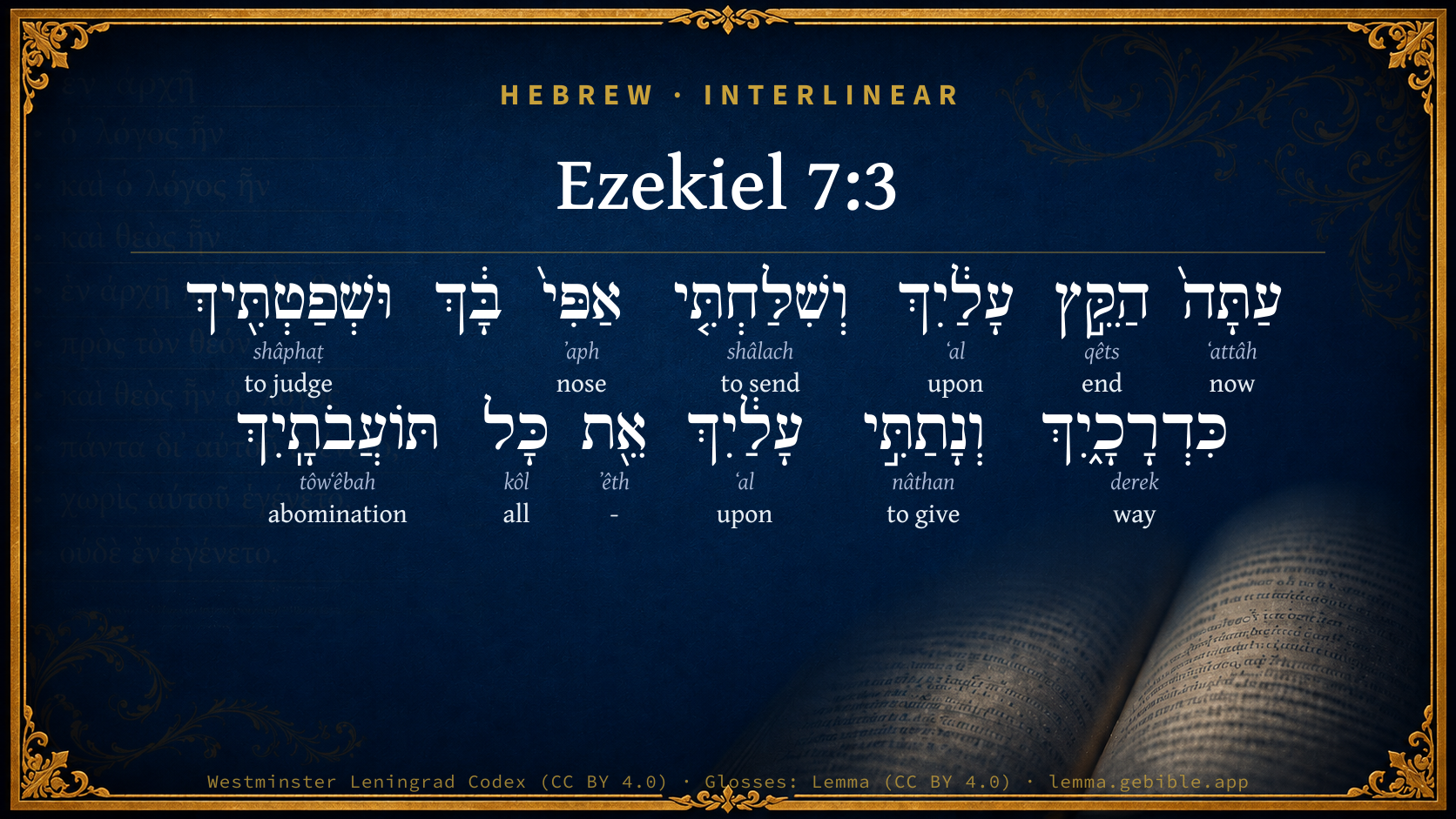
Hebrew (Westminster Leningrad Codex) Ezekiel 7:3 appears in the Hebrew Old Testament. The text above is from the Westminster Leningrad Codex. Each word links to its Strong’s number, a concise gloss, and parsing drawn from the Open Scriptures Hebrew Bible morphology. Click any word for its full Brown-Driver-Briggs (BDB) entry.
Download image
Cite this verse

Ezekiel 7:3 (World English Bible). Public Domain. Lemma interlinear Bible study tool, https://lemma.gebible.app/v/ezekiel/7/3.

Show BibTeX & RIS
BibTeX
RIS
English Translation
Now is the end on you, and I will send my anger on you, and will judge you according to your ways; and I will bring on you all your abominations.
World English Bible · Public Domain
Download a study sheet

One document with this verse’s original text, its word-by-word gloss line, the meaning frame, cross-references with their text, attributed commentary, and full source and license credits — printable, and it pastes into notes with its structure intact.

This verse Autodidact and up

Study sheet (.html) Plain text (.txt)

A passage Seminary Student

Up to 50 verses in one chapter. A passage sheet keeps up to 6 commentary sources and 12 cross-references per verse, in the order this page ranks them, and says so on the sheet whenever that leaves anything out. Ask for a single verse and you get the Autodidact verse sheet above.

Everything on this page stays free to read, with no account — the sheet is a download of what is already on screen, not access to it.

Want to remove ads? Support Godless Engineer
Compare translations 3

The same verse in 3 English versions, stacked beneath the original-language interlinear above. Click any original word for its lexicon entry.

Each is an independent rendering of the whole verse — the interlinear is not word-aligned to these translations.

Highlighted words mark where these versions differ — a whole-verse word diff, not a word-by-word alignment.

  • World English Bible Public Domain
    Now is the end on you, and I will send my anger on you, and will judge you according to your ways; and I will bring on you all your abominations.
  • King James Version Public Domain
    Now is the end come upon thee, and I will send mine anger upon thee, and will judge thee according to thy ways, and will recompense upon thee all thine abominations.
  • unfoldingWord Literal Text CC BY-SA 4.0
    Now the end is upon you, for I am sending out my wrath on you, and I will judge you according to your ways; then I will bring all your abominations upon you.

unfoldingWord Literal Text — © unfoldingWord, licensed CC BY-SA 4.0. Word-aligned USFM3 via Door43 (git.door43.org/unfoldingWord/en_ult).

Versions to compare (up to 4)

3 of 4 selected

Show all 18 translations

Every available English version of this verse, each an independent rendering of the whole verse.

  • World English Bible Public Domain
    Now is the end on you, and I will send my anger on you, and will judge you according to your ways; and I will bring on you all your abominations.
  • Berean Standard Bible Public Domain
    The end is now upon you, and I will unleash My anger against you. I will judge you according to your ways and repay you for all your abominations.
  • Majority Standard Bible Public Domain
    The end is now upon you, and I will unleash My anger against you. I will judge you according to your ways and repay you for all your abominations.
  • King James Version Public Domain
    Now is the end come upon thee, and I will send mine anger upon thee, and will judge thee according to thy ways, and will recompense upon thee all thine abominations.
  • American Standard Version (1901) Public Domain
    Now is the end upon thee, and I will send mine anger upon thee, and will judge thee according to thy ways; and I will bring upon thee all thine abominations.
  • Revised Version (1885) Public Domain
    Now is the end upon thee, and I will send mine anger upon thee, and will judge thee according to thy ways; and I will bring upon thee all thine abominations.
  • Geneva Bible (1599) Public Domain
    Nowe is the ende come vpon thee, and I wil sende my wrath vpon thee, and will iudge thee according to thy wayes, and will laye vpon thee all thine abominations.
  • Douay-Rheims (1899) Public Domain
    Now is an end come upon thee, and I will send my wrath upon thee, and I will judge thee according to thy ways: and I will set all thy abominations against thee.
  • Young's Literal Translation Public Domain
    Now `is' the end unto thee, And I have sent Mine anger upon thee, And judged thee according to thy ways, And set against thee all thine abominations.
  • Literal Standard Version CC BY-SA 4.0
    Now [is] the end for you, || And I have sent My anger on you, || And judged you according to your ways, || And set all your abominations against you.
  • Unlocked Literal Bible CC BY-SA 4.0
    Now the end is upon you, for I am sending out my wrath on you, and I will judge you according to your ways; then I will bring all your abominations upon you.
  • unfoldingWord Literal Text CC BY-SA 4.0
    Now the end is upon you, for I am sending out my wrath on you, and I will judge you according to your ways; then I will bring all your abominations upon you.
  • Darby Bible Public Domain
    Now is the end upon thee; and I will send mine anger upon thee, and will judge thee according to thy ways, and will bring upon thee all thine abominations.
  • World Messianic Bible Public Domain
    Now the end is on you, and I will send my anger on you, and will judge you according to your ways. I will bring on you all your abominations.
  • Webster's Bible Public Domain
    Now is the end come upon thee, and I will send my anger upon thee, and will judge thee according to thy ways, and will recompense upon thee all thy abominations.
  • Free Bible Version CC BY-SA 4.0
    Now is the end for you! I'm going to direct my anger against you. I'm judging you for your actions and will pay you back for the offensive things you've done.
  • Bible in Basic English Public Domain
    Now the end has come on you, and I will send my wrath on you, judging you for your ways, I will send punishment on you for all your disgusting acts.
  • JPS Tanakh (1917) Public Domain
    Now is the end upon thee, and I will send Mine anger upon thee, and will judge thee according to thy ways; and I will bring upon thee all thine abominations.

Literal Standard Version (2020), Covenant Press — licensed CC BY-SA 4.0. Text via the HelloAO Bible API (eBible.org). Unlocked Literal Bible (unfoldingWord) — licensed CC BY-SA 4.0. Text via the HelloAO Bible API (eBible.org). unfoldingWord Literal Text — © unfoldingWord, licensed CC BY-SA 4.0. Word-aligned USFM3 via Door43 (git.door43.org/unfoldingWord/en_ult). Free Bible Version, Dr. Jonathan Gallagher — licensed CC BY-SA 4.0. Text via the HelloAO Bible API (eBible.org).

Word by word

More ways to search: Search by grammar → Find every occurrence → Compare this word →

Practice this passage: Drill this verse → Learn its vocabulary →

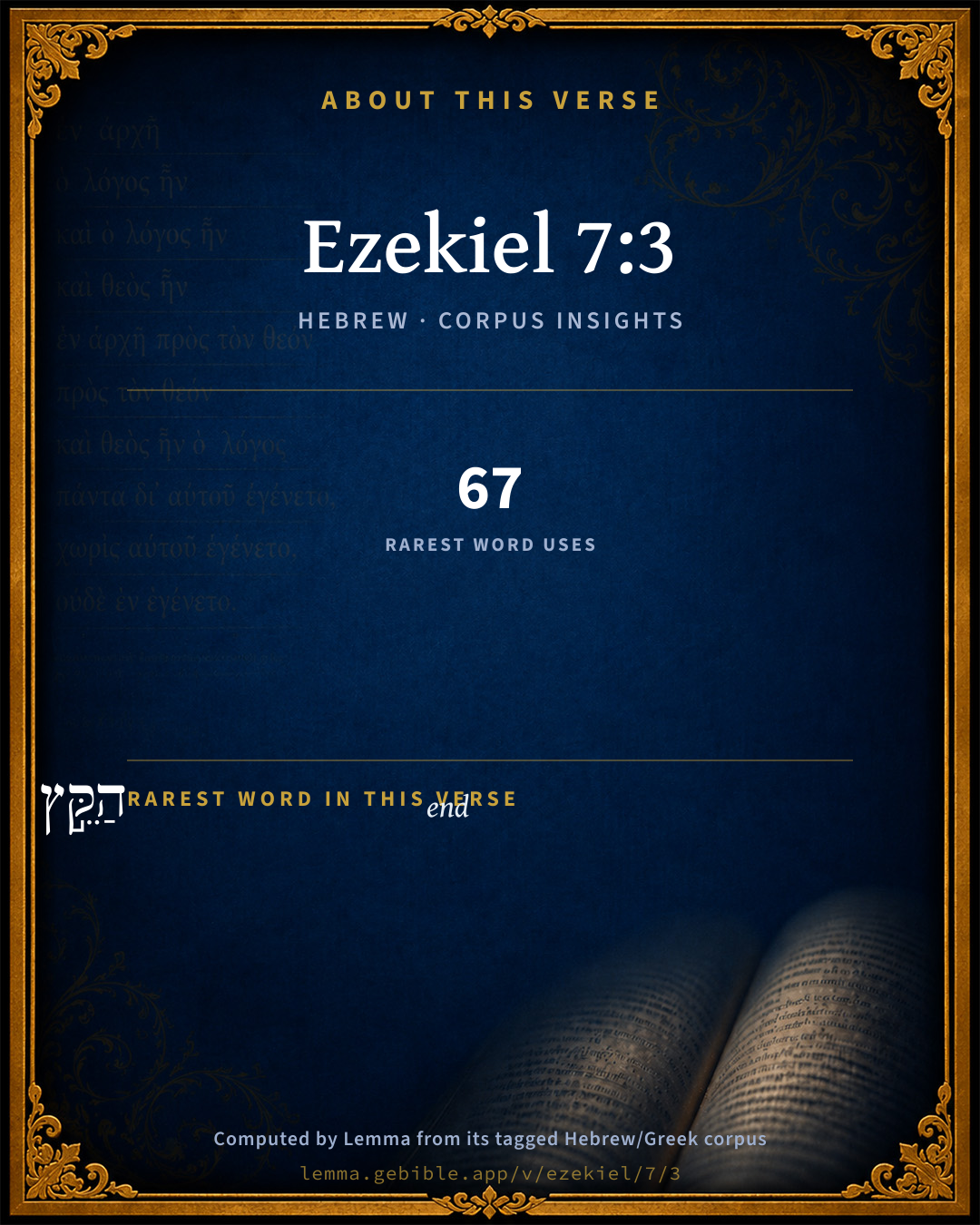
הַקֵּ֣ץ
qêts
H7093
“the · end”
Particle, Definite Article + Noun, Common, Masculine, Singular, Absolute
Part of Speech
Particle + Noun
Type
Common
Gender
Masculine
Number
Singular
State
Absolute
Full BDB Definition

Origin: contracted from H7112 , an extremity

TWOT: 2060a

end - end, at the end of (of time) - end (of space)
  1. עַתָּה֙ ʻattâh H6258 “now” Adverb
  2. עָלַ֔יִךְ ʻal H5921 “upon · you” Preposition + Suffix, Personal, 2nd Person, Feminine, Singular
  3. וְשִׁלַּחְתִּ֤י shâlach H7971 “and · to send” Conjunction + Verb, Piel, Sequential Perfect, 1st Person, Common, Singular
  4. אַפִּי֙ ʼaph H639 “nose · my” Noun, Common, Masculine, Singular, Construct + Suffix, Personal, 1st Person, Common, Singular
  5. וּשְׁפַטְתִּ֖יךְ shâphaṭ H8199 “and · to judge · you” Conjunction + Verb, Qal, Sequential Perfect, 1st Person, Common, Singular + Suffix, Personal, 2nd Person, Feminine, Singular
  6. כִּדְרָכָ֑יִךְ derek H1870 “like/as · ways · your” Preposition + Noun, Common, Both, Plural, Construct + Suffix, Personal, 2nd Person, Feminine, Singular
  7. וְנָתַתִּ֣י nâthan H5414 “and · to give” Conjunction + Verb, Qal, Sequential Perfect, 1st Person, Common, Singular
  8. עָלַ֔יִךְ ʻal H5921 “upon · you” Preposition + Suffix, Personal, 2nd Person, Feminine, Singular
  9. אֵ֖ת ʼêth H853 “-” Particle, Direct Object
  10. כָּל kôl H3605 “all of” Noun, Common, Masculine, Singular, Construct
  11. תּוֹעֲבֹתָֽיִךְ tôwʻêbah H8441 “abominations · your” Noun, Common, Feminine, Plural, Construct + Suffix, Personal, 2nd Person, Feminine, Singular

About this verse

These counts appear in no published source. They are computed here, from the morphology-tagged text and Lemma’s own curated glosses. What Lemma adds →

13
words
11
distinct lemmas
Prophets
section

Grammatical profile

  • 3 verbs
  • 5 nouns
  • 3 prepositions
  • 1 adverb
  • 1 particle

Verb forms

  • וְשִׁלַּחְתִּ֤י Piel · Sequential Perfect
  • וּשְׁפַטְתִּ֖יךְ Qal · Sequential Perfect
  • וְנָתַתִּ֣י Qal · Sequential Perfect

Repetition

A word recurs within this verse — often emphatic in Hebrew:

  • עָלַ֔יִךְ upon H5921 ×2

Hebrew & Septuagint length

In English translation the verse runs 31 words from the Hebrew and 6 from the Septuagint (LXX English) — the Septuagint runs noticeably shorter here. See the side-by-side →

A rough comparison of the two English renderings, which tokenize alike — not a word-level alignment.

Word counts can differ between the Hebrew and the Greek without any difference in meaning — e.g. the Hebrew direct-object marker אֵת has no separate Greek word, and Greek often adds the article ὁ.

Cross-references

12

Topical passages linked to Ezekiel 7:3 in the Treasury of Scripture Knowledge — connected by theme and wording, ordered by reader-vote popularity; previews shown in the World English Bible.

  • Ezekiel 18:30 Therefore I will judge you, house of Israel, everyone according to his ways, says the Lord Yahweh. Return you, and turn yourselves from all your transgressions; so iniquity shall not be your ruin.
  • Ezekiel 5:13 Thus shall my anger be accomplished, and I will cause my wrath toward them to rest, and I shall be comforted; and they shall know that I, Yahweh, have spoken in my zeal, when I have accomplished my wrath on them.
  • Ezekiel 7:8–9 Now will I shortly pour out my wrath on you, and accomplish my anger against you, and will judge you according to your ways; and I will bring on you all your abominations.
  • Ezekiel 16:38 I will judge you, as women who break wedlock and shed blood are judged; and I will bring on you the blood of wrath and jealousy.
  • Ezekiel 33:20 Yet you say, The way of the Lord is not equal. House of Israel, I will judge you everyone after his ways.
  • Ezekiel 6:3–7 and say, You mountains of Israel, hear the word of the Lord Yahweh: Thus says the Lord Yahweh to the mountains and to the hills, to the watercourses and to the valleys: Behold, I, even I, will bring a sword on you, and I will destroy your high places.
  • Ezekiel 6:12–13 He who is far off shall die of the pestilence; and he who is near shall fall by the sword; and he who remains and is besieged shall die by the famine: thus will I accomplish my wrath on them.
  • Ezekiel 7:27 The king shall mourn, and the prince shall be clothed with desolation, and the hands of the people of the land shall be troubled: I will do to them after their way, and according to their deserts will I judge them; and they shall know that I am Yahweh.
  • Ezekiel 11:10–11 You shall fall by the sword; I will judge you in the border of Israel; and you shall know that I am Yahweh.
  • Ezekiel 34:20–22 Therefore thus says the Lord Yahweh to them: Behold, I, even I, will judge between the fat sheep and the lean sheep.
  • Ezekiel 36:19 and I scattered them among the nations, and they were dispersed through the countries: according to their way and according to their doings I judged them.
  • Revelation 20:12–13 I saw the dead, the great and the small, standing before the throne, and they opened books. Another book was opened, which is the book of life. The dead were judged out of the things which were written in the books, according to their works.

Cross-references courtesy of OpenBible.info (CC BY 4.0).

Hebrew and Greek witnesses Masoretic Hebrew ↔ Greek Septuagint

The same verse in the two great witnesses to the Old Testament, shown verse-for-verse.

Here the Septuagint runs noticeably shorter than the Hebrew — LXX2012 (modern English Septuagint) 6 words vs World English Bible 31. A rough length comparison of the two English translations, not a word-level alignment — read both below.

These are two independent witnesses, not word-aligned to each other, and the Septuagint is shown in lemma (dictionary) form.

Hebrew Ezekiel 7:3 Masoretic · Westminster Leningrad Codex

עַתָּה֙ הַקֵּ֣ץ עָלַ֔יִךְ וְשִׁלַּחְתִּ֤י אַפִּי֙ בָּ֔ךְ וּשְׁפַטְתִּ֖יךְ כִּדְרָכָ֑יִךְ וְנָתַתִּ֣י עָלַ֔יִךְ אֵ֖ת כָּל תּוֹעֲבֹתָֽיִךְ

Now is the end on you, and I will send my anger on you, and will judge you according to your ways; and I will bring on you all your abominations.

World English Bible · Public Domain

Greek LXX Ezekiel 7:3 Septuagint · lemma form

ἥκω ὁ πέρας

The end is come on you,

LXX2012 (modern English Septuagint) · Public Domain

Hebrew: Westminster Leningrad Codex (CC BY 4.0). Greek: Septuagint (public domain); English from LXX2012 (modern English Septuagint) (Public Domain). How the Septuagint differs from the Hebrew →

Targum (Aramaic paraphrase)

1

The Targum is the ancient Jewish Aramaic paraphrase of the Hebrew Scriptures — an interpretive translation, not the Hebrew text itself. Onkelos (literal) and Pseudo-Jonathan (expansive) render the Torah, and Jonathan the Prophets. Coverage is partial: where no permissively-licensed English translation exists for a verse, only the Aramaic is shown. This is verse-level text, not a word-by-word alignment to the Hebrew.

  1. Targum Jonathan Prophets (Joshua–Malachi)
    כְּעַן מְטַת פּוּרְעֲנוּת קִצָא לְמֵיתֵי עֲלָךְ וְאֶשְׁלַח רוּגְזִי בִּיךְ וְאִתְפְּרַע מִנִיךְ כְּאוֹרְחָתַיִךְ וְאֶתֵּן עֲלָךְ יַת כָּל תּוֹעֲבָתָיִךְ:

    (no public-domain English translation for this verse)

    Targum Jonathan — Aramaic: “Mikraot Gedolot” (public domain). English: “Sefaria Community Translation” (CC0 1.0 (public-domain dedication)); “London "Chaldee Paraphrase," 1871” (public domain). Text via Sefaria.

Commentary

Notes on Ezekiel 7:3 from classic Christian and Jewish commentators (each source and its license shown beneath its notes). The classic Christian expositions comment on the surrounding passage and are grouped to its opening verse, so a note may address several verses; the Jewish commentaries on the Tanakh (Rashi and others) are per-verse, so they appear only where the commentator wrote on this verse.

Lemma curates 59 commentaries, every one of them public domain or Creative Commons licensed, each selected and text-cleaned for this edition rather than reprinted as found. About our sources →

Trapp's Complete Commentary

John Trapp

Eze 7:3 Now [is] the end [come] upon thee, and I will send mine anger upon thee, and will judge thee according to thy ways, and will recompense upon thee all thine abominations.

Ver. 3. Now is the end come upon thee.] Even upon thee, O Israel. Who would ever have thought it {Lam 4:12}

And I will send mine anger upon thee.] Reveal it from heaven. {as Rom 1:18}

And will judge thee according to thy ways,] i.e., I will punish thee for thy ways. {as Hos 4:9 Oba 1:15}

And will recompense upon thee.] Heb., I will give or put upon thee all thine abominations - q.d., Thou hast hitherto put them upon me, but I will have a writ of removal, and set them upon their own base. {as Zec 5:11}

John Trapp, A Commentary or Exposition upon All the Books of the Old and New Testament (1647–1656) — public domain. Text from a community e-Sword module.

Tyndale Open Study Notes

Tyndale Open Resources

7:3-4 There was no hope that God would change his mind. • Then you will know that I am the Lord: When they received exactly what they deserved, the people would recognize the Lord’s power and holiness.

Tyndale Open Study Notes — © Tyndale Open Resources, licensed CC BY-SA 4.0. Text via the HelloAO Bible API.

Geneva Bible (1599)

Geneva Bible translators

I will punish thee as thou hast deserved for thine idolatry.

Geneva Bible (1599) marginal notes — public domain. Text via Bolls.life.

John Calvin's Commentaries

He puts the word end a third time, and repeats it even a fourth and a fifth time. Whence we collect, that those miserable ones, although admonished more than enough both by teaching and experience, were yet like brute animals, so that they always promised themselves something to fly to, and were not impressed with the fear with which the Prophet would strike them. They did not think that an end was really coming, but said, Oh! something will remain, some will escape; and this therefore was their pride. Hence the Prophet does not inculcate the same word in vain: now, says he, the end is come When he says the end has come, he signifies that the Israelites vainly and foolishly trusted in the future, because they had not yet experienced extreme rigor. God, as he had said, had been lenient with them as to punishment. What then did they do? When they perceived such forbearance in God they thought, that it would always be so. Hence the Prophet marks the difference between the past and future, as if he should say, that God’s vengeance as they had formerly known it, was moderate, but now nothing else remained but that God should utterly tear them up and consume them. Now, therefore, there is an end concerning thee He had spoken in the third person, but he was directing his discourse to the whole land of Israel, and he had said upon the four corners of the land, now, says he, the end cometh upon thee Then, I will send my indignation upon thee God indeed had given signs of his anger, but he had not been so severe that the Israelites ceased from flattering themselves. When, therefore, he speaks of his own indignation, he doubtless signifies that he was so offended that he would not restrain himself as he had formerly done. This too is the sense of what follows, I will judge thee according to thy ways. They had been judged formerly, but only in part; for God had given them time for repentance had they been curable: but now, when he compares their judgment with their sins, he means, that nothing was wanting to extreme severity. And he explains that more clearly at the end of the verse, I will put upon thee all thine abominations, that is, I will cast thine own burden upon thee. For although God had begun to exact just punishment. for their superstitions, yet they had not suffered a greater burden than they deserved. Hence God now pronounces that all their abominations should come upon their own heads, so that they should be utterly buried. It follows —

John Calvin's Commentaries (1540-1563) — public domain. Text from the Calvin Translation Society English edition (1840s-50s) via the Christian Classics Ethereal Library (ccel.org). Calvin's coverage is partial (roughly two-thirds of the Bible); uncommented books and verses are honest gaps, never fabricated. The 19th-century editor's footnotes and remarks are omitted so the notes are faithfully Calvin's own voice.

The Cambridge Bible for Schools and Colleges

gen. ed. J. J. S. Perowne

3. send mine anger] Is an unusual form of expression.

will recompense] Bring or put. Chastisement is but sin assuming another form, a form which it inevitably takes.

The Cambridge Bible for Schools and Colleges (gen. ed. J. J. S. Perowne; Cambridge University Press, 1878–1918) — public domain. Text from a community e-Sword module.

John Gill's Exposition

And mine eye shall not spare thee, neither will I have pity,.... Though the punishment will be heavy, and the lamentation will be great; see Eze 5:11;

but I will recompense thy ways upon thee; the evil of punishment for the evil of sin, the righteous demerit of their actions:

and thine abominations shall be in the midst of thee; not taken away, unatoned for, and indeed not repented of. The Targum is,

"and the punishment of thine abominations shall be in the midst of thee:''

and ye shall know that I am the Lord; to whom vengeance belongs; who takes notice of sinful actions, and punishes for them; to whom appertain the perfections of omniscience, omnipotence, and punitive justice.

John Gill's Exposition of the Whole Bible (1746–1763) — public domain (CC PDM 1.0). Text via the HelloAO Bible API.

Albert Barnes' Notes on the Bible

A kind of refrain, repeated in Eze 7:8-9, as the close of another stanza.

Albert Barnes' Notes on the Bible (1834–1885) — public domain. Text from a community e-Sword/MySword module.

Haydock's Catholic Bible Commentary

Set, as accusers, to increase thy confusion.

George Leo Haydock (1774–1849), Haydock's Catholic Family Bible and Commentary, 1859 edition — public domain. Excludes Psalms (Douay-Rheims chapter numbering differs from Protestant) and Deuterocanonical books (Catholic canon only).

Matthew Poole's English Annotations

There shall be no more delays, mine anger is upon thee. It is I who send the Chaldeans, the pestilence, famine, &c.; these are commissioned by me.

Will judge, punish,

thee according to thy way, as thou deservest.

Recompense, Heb. give, unto thee as the wages of thy iniquities, or lay all the guilt and all the punishment of all thy sins upon thee.

Matthew Poole's English Annotations on the Holy Bible (1683–1685) — public domain. Text from a community e-Sword/MySword module.

The Pulpit Commentary

Now is the end upon thee, etc. We note the repetition of this and ver. 4 in vers. 8, 9, as a kind of refrain in the lamentation. Stress is laid, and for the time laid exclusively, on the unpitying character of the Divine judgments. And this is followed as before, in Eze_6:14, by "Ye shall know that I am the Lord." Fear must teach men the lesson which love had failed to teach.

The Pulpit Commentary (1880–1919), ed. H.D.M. Spence-Jones & Joseph S. Exell — public domain. Text from a community e-Sword module.

unfoldingWord translationNotes

Door43 World Missions Community

General Information:

These are Yahweh's words to the people of Israel.

the end is upon you

The "end" is spoken of as if it were a robber attacking the people. AT: "your life is finished" (See: Personification)

I am sending out my wrath on you

"Wrath" is spoken of as if it were an arrow that Yahweh was shooting at the people. AT: "I am angry, and I will punish you" (See: Metaphor)

according to your ways

"according to the things you do" or "because of the wicked things you do"

I will bring all your abominations upon you

"I will punish you for doing those things that I hate so much"

For my eyes will not pity you

The eye is a synecdoche for the person whose eye it is. AT: "For I will not pity you" (See: Synecdoche)

I will bring your ways upon you

The way a person lives is spoken of as a path on which one walks. AT: "I will punish you for the things you have done" (See: Metaphor)

your abominations will be in your midst

Possible meanings are 1) "I will punish all of you because of your abominations" or 2) "this will happen as long as you continue to worship idols."

know that I am Yahweh

When Yahweh says that people will know that he is Yahweh, he is implying that they will know that he is the one true God who has supreme authority and power. See how you translated this in Ezekiel 6:7. AT: "understand that I am Yahweh, the one true God" or "realize that I, Yahweh, have supreme power and authority" (See: Assumed Knowledge and Implicit Information)

translationWords

send

wrath

judge

abomination

compassion

know

unfoldingWord translationNotes — © Distant Shores Media and the Door43 World Missions Community, licensed CC BY-SA 4.0. Source: git.door43.org/Door43/en_tn.

Lesson kit

Teaching starters — assembled from the data on this page, not authored interpretation. Every prompt links to the verse data it draws on. Edit before teaching.

Ezekiel, in the Prophets, opens this verse with 13 words (11 distinct Hebrew lemmas). Its most distinctive word is qêts (“end”). The Greek Septuagint runs shorter here. A historical commentator’s framing appears above. Read the whole chapter for the surrounding context.

Discussion questions

  1. The word qêts carries the sense “end.” How does it shape the verse?
  2. How does Ezekiel 18:30, which shares this passage’s theme, read alongside this verse?
  3. What does the repetition of “upon” (2× in this one verse) do in this verse?
  4. The Septuagint runs shorter here than the Hebrew. What might account for the difference?
  5. These translations render this verse differently. What is at stake in choosing one wording over another?
  6. «וְשִׁלַּחְתִּ֤י» is a Piel Sequential Perfect verb. How does that grammatical form shape the action described?
  7. Compare how Trapp's Complete Commentary and Tyndale Open Study Notes read this verse. Where do they agree or differ?

Things to notice

Reading settings

Reading text

Shown beneath each verse's original-language words.

Old Testament
Old Testament edition

Read the OT as the Masoretic Hebrew (MT) or the Greek Septuagint (LXX).

English shown for the Greek Septuagint (in the Hebrew ↔ Greek comparison).

Comparing translations? Open the Compare panel on any verse page to stack up to four side by side.