Exodus 21:32

Hebrew (Westminster Leningrad Codex) Exodus 21:32 appears in the Hebrew Old Testament. The text above is from the Westminster Leningrad Codex. Each word links to its Strong’s number, a concise gloss, and parsing drawn from the Open Scriptures Hebrew Bible morphology. Click any word for its full Brown-Driver-Briggs (BDB) entry.
Download image
Cite this verse

Exodus 21:32 (World English Bible). Public Domain. Lemma interlinear Bible study tool, https://lemma.gebible.app/v/exodus/21/32.

Show BibTeX & RIS
BibTeX
RIS
English Translation
If the bull gores a man-servant or a maid-servant, thirty shekels of silver shall be given to their master, and the ox shall be stoned.
World English Bible · Public Domain
Download a study sheet

One document with this verse’s original text, its word-by-word gloss line, the meaning frame, cross-references with their text, attributed commentary, and full source and license credits — printable, and it pastes into notes with its structure intact.

This verse Autodidact and up

Study sheet (.html) Plain text (.txt)

A passage Seminary Student

Up to 50 verses in one chapter. A passage sheet keeps up to 6 commentary sources and 12 cross-references per verse, in the order this page ranks them, and says so on the sheet whenever that leaves anything out. Ask for a single verse and you get the Autodidact verse sheet above.

Everything on this page stays free to read, with no account — the sheet is a download of what is already on screen, not access to it.

Want to remove ads? Support Godless Engineer
Compare translations 3

The same verse in 3 English versions, stacked beneath the original-language interlinear above. Click any original word for its lexicon entry.

Each is an independent rendering of the whole verse — the interlinear is not word-aligned to these translations.

Highlighted words mark where these versions differ — a whole-verse word diff, not a word-by-word alignment.

  • World English Bible Public Domain
    If the bull gores a man-servant or a maid-servant, thirty shekels of silver shall be given to their master, and the ox shall be stoned.
  • King James Version Public Domain
    If the ox shall push a manservant or a maidservant; he shall give unto their master thirty shekels of silver, and the ox shall be stoned.
  • unfoldingWord Literal Text CC BY-SA 4.0
    If the ox gores a male servant or a female servant, he shall give thirty silver shekels to the master, and the ox shall be stoned.

unfoldingWord Literal Text — © unfoldingWord, licensed CC BY-SA 4.0. Word-aligned USFM3 via Door43 (git.door43.org/unfoldingWord/en_ult).

Versions to compare (up to 4)

3 of 4 selected

Show all 18 translations

Every available English version of this verse, each an independent rendering of the whole verse.

  • World English Bible Public Domain
    If the bull gores a man-servant or a maid-servant, thirty shekels of silver shall be given to their master, and the ox shall be stoned.
  • Berean Standard Bible Public Domain
    If the ox gores a manservant or maidservant, the owner must pay thirty shekels of silver to the master of that servant, and the ox must be stoned.
  • Majority Standard Bible Public Domain
    If the ox gores a manservant or maidservant, the owner must pay thirty shekels of silver to the master of that servant, and the ox must be stoned.
  • King James Version Public Domain
    If the ox shall push a manservant or a maidservant; he shall give unto their master thirty shekels of silver, and the ox shall be stoned.
  • American Standard Version (1901) Public Domain
    If the ox gore a man-servant or a maid-servant, there shall be given unto their master thirty shekels of silver, and the ox shall be stoned.
  • Revised Version (1885) Public Domain
    If the ox gore a manservant or a maidservant; he shall give unto their master thirty shekels of silver, and the ox shall be stoned.
  • Geneva Bible (1599) Public Domain
    If the oxe gore a seruant or a mayde, hee shall giue vnto their master thirtie shekels of siluer, and the oxe shalbe stoned.
  • Douay-Rheims (1899) Public Domain
    If he assault a bondman or a bond woman, he shall give thirty sicles of silver to their master, and the ox shall be stoned.
  • Young's Literal Translation Public Domain
    `If the ox gore a man-servant or a handmaid, thirty silver shekels he doth give to their lord, and the ox is stoned.
  • Literal Standard Version CC BY-SA 4.0
    If the ox gores a manservant or a handmaid, he gives thirty silver shekels to their lord, and the ox is stoned.
  • Unlocked Literal Bible CC BY-SA 4.0
    If the ox gores a male servant or a female servant, the ox's owner must pay thirty shekels of silver, and the ox must be stoned.
  • unfoldingWord Literal Text CC BY-SA 4.0
    If the ox gores a male servant or a female servant, he shall give thirty silver shekels to the master, and the ox shall be stoned.
  • Darby Bible Public Domain
    If the ox gore a bondman or a handmaid, he shall give to their master thirty shekels of silver, and the ox shall be stoned.
  • World Messianic Bible Public Domain
    If the bull gores a male servant or a female servant, thirty shekels of silver shall be given to their master, and the ox shall be stoned.
  • Webster's Bible Public Domain
    If the ox shall push a man-servant, or maid-servant; he shall give to their master thirty shekels of silver, and the ox shall be stoned.
  • Free Bible Version CC BY-SA 4.0
    If the ox uses its horns and kills a male or female slave, the owner of the ox must pay thirty shekels of silver to the slave's master, and the ox must be stoned to death.
  • Bible in Basic English Public Domain
    If the death of a man-servant or of a woman-servant is caused by the ox, the owner is to give their master thirty shekels of silver, and the ox is to be stoned.
  • JPS Tanakh (1917) Public Domain
    If the ox gore a bondman or a bondwoman, he shall give unto their master thirty shekels of silver, and the ox shall be stoned.

Literal Standard Version (2020), Covenant Press — licensed CC BY-SA 4.0. Text via the HelloAO Bible API (eBible.org). Unlocked Literal Bible (unfoldingWord) — licensed CC BY-SA 4.0. Text via the HelloAO Bible API (eBible.org). unfoldingWord Literal Text — © unfoldingWord, licensed CC BY-SA 4.0. Word-aligned USFM3 via Door43 (git.door43.org/unfoldingWord/en_ult). Free Bible Version, Dr. Jonathan Gallagher — licensed CC BY-SA 4.0. Text via the HelloAO Bible API (eBible.org).

Word by word

More ways to search: Search by grammar → Find every occurrence → Compare this word →

Practice this passage: Drill this verse → Learn its vocabulary →

יִגַּ֥ח
nâgach
H5055
“to gore”
Verb, Qal, Imperfect, 3rd Person, Masculine, Singular
Part of Speech
Verb
Stem
Qal
Form
Imperfect
Person
3rd Person
Gender
Masculine
Number
Singular
Full BDB Definition

Origin: a primitive root

TWOT: 1291

to push, thrust, gore - (Qal) to gore - (Piel) to push or thrust at - (Hithpael) to engage in thrusting, wage war
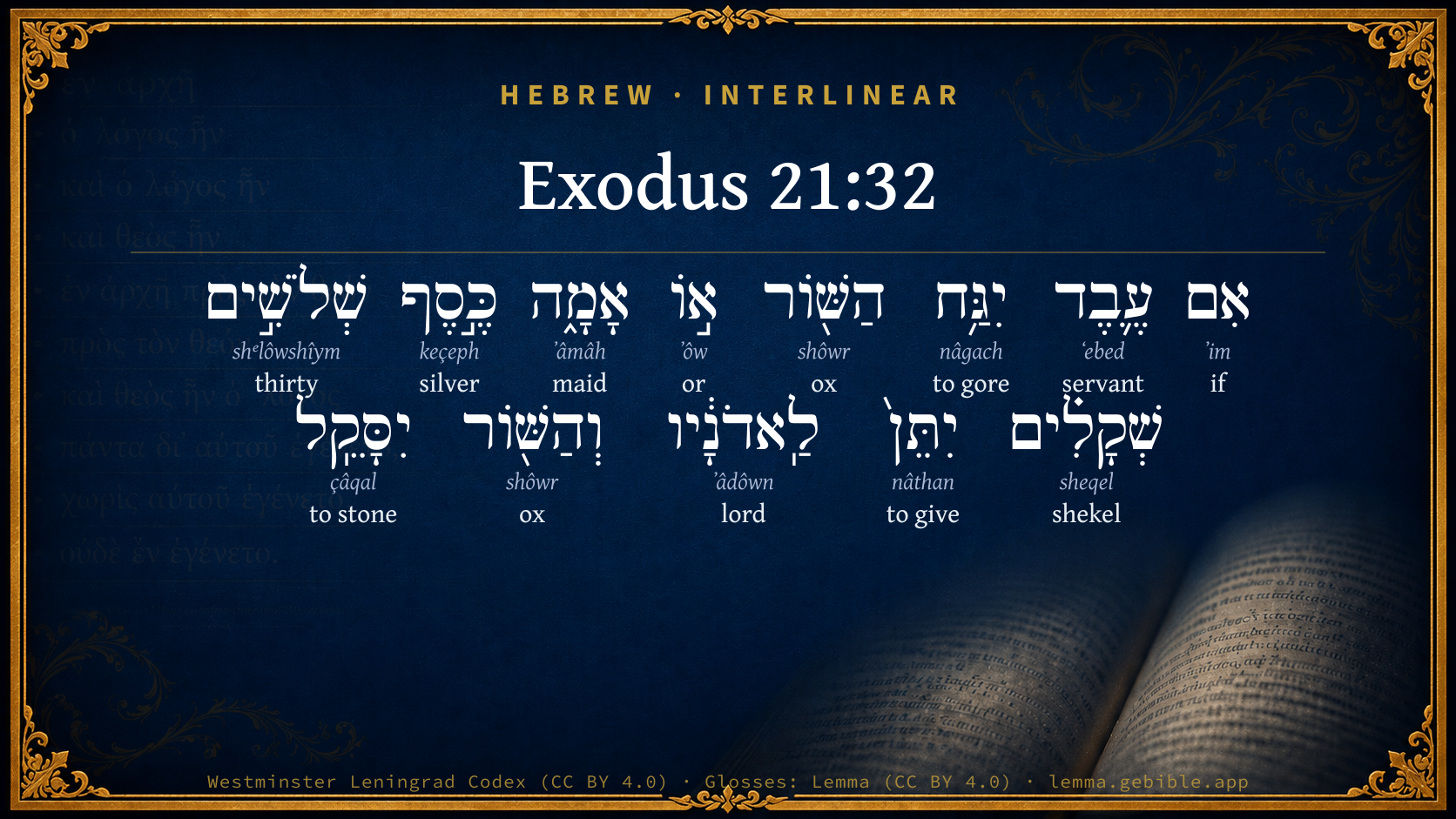
  1. אִם ʼim H518 “if” Conjunction
  2. עֶ֛בֶד ʻebed H5650 “servant” Noun, Common, Masculine, Singular, Absolute
  3. הַשּׁ֖וֹר shôwr H7794 “the · ox” Particle, Definite Article + Noun, Common, Masculine, Singular, Absolute
  4. א֣וֹ ʼôw H176 “or” Conjunction
  5. אָמָ֑ה ʼâmâh H519 “maid” Noun, Common, Feminine, Singular, Absolute
  6. כֶּ֣סֶף keçeph H3701 “silver” Noun, Common, Masculine, Singular, Absolute
  7. שְׁלֹשִׁ֣ים shᵉlôwshîym H7970 “thirty” Adjective, Cardinal number, Both, Plural, Absolute
  8. שְׁקָלִ֗ים sheqel H8255 “shekels” Noun, Common, Masculine, Plural, Absolute
  9. יִתֵּן֙ nâthan H5414 “to give” Verb, Qal, Imperfect, 3rd Person, Masculine, Singular
  10. לַֽאדֹנָ֔יו ʼâdôwn H113 “to/for · lords · his” Preposition + Noun, Common, Masculine, Plural, Construct + Suffix, Personal, 3rd Person, Masculine, Singular
  11. וְהַשּׁ֖וֹר shôwr H7794 “and · the · ox” Conjunction + Particle, Definite Article + Noun, Common, Masculine, Singular, Absolute
  12. יִסָּקֵֽל çâqal H5619 “to stone” Verb, Niphal, Imperfect, 3rd Person, Masculine, Singular

About this verse

These counts appear in no published source. They are computed here, from the morphology-tagged text and Lemma’s own curated glosses. What Lemma adds →

13
words
12
distinct lemmas
Pentateuch
section

Notable vocabulary

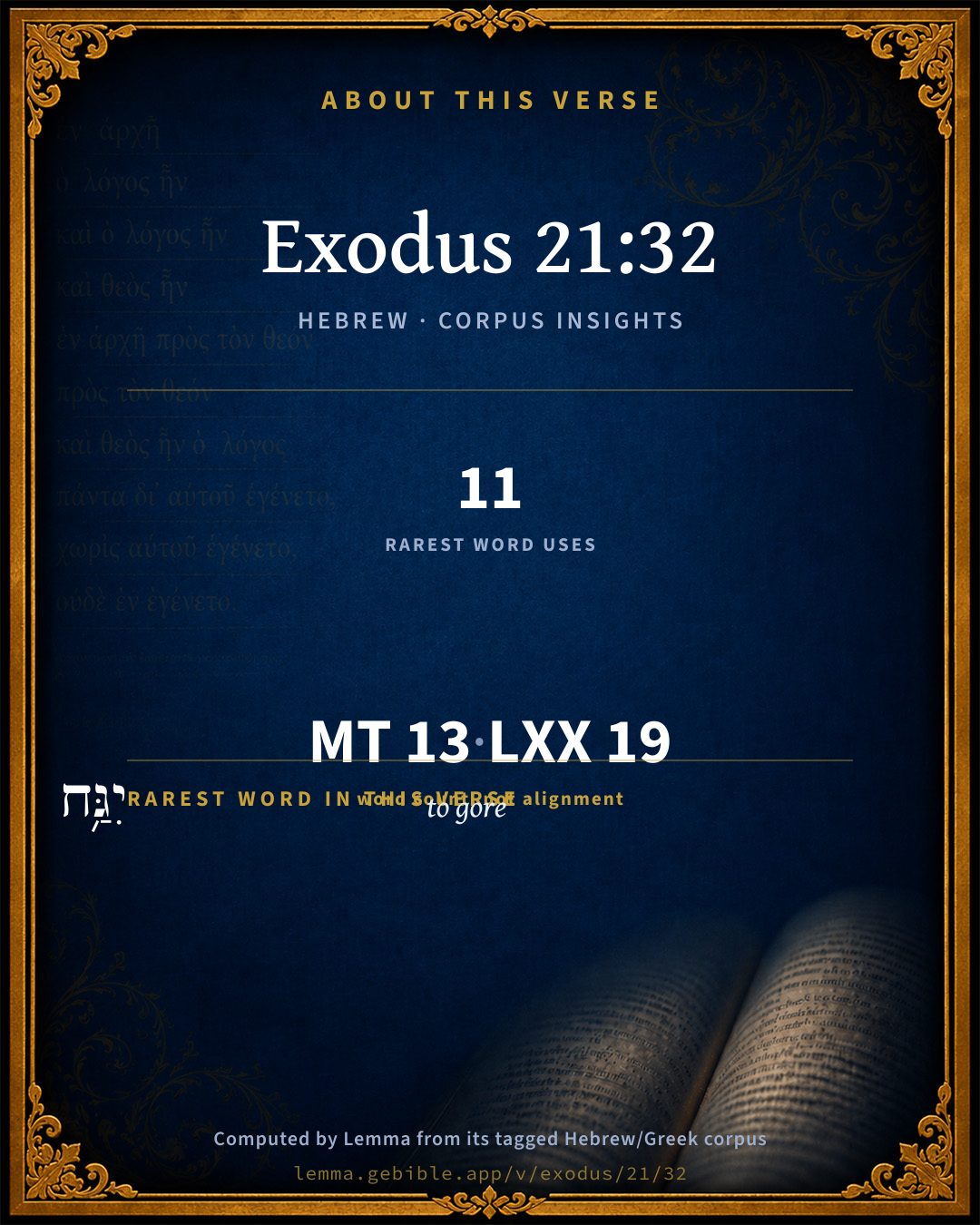
The rarest word here is יִגַּ֥ח to gore H5055 — appearing just 11 times in the whole Hebrew Bible.

Shared distinctive vocabulary

יִגַּ֥ח to gore H5055 occurs in 10 verses of the Hebrew Bible. Also found in:

Grammatical profile

  • 3 verbs
  • 7 nouns
  • 1 adjective
  • 2 conjunctions

Verb forms

  • יִגַּ֥ח Qal · Imperfect
  • יִתֵּן֙ Qal · Imperfect
  • יִסָּקֵֽל Niphal · Imperfect

Repetition

A word recurs within this verse — often emphatic in Hebrew:

  • הַשּׁ֖וֹר ox H7794 ×2

Hebrew & Septuagint length

In English translation the verse runs 25 words from the Hebrew and 24 from the Septuagint (LXX English) — closely comparable.

A rough comparison of the two English renderings, which tokenize alike — not a word-level alignment.

Word counts can differ between the Hebrew and the Greek without any difference in meaning — e.g. the Hebrew direct-object marker אֵת has no separate Greek word, and Greek often adds the article ὁ.

In the original languages it is 13 Hebrew tokens and 19 Greek tokens — but the two are counted differently (Hebrew bundles its prefixes and suffixes into one token; the Greek is in lemma form), so that isn’t a like-for-like length.

Cross-references

6

Topical passages linked to Exodus 21:32 in the Treasury of Scripture Knowledge — connected by theme and wording, ordered by reader-vote popularity; previews shown in the World English Bible.

  • Zechariah 11:12–13 I said to them, "If you think it best, give me my wages; and if not, keep them." So they weighed for my wages thirty pieces of silver.
  • Matthew 26:15 and said, "What are you willing to give me, that I should deliver him to you?" They weighed out for him thirty pieces of silver.
  • Matthew 27:3–9 Then Judas, who betrayed him, when he saw that Jesus was condemned, felt remorse, and brought back the thirty pieces of silver to the chief priests and elders,
  • Genesis 37:28 Midianites who were merchants passed by, and they drew and lifted up Joseph out of the pit, and sold Joseph to the Ishmaelites for twenty pieces of silver. They brought Joseph into Egypt.
  • Exodus 21:28–29 "If a bull gores a man or a woman to death, the bull shall surely be stoned, and its flesh shall not be eaten; but the owner of the bull shall not be held responsible.
  • Philippians 2:7 but emptied himself, taking the form of a servant, being made in the likeness of men.

Cross-references courtesy of OpenBible.info (CC BY 4.0).

Hebrew and Greek witnesses Masoretic Hebrew ↔ Greek Septuagint

The same verse in the two great witnesses to the Old Testament, shown verse-for-verse.

These are two independent witnesses, not word-aligned to each other, and the Septuagint is shown in lemma (dictionary) form.

Hebrew Exodus 21:32 Masoretic · Westminster Leningrad Codex

אִם עֶ֛בֶד יִגַּ֥ח הַשּׁ֖וֹר א֣וֹ אָמָ֑ה כֶּ֣סֶף שְׁלֹשִׁ֣ים שְׁקָלִ֗ים יִתֵּן֙ לַֽאדֹנָ֔יו וְהַשּׁ֖וֹר יִסָּקֵֽל

If the bull gores a man-servant or a maid-servant, thirty shekels of silver shall be given to their master, and the ox shall be stoned.

World English Bible · Public Domain

Greek LXX Exodus 21:32 Septuagint · lemma form

ἐάν δέ παῖς κερατίζω ὁ ταῦρος ἤ παιδίσκη ἀργύριον τριάκοντα δίδραγμον δίδωμι ὁ κύριος αὐτός καί ὁ ταῦρος λιθοβολέω

And if the bull gore a man-servant or maidservant, he shall pay to their master thirty silver didrachmas, and the bull shall be stoned.

LXX2012 (modern English Septuagint) · Public Domain

On this verse, Haydock's Catholic Bible Commentary discusses the Septuagint’s reading. Read the note in Commentary ↓

Hebrew: Westminster Leningrad Codex (CC BY 4.0). Greek: Septuagint (public domain); English from LXX2012 (modern English Septuagint) (Public Domain). How the Septuagint differs from the Hebrew →

Targum (Aramaic paraphrase)

2

The Targum is the ancient Jewish Aramaic paraphrase of the Hebrew Scriptures — an interpretive translation, not the Hebrew text itself. Onkelos (literal) and Pseudo-Jonathan (expansive) render the Torah, and Jonathan the Prophets. Coverage is partial: where no permissively-licensed English translation exists for a verse, only the Aramaic is shown. This is verse-level text, not a word-by-word alignment to the Hebrew.

  1. Targum Onkelos Torah (Genesis–Deuteronomy)
    אִם לְעַבְדָא יַגַח תּוֹרָא אוֹ לְאַמְתָא כְּסַף תְּלָתִין סִלְעִין יִתֵּן לְרִבּוֹנֵהּ וְתוֹרָא יִתְרְגֵם:

    (no public-domain English translation for this verse)

    Targum Onkelos — Aramaic: “Onkelos Genesis” (public domain); “Onkelos Exodus” (public domain); “Onkelos Leviticus” (public domain); “Onkelos Numbers” (public domain); “Onkelos Deuteronomy” (public domain). English: “Sefaria Community Translation” (CC0 1.0 (public-domain dedication)); “J.W. Etheridge. The Targums of Onkelos and Jonathan Ben Uzziel on the Pentateuch. London: Longmans, Green, 1862” (public domain). Text via Sefaria.

  2. Targum Pseudo-Jonathan Torah (Genesis–Deuteronomy)
    בְּרַם אִין עֶבֶד כְּנַעֲנָאֵי נְגַשׁ תּוֹרָא אוֹ אַמְתָא כְּנַעֲנִיתָא כְּסַף תְּלָתִין סִלְעִין יִתֵּן לְמָרֵיהּ דְּעַבְדָא אוֹ דְאַמְתָא וְתוֹרָא יִתְרְגָם

    If an ox goreth a Kenaanite man-servant or handmaid, the master of the man or woman-servant shall give thirty sileen of silver, and the ox shall be stoned.

    Targum Pseudo-Jonathan — Aramaic: “Targum Jonathan on Genesis” (public domain); “Targum Jonathan on Exodus” (public domain); “Targum Jonathan on Leviticus” (public domain); “Targum Jonathan on Numbers” (public domain); “Targum Jonathan on Deuteronomy” (public domain). English: “The Targum of Jonathan ben Uzziel, trans. J. W. Etheridge, London, 1862” (public domain). Text via Sefaria.

Commentary

Notes on Exodus 21:32 from classic Christian and Jewish commentators (each source and its license shown beneath its notes). The classic Christian expositions comment on the surrounding passage and are grouped to its opening verse, so a note may address several verses; the Jewish commentaries on the Tanakh (Rashi and others) are per-verse, so they appear only where the commentator wrote on this verse.

Lemma curates 59 commentaries, every one of them public domain or Creative Commons licensed, each selected and text-cleaned for this edition rather than reprinted as found. About our sources →

Trapp's Complete Commentary

John Trapp

Exo 21:32 If the ox shall push a manservant or a maidservant; he shall give unto their master thirty shekels of silver, and the ox shall be stoned.

Ver. 32. Thirty shekels.] This same was that "goodly price" that our Lord Christ was valued at by the vile Jews. {Zec 11:12-13 Mat 26:15}

John Trapp, A Commentary or Exposition upon All the Books of the Old and New Testament (1647–1656) — public domain. Text from a community e-Sword module.

Geneva Bible (1599)

Geneva Bible translators

Read Gen. 23:15.

Geneva Bible (1599) marginal notes — public domain. Text via Bolls.life.

Adam Clarke's Commentary

Verse 32. Thirty shekels] Each worth about three shillings English; see Ge 20:16-15. So, counting the shekel at its utmost value, the life of a slave was valued at four pounds ten shillings. And at this price these same vile people valued the life of our blessed Lord; see Zec 11:12-13; Mt 26:15. And in return, the justice of God has ordered it so, that they have been sold for slaves into every country of the universe. And yet, strange to tell, they see not the hand of God in so visible a retribution!

Adam Clarke's Commentary on the Bible (1810–1826) — public domain. Text from a community e-Sword/MySword module.

The Cambridge Bible for Schools and Colleges

gen. ed. J. J. S. Perowne

32. If the ox killed a slave, however, it was sufficient if its owner paid his master as compensation the ordinary value of a slave, and suffered at the same time the loss of his animal’s services. Another instance of the lower value set upon a slave’s life: he is in this case valued simply as a chattel.

a manservant or a maidservant] a male or female Slave.

thirty shekels of silver] doubtless the average price of a slave at the time It seems that the intrinsic value of a shekel of silver was about 2 Samuel 9 d. (DB. iii. 420a), so that the silver of 30 shekels would be worth now about £4. 2 Samuel 6 d, (though its purchasing power would be many times greater: ibid. note, and 431 f.). The free Hebrew was valued at 50 shekels (Lev_27:3 f.). The same sum was offered as his wages to the prophet who, in the allegory of Zechariah 11, represented the rejected ruler of his people (v. 12: cf. Mat_26:15). Joseph was sold to the Ishmaelites for twenty shekels of silver (Gen_37:28 b [J]).

The Cambridge Bible for Schools and Colleges (gen. ed. J. J. S. Perowne; Cambridge University Press, 1878–1918) — public domain. Text from a community e-Sword module.

John Gill's Exposition

If the ox shall push a manservant, or a maidservant,.... Which the Targum of Jonathan and Jarchi interpret of a Canaanitish servant, man or maid; but no doubt the same provision was made for an Hebrew servant, man or maid, as for a Gentile one:

he shall give unto their master thirty shekels of silver; that is, the owner of the ox shall pay so much to the masters of the servants for the loss they have sustained by his ox goring them; and Maimonides (r) observes, that"the ransom of servants, whether great or small, whether male or female, is fixed in the law, thirty shekels of good silver, whether the servant is worth a hundred pounds, or whether he is worth but a penny.''This was the price our Lord and Saviour Jesus Christ was sold at; see Gill on Mat 26:15.

(r) Hilchot Niske Maimon, c. 11. sect. 1.

John Gill's Exposition of the Whole Bible (1746–1763) — public domain (CC PDM 1.0). Text via the HelloAO Bible API.

Haydock's Catholic Bible Commentary

Bond man, &c., of any of those uncircumcised nations, (Jonathan) whom it was lawful to put to death; and hence their life was esteemed of less value. (Haydock) --- Sicles. Septuagint, "didrachmas." This was the price of a slave, for which our Saviour was sold: that of a free-man was double. (Calmet)

George Leo Haydock (1774–1849), Haydock's Catholic Family Bible and Commentary, 1859 edition — public domain. Excludes Psalms (Douay-Rheims chapter numbering differs from Protestant) and Deuterocanonical books (Catholic canon only).

Matthew Poole's English Annotations

The half the freeman’s price. See Poole on "Mat 26:5".

Matthew Poole's English Annotations on the Holy Bible (1683–1685) — public domain. Text from a community e-Sword/MySword module.

The Pulpit Commentary

If the ox shall push a manservant or a maidservant. Hitherto, the case of free persons only has been considered. But the accident might have happened to a slave. Where this was the case, the death of the ox was still made indispensable, and thus far the same sacredness was made to attach to the life of the slave and of the freeman. But, in lieu of a varying fine, the average price of a slave, thirty shekels of silver, was appointed to be paid in all cases, as a compensation to the master

The Pulpit Commentary (1880–1919), ed. H.D.M. Spence-Jones & Joseph S. Exell — public domain. Text from a community e-Sword module.

Rashi

Rabbi Shlomo Yitzchaki (Rashi)

אם עבד או אמה IF [AN OX SHALL THRUST] A MANSERVANT OR A MAIDSERVANT — Canaanitish servants (Mekhilta).

שלשים שקלים יתן HE SHALL GIVE THIRTY SHEKELS — This is the enactment of Scripture (and no reason is given) — the indemnity shall be thirty shekels whether the slave was worth a thousand zuz or was worth no more than one denar. A shekel weighs four gold coins, making half an ounce according to the correct weight of Cologne.

Rashi on the Tanakh — English translations: “The Judaica Press complete Tanach with Rashi, translated by A. J. Rosenberg” (CC BY 4.0); “Pentateuch with Rashi's commentary by M. Rosenbaum and A.M. Silbermann, 1929-1934” (public domain); “The Metsudah Tanach series, Lakewood, N.J” (CC BY 4.0); and “The Book of Joshua, Metsudah Publications, 1997” (CC BY 4.0). Text via Sefaria.

Lesson kit

Teaching starters — assembled from the data on this page, not authored interpretation. Every prompt links to the verse data it draws on. Edit before teaching.

Exodus, in the Pentateuch, opens this verse with 13 words (12 distinct Hebrew lemmas). Its most distinctive word is nâgach (“to gore”). A historical commentator’s framing appears above. Read the whole chapter for the surrounding context.

Discussion questions

  1. The word nâgach carries the sense “to gore.” How does it shape the verse?
  2. Exodus 21:28 shares the word «to gore» with this verse. How do the two illuminate each other?
  3. “ox” occurs 2× in this one verse. What is the effect of the repetition?
  4. These translations render this verse differently; the difference is in the English rendering, not the original. What questions does that raise?
  5. The verb «יִגַּ֥ח» is Qal Imperfect. How does its form color the action?
  6. Reading how Trapp's Complete Commentary and Geneva Bible (1599) read this verse, where do the two commentators agree and where do they part?

Things to notice

Reading settings

Reading text

Shown beneath each verse's original-language words.

Old Testament
Old Testament edition

Read the OT as the Masoretic Hebrew (MT) or the Greek Septuagint (LXX).

English shown for the Greek Septuagint (in the Hebrew ↔ Greek comparison).

Comparing translations? Open the Compare panel on any verse page to stack up to four side by side.