Genesis 30:6

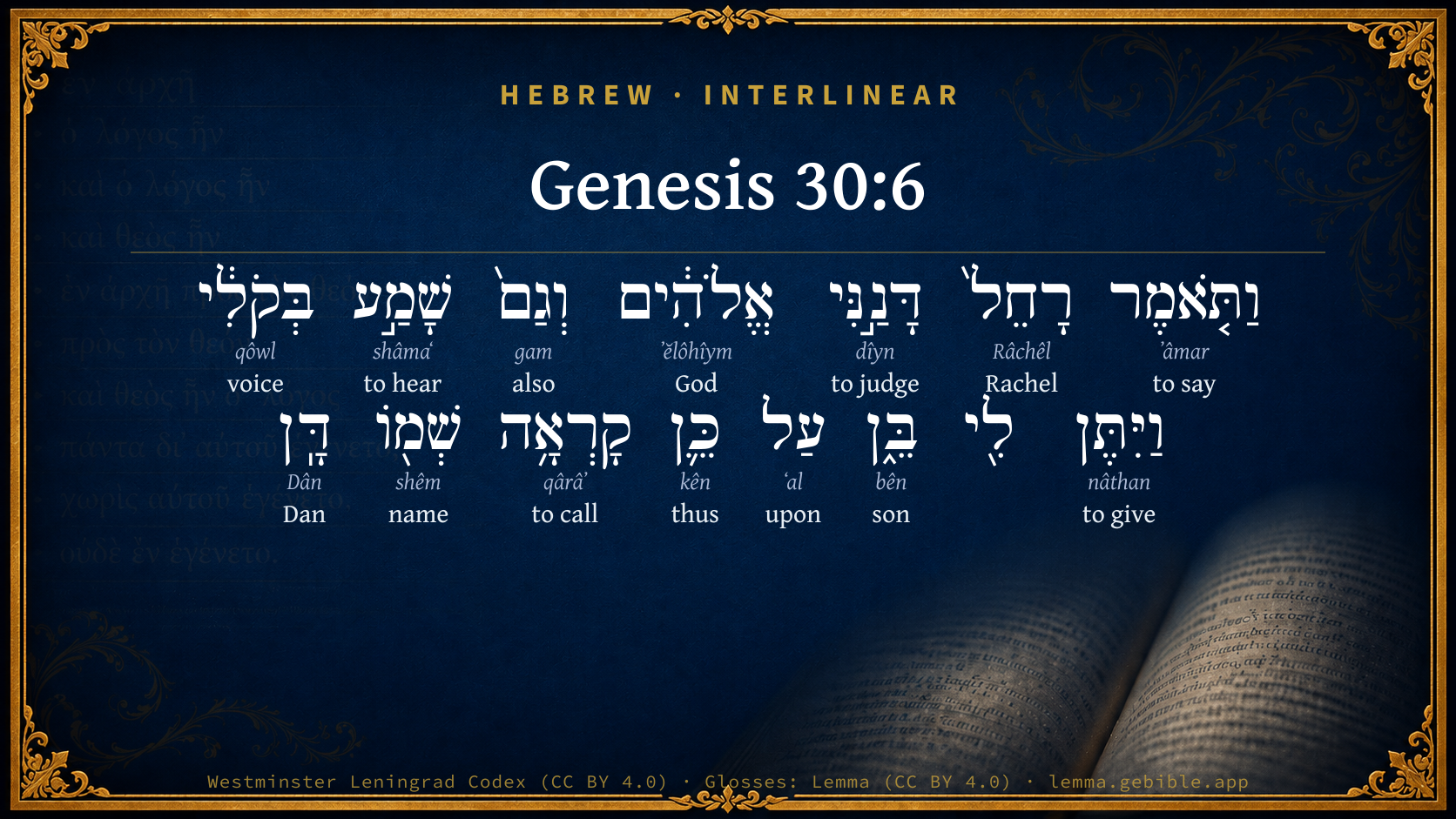
Hebrew (Westminster Leningrad Codex) Genesis 30:6 appears in the Hebrew Old Testament. The text above is from the Westminster Leningrad Codex. Each word links to its Strong’s number, a concise gloss, and parsing drawn from the Open Scriptures Hebrew Bible morphology. Click any word for its full Brown-Driver-Briggs (BDB) entry.
Download image
Cite this verse

Genesis 30:6 (World English Bible). Public Domain. Lemma interlinear Bible study tool, https://lemma.gebible.app/v/genesis/30/6.

Show BibTeX & RIS
BibTeX
RIS
English Translation
Rachel said, "God has judged me, and has also heard my voice, and has given me a son." Therefore called she his name Dan.
World English Bible · Public Domain
Download a study sheet

One document with this verse’s original text, its word-by-word gloss line, the meaning frame, cross-references with their text, attributed commentary, and full source and license credits — printable, and it pastes into notes with its structure intact.

This verse Autodidact and up

Study sheet (.html) Plain text (.txt)

A passage Seminary Student

Up to 50 verses in one chapter. A passage sheet keeps up to 6 commentary sources and 12 cross-references per verse, in the order this page ranks them, and says so on the sheet whenever that leaves anything out. Ask for a single verse and you get the Autodidact verse sheet above.

Everything on this page stays free to read, with no account — the sheet is a download of what is already on screen, not access to it.

Want to remove ads? Support Godless Engineer
Compare translations 3

The same verse in 3 English versions, stacked beneath the original-language interlinear above. Click any original word for its lexicon entry.

Each is an independent rendering of the whole verse — the interlinear is not word-aligned to these translations.

Highlighted words mark where these versions differ — a whole-verse word diff, not a word-by-word alignment.

  • World English Bible Public Domain
    Rachel said, "God has judged me, and has also heard my voice, and has given me a son." Therefore called she his name Dan.
  • King James Version Public Domain
    And Rachel said, God hath judged me, and hath also heard my voice, and hath given me a son: therefore called she his name Dan.
  • unfoldingWord Literal Text CC BY-SA 4.0
    and Rachel said, “God has vindicated me, and indeed, he has listened to my voice and given to me a son!” For that she called his name Dan.

unfoldingWord Literal Text — © unfoldingWord, licensed CC BY-SA 4.0. Word-aligned USFM3 via Door43 (git.door43.org/unfoldingWord/en_ult).

Versions to compare (up to 4)

3 of 4 selected

Show all 18 translations

Every available English version of this verse, each an independent rendering of the whole verse.

  • World English Bible Public Domain
    Rachel said, "God has judged me, and has also heard my voice, and has given me a son." Therefore called she his name Dan.
  • Berean Standard Bible Public Domain
    Then Rachel said, “God has vindicated me; He has heard my plea and given me a son.” So she named him Dan.
  • Majority Standard Bible Public Domain
    Then Rachel said, “God has vindicated me; He has heard my plea and given me a son.” So she named him Dan.
  • King James Version Public Domain
    And Rachel said, God hath judged me, and hath also heard my voice, and hath given me a son: therefore called she his name Dan.
  • American Standard Version (1901) Public Domain
    And Rachel said, God hath judged me, and hath also heard my voice, and hath given me a son: therefore called she his name Dan.
  • Revised Version (1885) Public Domain
    And Rachel said, God hath judged me, and hath also heard my voice, and hath given me a son: therefore called she his name Dan.
  • Geneva Bible (1599) Public Domain
    Then said Rahel, God hath giuen sentence on my side, and hath also heard my voyce, and hath giuen mee a sonne: therefore called shee his name, Dan.
  • Douay-Rheims (1899) Public Domain
    And Rachel said: The Lord hath judged for me, and hath heard my voice, giving me a son, and therefore she called his name Dan.
  • Young's Literal Translation Public Domain
    and Rachel saith, `God hath decided for me, and also hath hearkened to my voice, and giveth to me a son;' therefore hath she called his name Dan.
  • Literal Standard Version CC BY-SA 4.0
    and Rachel says, “God has decided for me, and has also listened to my voice, and gives a son to me”; therefore she has called his name Dan.
  • Unlocked Literal Bible CC BY-SA 4.0
    Then Rachel said, “God has vindicated me, and he has heard my voice and given me a son.” For this reason she called his name Dan.
  • unfoldingWord Literal Text CC BY-SA 4.0
    and Rachel said, “God has vindicated me, and indeed, he has listened to my voice and given to me a son!” For that she called his name Dan.
  • Darby Bible Public Domain
    And Rachel said, God has done me justice, and has also heard my voice, and given me a son; therefore she called his name Dan.
  • World Messianic Bible Public Domain
    Rachel said, “God has judged me, and has also heard my voice, and has given me a son.” Therefore she called his name Dan.
  • Webster's Bible Public Domain
    And Rachel said, God hath judged me, and hath also heard my voice, and hath given me a son: therefore she called his name Dan.
  • Free Bible Version CC BY-SA 4.0
    Rachel said, “God has judged in my favor! He listened to me and gave me a son.” So she named him Dan.
  • Bible in Basic English Public Domain
    Then Rachel said, God has been my judge, and has given ear to my voice, and has given me a son; so he was named Dan.
  • JPS Tanakh (1917) Public Domain
    And Rachel said: 'God hath judged me, and hath also heard my voice, and hath given me a son.' Therefore called she his name Dan.

Literal Standard Version (2020), Covenant Press — licensed CC BY-SA 4.0. Text via the HelloAO Bible API (eBible.org). Unlocked Literal Bible (unfoldingWord) — licensed CC BY-SA 4.0. Text via the HelloAO Bible API (eBible.org). unfoldingWord Literal Text — © unfoldingWord, licensed CC BY-SA 4.0. Word-aligned USFM3 via Door43 (git.door43.org/unfoldingWord/en_ult). Free Bible Version, Dr. Jonathan Gallagher — licensed CC BY-SA 4.0. Text via the HelloAO Bible API (eBible.org).

Word by word

More ways to search: Search by grammar → Find every occurrence → Compare this word →

Practice this passage: Drill this verse → Learn its vocabulary →

דָּנַ֣נִּי
dîyn
H1777
“to judge · me”
Verb, Qal, Perfect, 3rd Person, Masculine, Singular + Suffix, Personal, 1st Person, Common, Singular
Part of Speech
Verb
Stem
Qal
Form
Perfect
Person
3rd Person
Gender
Masculine
Number
Singular
Full BDB Definition

Origin: a primitive root [comp. H113 ]

TWOT: 426

to judge, contend, plead - (Qal) - to act as judge, minister judgment - to plead a cause - to execute judgment, requite, vindicate - to govern - to contend, strive - (Niphal) to be at strife, quarrel
  1. וַתֹּ֤אמֶר ʼâmar H559 “and · to say” Conjunction + Verb, Qal, Sequential Imperfect, 3rd Person, Feminine, Singular
  2. רָחֵל֙ Râchêl H7354 “Rachel” Noun, Proper
  3. אֱלֹהִ֔ים ʼĕlôhîym H430 “God(s)” Noun, Common, Masculine, Plural, Absolute
  4. וְגַם֙ gam H1571 “and · also” Conjunction + Particle, Accusative
  5. שָׁמַ֣ע shâmaʻ H8085 “to hear” Verb, Qal, Perfect, 3rd Person, Masculine, Singular
  6. בְּקֹלִ֔י qôwl H6963 “in/at · voice · my” Preposition + Noun, Common, Masculine, Singular, Construct + Suffix, Personal, 1st Person, Common, Singular
  7. וַיִּתֶּן nâthan H5414 “and · to give” Conjunction + Verb, Qal, Sequential Imperfect, 3rd Person, Masculine, Singular
  8. בֵּ֑ן bên H1121 “son” Noun, Common, Masculine, Singular, Absolute
  9. עַל ʻal H5921 “upon” Preposition
  10. כֵּ֛ן kên H3651 “thus” Particle, Demonstrative
  11. קָרְאָ֥ה qârâʼ H7121 “to call” Verb, Qal, Perfect, 3rd Person, Feminine, Singular
  12. שְׁמ֖וֹ shêm H8034 “name · his” Noun, Common, Masculine, Singular, Construct + Suffix, Personal, 3rd Person, Masculine, Singular
  13. דָּֽן Dân H1835 “Dan” Noun, Proper

About this verse

These counts appear in no published source. They are computed here, from the morphology-tagged text and Lemma’s own curated glosses. What Lemma adds →

15
words
14
distinct lemmas
Pentateuch
section

Notable vocabulary

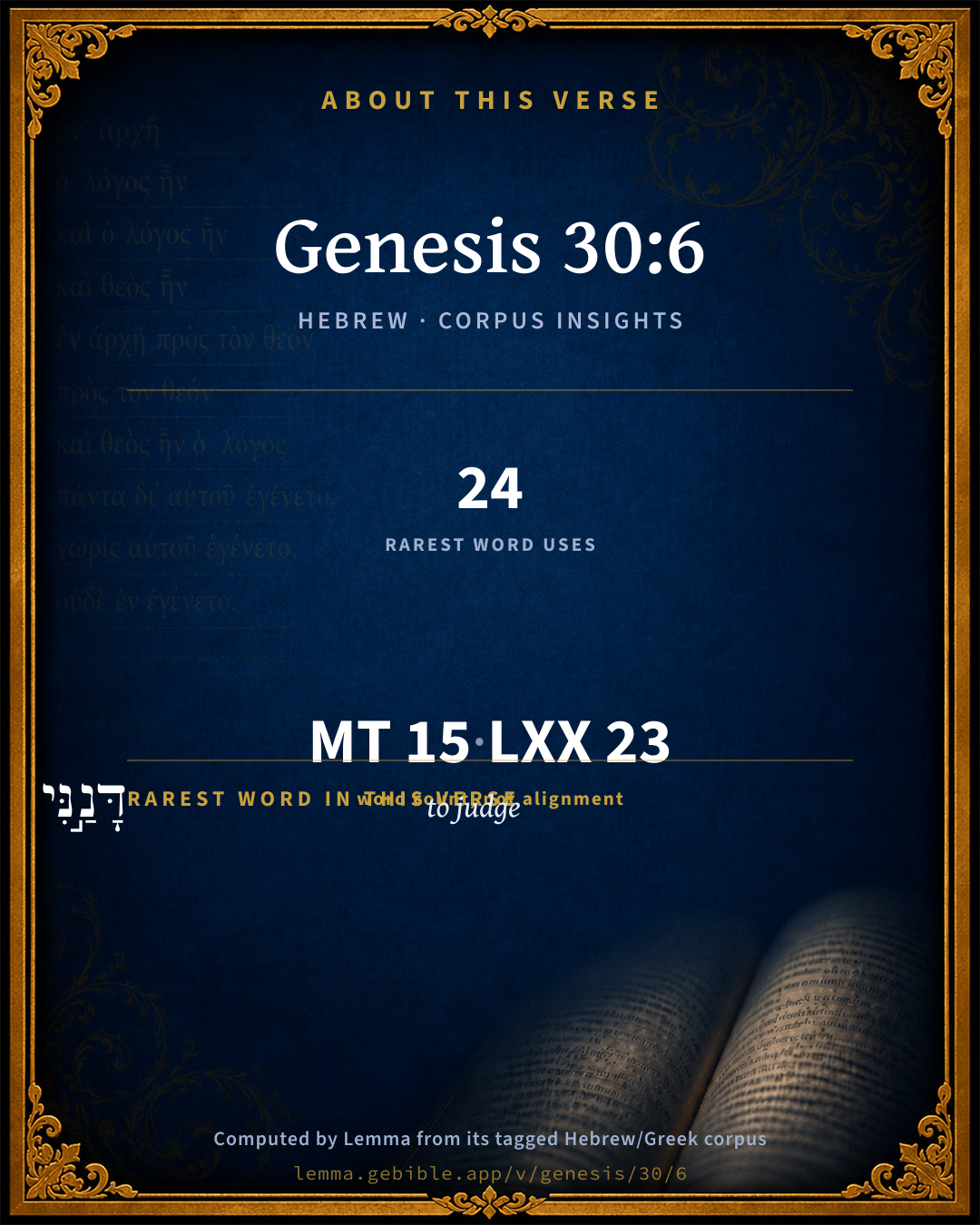
The rarest word here is דָּנַ֣נִּי to judge H1777 — appearing just 24 times in the whole Hebrew Bible.

Shared distinctive vocabulary

דָּנַ֣נִּי to judge H1777 occurs in 24 verses of the Hebrew Bible. Also found in:

Grammatical profile

  • 5 verbs
  • 6 nouns
  • 2 prepositions
  • 2 particles

Verb forms

  • וַתֹּ֤אמֶר Qal · Sequential Imperfect
  • דָּנַ֣נִּי Qal · Perfect
  • שָׁמַ֣ע Qal · Perfect
  • וַיִּתֶּן Qal · Sequential Imperfect
  • קָרְאָ֥ה Qal · Perfect

Hebrew & Septuagint length

In English translation the verse runs 24 words from the Hebrew and 26 from the Septuagint (LXX English) — closely comparable.

A rough comparison of the two English renderings, which tokenize alike — not a word-level alignment.

Word counts can differ between the Hebrew and the Greek without any difference in meaning — e.g. the Hebrew direct-object marker אֵת has no separate Greek word, and Greek often adds the article ὁ.

In the original languages it is 15 Hebrew tokens and 23 Greek tokens — but the two are counted differently (Hebrew bundles its prefixes and suffixes into one token; the Greek is in lemma form), so that isn’t a like-for-like length.

Cross-references

11

Topical passages linked to Genesis 30:6 in the Treasury of Scripture Knowledge — connected by theme and wording, ordered by reader-vote popularity; previews shown in the World English Bible.

  • Lamentations 3:59 Yahweh, you have seen my wrong; judge you my cause.
  • Psalms 35:24 Vindicate me, Yahweh my God, according to your righteousness; Don't let them gloat over me.
  • Psalms 43:1 Vindicate me, God, and plead my cause against an ungodly nation. Oh, deliver me from deceitful and wicked men.
  • Genesis 49:16–17 "Dan will judge his people, As one of the tribes of Israel.
  • Genesis 29:32–35 Leah conceived, and bore a son, and she named him Reuben. For she said, "Because Yahweh has looked at my affliction. For now my husband will love me."
  • Genesis 35:25 The sons of Bilhah (Rachel's handmaid): Dan and Naphtali.
  • Genesis 46:23 The son of Dan: Hushim.
  • Deuteronomy 33:22 Of Dan he said, Dan is a lion's cub, That leaps forth from Bashan.
  • Jeremiah 13:2 So I bought a belt according to the word of Yahweh, and put it on my loins.
  • Jeremiah 13:24 Therefore will I scatter them, as the stubble that passes away, by the wind of the wilderness.
  • Jeremiah 15:14–20 I will make [them] to pass with your enemies into a land which you don't know; for a fire is kindled in my anger, which shall burn on you.

Cross-references courtesy of OpenBible.info (CC BY 4.0).

Hebrew and Greek witnesses Masoretic Hebrew ↔ Greek Septuagint

The same verse in the two great witnesses to the Old Testament, shown verse-for-verse.

These are two independent witnesses, not word-aligned to each other, and the Septuagint is shown in lemma (dictionary) form.

Hebrew Genesis 30:6 Masoretic · Westminster Leningrad Codex

וַתֹּ֤אמֶר רָחֵל֙ דָּנַ֣נִּי אֱלֹהִ֔ים וְגַם֙ שָׁמַ֣ע בְּקֹלִ֔י וַיִּתֶּן לִ֖י בֵּ֑ן עַל כֵּ֛ן קָרְאָ֥ה שְׁמ֖וֹ דָּֽן

Rachel said, "God has judged me, and has also heard my voice, and has given me a son." Therefore called she his name Dan.

World English Bible · Public Domain

Greek LXX Genesis 30:6 Septuagint · lemma form

καί εἶπον ραχηλ κρίνω ἐγώ ὁ θεός καί ἐπιἀκούω ὁ φωνή ἐγώ καί δίδωμι ἐγώ υἱός διά οὗτος καλέω ὁ ὄνομα αὐτός δαν

And Rachel said, God has given judgment for me, and listened to my voice, and has given me a son; therefore she called his name, Dan.

LXX2012 (modern English Septuagint) · Public Domain

Hebrew: Westminster Leningrad Codex (CC BY 4.0). Greek: Septuagint (public domain); English from LXX2012 (modern English Septuagint) (Public Domain). How the Septuagint differs from the Hebrew →

Targum (Aramaic paraphrase)

2

The Targum is the ancient Jewish Aramaic paraphrase of the Hebrew Scriptures — an interpretive translation, not the Hebrew text itself. Onkelos (literal) and Pseudo-Jonathan (expansive) render the Torah, and Jonathan the Prophets. Coverage is partial: where no permissively-licensed English translation exists for a verse, only the Aramaic is shown. This is verse-level text, not a word-by-word alignment to the Hebrew.

  1. Targum Onkelos Torah (Genesis–Deuteronomy)
    וַאֲמֶרֶת רָחֵל דְּנַנִּי יְיָ וְאַף קַבִּיל צְלוֹתִי וִיהַב לִי בַּר עַל כֵּן קְרַת שְׁמֵהּ דָּן

    (no public-domain English translation for this verse)

    Targum Onkelos — Aramaic: “Onkelos Genesis” (public domain); “Onkelos Exodus” (public domain); “Onkelos Leviticus” (public domain); “Onkelos Numbers” (public domain); “Onkelos Deuteronomy” (public domain). English: “Sefaria Community Translation” (CC0 1.0 (public-domain dedication)); “J.W. Etheridge. The Targums of Onkelos and Jonathan Ben Uzziel on the Pentateuch. London: Longmans, Green, 1862” (public domain). Text via Sefaria.

  2. Targum Pseudo-Jonathan Torah (Genesis–Deuteronomy)
    וַאֲמַרַת רָחֵל דָן יְתִי יְיָ בִּרְחִימוֹי טַבְיָא וּלְחוֹד שָׁמַע בְּקוֹל צְלוֹתִי וִיהַב לִי בַּר וְהֵיכְדֵין עָתִיד לְמִידַן עַל יַד שִׁמְשׁוֹן בַּר מָנוֹח דְמִן זַרְעֲיָיתֵיהּ וְלָא מָסַר בִּידֵיהּ יַת עַמָא דִפְלִשְׁתָּאֵי בְּגִין כֵּן קְרַת שְׁמֵיהּ דָן

    And Rahel said, The Lord hath judged me in His good mercies; He hath also heard the voice of my prayer, and given me a son; and so it is to be that He shall judge by the hand of Shimshon bar Manovach, who shall be of his seed; and hath he not delivered into his hand the people of the Philistaee? Therefore she called his name Dan.

    Targum Pseudo-Jonathan — Aramaic: “Targum Jonathan on Genesis” (public domain); “Targum Jonathan on Exodus” (public domain); “Targum Jonathan on Leviticus” (public domain); “Targum Jonathan on Numbers” (public domain); “Targum Jonathan on Deuteronomy” (public domain). English: “The Targum of Jonathan ben Uzziel, trans. J. W. Etheridge, London, 1862” (public domain). Text via Sefaria.

Commentary

Notes on Genesis 30:6 from classic Christian and Jewish commentators (each source and its license shown beneath its notes). The classic Christian expositions comment on the surrounding passage and are grouped to its opening verse, so a note may address several verses; the Jewish commentaries on the Tanakh (Rashi and others) are per-verse, so they appear only where the commentator wrote on this verse.

Lemma curates 59 commentaries, every one of them public domain or Creative Commons licensed, each selected and text-cleaned for this edition rather than reprinted as found. About our sources →

Trapp's Complete Commentary

John Trapp

Gen 30:6 And Rachel said, God hath judged me, and hath also heard my voice, and hath given me a son: therefore called she his name Dan.

Ver. 6. God hath judged me, &c.] A vile profanation of God’s holy name, under an opinion and pretence of piety. So they that, brow-beating their brethren, better than themselves, said, "Let the Lord be glorified"; {Isa 66:5} and it grew to a proverb, In nomine Domini incipit omne malum . The conspirators in Edward VI’s time endorsed their letters with "Glory be to God on high, on earth peace," &c. {a} A fair glove drawn upon a foul hand.

{a} Act. and Mon.

John Trapp, A Commentary or Exposition upon All the Books of the Old and New Testament (1647–1656) — public domain. Text from a community e-Sword module.

Adam Clarke's Commentary

Verse 6. Called she his name Dan.] Because she found God had judged for her, and decided she should have a son by her handmaid; hence she called his name דן dan, judging.

Adam Clarke's Commentary on the Bible (1810–1826) — public domain. Text from a community e-Sword/MySword module.

Ellicott's Commentary for English Readers

(6) God hath judged me.—Rachel has no misgivings herself as to the rectitude of her conduct, and by the name she gives the child, she affirms that God also had given a decision in her favour; for “Dan” means judging. While, too, Leah had spoken of Jehovah, Rachel speaks of Elohim, not merely because she could not expect a child of Bilhah to be the ancestor of the Messiah, but because she was herself half an idolater (Gen_31:19). When, however, she has a child of her own, she, too, taught by long trial, speaks of Jehovah (Gen_30:24).

A Bible Commentary for English Readers, edited by Charles John Ellicott (1878–1897) — public domain. Text from a community e-Sword module.

The Cambridge Bible for Schools and Colleges

gen. ed. J. J. S. Perowne

6. judged] Heb. dan, “he judged.” When Rachel says “he has judged me,” she means “God has decided in my favour.” For this use of “judge” in the sense of “vindicate,” cf. Psa_43:1, “Judge me, O God, and plead my cause”; Psa_54:1, “Save me, O God, … and judge me.” The name “Dan” is possibly an abbreviation of a longer form, such as Daniel, and Abidan (Num_1:11).

Dan and Naphtali, as Bilhah’s children, are associated with the Rachel children in tribal history; cf. Judges 5.

The Cambridge Bible for Schools and Colleges (gen. ed. J. J. S. Perowne; Cambridge University Press, 1878–1918) — public domain. Text from a community e-Sword module.

John Gill's Exposition

And Bilhah, Rachel's maid, conceived again,.... Soon after the birth of her first child:

and bare Jacob a second son; this was his sixth son, but the second by Bilhah.

John Gill's Exposition of the Whole Bible (1746–1763) — public domain (CC PDM 1.0). Text via the HelloAO Bible API.

Haydock's Catholic Bible Commentary

Dan, means judgment. From the same root as Adonis; Adoni, my lord or judge, &c. Rachel’s whole solicitude was for children. (Haydock)

George Leo Haydock (1774–1849), Haydock's Catholic Family Bible and Commentary, 1859 edition — public domain. Excludes Psalms (Douay-Rheims chapter numbering differs from Protestant) and Deuterocanonical books (Catholic canon only).

Matthew Poole's English Annotations

God hath judged me, pleaded my cause, or given sentence for me, as this phrase is oft taken.

Matthew Poole's English Annotations on the Holy Bible (1683–1685) — public domain. Text from a community e-Sword/MySword module.

Whedon's Commentary on the Bible

Daniel D. Whedon

6. Dan — Which means a judge, for, as she puts it, God had judged her cause, and vindicated her in this procedure. Observe that Rachel here speaks of God, Elohim, whereas Leah acknowledged Jehovah.

Gen_30:32-33; Gen_30:35. In Gen_30:20, however, Leah uses the name Elohim, and in Gen_30:24, Rachel acknowledges Jehovah.

Daniel D. Whedon (gen. ed.), Commentary on the Old and New Testaments (1874–1909) — public domain. Text from a community e-Sword module.

The Pulpit Commentary

And Rachel said, God hath judged me, chastened me," as in Gen_15:14; (Ainsworth, Wordsworth) better, "hath procured for me justice," as if reckoning her sterility an injustice by the side of Leah"s fecundity (Keil, Lange); or, hath carried through my cause like a patron, i.e. hath vindicated me from the reproach of barrenness (Munster, Rosenm or, hath dealt with me according to his sovereign justice, withholding" from me the fruit of the womb while I was forgetful of my dependence on him, and granting me posterity when I approached him in humble supplication (Murphy), which it is obvious from the next clause that Rachel didand hath also heard my voice, and hath given me a son. With undue severity older interpreters regard Rachel as using the Divine name more hypocritarum, who, when their schemes prosper, think that God favors them (Vatablus, Calvin). The employment of Elohim by Jacob and Rachel, supposed to mark the first thirteen verses as belonging to the primitive document (Tuch, Bleek, Kalisch), though by others (Davidson, Colenso) they are ascribed to the Jehovist, is sufficiently explained by Rachers consciousness that in a large measure her handmaid"s son was rather the fruit of her own impious device than the gift of Jehovah (Hengstenberg). Therefore called she his name Dan i.e. "Judge," one decreeing justice, vindex, from WD, to judge (Gesenius, Keil, Lange, et alii), though, as in other proper names, e.g. Joseph, Zebulun, in which two verbs are alluded to, Michaelis thinks non ajudicando solum, sed et ab audiendo nomen accepisse Danem, and connects it with another verb, a denominative from an Arabic root, signifying to hear (vide "Suppl.," p. 425).

The Pulpit Commentary (1880–1919), ed. H.D.M. Spence-Jones & Joseph S. Exell — public domain. Text from a community e-Sword module.

Rashi

Rabbi Shlomo Yitzchaki (Rashi)

דנני אלהים GOD HATH PRONOUNCED JUDGMENT UPON ME — He judged me and found me guilty; he judged me again and found me guiltless (Genesis Rabbah 71:7).

Rashi on the Tanakh — English translations: “The Judaica Press complete Tanach with Rashi, translated by A. J. Rosenberg” (CC BY 4.0); “Pentateuch with Rashi's commentary by M. Rosenbaum and A.M. Silbermann, 1929-1934” (public domain); “The Metsudah Tanach series, Lakewood, N.J” (CC BY 4.0); and “The Book of Joshua, Metsudah Publications, 1997” (CC BY 4.0). Text via Sefaria.

Radak

Rabbi David Kimhi (Radak)

ותאמר...דנני אלוקים, He compared my legal status with that of my sister and found me also as deserving to have children, just as she is deserving. Seeing she spoke about the legal aspect of G’d’s judgment, as opposed to the favours granted by G’d’s attribute of Mercy, i.e. ה', she used His attribute of Justice when referring to Him, i.e. אלוקים.

וגם שמע בקולי, to the prayer I offered to Him concerning this child. Even if I had not been worthy, He accepted my prayer.

ויתן לי בן, seeing that I intend to relate to him as if he were the fruit of my own womb. He is part of my family. [according to tradition both Zilpah and Bilhah were sisters to Rachel and Leah paternally, though they did not have the same mother. Ed.]

Radak on the Tanakh — English translations: “Sefaria Community Translation” (CC0 1.0 (public-domain dedication)); “Eliyahu Munk, HaChut Hameshulash” (CC BY 4.0); “Rabbi Mike Feuer, Jerusalem Anthology” (CC BY 4.0); and “R. David Kimhi on the first book of Psalms, Translated by R.G. Finch, London, 1919” (public domain). Text via Sefaria.

Lesson kit

Teaching starters — assembled from the data on this page, not authored interpretation. Every prompt links to the verse data it draws on. Edit before teaching.

Genesis, in the Pentateuch, opens this verse with 15 words (14 distinct Hebrew lemmas). Its most distinctive word is dîyn (“to judge”). A historical commentator’s framing appears above. Read the whole chapter for the surrounding context.

Discussion questions

  1. The word dîyn carries the sense “to judge.” How does it shape the verse?
  2. How does Genesis 6:3, which shares the word «to judge», read alongside this verse?
  3. These translations render this verse differently. What is at stake in choosing one wording over another?
  4. «וַתֹּ֤אמֶר» is a Qal Sequential Imperfect verb. How does that grammatical form shape the action described?
  5. Compare how Trapp's Complete Commentary and Adam Clarke's Commentary read this verse. Where do they agree or differ?

Things to notice

Reading settings

Reading text

Shown beneath each verse's original-language words.

Old Testament
Old Testament edition

Read the OT as the Masoretic Hebrew (MT) or the Greek Septuagint (LXX).

English shown for the Greek Septuagint (in the Hebrew ↔ Greek comparison).

Comparing translations? Open the Compare panel on any verse page to stack up to four side by side.