
Genesis 47:19

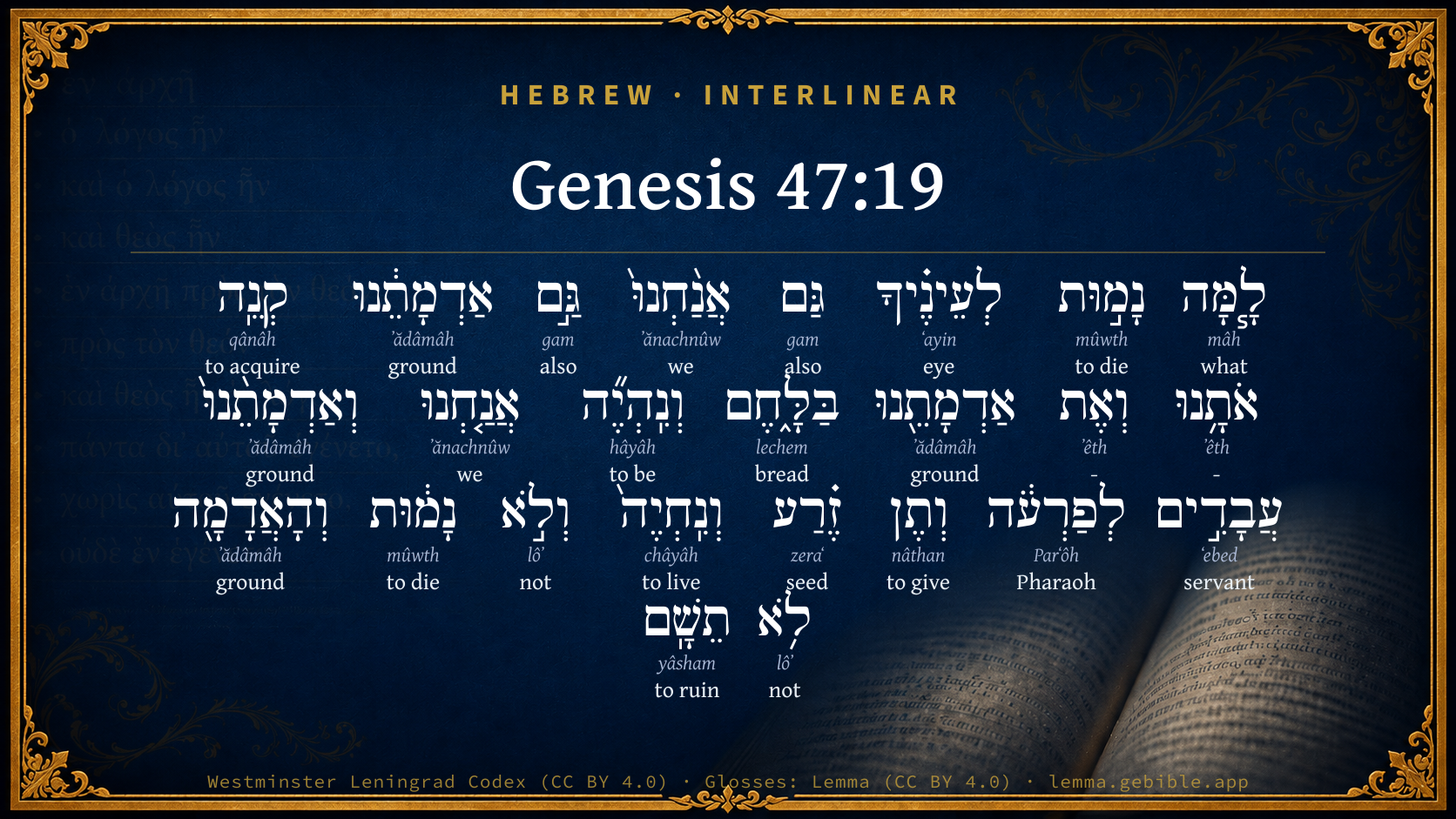
Hebrew (Westminster Leningrad Codex) Genesis 47:19 appears in the Hebrew Old Testament. The text above is from the Westminster Leningrad Codex. Each word links to its Strong’s number, a concise gloss, and parsing drawn from the Open Scriptures Hebrew Bible morphology. Click any word for its full Brown-Driver-Briggs (BDB) entry.
Download image
Cite this verse

Genesis 47:19 (World English Bible). Public Domain. Lemma interlinear Bible study tool, https://lemma.gebible.app/v/genesis/47/19.

Show BibTeX & RIS
BibTeX
RIS
English Translation
Why should we die before your eyes, both we and our land? Buy us and our land for bread, and we and our land will be servants to Pharaoh. Give us seed, that we may live, and not die, and that the land won't be desolate."
World English Bible · Public Domain
Highlights
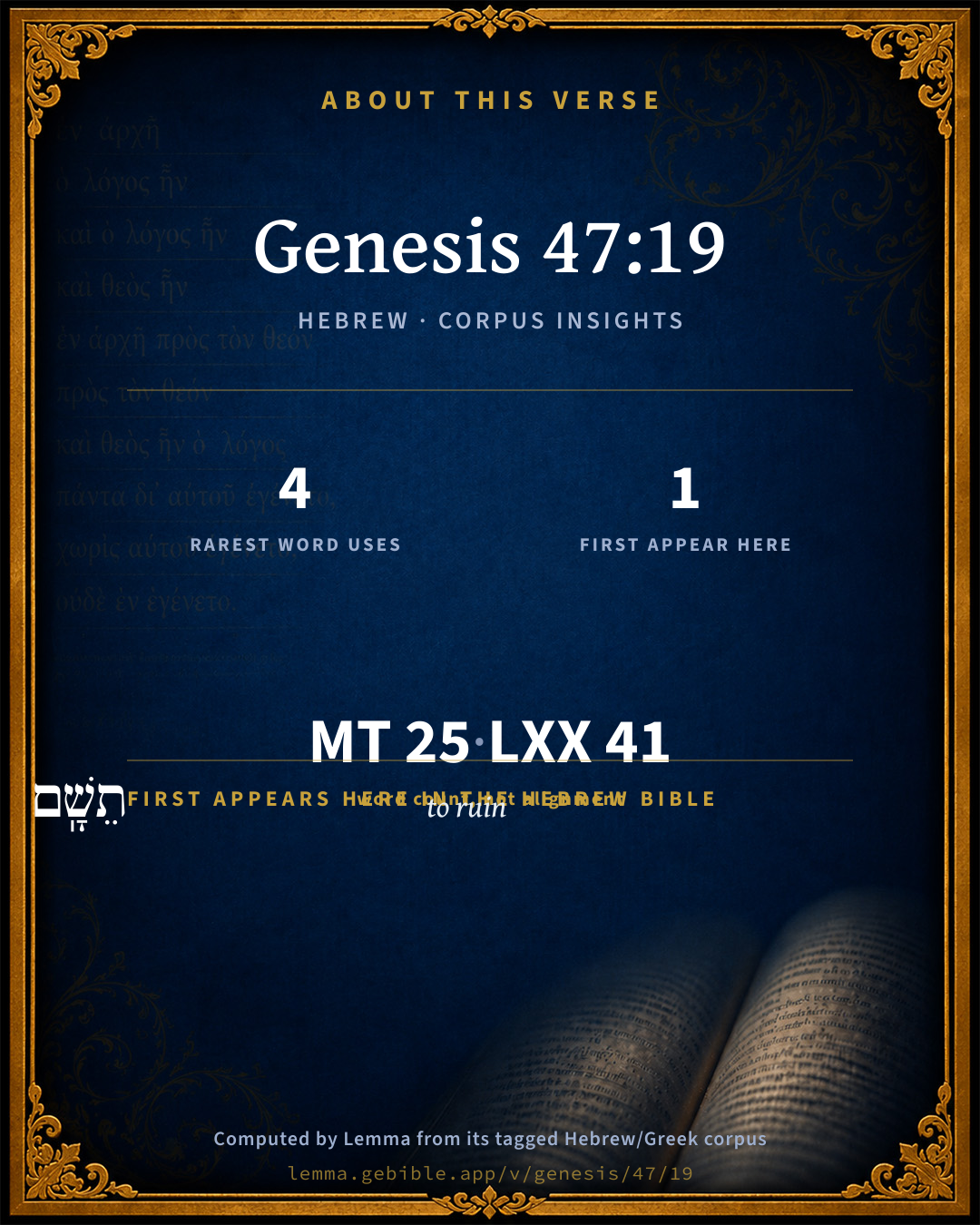
  • 1 first appearance in the Hebrew Bible
Full analysis ↓
Download a study sheet

One document with this verse’s original text, its word-by-word gloss line, the meaning frame, cross-references with their text, attributed commentary, and full source and license credits — printable, and it pastes into notes with its structure intact.

This verse Autodidact and up

Study sheet (.html) Plain text (.txt)

A passage Seminary Student

Up to 50 verses in one chapter. A passage sheet keeps up to 6 commentary sources and 12 cross-references per verse, in the order this page ranks them, and says so on the sheet whenever that leaves anything out. Ask for a single verse and you get the Autodidact verse sheet above.

Everything on this page stays free to read, with no account — the sheet is a download of what is already on screen, not access to it.

Want to remove ads? Support Godless Engineer
Compare translations 3

The same verse in 3 English versions, stacked beneath the original-language interlinear above. Click any original word for its lexicon entry.

Each is an independent rendering of the whole verse — the interlinear is not word-aligned to these translations.

Highlighted words mark where these versions differ — a whole-verse word diff, not a word-by-word alignment.

  • World English Bible Public Domain
    Why should we die before your eyes, both we and our land? Buy us and our land for bread, and we and our land will be servants to Pharaoh. Give us seed, that we may live, and not die, and that the land won't be desolate."
  • King James Version Public Domain
    Wherefore shall we die before thine eyes, both we and our land? buy us and our land for bread, and we and our land will be servants unto Pharaoh: and give us seed, that we may live, and not die, that the land be not desolate.
  • unfoldingWord Literal Text CC BY-SA 4.0
    Why should we die before your eyes, both we and our land? Buy us and our land for the bread, and we and our land will be slaves to Pharaoh. Give seed so that we will live and not die, and the land will not be desolate!”

unfoldingWord Literal Text — © unfoldingWord, licensed CC BY-SA 4.0. Word-aligned USFM3 via Door43 (git.door43.org/unfoldingWord/en_ult).

Versions to compare (up to 4)

3 of 4 selected

Show all 18 translations

Every available English version of this verse, each an independent rendering of the whole verse.

  • World English Bible Public Domain
    Why should we die before your eyes, both we and our land? Buy us and our land for bread, and we and our land will be servants to Pharaoh. Give us seed, that we may live, and not die, and that the land won't be desolate."
  • Berean Standard Bible Public Domain
    Why should we perish before your eyes—we and our land as well? Purchase us and our land in exchange for food. Then we, along with our land, will be slaves to Pharaoh. Give us seed that we may live and not die, and that the land may not become desolate.”
  • Majority Standard Bible Public Domain
    Why should we perish before your eyes—we and our land as well? Purchase us and our land in exchange for food. Then we, along with our land, will be slaves to Pharaoh. Give us seed that we may live and not die, and that the land may not become desolate.”
  • King James Version Public Domain
    Wherefore shall we die before thine eyes, both we and our land? buy us and our land for bread, and we and our land will be servants unto Pharaoh: and give us seed, that we may live, and not die, that the land be not desolate.
  • American Standard Version (1901) Public Domain
    wherefore should we die before thine eyes, both we and our land? buy us and our land for bread, and we and our land will be servants unto Pharaoh: and give us seed, that we may live, and not die, and that the land be not desolate.
  • Revised Version (1885) Public Domain
    wherefore should we die before thine eyes, both we and our land? buy us and our land for bread, and we and our land will be servants unto Pharaoh: and give us seed, that we may live, and not die, and that the land be not desolate.
  • Geneva Bible (1599) Public Domain
    Why shall we perish in thy sight, both we, and our land? bye vs and our land for bread, and we and our land will be bonde to Pharaoh: therefore giue vs seede, that we may liue and not dye, and that the land go not to waste.
  • Douay-Rheims (1899) Public Domain
    Why therefore shall we die before thy eyes? we will be thins, both we and our lands: buy us to be the king's servants, and give us seed, lest for want of tillers the land be turned into a wilderness.
  • Young's Literal Translation Public Domain
    why do we die before thine eyes, both we and our ground? buy us and our ground for bread, and we and our ground are servants to Pharaoh; and give seed, and we live, and die not, and the ground is not desolate.'
  • Literal Standard Version CC BY-SA 4.0
    why do we die before your eyes, both we and our ground? Buy us and our ground for bread, and we and our ground are servants to Pharaoh; and give seed, and we live, and do not die, and the ground is not desolate.”
  • Unlocked Literal Bible CC BY-SA 4.0
    Why should we die before your eyes, both we and our land? Buy us and our land in exchange for food, and we and our land will be servants to Pharaoh. Give us seed that we may live and not die, and that the land may not become desolate.”
  • unfoldingWord Literal Text CC BY-SA 4.0
    Why should we die before your eyes, both we and our land? Buy us and our land for the bread, and we and our land will be slaves to Pharaoh. Give seed so that we will live and not die, and the land will not be desolate!”
  • Darby Bible Public Domain
    Why should we die before thine eyes, both we and our land? Buy us and our land for bread, and we and our land will be bondmen to Pharaoh; and give seed, that we may live, and not die, and that the land be not desolate.
  • World Messianic Bible Public Domain
    Why should we die before your eyes, both we and our land? Buy us and our land for bread, and we and our land will be servants to Pharaoh. Give us seed, that we may live, and not die, and that the land won’t be desolate.”
  • Webster's Bible Public Domain
    Why shall we die before thy eyes, both we and our land? buy us and our land for bread, and we and our land will be servants to Pharaoh: and give us seed, that we may live, and not die, that the land be not desolate.
  • Free Bible Version CC BY-SA 4.0
    Do you want us to die right in front of you? So buy us and our land in return for food. Then our land will belong to Pharaoh, and we'll be his slaves. Just give us grain so we can live and won't die, and so the land won't be abandoned.”
  • Bible in Basic English Public Domain
    Are we to come to destruction before your eyes, we and our land? take us and our land and give us bread; and we and our land will be servants to Pharaoh; and give us seed so that we may have life and the land may not become waste.
  • JPS Tanakh (1917) Public Domain
    Wherefore should we die before thine eyes, both we and our land? buy us and our land for bread, and we and our land will be bondmen unto Pharaoh; and give us seed, that we may live, and not die, and that the land be not desolate.'

Literal Standard Version (2020), Covenant Press — licensed CC BY-SA 4.0. Text via the HelloAO Bible API (eBible.org). Unlocked Literal Bible (unfoldingWord) — licensed CC BY-SA 4.0. Text via the HelloAO Bible API (eBible.org). unfoldingWord Literal Text — © unfoldingWord, licensed CC BY-SA 4.0. Word-aligned USFM3 via Door43 (git.door43.org/unfoldingWord/en_ult). Free Bible Version, Dr. Jonathan Gallagher — licensed CC BY-SA 4.0. Text via the HelloAO Bible API (eBible.org).

Word by word

More ways to search: Search by grammar → Find every occurrence → Compare this word →

Practice this passage: Drill this verse → Learn its vocabulary →

תֵשָֽׁם
yâsham
H3456
“to ruin”
Verb, Qal, Imperfect, 3rd Person, Feminine, Singular
Part of Speech
Verb
Stem
Qal
Form
Imperfect
Person
3rd Person
Gender
Feminine
Number
Singular
Full BDB Definition

Origin: a primitive root

TWOT: 927

(Qal) to ruin, be desolate
  1. לָ֧מָּה mâh H4100 “to/for · what” Preposition + Particle, Interrogative
  2. נָמ֣וּת mûwth H4191 “to die” Verb, Qal, Imperfect, 1st Person, Common, Plural
  3. לְעֵינֶ֗יךָ ʻayin H5869 “to/for · eyes · your” Preposition + Noun, Common, Both, Dual, Construct + Suffix, Personal, 2nd Person, Masculine, Singular
  4. גַּם gam H1571 “also” Particle, Accusative
  5. אֲנַ֨חְנוּ֙ ʼănachnûw H587 “we” Pronoun, Personal, 1st Person, Common, Plural
  6. גַּ֣ם gam H1571 “also” Particle, Accusative
  7. אַדְמָתֵ֔נוּ ʼădâmâh H127 “ground · our” Noun, Common, Feminine, Singular, Construct + Suffix, Personal, 1st Person, Common, Plural
  8. קְנֵֽה qânâh H7069 “acquire” Verb, Qal, Imperative, 2nd Person, Masculine, Singular
  9. אֹתָ֥נוּ ʼêth H853 “- · us” Particle, Direct Object + Suffix, Personal, 1st Person, Common, Plural
  10. וְאֶת ʼêth H853 “and · -” Conjunction + Particle, Direct Object
  11. אַדְמָתֵ֖נוּ ʼădâmâh H127 “ground · our” Noun, Common, Feminine, Singular, Construct + Suffix, Personal, 1st Person, Common, Plural
  12. בַּלָּ֑חֶם lechem H3899 “in/at the · bread” Preposition, Determined + Noun, Common, Both, Singular, Absolute
  13. וְנִֽהְיֶ֞ה hâyâh H1961 “and · to be” Conjunction + Verb, Qal, Imperfect, 1st Person, Common, Plural
  14. אֲנַ֤חְנוּ ʼănachnûw H587 “we” Pronoun, Personal, 1st Person, Common, Plural
  15. וְאַדְמָתֵ֨נוּ֙ ʼădâmâh H127 “and · ground · our” Conjunction + Noun, Common, Feminine, Singular, Construct + Suffix, Personal, 1st Person, Common, Plural
  16. עֲבָדִ֣ים ʻebed H5650 “servants” Noun, Common, Masculine, Plural, Absolute
  17. לְפַרְעֹ֔ה Parʻôh H6547 “to/for · Pharaoh” Preposition + Noun, Proper
  18. וְתֶן nâthan H5414 “and · give” Conjunction + Verb, Qal, Imperative, 2nd Person, Masculine, Singular
  19. זֶ֗רַע zeraʻ H2233 “seed” Noun, Common, Masculine, Singular, Absolute
  20. וְנִֽחְיֶה֙ châyâh H2421 “and · to live” Conjunction + Verb, Qal, Imperfect, 1st Person, Common, Plural
  21. וְלֹ֣א lôʼ H3808 “and · not” Conjunction + Particle, Negative
  22. נָמ֔וּת mûwth H4191 “to die” Verb, Qal, Imperfect, 1st Person, Common, Plural
  23. וְהָאֲדָמָ֖ה ʼădâmâh H127 “and · the · ground” Conjunction + Particle, Definite Article + Noun, Common, Feminine, Singular, Absolute
  24. לֹ֥א lôʼ H3808 “not” Particle, Negative

About this verse

These counts appear in no published source. They are computed here, from the morphology-tagged text and Lemma’s own curated glosses. What Lemma adds →

25
words
17
distinct lemmas
Pentateuch
section

Notable vocabulary

The rarest word here is תֵשָֽׁם to ruin H3456 — appearing just 4 times in the whole Hebrew Bible.

First appearance in Scripture

This word makes its first canonical appearance in the Hebrew Bible here:

  • תֵשָֽׁם to ruin H3456

Shared distinctive vocabulary

תֵשָֽׁם to ruin H3456 occurs in 4 verses of the Hebrew Bible. Also found in:

Grammatical profile

  • 7 verbs
  • 9 nouns
  • 2 pronouns
  • 7 particles

Verb forms

  • נָמ֣וּת Qal · Imperfect
  • קְנֵֽה Qal · Imperative
  • וְנִֽהְיֶ֞ה Qal · Imperfect
  • וְתֶן Qal · Imperative
  • וְנִֽחְיֶה֙ Qal · Imperfect
  • נָמ֔וּת Qal · Imperfect
  • תֵשָֽׁם Qal · Imperfect

Repetition

Words recur within this verse — often emphatic in Hebrew:

  • אַדְמָתֵ֔נוּ ground H127 ×4
  • נָמ֣וּת to die H4191 ×2
  • גַּם also H1571 ×2
  • אֲנַ֨חְנוּ֙ we H587 ×2
  • וְלֹ֣א not H3808 ×2

Hebrew & Septuagint length

In English translation the verse runs 46 words from the Hebrew and 51 from the Septuagint (LXX English) — closely comparable.

A rough comparison of the two English renderings, which tokenize alike — not a word-level alignment.

Word counts can differ between the Hebrew and the Greek without any difference in meaning — e.g. the Hebrew direct-object marker אֵת has no separate Greek word, and Greek often adds the article ὁ.

In the original languages it is 25 Hebrew tokens and 41 Greek tokens — but the two are counted differently (Hebrew bundles its prefixes and suffixes into one token; the Greek is in lemma form), so that isn’t a like-for-like length.

Cross-references

7

Topical passages linked to Genesis 47:19 in the Treasury of Scripture Knowledge — connected by theme and wording, ordered by reader-vote popularity; previews shown in the World English Bible.

  • Nehemiah 5:2–3 For there were that said, We, our sons and our daughters, are many: let us get grain, that we may eat and live.
  • Job 2:4 Satan answered Yahweh, and said, "Skin for skin. Yes, all that a man has will he give for his life.
  • Lamentations 1:11 All her people sigh, they seek bread; They have given their pleasant things for food to refresh the soul: Look, Yahweh, and see; for I am become abject.
  • Lamentations 5:6 We have given the hand to the Egyptians, To the Assyrians, to be satisfied with bread.
  • Lamentations 5:9 We get our bread at the peril of our lives, Because of the sword of the wilderness.
  • Matthew 16:26 For what will it profit a man, if he gains the whole world, and forfeits his life? Or what will a man give in exchange for his life?
  • Philippians 3:8–9 Yes most assuredly, and I count all things to be loss for the excellency of the knowledge of Christ Jesus, my Lord, for whom I suffered the loss of all things, and count them nothing but refuse, that I may gain Christ

Cross-references courtesy of OpenBible.info (CC BY 4.0).

Hebrew and Greek witnesses Masoretic Hebrew ↔ Greek Septuagint

The same verse in the two great witnesses to the Old Testament, shown verse-for-verse.

These are two independent witnesses, not word-aligned to each other, and the Septuagint is shown in lemma (dictionary) form.

Hebrew Genesis 47:19 Masoretic · Westminster Leningrad Codex

לָ֧מָּה נָמ֣וּת לְעֵינֶ֗יךָ גַּם אֲנַ֨חְנוּ֙ גַּ֣ם אַדְמָתֵ֔נוּ קְנֵֽה אֹתָ֥נוּ וְאֶת אַדְמָתֵ֖נוּ בַּלָּ֑חֶם וְנִֽהְיֶ֞ה אֲנַ֤חְנוּ וְאַדְמָתֵ֨נוּ֙ עֲבָדִ֣ים לְפַרְעֹ֔ה וְתֶן זֶ֗רַע וְנִֽחְיֶה֙ וְלֹ֣א נָמ֔וּת וְהָאֲדָמָ֖ה לֹ֥א תֵשָֽׁם

Why should we die before your eyes, both we and our land? Buy us and our land for bread, and we and our land will be servants to Pharaoh. Give us seed, that we may live, and not die, and that the land won't be desolate."

World English Bible · Public Domain

Greek LXX Genesis 47:19 Septuagint · lemma form

ἵνα οὖν μή ἀποθνήσκω ἐναντίον σύ καί ὁ γῆ ἐρημόω κτάομαι ἐγώ καί ὁ γῆ ἐγώ ἀντί ἄρτος καί εἰμί ἐγώ καί ὁ γῆ ἐγώ παῖς φαραώ δίδωμι σπέρμα ἵνα σπείρω καί ζάω καί μή ἀποθνήσκω καί ὁ γῆ οὐ ἐρημόω

In order, then, that we die not before you, and the land be made desolate, buy us and our land for bread, and we and our land will be servants to Pharao: give seed that we may sow, and live and not die, so our land shall not be made desolate.

LXX2012 (modern English Septuagint) · Public Domain

Hebrew: Westminster Leningrad Codex (CC BY 4.0). Greek: Septuagint (public domain); English from LXX2012 (modern English Septuagint) (Public Domain). How the Septuagint differs from the Hebrew →

Targum (Aramaic paraphrase)

2

The Targum is the ancient Jewish Aramaic paraphrase of the Hebrew Scriptures — an interpretive translation, not the Hebrew text itself. Onkelos (literal) and Pseudo-Jonathan (expansive) render the Torah, and Jonathan the Prophets. Coverage is partial: where no permissively-licensed English translation exists for a verse, only the Aramaic is shown. This is verse-level text, not a word-by-word alignment to the Hebrew.

  1. Targum Onkelos Torah (Genesis–Deuteronomy)
    לְמָה נְמוּת לְעֵינָיךְ אַף אֲנַחְנָא אַף אַרְעָתָנָא קְנֵי יָתָנָא וְיָת אַרְעָתָנָא בְּלַחְמָא וּנְהֵי אֲנַחְנָא וְאַרְעָתָנָא עַבְדִּין לְפַרְעֹה וְהַב בַּר זַרְעָא וְנֵיחֵי וְלָא נְמוּת וְאַרְעָא לָא תְבוּר

    (no public-domain English translation for this verse)

    Targum Onkelos — Aramaic: “Onkelos Genesis” (public domain); “Onkelos Exodus” (public domain); “Onkelos Leviticus” (public domain); “Onkelos Numbers” (public domain); “Onkelos Deuteronomy” (public domain). English: “Sefaria Community Translation” (CC0 1.0 (public-domain dedication)); “J.W. Etheridge. The Targums of Onkelos and Jonathan Ben Uzziel on the Pentateuch. London: Longmans, Green, 1862” (public domain). Text via Sefaria.

  2. Targum Pseudo-Jonathan Torah (Genesis–Deuteronomy)
    לְמָא נְמוּת וְעֵינָךְ חָמָן אוּף אֲנָן אוּף אַרְעָן קְנֵי יָתָן וְיַת אַרְעָן בְּלַחְמָא וּנְהִי אֲנַן וְאַרְעָן עַבְדִין לְפַרְעה וְהַב בַּר זַרְעָא וְנֵיחֵי וְלָא נְמוּת וְאַרַע לָא תִשְׁתּוֹמֵם

    Why should we die and thine eye seeing (it), both we and our land also? Buy us, and our land, for bread, and we and our land will be servants of Pharoh, and give the seed of corn, that we may live and not die, and the land be not desolated.

    Targum Pseudo-Jonathan — Aramaic: “Targum Jonathan on Genesis” (public domain); “Targum Jonathan on Exodus” (public domain); “Targum Jonathan on Leviticus” (public domain); “Targum Jonathan on Numbers” (public domain); “Targum Jonathan on Deuteronomy” (public domain). English: “The Targum of Jonathan ben Uzziel, trans. J. W. Etheridge, London, 1862” (public domain). Text via Sefaria.

Commentary

Notes on Genesis 47:19 from classic Christian and Jewish commentators (each source and its license shown beneath its notes). The classic Christian expositions comment on the surrounding passage and are grouped to its opening verse, so a note may address several verses; the Jewish commentaries on the Tanakh (Rashi and others) are per-verse, so they appear only where the commentator wrote on this verse.

Lemma curates 59 commentaries, every one of them public domain or Creative Commons licensed, each selected and text-cleaned for this edition rather than reprinted as found. About our sources →

Trapp's Complete Commentary

John Trapp

Gen 47:19 Wherefore shall we die before thine eyes, both we and our land? buy us and our land for bread, and we and our land will be servants unto Pharaoh: and give [us] seed, that we may live, and not die, that the land be not desolate.

Ver. 19. Buy us and our land for bread.] It was their own desire, therefore no injury. Nay, it was charity in Joseph, in remitting their services, and taking only their lands: yea, liberality, in reserving the fifth part only to the king; when husbandmen usually till for half the increase. And this the Egyptians thankfully acknowledge, Gen 47:25.

John Trapp, A Commentary or Exposition upon All the Books of the Old and New Testament (1647–1656) — public domain. Text from a community e-Sword module.

Geneva Bible (1599)

Geneva Bible translators

For except the ground be tilled and sown, it perisheth, and is as it were dead.

Geneva Bible (1599) marginal notes — public domain. Text via Bolls.life.

Adam Clarke's Commentary

Verse 19. Buy us and our land for bread] In times of famine in Hindostan, thousands of children have been sold to prevent their perishing. In the Burman empire the sale of whole families to discharge debts is very common. - Ward's Customs.

Adam Clarke's Commentary on the Bible (1810–1826) — public domain. Text from a community e-Sword/MySword module.

John Gill's Exposition

And Joseph bought all the land of Egypt for Pharaoh,.... Not for himself, nor did he entail it on his posterity, but for Pharaoh, who became sole proprietor of it:

for the Egyptians sold every man his field, because the famine prevailed over them; everyone that had a field sold it to buy bread for his family, so great was the famine; no mention is made of their houses, either because these went with their lands, or they were so mean that they were of little account, and would scarce bear any price; for as Diodorus Siculus (h) reports of the Egyptians, they were less careful of the structure of their houses, and exceeded all bounds in the magnificence of their sepulchres:

so the land became Pharaoh's; not only with respect to dominion and government, so it was before, but with respect to property; before, every man's field, and garden, and vineyard were his own, and he was in possession thereof for his own use, but now being sold, were Pharaoh's; and they held them of him, and paid a rent for them in a manner hereafter directed by a law.

(h) Bibliothec. l. 1. p. 47.

John Gill's Exposition of the Whole Bible (1746–1763) — public domain (CC PDM 1.0). Text via the HelloAO Bible API.

Haydock's Catholic Bible Commentary

Servants. A person may part with his liberty, to preserve life. (Menochius)

George Leo Haydock (1774–1849), Haydock's Catholic Family Bible and Commentary, 1859 edition — public domain. Excludes Psalms (Douay-Rheims chapter numbering differs from Protestant) and Deuterocanonical books (Catholic canon only).

Matthew Poole's English Annotations

Wherefore shall we die before thine eyes, i.e. whilst thou lookest upon us like an idle spectator, not pitying and relieving us? The land is said to die improperly, when it is desolate and barren, and when the fruits of it die, or, which is equivalent to it, do not live.

We and our land will be servants unto Pharaoh; Pharaoh shall be the sole proprietor, and we are content to be his tenants, to manage it for his use.

Give us seed, because this was the last year of famine, as Joseph informed them, and therefore they tilled and sowed the ground for the following year.

That the land be not desolate, without inhabitants, as it will be if thou sufferest us to die for want of bread.

Matthew Poole's English Annotations on the Holy Bible (1683–1685) — public domain. Text from a community e-Sword/MySword module.

Rashi

Rabbi Shlomo Yitzchaki (Rashi)

ותן זרע GIVE US SEED — to sow in the ground. Although Joseph had said (Genesis 45:6) “And there are yet five years when there will be no plowing and sowing”, as soon as Jacob came to Egypt a blessing came with his arrival: they began to sow and the famine came to an end. Thus do we read in the Tosefta of Sotah (Tosefta Sotah 10:3).

לא תשם means it shall not be desolate. The Targum renders it by לא תבור shall not be uncultivated, which has the same meaning as (Mishnah Peah 2:1) שדה בור an uncultivated field — one which is not ploughed.

Rashi on the Tanakh — English translations: “The Judaica Press complete Tanach with Rashi, translated by A. J. Rosenberg” (CC BY 4.0); “Pentateuch with Rashi's commentary by M. Rosenbaum and A.M. Silbermann, 1929-1934” (public domain); “The Metsudah Tanach series, Lakewood, N.J” (CC BY 4.0); and “The Book of Joshua, Metsudah Publications, 1997” (CC BY 4.0). Text via Sefaria.

Ramban (Nachmanides)

Rabbi Moshe ben Nachman (Ramban / Nachmanides)

BUY US AND OUR LAND. Now they said to him that he should also purchase their bodies as servants for Pharaoh, and thus did Joseph say, Behold, I have bought you this day and your land. However, Scripture records, And Joseph bought all the land of Egypt for Pharaoh; for the Egyptians sold every man his field, but it does not say that he bought their bodies, only the land. The reason for it is that the Egyptians told Joseph that he should purchase them as servants to perform the king’s business as he pleases. But Joseph wanted to buy only the land, and he made a condition with them that they work on it forever, thus becoming Pharaoh’s family tenants. Afterwards he said to them, “Behold, I have bought you this day and your land for Pharaoh, not as servants as you told me, but you will belong to him with the land. Now it is proper that the king, who is now lord of the land, take four parts of the harvest and that you take the remaining fifth, but I will deal kindly with you in that you will take the portion due to the owner of the land, and Pharaoh will take the portion due the tenant. However, you will be sold to him in that you will not be able to leave the fields.” This is the meaning of that which they vowed to him, And the land will not be desolate meaning that it will never be desolate. For this reason they said to Joseph, “We have found favor in the sight of my lord, for you have been lenient with us by permitting us to take four parts of the harvest so that we may use them to live, and we will be Pharaoh’s servants, as we have vowed, in that we will work the ground in accordance with his will.”Vayechi

Ramban (Nachmanides) on the Tanakh — English translation: “Commentary on the Torah by Ramban (Nachmanides). Translated and annotated by Charles B. Chavel. New York, Shilo Pub. House, 1971-1976” (CC BY 4.0). Text via Sefaria.

Radak

Rabbi David Kimhi (Radak)

?למה נמות, the reason why the verse speaks also about the death of the land, i.e. גם אדמתנו, is that earth which is desolate is as if “dead.” This is also why the farmers used the expression ולא תשם, “and it would become desolate.”

Radak on the Tanakh — English translations: “Sefaria Community Translation” (CC0 1.0 (public-domain dedication)); “Eliyahu Munk, HaChut Hameshulash” (CC BY 4.0); “Rabbi Mike Feuer, Jerusalem Anthology” (CC BY 4.0); and “R. David Kimhi on the first book of Psalms, Translated by R.G. Finch, London, 1919” (public domain). Text via Sefaria.

Lesson kit

Teaching starters — assembled from the data on this page, not authored interpretation. Every prompt links to the verse data it draws on. Edit before teaching.

Genesis, in the Pentateuch, opens this verse with 25 words (17 distinct Hebrew lemmas). Its most distinctive word is yâsham (“to ruin”). A historical commentator’s framing appears above. Read the whole chapter for the surrounding context.

Discussion questions

  1. How does “to ruin” (yâsham) shape what this verse is saying?
  2. This is the first place “to ruin” appears in Scripture (first appears here). What does its debut here establish?
  3. How does Ezekiel 6:6, which shares the word «to ruin», read alongside this verse?
  4. What does the repetition of “ground” (4× in this one verse) do in this verse?
  5. These translations render this verse differently. What is at stake in choosing one wording over another?
  6. «נָמ֣וּת» is a Qal Imperfect verb. How does that grammatical form shape the action described?
  7. Compare how Trapp's Complete Commentary and Geneva Bible (1599) read this verse. Where do they agree or differ?

Things to notice

Reading settings

Reading text

Shown beneath each verse's original-language words.

Old Testament
Old Testament edition

Read the OT as the Masoretic Hebrew (MT) or the Greek Septuagint (LXX).

English shown for the Greek Septuagint (in the Hebrew ↔ Greek comparison).

Comparing translations? Open the Compare panel on any verse page to stack up to four side by side.