Exodus 5:16

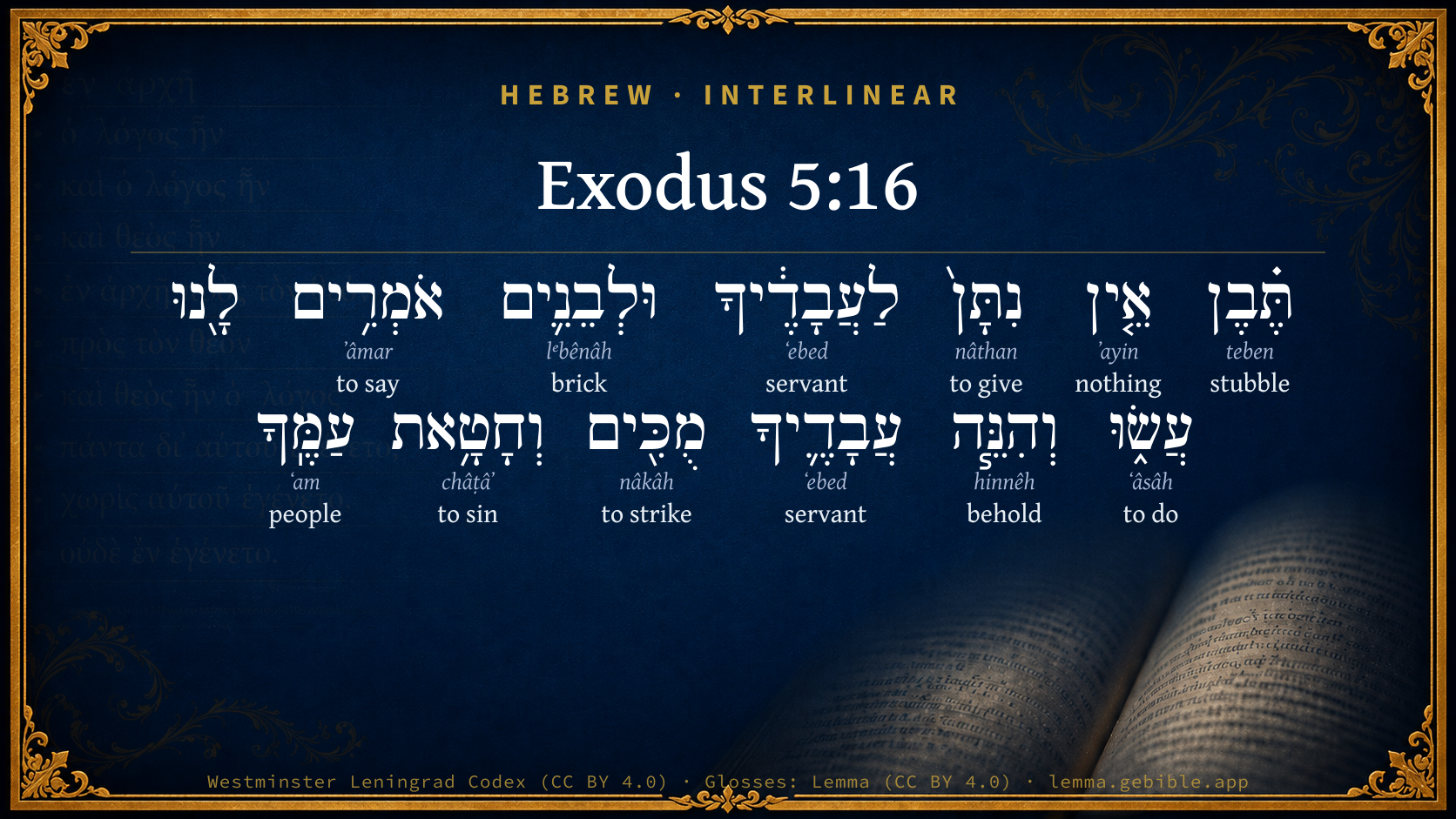
Hebrew (Westminster Leningrad Codex) Exodus 5:16 appears in the Hebrew Old Testament. The text above is from the Westminster Leningrad Codex. Each word links to its Strong’s number, a concise gloss, and parsing drawn from the Open Scriptures Hebrew Bible morphology. Click any word for its full Brown-Driver-Briggs (BDB) entry.
Download image
Cite this verse

Exodus 5:16 (World English Bible). Public Domain. Lemma interlinear Bible study tool, https://lemma.gebible.app/v/exodus/5/16.

Show BibTeX & RIS
BibTeX
RIS
English Translation
No straw is given to your servants, and they tell us, 'Make brick!' and, behold, your servants are beaten; but the fault is in your own people."
World English Bible · Public Domain
Download a study sheet

One document with this verse’s original text, its word-by-word gloss line, the meaning frame, cross-references with their text, attributed commentary, and full source and license credits — printable, and it pastes into notes with its structure intact.

This verse Autodidact and up

Study sheet (.html) Plain text (.txt)

A passage Seminary Student

Up to 50 verses in one chapter. A passage sheet keeps up to 6 commentary sources and 12 cross-references per verse, in the order this page ranks them, and says so on the sheet whenever that leaves anything out. Ask for a single verse and you get the Autodidact verse sheet above.

Everything on this page stays free to read, with no account — the sheet is a download of what is already on screen, not access to it.

Want to remove ads? Support Godless Engineer
Compare translations 3

The same verse in 3 English versions, stacked beneath the original-language interlinear above. Click any original word for its lexicon entry.

Each is an independent rendering of the whole verse — the interlinear is not word-aligned to these translations.

Highlighted words mark where these versions differ — a whole-verse word diff, not a word-by-word alignment.

  • World English Bible Public Domain
    No straw is given to your servants, and they tell us, 'Make brick!' and, behold, your servants are beaten; but the fault is in your own people."
  • King James Version Public Domain
    There is no straw given unto thy servants, and they say to us, Make brick: and, behold, thy servants are beaten; but the fault is in thine own people.
  • unfoldingWord Literal Text CC BY-SA 4.0
    No straw is being given to your servants. And they are saying to us, ‘Make bricks!’ And behold, your servants are beaten, but it is the sin of your people.”

unfoldingWord Literal Text — © unfoldingWord, licensed CC BY-SA 4.0. Word-aligned USFM3 via Door43 (git.door43.org/unfoldingWord/en_ult).

Versions to compare (up to 4)

3 of 4 selected

Show all 18 translations

Every available English version of this verse, each an independent rendering of the whole verse.

  • World English Bible Public Domain
    No straw is given to your servants, and they tell us, 'Make brick!' and, behold, your servants are beaten; but the fault is in your own people."
  • Berean Standard Bible Public Domain
    No straw has been given to your servants, yet we are told, ‘Make bricks!’ Look, your servants are being beaten, but the fault is with your own people.”
  • Majority Standard Bible Public Domain
    No straw has been given to your servants, yet we are told, ‘Make bricks!’ Look, your servants are being beaten, but the fault is with your own people.”
  • King James Version Public Domain
    There is no straw given unto thy servants, and they say to us, Make brick: and, behold, thy servants are beaten; but the fault is in thine own people.
  • American Standard Version (1901) Public Domain
    There is no straw given unto thy servants, and they say to us, Make brick: and, behold, thy servants are beaten; but the fault it in thine own people.
  • Revised Version (1885) Public Domain
    There is no straw given unto thy servants, and they say to us, Make brick: and, behold, thy servants are beaten; but the fault is in thine own people.
  • Geneva Bible (1599) Public Domain
    There is no strawe giuen to thy seruantes, and they say vnto vs, Make bricke: and loe, thy seruants are beaten, and thy people is blamed.
  • Douay-Rheims (1899) Public Domain
    Straw is not given us, and bricks are required of us as before: behold we thy servants are beaten with whips, and thy people is unjustly dealt withal.
  • Young's Literal Translation Public Domain
    Straw is not given to thy servants, and they are saying to us, Make bricks, and lo, thy servants are smitten -- and thy people hath sinned.'
  • Literal Standard Version CC BY-SA 4.0
    Straw is not given to your servants, and they are saying to us, Make bricks, and behold, your servants are struck—and your people have sinned.”
  • Unlocked Literal Bible CC BY-SA 4.0
    No straw is being given to your servants anymore, but they are still telling us, 'Make bricks!' We, your servants, are even beaten now, but it is the fault of your own people.”
  • unfoldingWord Literal Text CC BY-SA 4.0
    No straw is being given to your servants. And they are saying to us, ‘Make bricks!’ And behold, your servants are beaten, but it is the sin of your people.”
  • Darby Bible Public Domain
    There is no straw given to thy bondmen, and they say to us, Make brick; and behold, thy bondmen are beaten, but it is the fault of thy people.
  • World Messianic Bible Public Domain
    No straw is given to your servants, and they tell us, ‘Make brick!’ and behold, your servants are beaten; but the fault is in your own people.”
  • Webster's Bible Public Domain
    There is no straw given to thy servants, and they say to us, Make brick: and behold, thy servants are beaten; but the fault is in thy own people.
  • Free Bible Version CC BY-SA 4.0
    You don't give us any straw but your slave drivers demand that we make bricks, and they beat us! Your people are treating us badly!”
  • Bible in Basic English Public Domain
    They give us no dry stems and they say to us, Make bricks: and they give your servants blows; but it is your people who are in the wrong.
  • JPS Tanakh (1917) Public Domain
    There is no straw given unto thy servants, and they say to us: Make brick; and, behold, thy servants are beaten, but the fault is in thine own people.'

Literal Standard Version (2020), Covenant Press — licensed CC BY-SA 4.0. Text via the HelloAO Bible API (eBible.org). Unlocked Literal Bible (unfoldingWord) — licensed CC BY-SA 4.0. Text via the HelloAO Bible API (eBible.org). unfoldingWord Literal Text — © unfoldingWord, licensed CC BY-SA 4.0. Word-aligned USFM3 via Door43 (git.door43.org/unfoldingWord/en_ult). Free Bible Version, Dr. Jonathan Gallagher — licensed CC BY-SA 4.0. Text via the HelloAO Bible API (eBible.org).

Word by word

More ways to search: Search by grammar → Find every occurrence → Compare this word →

Practice this passage: Drill this verse → Learn its vocabulary →

וּלְבֵנִ֛ים
lᵉbênâh
H3843
“and · bricks”
Conjunction + Noun, Common, Feminine, Plural, Absolute
Part of Speech
Conjunction + Noun
Type
Common
Gender
Feminine
Number
Plural
State
Absolute
Full BDB Definition

Origin: from H3835

TWOT: 1074g

tile, brick - brick - tile - pavement
  1. תֶּ֗בֶן teben H8401 “stubble” Noun, Common, Masculine, Singular, Absolute
  2. אֵ֤ין ʼayin H369 “nothing” Particle, Negative
  3. נִתָּן֙ nâthan H5414 “giving” Verb, Niphal, Participle Active, Masculine, Singular, Absolute
  4. לַעֲבָדֶ֔יךָ ʻebed H5650 “to/for · servants · your” Preposition + Noun, Common, Masculine, Plural, Construct + Suffix, Personal, 2nd Person, Masculine, Singular
  5. אֹמְרִ֥ים ʼâmar H559 “saying” Verb, Qal, Participle Active, Masculine, Plural, Absolute
  6. עֲשׂ֑וּ ʻâsâh H6213 “do” Verb, Qal, Imperative, 2nd Person, Masculine, Plural
  7. וְהִנֵּ֧ה hinnêh H2009 “and · behold” Conjunction + Particle, Demonstrative
  8. עֲבָדֶ֛יךָ ʻebed H5650 “servants · your” Noun, Common, Masculine, Plural, Construct + Suffix, Personal, 2nd Person, Masculine, Singular
  9. מֻכִּ֖ים nâkâh H5221 “struck” Verb, Hophal, Participle Passive, Masculine, Plural, Absolute
  10. וְחָטָ֥את châṭâʼ H2398 “and · to sin” Conjunction + Verb, Qal, Sequential Perfect, 2nd Person, Masculine, Singular
  11. עַמֶּֽךָ ʻam H5971 “people · your” Noun, Common, Masculine, Singular, Construct + Suffix, Personal, 2nd Person, Masculine, Singular

About this verse

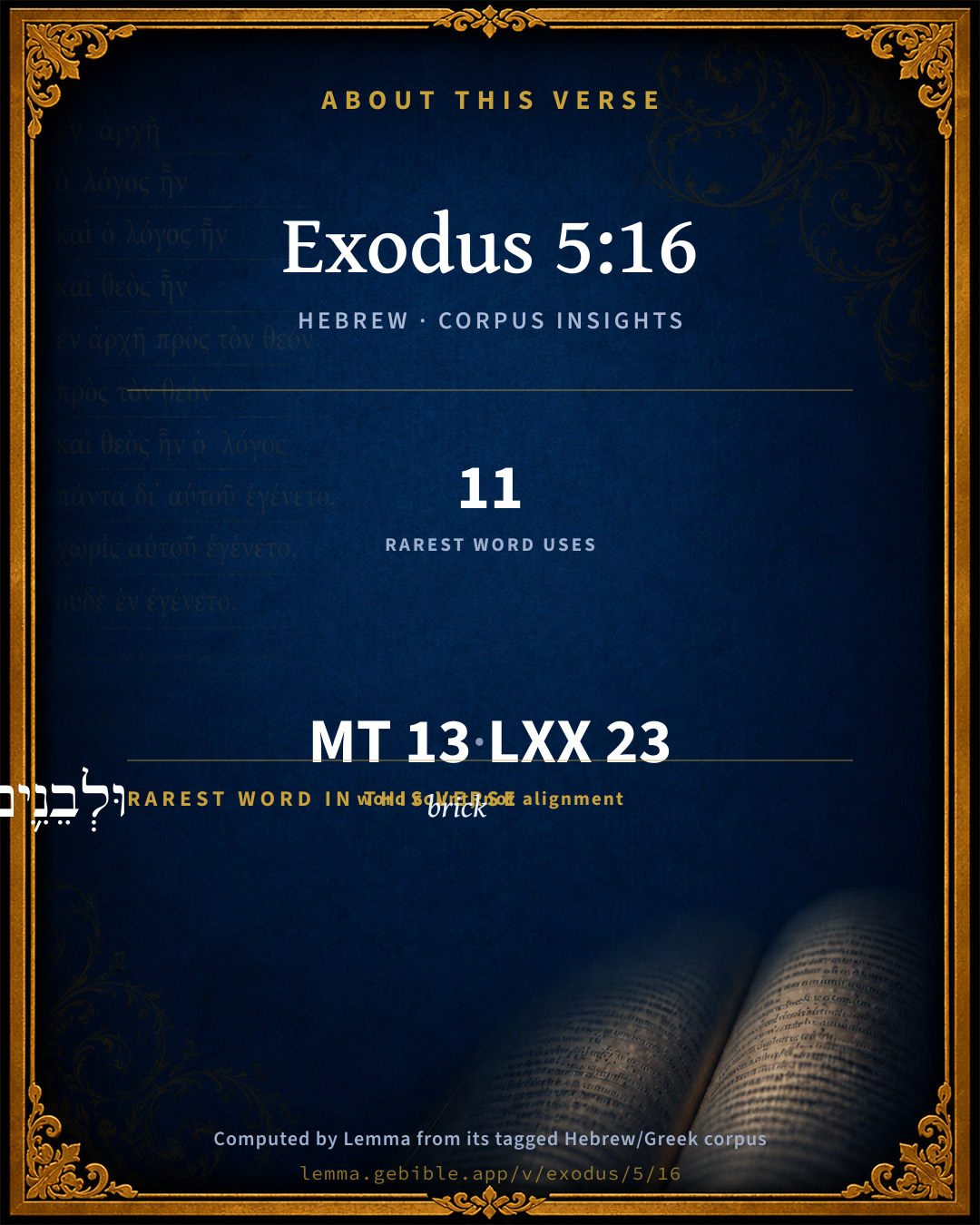
These counts appear in no published source. They are computed here, from the morphology-tagged text and Lemma’s own curated glosses. What Lemma adds →

13
words
11
distinct lemmas
Pentateuch
section

Notable vocabulary

The rarest word here is וּלְבֵנִ֛ים brick H3843 — appearing just 11 times in the whole Hebrew Bible.

Shared distinctive vocabulary

וּלְבֵנִ֛ים brick H3843 occurs in 10 verses of the Hebrew Bible. Also found in:

Grammatical profile

  • 5 verbs
  • 5 nouns
  • 1 preposition
  • 2 particles

Verb forms

  • נִתָּן֙ Niphal · Participle Active
  • אֹמְרִ֥ים Qal · Participle Active
  • עֲשׂ֑וּ Qal · Imperative
  • מֻכִּ֖ים Hophal · Participle Passive
  • וְחָטָ֥את Qal · Sequential Perfect

Repetition

A word recurs within this verse — often emphatic in Hebrew:

  • לַעֲבָדֶ֔יךָ servant H5650 ×2

Hebrew & Septuagint length

In English translation the verse runs 27 words from the Hebrew and 27 from the Septuagint (LXX English) — the same length.

A rough comparison of the two English renderings, which tokenize alike — not a word-level alignment.

Word counts can differ between the Hebrew and the Greek without any difference in meaning — e.g. the Hebrew direct-object marker אֵת has no separate Greek word, and Greek often adds the article ὁ.

In the original languages it is 13 Hebrew tokens and 23 Greek tokens — but the two are counted differently (Hebrew bundles its prefixes and suffixes into one token; the Greek is in lemma form), so that isn’t a like-for-like length.

Hebrew and Greek witnesses Masoretic Hebrew ↔ Greek Septuagint

The same verse in the two great witnesses to the Old Testament, shown verse-for-verse.

These are two independent witnesses, not word-aligned to each other, and the Septuagint is shown in lemma (dictionary) form.

Hebrew Exodus 5:16 Masoretic · Westminster Leningrad Codex

תֶּ֗בֶן אֵ֤ין נִתָּן֙ לַעֲבָדֶ֔יךָ וּלְבֵנִ֛ים אֹמְרִ֥ים לָ֖נוּ עֲשׂ֑וּ וְהִנֵּ֧ה עֲבָדֶ֛יךָ מֻכִּ֖ים וְחָטָ֥את עַמֶּֽךָ

No straw is given to your servants, and they tell us, 'Make brick!' and, behold, your servants are beaten; but the fault is in your own people."

World English Bible · Public Domain

Greek LXX Exodus 5:16 Septuagint · lemma form

ἄχυρον οὐ δίδωμι ὁ οἰκέτης σύ καί ὁ πλίνθος ἐγώ λέγω ποιέω καί ἰδού ὁ παῖς σύ μαστιγόω ἀδικέω οὖν ὁ λαός σύ

Straw is not given to your servants, and they tell us to make brick; and behold your servants have been scourged: you will therefore injure your people.

LXX2012 (modern English Septuagint) · Public Domain

On this verse, The Cambridge Bible for Schools and Colleges discusses the Septuagint’s reading. Read the note in Commentary ↓

Hebrew: Westminster Leningrad Codex (CC BY 4.0). Greek: Septuagint (public domain); English from LXX2012 (modern English Septuagint) (Public Domain). How the Septuagint differs from the Hebrew →

Targum (Aramaic paraphrase)

2

The Targum is the ancient Jewish Aramaic paraphrase of the Hebrew Scriptures — an interpretive translation, not the Hebrew text itself. Onkelos (literal) and Pseudo-Jonathan (expansive) render the Torah, and Jonathan the Prophets. Coverage is partial: where no permissively-licensed English translation exists for a verse, only the Aramaic is shown. This is verse-level text, not a word-by-word alignment to the Hebrew.

  1. Targum Onkelos Torah (Genesis–Deuteronomy)
    תִּבְנָא לָא מִתְיְהֵב לְעַבְדָיךְ וּלְבֵנַיָא אָמְרִין לָנָא עִבִידוּ וְהָא עַבְדָיךְ לָקָן וְחָטָן עֲלֵיהוֹן עַמָךְ:

    (no public-domain English translation for this verse)

    Targum Onkelos — Aramaic: “Onkelos Genesis” (public domain); “Onkelos Exodus” (public domain); “Onkelos Leviticus” (public domain); “Onkelos Numbers” (public domain); “Onkelos Deuteronomy” (public domain). English: “Sefaria Community Translation” (CC0 1.0 (public-domain dedication)); “J.W. Etheridge. The Targums of Onkelos and Jonathan Ben Uzziel on the Pentateuch. London: Longmans, Green, 1862” (public domain). Text via Sefaria.

  2. Targum Pseudo-Jonathan Torah (Genesis–Deuteronomy)
    תִּבְנָא לָא מִתְיַהַב לְעַבְדָךְ וְלִבְנַיָא אָמְרִין לָנָא עִיבִידוּ וְהָא עַבְדָךְ לַקְיָין וּחְיוּבְתְּהוֹן דְעַמָךְ תָּקְפָא וְסַלְקָא

    Thou hast not given thy servants the straw, and (yet) say they to us, Make the bricks; and, behold, they beat thy servants, and the guilty treatment of thy people is strong, but it goeth up!

    Targum Pseudo-Jonathan — Aramaic: “Targum Jonathan on Genesis” (public domain); “Targum Jonathan on Exodus” (public domain); “Targum Jonathan on Leviticus” (public domain); “Targum Jonathan on Numbers” (public domain); “Targum Jonathan on Deuteronomy” (public domain). English: “The Targum of Jonathan ben Uzziel, trans. J. W. Etheridge, London, 1862” (public domain). Text via Sefaria.

Commentary

Notes on Exodus 5:16 from classic Christian and Jewish commentators (each source and its license shown beneath its notes). The classic Christian expositions comment on the surrounding passage and are grouped to its opening verse, so a note may address several verses; the Jewish commentaries on the Tanakh (Rashi and others) are per-verse, so they appear only where the commentator wrote on this verse.

Lemma curates 59 commentaries, every one of them public domain or Creative Commons licensed, each selected and text-cleaned for this edition rather than reprinted as found. About our sources →

Trapp's Complete Commentary

John Trapp

Exo 5:16 There is no straw given unto thy servants, and they say to us, Make brick: and, behold, thy servants [are] beaten; but the fault [is] in thine own people.

Ver. 16. But the fault is in thine own people.] Effugiunt corvi, vexat censura columbas. As a man is friended, so is his matter ended. And where the hedge is low, a man may lightly make large leaps. Or, as the Frenchman saith, Qui son chien vult tuer, la rage luy met sus, He that hath a mind to kill a dog, gives out that he is mad. It was fault enough in God’s Israel, that they would not be miserable.

John Trapp, A Commentary or Exposition upon All the Books of the Old and New Testament (1647–1656) — public domain. Text from a community e-Sword module.

Joseph Benson's Commentary

Exo 5:16. The fault is in thine own people — That is, in the Egyptian task- masters; who, by sending us abroad to gather straw, hinder us from doing the work which they require; and so are both unjust and unreasonable. For if they had given us straw we should have fulfilled our tasks.

Joseph Benson's Commentary on the Old and New Testaments (1811–1818) — public domain. Text from a community e-Sword module.

Geneva Bible (1599)

Geneva Bible translators

Or, thy people the Egyptians are in fault.

Geneva Bible (1599) marginal notes — public domain. Text via Bolls.life.

Adam Clarke's Commentary

Verse 16. The fault is in thine own people.] חטאת chatath, the SIN, is in thy own people. 1st. Because they require impossibilities; and 2dly, because they punish us for not doing what cannot be performed.

Adam Clarke's Commentary on the Bible (1810–1826) — public domain. Text from a community e-Sword/MySword module.

Ellicott's Commentary for English Readers

(16) The fault is in thine own people.—Heb., thy people is in fault. There can be no reasonable doubt that this clause is antithetical to the preceding one, and means that, though the Hebrews are punished, the people really in fault are the Egyptians.

A Bible Commentary for English Readers, edited by Charles John Ellicott (1878–1897) — public domain. Text from a community e-Sword module.

The Cambridge Bible for Schools and Colleges

gen. ed. J. J. S. Perowne

16. they say] viz. the Egyptian ‘taskmasters.’

but the fault is in thine own people] The text cannot be right: not only is the Heb. ungrammatical, but the fault was not in the people, but in the king. It is better, adding one letter, to read with LXX. Pesh. Di. Bä. ‘and thou sinnest against thine own people,’ i.e. committest a wrong against thine own subjects, the Hebrews.

The Cambridge Bible for Schools and Colleges (gen. ed. J. J. S. Perowne; Cambridge University Press, 1878–1918) — public domain. Text from a community e-Sword module.

John Gill's Exposition

There is no straw given unto thy servants,.... As used to be, which they supposed Pharaoh knew nothing of, and by which it appears that the order given by Pharaoh, Exo 5:6 was not given in the hearing of the officers, only to the taskmasters, and by them to be made known to the officers, though indeed both are there mentioned, and both represent this to the people, Exo 5:10.

and they say to us, make brick, though they had no straw to make or burn it with:

and, behold, thy servants are beaten; because the same number of bricks is not made as heretofore, but the fault is in thine own people; the taskmasters, who sent the people abroad to get straw or stubble themselves, and therefore could not make the same bricks as before; or "thy people sin" (n), the guilt is theirs: or by thy people are meant the Israelites, whom they call Pharaoh's people to gain favour with him; and then the sense is, either "sin" is imputed "to thy people" (o), the blame is laid upon them, or punishment is inflicted on them without cause, sin being often put for punishment; they are wrongfully charged with a fault, and wrongfully punished.

(n) "et peccat populus tuns", Montanus, Drusius, Cartwright. (o) So Vatablus, Piscator, and some in Munster, Pagninus.

John Gill's Exposition of the Whole Bible (1746–1763) — public domain (CC PDM 1.0). Text via the HelloAO Bible API.

Haydock's Catholic Bible Commentary

Withal. Hebrew, "the fault is in thy own people," who require impossibilities. (Calmet) --- They throw the blame upon the king’s officers, (Menochius) though it was his own. (Haydock)

George Leo Haydock (1774–1849), Haydock's Catholic Family Bible and Commentary, 1859 edition — public domain. Excludes Psalms (Douay-Rheims chapter numbering differs from Protestant) and Deuterocanonical books (Catholic canon only).

Matthew Poole's English Annotations

i.e. The Egyptian task-masters, who, by sending us abroad to gather straw, hinder us from doing the work which they require; and so they are both unjust and unreasonable. They charge the task-masters, not the king, either in civility and duty, casting his fault upon the instruments; or because they did not know, or at best not believe, that this was the king’s act. Others, Thy people, i.e. the Egyptians, make themselves guilty, and will bring the vengeance of God upon them for their cruelty.

Matthew Poole's English Annotations on the Holy Bible (1683–1685) — public domain. Text from a community e-Sword/MySword module.

The Pulpit Commentary

They say to us. Or, "they keep saying to us." The participle is used, which implies continuance or repetition. The fruit is in thine own people. Literally, "Thine own people is in fault," or "sins.

Sufferings, even at the hand of lawful authorities, not always deserved.

servants are beaten; but the fault is in thine own people." Punishment often visits the wrong back. Kings commit injuries or follies, and their subjects suffer. Employers are greedy of gain, and their "hands" must work overtime, go without sleep, trench on the Sunday rest. Wholesale tradesmen adulterate goods, and retail traders are blamed and lose custom. Justice itself is often at fault, and punishes the wrong person sometimes by a mere mistake, as when the wrong man is hanged for a murder; but sometimes also through a defect in the law itself which judges have to administer; as when Christians were delivered to the wild beasts for not sacrificing to the divinity of the emperor, or Protestants were burnt at the stake for denying transubstantiation. It is not to be assumed that the law is always right. The law of any country at any time is only the expression of the will of those who are in authority at the time, and has no more divinity or sacredness about it than they have. Those who transgress the law will, of course, be punished for it; but that fact proves nothing as to their good-or ill-desert. The greatest benefactors of mankind have had to set human law at defiance, and to endure its penalties. Their answer to the authorities who persecute them might constantly be, "Thy servants are beaten, but the fault is in thine own people."

The Pulpit Commentary (1880–1919), ed. H.D.M. Spence-Jones & Joseph S. Exell — public domain. Text from a community e-Sword module.

Rashi

Rabbi Shlomo Yitzchaki (Rashi)

ולבנים אמרים לנו AND BRICKS THEY — the taskmasters — SAY TO US עשו MAKE, just as the former number.

וְחָטָאת עַמֶּךָ BUT THE FAULT IS IN THINE OWN PEOPLE — If the word וחטאת had the vowel Patach under the ט I would say that it is a noun in the construct state, so that the meaning would be, “and this thing is the sin of thy people” But now, since the vowel is Kametz, it is a noun in the absolute case, and its meaning is as follows: “And this thing brings sin upon thy people”, as though it were written וחטאת לעמך. Sirnilarly we find ל omitted in, (Ruth 1:19) “When they were come בית לחם” which is the same as לבית לחם, to Bethlehem, and there are many similar examples.

Rashi on the Tanakh — English translations: “The Judaica Press complete Tanach with Rashi, translated by A. J. Rosenberg” (CC BY 4.0); “Pentateuch with Rashi's commentary by M. Rosenbaum and A.M. Silbermann, 1929-1934” (public domain); “The Metsudah Tanach series, Lakewood, N.J” (CC BY 4.0); and “The Book of Joshua, Metsudah Publications, 1997” (CC BY 4.0). Text via Sefaria.

Lesson kit

Teaching starters — assembled from the data on this page, not authored interpretation. Every prompt links to the verse data it draws on. Edit before teaching.

Exodus, in the Pentateuch, opens this verse with 13 words (11 distinct Hebrew lemmas). Its most distinctive word is lᵉbênâh (“brick”). A historical commentator’s framing appears above. Read the whole chapter for the surrounding context.

Discussion questions

  1. What does “brick” (lᵉbênâh) contribute to the verse as a whole?
  2. Genesis 11:3 shares the word «brick» with this verse. How do the two illuminate each other?
  3. “servant” occurs 2× in this one verse. What is the effect of the repetition?
  4. The translations on this page render this verse differently — a whole-verse word diff, not a word-by-word alignment. What might account for the different wordings?
  5. The verb «נִתָּן֙» is Niphal Participle Active. How does its form color the action?
  6. Reading how Trapp's Complete Commentary and Joseph Benson's Commentary read this verse, where do the two commentators agree and where do they part?

Things to notice

Reading settings

Reading text

Shown beneath each verse's original-language words.

Old Testament
Old Testament edition

Read the OT as the Masoretic Hebrew (MT) or the Greek Septuagint (LXX).

English shown for the Greek Septuagint (in the Hebrew ↔ Greek comparison).

Comparing translations? Open the Compare panel on any verse page to stack up to four side by side.