
Deuteronomy 1:27

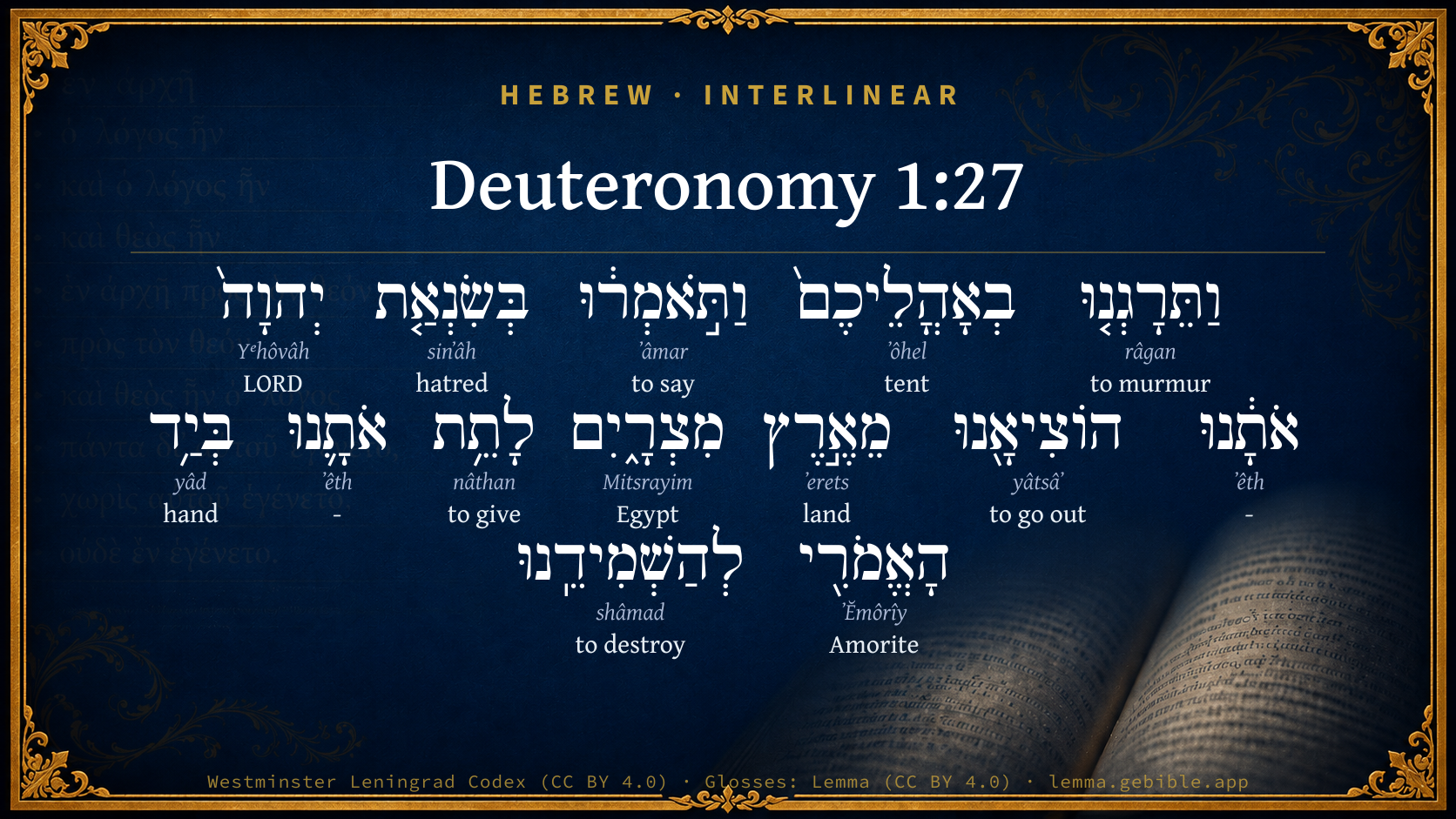
Hebrew (Westminster Leningrad Codex) Deuteronomy 1:27 appears in the Hebrew Old Testament. The text above is from the Westminster Leningrad Codex. Each word links to its Strong’s number, a concise gloss, and parsing drawn from the Open Scriptures Hebrew Bible morphology. Click any word for its full Brown-Driver-Briggs (BDB) entry.
Download image
Cite this verse

Deuteronomy 1:27 (World English Bible). Public Domain. Lemma interlinear Bible study tool, https://lemma.gebible.app/v/deuteronomy/1/27.

Show BibTeX & RIS
BibTeX
RIS
English Translation
and you murmured in your tents, and said, Because Yahweh hated us, he has brought us forth out of the land of Egypt, to deliver us into the hand of the Amorites, to destroy us.
World English Bible · Public Domain
Highlights
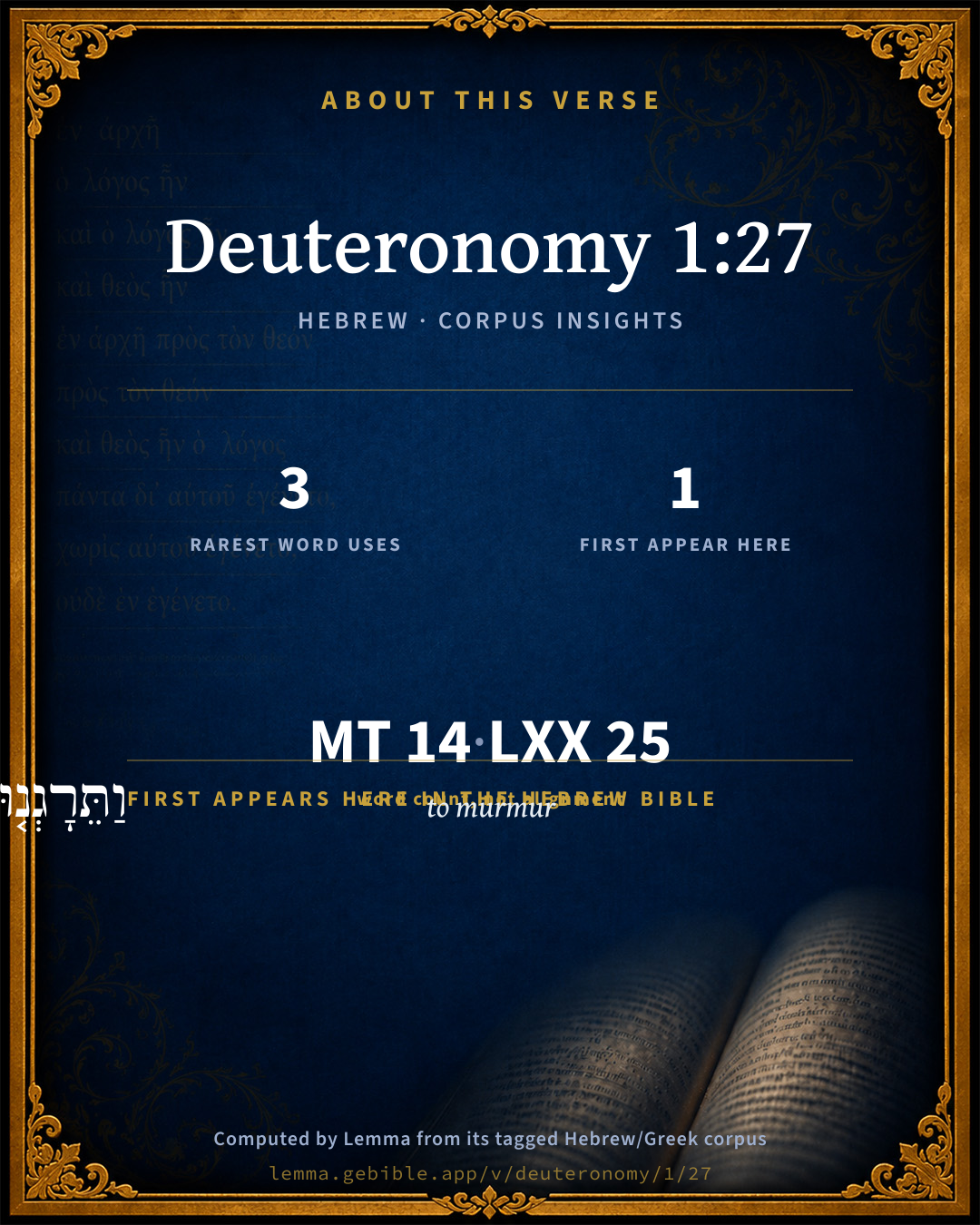
  • 1 first appearance in the Hebrew Bible
Full analysis ↓
Download a study sheet

One document with this verse’s original text, its word-by-word gloss line, the meaning frame, cross-references with their text, attributed commentary, and full source and license credits — printable, and it pastes into notes with its structure intact.

This verse Autodidact and up

Study sheet (.html) Plain text (.txt)

A passage Seminary Student

Up to 50 verses in one chapter. A passage sheet keeps up to 6 commentary sources and 12 cross-references per verse, in the order this page ranks them, and says so on the sheet whenever that leaves anything out. Ask for a single verse and you get the Autodidact verse sheet above.

Everything on this page stays free to read, with no account — the sheet is a download of what is already on screen, not access to it.

Want to remove ads? Support Godless Engineer
Compare translations 3

The same verse in 3 English versions, stacked beneath the original-language interlinear above. Click any original word for its lexicon entry.

Each is an independent rendering of the whole verse — the interlinear is not word-aligned to these translations.

Highlighted words mark where these versions differ — a whole-verse word diff, not a word-by-word alignment.

  • World English Bible Public Domain
    and you murmured in your tents, and said, Because Yahweh hated us, he has brought us forth out of the land of Egypt, to deliver us into the hand of the Amorites, to destroy us.
  • King James Version Public Domain
    And ye murmured in your tents, and said, Because the LORD hated us, he hath brought us forth out of the land of Egypt, to deliver us into the hand of the Amorites, to destroy us.
  • unfoldingWord Literal Text CC BY-SA 4.0
    And you grumbled in your tents and said, ‘In the hatred of Yahweh against us he brought us from the land of Egypt to give us into the hand of the Amorites to destroy us.

unfoldingWord Literal Text — © unfoldingWord, licensed CC BY-SA 4.0. Word-aligned USFM3 via Door43 (git.door43.org/unfoldingWord/en_ult).

Versions to compare (up to 4)

3 of 4 selected

Show all 18 translations

Every available English version of this verse, each an independent rendering of the whole verse.

  • World English Bible Public Domain
    and you murmured in your tents, and said, Because Yahweh hated us, he has brought us forth out of the land of Egypt, to deliver us into the hand of the Amorites, to destroy us.
  • Berean Standard Bible Public Domain
    You grumbled in your tents and said, “Because the LORD hates us, He has brought us out of the land of Egypt to deliver us into the hand of the Amorites to be annihilated.
  • Majority Standard Bible Public Domain
    You grumbled in your tents and said, “Because the LORD hates us, He has brought us out of the land of Egypt to deliver us into the hand of the Amorites to be annihilated.
  • King James Version Public Domain
    And ye murmured in your tents, and said, Because the LORD hated us, he hath brought us forth out of the land of Egypt, to deliver us into the hand of the Amorites, to destroy us.
  • American Standard Version (1901) Public Domain
    and ye murmured in your tents, and said, Because Jehovah hated us, he hath brought us forth out of the land of Egypt, to deliver us into the hand of the Amorites, to destroy us.
  • Revised Version (1885) Public Domain
    and ye murmured in your tents, and said, Because the LORD hated us, he hath brought us forth out of the land of Egypt, to deliver us into the hand of the Amorites, to destroy us.
  • Geneva Bible (1599) Public Domain
    And murmured in your tentes, and sayd, Because the Lord hated vs, therefore hath hee brought vs out of the land of Egypt, to deliuer vs into the hand of the Amorites, and to destroy vs.
  • Douay-Rheims (1899) Public Domain
    Taking of the fruits thereof, to shew its fertility, they brought them to us, and said: The land is good, which the Lord our God will give us.
  • Young's Literal Translation Public Domain
    and murmur in your tents, and say, In Jehovah's hating us He hath brought us out of the land of Egypt, to give us into the hand of the Amorite -- to destroy us;
  • Literal Standard Version CC BY-SA 4.0
    and murmur in your tents, and say, In YHWH’s hating us He has brought us out of the land of Egypt, to give us into the hand of the Amorite—to destroy us;
  • Unlocked Literal Bible CC BY-SA 4.0
    You complained in your tents and said, “It is because Yahweh hated us that he has brought us out of the land of Egypt, to give us into the hand of the Amorites to destroy us.
  • unfoldingWord Literal Text CC BY-SA 4.0
    And you grumbled in your tents and said, ‘In the hatred of Yahweh against us he brought us from the land of Egypt to give us into the hand of the Amorites to destroy us.
  • Darby Bible Public Domain
    and ye murmured in your tents, and said, Because Jehovah hated us, he hath brought us forth out of the land of Egypt, to deliver us into the hand of the Amorites, to destroy us.
  • World Messianic Bible Public Domain
    You murmured in your tents, and said, “Because the LORD hated us, he has brought us out of the land of Egypt, to deliver us into the hand of the Amorites to destroy us.
  • Webster's Bible Public Domain
    And ye murmured in your tents, and said, Because the LORD hated us, he hath brought us forth from the land of Egypt, to deliver us into the hand of the Amorites, to destroy us.
  • Free Bible Version CC BY-SA 4.0
    You complained while you were in your tents and said, “It's because the Lord hates us that he led us out of Egypt in order to hand us over to the Amorites to be wiped out.
  • Bible in Basic English Public Domain
    And you made an angry outcry in your tents, and said, In his hate for us the Lord has taken us out of the land of Egypt, to give us up into the hands of the Amorites for our destruction.
  • JPS Tanakh (1917) Public Domain
    and ye murmured in your tents, and said: 'Because the LORD hated us, He hath brought us forth out of the land of Egypt, to deliver us into the hand of the Amorites, to destroy us.

Literal Standard Version (2020), Covenant Press — licensed CC BY-SA 4.0. Text via the HelloAO Bible API (eBible.org). Unlocked Literal Bible (unfoldingWord) — licensed CC BY-SA 4.0. Text via the HelloAO Bible API (eBible.org). unfoldingWord Literal Text — © unfoldingWord, licensed CC BY-SA 4.0. Word-aligned USFM3 via Door43 (git.door43.org/unfoldingWord/en_ult). Free Bible Version, Dr. Jonathan Gallagher — licensed CC BY-SA 4.0. Text via the HelloAO Bible API (eBible.org).

Word by word

More ways to search: Search by grammar → Find every occurrence → Compare this word →

Practice this passage: Drill this verse → Learn its vocabulary →

וַתֵּרָגְנ֤וּ
râgan
H7279
“and · to murmur”
Conjunction + Verb, Niphal, Sequential Imperfect, 2nd Person, Masculine, Plural
Part of Speech
Conjunction + Verb
Stem
Niphal
Form
Sequential Imperfect
Person
2nd Person
Gender
Masculine
Number
Plural
Full BDB Definition

Origin: a primitive root

TWOT: 2115

to murmur, whisper - (Qal) murmurer (participle) - (Niphal) - to murmur - backbiter (participle)
  1. בְאָהֳלֵיכֶם֙ ʼôhel H168 “in/at · tents · your” Preposition + Noun, Common, Masculine, Plural, Construct + Suffix, Personal, 2nd Person, Masculine, Plural
  2. וַתֹּ֣אמְר֔וּ ʼâmar H559 “and · to say” Conjunction + Verb, Qal, Sequential Imperfect, 2nd Person, Masculine, Plural
  3. בְּשִׂנְאַ֤ת sinʼâh H8135 “in/at · hatred of” Preposition + Noun, Common, Feminine, Singular, Construct
  4. יְהוָה֙ Yᵉhôvâh H3068 “LORD” Noun, Proper
  5. אֹתָ֔נוּ ʼêth H853 “- · us” Particle, Direct Object + Suffix, Personal, 1st Person, Common, Plural
  6. הוֹצִיאָ֖נוּ yâtsâʼ H3318 “to go out · us” Verb, Hiphil, Perfect, 3rd Person, Masculine, Singular + Suffix, Personal, 1st Person, Common, Plural
  7. מֵאֶ֣רֶץ ʼerets H776 “from · land of” Preposition + Noun, Common, Both, Singular, Construct
  8. מִצְרָ֑יִם Mitsrayim H4714 “Egypt” Noun, Proper
  9. לָתֵ֥ת nâthan H5414 “to give” Preposition + Verb, Qal, Infinitive Construct
  10. אֹתָ֛נוּ ʼêth H853 “- · us” Particle, Direct Object + Suffix, Personal, 1st Person, Common, Plural
  11. בְּיַ֥ד yâd H3027 “in/at · hand of” Preposition + Noun, Common, Both, Singular, Construct
  12. הָאֱמֹרִ֖י ʼĔmôrîy H567 “the · Amorite” Particle, Definite Article + Noun, Gentilic, Masculine, Singular, Absolute
  13. לְהַשְׁמִידֵֽנוּ shâmad H8045 “to destroy · us” Preposition + Verb, Hiphil, Infinitive Construct + Suffix, Personal, 1st Person, Common, Plural

About this verse

These counts appear in no published source. They are computed here, from the morphology-tagged text and Lemma’s own curated glosses. What Lemma adds →

14
words
13
distinct lemmas
Pentateuch
section

Notable vocabulary

The rarest word here is וַתֵּרָגְנ֤וּ to murmur H7279 — appearing just 3 times in the whole Hebrew Bible.

First appearance in Scripture

This word makes its first canonical appearance in the Hebrew Bible here:

  • וַתֵּרָגְנ֤וּ to murmur H7279

Shared distinctive vocabulary

וַתֵּרָגְנ֤וּ to murmur H7279 occurs in 3 verses of the Hebrew Bible. Also found in:

Grammatical profile

  • 5 verbs
  • 7 nouns
  • 2 particles

Verb forms

  • וַתֵּרָגְנ֤וּ Niphal · Sequential Imperfect
  • וַתֹּ֣אמְר֔וּ Qal · Sequential Imperfect
  • הוֹצִיאָ֖נוּ Hiphil · Perfect
  • לָתֵ֥ת Qal · Infinitive Construct
  • לְהַשְׁמִידֵֽנוּ Hiphil · Infinitive Construct

Hebrew & Septuagint length

In English translation the verse runs 35 words from the Hebrew and 35 from the Septuagint (LXX English) — the same length.

A rough comparison of the two English renderings, which tokenize alike — not a word-level alignment.

Word counts can differ between the Hebrew and the Greek without any difference in meaning — e.g. the Hebrew direct-object marker אֵת has no separate Greek word, and Greek often adds the article ὁ.

In the original languages it is 14 Hebrew tokens and 25 Greek tokens — but the two are counted differently (Hebrew bundles its prefixes and suffixes into one token; the Greek is in lemma form), so that isn’t a like-for-like length.

Cross-references

8

Topical passages linked to Deuteronomy 1:27 in the Treasury of Scripture Knowledge — connected by theme and wording, ordered by reader-vote popularity; previews shown in the World English Bible.

  • Deuteronomy 9:28 lest the land whence you brought us out say, Because Yahweh was not able to bring them into the land which he promised to them, and because he hated them, he has brought them out to kill them in the wilderness.
  • Numbers 14:3 Why does Yahweh bring us to this land, to fall by the sword? Our wives and our little ones will be a prey: wouldn't it be better for us to return into Egypt?
  • Psalms 106:25 But murmured in their tents, And didn't listen to Yahweh's voice.
  • Exodus 16:3 and the children of Israel said to them, "We wish that we had died by the hand of Yahweh in the land of Egypt, when we sat by the flesh-pots, when we ate our fill of bread, for you have brought us out into this wilderness, to kill this whole assembly with hunger."
  • Exodus 16:8 Moses said, "Now Yahweh shall give you meat to eat in the evening, and in the morning bread to satisfy you; because Yahweh hears your murmurings which you murmur against him. And who are we? Your murmurings are not against us, but against Yahweh."
  • Numbers 21:5 The people spoke against God, and against Moses, Why have you brought us up out of Egypt to die in the wilderness? for there is no bread, and there is no water; and our soul loathes this light bread.
  • Matthew 25:24 "He also who had received the one talent came and said, 'Lord, I knew you that you are a hard man, reaping where you did not sow, and gathering where you did not scatter.
  • Luke 19:21 for I feared you, because you are an exacting man. You take up that which you didn't lay down, and reap that which you didn't sow.'

Cross-references courtesy of OpenBible.info (CC BY 4.0).

Hebrew and Greek witnesses Masoretic Hebrew ↔ Greek Septuagint

The same verse in the two great witnesses to the Old Testament, shown verse-for-verse.

These are two independent witnesses, not word-aligned to each other, and the Septuagint is shown in lemma (dictionary) form.

Hebrew Deuteronomy 1:27 Masoretic · Westminster Leningrad Codex

וַתֵּרָגְנ֤וּ בְאָהֳלֵיכֶם֙ וַתֹּ֣אמְר֔וּ בְּשִׂנְאַ֤ת יְהוָה֙ אֹתָ֔נוּ הוֹצִיאָ֖נוּ מֵאֶ֣רֶץ מִצְרָ֑יִם לָתֵ֥ת אֹתָ֛נוּ בְּיַ֥ד הָאֱמֹרִ֖י לְהַשְׁמִידֵֽנוּ

and you murmured in your tents, and said, Because Yahweh hated us, he has brought us forth out of the land of Egypt, to deliver us into the hand of the Amorites, to destroy us.

World English Bible · Public Domain

Greek LXX Deuteronomy 1:27 Septuagint · lemma form

καί διαγογγύζω ἐν ὁ σκηνή σύ καί εἶπον διά ὁ μισέω κύριος ἐγώ ἐκἄγω ἐγώ ἐκ γῆ αἴγυπτος παραδίδωμι ἐγώ εἰς χείρ ἀμορραῖος ἐκὀλεθρεύω ἐγώ

And you⌃ murmured in your tents, and said, Because the Lord hated us, he has brought us out of the land of Egypt to deliver us into the hands of the Amorites, to destroy us.

LXX2012 (modern English Septuagint) · Public Domain

Hebrew: Westminster Leningrad Codex (CC BY 4.0). Greek: Septuagint (public domain); English from LXX2012 (modern English Septuagint) (Public Domain). How the Septuagint differs from the Hebrew →

Targum (Aramaic paraphrase)

2

The Targum is the ancient Jewish Aramaic paraphrase of the Hebrew Scriptures — an interpretive translation, not the Hebrew text itself. Onkelos (literal) and Pseudo-Jonathan (expansive) render the Torah, and Jonathan the Prophets. Coverage is partial: where no permissively-licensed English translation exists for a verse, only the Aramaic is shown. This is verse-level text, not a word-by-word alignment to the Hebrew.

  1. Targum Onkelos Torah (Genesis–Deuteronomy)
    וְאִתְרַעַמְתּוּן בְּמַשְׁכְּנֵיכוֹן וַאֲמַרְתּוּן בִּדְסָנֵי יְיָ יָתָנָא אַפְּקָנָא מֵאַרְעָא דְמִצְרָיִם לְמִמְסַר יָתָנָא בִּידָא דֶאֱמוֹרָאָה לְשֵׁיצָיוּתָנָא

    (no public-domain English translation for this verse)

    Targum Onkelos — Aramaic: “Onkelos Genesis” (public domain); “Onkelos Exodus” (public domain); “Onkelos Leviticus” (public domain); “Onkelos Numbers” (public domain); “Onkelos Deuteronomy” (public domain). English: “Sefaria Community Translation” (CC0 1.0 (public-domain dedication)); “J.W. Etheridge. The Targums of Onkelos and Jonathan Ben Uzziel on the Pentateuch. London: Longmans, Green, 1862” (public domain). Text via Sefaria.

  2. Targum Pseudo-Jonathan Torah (Genesis–Deuteronomy)
    וְרַגִינְתּוּן בְּמַשְׁכְּנֵיכוֹן נְסֵיבְתּוּן בְּנֵיכוֹן וּבְנָתֵיכוֹן בְּעִיטְפֵיכוֹן לְמֵימָר וַוי לְכוֹן סַגִיפִין מְחַר אַתּוּן מִתְקַטְלִין מְטוֹל דְּסָנֵי יְיָ יָתָנָא אַפְקָנָא מִן אַרְעָא דְמִצְרַיִם לְמִימְסַר יָתָנָא בִּידָא דֶאֱמוֹרָאֵי לְשֵׁצֵיוּתָנָא

    And you cried in your tents, taking your sons and your daughters to your breasts, saying, Woe to you, ye stricken ones! tomorrow ye will be slain. Why hath the Lord hated us, to have brought us out of the land of Mizraim, to deliver us into the hand of the Amorites to destroy us?

    Targum Pseudo-Jonathan — Aramaic: “Targum Jonathan on Genesis” (public domain); “Targum Jonathan on Exodus” (public domain); “Targum Jonathan on Leviticus” (public domain); “Targum Jonathan on Numbers” (public domain); “Targum Jonathan on Deuteronomy” (public domain). English: “The Targum of Jonathan ben Uzziel, trans. J. W. Etheridge, London, 1862” (public domain). Text via Sefaria.

Commentary

Notes on Deuteronomy 1:27 from classic Christian and Jewish commentators (each source and its license shown beneath its notes). The classic Christian expositions comment on the surrounding passage and are grouped to its opening verse, so a note may address several verses; the Jewish commentaries on the Tanakh (Rashi and others) are per-verse, so they appear only where the commentator wrote on this verse.

Lemma curates 59 commentaries, every one of them public domain or Creative Commons licensed, each selected and text-cleaned for this edition rather than reprinted as found. About our sources →

Trapp's Complete Commentary

John Trapp

Deu 1:27 And ye murmured in your tents, and said, Because the LORD hated us, he hath brought us forth out of the land of Egypt, to deliver us into the hand of the Amorites, to destroy us.

Ver. 27. Because the Lord hated us.] A gross mistake. Why should it then so greatly grieve us. that our good intentions are so much misconstrued? That is here complained of, as an argument of God’s hatred, that he intended for an instance of his love. {Deu 4:37; Deu 7:8} In quo dilexisti nos? "wherein hast thou loved us?" said those malcontents in Malachi, {Mal 1:2} that cast the helve after the hatchet, as the proverb is, and like children, because they might not have what they would, grew sullen, and would have nothing.

John Trapp, A Commentary or Exposition upon All the Books of the Old and New Testament (1647–1656) — public domain. Text from a community e-Sword module.

Joseph Benson's Commentary

Deu 1:27. Because the Lord hated us — This shows what dishonourable and unworthy thoughts they had entertained of God, to imagine him capable of being actuated by hatred to his own creatures. Their sins, indeed, he could not but view with hatred; just as every good and wise parent must dislike all evil dispositions and practices in his children: but God, infinitely good, can no more hate any thing that he has made, than a tender mother can be hardened against her sucking child.

Joseph Benson's Commentary on the Old and New Testaments (1811–1818) — public domain. Text from a community e-Sword module.

Geneva Bible (1599)

Geneva Bible translators

Such was the Jews’ unthankfulness, that they counted God’s especial love, hatred.

Geneva Bible (1599) marginal notes — public domain. Text via Bolls.life.

Ellicott's Commentary for English Readers

(27) Because the Lord hated us.—A most astounding commentary on the events of the exodus up to that date. It is a stronger expression than any recorded, even in Num_14:3.

A Bible Commentary for English Readers, edited by Charles John Ellicott (1878–1897) — public domain. Text from a community e-Sword module.

The Cambridge Bible for Schools and Colleges

gen. ed. J. J. S. Perowne

27. and ye murmured] Heb. ragan, not elsewhere in Pent. P uses a different verb.

in your tents] Transposing two consonants Geiger reads against your God. This change is unnecessary. Discontent with a report, originally suggested by the people themselves, and discontent that shaped itself (according to JE) to the demand for another leader, would at first be uttered in private.

Because the Lord hated us] To this extreme of unbelief and ingratitude were the people driven by the report of a few among themselves, in spite of their long experience of God’s leading. The passage is eloquent of the fickleness with which a people will suffer the lessons of its past—facts of Providence it has proved and lived upon—to be overthrown by the opinion of a few ‘experts’ as to a still untried situation! To which the answer is memorable—Be the facts as the ‘experts’ assert, do ye try the situation and prove that God will be with you there as He has been with you before.

to deliver us into the hand of] A phrase frequent in D: 9 times, + 10 in deuteronomic passages in Jos., against 5 times in JE.

the Amorites] See on Deu_1:7.

to destroy us] Another phrase so characteristic of D that in its active and pass. forms it occurs 28 times in the Bk + 5 in deuteronomic passages in Jos. against 4 or 5 times in all the rest of the Hexateuch.

The Cambridge Bible for Schools and Colleges (gen. ed. J. J. S. Perowne; Cambridge University Press, 1878–1918) — public domain. Text from a community e-Sword module.

John Gill's Exposition

And ye murmured in your tents,.... Not in a private manner; for though the murmurs began there, they having wept all night after the report of the spies; yet it became general and public, and they gathered together in a body, and openly expressed their murmurs against Moses and Aaron, Num 14:1,

and said, because the Lord hated us, he hath brought us forth out of the land of Egypt; a strange expression indeed! when it was such a plain amazing instance of his love to them, as could not but be seen by them; being done in such a remarkable and extraordinary manner, by inflicting judgments on their enemies in a miraculous way, giving them favour in their eyes, to lend them their clothes and jewels, and bringing them out with such an high hand, openly and publicly in the sight of them, where they had been in the most wretched slavery for many years; yet this is interpreted an hatred of them, and as done with an ill design upon them, as follows:

to deliver us into the hand of the Amorites, to destroy us; which now, under the power of their fears and unbelief, they thought would be quickly their case; see Deu 4:37.

John Gill's Exposition of the Whole Bible (1746–1763) — public domain (CC PDM 1.0). Text via the HelloAO Bible API.

Haydock's Catholic Bible Commentary

Hateth us. Such an opinion, can bring nothing but destruction. (Du Hamel)

George Leo Haydock (1774–1849), Haydock's Catholic Family Bible and Commentary, 1859 edition — public domain. Excludes Psalms (Douay-Rheims chapter numbering differs from Protestant) and Deuterocanonical books (Catholic canon only).

Matthew Poole's English Annotations

Because the Lord hated us, and therefore designed to destroy us.

Matthew Poole's English Annotations on the Holy Bible (1683–1685) — public domain. Text from a community e-Sword/MySword module.

Whedon's Commentary on the Bible

Daniel D. Whedon

27. Ye murmured in your tents — It is true that the great majority of the murmurers had died since that time; but Moses speaks to the nation as still containing the elements of unbelief, ingratitude, and disloyalty. These discourses abound in reproofs and warnings to the generations then existing and the generations to come, based on the sins of those who left their bones in the wilderness.

Daniel D. Whedon (gen. ed.), Commentary on the Old and New Testaments (1874–1909) — public domain. Text from a community e-Sword module.

The Pulpit Commentary

Ye murmured in your tents; an allusion to what is recorded Num_14:1, etc. Moses addresses the people then with him as if they had been the parties who so rebelled and murmured at Kadesh, though all that generation, except himself, Joshua, and Caleb, had perished. This he does, not merely because of the solidarity of the nation, but also that he might suggest to them the possibility that the same evil spirit might still lurk among them, and consequently the need of being on their guard against allowing it to get scope.

The Pulpit Commentary (1880–1919), ed. H.D.M. Spence-Jones & Joseph S. Exell — public domain. Text from a community e-Sword module.

Rashi

Rabbi Shlomo Yitzchaki (Rashi)

ותרגנו — This is an expression denoting slander. Similar is, (Proverbs 18:8) “The words of a נרגן” i.e. of a man who brings a false report (Sifrei Devarim 24:1).

בשנאת ה׳ אתנו BECAUSE THE LORD HATETH US — Really, however, He loved you, but you hated Him. A common proverb says: What is in your own mind about your friend, you imagine is what is in his mind about you (Sifrei Devarim 24:3).

בשנאת ה' אתנו הוציאנו מארץ מצרים BECAUSE THE LORD HATETH US HE HATH BROUGHT US FORTH FROM THE LAND OF EGYPT — His bringing us forth was out of hatred. A parable! It may be compared to an earthly king who had two sons, and who had two fields, one well-watered; the other arid (dependent upon rain only). To him whom he loved best of his sons he gave the well-watered field, and to him whom he loved less he gave the arid one. The land of Egypt is a well-watered country, for the Nile rises and irrigates it, whilst the land of Canaan is an arid country — and He brought us forth from well-watered Egypt to give us the arid land of Canaan (Numbers Rabbah 17:3).

Rashi on the Tanakh — English translations: “The Judaica Press complete Tanach with Rashi, translated by A. J. Rosenberg” (CC BY 4.0); “Pentateuch with Rashi's commentary by M. Rosenbaum and A.M. Silbermann, 1929-1934” (public domain); “The Metsudah Tanach series, Lakewood, N.J” (CC BY 4.0); and “The Book of Joshua, Metsudah Publications, 1997” (CC BY 4.0). Text via Sefaria.

Lesson kit

Teaching starters — assembled from the data on this page, not authored interpretation. Every prompt links to the verse data it draws on. Edit before teaching.

Deuteronomy, in the Pentateuch, opens this verse with 14 words (13 distinct Hebrew lemmas). Its most distinctive word is râgan (“to murmur”). A historical commentator’s framing appears above. Read the whole chapter for the surrounding context.

Discussion questions

  1. How does “to murmur” (râgan) shape what this verse is saying?
  2. This is the first place “to murmur” appears in Scripture (first appears here). What does its debut here establish?
  3. How does Psalms 106:25, which shares the word «to murmur», read alongside this verse?
  4. These translations render this verse differently; the difference is in the English rendering, not the original. What questions does that raise?
  5. «וַתֵּרָגְנ֤וּ» is a Niphal Sequential Imperfect verb. How does that grammatical form shape the action described?
  6. Compare how Trapp's Complete Commentary and Joseph Benson's Commentary read this verse. Where do they agree or differ?

Things to notice

Reading settings

Reading text

Shown beneath each verse's original-language words.

Old Testament
Old Testament edition

Read the OT as the Masoretic Hebrew (MT) or the Greek Septuagint (LXX).

English shown for the Greek Septuagint (in the Hebrew ↔ Greek comparison).

Comparing translations? Open the Compare panel on any verse page to stack up to four side by side.