
Genesis 38:18

Hebrew (Westminster Leningrad Codex) Genesis 38:18 appears in the Hebrew Old Testament. The text above is from the Westminster Leningrad Codex. Each word links to its Strong’s number, a concise gloss, and parsing drawn from the Open Scriptures Hebrew Bible morphology. Click any word for its full Brown-Driver-Briggs (BDB) entry.
Download image
Cite this verse

Genesis 38:18 (World English Bible). Public Domain. Lemma interlinear Bible study tool, https://lemma.gebible.app/v/genesis/38/18.

Show BibTeX & RIS
BibTeX
RIS
English Translation
He said, "What pledge will I give you?" She said, "Your signet and your cord, and your staff that is in your hand." He gave them to her, and came in to her, and she conceived by him.
World English Bible · Public Domain
Highlights
  • 3 first appearances in the Hebrew Bible
Full analysis ↓
Download a study sheet

One document with this verse’s original text, its word-by-word gloss line, the meaning frame, cross-references with their text, attributed commentary, and full source and license credits — printable, and it pastes into notes with its structure intact.

This verse Autodidact and up

Study sheet (.html) Plain text (.txt)

A passage Seminary Student

Up to 50 verses in one chapter. A passage sheet keeps up to 6 commentary sources and 12 cross-references per verse, in the order this page ranks them, and says so on the sheet whenever that leaves anything out. Ask for a single verse and you get the Autodidact verse sheet above.

Everything on this page stays free to read, with no account — the sheet is a download of what is already on screen, not access to it.

Want to remove ads? Support Godless Engineer
Compare translations 3

The same verse in 3 English versions, stacked beneath the original-language interlinear above. Click any original word for its lexicon entry.

Each is an independent rendering of the whole verse — the interlinear is not word-aligned to these translations.

Highlighted words mark where these versions differ — a whole-verse word diff, not a word-by-word alignment.

  • World English Bible Public Domain
    He said, "What pledge will I give you?" She said, "Your signet and your cord, and your staff that is in your hand." He gave them to her, and came in to her, and she conceived by him.
  • King James Version Public Domain
    And he said, What pledge shall I give thee? And she said, Thy signet, and thy bracelets, and thy staff that is in thine hand. And he gave it her, and came in unto her, and she conceived by him.
  • unfoldingWord Literal Text CC BY-SA 4.0
    Then he said, “What the pledge that I should give to you?” And she said, “Your signet and your cord and your staff that in your hand.” So he gave to her and went to her, and she conceived by him.

unfoldingWord Literal Text — © unfoldingWord, licensed CC BY-SA 4.0. Word-aligned USFM3 via Door43 (git.door43.org/unfoldingWord/en_ult).

Versions to compare (up to 4)

3 of 4 selected

Show all 17 translations

Every available English version of this verse, each an independent rendering of the whole verse.

  • World English Bible Public Domain
    He said, "What pledge will I give you?" She said, "Your signet and your cord, and your staff that is in your hand." He gave them to her, and came in to her, and she conceived by him.
  • Berean Standard Bible Public Domain
    “What pledge should I give you?” he asked. She answered, “Your seal and your cord, and the staff in your hand.” So he gave them to her and slept with her, and she became pregnant by him.
  • Majority Standard Bible Public Domain
    “What pledge should I give you?” he asked. She answered, “Your seal and your cord, and the staff in your hand.” So he gave them to her and slept with her, and she became pregnant by him.
  • King James Version Public Domain
    And he said, What pledge shall I give thee? And she said, Thy signet, and thy bracelets, and thy staff that is in thine hand. And he gave it her, and came in unto her, and she conceived by him.
  • American Standard Version (1901) Public Domain
    And he said, What pledge shall I give thee? And she said, Thy signet and thy cord, and thy staff that is in thy hand. And he gave them to her, and came in unto her, and she conceived by him.
  • Revised Version (1885) Public Domain
    And he said, What pledge shall I give thee? And she said, Thy signet and thy cord, and thy staff that is in thine hand. And he gave them to her, and came in unto her, and she conceived by him.
  • Geneva Bible (1599) Public Domain
    Then he saide, What is the pledge that I shall giue thee? And she answered, Thy signet, and thy cloke, and thy staffe that is in thine hande. So he gaue it her, and lay by her, and she was with childe by him.
  • Young's Literal Translation Public Domain
    and he saith, `What `is' the pledge that I give to thee?' and she saith, `Thy seal, and thy ribbon, and thy staff which `is' in thy hand;' and he giveth to her, and goeth in unto her, and she conceiveth to him;
  • Literal Standard Version CC BY-SA 4.0
    And he says, “What [is] the pledge that I give to you?” And she says, “Your seal, and your ribbon, and your staff which [is] in your hand”; and he gives to her, and goes in to her, and she conceives to him;
  • Unlocked Literal Bible CC BY-SA 4.0
    He said, “What pledge can I give you?” She replied, “Your seal and cord, and the staff that is in your hand.” He gave them to her and slept with her, and she became pregnant by him.
  • unfoldingWord Literal Text CC BY-SA 4.0
    Then he said, “What the pledge that I should give to you?” And she said, “Your signet and your cord and your staff that in your hand.” So he gave to her and went to her, and she conceived by him.
  • Darby Bible Public Domain
    And he said, What pledge shall I give thee? And she said, Thy signet, and thy lace, and thy staff which is in thy hand. And he gave [it] her, and went in to her; and she conceived by him.
  • World Messianic Bible Public Domain
    He said, “What pledge will I give you?” She said, “Your signet and your cord, and your staff that is in your hand.” He gave them to her, and came in to her, and she conceived by him.
  • Webster's Bible Public Domain
    And he said, What pledge shall I give thee? and she said, Thy signet, and thy bracelets, and thy staff that is in thy hand: and he gave them to her, and came in to her, and she conceived by him.
  • Free Bible Version CC BY-SA 4.0
    “What guarantee do I have to give you?” he asked. “Your signet seal and its cord, and your walking stick that you're holding,” she replied. He handed them over to her. He slept with her and she became pregnant.
  • Bible in Basic English Public Domain
    And he said, What would you have? And she said, Your ring and its cord and the stick in your hand. So he gave them to her and went in to her, and she became with child by him.
  • JPS Tanakh (1917) Public Domain
    And he said: 'What pledge shall I give thee?' And she said: 'Thy signet and thy cord, and thy staff that is in thy hand.' And he gave them to her, and came in unto her, and she conceived by him.

Literal Standard Version (2020), Covenant Press — licensed CC BY-SA 4.0. Text via the HelloAO Bible API (eBible.org). Unlocked Literal Bible (unfoldingWord) — licensed CC BY-SA 4.0. Text via the HelloAO Bible API (eBible.org). unfoldingWord Literal Text — © unfoldingWord, licensed CC BY-SA 4.0. Word-aligned USFM3 via Door43 (git.door43.org/unfoldingWord/en_ult). Free Bible Version, Dr. Jonathan Gallagher — licensed CC BY-SA 4.0. Text via the HelloAO Bible API (eBible.org).

Word by word

More ways to search: Search by grammar → Find every occurrence → Compare this word →

Practice this passage: Drill this verse → Learn its vocabulary →

הָֽעֵרָבוֹן֮
ʻărâbôwn
H6162
“the · security”
Particle, Definite Article + Noun, Common, Masculine, Singular, Absolute
Part of Speech
Particle + Noun
Type
Common
Gender
Masculine
Number
Singular
State
Absolute
Full BDB Definition

Origin: from H6148 (in the sense of exchange)

TWOT: 1686b

pledge, security
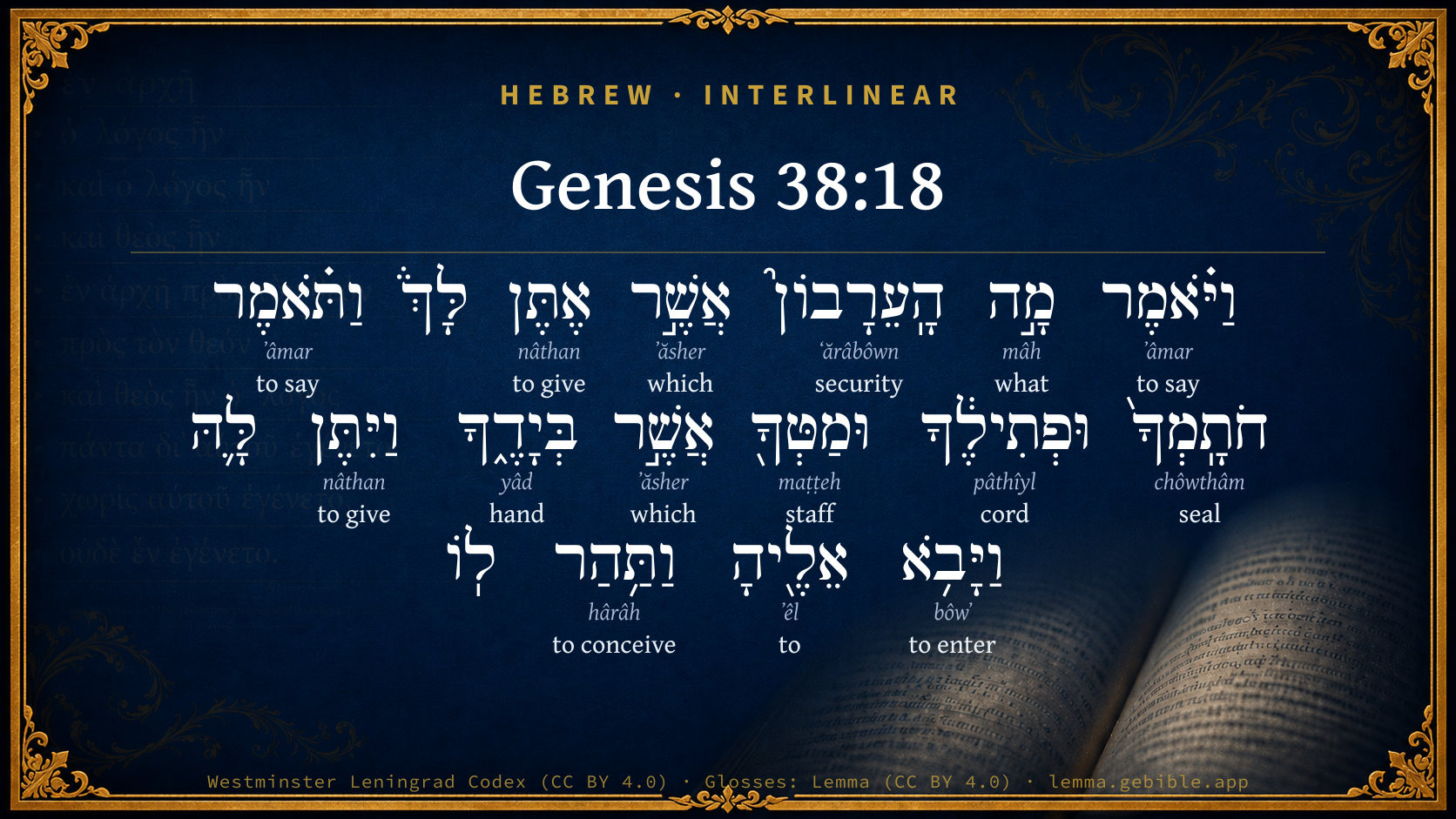
  1. וַיֹּ֗אמֶר ʼâmar H559 “and · to say” Conjunction + Verb, Qal, Sequential Imperfect, 3rd Person, Masculine, Singular
  2. מָ֣ה mâh H4100 “what” Particle, Interrogative
  3. אֲשֶׁ֣ר ʼăsher H834 “which” Particle, Relative
  4. אֶתֶּן nâthan H5414 “to give” Verb, Qal, Imperfect, 1st Person, Common, Singular
  5. וַתֹּ֗אמֶר ʼâmar H559 “and · to say” Conjunction + Verb, Qal, Sequential Imperfect, 3rd Person, Feminine, Singular
  6. חֹתָֽמְךָ֙ chôwthâm H2368 “seal · your” Noun, Common, Masculine, Singular, Construct + Suffix, Personal, 2nd Person, Masculine, Singular
  7. וּפְתִילֶ֔ךָ pâthîyl H6616 “and · cord · your” Conjunction + Noun, Common, Masculine, Singular, Construct + Suffix, Personal, 2nd Person, Masculine, Singular
  8. וּמַטְּךָ֖ maṭṭeh H4294 “and · staff · your” Conjunction + Noun, Common, Masculine, Singular, Construct + Suffix, Personal, 2nd Person, Masculine, Singular
  9. אֲשֶׁ֣ר ʼăsher H834 “which” Particle, Relative
  10. בְּיָדֶ֑ךָ yâd H3027 “in/at · hand · your” Preposition + Noun, Common, Both, Singular, Construct + Suffix, Personal, 2nd Person, Masculine, Singular
  11. וַיִּתֶּן nâthan H5414 “and · to give” Conjunction + Verb, Qal, Sequential Imperfect, 3rd Person, Masculine, Singular
  12. וַיָּבֹ֥א bôwʼ H935 “and · to enter” Conjunction + Verb, Qal, Sequential Imperfect, 3rd Person, Masculine, Singular
  13. אֵלֶ֖יהָ ʼêl H413 “to · her” Preposition + Suffix, Personal, 3rd Person, Feminine, Singular
  14. וַתַּ֥הַר hârâh H2029 “and · to conceive” Conjunction + Verb, Qal, Sequential Imperfect, 3rd Person, Feminine, Singular

About this verse

These counts appear in no published source. They are computed here, from the morphology-tagged text and Lemma’s own curated glosses. What Lemma adds →

18
words
12
distinct lemmas
Pentateuch
section

Notable vocabulary

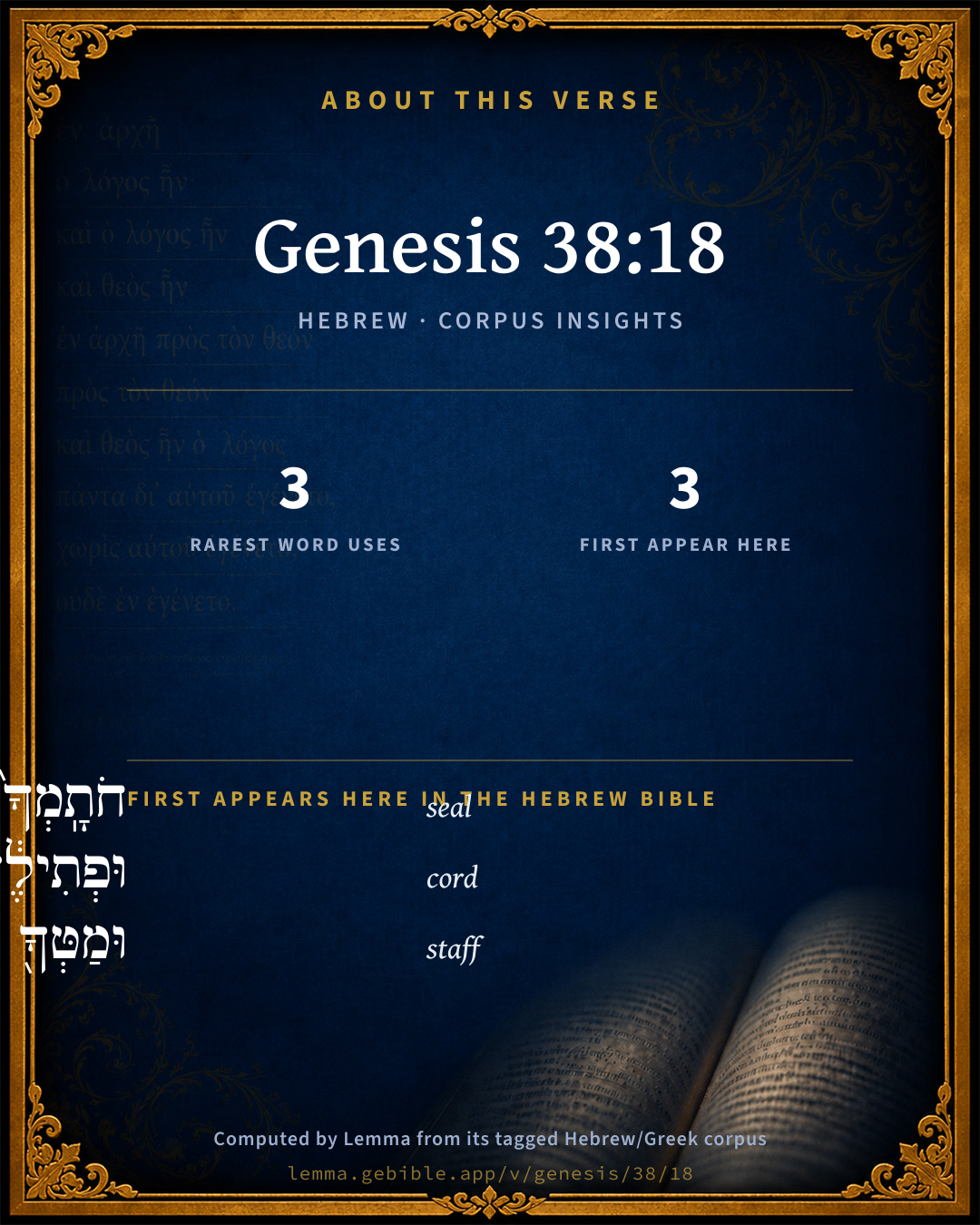
The rarest word here is הָֽעֵרָבוֹן֮ security H6162 — appearing just 3 times in the whole Hebrew Bible.

First appearance in Scripture

These words make their first canonical appearance in the Hebrew Bible here:

  • חֹתָֽמְךָ֙ seal H2368
  • וּפְתִילֶ֔ךָ cord H6616
  • וּמַטְּךָ֖ staff H4294

Shared distinctive vocabulary

הָֽעֵרָבוֹן֮ security H6162 occurs in 3 verses of the Hebrew Bible. Also found in:

Grammatical profile

  • 6 verbs
  • 5 nouns
  • 4 prepositions
  • 3 particles

Verb forms

  • וַיֹּ֗אמֶר Qal · Sequential Imperfect
  • אֶתֶּן Qal · Imperfect
  • וַתֹּ֗אמֶר Qal · Sequential Imperfect
  • וַיִּתֶּן Qal · Sequential Imperfect
  • וַיָּבֹ֥א Qal · Sequential Imperfect
  • וַתַּ֥הַר Qal · Sequential Imperfect

Repetition

Words recur within this verse — often emphatic in Hebrew:

  • וַיֹּ֗אמֶר to say H559 ×2
  • אֶתֶּן to give H5414 ×2
  • אֲשֶׁ֣ר which H834 ×2

Hebrew & Septuagint length

In English translation the verse runs 38 words from the Hebrew and 42 from the Septuagint (LXX English) — closely comparable.

A rough comparison of the two English renderings, which tokenize alike — not a word-level alignment.

Word counts can differ between the Hebrew and the Greek without any difference in meaning — e.g. the Hebrew direct-object marker אֵת has no separate Greek word, and Greek often adds the article ὁ.

Cross-references

4

Topical passages linked to Genesis 38:18 in the Treasury of Scripture Knowledge — connected by theme and wording, ordered by reader-vote popularity; previews shown in the World English Bible.

  • Genesis 38:25–26 When she was brought forth, she sent to her father-in-law, saying, "By the man, whose these are, I am with child." She also said, "Please discern whose are these-- the signet, and the cords, and the staff."
  • Jeremiah 22:24 As I live, says Yahweh, though Coniah the son of Jehoiakim king of Judah were the signet on my right hand, yet would I pluck you there;
  • Hosea 4:11 Prostitution, wine, and new wine take away understanding.
  • Luke 15:22 "But the father said to his servants, 'Bring out the best robe, and put it on him. Put a ring on his hand, and shoes on his feet.

Cross-references courtesy of OpenBible.info (CC BY 4.0).

Hebrew and Greek witnesses Masoretic Hebrew ↔ Greek Septuagint

The same verse in the two great witnesses to the Old Testament, shown verse-for-verse.

These are two independent witnesses, not word-aligned to each other, and the Septuagint is shown in lemma (dictionary) form.

Hebrew Genesis 38:18 Masoretic · Westminster Leningrad Codex

וַיֹּ֗אמֶר מָ֣ה הָֽעֵרָבוֹן֮ אֲשֶׁ֣ר אֶתֶּן לָּךְ֒ וַתֹּ֗אמֶר חֹתָֽמְךָ֙ וּפְתִילֶ֔ךָ וּמַטְּךָ֖ אֲשֶׁ֣ר בְּיָדֶ֑ךָ וַיִּתֶּן לָּ֛הּ וַיָּבֹ֥א אֵלֶ֖יהָ וַתַּ֥הַר לֽוֹ

He said, "What pledge will I give you?" She said, "Your signet and your cord, and your staff that is in your hand." He gave them to her, and came in to her, and she conceived by him.

World English Bible · Public Domain

Greek LXX Genesis 38:18 Septuagint · lemma form

ὁ δέ εἶπον τίς ὁ ἀρραβών σύ δίδωμι ὁ δέ εἶπον ὁ δακτύλιος σύ καί ὁ ὁρμίσκος καί ὁ ῥάβδος ὁ ἐν ὁ χείρ σύ καί δίδωμι αὐτός καί εἰςἔρχομαι πρός αὐτός καί ἐν γαστήρ λαμβάνω ἐκ αὐτός

And he said, What is the earnest that I shall give you? and she said, Your ring, and your bracelet, and the staff in your hand; and he gave them to her, and went in to her, and she conceived by him.

LXX2012 (modern English Septuagint) · Public Domain

On this verse, The Pulpit Commentary discusses the Septuagint’s reading. Read the note in Commentary ↓

Hebrew: Westminster Leningrad Codex (CC BY 4.0). Greek: Septuagint (public domain); English from LXX2012 (modern English Septuagint) (Public Domain). How the Septuagint differs from the Hebrew →

Targum (Aramaic paraphrase)

2

The Targum is the ancient Jewish Aramaic paraphrase of the Hebrew Scriptures — an interpretive translation, not the Hebrew text itself. Onkelos (literal) and Pseudo-Jonathan (expansive) render the Torah, and Jonathan the Prophets. Coverage is partial: where no permissively-licensed English translation exists for a verse, only the Aramaic is shown. This is verse-level text, not a word-by-word alignment to the Hebrew.

  1. Targum Onkelos Torah (Genesis–Deuteronomy)
    וַאֲמַר מָה מַשְׁכּוֹנָא דִּי אֶתֵּן לָךְ וַאֲמֶרֶת עִזְקְתָךְ וְשׁוֹשִׁפָּךְ וְחוּטְרָךְ דִּי בִידָךְ וִיהַב לַהּ וְעַל לְוָתַהּ וְעַדִּיאַת לֵהּ

    (no public-domain English translation for this verse)

    Targum Onkelos — Aramaic: “Onkelos Genesis” (public domain); “Onkelos Exodus” (public domain); “Onkelos Leviticus” (public domain); “Onkelos Numbers” (public domain); “Onkelos Deuteronomy” (public domain). English: “Sefaria Community Translation” (CC0 1.0 (public-domain dedication)); “J.W. Etheridge. The Targums of Onkelos and Jonathan Ben Uzziel on the Pentateuch. London: Longmans, Green, 1862” (public domain). Text via Sefaria.

  2. Targum Pseudo-Jonathan Torah (Genesis–Deuteronomy)
    וַאֲמַר מַה מַשְׁכּוֹנָא דְאֶתֵּן לִיךְ וַאֲמָרַת סִיטוּמְתָּךְ וְחוּטְיָיךְ וְחוּטְרָךְ דְבִידָךְ וִיהַב לָהּ וְעַל לְוָותָהּ וְאִתְעַבָּרַת לֵיהּ

    And he said, What pledge shall I give thee? And she answered, Thy seal, and thy mantle, and thy staff which is in thy hand. And he gave (them) to her, and went in with her; and she conceived by him.

    Targum Pseudo-Jonathan — Aramaic: “Targum Jonathan on Genesis” (public domain); “Targum Jonathan on Exodus” (public domain); “Targum Jonathan on Leviticus” (public domain); “Targum Jonathan on Numbers” (public domain); “Targum Jonathan on Deuteronomy” (public domain). English: “The Targum of Jonathan ben Uzziel, trans. J. W. Etheridge, London, 1862” (public domain). Text via Sefaria.

Commentary

Notes on Genesis 38:18 from classic Christian and Jewish commentators (each source and its license shown beneath its notes). The classic Christian expositions comment on the surrounding passage and are grouped to its opening verse, so a note may address several verses; the Jewish commentaries on the Tanakh (Rashi and others) are per-verse, so they appear only where the commentator wrote on this verse.

Lemma curates 59 commentaries, every one of them public domain or Creative Commons licensed, each selected and text-cleaned for this edition rather than reprinted as found. About our sources →

Trapp's Complete Commentary

John Trapp

Gen 38:18 And he said, What pledge shall I give thee? And she said, Thy signet, and thy bracelets, and thy staff that [is] in thine hand. And he gave [it] her, and came in unto her, and she conceived by him.

Ver. 18. And he gave it her, and came in unto her.] He gave her whatsoever she desired; as the manner of such men is: and although he committed incest ignorantly, yet not through ignorance, but through heat of lust, which is brutish and boisterous, burning as an oven: whence the Greeks have named it: and Plato compares it to a headstrong horse. {a}

{a} ’Eπιθυμια απο του θυμιεν ardere. Plato appetitum assimilat equo, qui sit, σκολιος, κρατεραυχων, Bραχυτραχηλος, μελαγχρως, κωφος, μαντιγι μογις υτεικων.

John Trapp, A Commentary or Exposition upon All the Books of the Old and New Testament (1647–1656) — public domain. Text from a community e-Sword module.

Tyndale Open Study Notes

Tyndale Open Resources

38:18 identification seal: A stone or metal cylinder was engraved with distinctive designs and was usually worn around the neck on a cord; when rolled onto clay or wax, it left a distinct impression.

Tyndale Open Study Notes — © Tyndale Open Resources, licensed CC BY-SA 4.0. Text via the HelloAO Bible API.

Geneva Bible (1599)

Geneva Bible translators

Or, tyre of thine head.

Geneva Bible (1599) marginal notes — public domain. Text via Bolls.life.

Jamieson, Fausset & Brown

Robert Jamieson, A. R. Fausset & David Brown

signet, &c.--Bracelets, including armlets, were worn by men as well as women among the Hebrews. But the Hebrew word here rendered "bracelets," is everywhere else translated "lace" or "ribbon"; so that as the signet alone was probably more than an equivalent for the kid, it is not easy to conjecture why the other things were given in addition, except by supposing the perforated seal was attached by a ribbon to the staff.

Jamieson, Fausset & Brown — Commentary Critical and Explanatory on the Whole Bible (1871) — public domain (CC PDM 1.0). Text via the HelloAO Bible API.

Ellicott's Commentary for English Readers

(18) Thy bracelets.—Heb., thy cord. The art of engraving was probably not advanced enough among these nomads to permit them to engrave gems small enough to wear in a ring. Judah evidently suspended his signet round his neck by a cord; and this custom still exists among the Arabs, of whom some wear signet rings, while others hang them round their necks. Probably each man of distinction had his emblem, and in Genesis 49 Jacob seems to refer to them. Thus Judah’s emblem was a lion, Zebulun’s a ship, Issachar’s an ass, &c.

Thy staff.—The staff in ancient times was elaborately adorned. Herodotus (i. 195) describes the staves carried by the Babylonians, as having on them carvings of fruit, or of some flower or bird; and Homer perpetually makes mention of the “sceptres,” that is, walking-sticks, of the kings, as carved so magnificently as to be worthy of being ascribed to Hephaestus, and handed down as emblems of authority from father to son. (See Iliad, ii. 101-107.) It is from these staves that the sceptres of kings, and the batons of field-marshals, &c, are derived.

A Bible Commentary for English Readers, edited by Charles John Ellicott (1878–1897) — public domain. Text from a community e-Sword module.

The Cambridge Bible for Schools and Colleges

gen. ed. J. J. S. Perowne

18. signet … cord … staff] The signet ring is frequently worn by Arabs on a cord fastened round the neck. Cf. Son_8:6, “set me as a seal upon thine heart.” The signet ring and the staff, which was often carved and highly ornamented, would be the most personal possessions of a Sheikh, and, as pledges, a most certain means of identification. This astute manoeuvre is the turning-point of the whole story.

The Cambridge Bible for Schools and Colleges (gen. ed. J. J. S. Perowne; Cambridge University Press, 1878–1918) — public domain. Text from a community e-Sword module.

John Gill's Exposition

And she arose and went away,.... To her father's house immediately, as soon as ever she had parted with Judah; and lest she should be found by the person that would be sent with the kid, and be discovered, she made all the haste she could:

and laid by her veil from her, and put on the garments of her widowhood; that it might not be known or suspected that she had been abroad.

John Gill's Exposition of the Whole Bible (1746–1763) — public domain (CC PDM 1.0). Text via the HelloAO Bible API.

Haydock's Catholic Bible Commentary

Staff. These were all marks of dignity. "Kings made use of spears, or sceptres, before they wore a diadem." (Trogus. 43.) (Calmet) --- Juda might blame himself for exposing these valuable things, and divesting himself of all his dignity, to gratify his unjustifiable passion. If some have excused both the parties concerned, the Scripture at least sufficiently shews in what light we ought to consider their conduct. Juda himself thought her worthy of death; though in some sense, she was juster than himself, ver. 24, 26. (Haydock) --- She was guilty of a sort of adultery, being engaged to Sela; and also of incest, &c.; whereas the fault of Juda, through ignorance of her person, was simply fornication; which is, however, always contrary to the law of nature, as the pagans themselves confessed. (Grotius in Matthew v.) (Calmet) --- From Christ’s choosing to be born of such progenitors, we may learn to adore his humility and tender regard for sinners. (Haydock)

George Leo Haydock (1774–1849), Haydock's Catholic Family Bible and Commentary, 1859 edition — public domain. Excludes Psalms (Douay-Rheims chapter numbering differs from Protestant) and Deuterocanonical books (Catholic canon only).

Matthew Poole's English Annotations

Thy bracelets, or handkerchief, or girdle, or any other ornament made of twisted thread, which the Hebrew word signifies. God so ordering things by his providence, that his sin might be discovered. And this and other such horrid crimes committed sometimes by the patriarchs, and other eminent persons, it hath pleased God for divers wise and holy reasons to leave upon record, partly, to discover how great and deep the corruption of man’s nature is, and that even in the best; partly, to oblige all men to a humble sense of their own infirmity, and to a diligent application of themselves to God for his gracious succours, and to a greater circumspection and watchfulness to prevent those evils in themselves; partly, to encourage even the greatest sinners to repentance and the hope of pardon; and partly, for the just punishment and obduration of incorrigible sinners, who make such sad examples matter of their delight and imitation.

Matthew Poole's English Annotations on the Holy Bible (1683–1685) — public domain. Text from a community e-Sword/MySword module.

Whedon's Commentary on the Bible

Daniel D. Whedon

18. Signet… bracelets — These were probably a signet ring, suspended on a cord or band, (פתיל,) not bracelet, and worn upon the neck. So say Gesenius and Keil.

Daniel D. Whedon (gen. ed.), Commentary on the Old and New Testaments (1874–1909) — public domain. Text from a community e-Sword module.

The Pulpit Commentary

And he said, What pledge shall I give thee? And she said, Thy signet, the chotham, or signet, was either worn on the finger, daktulion (LXX) or suspended round the neck by a pithil, or silk string. Its impression was a sign of property and a means of security (cf. Mat_27:66; Joh_3:33; Eph_1:13, &c.); Among the ancient Babylonians it was customary for every one to wear such a ring (Herod., 1:195); and modern Arabians in towns wear a seal-ring on the finger, or fastened by a cord round the neck, the impression of which serves as a signature (Robinson, 1:52). The seals and signets that have been brought to light by the excavations in Assyria and Babylon (Layard, "Nin. and Bab.," 152-159, 602-608) are of various forms and materials. They show the art of engraving to have been of great antiquity; but whether Judah"s signet was marked with alphabetical characters cannot be determined, though it may have been, since alphabetical writing was as old at least as the time of Abraham (vide Keil, "Introd.," Part I sect. 1. Genesis 1. and thy bracelets (rather, thy chain, pithil, ut supra), and thy staff (the mateh, or rod, was so called from the idea of stretching out, the root being natah, to stretch out or extend) that is in thine hand. This too every Baby-Ionian carried (Herod., 1:195). "It was necessarily adorned with some device carved upon it, and consisting in a flower or a fruit, a bird, or some other animal" (Kalisch). And he gave it her, and came in unto her, and she conceived by him.

The Pulpit Commentary (1880–1919), ed. H.D.M. Spence-Jones & Joseph S. Exell — public domain. Text from a community e-Sword module.

Rashi

Rabbi Shlomo Yitzchaki (Rashi)

חתמך ופתילך THY SIGNET AND THY STRING — The Targum renders it by “Thy signet and thy cloak” — the ring which you use as a seal and the cloak with which you cover yourself

ותהר לו AND SHE CONCEIVED BY HIM (לו, to him) — she conceived men who were strong, similar to himself, and men who were righteous, similar to himself (Genesis Rabbah 85:9).

Rashi on the Tanakh — English translations: “The Judaica Press complete Tanach with Rashi, translated by A. J. Rosenberg” (CC BY 4.0); “Pentateuch with Rashi's commentary by M. Rosenbaum and A.M. Silbermann, 1929-1934” (public domain); “The Metsudah Tanach series, Lakewood, N.J” (CC BY 4.0); and “The Book of Joshua, Metsudah Publications, 1997” (CC BY 4.0). Text via Sefaria.

Ramban (Nachmanides)

Rabbi Moshe ben Nachman (Ramban / Nachmanides)

THY SIGNET ‘UP’THILECHA.’ Onkelos renders it as “thy signet and thy cloak,” meaning “the ring which you use as a seal, and the cloak with which you cover yourself.” This is Rashi’s language.But it is not correct to say that he would give his cloak, and go away from her unclothed. And how is it that a cloak is called p’thil in the Hebrew language? And how can it be referred to later on as p’thilim, in the plural? Now should you say that on account of its fringed strings (p’thilim), the garment was called p’thil, far be it that Judah should fulfill the Commandment of Tzitzith (Fringes), yet treat it so lightly as to give it away in unchastity! Perhaps, he had with him a small scarf which he occasionally wound around part of the head, and which was called p’thil because it was short as a p’thil (fringe), and it is this which the Targum [Onkelos] rendered as shashifa, [which Rashi incorrectly took to mean “a cloak”]. Now you will not find that Onkelos will translate simlah (a garment) as shashifa wherever it is found in the Torah. Instead, he translates it throughout by a term denoting “cover” or “garment,” excepting the verse, And they shall spread the ‘simlah’ (garment), concerning which he says, “And they shall spread the shashifa,” because this is the sudar referred to in the Talmud.” See also Ramban to Deuteronomy 22:17. through which virginity is established. So did Jonathan ben Uziel translate hama’ataphoth (the mantlets) as shashifa, these being small scarfs which they wound around the head, and distinguished persons spread them over their bonnets and headbands. This custom still prevails in eastern countries.It is further possible that Judah possessed a seal impressed with the form of a lion or some other known figure, as rulers do, and he also had fringes in his hand, woven in the same design, with which to stroll about, as well as a rod in his hand, as becomes a ruler or lord, even as it is written, A strong rod, to be a sceptre to rule, and it is further written, The sceptre shall not depart from Judah. It was these that he gave into Tamar’s hand.

Ramban (Nachmanides) on the Tanakh — English translation: “Commentary on the Torah by Ramban (Nachmanides). Translated and annotated by Charles B. Chavel. New York, Shilo Pub. House, 1971-1976” (CC BY 4.0). Text via Sefaria.

Radak

Rabbi David Kimhi (Radak)

חותמך, as per Onkelos, the signet ring.

ופתילך, your outer garment, cloak, as per Onkelos, שושיפך. Or, what is meant is the turban, i.e. a status symbol. In Numbers 19,15 the expression צמיד פתיל, “a tightly fitting lid,” describes a vessel of contours similar to a turban. The expression also occurs in the Mishnah Shabbat 28, as well as in verse 25 in our chapter [because of the plural mode, Ed.] it appears to describe attire each composed of two different cloths and colour.

Radak on the Tanakh — English translations: “Sefaria Community Translation” (CC0 1.0 (public-domain dedication)); “Eliyahu Munk, HaChut Hameshulash” (CC BY 4.0); “Rabbi Mike Feuer, Jerusalem Anthology” (CC BY 4.0); and “R. David Kimhi on the first book of Psalms, Translated by R.G. Finch, London, 1919” (public domain). Text via Sefaria.

Lesson kit

Teaching starters — assembled from the data on this page, not authored interpretation. Every prompt links to the verse data it draws on. Edit before teaching.

Genesis, in the Pentateuch, opens this verse with 18 words (12 distinct Hebrew lemmas). Its most distinctive word is ʻărâbôwn (“security”). A historical commentator’s framing appears above. Read the whole chapter for the surrounding context.

Discussion questions

  1. The word ʻărâbôwn carries the sense “security.” How does it shape the verse?
  2. 3 words here appear for the first time in Scripture. What is being introduced at this debut?
  3. Genesis 38:17 shares the word «security» with this verse. How do the two illuminate each other?
  4. “to say” occurs 2× in this one verse. What is the effect of the repetition?
  5. The translations on this page render this verse differently — a whole-verse word diff, not a word-by-word alignment. What might account for the different wordings?
  6. The verb «וַיֹּ֗אמֶר» is Qal Sequential Imperfect. How does its form color the action?
  7. Reading how Trapp's Complete Commentary and Tyndale Open Study Notes read this verse, where do the two commentators agree and where do they part?

Things to notice

  • 3 words make their first canonical appearance in Scripture here.
  • These translations choose different wording for 8 words in this verse.
  • “to say” occurs 2× in this single verse.
  • 12 distinct Hebrew lemmas span 18 words in this verse.

Reading settings

Reading text

Shown beneath each verse's original-language words.

Old Testament
Old Testament edition

Read the OT as the Masoretic Hebrew (MT) or the Greek Septuagint (LXX).

English shown for the Greek Septuagint (in the Hebrew ↔ Greek comparison).

Comparing translations? Open the Compare panel on any verse page to stack up to four side by side.