Exodus 3:21

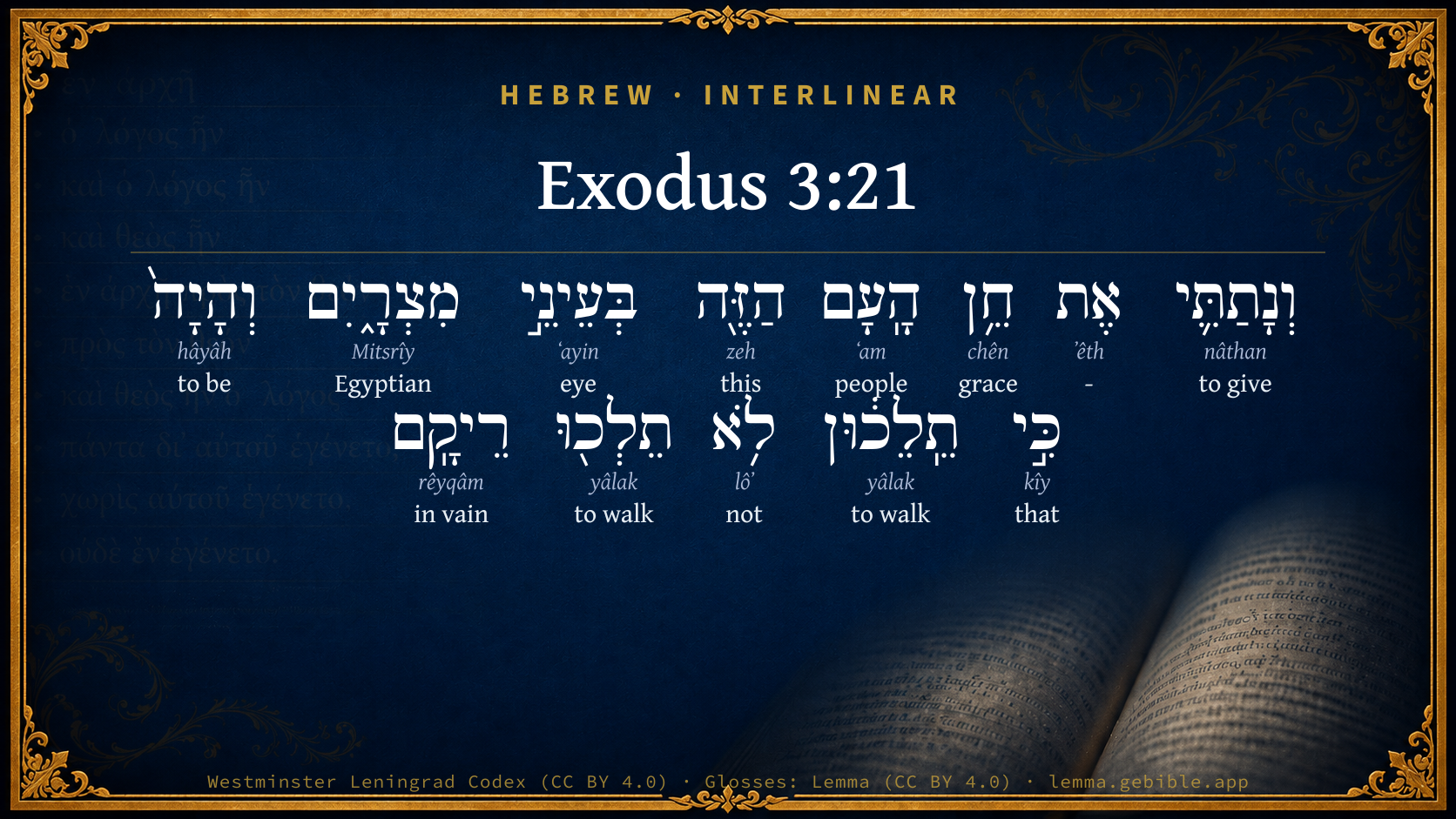
Hebrew (Westminster Leningrad Codex) Exodus 3:21 appears in the Hebrew Old Testament. The text above is from the Westminster Leningrad Codex. Each word links to its Strong’s number, a concise gloss, and parsing drawn from the Open Scriptures Hebrew Bible morphology. Click any word for its full Brown-Driver-Briggs (BDB) entry.
Download image
Cite this verse

Exodus 3:21 (World English Bible). Public Domain. Lemma interlinear Bible study tool, https://lemma.gebible.app/v/exodus/3/21.

Show BibTeX & RIS
BibTeX
RIS
English Translation
I will give this people favor in the sight of the Egyptians, and it will happen that when you go, you shall not go empty-handed.
World English Bible · Public Domain
Download a study sheet

One document with this verse’s original text, its word-by-word gloss line, the meaning frame, cross-references with their text, attributed commentary, and full source and license credits — printable, and it pastes into notes with its structure intact.

This verse Autodidact and up

Study sheet (.html) Plain text (.txt)

A passage Seminary Student

Up to 50 verses in one chapter. A passage sheet keeps up to 6 commentary sources and 12 cross-references per verse, in the order this page ranks them, and says so on the sheet whenever that leaves anything out. Ask for a single verse and you get the Autodidact verse sheet above.

Everything on this page stays free to read, with no account — the sheet is a download of what is already on screen, not access to it.

Want to remove ads? Support Godless Engineer
Compare translations 3

The same verse in 3 English versions, stacked beneath the original-language interlinear above. Click any original word for its lexicon entry.

Each is an independent rendering of the whole verse — the interlinear is not word-aligned to these translations.

Highlighted words mark where these versions differ — a whole-verse word diff, not a word-by-word alignment.

  • World English Bible Public Domain
    I will give this people favor in the sight of the Egyptians, and it will happen that when you go, you shall not go empty-handed.
  • King James Version Public Domain
    And I will give this people favor in the sight of the Egyptians: and it shall come to pass, that, when ye go, ye shall not go empty.
  • unfoldingWord Literal Text CC BY-SA 4.0
    And I shall give this people favor in the eyes of the Egyptians, and it will be that when you go, you will not go emptily.

unfoldingWord Literal Text — © unfoldingWord, licensed CC BY-SA 4.0. Word-aligned USFM3 via Door43 (git.door43.org/unfoldingWord/en_ult).

Versions to compare (up to 4)

3 of 4 selected

Show all 18 translations

Every available English version of this verse, each an independent rendering of the whole verse.

  • World English Bible Public Domain
    I will give this people favor in the sight of the Egyptians, and it will happen that when you go, you shall not go empty-handed.
  • Berean Standard Bible Public Domain
    And I will grant this people such favor in the sight of the Egyptians that when you leave, you will not go away empty-handed.
  • Majority Standard Bible Public Domain
    And I will grant this people such favor in the sight of the Egyptians that when you leave, you will not go away empty-handed.
  • King James Version Public Domain
    And I will give this people favor in the sight of the Egyptians: and it shall come to pass, that, when ye go, ye shall not go empty.
  • American Standard Version (1901) Public Domain
    And I will give this people favor in the sight of the Egyptians: and it shall come to pass, that, when ye go, ye shall not go empty.
  • Revised Version (1885) Public Domain
    And I will give this people favour in the sight of the Egyptians: and it shall come to pass, that, when ye go, ye shall not go empty:
  • Geneva Bible (1599) Public Domain
    And I will make this people to be fauoured of the Egyptians: so that when ye go, ye shall not goe emptie.
  • Douay-Rheims (1899) Public Domain
    And I will give favour to this people, in the sight of the Egyptians: and when you go forth, you shall not depart empty:
  • Young's Literal Translation Public Domain
    `And I have given the grace of this people in the eyes of the Egyptians, and it hath come to pass, when ye go, ye go not empty;
  • Literal Standard Version CC BY-SA 4.0
    And I have given the grace of this people in the eyes of the Egyptians, and it has come to pass, when you go, you do not go empty;
  • Unlocked Literal Bible CC BY-SA 4.0
    I will grant this people favor from the Egyptians, so when you leave, you will not go empty-handed.
  • unfoldingWord Literal Text CC BY-SA 4.0
    And I shall give this people favor in the eyes of the Egyptians, and it will be that when you go, you will not go emptily.
  • Darby Bible Public Domain
    And I will give this people favour in the eyes of the Egyptians, and it shall come to pass, when ye go out, that ye shall not go out empty;
  • World Messianic Bible Public Domain
    I will give this people favor in the sight of the Egyptians, and it will happen that when you go, you shall not go empty-handed.
  • Webster's Bible Public Domain
    And I will give this people favor in the sight of the Egyptians: and it shall come to pass, that when ye go, ye shall not go empty:
  • Free Bible Version CC BY-SA 4.0
    I will make the Egyptians treat you well as a people, so when you go you won't leave empty-handed.
  • Bible in Basic English Public Domain
    And I will give this people grace in the eyes of the Egyptians, so that when you go out you will go out with your hands full.
  • JPS Tanakh (1917) Public Domain
    And I will give this people favour in the sight of the Egyptians. And it shall come to pass, that, when ye go, ye shall not go empty;

Literal Standard Version (2020), Covenant Press — licensed CC BY-SA 4.0. Text via the HelloAO Bible API (eBible.org). Unlocked Literal Bible (unfoldingWord) — licensed CC BY-SA 4.0. Text via the HelloAO Bible API (eBible.org). unfoldingWord Literal Text — © unfoldingWord, licensed CC BY-SA 4.0. Word-aligned USFM3 via Door43 (git.door43.org/unfoldingWord/en_ult). Free Bible Version, Dr. Jonathan Gallagher — licensed CC BY-SA 4.0. Text via the HelloAO Bible API (eBible.org).

Word by word

More ways to search: Search by grammar → Find every occurrence → Compare this word →

Practice this passage: Drill this verse → Learn its vocabulary →

רֵיקָֽם
rêyqâm
H7387
“in vain”
Adverb
Part of Speech
Adverb
Full BDB Definition

Origin: from H7386

TWOT: 2161c

vainly, emptily - in empty condition, empty, emptily - in vain, without effect, vainly
  1. וְנָתַתִּ֛י nâthan H5414 “and · to give” Conjunction + Verb, Qal, Sequential Perfect, 1st Person, Common, Singular
  2. אֶת ʼêth H853 “-” Particle, Direct Object
  3. חֵ֥ן chên H2580 “grace of” Noun, Common, Masculine, Singular, Construct
  4. הָֽעָם ʻam H5971 “the · people” Particle, Definite Article + Noun, Common, Masculine, Singular, Absolute
  5. הַזֶּ֖ה zeh H2088 “the · this” Particle, Definite Article + Pronoun, Demonstrative, Masculine, Singular
  6. בְּעֵינֵ֣י ʻayin H5869 “in/at · eyes of” Preposition + Noun, Common, Both, Dual, Construct
  7. מִצְרָ֑יִם Mitsrîy H4713 “Egyptian” Noun, Proper
  8. וְהָיָה֙ hâyâh H1961 “and · to be” Conjunction + Verb, Qal, Sequential Perfect, 3rd Person, Masculine, Singular
  9. כִּ֣י kîy H3588 “that” Conjunction
  10. תֵֽלֵכ֔וּן yâlak H3212 “to walk” Verb, Qal, Imperfect, 2nd Person, Masculine, Plural + Suffix, n
  11. לֹ֥א lôʼ H3808 “not” Particle, Negative
  12. תֵלְכ֖וּ yâlak H3212 “to walk” Verb, Qal, Imperfect, 2nd Person, Masculine, Plural

About this verse

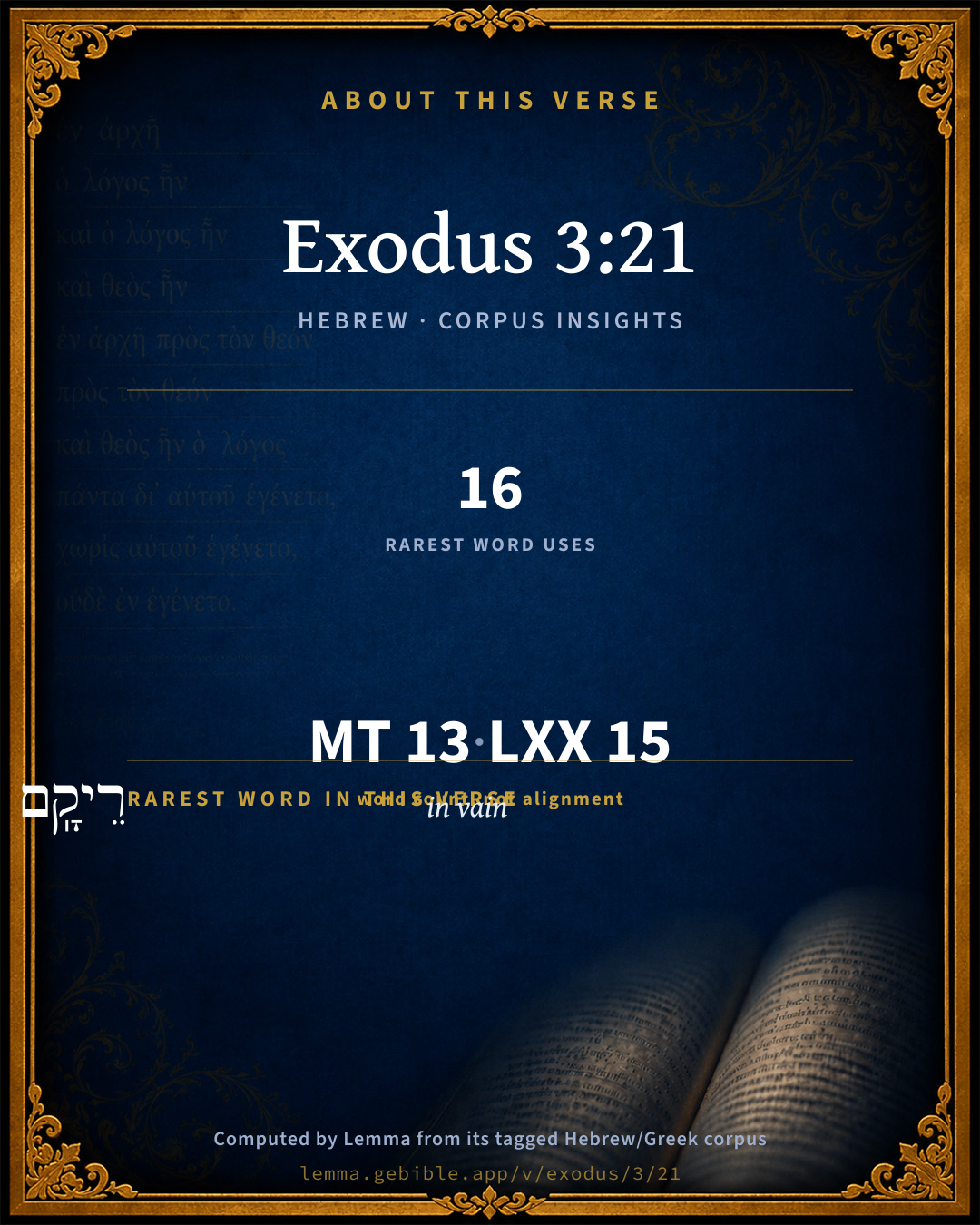
These counts appear in no published source. They are computed here, from the morphology-tagged text and Lemma’s own curated glosses. What Lemma adds →

13
words
12
distinct lemmas
Pentateuch
section

Notable vocabulary

The rarest word here is רֵיקָֽם in vain H7387 — appearing just 16 times in the whole Hebrew Bible.

Shared distinctive vocabulary

רֵיקָֽם in vain H7387 occurs in 16 verses of the Hebrew Bible. Also found in:

Grammatical profile

  • 4 verbs
  • 4 nouns
  • 1 pronoun
  • 1 conjunction
  • 1 adverb
  • 2 particles

Verb forms

  • וְנָתַתִּ֛י Qal · Sequential Perfect
  • וְהָיָה֙ Qal · Sequential Perfect
  • תֵֽלֵכ֔וּן Qal · Imperfect
  • תֵלְכ֖וּ Qal · Imperfect

Repetition

A word recurs within this verse — often emphatic in Hebrew:

  • תֵֽלֵכ֔וּן to walk H3212 ×2

Hebrew & Septuagint length

In English translation the verse runs 25 words from the Hebrew and 23 from the Septuagint (LXX English) — closely comparable.

A rough comparison of the two English renderings, which tokenize alike — not a word-level alignment.

Word counts can differ between the Hebrew and the Greek without any difference in meaning — e.g. the Hebrew direct-object marker אֵת has no separate Greek word, and Greek often adds the article ὁ.

In the original languages it is 13 Hebrew tokens and 15 Greek tokens — but the two are counted differently (Hebrew bundles its prefixes and suffixes into one token; the Greek is in lemma form), so that isn’t a like-for-like length.

Cross-references

8

Topical passages linked to Exodus 3:21 in the Treasury of Scripture Knowledge — connected by theme and wording, ordered by reader-vote popularity; previews shown in the World English Bible.

  • Exodus 12:36 Yahweh gave the people favor in the sight of the Egyptians, so that they let them have what they asked. They despoiled the Egyptians.
  • Exodus 11:3 Yahweh gave the people favor in the sight of the Egyptians. Moreover the man Moses was very great in the land of Egypt, in the sight of Pharaoh's servants, and in the sight of the people.
  • Psalms 105:37 He brought them forth with silver and gold. There was not one feeble person among his tribes.
  • Proverbs 16:7 When a man's ways please Yahweh, He makes even his enemies to be at peace with him.
  • Psalms 106:46 He made them also to be pitied By all those who carried them captive.
  • Genesis 39:21 But Yahweh was with Joseph, and showed kindness to him, and gave him favor in the sight of the keeper of the prison.
  • Acts 7:10 and delivered him out of all his afflictions, and gave him favor and wisdom before Pharaoh, king of Egypt. He made him governor over Egypt and all his house.
  • Nehemiah 1:11 Lord, I beg you, let now your ear be attentive to the prayer of your servant, and to the prayer of your servants, who delight to fear your name; and please prosper your servant this day, and grant him mercy in the sight of this man. Now I was cup bearer to the king.

Cross-references courtesy of OpenBible.info (CC BY 4.0).

Hebrew and Greek witnesses Masoretic Hebrew ↔ Greek Septuagint

The same verse in the two great witnesses to the Old Testament, shown verse-for-verse.

These are two independent witnesses, not word-aligned to each other, and the Septuagint is shown in lemma (dictionary) form.

Hebrew Exodus 3:21 Masoretic · Westminster Leningrad Codex

וְנָתַתִּ֛י אֶת חֵ֥ן הָֽעָם הַזֶּ֖ה בְּעֵינֵ֣י מִצְרָ֑יִם וְהָיָה֙ כִּ֣י תֵֽלֵכ֔וּן לֹ֥א תֵלְכ֖וּ רֵיקָֽם

I will give this people favor in the sight of the Egyptians, and it will happen that when you go, you shall not go empty-handed.

World English Bible · Public Domain

Greek LXX Exodus 3:21 Septuagint · lemma form

καί δίδωμι χάρις ὁ λαός οὗτος ἐναντίον ὁ αἰγύπτιος ὅταν δέ ἀποτρέχω οὐ ἀποἔρχομαι κενός

And I will give this people favor in the sight of the Egyptians, and whenever you⌃ shall escape, you⌃ shall not depart empty.

LXX2012 (modern English Septuagint) · Public Domain

On this verse, Keil & Delitzsch discusses the Septuagint’s reading. Read the note in Commentary ↓

Hebrew: Westminster Leningrad Codex (CC BY 4.0). Greek: Septuagint (public domain); English from LXX2012 (modern English Septuagint) (Public Domain). How the Septuagint differs from the Hebrew →

Targum (Aramaic paraphrase)

2

The Targum is the ancient Jewish Aramaic paraphrase of the Hebrew Scriptures — an interpretive translation, not the Hebrew text itself. Onkelos (literal) and Pseudo-Jonathan (expansive) render the Torah, and Jonathan the Prophets. Coverage is partial: where no permissively-licensed English translation exists for a verse, only the Aramaic is shown. This is verse-level text, not a word-by-word alignment to the Hebrew.

  1. Targum Onkelos Torah (Genesis–Deuteronomy)
    וְאֶתֵּן יָת עַמָא הָדֵין לְרַחֲמִין בְּעֵינֵי מִצְרָאֵי וִיהֵי אֲרֵי תְהָכוּן לָא תְהָכוּן רֵיקָנִין:

    (no public-domain English translation for this verse)

    Targum Onkelos — Aramaic: “Onkelos Genesis” (public domain); “Onkelos Exodus” (public domain); “Onkelos Leviticus” (public domain); “Onkelos Numbers” (public domain); “Onkelos Deuteronomy” (public domain). English: “Sefaria Community Translation” (CC0 1.0 (public-domain dedication)); “J.W. Etheridge. The Targums of Onkelos and Jonathan Ben Uzziel on the Pentateuch. London: Longmans, Green, 1862” (public domain). Text via Sefaria.

  2. Targum Pseudo-Jonathan Torah (Genesis–Deuteronomy)
    וְאֶתֵּן יַת עַמָא הָדֵין לְרַחֲמִין בְּעֵינֵי מִצְרָאֵי וִיהֵי אֲרוּם תַּחֲכוּן מִן תַּמָן פְּרוּקִין לָא תַהֲכוּן רֵיקָנִין

    And I will give this people grace in the eyes of the Mizraee; and it shall be that when ye go free from thence, ye shall not go empty.

    Targum Pseudo-Jonathan — Aramaic: “Targum Jonathan on Genesis” (public domain); “Targum Jonathan on Exodus” (public domain); “Targum Jonathan on Leviticus” (public domain); “Targum Jonathan on Numbers” (public domain); “Targum Jonathan on Deuteronomy” (public domain). English: “The Targum of Jonathan ben Uzziel, trans. J. W. Etheridge, London, 1862” (public domain). Text via Sefaria.

Commentary

Notes on Exodus 3:21 from classic Christian and Jewish commentators (each source and its license shown beneath its notes). The classic Christian expositions comment on the surrounding passage and are grouped to its opening verse, so a note may address several verses; the Jewish commentaries on the Tanakh (Rashi and others) are per-verse, so they appear only where the commentator wrote on this verse.

Lemma curates 59 commentaries, every one of them public domain or Creative Commons licensed, each selected and text-cleaned for this edition rather than reprinted as found. About our sources →

Trapp's Complete Commentary

John Trapp

Exo 3:21 And I will give this people favour in the sight of the Egyptians: and it shall come to pass, that, when ye go, ye shall not go empty:

Ver. 21. I will give this people favour.] It is God that fashioneth men’s spirits, and speaketh ofttimes for them in the hearts of their greatest enemies.

John Trapp, A Commentary or Exposition upon All the Books of the Old and New Testament (1647–1656) — public domain. Text from a community e-Sword module.

Keil & Delitzsch

C. F. Keil & F. Delitzsch

Not only would God compel Pharaoh to let Israel go; He would not let His people go out empty, but, according to the promise in Gen 15:14, with great substance. "I will give this people favour in the eyes of the Egyptians;" that is to say, the Egyptians should be so favourably disposed towards them, that when they solicited of their neighbours clothes and ornaments of gold and silver, their request should be granted. "So shall ye spoil the Egyptians." What is here foretold as a promise, the Israelites are directed to do in Exo 11:2-3; and according to Exo 12:35-36, it was really carried out. Immediately before their departure from Egypt, the Israelites asked (ישׁאלוּ) the Egyptians for gold and silver ornaments (כּלים not vessels, either for sacrifice, the house, or the table, but jewels; cf. Gen 24:53; Exo 35:22; Num 31:50) and clothes; and God gave them favour in the eyes of the Egyptians, so that they gave them to them. For אשּׁה שׁאלה, "Let every woman ask of her (female) neighbour and of her that sojourneth in her house" (בּיתהּ גּרת, from which it is evident that the Israelites did not live apart, but along with the Egyptians), we find in Exo 11:2, "Let every man ask of his neighbour, and every woman of her (female) neighbour." - ושׂמתּם, "and put them upon your sons and daughters." על שׂוּם, to put on, applied to clothes and ornaments in Lev 8:8 and Gen 41:42. This command and its execution have frequently given occasion to the opponents of the Scriptures to throw contempt upon the word of God, the asking being regarded as borrowing, and the spoiling of the Egyptians as purloining. At the same time, the attempts made to vindicate this purloining from the wickedness of stealing have been in many respects unsatisfactory.

(Note: For the different views as to the supposed borrowing of the gold and silver vessels, see Hengstenberg, Dissertations on the Pentateuch, vol. ii. pp. 419ff., and Kurtz, History of the Old Covenant, vol. ii. 319ff.)

But the only meaning of שׁאל is to ask or beg,

(Note: Even in Kg2 5:6; see my commentary on the passage.)

and השׁאיל, which is only met with in Exo 12:36 and Sa1 1:28, does not mean to lend, but to suffer to ask, to hear and grant a request. ישׁאלוּם (Exo 12:36), lit., they allowed them to ask; i.e., "the Egyptians did not turn away the petitioners, as not wanting to listen to them, but received their petition with good-will, and granted their request. No proof can be brought that השׁאיל means to lend, as is commonly supposed; the word occurs again in Sa1 1:28, and there it means to grant or give" (Knobel on Exo 12:36). Moreover the circumstances under which the שׁאל and השׁאיל took place, were quite at variance with the idea of borrowing and lending. For even if Moses had not spoken without reserve of the entire departure of the Israelites, the plagues which followed one after another, and with which the God of the Hebrews gave emphasis to His demand as addressed through Moses to Pharaoh, "Let My people go, that they may serve Me," must have made it evident to every Egyptian, that all this had reference to something greater than a three days' march to celebrate a festival. And under these circumstances no Egyptian could have cherished the thought, that the Israelites were only borrowing the jewels they asked of them, and would return them after the festival. What they gave under such circumstances, they could only give or present without the slightest prospect of restoration. Still less could the Israelites have had merely the thought of borrowing in their mind, seeing that God had said to Moses, "I will give the Israelites favour in the eyes of the Egyptians; and it will come to pass, that when ye go out, ye shall not go out empty" (Exo 3:21). If, therefore, it is "natural to suppose that these jewels were festal vessels with which the Egyptians furnished the poor Israelites for the intended feast," and even if "the Israelites had their thoughts directed with all seriousness to the feast which they were about to celebrate to Jehovah in the desert" (Baumgarten); their request to the Egyptians cannot have referred to any borrowing, nor have presupposed any intention to restore what they received on their return. From the very first the Israelites asked without intending to restore, and the Egyptians granted their request without any hope of receiving back, because God had made their hearts favourably disposed to the Israelites. The expressions את־מצרים נצּלתּם in Exo 3:22, and וינצּלוּ in Exo 12:36, are not at variance with this, but rather require it. For נצל does not mean to purloin, to steal, to take away secretly by cunning and fraud, but to plunder (Ch2 20:25), as both the lxx (σκυλεύειν) and Vulgate (spoliare) have rendered it. Rosenmller, therefore, is correct in his explanation: "Et spoliabitis Aegyptios, ita ut ab Aegyptiis, qui vos tam dura servitute oppresserunt, spolia auferetis." So also is Hengstenberg, who says, "The author represents the Israelites as going forth, laden as it were with the spoils of their formidable enemy, trophies of the victory which God's power had bestowed on their weakness. While he represents the gifts of the Egyptians as spoils which God had distributed to His host (as Israel is called in Exo 12:41), he leads us to observe that the bestowment of these gifts, which outwardly appeared to be the effect of the good-will of the Egyptians, if viewed more deeply, proceeded from another Giver; that the outwardly free act of the Egyptians was effected by an inward divine constraint which they could not withstand" (Dissertations, vol. ii. p. 431). - Egypt had spoiled Israel by the tributary labour so unjustly enforced, and now Israel carried off the spoil of Egypt-a prelude to the victory which the people of God will one day obtain in their conflict with the power of the world (cf. Zac 14:14).

Keil & Delitzsch — Biblical Commentary on the Old Testament (1861–1891) — public domain (CC PDM 1.0). Text via the HelloAO Bible API. (Old Testament only.)

The Cambridge Bible for Schools and Colleges

gen. ed. J. J. S. Perowne

21–22. Not only will the Egyptians then let the Israelites go, but God will give them favour in the eyes of the Egyptians, and they will bestow many valuables upon them. The verses, it is evident, must belong to the narrator who regards the Israelites as settled among the Egyptians themselves (i.e. E), not to J, who (see on Exo_8:22) represents them as living apart in the land of Goshen.

The Cambridge Bible for Schools and Colleges (gen. ed. J. J. S. Perowne; Cambridge University Press, 1878–1918) — public domain. Text from a community e-Sword module.

John Gill's Exposition

And I will give this people favour in the sight of the Egyptians,.... That is, give the Israelites favour in their sight, a little before their departure, who should be ready to do anything for them, or bestow anything upon them; or however lend them what they would desire, being glad to be at peace with them, or get rid of them, for whose sakes they would perceive all those sore calamities came upon them, they were distressed with:

and it shall come to pass, that when ye go, ye shall not go empty; destitute of what was necessary for them, but even with great substance, as was foretold by Abraham they should, and which prophecy was now about to be fulfilled, Gen 15:14.

John Gill's Exposition of the Whole Bible (1746–1763) — public domain (CC PDM 1.0). Text via the HelloAO Bible API.

Haydock's Catholic Bible Commentary

Egyptians, among whom the Hebrews were forced to live, not being now allowed to enjoy the fertile country of Gessen alone, according to Joseph’s disposition. The subsequent kings altered that wise regulation. (Haydock)

George Leo Haydock (1774–1849), Haydock's Catholic Family Bible and Commentary, 1859 edition — public domain. Excludes Psalms (Douay-Rheims chapter numbering differs from Protestant) and Deuterocanonical books (Catholic canon only).

Matthew Poole's English Annotations

I will give this people favour, so that they shall readily grant what the Israelites desire. See Exo 12:36.

Matthew Poole's English Annotations on the Holy Bible (1683–1685) — public domain. Text from a community e-Sword/MySword module.

The Pulpit Commentary

Vers. 21, 22. The "spoiling of the Egyptians" has called forth much bitter comment. (See Kalisch, note on Exo_3:22) It has been termed a combination of "fraud, deception and theft deceit and nefarious fraud villainy," and the like. The unfortunate translation of a verb meaning "ask" by "borrow" in ver. 22, has greatly helped the objectors. In reality, what God here commanded and declared was this: The Israelite women were told on the eve of their departure from Egypt to ask presents (bakh-sheesh) from their rich Egyptian neighbours, as a contribution to the necessary expenses of the long journey on which they were entering; and God promised that he would so favourably incline the hearts of these neighbours towards them, that, in reply to their request, articles of silver and of gold, together with raiment, would be freely and bounteously bestowed on them so freely and so bounteously, that they might clothe and adorn, not only themselves, but their sons and daughters, with the presents; and the entire result would be that, instead of quitting Egypt like a nation of slaves, in rags and penniless, they would go forth in the guise of an army of conquerors, laden with the good things of the country, having (with their own good-will) "spoiled the Egyptians." No fraud, no deceit, was to be practised the Egyptians perfectly well understood that, if the Israelites once went, they would never voluntarily return they were asked to give and they gave with the result that Egypt was "spoiled." Divine justice sees in this a rightful nemesis. Oppressed, wronged, down-trodden, miserably paid for their hard labour during centuries, the Israelites were to obtain at the last something like a compensation for their ill-usage; the riches of Africa were to be showered on them. Egypt, "glad at their departing," was to build them a bridge of gold to expedite their flight, and to despoil herself in order to enrich her quondam slaves, of whom she was, under the circumstances, delighted to be rid. Vers. 21, 22. God brings good out of evil.

Had Pharaoh yielded at the first, the Egyptians would have seen the departure of Israel with regret, and would have in no way facilitated it. The opposition of the king and court, the long struggle, the ill-usage of the Israelites by the monarch who so often promised to release them, and so often retracted his word, awoke a sympathy with the Israelites, and an interest in them, which would have been altogether lacking had there been no. Opposition, no struggle, no ill-usage. Again, the plagues, especially the last, thoroughly alarmed the Egyptians, and made them anxious to be quit of such dangerous neighbours. "Egypt was glad of their departing, for they were afraid of them". (Psa_105:38) But for Pharaoh"s obduracy the plagues would not have been sent; and but for the plagues the departing Israelites would not have been looked upon by the Egyptians with the "favour" which led to their going out laden with gifts. Thus Pharaoh"s stubbornness, though it led to their sufferings being prolonged, led also to their final triumphant exit, as spoilers, not as spoiled, laden with the good things of Egypt, "jewels of silver and jewels of gold," and rich apparel, the best that the Egyptians had to offer. History presents an infinitude of similar cases, where the greatest advantages have been the result of oppression and wrong. Extreme tyranny constantly leads to the assertion of freedom; anarchy to the firm establishment of law; defeat and ill-usage by a conqueror to the moral recovery of a declining race or nation. Each man"s experience will tell him of the good that has arisen to him individually from sickness, from disappointment, from bereavement, from what-seemed at the time wholly evil. God brings good out of evil in a thousand marvellous ways; at one time by turning the hearts of oppressors, at another by raising the tone and spirit of the oppressed; now by letting evil run riot until it produces general disgust, anon by making use of adverse circumstances to train a champion and deliverer. Countless are the evidences that God causes evil to work towards good; uses it as an instrument-evolves his own purposes, in part, by its means, vindicating thus his absolute lordship over all, and showing that evil itself, though it fight against him, cannot thwart him.

The Pulpit Commentary (1880–1919), ed. H.D.M. Spence-Jones & Joseph S. Exell — public domain. Text from a community e-Sword module.

Lesson kit

Teaching starters — assembled from the data on this page, not authored interpretation. Every prompt links to the verse data it draws on. Edit before teaching.

Exodus, in the Pentateuch, opens this verse with 13 words (12 distinct Hebrew lemmas). Its most distinctive word is rêyqâm (“in vain”). A historical commentator’s framing appears above. Read the whole chapter for the surrounding context.

Discussion questions

  1. How does “in vain” (rêyqâm) shape what this verse is saying?
  2. Genesis 31:42 shares the word «in vain» with this verse. How do the two illuminate each other?
  3. “to walk” occurs 2× in this one verse. What is the effect of the repetition?
  4. These translations render this verse differently; the difference is in the English rendering, not the original. What questions does that raise?
  5. The verb «וְנָתַתִּ֛י» is Qal Sequential Perfect. How does its form color the action?
  6. Reading how Trapp's Complete Commentary and Keil & Delitzsch read this verse, where do the two commentators agree and where do they part?

Things to notice

Reading settings

Reading text

Shown beneath each verse's original-language words.

Old Testament
Old Testament edition

Read the OT as the Masoretic Hebrew (MT) or the Greek Septuagint (LXX).

English shown for the Greek Septuagint (in the Hebrew ↔ Greek comparison).

Comparing translations? Open the Compare panel on any verse page to stack up to four side by side.