
1 Samuel 6:5

Hebrew (Westminster Leningrad Codex) 1 Samuel 6:5 appears in the Hebrew Old Testament. The text above is from the Westminster Leningrad Codex. Each word links to its Strong’s number, a concise gloss, and parsing drawn from the Open Scriptures Hebrew Bible morphology. Click any word for its full Brown-Driver-Briggs (BDB) entry.
Download image
Cite this verse

1 Samuel 6:5 (World English Bible). Public Domain. Lemma interlinear Bible study tool, https://lemma.gebible.app/v/1-samuel/6/5.

Show BibTeX & RIS
BibTeX
RIS
English Translation
Therefore you shall make images of your tumors, and images of your mice that mar the land; and you shall give glory to the God of Israel: peradventure he will lighten his hand from off you, and from off your gods, and from off your land.
World English Bible · Public Domain
Download a study sheet

One document with this verse’s original text, its word-by-word gloss line, the meaning frame, cross-references with their text, attributed commentary, and full source and license credits — printable, and it pastes into notes with its structure intact.

This verse Autodidact and up

Study sheet (.html) Plain text (.txt)

A passage Seminary Student

Up to 50 verses in one chapter. A passage sheet keeps up to 6 commentary sources and 12 cross-references per verse, in the order this page ranks them, and says so on the sheet whenever that leaves anything out. Ask for a single verse and you get the Autodidact verse sheet above.

Everything on this page stays free to read, with no account — the sheet is a download of what is already on screen, not access to it.

Want to remove ads? Support Godless Engineer
Compare translations 3

The same verse in 3 English versions, stacked beneath the original-language interlinear above. Click any original word for its lexicon entry.

Each is an independent rendering of the whole verse — the interlinear is not word-aligned to these translations.

Highlighted words mark where these versions differ — a whole-verse word diff, not a word-by-word alignment.

  • World English Bible Public Domain
    Therefore you shall make images of your tumors, and images of your mice that mar the land; and you shall give glory to the God of Israel: peradventure he will lighten his hand from off you, and from off your gods, and from off your land.
  • King James Version Public Domain
    Wherefore ye shall make images of your emerods, and images of your mice that mar the land; and ye shall give glory unto the God of Israel: peradventure he will lighten his hand from off you, and from off your gods, and from off your land.
  • unfoldingWord Literal Text CC BY-SA 4.0
    And you shall make images of your tumors and images of your mice, the ones destroying the land, and you shall give glory to the God of Israel. Perhaps he will lighten his hand from upon you and from upon your gods and from upon your land.

unfoldingWord Literal Text — © unfoldingWord, licensed CC BY-SA 4.0. Word-aligned USFM3 via Door43 (git.door43.org/unfoldingWord/en_ult).

Versions to compare (up to 4)

3 of 4 selected

Show all 18 translations

Every available English version of this verse, each an independent rendering of the whole verse.

  • World English Bible Public Domain
    Therefore you shall make images of your tumors, and images of your mice that mar the land; and you shall give glory to the God of Israel: peradventure he will lighten his hand from off you, and from off your gods, and from off your land.
  • Berean Standard Bible Public Domain
    Make images of your tumors and of the rats that are ravaging the land. Give glory to the God of Israel, and perhaps He will lift His hand from you and your gods and your land.
  • Majority Standard Bible Public Domain
    Make images of your tumors and of the rats that are ravaging the land. Give glory to the God of Israel, and perhaps He will lift His hand from you and your gods and your land.
  • King James Version Public Domain
    Wherefore ye shall make images of your emerods, and images of your mice that mar the land; and ye shall give glory unto the God of Israel: peradventure he will lighten his hand from off you, and from off your gods, and from off your land.
  • American Standard Version (1901) Public Domain
    Wherefore ye shall make images of your tumors, and images of your mice that mar the land; and ye shall give glory unto the God of Israel: peradventure he will lighten his hand from off you, and from off your gods, and from off your land.
  • Revised Version (1885) Public Domain
    Wherefore ye shall make images of your tumours, and images of your mice that mar the land; and ye shall give glory unto the God of Israel: peradventure he will lighten his hand from off you, and from off your gods, and from off your land:
  • Geneva Bible (1599) Public Domain
    Wherefore ye shall make the similitudes of your emerods, and the similitudes of your mise that destroy the land: so ye shall giue glory vnto the God of Israel, that he may take his hand from you, and from your gods, and from your land.
  • Douay-Rheims (1899) Public Domain
    According to the number of the provinces of the Philistines you shall make five golden emerods, and five golden mice: for the same plague hath been upon you all, and upon your lords. And you shall make the likeness of your emerods, and the likeness of the mice that have destroyed the land, and you shall give glory to the God of Israel: to see if he will take off his hand from you, and from your gods, and from your land.
  • Young's Literal Translation Public Domain
    and ye have made images of your emerods, and images of your mice that are corrupting the land, and have given honour to the God of Israel; it may be He doth lighten His hand from off you, and from off your gods, and from off your land;
  • Literal Standard Version CC BY-SA 4.0
    and you have made images of your lumps, and images of your muroids that are corrupting the land, and have given glory to the God of Israel; it may be [that] He lightens His hand from off you, and from off your gods, and from off your land;
  • Unlocked Literal Bible CC BY-SA 4.0
    So you must make models of your tumors, and models of your mice that ravage the land, and give glory to the God of Israel. Perhaps he will lift his hand from you, from your gods, and from your land.
  • unfoldingWord Literal Text CC BY-SA 4.0
    And you shall make images of your tumors and images of your mice, the ones destroying the land, and you shall give glory to the God of Israel. Perhaps he will lighten his hand from upon you and from upon your gods and from upon your land.
  • Darby Bible Public Domain
    And ye shall make images of your hemorrhoids, and images of your mice that destroy the land, and give glory to the God of Israel: perhaps he will lighten his hand from off you, and from off your gods, and from off your land.
  • World Messianic Bible Public Domain
    Therefore you shall make images of your tumors and images of your mice that mar the land; and you shall give glory to the God of Israel. Perhaps he will release his hand from you, from your gods, and from your land.
  • Webster's Bible Public Domain
    Wherefore ye shall make images of your emerods, and images of your mice that mar the land; and ye shall give glory to the God of Israel: it may be he will lighten his hand from off you, and from off your gods, and from off your land.
  • Free Bible Version CC BY-SA 4.0
    Make models to represent your swellings and the rats destroying the country, and honor the God of Israel. Perhaps he will stop punishing you, your gods, and your land.
  • Bible in Basic English Public Domain
    So make images of the growths caused by your disease and of the mice which are damaging your land; and give glory to the God of Israel: it may be that the weight of his hand will be lifted from you and from your gods and from your land.
  • JPS Tanakh (1917) Public Domain
    Wherefore ye shall make images of your emerods, and images of your mice that mar the land; and ye shall give glory unto the God of Israel; peradventure He will lighten His hand from off you, and from off your gods, and from off your land.

Literal Standard Version (2020), Covenant Press — licensed CC BY-SA 4.0. Text via the HelloAO Bible API (eBible.org). Unlocked Literal Bible (unfoldingWord) — licensed CC BY-SA 4.0. Text via the HelloAO Bible API (eBible.org). unfoldingWord Literal Text — © unfoldingWord, licensed CC BY-SA 4.0. Word-aligned USFM3 via Door43 (git.door43.org/unfoldingWord/en_ult). Free Bible Version, Dr. Jonathan Gallagher — licensed CC BY-SA 4.0. Text via the HelloAO Bible API (eBible.org).

Word by word

More ways to search: Search by grammar → Find every occurrence → Compare this word →

Practice this passage: Drill this verse → Learn its vocabulary →

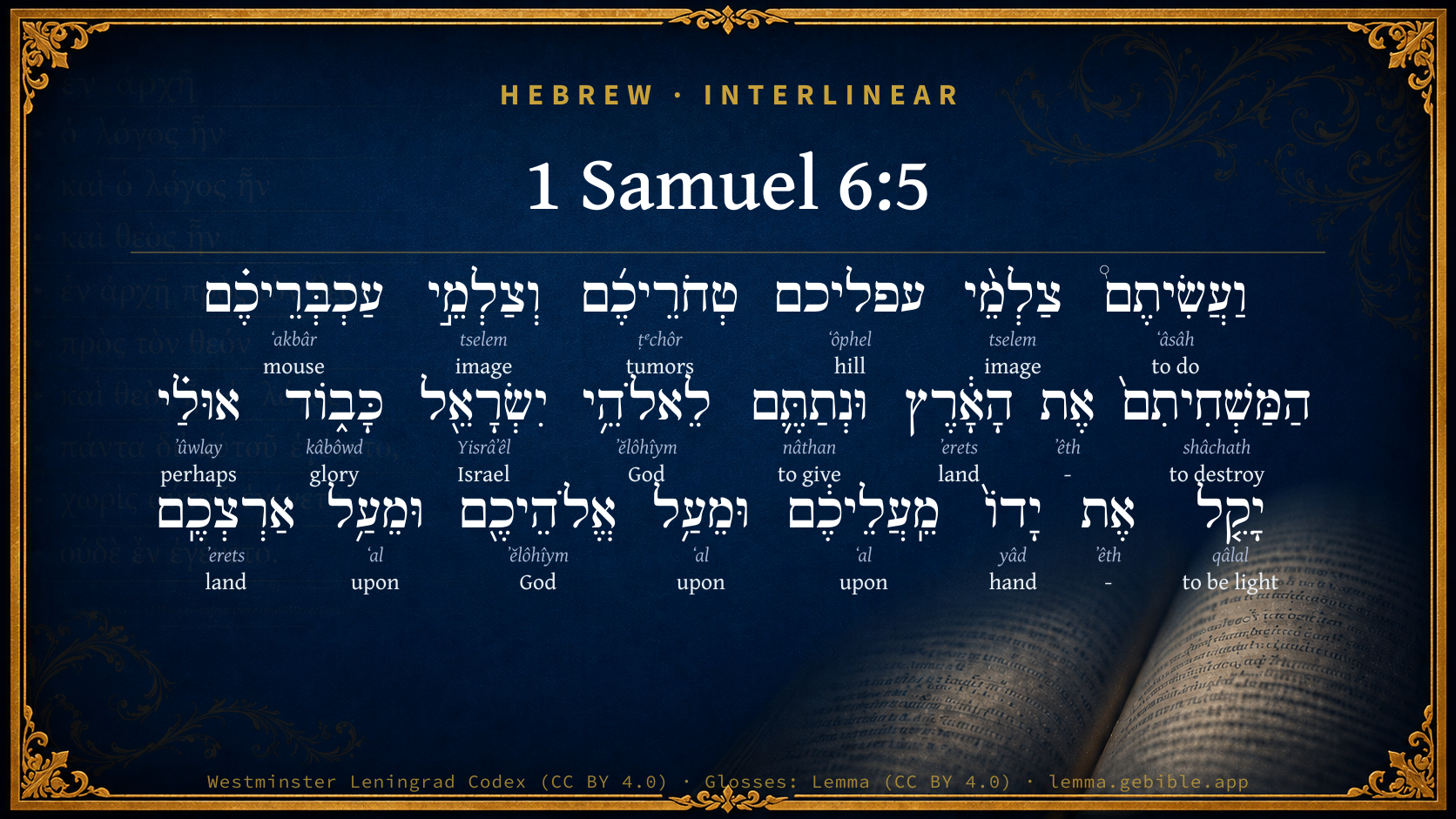
עַכְבְּרֵיכֶ֗ם
ʻakbâr
H5909
“mice · your”
Noun, Common, Masculine, Plural, Construct + Suffix, Personal, 2nd Person, Masculine, Plural
Part of Speech
Noun
Type
Common
Gender
Masculine
Number
Plural
State
Construct
Full BDB Definition

Origin: probably from the same as H5908 in the secondary sense of attacking

TWOT: 1618

mouse
  1. וַעֲשִׂיתֶם֩ ʻâsâh H6213 “and · to do” Conjunction + Verb, Qal, Sequential Perfect, 2nd Person, Masculine, Plural
  2. צַלְמֵ֨י tselem H6754 “images of” Noun, Common, Masculine, Plural, Construct
  3. עפליכם ʻôphel H6076 “tumors · your” Noun, Common, Masculine, Plural, Construct + Suffix, Personal, 2nd Person, Masculine, Plural
  4. טְחֹרֵיכֶ֜ם ṭᵉchôr H2914 “tumors · your” Noun, Common, Masculine, Plural, Construct + Suffix, Personal, 2nd Person, Masculine, Plural
  5. וְצַלְמֵ֣י tselem H6754 “and · images of” Conjunction + Noun, Common, Masculine, Plural, Construct
  6. הַמַּשְׁחִיתִם֙ shâchath H7843 “the · destroying” Particle, Definite Article + Verb, Hiphil, Participle Active, Masculine, Plural, Absolute
  7. אֶת ʼêth H853 “-” Particle, Direct Object
  8. הָאָ֔רֶץ ʼerets H776 “the · land” Particle, Definite Article + Noun, Common, Both, Singular, Absolute
  9. וּנְתַתֶּ֛ם nâthan H5414 “and · to give” Conjunction + Verb, Qal, Sequential Perfect, 2nd Person, Masculine, Plural
  10. לֵאלֹהֵ֥י ʼĕlôhîym H430 “to/for · God(s) of” Preposition + Noun, Common, Masculine, Plural, Construct
  11. יִשְׂרָאֵ֖ל Yisrâʼêl H3478 “Israel” Noun, Proper
  12. כָּב֑וֹד kâbôwd H3519 “glory” Noun, Common, Both, Singular, Absolute
  13. אוּלַ֗י ʼûwlay H194 “perhaps” Adverb
  14. יָקֵ֤ל qâlal H7043 “to be light” Verb, Hiphil, Imperfect, 3rd Person, Masculine, Singular
  15. אֶת ʼêth H853 “-” Particle, Direct Object
  16. יָדוֹ֙ yâd H3027 “hand · his” Noun, Common, Both, Singular, Construct + Suffix, Personal, 3rd Person, Masculine, Singular
  17. מֵֽעֲלֵיכֶ֔ם ʻal H5921 “from · upon · you” Preposition + Preposition + Suffix, Personal, 2nd Person, Masculine, Plural
  18. וּמֵעַ֥ל ʻal H5921 “and · from · upon” Conjunction + Preposition + Preposition
  19. אֱלֹהֵיכֶ֖ם ʼĕlôhîym H430 “God(s) · your” Noun, Common, Masculine, Plural, Construct + Suffix, Personal, 2nd Person, Masculine, Plural
  20. וּמֵעַ֥ל ʻal H5921 “and · from · upon” Conjunction + Preposition + Preposition
  21. אַרְצְכֶֽם ʼerets H776 “land · your” Noun, Common, Both, Singular, Construct + Suffix, Personal, 2nd Person, Masculine, Plural

About this verse

These counts appear in no published source. They are computed here, from the morphology-tagged text and Lemma’s own curated glosses. What Lemma adds →

22
words
16
distinct lemmas
Historical
section

Notable vocabulary

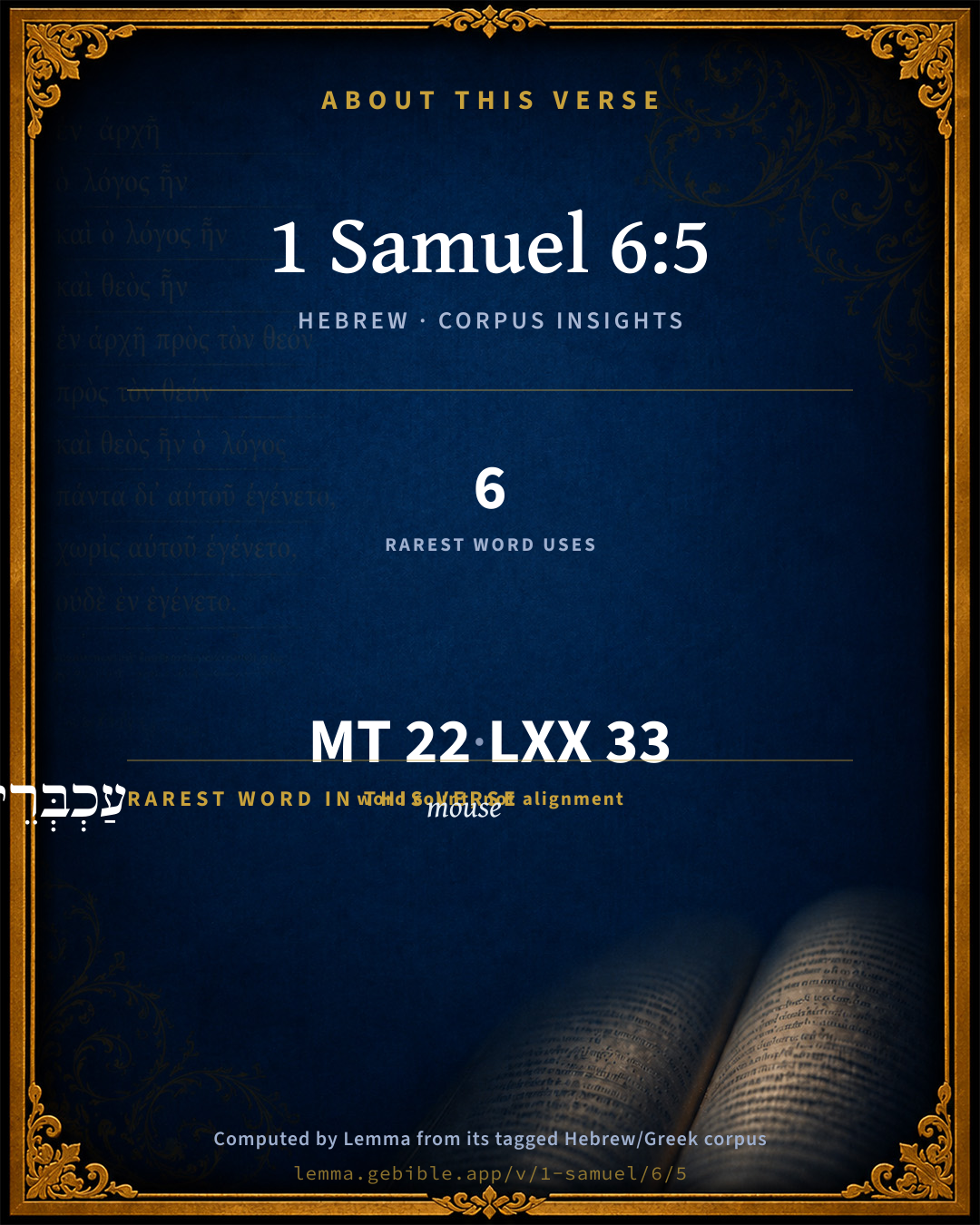
The rarest word here is עַכְבְּרֵיכֶ֗ם mouse H5909 — appearing just 6 times in the whole Hebrew Bible.

Shared distinctive vocabulary

עַכְבְּרֵיכֶ֗ם mouse H5909 occurs in 6 verses of the Hebrew Bible. Also found in:

Grammatical profile

  • 4 verbs
  • 12 nouns
  • 3 prepositions
  • 1 adverb
  • 2 particles

Verb forms

  • וַעֲשִׂיתֶם֩ Qal · Sequential Perfect
  • הַמַּשְׁחִיתִם֙ Hiphil · Participle Active
  • וּנְתַתֶּ֛ם Qal · Sequential Perfect
  • יָקֵ֤ל Hiphil · Imperfect

Repetition

Words recur within this verse — often emphatic in Hebrew:

  • מֵֽעֲלֵיכֶ֔ם upon H5921 ×3
  • צַלְמֵ֨י image H6754 ×2
  • הָאָ֔רֶץ land H776 ×2
  • לֵאלֹהֵ֥י God H430 ×2

Hebrew & Septuagint length

In English translation the verse runs 46 words from the Hebrew and 66 from the Septuagint (LXX English) — the Septuagint runs noticeably longer here. See the side-by-side →

A rough comparison of the two English renderings, which tokenize alike — not a word-level alignment.

Word counts can differ between the Hebrew and the Greek without any difference in meaning — e.g. the Hebrew direct-object marker אֵת has no separate Greek word, and Greek often adds the article ὁ.

In the original languages it is 22 Hebrew tokens and 33 Greek tokens — but the two are counted differently (Hebrew bundles its prefixes and suffixes into one token; the Greek is in lemma form), so that isn’t a like-for-like length.

Cross-references

26

Topical passages linked to 1 Samuel 6:5 in the Treasury of Scripture Knowledge — connected by theme and wording, ordered by reader-vote popularity; previews shown in the World English Bible.

  • Joshua 7:19 Joshua said to Achan, My son, please give glory to Yahweh, the God of Israel, and make confession to him; and tell me now what you have done; don't hide it from me.
  • 1 Samuel 5:6–7 But the hand of Yahweh was heavy on them of Ashdod, and he destroyed them, and struck them with tumors, even Ashdod and the borders of it.
  • 1 Samuel 5:11 They sent therefore and gathered together all the lords of the Philistines, and they said, Send away the ark of the God of Israel, and let it go again to its own place, that it not kill us and our people. For there was a deadly confusion throughout all the city; the hand of God was very heavy there.
  • 1 Samuel 5:3–4 When they of Ashdod arose early on the next day, behold, Dagon was fallen on his face to the ground before the ark of Yahweh. They took Dagon, and set him in his place again.
  • Isaiah 42:12 Let them give glory to Yahweh, and declare his praise in the islands.
  • John 9:24 So they called the man who was blind a second time, and said to him, "Give glory to God. We know that this man is a sinner."
  • 1 Samuel 5:9 It was so, that after they had carried it about, the hand of Yahweh was against the city with a very great confusion: and he struck the men of the city, both small and great; and tumors broke out on them.
  • Psalms 32:4 For day and night your hand was heavy on me. My strength was sapped in the heat of summer. Selah.
  • Jeremiah 13:16 Give glory to Yahweh your God, before he cause darkness, and before your feet stumble on the dark mountains, and, while you look for light, he turn it into the shadow of death, and make it gross darkness.
  • Joel 1:4–7 What the swarming locust has left, the great locust has eaten. What the great locust has left, the grasshopper has eaten. What the grasshopper has left, the caterpillar has eaten.
  • Exodus 8:5 Yahweh said to Moses, "Tell Aaron, 'Stretch forth your hand with your rod over the rivers, over the streams, and over the pools, and cause frogs to come up on the land of Egypt.'"
  • Exodus 8:17 They did so; and Aaron stretched out his hand with his rod, and struck the dust of the earth, and there were lice on man, and on animal; all the dust of the earth became lice throughout all the land of Egypt.
  • Exodus 8:24 Yahweh did so; and there came grievous swarms of flies into the house of Pharaoh, and into his servants' houses: and in all the land of Egypt the land was corrupted by reason of the swarms of flies.
  • Exodus 10:14–15 The locusts went up over all the land of Egypt, and rested in all the borders of Egypt. They were very grievous. Before them there were no such locusts as they, neither after them shall be such.
  • Exodus 12:12 For I will go through the land of Egypt in that night, and will strike all the firstborn in the land of Egypt, both man and animal. Against all the gods of Egypt I will execute judgments: I am Yahweh.
  • Numbers 33:4 while the Egyptians were burying all their firstborn, whom Yahweh had struck among them: on their gods also Yahweh executed judgments.
  • Psalms 18:44 As soon as they hear of me they shall obey me. The foreigners shall submit themselves to me.
  • Psalms 39:10 Remove your scourge away from me. I am overcome by the blow of your hand.
  • Psalms 66:3 Tell God, "How awesome are your deeds! Through the greatness of your power, your enemies submit themselves to you.
  • Isaiah 19:1 The burden of Egypt. Behold, Yahweh rides on a swift cloud, and comes to Egypt: and the idols of Egypt shall tremble at his presence; and the heart of Egypt shall melt in the midst of it.
  • Jeremiah 3:13 Only acknowledge your iniquity, that you have transgressed against Yahweh your God, and have scattered your ways to the strangers under every green tree, and you have not obeyed my voice, says Yahweh.
  • Joel 2:25 I will restore to you the years that the swarming locust has eaten, The great locust, the grasshopper, and the caterpillar, My great army, which I sent among you.
  • Malachi 2:2 If you will not listen, and if you will not lay it to heart, to give glory to my name," says Yahweh of Hosts, "then will I send the curse on you, and I will curse your blessings. Indeed, I have cursed them already, because you do not lay it to heart.
  • Revelation 11:13 In that day there was a great earthquake, and a tenth of the city fell. Seven thousand people were killed in the earthquake, and the rest were terrified, and gave glory to the God of heaven.
  • Revelation 14:7 He said with a loud voice, "Fear the Lord, and give him glory; for the hour of his judgment has come. Worship him who made the heaven, the earth, the sea, and the springs of waters!"
  • Revelation 16:9 People were scorched with great heat, and people blasphemed the name of God who has the power over these plagues. They didn't repent and give him glory.

Cross-references courtesy of OpenBible.info (CC BY 4.0).

Hebrew and Greek witnesses Masoretic Hebrew ↔ Greek Septuagint

The same verse in the two great witnesses to the Old Testament, shown verse-for-verse.

Here the Septuagint runs noticeably longer than the Hebrew — LXX2012 (modern English Septuagint) 66 words vs World English Bible 46. A rough length comparison of the two English translations, not a word-level alignment — read both below.

These are two independent witnesses, not word-aligned to each other, and the Septuagint is shown in lemma (dictionary) form.

Hebrew 1 Samuel 6:5 Masoretic · Westminster Leningrad Codex

וַעֲשִׂיתֶם֩ צַלְמֵ֨י עפליכם טְחֹרֵיכֶ֜ם וְצַלְמֵ֣י עַכְבְּרֵיכֶ֗ם הַמַּשְׁחִיתִם֙ אֶת הָאָ֔רֶץ וּנְתַתֶּ֛ם לֵאלֹהֵ֥י יִשְׂרָאֵ֖ל כָּב֑וֹד אוּלַ֗י יָקֵ֤ל אֶת יָדוֹ֙ מֵֽעֲלֵיכֶ֔ם וּמֵעַ֥ל אֱלֹהֵיכֶ֖ם וּמֵעַ֥ל אַרְצְכֶֽם

Therefore you shall make images of your tumors, and images of your mice that mar the land; and you shall give glory to the God of Israel: peradventure he will lighten his hand from off you, and from off your gods, and from off your land.

World English Bible · Public Domain

Greek LXX 1 Samuel 6:5 Septuagint · lemma form

καί μῦς χρυσοῦς ὁμοίωμα ὁ μῦς σύ ὁ διαφθείρω ὁ γῆ καί δίδωμι ὁ κύριος δόξα ὅπως κουφίζω ὁ χείρ αὐτός ἀπό σύ καί ἀπό ὁ θεός σύ καί ἀπό ὁ γῆ σύ

According to the number of the lords of the Philistines, five golden tumors, for the plague was on you, and on your rulers, and on the people; and golden mice, the likeness of the mice that destroy your land: and you⌃ shall give glory to the Lord, that he may lighten his hand from off you, and from off your gods, and from off your land.

LXX2012 (modern English Septuagint) · Public Domain

On this verse, The Pulpit Commentary discusses the Septuagint’s reading. Read the note in Commentary ↓

Hebrew: Westminster Leningrad Codex (CC BY 4.0). Greek: Septuagint (public domain); English from LXX2012 (modern English Septuagint) (Public Domain). How the Septuagint differs from the Hebrew →

Targum (Aramaic paraphrase)

1

The Targum is the ancient Jewish Aramaic paraphrase of the Hebrew Scriptures — an interpretive translation, not the Hebrew text itself. Onkelos (literal) and Pseudo-Jonathan (expansive) render the Torah, and Jonathan the Prophets. Coverage is partial: where no permissively-licensed English translation exists for a verse, only the Aramaic is shown. This is verse-level text, not a word-by-word alignment to the Hebrew.

  1. Targum Jonathan Prophets (Joshua–Malachi)
    וְתַעְבְּדוּן צַלְמֵי טְחוֹרֵיכוֹן וְצַלְמֵי עַכְבְּרֵיכוֹן דִמְחַבְּלִין יַת אַרְעָא וְתִתְּנוּן קֳדָם אֱלָהָא דְיִשְׂרָאֵל יְקָרָא מָאִים תָּנוּחַ מְחָתֵיהּ מִנְכוֹן וּמִן טַעֲוַתְכוֹן וּמִן אַרְעֲכוֹן:

    (no public-domain English translation for this verse)

    Targum Jonathan — Aramaic: “Mikraot Gedolot” (public domain). English: “Sefaria Community Translation” (CC0 1.0 (public-domain dedication)); “London "Chaldee Paraphrase," 1871” (public domain). Text via Sefaria.

Commentary

Notes on 1 Samuel 6:5 from classic Christian and Jewish commentators (each source and its license shown beneath its notes). The classic Christian expositions comment on the surrounding passage and are grouped to its opening verse, so a note may address several verses; the Jewish commentaries on the Tanakh (Rashi and others) are per-verse, so they appear only where the commentator wrote on this verse.

Lemma curates 59 commentaries, every one of them public domain or Creative Commons licensed, each selected and text-cleaned for this edition rather than reprinted as found. About our sources →

Trapp's Complete Commentary

John Trapp

1Sa 6:5 Wherefore ye shall make images of your emerods, and images of your mice that mar the land; and ye shall give glory unto the God of Israel: peradventure he will lighten his hand from off you, and from off your gods, and from off your land.

Ver. 5. Wherefore ye shall make images of your emerods.] Similitudines anorum vestrorum, so the Vulgate rendereth it. And indeed they could not well make the images of their emerods, without making images of their secret parts, where they brake out; which could not but redound to their great shame and perpetual ignominy.

And images of your mice that mar the land.] Pliny {a} out of Varro telleth us of a town in Spain undermined and overturned by conies: of another in Thessaly, by moles: a third in France, by frogs: a fourth in Africa, by locusts: and a fifth in Guarus marred by mice. He writeth {b} also, that the inhabitants of Troas were driven out of their town by mice. And no longer since than in the year of grace 1581, in the county of Essex, an army of mice so overran the marshes in Dengey-hundred, near unto Southminster, that they ate the grass to the very roots; and so tainted the same with their venomous teeth, that a great murrain fell upon the cattle which grazed thereon. {c}

{a} Lib. viii. cap. 29.

{b} Lib. x. cap. 68.

{c} Speed, in Essex.

John Trapp, A Commentary or Exposition upon All the Books of the Old and New Testament (1647–1656) — public domain. Text from a community e-Sword module.

Joseph Benson's Commentary

1Sa 6:5. Of your mice that mar the land — By this it appears that their county was infested by mice, which had eaten their corn in the field, and other fruits of the earth, though no mention is made of this before. And give glory to the God of Israel — That is, acknowledge, by this present, that he is the inflicter of these plagues, and has power to remove them, begging his pardon and seeking for healing from him. And hereby give him the glory of his power in conquering you, who seemed to have conquered him; of his justice in punishing you; and of his goodness if he relieve you. For this is the signification of this phrase in a similar case, (Rev 16:9,) where St. John complains that after many plagues men did not repent. To give glory unto God — That is, to acknowledge his sovereign authority, power, justice, and other attributes.

Joseph Benson's Commentary on the Old and New Testaments (1811–1818) — public domain. Text from a community e-Sword module.

Geneva Bible (1599)

Geneva Bible translators

This is God’s judgment upon the idolaters, that knowing the true God, they worship him not aright.

Geneva Bible (1599) marginal notes — public domain. Text via Bolls.life.

Jamieson, Fausset & Brown

Robert Jamieson, A. R. Fausset & David Brown

give glory unto the God of Israel--By these propitiatory presents, the Philistines would acknowledge His power and make reparation for the injury done to His ark.

lighten his hand . . . from off your gods--Elohim for god.

Jamieson, Fausset & Brown — Commentary Critical and Explanatory on the Whole Bible (1871) — public domain (CC PDM 1.0). Text via the HelloAO Bible API.

Adam Clarke's Commentary

Verse 5. He will lighten his hand from off you] The whole land was afflicted; the ground was marred by the mice; the common people and the lords afflicted by the haemorrhoids, and their gods broken in pieces.

Adam Clarke's Commentary on the Bible (1810–1826) — public domain. Text from a community e-Sword/MySword module.

Ellicott's Commentary for English Readers

(5) Images of your mice.—This is the first mention of the plague of “mice” in the Hebrew text. The Greek Version had (see above) carefully appended to the description of the bodily disease the account of this scourge which devastated the land of Philistia. In these warm countries which border the Mediterranean vast quantities of these mice from time to time seem to have appeared and devoured the crops. Aristotle and Pliny both mention their devastations. In Egypt this visitation was so dreaded that the mouse seems to have been the hieroglyphic for destruction. The curse then weighed heavily in Philistia, both upon man and the land.

A Bible Commentary for English Readers, edited by Charles John Ellicott (1878–1897) — public domain. Text from a community e-Sword module.

The Cambridge Bible for Schools and Colleges

gen. ed. J. J. S. Perowne

5. images of your mice that mar the land] The Heb. text now first definitely speaks of the plague of mice, which was alluded to in ch. 1Sa_5:6. The Sept. as we have seen mentions it in 1Sa_5:6 and 1Sa_6:1. The extraordinary voracity of field-mice, and the incredible rate at which they multiply, are noticed by many ancient writers on Natural History. Aristotle, in his History of Animals (VI. 37) says, “In many places mice are wont to appear in the fields in such unspeakable numbers, that scarce anything is left of the whole crop. So rapidly do they consume the corn, that in some cases small farmers have observed their crops ripe and ready for the sickle on one day, and coming the next with the reapers, have found them entirely devoured.”

In 1848, it is said, the coffee crop in Ceylon was entirely destroyed by mice.

These images are not to be compared with the talismans or amulets made by magicians and astrologers in later times to effect cures or avert evils, as is done by Kitto, who gives many examples of such charms (Bible Illustrations, p. 84): nor with the thank-offerings for recovery in the form of the injured members which may be seen suspended at the altars of Roman Catholic churches in Switzerland and Italy at the present day: but with “a custom which according to the traveller Tavernier has prevailed in India from time immemorial, that when a pilgrim takes a journey to a pagoda to be cured of a disease, he offers to the idol a present, either in gold, silver, or copper, according to his ability, of the shape of the diseased or injured member. Such a present passes as a practical acknowledgment that the god has inflicted the suffering or evil.” Thus in the present case the Philistines offered “representations of the instruments of their chastisements” as an acknowledgment that the plagues of boils and mice were inflicted by the God of Israel, and were not “a chance.” Thereby they would “give glory to the God of Israel.” Cp. Rev_16:9.

The question has been raised, whether there was a plague of mice at all. The mouse was the Egyptian symbol of destruction, and the two kinds of images were, it is said, emblematic of the same thing, the pestilence. The words that mar the land may mean no more than “mice such as are commonly found in the country.” The theory is more ingenious than probable. The natural inference from the text certainly is that there was a plague of mice, and it is quite in accordance with the practice of Hebrew writers that in a condensed narrative like the present, the fact of the desolation of the country should be barely mentioned in ch. 1Sa_5:6; and the cause of it stated incidentally afterwards.

We should compare (though with caution) the Brazen Serpent (Num_21:8). (a) It too represented the instrument of chastisement: (b) Looking to it implied an acknowledgment of sin, and a desire for deliverance from punishment, as did the sending of these offerings by the Philistines.

1Sa_6:4-5 stand as follows in the Sept.: “And they say, What shall be the expiation for the plague which we shall return to it? And they said, According to the number of the satraps of the aliens five golden seats, for one calamity was on you, both on your rulers and on the people: and golden mice in the likeness of your mice that mar the land.” Possibly this is an intentional alteration to get rid of the apparent discrepancy with 1Sa_6:18. See note there.

The Cambridge Bible for Schools and Colleges (gen. ed. J. J. S. Perowne; Cambridge University Press, 1878–1918) — public domain. Text from a community e-Sword module.

John Gill's Exposition

Wherefore ye shall make images of your emerods,.... Which some take to be images of the five cities; others of a man at large with the disease in his back parts; others of that part of the body of a man only, in a circular form, in which the disease was, and expressing that; but the text is plain for the disease only, as high large tumours: though Maimonides (f) says of these images, that the word is attributed to them, not because of their external form, but because of their spiritual virtue and influence; whereby the damage or disease of the emerods in the hinder parts were removed: he seems to take them to be a sort of talismans, which were images of a disease or noxious creature a country was infected with, made under some celestial influence to remove it; and Tavernier (g) relates, as Bishop Patrick observes, that it is a practice with the Indians to this day, that when any pilgrim goes to a pagoda for the cure of any disease, he brings the figure of the member affected, made either of gold, silver, or copper, according to his quality, which he offers to his god. There is a tradition among the Heathens, which seems to be borrowed from this history, and serves to establish the credit of it; the Athenians not receiving Bacchus and his rites with due honour, he was angry with them, and smote them with a disease in their private parts, which was incurable; on which they consulted the oracle, which advised them in order to be rid of the disease to receive the god with all honour and respect; which order the Athenians obeyed, and made images of the several parts, privately and publicly, and with these honoured the god in memory of the disease (h): both the disease and cure are here plainly pointed at:

and images of your mice that mar the land; that devoured the fruits of it, as these creatures in many instances have been known to do; and particularly in Palestine, the country of the Philistines, where in some places their fields were sometimes almost deserted because of the abundance of them; and were it not for a sort of birds that devoured them, the inhabitants could not sow their seed (i): the Boeotians sacrificed to Apollo Pornopion (which signifies a mouse), to save their country from them (k); Aristotle (l) reports of field mice, that they sometimes increase to such incredible numbers, that scarce any of the corn of the field is left by them; and so soon consumed, that some husbandmen, having appointed their labourers to cut down their corn on one day, coming to it the next day, in order to cut it down, have found it all consumed; Pliny (m) speaks of field mice destroying the harvest; Aelianus (n) relates such an incursion of field mice into some parts of Italy, as obliged the inhabitants to leave the country, and which destroyed the corn fields and plants, as if they had been consumed by heat or cold, or any unseasonable weather; and not only seeds were gnawn, but roots cut up; so the Abderites (o) were obliged to leave their country because of mice and frogs:

and ye shall give glory to the God of Israel; by sending these images as monuments of their shameful and painful disease, and of the ruin of their fields; owning that it was the hand of the Lord that smote their bodies with emerods, and filled their fields with mice which devoured them; seeking and asking pardoning of him by the trespass offering they sent him:

peradventure he will lighten his hand from you: abate the violence of the disease, and at length entirely remove it:

and from your gods; not Dagon only, but others seem to have suffered, wherever the ark came: for the Philistines had other deities; besides Dagon at Ashdod, there were Baalzebub at Ekron, and Marnas at Gaza, and Derceto at Ashkelon; and perhaps another at Gath, though unknown; and besides the gods suffered, or however their priests, by the number of men that died, and by the fruits of the earth being destroyed; which must in course lessen their revenues: and from off your land; the fruits of which were destroyed by mice.

(f) Moreh Nevochim, par. 1. c. 1. (g) Travels, p. 92. (h) Scholia in Aristoph. Acharnen. Act ii. Scen. 1. p. 383, 384. Edit. Genev. 1607. (i) Magini Geograph. par. 2. fol. 241. (k) Alex. ab Alex. Genial. Dier. l. 1. c. 13. (l) Hist. Animal. l. 6. c. 37. "----saepe exiguus mus", &c. Virgil, Georg. l. 1. v. 181, 182. (m) Nat. Hist. l. 10. c. 65. (n) De Animal. l. 17. c. 41. (o) Justin. l. 15. c. 2.

John Gill's Exposition of the Whole Bible (1746–1763) — public domain (CC PDM 1.0). Text via the HelloAO Bible API.

Haydock's Catholic Bible Commentary

Provinces. Hebrew seranim, "lords." --- Emerods. Theodoret observes, that the tombs of the martyrs were adorned with figures of eyes, &c., in gratitude for their having procured redress for the afflicted. --- Israel, whose ark you have treated in an improper manner. (Calmet) --- You shall thus confess that He chastises, and grants health. (Menochius) --- Gods. Not only Dagon, but the other idols, were humbled, (Haydock) though the Hebrew word denotes also one god, or princes, &c.

George Leo Haydock (1774–1849), Haydock's Catholic Family Bible and Commentary, 1859 edition — public domain. Excludes Psalms (Douay-Rheims chapter numbering differs from Protestant) and Deuterocanonical books (Catholic canon only).

Matthew Poole's English Annotations

Glory unto the God of Israel; the glory of his power in conquering you, who seemed and pretended to have conquered him; of his justice in punishing you; and of his goodness if he shall relieve you.

From off your gods they so speak, either because not only Dagon, but their other gods also, were thrown down by the ark, though that be not related; or because the plural number in that case was commonly used for the singular.

Matthew Poole's English Annotations on the Holy Bible (1683–1685) — public domain. Text from a community e-Sword/MySword module.

Whedon's Commentary on the Bible

Daniel D. Whedon

5. Images of your mice that mar the land — This plague is here for the first time distinctly mentioned, though something of the kind is implied, 1Sa_5:6, where the coasts of Ashdod are said to have been smitten. A sudden and rapid increase of this little animal in seven months might be a sore plague indeed to the harvest fields of the Philistines. “Of all the smaller rodentia which are injurious, both in the fields and in the woods, there is not,” says Professor Bell, “one which produces such extensive destruction as this little animal when its increase, as is sometimes the case, becomes multitudinous.”

You… your gods… your land — Their persons were plagued with boils, their gods with disgrace, and their land with mice.

Daniel D. Whedon (gen. ed.), Commentary on the Old and New Testaments (1874–1909) — public domain. Text from a community e-Sword module.

The Pulpit Commentary

Mice that mar the land. The idea of a plague of field mice is, as we have seen, due to one of those many unauthorised insertions of the Septuagint by which they supposed that they removed difficulties from the way of their readers. As the ancients use the names of animals in a very generic way, any rodent may be meant from the jerboa downwards; but probably it was the common field mouse, arvicola arvensis, still common in Syria, which multiplies with great rapidity, and is very destructive to the crops, and so became the symbol of devastation and pestilence (see on ch. 5:6). When, as Herodotus relates (Book 2:141), the Assyrian army of Sennacherib had been defeated, because a vast multitude of field mice had overrun his camp and gnawed asunder the bow strings of his troops, the Egyptians raised a statue to Hephaestus, holding in his hand a mouse. But very probably this is but the literal explanation by Herodotus of what he saw, while to a well instructed Egyptian it represented their god of healing, holding in his hand the mouse, as the symbol either of the devastation which he had averted, or of the pestilence with which he had smitten the Assyrian army. (see on 1Sa_5:6)

The Pulpit Commentary (1880–1919), ed. H.D.M. Spence-Jones & Joseph S. Exell — public domain. Text from a community e-Sword module.

John Wesley's Explanatory Notes

Give glory - The glory of his power in conquering you, who seemed to have conquered him; of his justice in punishing you, and of his goodness if he relieve you.

John Wesley, Explanatory Notes Upon the Whole Bible (1754–1765) — public domain. Text via the GEBible commentary corpus.

unfoldingWord translationNotes

Door43 World Missions Community

models

A model is something that looks like a real thing.

tumors

Possible meanings are 1) painful swelling under the skin or 2) hemorrhoids. See how you translated this in 1 Samuel 5:6.

that ravage

"that are destroying"

the God of Israel

Possible meanings are 1) they were speaking the proper name of the God of Israel or 2) they believed that Israel worshiped one of many gods, "the god of Israel." See how you translated this in 1 Samuel 5:7.

lift his hand from you, from your gods, and from your land

Here "hand" is a metonym used to represent God's power to afflict or discipline. AT: "stop punishing you, your gods and your land" (See: Metonymy)

Why should you harden your hearts, as the Egyptians and Pharaoh hardened their hearts?

The priests and diviners use a rhetorical question to urge the Philistines to think very seriously about what will happen if they refuse to obey God. This can be translated as a warning. AT: "Do not be stubborn like the Egyptians and Pharaoh were!" (See: Rhetorical Question)

harden your hearts

This is an idiom that means to be stubborn or unwilling to obey God. AT: "refuse to obey God" (See: Idiom)

did not the Egyptians send away the people, and they left?

This is another rhetorical question used to remind the Philistines how the Egyptians finally sent the Israelites out of Egypt so that God would stop afflicting the Egyptians. This can be translated as a statement. AT: "remember that the Egyptians sent the Israelites out of Egypt." (See: Rhetorical Question)

translationWords

glory

hand

false god

heart

Egypt

Pharaoh

unfoldingWord translationNotes — © Distant Shores Media and the Door43 World Missions Community, licensed CC BY-SA 4.0. Source: git.door43.org/Door43/en_tn.

Lesson kit

Teaching starters — assembled from the data on this page, not authored interpretation. Every prompt links to the verse data it draws on. Edit before teaching.

1 Samuel, in the Historical, opens this verse with 22 words (16 distinct Hebrew lemmas). Its most distinctive word is ʻakbâr (“mouse”). The Greek Septuagint runs longer here. A historical commentator’s framing appears above. Read the whole chapter for the surrounding context.

Discussion questions

  1. What does “mouse” (ʻakbâr) contribute to the verse as a whole?
  2. How does Leviticus 11:29, which shares the word «mouse», read alongside this verse?
  3. What does the repetition of “upon” (3× in this one verse) do in this verse?
  4. The Septuagint runs longer here than the Hebrew. What might account for the difference?
  5. These translations render this verse differently. What is at stake in choosing one wording over another?
  6. «וַעֲשִׂיתֶם֩» is a Qal Sequential Perfect verb. How does that grammatical form shape the action described?
  7. Compare how Trapp's Complete Commentary and Joseph Benson's Commentary read this verse. Where do they agree or differ?

Things to notice

Reading settings

Reading text

Shown beneath each verse's original-language words.

Old Testament
Old Testament edition

Read the OT as the Masoretic Hebrew (MT) or the Greek Septuagint (LXX).

English shown for the Greek Septuagint (in the Hebrew ↔ Greek comparison).

Comparing translations? Open the Compare panel on any verse page to stack up to four side by side.