
Deuteronomy 7:16

Hebrew (Westminster Leningrad Codex) Deuteronomy 7:16 appears in the Hebrew Old Testament. The text above is from the Westminster Leningrad Codex. Each word links to its Strong’s number, a concise gloss, and parsing drawn from the Open Scriptures Hebrew Bible morphology. Click any word for its full Brown-Driver-Briggs (BDB) entry.
Download image
Cite this verse

Deuteronomy 7:16 (World English Bible). Public Domain. Lemma interlinear Bible study tool, https://lemma.gebible.app/v/deuteronomy/7/16.

Show BibTeX & RIS
BibTeX
RIS
English Translation
You shall consume all the peoples who Yahweh your God shall deliver to you; your eye shall not pity them: neither shall you serve their gods; for that will be a snare to you.
World English Bible · Public Domain
Download a study sheet

One document with this verse’s original text, its word-by-word gloss line, the meaning frame, cross-references with their text, attributed commentary, and full source and license credits — printable, and it pastes into notes with its structure intact.

This verse Autodidact and up

Study sheet (.html) Plain text (.txt)

A passage Seminary Student

Up to 50 verses in one chapter. A passage sheet keeps up to 6 commentary sources and 12 cross-references per verse, in the order this page ranks them, and says so on the sheet whenever that leaves anything out. Ask for a single verse and you get the Autodidact verse sheet above.

Everything on this page stays free to read, with no account — the sheet is a download of what is already on screen, not access to it.

Want to remove ads? Support Godless Engineer
Compare translations 3

The same verse in 3 English versions, stacked beneath the original-language interlinear above. Click any original word for its lexicon entry.

Each is an independent rendering of the whole verse — the interlinear is not word-aligned to these translations.

Highlighted words mark where these versions differ — a whole-verse word diff, not a word-by-word alignment.

  • World English Bible Public Domain
    You shall consume all the peoples who Yahweh your God shall deliver to you; your eye shall not pity them: neither shall you serve their gods; for that will be a snare to you.
  • King James Version Public Domain
    And thou shalt consume all the people which the LORD thy God shall deliver thee; thine eye shall have no pity upon them: neither shalt thou serve their gods; for that will be a snare unto thee.
  • unfoldingWord Literal Text CC BY-SA 4.0
    And you shall consume all the peoples whom Yahweh your God will give to you; your eye shall not pity them. And do not serve their gods, for it will be a snare for you.

unfoldingWord Literal Text — © unfoldingWord, licensed CC BY-SA 4.0. Word-aligned USFM3 via Door43 (git.door43.org/unfoldingWord/en_ult).

Versions to compare (up to 4)

3 of 4 selected

Show all 18 translations

Every available English version of this verse, each an independent rendering of the whole verse.

  • World English Bible Public Domain
    You shall consume all the peoples who Yahweh your God shall deliver to you; your eye shall not pity them: neither shall you serve their gods; for that will be a snare to you.
  • Berean Standard Bible Public Domain
    You must destroy all the peoples the LORD your God will deliver to you. Do not look on them with pity. Do not worship their gods, for that will be a snare to you.
  • Majority Standard Bible Public Domain
    You must destroy all the peoples the LORD your God will deliver to you. Do not look on them with pity. Do not worship their gods, for that will be a snare to you.
  • King James Version Public Domain
    And thou shalt consume all the people which the LORD thy God shall deliver thee; thine eye shall have no pity upon them: neither shalt thou serve their gods; for that will be a snare unto thee.
  • American Standard Version (1901) Public Domain
    And thou shalt consume all the peoples that Jehovah thy God shall deliver unto thee; thine eye shall not pity them: neither shalt thou serve their gods; for that will be a snare unto thee.
  • Revised Version (1885) Public Domain
    And thou shalt consume all the peoples which the LORD thy God shall deliver unto thee; thine eye shall not pity them: neither shalt thou serve their gods; for that will be a snare unto thee.
  • Geneva Bible (1599) Public Domain
    Thou shalt therefore consume all people which the Lord thy God shall giue thee: thine eye shall not spare them, neither shalt thou serue their gods, for that shalbe thy destruction.
  • Douay-Rheims (1899) Public Domain
    Thou shalt consume all the people, which the Lord thy God will deliver to thee. Thy eye shall not spare them, neither shalt thou serve their gods, lest they be thy ruin.
  • Young's Literal Translation Public Domain
    `And thou hast consumed all the peoples whom Jehovah thy God is giving to thee; thine eye hath no pity on them, and thou dost not serve their gods, for a snare it `is' to thee.
  • Literal Standard Version CC BY-SA 4.0
    And you have consumed all the peoples whom your God YHWH is giving to you; your eye has no pity on them, and you do not serve their gods, for it [is] a snare to you.
  • Unlocked Literal Bible CC BY-SA 4.0
    You will consume all the peoples whom Yahweh your God will give over to you, and your eye will not pity them. You will not worship their gods, for that will be a trap for you.
  • unfoldingWord Literal Text CC BY-SA 4.0
    And you shall consume all the peoples whom Yahweh your God will give to you; your eye shall not pity them. And do not serve their gods, for it will be a snare for you.
  • Darby Bible Public Domain
    And thou shalt consume all the peoples that Jehovah thy God will give up unto thee; thine eye shall not spare them, and thou shalt not serve their gods; for that would be a snare unto thee.
  • World Messianic Bible Public Domain
    You shall consume all the peoples whom the LORD your God shall deliver to you. Your eye shall not pity them. You shall not serve their gods; for that would be a snare to you.
  • Webster's Bible Public Domain
    And thou shalt consume all the people which the LORD thy God shall deliver to thee; thy eye shall have no pity upon them: neither shalt thou serve their gods; for that will be a snare to thee.
  • Free Bible Version CC BY-SA 4.0
    You are to destroy all the nations the Lord your God hands over to you. Don't look on them with sympathy. Don't worship their gods, for that will end up being a trap to you.
  • Bible in Basic English Public Domain
    And you are to send destruction on all the peoples which the Lord your God gives into your hands; have no pity on them, and do not give worship to their gods; for that will be a cause of sin to you.
  • JPS Tanakh (1917) Public Domain
    And thou shalt consume all the peoples that the LORD thy God shall deliver unto thee; thine eye shall not pity them; neither shalt thou serve their gods; for that will be a snare unto thee.

Literal Standard Version (2020), Covenant Press — licensed CC BY-SA 4.0. Text via the HelloAO Bible API (eBible.org). Unlocked Literal Bible (unfoldingWord) — licensed CC BY-SA 4.0. Text via the HelloAO Bible API (eBible.org). unfoldingWord Literal Text — © unfoldingWord, licensed CC BY-SA 4.0. Word-aligned USFM3 via Door43 (git.door43.org/unfoldingWord/en_ult). Free Bible Version, Dr. Jonathan Gallagher — licensed CC BY-SA 4.0. Text via the HelloAO Bible API (eBible.org).

Word by word

More ways to search: Search by grammar → Find every occurrence → Compare this word →

Practice this passage: Drill this verse → Learn its vocabulary →

תָחֹ֥ס
chûwç
H2347
“to pity”
Verb, Qal, Imperfect, 3rd Person, Feminine, Singular
Part of Speech
Verb
Stem
Qal
Form
Imperfect
Person
3rd Person
Gender
Feminine
Number
Singular
Full BDB Definition

Origin: a primitive root

TWOT: 626

(Qal) to pity, have compassion, spare, look upon with compassion
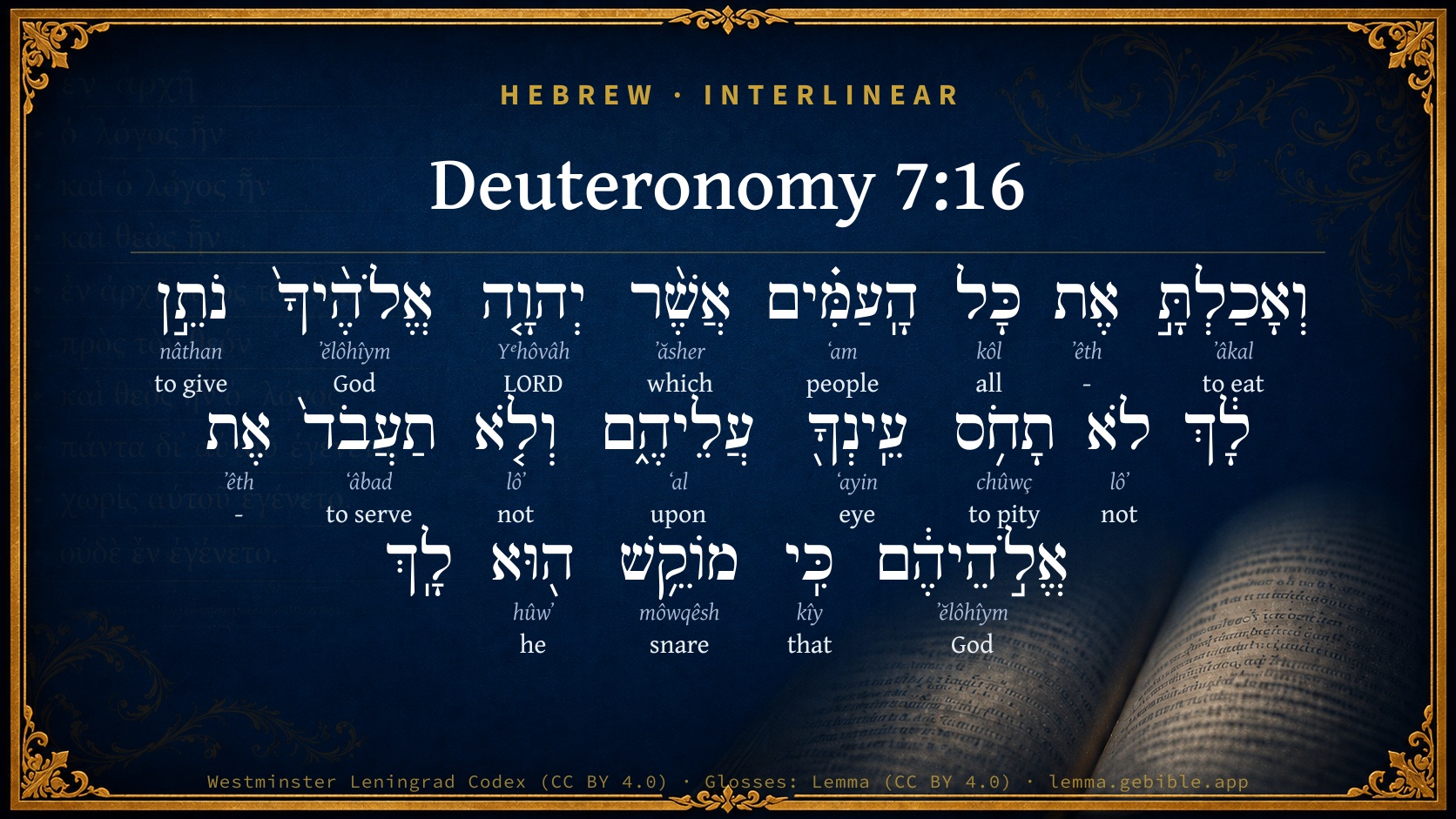
  1. וְאָכַלְתָּ֣ ʼâkal H398 “and · to eat” Conjunction + Verb, Qal, Sequential Perfect, 2nd Person, Masculine, Singular
  2. אֶת ʼêth H853 “-” Particle, Direct Object
  3. כָּל kôl H3605 “all of” Noun, Common, Masculine, Singular, Construct
  4. הָֽעַמִּ֗ים ʻam H5971 “the · peoples” Particle, Definite Article + Noun, Common, Masculine, Plural, Absolute
  5. אֲשֶׁ֨ר ʼăsher H834 “which” Particle, Relative
  6. יְהוָ֤ה Yᵉhôvâh H3068 “LORD” Noun, Proper
  7. אֱלֹהֶ֨יךָ֙ ʼĕlôhîym H430 “God(s) · your” Noun, Common, Masculine, Plural, Construct + Suffix, Personal, 2nd Person, Masculine, Singular
  8. נֹתֵ֣ן nâthan H5414 “giving” Verb, Qal, Participle Active, Masculine, Singular, Absolute
  9. לֹא lôʼ H3808 “not” Particle, Negative
  10. עֵֽינְךָ֖ ʻayin H5869 “eye · your” Noun, Common, Both, Singular, Construct + Suffix, Personal, 2nd Person, Masculine, Singular
  11. עֲלֵיהֶ֑ם ʻal H5921 “upon · them” Preposition + Suffix, Personal, 3rd Person, Masculine, Plural
  12. וְלֹ֤א lôʼ H3808 “and · not” Conjunction + Particle, Negative
  13. תַעֲבֹד֙ ʻâbad H5647 “to serve” Verb, Qal, Imperfect, 2nd Person, Masculine, Singular
  14. אֶת ʼêth H853 “-” Particle, Direct Object
  15. אֱלֹ֣הֵיהֶ֔ם ʼĕlôhîym H430 “God(s) · their” Noun, Common, Masculine, Plural, Construct + Suffix, Personal, 3rd Person, Masculine, Plural
  16. כִּֽי kîy H3588 “that” Conjunction
  17. מוֹקֵ֥שׁ môwqêsh H4170 “snare” Noun, Common, Masculine, Singular, Absolute
  18. ה֖וּא hûwʼ H1931 “he” Pronoun, Personal, 3rd Person, Masculine, Singular

About this verse

These counts appear in no published source. They are computed here, from the morphology-tagged text and Lemma’s own curated glosses. What Lemma adds →

21
words
16
distinct lemmas
Pentateuch
section

Notable vocabulary

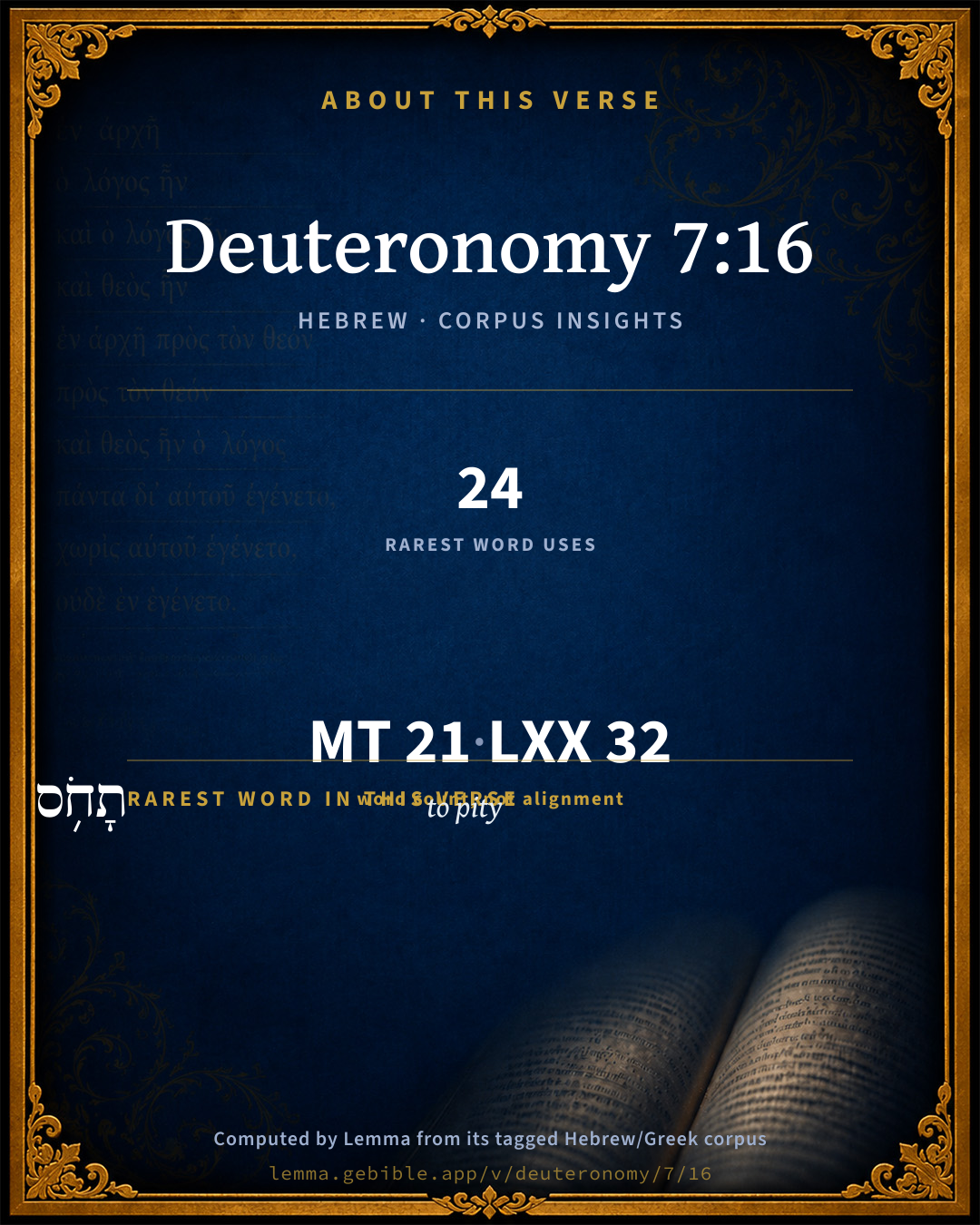
The rarest word here is תָחֹ֥ס to pity H2347 — appearing just 24 times in the whole Hebrew Bible.

Shared distinctive vocabulary

תָחֹ֥ס to pity H2347 occurs in 24 verses of the Hebrew Bible. Also found in:

Grammatical profile

  • 4 verbs
  • 7 nouns
  • 1 pronoun
  • 3 prepositions
  • 1 conjunction
  • 5 particles

Verb forms

  • וְאָכַלְתָּ֣ Qal · Sequential Perfect
  • נֹתֵ֣ן Qal · Participle Active
  • תָחֹ֥ס Qal · Imperfect
  • תַעֲבֹד֙ Qal · Imperfect

Repetition

Words recur within this verse — often emphatic in Hebrew:

  • אֱלֹהֶ֨יךָ֙ God H430 ×2
  • לֹא not H3808 ×2

Hebrew & Septuagint length

In English translation the verse runs 34 words from the Hebrew and 37 from the Septuagint (LXX English) — closely comparable.

A rough comparison of the two English renderings, which tokenize alike — not a word-level alignment.

Word counts can differ between the Hebrew and the Greek without any difference in meaning — e.g. the Hebrew direct-object marker אֵת has no separate Greek word, and Greek often adds the article ὁ.

In the original languages it is 21 Hebrew tokens and 32 Greek tokens — but the two are counted differently (Hebrew bundles its prefixes and suffixes into one token; the Greek is in lemma form), so that isn’t a like-for-like length.

Cross-references

17

Topical passages linked to Deuteronomy 7:16 in the Treasury of Scripture Knowledge — connected by theme and wording, ordered by reader-vote popularity; previews shown in the World English Bible.

  • Exodus 23:33 They shall not dwell in your land, lest they make you sin against me, for if you serve their gods, it will surely be a snare to you."
  • Judges 8:27 Gideon made an ephod of it, and put it in his city, even in Ophrah: and all Israel played the prostitute after it there; and it became a snare to Gideon, and to his house.
  • Deuteronomy 7:2 and when Yahweh your God shall deliver them up before you, and you shall strike them; then you shall utterly destroy them: you shall make no covenant with them, nor show mercy to them;
  • Deuteronomy 13:8 you shall not consent to him, nor listen to him; neither shall your eye pity him, neither shall you spare, neither shall you conceal him:
  • Deuteronomy 19:13 Your eye shall not pity him, but you shall put away the innocent blood from Israel, that it may go well with you.
  • Deuteronomy 19:21 Your eyes shall not pity; life [shall go] for life, eye for eye, tooth for tooth, hand for hand, foot for foot.
  • Deuteronomy 25:12 then you shall cut off her hand, your eye shall have no pity.
  • 1 Corinthians 15:33 Don't be deceived! "Evil companionships corrupt good morals."
  • Exodus 34:12–16 Be careful, lest you make a covenant with the inhabitants of the land where you are going, lest it be for a snare in the midst of you:
  • Psalms 106:36 They served their idols, Which became a snare to them.
  • Numbers 33:55 But if you will not drive out the inhabitants of the land from before you, then shall those who you let remain of them be as pricks in your eyes, and as thorns in your sides, and they shall vex you in the land in which you dwell.
  • Judges 2:3 Therefore I also said, I will not drive them out from before you; but they shall be [as thorns] in your sides, and their gods shall be a snare to you.
  • Judges 3:6 and they took their daughters to be their wives, and gave their own daughters to their sons and served their gods.
  • Jeremiah 21:7 Afterward, says Yahweh, I will deliver Zedekiah king of Judah, and his servants, and the people, even such as are left in this city from the pestilence, from the sword, and from the famine, into the hand of Nebuchadrezzar king of Babylon, and into the hand of their enemies, and into the hand of those who seek their life: and he shall strike them with the edge of the sword; he shall not spare them, neither have pity, nor have mercy.
  • Judges 2:12 and they forsook Yahweh, the God of their fathers, who brought them out of the land of Egypt, and followed other gods, of the gods of the peoples who were round about them, and bowed themselves down to them: and they provoked Yahweh to anger.
  • Deuteronomy 12:30–31 take heed to yourself that you not be ensnared to follow them, after that they are destroyed from before you; and that you not inquire after their gods, saying, How do these nations serve their gods? even so will I do likewise.
  • Joshua 23:13–16 know for a certainty that Yahweh your God will no more drive these nations from out of your sight; but they shall be a snare and a trap to you, and a scourge in your sides, and thorns in your eyes, until you perish from off this good land which Yahweh your God has given you.

Cross-references courtesy of OpenBible.info (CC BY 4.0).

Hebrew and Greek witnesses Masoretic Hebrew ↔ Greek Septuagint

The same verse in the two great witnesses to the Old Testament, shown verse-for-verse.

These are two independent witnesses, not word-aligned to each other, and the Septuagint is shown in lemma (dictionary) form.

Hebrew Deuteronomy 7:16 Masoretic · Westminster Leningrad Codex

וְאָכַלְתָּ֣ אֶת כָּל הָֽעַמִּ֗ים אֲשֶׁ֨ר יְהוָ֤ה אֱלֹהֶ֨יךָ֙ נֹתֵ֣ן לָ֔ךְ לֹא תָחֹ֥ס עֵֽינְךָ֖ עֲלֵיהֶ֑ם וְלֹ֤א תַעֲבֹד֙ אֶת אֱלֹ֣הֵיהֶ֔ם כִּֽי מוֹקֵ֥שׁ ה֖וּא לָֽךְ

You shall consume all the peoples who Yahweh your God shall deliver to you; your eye shall not pity them: neither shall you serve their gods; for that will be a snare to you.

World English Bible · Public Domain

Greek LXX Deuteronomy 7:16 Septuagint · lemma form

καί ἐσθίω πᾶς ὁ σκῦλον ὁ ἔθνος ὅς κύριος ὁ θεός σύ δίδωμι σύ οὐ φείδομαι ὁ ὀφθαλμός σύ ἐπί αὐτός καί οὐ λατρεύω ὁ θεός αὐτός ὅτι σκῶλον οὗτος εἰμί σύ

And you shall eat all the spoils of the nations which the Lord your God gives you; your eye shall not spare them, and you shall not serve their gods; for this is an offense to you.

LXX2012 (modern English Septuagint) · Public Domain

Hebrew: Westminster Leningrad Codex (CC BY 4.0). Greek: Septuagint (public domain); English from LXX2012 (modern English Septuagint) (Public Domain). How the Septuagint differs from the Hebrew →

Targum (Aramaic paraphrase)

2

The Targum is the ancient Jewish Aramaic paraphrase of the Hebrew Scriptures — an interpretive translation, not the Hebrew text itself. Onkelos (literal) and Pseudo-Jonathan (expansive) render the Torah, and Jonathan the Prophets. Coverage is partial: where no permissively-licensed English translation exists for a verse, only the Aramaic is shown. This is verse-level text, not a word-by-word alignment to the Hebrew.

  1. Targum Onkelos Torah (Genesis–Deuteronomy)
    וּתְגַמַר יָת כָּל עַמְמַיָא דִי יְיָ אֱלָהָךְ יָהֵב לָךְ לָא תְחוּס עֵינָךְ עֲלֵיהוֹן וְלָא תִפְלַח יָת טַּעֲוָתְהוֹן אֲרֵי לְתַקְלָא הוּא לָךְ

    (no public-domain English translation for this verse)

    Targum Onkelos — Aramaic: “Onkelos Genesis” (public domain); “Onkelos Exodus” (public domain); “Onkelos Leviticus” (public domain); “Onkelos Numbers” (public domain); “Onkelos Deuteronomy” (public domain). English: “Sefaria Community Translation” (CC0 1.0 (public-domain dedication)); “J.W. Etheridge. The Targums of Onkelos and Jonathan Ben Uzziel on the Pentateuch. London: Longmans, Green, 1862” (public domain). Text via Sefaria.

  2. Targum Pseudo-Jonathan Torah (Genesis–Deuteronomy)
    וּתְגַמַר יַת כָּל עַמְמַיָא דַיְיָ אֱלָהָךְ יָהִיב לָךְ לָא תֵיחוֹס עֵינָךְ עֲלֵיהוֹן וְלָא תִפְלַח יַת טַעֲוַותְהוֹן אֲרוּם לְתוּקְלָא הִינוּן לָךְ

    And thou shalt consume all the nations which the Lord thy God giveth up to thee; thine eye shall not spare them nor their idols, because they would be a stumbling block to thee.

    Targum Pseudo-Jonathan — Aramaic: “Targum Jonathan on Genesis” (public domain); “Targum Jonathan on Exodus” (public domain); “Targum Jonathan on Leviticus” (public domain); “Targum Jonathan on Numbers” (public domain); “Targum Jonathan on Deuteronomy” (public domain). English: “The Targum of Jonathan ben Uzziel, trans. J. W. Etheridge, London, 1862” (public domain). Text via Sefaria.

Commentary

Notes on Deuteronomy 7:16 from classic Christian and Jewish commentators (each source and its license shown beneath its notes). The classic Christian expositions comment on the surrounding passage and are grouped to its opening verse, so a note may address several verses; the Jewish commentaries on the Tanakh (Rashi and others) are per-verse, so they appear only where the commentator wrote on this verse.

Lemma curates 59 commentaries, every one of them public domain or Creative Commons licensed, each selected and text-cleaned for this edition rather than reprinted as found. About our sources →

The Biblical Illustrator

Joseph S. Exell

Deu_7:16

Thou shalt consume all the people.

The destruction of the Canaanites

I. The destruction of the Canaanites was in conformity with the ordinary procedure of God in the moral government of the world. If He choose, in punishing sinners, to visit at one time with a flood of waters, at another with fire from heaven, at another with a deadly epidemic, at another with the scourge of war, who shall dare to question the propriety of His choice in the weapons of destruction?

II. The destruction of the Canaanites was in punishment of sin and as such was just towards themselves. The vilest practices were rife among the people. Their very religion was a system of sorcery, sensuality, and depravity. The traces of ancient Syrian worship exhibit the vilest features of pagan idolatry. Their very gods were demons (Psa_106:37). Human sacrifices were offered at their shrines. The grossest abominations were practised in their orgies. If such, then, was the light, what would the darkness be? In other words, if this was the religion of the country, what would the vices of the people be?

III. The destruction of the Canaanites was a spiritual safeguard to the Israelites. We are tempted to ask whether it was well that the Israelites should be made the executioners of Gods wrath upon their brother man. Would they not be tempted to lose sight of their subordination to Gods purpose, and to take up the cause with feelings of proper fanaticism? Again, would not the part to which they were called tend to foster in them cruelty and recklessness of human life? On the contrary, we find that the snare of the Israelites lay in the opposite direction, and that they were ever more ready to spare than to slay. No token appears of any tendency to rapacity or violence having been impressed upon the national mind, while the salutary lessons that were thus taught them are apparent. In no way could the Israelites have been so forcibly convinced of the hatefulness of idolatry and impurity as when they themselves were made Gods ministers of vengeance against the crying evils. They were thus made witnesses against themselves should they ever adopt like abominations.

IV. The destruction of the Canaanites was necessary for the moral preservation of the world. Clearly it was an act of mercy to the little children of the Canaanites, who were cut off before they knew between good and evil. To the Israelites the extirpation of these nations was an act of mercy. Even crippled and curtailed as the Canaanites were, their influence for evil was too strong; but had they remained in larger bodies, and especially had the women been spared, piety would soon have become unknown among the people of God. But if the destruction of the Canaanites was an act of mercy to Israel, and necessary for their spiritual safely, it follows that it was not less a mercy to the whole world, and necessary for the preservation of the spiritual life of the entire family of mankind. The Church of the present day is but the continuation of the Church of the wilderness. Had that been destroyed, the materials of which the Saviour at His coming built the Church of the New Testament would not have been in existence. The impediments in the way of the Gospel would have been tenfold. To the present day the early ruin of the faith of Gods people which would have resulted from the general toleration of the Canaanites would have borne its bitter fruits.

V. The destruction of the Canaanites has a deep symbolical and practical lesson for us all. God changes not; the same principles direct His dealings now as then. The flesh must be mortified and subdued. See Jesus, our Joshua, stretches forth the spear. He commands the conflict; onward, then, and conquer. (G. W. Butler, M. A.)

The Christian failure and its reasons

Though the Israelites have passed out of Egypt and beyond the Red Sea and through the wilderness, they have not passed beyond the domain of struggle and duty; they must go on to possess the land. In its southeastern border dwell the Moabites; north of them are the Amorites, strongly intrenched; above them the Hittites; on the west side, beyond the Jordan, are the Anakim; above these, a mighty nation, the Canaanites; near them the Perizzites, etc.

I. The thing to be done. Too much is our Christianity over-anxious about its beginnings and too careless about its subsequent growth and reach. We are all the time seeking just to get people out of Egypt, we are all the time too unconcerned as to whether these people go on to conquer Canaan for the Lord. Having come to Jesus, the reign of Jesus is to be extended inwardly over the entire soul, outwardly over the entire life. Canaan reached was not Canaan conquered. The converted man is not yet a sanctified man. Evil pride, vanity, jealousy, covetousness, passionateness, discontent, bad habits, etc.

Hittites, Perizzites, Canaanites enough are yet resident in even the converted soul.

II. The force by which this conquest is to be accomplished. And thou shalt consume all the people which the Lord thy God shall deliver thee. The soul and God--these are the forces of conflict.

III. Some reasons for the Christian failure.

1. Ceasing of battle. After a while some of the Israelites stopped struggling against the aliens.

2. Fear. These Israelites would not struggle against certain of the aliens, because they had chariots of iron. So some bad habit frightens a Christian from struggle.

3. Success of a sort. And it came to pass when Israel was strong they put the Canaanites to tribute, and did not utterly drive them out. Many a man, professedly Christian, dares not attempt to be the Christian he knows he ought to be because, successful in worldly affairs, his worldly interests will not let him. So he salves his conscience by putting his questionable gain under tribute; gives it, or a portion of it, in charity, etc.

IV. Result. Will be a snare unto thee. Was their failure not a snare? Call to mind the history of the Israelites, the destruction of the ten tribes. The only proof of a real Christianity is a continually advancing self-conquest. (Homiletic Review.)

The Biblical Illustrator, edited by Joseph S. Exell (c. 1880s–1900s) — public domain. Text from a community e-Sword module.

Geneva Bible (1599)

Geneva Bible translators

We ought not to be merciful, where God commandeth severity.

Geneva Bible (1599) marginal notes — public domain. Text via Bolls.life.

Ellicott's Commentary for English Readers

(16) Thou shalt consume (literally, eat up) all the people which the Lord thy God shall deliver thee.—When delivered to Israel, they are delivered for execution; but the time of delivery is in the hand of Jehovah. (Comp. the words of Caleb and Joshua in Num_14:9 : “They are bread for us: their shadow is departed from them, and the Lord is with us.”)

A Bible Commentary for English Readers, edited by Charles John Ellicott (1878–1897) — public domain. Text from a community e-Sword module.

The Cambridge Bible for Schools and Colleges

gen. ed. J. J. S. Perowne

16. consume] Lit. eat up, a common figure, JE, Num_22:4.

shall deliver] See on Deu_7:2.

The rest of the v. Steuern. takes as an addition, because the theme of Deu_7:12-16 is what Jehovah does; and this, a warning for Israel, breaks the course of the thought. But this is to impute too fine a logic to such a discursive writer.

thine eye shall not pity them] Deu_13:8, Deu_19:13; Deu_19:21, Deu_25:12, all Sg.; elsewhere in Hex. only in the edit. passage, Gen_45:20, and with a different object, but common in Ezek., of God’s eye on the people, and also found in Jer. and other post-deuteronomic writings. Cp. Deu_7:2, thou shalt not pity them, with another vb.

neither shalt thou serve their gods … snare unto thee] Similarly in edit. Exo_23:33; Exo_34:12. See note on former.

The Cambridge Bible for Schools and Colleges (gen. ed. J. J. S. Perowne; Cambridge University Press, 1878–1918) — public domain. Text from a community e-Sword module.

John Gill's Exposition

And thou shall consume all the people which the Lord thy God shall deliver thee,.... All the inhabitants of the land of Canaan, which the Lord should deliver into their hands; them they were not to spare, but utterly destroy men, women, and children:

thine eye shall have no pity upon them; See Gill on Deu 7:2,

neither shall thou serve their gods, for that will be a snare unto thee; which will bring into utter ruin and destruction; see Exo 23:33.

John Gill's Exposition of the Whole Bible (1746–1763) — public domain (CC PDM 1.0). Text via the HelloAO Bible API.

Haydock's Catholic Bible Commentary

Consume. Kill the inhabitants, plunder their effects, (Menochius) destroy their idols.

George Leo Haydock (1774–1849), Haydock's Catholic Family Bible and Commentary, 1859 edition — public domain. Excludes Psalms (Douay-Rheims chapter numbering differs from Protestant) and Deuterocanonical books (Catholic canon only).

Matthew Poole's English Annotations

An occasion of sin and utter destruction. See Exo 23:33; 34:12; Jdg 2:3.

Matthew Poole's English Annotations on the Holy Bible (1683–1685) — public domain. Text from a community e-Sword/MySword module.

The Pulpit Commentary

Vers. 16-26. The heathen they were utterly to extirpate from the land which God was about to give them; mighty as these nations were, they were not to be afraid of them, for God would be with his people, and would deliver these nations, with their kings, into their hands. Not all at once, however, should the former occupants of the country be driven out; this should be done by degrees, lest, the land being suddenly depopulated, the wild animals would increase too much, so as to be a source of danger and trouble to the settlers; but ultimately they should be utterly destroyed, and with them all the objects and implements of their idolatrous worship.

And thou shalt consume; literally, eat, devour (Tlkaw). Unless they consumed them as one consumes food, they would be a snare to them, by tempting them to join in their idolatry.

The Pulpit Commentary (1880–1919), ed. H.D.M. Spence-Jones & Joseph S. Exell — public domain. Text from a community e-Sword module.

unfoldingWord translationNotes

Door43 World Missions Community

General Information:

Moses continues to tell the people of Israel Yahweh's words as if the Israelites are one person. (See: Forms of You)

You will consume all the peoples

"I command you to completely destroy all the people groups"

your eye will not pity them

This is a command. Moses speaks as if what the eye sees were the eye itself. AT: "do not allow what you see to cause you to pity them" or "do not pity them because you see that what you are doing is hurting them" (See: Metonymy)

You will not worship

"never worship"

that will be a trap for you

If the people worship other gods, they will be like an animal caught in a hunter's trap, and they will be unable to escape. (See: Metaphor)

translationWords

consume

people group

Yahweh

God

worship

false god

snare

unfoldingWord translationNotes — © Distant Shores Media and the Door43 World Missions Community, licensed CC BY-SA 4.0. Source: git.door43.org/Door43/en_tn.

Lesson kit

Teaching starters — assembled from the data on this page, not authored interpretation. Every prompt links to the verse data it draws on. Edit before teaching.

Deuteronomy, in the Pentateuch, opens this verse with 21 words (16 distinct Hebrew lemmas). Its most distinctive word is chûwç (“to pity”). A historical commentator’s framing appears above. Read the whole chapter for the surrounding context.

Discussion questions

  1. What does “to pity” (chûwç) contribute to the verse as a whole?
  2. How does Genesis 45:20, which shares the word «to pity», read alongside this verse?
  3. What does the repetition of “God” (2× in this one verse) do in this verse?
  4. The translations on this page render this verse differently — a whole-verse word diff, not a word-by-word alignment. What might account for the different wordings?
  5. «וְאָכַלְתָּ֣» is a Qal Sequential Perfect verb. How does that grammatical form shape the action described?
  6. Compare how The Biblical Illustrator and Geneva Bible (1599) read this verse. Where do they agree or differ?

Things to notice

Reading settings

Reading text

Shown beneath each verse's original-language words.

Old Testament
Old Testament edition

Read the OT as the Masoretic Hebrew (MT) or the Greek Septuagint (LXX).

English shown for the Greek Septuagint (in the Hebrew ↔ Greek comparison).

Comparing translations? Open the Compare panel on any verse page to stack up to four side by side.