
Genesis 42:25

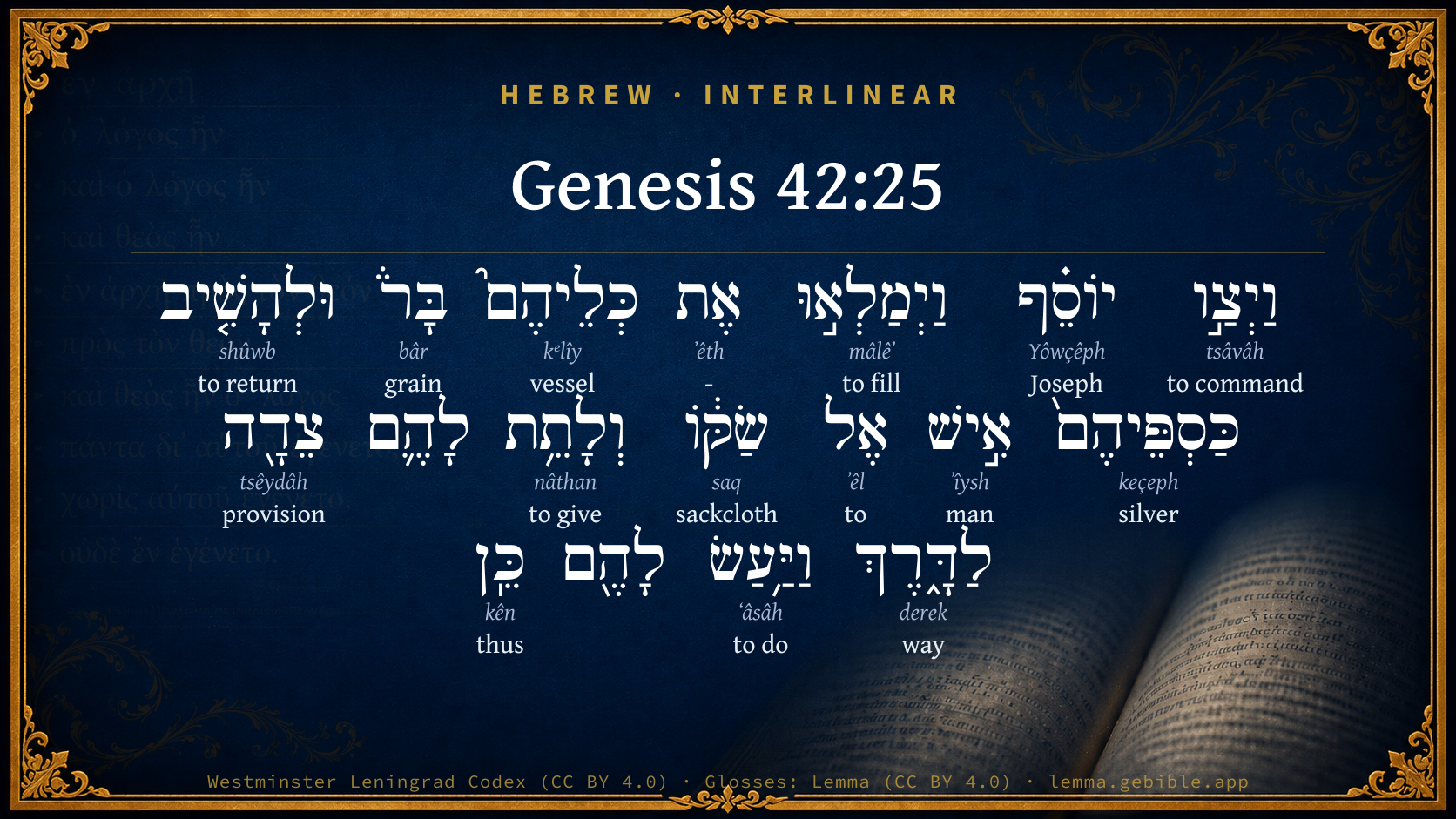
Hebrew (Westminster Leningrad Codex) Genesis 42:25 appears in the Hebrew Old Testament. The text above is from the Westminster Leningrad Codex. Each word links to its Strong’s number, a concise gloss, and parsing drawn from the Open Scriptures Hebrew Bible morphology. Click any word for its full Brown-Driver-Briggs (BDB) entry.
Download image
Cite this verse

Genesis 42:25 (World English Bible). Public Domain. Lemma interlinear Bible study tool, https://lemma.gebible.app/v/genesis/42/25.

Show BibTeX & RIS
BibTeX
RIS
English Translation
Then Joseph commanded to fill their bags with grain, and to restore every man's money into his sack, and to give them food for the way. So it done to them.
World English Bible · Public Domain
Download a study sheet

One document with this verse’s original text, its word-by-word gloss line, the meaning frame, cross-references with their text, attributed commentary, and full source and license credits — printable, and it pastes into notes with its structure intact.

This verse Autodidact and up

Study sheet (.html) Plain text (.txt)

A passage Seminary Student

Up to 50 verses in one chapter. A passage sheet keeps up to 6 commentary sources and 12 cross-references per verse, in the order this page ranks them, and says so on the sheet whenever that leaves anything out. Ask for a single verse and you get the Autodidact verse sheet above.

Everything on this page stays free to read, with no account — the sheet is a download of what is already on screen, not access to it.

Want to remove ads? Support Godless Engineer
Compare translations 3

The same verse in 3 English versions, stacked beneath the original-language interlinear above. Click any original word for its lexicon entry.

Each is an independent rendering of the whole verse — the interlinear is not word-aligned to these translations.

Highlighted words mark where these versions differ — a whole-verse word diff, not a word-by-word alignment.

  • World English Bible Public Domain
    Then Joseph commanded to fill their bags with grain, and to restore every man's money into his sack, and to give them food for the way. So it done to them.
  • King James Version Public Domain
    Then Joseph commanded to fill their sacks with corn, and to restore every man's money into his sack, and to give them provision for the way: and thus did he unto them.
  • unfoldingWord Literal Text CC BY-SA 4.0
    Then Joseph ordered and they filled their bags grain. And to return man’s silver to his sack and to give provisions to them for the road. And he did that for them.

unfoldingWord Literal Text — © unfoldingWord, licensed CC BY-SA 4.0. Word-aligned USFM3 via Door43 (git.door43.org/unfoldingWord/en_ult).

Versions to compare (up to 4)

3 of 4 selected

Show all 18 translations

Every available English version of this verse, each an independent rendering of the whole verse.

  • World English Bible Public Domain
    Then Joseph commanded to fill their bags with grain, and to restore every man's money into his sack, and to give them food for the way. So it done to them.
  • Berean Standard Bible Public Domain
    Then Joseph gave orders to fill their bags with grain, to return each man’s silver to his sack, and to give them provisions for their journey. This order was carried out,
  • Majority Standard Bible Public Domain
    Then Joseph gave orders to fill their bags with grain, to return each man’s silver to his sack, and to give them provisions for their journey. This order was carried out,
  • King James Version Public Domain
    Then Joseph commanded to fill their sacks with corn, and to restore every man's money into his sack, and to give them provision for the way: and thus did he unto them.
  • American Standard Version (1901) Public Domain
    Then Joseph commanded to fill their vessels with grain, and to restore every man's money into his sack, and to give them provisions for the way: and thus was it done unto them.
  • Revised Version (1885) Public Domain
    Then Joseph commanded to fill their vessels with corn, and to restore every man’s money into his sack, and to give them provision for the way: and thus was it done unto them.
  • Geneva Bible (1599) Public Domain
    So Ioseph commanded that they should fill their sackes with wheate, and put euery mans money againe in his sacke, and giue them vitaile for the iourney: and thus did he vnto them.
  • Douay-Rheims (1899) Public Domain
    And taking Simeon, and binking him in their presence, he commanded his servants to fill their sacks with wheat, and to put every man's money again in their sacks, and to give them besides provisions for the way: and they did so.
  • Young's Literal Translation Public Domain
    And Joseph commandeth, and they fill their vessels `with' corn, also to put back the money of each unto his sack, and to give to them provision for the way; and one doth to them so.
  • Literal Standard Version CC BY-SA 4.0
    And Joseph commands, and they fill their vessels [with] grain, also to put back the money of each of them into his sack, and to give to them provision for the way; and one does to them so.
  • Unlocked Literal Bible CC BY-SA 4.0
    Then Joseph commanded his servants to fill his brothers' bags with grain, and to put every man's money back into his sack, and to give them provisions for the journey. It was done for them.
  • unfoldingWord Literal Text CC BY-SA 4.0
    Then Joseph ordered and they filled their bags grain. And to return man’s silver to his sack and to give provisions to them for the road. And he did that for them.
  • Darby Bible Public Domain
    And Joseph gave orders to fill their vessels with corn, and to restore every man's money into his sack, and to give them provision for the way. And thus did they to them.
  • World Messianic Bible Public Domain
    Then Joseph gave a command to fill their bags with grain, and to restore each man’s money into his sack, and to give them food for the way. So it was done to them.
  • Webster's Bible Public Domain
    Then Joseph commanded to fill their sacks with corn, and to restore every man's money into his sack, and to give them provision for the way: and thus did he to them.
  • Free Bible Version CC BY-SA 4.0
    Joseph gave the order to fill up their sacks with grain, and also to return the money they had paid by placing it in the sacks as well. He also ordered that they should be provided with food for their journey home. All this was done.
  • Bible in Basic English Public Domain
    Then Joseph gave orders for their bags to be made full of grain, and for every man's money to be put back into his bag, and for food to be given them for the journey: which was done.
  • JPS Tanakh (1917) Public Domain
    Then Joseph commanded to fill their vessels with corn, and to restore every man's money into his sack, and to give them provision for the way; and thus was it done unto them.

Literal Standard Version (2020), Covenant Press — licensed CC BY-SA 4.0. Text via the HelloAO Bible API (eBible.org). Unlocked Literal Bible (unfoldingWord) — licensed CC BY-SA 4.0. Text via the HelloAO Bible API (eBible.org). unfoldingWord Literal Text — © unfoldingWord, licensed CC BY-SA 4.0. Word-aligned USFM3 via Door43 (git.door43.org/unfoldingWord/en_ult). Free Bible Version, Dr. Jonathan Gallagher — licensed CC BY-SA 4.0. Text via the HelloAO Bible API (eBible.org).

Word by word

More ways to search: Search by grammar → Find every occurrence → Compare this word →

Practice this passage: Drill this verse → Learn its vocabulary →

צֵדָ֖ה
tsêydâh
H6720
“provision”
Noun, Common, Both, Singular, Absolute
Part of Speech
Noun
Type
Common
Gender
Both
Number
Singular
State
Absolute
Full BDB Definition

Origin: from H6718

TWOT: 1886b

provision, food
  1. וַיְצַ֣ו tsâvâh H6680 “and · to command” Conjunction + Verb, Piel, Sequential Imperfect, 3rd Person, Masculine, Singular
  2. יוֹסֵ֗ף Yôwçêph H3130 “Joseph” Noun, Proper
  3. וַיְמַלְא֣וּ mâlêʼ H4390 “and · to fill” Conjunction + Verb, Piel, Sequential Imperfect, 3rd Person, Masculine, Plural
  4. אֶת ʼêth H853 “-” Particle, Direct Object
  5. כְּלֵיהֶם֮ kᵉlîy H3627 “vessels · their” Noun, Common, Masculine, Plural, Construct + Suffix, Personal, 3rd Person, Masculine, Plural
  6. בָּר֒ bâr H1250 “grain” Noun, Common, Masculine, Singular, Absolute
  7. וּלְהָשִׁ֤יב shûwb H7725 “and · to return” Conjunction + Preposition + Verb, Hiphil, Infinitive Construct
  8. כַּסְפֵּיהֶם֙ keçeph H3701 “silver · their” Noun, Common, Masculine, Plural, Construct + Suffix, Personal, 3rd Person, Masculine, Plural
  9. אִ֣ישׁ ʼîysh H376 “man” Noun, Common, Masculine, Singular, Absolute
  10. אֶל ʼêl H413 “to” Preposition
  11. שַׂקּ֔וֹ saq H8242 “sackcloth · his” Noun, Common, Masculine, Singular, Construct + Suffix, Personal, 3rd Person, Masculine, Singular
  12. וְלָתֵ֥ת nâthan H5414 “and · to give” Conjunction + Preposition + Verb, Qal, Infinitive Construct
  13. לַדָּ֑רֶךְ derek H1870 “to/for the · way” Preposition, Determined + Noun, Common, Both, Singular, Absolute
  14. וַיַּ֥עַשׂ ʻâsâh H6213 “and · to do” Conjunction + Verb, Qal, Sequential Imperfect, 3rd Person, Masculine, Singular
  15. כֵּֽן kên H3651 “thus” Particle, Demonstrative

About this verse

These counts appear in no published source. They are computed here, from the morphology-tagged text and Lemma’s own curated glosses. What Lemma adds →

18
words
16
distinct lemmas
Pentateuch
section

Notable vocabulary

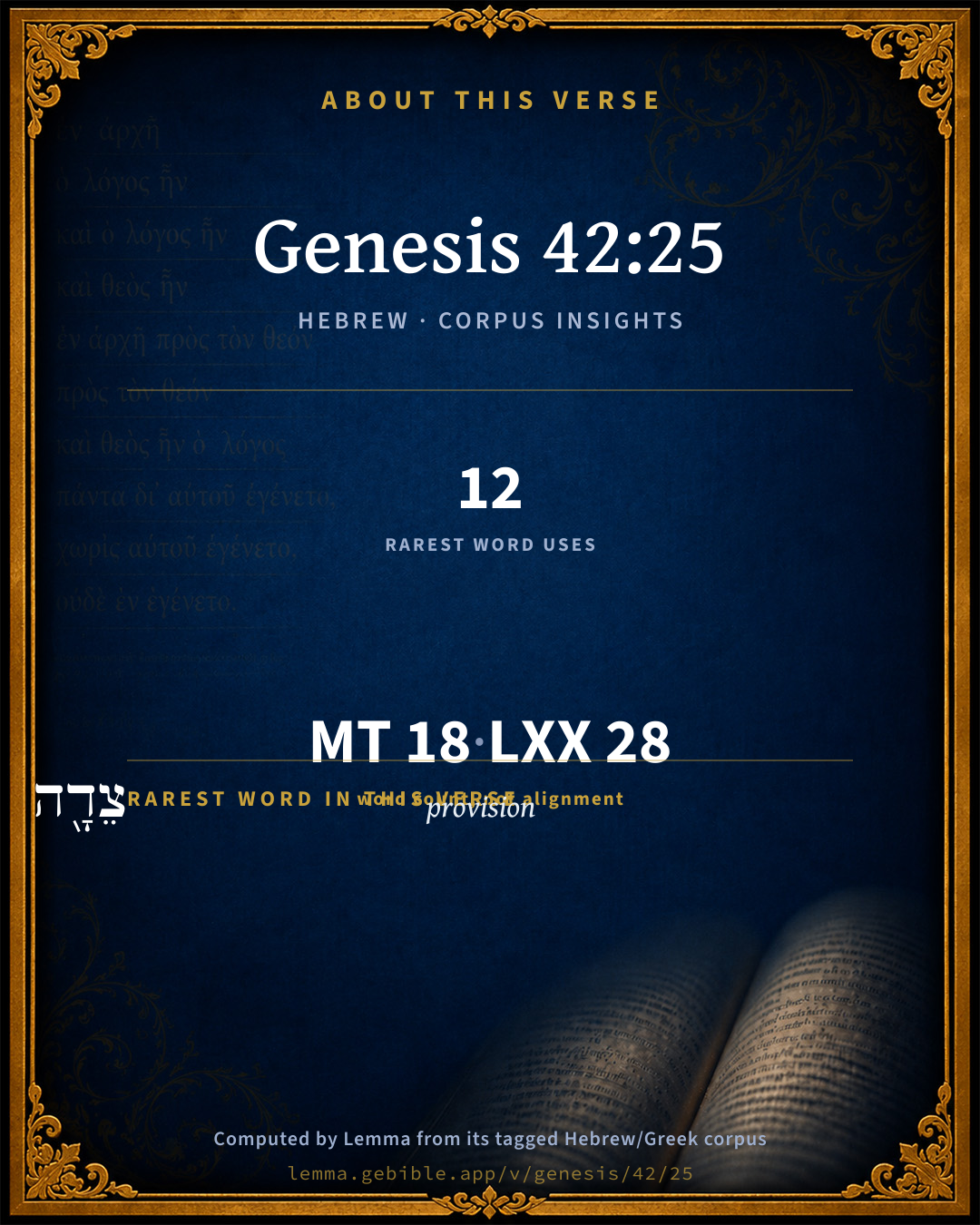
The rarest word here is צֵדָ֖ה provision H6720 — appearing just 12 times in the whole Hebrew Bible.

Shared distinctive vocabulary

צֵדָ֖ה provision H6720 occurs in 11 verses of the Hebrew Bible. Also found in:

Grammatical profile

  • 5 verbs
  • 8 nouns
  • 3 prepositions
  • 2 particles

Verb forms

  • וַיְצַ֣ו Piel · Sequential Imperfect
  • וַיְמַלְא֣וּ Piel · Sequential Imperfect
  • וּלְהָשִׁ֤יב Hiphil · Infinitive Construct
  • וְלָתֵ֥ת Qal · Infinitive Construct
  • וַיַּ֥עַשׂ Qal · Sequential Imperfect

Hebrew & Septuagint length

In English translation the verse runs 31 words from the Hebrew and 35 from the Septuagint (LXX English) — closely comparable.

A rough comparison of the two English renderings, which tokenize alike — not a word-level alignment.

Word counts can differ between the Hebrew and the Greek without any difference in meaning — e.g. the Hebrew direct-object marker אֵת has no separate Greek word, and Greek often adds the article ὁ.

In the original languages it is 18 Hebrew tokens and 28 Greek tokens — but the two are counted differently (Hebrew bundles its prefixes and suffixes into one token; the Greek is in lemma form), so that isn’t a like-for-like length.

Cross-references

7

Topical passages linked to Genesis 42:25 in the Treasury of Scripture Knowledge — connected by theme and wording, ordered by reader-vote popularity; previews shown in the World English Bible.

  • 1 Peter 3:9 not rendering evil for evil, or reviling for reviling; but instead blessing; knowing that to this were you called, that you may inherit a blessing.
  • Genesis 44:1–2 He commanded the steward of his house, saying, "Fill the men's sacks with food, as much as they can carry, and put every man's money in his sack's mouth.
  • Genesis 45:21 The sons of Israel did so. Joseph gave them wagons, according to the commandment of Pharaoh, and gave them provision for the way.
  • Isaiah 55:1 Ho, everyone who thirsts, come you to the waters, and he who has no money; come you, buy, and eat; yes, come, buy wine and milk without money and without price.
  • Matthew 5:44 But I tell you, love your enemies, bless those who curse you, do good to those who hate you, and pray for those who mistreat you and persecute you,
  • Matthew 6:33 But seek first God's Kingdom, and his righteousness; and all these things will be given to you as well.
  • Romans 12:17–21 Repay no one evil for evil. Respect what is honorable in the sight of all men.

Cross-references courtesy of OpenBible.info (CC BY 4.0).

Hebrew and Greek witnesses Masoretic Hebrew ↔ Greek Septuagint

The same verse in the two great witnesses to the Old Testament, shown verse-for-verse.

These are two independent witnesses, not word-aligned to each other, and the Septuagint is shown in lemma (dictionary) form.

Hebrew Genesis 42:25 Masoretic · Westminster Leningrad Codex

וַיְצַ֣ו יוֹסֵ֗ף וַיְמַלְא֣וּ אֶת כְּלֵיהֶם֮ בָּר֒ וּלְהָשִׁ֤יב כַּסְפֵּיהֶם֙ אִ֣ישׁ אֶל שַׂקּ֔וֹ וְלָתֵ֥ת לָהֶ֛ם צֵדָ֖ה לַדָּ֑רֶךְ וַיַּ֥עַשׂ לָהֶ֖ם כֵּֽן

Then Joseph commanded to fill their bags with grain, and to restore every man's money into his sack, and to give them food for the way. So it done to them.

World English Bible · Public Domain

Greek LXX Genesis 42:25 Septuagint · lemma form

ἐντέλλομαι δέ ιωσηφ ἐνπίμπλημι ὁ ἀγγεῖον αὐτός σῖτος καί ἀποδίδωμι ὁ ἀργύριον ἕκαστος εἰς ὁ σάκκος αὐτός καί δίδωμι αὐτός ἐπισιτισμός εἰς ὁ ὁδός καί γίγνομαι αὐτός οὕτως

And Joseph gave orders to fill their vessels with corn, and to return their money to each into his sack, and to give them provision for the way; and it was so done to them.

LXX2012 (modern English Septuagint) · Public Domain

Hebrew: Westminster Leningrad Codex (CC BY 4.0). Greek: Septuagint (public domain); English from LXX2012 (modern English Septuagint) (Public Domain). How the Septuagint differs from the Hebrew →

Targum (Aramaic paraphrase)

2

The Targum is the ancient Jewish Aramaic paraphrase of the Hebrew Scriptures — an interpretive translation, not the Hebrew text itself. Onkelos (literal) and Pseudo-Jonathan (expansive) render the Torah, and Jonathan the Prophets. Coverage is partial: where no permissively-licensed English translation exists for a verse, only the Aramaic is shown. This is verse-level text, not a word-by-word alignment to the Hebrew.

  1. Targum Onkelos Torah (Genesis–Deuteronomy)
    וּפַקֵּיד יוֹסֵף וּמְלוֹ יָת מָנֵיהוֹן עִיבוּרָא וְלַאֲתָבָא כַסְפֵּיהוֹן גְּבַר לְסַקֵּהּ וּלְמִתַּן לְהוֹן זְוָדִין לְאָרְחָא וַעֲבַד לְהוֹן כֵּן

    (no public-domain English translation for this verse)

    Targum Onkelos — Aramaic: “Onkelos Genesis” (public domain); “Onkelos Exodus” (public domain); “Onkelos Leviticus” (public domain); “Onkelos Numbers” (public domain); “Onkelos Deuteronomy” (public domain). English: “Sefaria Community Translation” (CC0 1.0 (public-domain dedication)); “J.W. Etheridge. The Targums of Onkelos and Jonathan Ben Uzziel on the Pentateuch. London: Longmans, Green, 1862” (public domain). Text via Sefaria.

  2. Targum Pseudo-Jonathan Torah (Genesis–Deuteronomy)
    וּפְקִיד יוֹסֵף לְעַבְדוֹי וּמְלַן יַת מָנֵיהוֹן עִיבּוּרָא וּלְאָתָבָא כַּסְפֵּיהוֹן דִגְבַר לְגוֹ שַקֵיהּ וּלְמִיתַּן לְהוֹן זְוָודִין לְאָרְחָא וְעָבַד לְהוֹם כֵּן

    And Joseph commanded his servant to fill their vehicles with corn, and to return each man's money in his sack, and to give them provisions for the way. And he did so for them.

    Targum Pseudo-Jonathan — Aramaic: “Targum Jonathan on Genesis” (public domain); “Targum Jonathan on Exodus” (public domain); “Targum Jonathan on Leviticus” (public domain); “Targum Jonathan on Numbers” (public domain); “Targum Jonathan on Deuteronomy” (public domain). English: “The Targum of Jonathan ben Uzziel, trans. J. W. Etheridge, London, 1862” (public domain). Text via Sefaria.

Commentary

Notes on Genesis 42:25 from classic Christian and Jewish commentators (each source and its license shown beneath its notes). The classic Christian expositions comment on the surrounding passage and are grouped to its opening verse, so a note may address several verses; the Jewish commentaries on the Tanakh (Rashi and others) are per-verse, so they appear only where the commentator wrote on this verse.

Lemma curates 59 commentaries, every one of them public domain or Creative Commons licensed, each selected and text-cleaned for this edition rather than reprinted as found. About our sources →

Trapp's Complete Commentary

John Trapp

Gen 42:25 Then Joseph commanded to fill their sacks with corn, and to restore every man’s money into his sack, and to give them provision for the way: and thus did he unto them.

Ver. 25. Then Joseph commanded to fill their sacks.] This was the revenge he took upon them for their many misusages. So Joshua marched all night, and fought all day for the Gibeonites that had deceived him. So Elisha set bread and water before the Syrians that came to surprise him. So St Paul bids, "If thine enemy hunger, feed him," &c. Injuries are more bravely overcome with benefits than recompensed with the pertinacy of a mutual hatred, said a very heathen. {a}

{a} Speciosius aliquanto iniuriae beneficiis vincuntur, quam mutui odii pertinacia pensantur. - Val. Vax., lib. iv. cap. 2.

John Trapp, A Commentary or Exposition upon All the Books of the Old and New Testament (1647–1656) — public domain. Text from a community e-Sword module.

The Biblical Illustrator

Joseph S. Exell

Gen_42:25-28

My money is restored; and lo, it is even in my sack: and their hearts failed them

The miseries of an awakened conscience

I.

THEY PURSUE THE SINNER EVERYWHERE.

II. THEY DRIVE THE SINNER TO PUT THE WORST CONSTRUCTION UPON EVERY EVENT.

III. THEY ARE INTENDED TO LEAD THE SINNER TO REPENTANCE. (T. H.Leale.)

The money returned

I. THE RETURN. Affairs in Egypt strangely settled, they set out on their return. They have been treated with a perplexing mixture of kindness and harshness. They have provision for their journey; but they remember the prison, and the hostage they have left behind. What shall they say to their father? Once they returned without Joseph. He scarcely recovered from that blow. Now they are without Simeon, and must demand Benjamin. How great their perplexity! They thought of Joseph when in the presence of the lord of Egypt; do they think of him now? By the very road they were travelling they saw him borne away years before. They were enveloped in mystery. The old man at home among his hungry household, and their own children awaiting their return. Simeons children, too, to meet; and no father brought back to them.

II. THE DISCOVERY. Thus perplexed, and anxiously anticipating the result, they arrive at one of the inns, or khans, at which the caravans stopped to rest. An ass needs provender. A sack is opened. The money is discovered. Consternation. What can it all mean? Did they reflect on the money for which they had once sold a brother? Probably Josephs purchasers once lodged with their newly bought slave in that very inn, and talked of the sum they had given, as these men were now talking of the money they had found. This money boded no good. An unheard-of thing, that a seller should return the money. Joseph very likely returned the money to ensure their return; lest they might need food and not have money to buy it. A new thing to tell their father.

III. THE FAMILY CONSTERNATION. They arrive at home. The first greetings over, inquiries are made. Where is Simeon? They relate the history of their adventures and Simeons detention. While they relate this strange history they open their sacks. A new discovery. All the money returned! Fear seizes the whole family. It is a new thing in the story of trade. May have been regarded by them as a pretext for the Egyptians coming and carrying them all away into captivity. Jacob especially filled with dread. He has now lost two sons, and sees in the returned money a new occasion of alarm. All these things are against me. But they were all for him, because a son was in it all. All things shall work together for the good of them who love God, because another Son--Jesus Christ--is concerned in our welfare. Learn:

I. Past sins cast their shadow on the present, and overcast the future.

II. The wicked fleeth when no man pursueth.

III. Conscience converts things strange into things ominous.

IV. Our ignorance of Divine plans causes us to charge God foolishly.

V. No money needed to procure the bread of life. In my hand no price I bring. Jesus Christ is an unspeakable GIFT. (J. C. Gray.)

A sorrowful company

They said one to another, What is this that God hath done unto us? They all spoke the same language of despondency. None of them, as far as we find, administered any comfort to his companions. It is an unhappy thing, when, in a company of men, not one is found who can speak a word in season, for advice or consolation to his companions in trouble. It is reported, that in a time of persecution, some faithful ministers met together to deliberate about their duty. All of them for a time were silent, or if anything was said, it tended only to increase the general dejection. At last they all recovered their spirits, at hearing one of their number say, We are all immortal till our work is done. These few words gave effect to a truth, which they already knew, that their days were numbered by a Divine decree, and that it was not in the power of all the men on earth to cut them off from the land of the living a moment before the time appointed by the wisdom and love of that God whom they served. (G. Lawson, D. D.)

The money found in the sack

1. See how sin pursues the sinner. Like an enemy that he cannot shake off, ready at any moment to accuse and torment. And it will do more against him hereafter, unless taken away.

2. Observe the fear of these men. They were bold, hard men; yet see how their heart fails them. Whom do they fear? The stern Egyptian ruler? No. Their own thoughts, their own secret, their own sin. Nothing makes men so fearful as an evil conscience.

3. But their thoughts turned not to their sin alone, but to God. They saw His hand in what befell them. This, as far as it went, was a wholesome thought. What they said was quite true; it was God that was dealing with them. It was well that they should feel it. (F. Bourdillon.)

The Biblical Illustrator, edited by Joseph S. Exell (c. 1880s–1900s) — public domain. Text from a community e-Sword module.

The Preacher's Complete Homiletical Commentary

Joseph S. Exell (gen. ed.)

CRITICAL NOTES.—

Gen_42:27. In the Inn.] “A camping place for the night rather than a caravansera. The term is from a verb meaning to lodge, and has the local prefix. These halting grounds are well understood by travellers, and are fixed according to the distance and the convenience of water for man and beast.”—(Jacobus.) There are no places of entertainment; even at the present day, in this desert over which they had to pass.—

Gen_42:28. And their heart failed them.] Heb. And their heart went forth. Thus, Son_5:6., “My soul failed when he spake.” (Heb. “Went forth.”) They had no courage left.

MAIN HOMILETICS OF THE PARAGRAPH.—Gen_42:25-28

THE MISERIES OF AN AWAKENED CONSCIENCE

I. They pursue the sinner everywhere. In a strange land, and far from any human habitation, these men are suddenly alarmed. Time and place are nothing to conscience. When once awakened it will not allow the sinner to rest.

II. They drive the sinner to put the worst construction upon every event. Joseph’s real motive in treating his brethren thus, was love; but that love was now operating so as to confound, perplex, and dismay them. They read it as a design to ensnare and find occasion against them. Thus when our conscience is awakened, we are alarmed and confounded even by those things which may be really working for our peace.

III. They are intended to lead the sinner to repentance. By this harsh treatment Joseph designed, as an immediate purpose, to fill the minds of his brethren with consternation and fear. But he had a deeper purpose of love. He hoped to bring them to humble their souls in penitence before God, so that they might feel the guilt of their sin and obtain forgiveness. In this way God deals with the sinner when He would bring him to a right mind; leads him into dark and perplexing situations so that he is utterly unable to perceive the design. By turns his hopes and his fears are awakened, so that he might be forced to bring his sin to remembrance and feel his utter danger and helplessness. The evil which God thus brings upon awakened souls is only that deep darkness which precedes the dawn. Had Joseph’s brethren known all, they could not have been brought to the right state of mind. And so, if we knew all God’s designs concerning us, it is possible that we might be spared some pain, yet might we miss many a salutary lesson. If we are in God’s way at all, there is a meaning of goodness for us—a purpose of love and blessing. But God’s order is this,—that it is only by the law, which brings home to us the knowledge of sin, that we can obtain the blessings of the Gospel.

SUGGESTIVE COMMENTS ON THE VERSES

Gen_42:25-28. They construe this circumstance to mean something against them; but in what way they know not. They do not reproach the man, the lord of the land, though it is likely from his treatment of them that they would suspect some ill design against them: but overlooking second causes they ask, “What is this that God hath done to us!” To His righteous judgment they attributed what they had already met with (Gen_42:21-22), and now it seems to them that He is still in a mysterious way, and with a design to require their brother’s blood at their hand. Such a construction, though painful for the present, was the most useful to them of any that could have been put upon it.—(Fuller.)

Simeon is left in pawn, in fetters; the rest return with their corn, with their money, paying nothing for their provision but their labour; that they might be as much troubled with the beneficence of that strange Egyptian lord, as before with his imperious suspicion. Their wealth was now more irksome to them than their need; and they fear God means to punish them more in this superfluity of money than in the want of victuals. It is a wise course to be jealous of our gain; and more to fear, than desire abundance.—(Bp. Hall.)

The Preacher's Complete Homiletical Commentary (gen. ed. Joseph S. Exell; Funk & Wagnalls, c. 1892) — public domain (pre-1929). A full-Bible homiletical/sermon-outline anthology covering 65 of 66 books (2 John is absent from the source module). Text from a community e-Sword module.

Tyndale Open Study Notes

Tyndale Open Resources

42:25-28 Joseph cared for his brothers’ needs; he had forgiven them (see study note on 42:24) and was fulfilling his role to provide for them. God used Joseph’s care to convict the brothers even more fully of their sin.

42:25 return each brother’s payment: He was now testing them to awaken their conscience and make them face their past guilt; once again, they were going home with silver instead of a brother (37:28-35).

Tyndale Open Study Notes — © Tyndale Open Resources, licensed CC BY-SA 4.0. Text via the HelloAO Bible API.

Jamieson, Fausset & Brown

Robert Jamieson, A. R. Fausset & David Brown

Joseph commanded to fill their sacks with corn, and to restore every man's money--This private generosity was not an infringement of his duty--a defrauding of the revenue. He would have a discretionary power--he was daily enriching the king's exchequer--and he might have paid the sum from his own purse.

Jamieson, Fausset & Brown — Commentary Critical and Explanatory on the Whole Bible (1871) — public domain (CC PDM 1.0). Text via the HelloAO Bible API.

Adam Clarke's Commentary

Verse 25. Commanded to fill their sacks] כליהם keleyhem, their vessels; probably large woollen bags, or baskets lined with leather, which, as Sir John Chardin says, are still in use through all Asia, and are called tambellet; they are covered with leather, the better to resist the wet, and to prevent dirt and sand from mixing with the grain. These vessels, of whatever sort, must have been different from those called שק sak in the twenty-seventh and following verses, which was probably only a small sack or bag, in which each had reserved a sufficiency of corn for his ass during the journey; the larger vessels or bags serving to hold the wheat or rice they had brought, and their own packages. The reader will at once see that the English word sack is plainly derived from the Hebrew.

Adam Clarke's Commentary on the Bible (1810–1826) — public domain. Text from a community e-Sword/MySword module.

Ellicott's Commentary for English Readers

(25) To fill their sacks.—Heb., their vessels. The word includes all their means of transport, and probably they had come with materials sufficient for the removal of a large quantity of corn. They had sacks as well. So in Gen_42:19, Joseph had commanded them to “carry corn for the famine of their houses.” And as their households were numerous, what would nine sacks of corn avail for their maintenance?

To restore every man’s money into his sack.—It is evident that each one had made his own separate purchase for his own household. The restoration of the money frightened Joseph’s brethren, as they saw in it a pretext for their detention on their next visit. But Joseph could not have meant thus to alarm them, as their fear would act as an obstacle to their coming again accompanied by Benjamin. It is more likely that he intended it as an encouragement, and sign of secret good will.

A Bible Commentary for English Readers, edited by Charles John Ellicott (1878–1897) — public domain. Text from a community e-Sword module.

John Gill's Exposition

And they came unto Jacob their father, unto the land of Canaan,.... Without being pursued and fetched back, or retarded in their journey as they might fear:

and told him all that befell unto them; chiefly what befell them while in Egypt:

saying, as follows.

John Gill's Exposition of the Whole Bible (1746–1763) — public domain (CC PDM 1.0). Text via the HelloAO Bible API.

Haydock's Catholic Bible Commentary

Simeon. If he had joined himself to Ruben and Juda, who seemed inclined to protect Joseph, they might easily have prevented the cruel act, by overawing their younger brothers. Hence he was most guilty. (Menochius) --- Presence. That they might learn to condole with an afflicted brother.

George Leo Haydock (1774–1849), Haydock's Catholic Family Bible and Commentary, 1859 edition — public domain. Excludes Psalms (Douay-Rheims chapter numbering differs from Protestant) and Deuterocanonical books (Catholic canon only).

Whedon's Commentary on the Bible

Daniel D. Whedon

25. Restore every man’s money — He would not take pay for his father’s and brothers’ food, but he would not openly decline it, lest he inadvertently betray himself and his feelings. He also, probably, furnished them provision for the way that they might not open their sacks until they reached their home.

Daniel D. Whedon (gen. ed.), Commentary on the Old and New Testaments (1874–1909) — public domain. Text from a community e-Sword module.

The Pulpit Commentary

Then (literally, and) Joseph commanded to fill literally, commanded, and they (i.e. Joseph"s men) filled their sacks (rather, vessels or receptacles, yliK) with corn, and to restore every man"s money (literally, the. dr pieces of silver, each) into his sack, qc, saccus, sakov, sakkov, sack. (vide Gen_37:34) Joseph "feels it impossible to bargain, with his father and his brethren for bread" (Baumgarten)and to give them prevision for the way: and thus did he (literally, it was done) unto them.

The Pulpit Commentary (1880–1919), ed. H.D.M. Spence-Jones & Joseph S. Exell — public domain. Text from a community e-Sword module.

Kretzmann's Popular Commentary

Paul E. Kretzmann

The Return to Canaan

v. 25. Then Joseph commanded to fill their sacks with corn, and to restore every man’s money into his sack, and to give them provision for the way; and thus did he unto them. Since it was not advisable, at this time, for him to reveal the reasons for acting thus, Joseph resorted to this secret measure, his object being to keep his brothers in a state of bewilderment and fear for the present. Provisions for the way he sent along, lest they be obliged to open their sacks very soon.

v. 26. And they laded their asses with the corn, and departed thence. The grain which they had brought for their needs made a big load, and they had a journey of several days.

v. 27. And as one of them opened his sack to give his ass provender in the inn, at the place where they encamped for the night, probably in one of the shed-like buildings which are found along the caravan roads, he espied his money; for, behold, it was in his sack’s mouth.

v. 28. And he said unto his brethren, my money is restored; and, lo, it is even in my sack; and their heart failed them, and they were afraid, saying one to another, What is this that God hath done unto us? In their great consternation over this unexplainable happening they hastily conclude that it was another way in which God was visiting their transgression upon them.

v. 29. And they came unto Jacob, their father, unto the land of Canaan, and told him all that befell unto them; saying,

v. 30. The man who is the lord of the land spake roughly to us, and took us for spies of the country.

v. 31. And we said unto him, We are true men; we are no spies;

v. 32. we be twelve brethren, sons of our father; one is not, and the youngest is this day with our father in the land of Canaan.

v. 33. And the man, the lord of the country, said unto us, Hereby shall I know that ye are true men: leave one of your brethren here with me, and take food for the famine of your households, and be gone;

v. 34. and bring your youngest brother unto me; then shall I know that ye are no spies, but that ye are true men; so will I deliver you your brother, and ye shall traffic in the land, have the right to trade, to buy and sell in the country. Thus the brethren gave their father a complete account of the strange happenings which had befallen them on their journey; and yet, there was missing a frank confession of their great sin. What they had confessed to one another they did not yet dare to tell their father. It was necessary to employ still sterner measures to reach that point.

Paul E. Kretzmann, Popular Commentary of the Bible (1921–1924) — public domain. Text from a community e-Sword module.

Ramban (Nachmanides)

Rabbi Moshe ben Nachman (Ramban / Nachmanides)

AND TO GIVE THEM PROVISION FOR THE WAY. The reason for saying this is so that they should not consume the food which they bought in the course of the journey. He informed them of this for he gave them the provisions for the journey in a kindly fashion so that they should be able to bring the brother [Benjamin] to him, for he said, “I have no intention of harming you if your words are verified.”

Ramban (Nachmanides) on the Tanakh — English translation: “Commentary on the Torah by Ramban (Nachmanides). Translated and annotated by Charles B. Chavel. New York, Shilo Pub. House, 1971-1976” (CC BY 4.0). Text via Sefaria.

Radak

Rabbi David Kimhi (Radak)

ויצו יוסף, he instructed his servants, the ones who were selling the grain (completing the transaction once it had been approved) to fill the brothers’ containers with grain, which they did. וימלאו; this is one of many verses in the Torah which has been written in an abbreviated manner.

ולהשיב, he also instructed his servants at the same time to replace the purchase money the brothers had paid.

ויעש להם כן, these words refer to the restoration of the money and the brothers being given enough provisions for themselves for their journey. We had heard already that their containers had been filled with grain.

Radak on the Tanakh — English translations: “Sefaria Community Translation” (CC0 1.0 (public-domain dedication)); “Eliyahu Munk, HaChut Hameshulash” (CC BY 4.0); “Rabbi Mike Feuer, Jerusalem Anthology” (CC BY 4.0); and “R. David Kimhi on the first book of Psalms, Translated by R.G. Finch, London, 1919” (public domain). Text via Sefaria.

Lesson kit

Teaching starters — assembled from the data on this page, not authored interpretation. Every prompt links to the verse data it draws on. Edit before teaching.

Genesis, in the Pentateuch, opens this verse with 18 words (16 distinct Hebrew lemmas). Its most distinctive word is tsêydâh (“provision”). A historical commentator’s framing appears above. Read the whole chapter for the surrounding context.

Discussion questions

  1. The word tsêydâh carries the sense “provision.” How does it shape the verse?
  2. How does Genesis 27:3, which shares the word «provision», read alongside this verse?
  3. The translations on this page render this verse differently — a whole-verse word diff, not a word-by-word alignment. What might account for the different wordings?
  4. «וַיְצַ֣ו» is a Piel Sequential Imperfect verb. How does that grammatical form shape the action described?
  5. Compare how Trapp's Complete Commentary and The Biblical Illustrator read this verse. Where do they agree or differ?

Things to notice

Reading settings

Reading text

Shown beneath each verse's original-language words.

Old Testament
Old Testament edition

Read the OT as the Masoretic Hebrew (MT) or the Greek Septuagint (LXX).

English shown for the Greek Septuagint (in the Hebrew ↔ Greek comparison).

Comparing translations? Open the Compare panel on any verse page to stack up to four side by side.