Exodus 21:4

Hebrew (Westminster Leningrad Codex) Exodus 21:4 appears in the Hebrew Old Testament. The text above is from the Westminster Leningrad Codex. Each word links to its Strong’s number, a concise gloss, and parsing drawn from the Open Scriptures Hebrew Bible morphology. Click any word for its full Brown-Driver-Briggs (BDB) entry.
Download image
Cite this verse

Exodus 21:4 (World English Bible). Public Domain. Lemma interlinear Bible study tool, https://lemma.gebible.app/v/exodus/21/4.

Show BibTeX & RIS
BibTeX
RIS
English Translation
If his master gives him a wife and she bears him sons or daughters, the wife and her children shall be her master's, and he shall go out by himself.
World English Bible · Public Domain
Download a study sheet

One document with this verse’s original text, its word-by-word gloss line, the meaning frame, cross-references with their text, attributed commentary, and full source and license credits — printable, and it pastes into notes with its structure intact.

This verse Autodidact and up

Study sheet (.html) Plain text (.txt)

A passage Seminary Student

Up to 50 verses in one chapter. A passage sheet keeps up to 6 commentary sources and 12 cross-references per verse, in the order this page ranks them, and says so on the sheet whenever that leaves anything out. Ask for a single verse and you get the Autodidact verse sheet above.

Everything on this page stays free to read, with no account — the sheet is a download of what is already on screen, not access to it.

Want to remove ads? Support Godless Engineer
Compare translations 3

The same verse in 3 English versions, stacked beneath the original-language interlinear above. Click any original word for its lexicon entry.

Each is an independent rendering of the whole verse — the interlinear is not word-aligned to these translations.

Highlighted words mark where these versions differ — a whole-verse word diff, not a word-by-word alignment.

  • World English Bible Public Domain
    If his master gives him a wife and she bears him sons or daughters, the wife and her children shall be her master's, and he shall go out by himself.
  • King James Version Public Domain
    If his master have given him a wife, and she have born him sons or daughters; the wife and her children shall be her master's, and he shall go out by himself.
  • unfoldingWord Literal Text CC BY-SA 4.0
    If his master gave him a wife and she bore him sons or daughters, the wife and her children are her master’s, and he must go out by himself.

unfoldingWord Literal Text — © unfoldingWord, licensed CC BY-SA 4.0. Word-aligned USFM3 via Door43 (git.door43.org/unfoldingWord/en_ult).

Versions to compare (up to 4)

3 of 4 selected

Show all 18 translations

Every available English version of this verse, each an independent rendering of the whole verse.

  • World English Bible Public Domain
    If his master gives him a wife and she bears him sons or daughters, the wife and her children shall be her master's, and he shall go out by himself.
  • Berean Standard Bible Public Domain
    If his master gives him a wife and she bears him sons or daughters, the woman and her children shall belong to her master, and only the man shall go free.
  • Majority Standard Bible Public Domain
    If his master gives him a wife and she bears him sons or daughters, the woman and her children shall belong to her master, and only the man shall go free.
  • King James Version Public Domain
    If his master have given him a wife, and she have born him sons or daughters; the wife and her children shall be her master's, and he shall go out by himself.
  • American Standard Version (1901) Public Domain
    If his master give him a wife and she bear him sons or daughters; the wife and her children shall be her master's, and he shall go out by himself.
  • Revised Version (1885) Public Domain
    If his master give him a wife, and she bear him sons or daughters; the wife and her children shall be her master’s, and he shall go out by himself.
  • Geneva Bible (1599) Public Domain
    If his master haue giuen him a wife, and she hath borne him sonnes or daughters, he wife and her children shalbe her masters, but he shall goe out himselfe alone.
  • Douay-Rheims (1899) Public Domain
    But if his master gave him a wife, and she hath borne sons and daughters: the woman and her children shall be her master's: but he himself shall go out with his raiment.
  • Young's Literal Translation Public Domain
    if his lord give to him a wife, and she hath borne to him sons or daughters -- the wife and her children are her lord's, and he goeth out by himself.
  • Literal Standard Version CC BY-SA 4.0
    if his lord gives a wife to him, and she has borne sons or daughters to him—the wife and her children are her lord’s, and he goes out by himself.
  • Unlocked Literal Bible CC BY-SA 4.0
    If his master gave him a wife and she bore him sons or daughters, the wife and her children will belong to her master, and he must go free by himself.
  • unfoldingWord Literal Text CC BY-SA 4.0
    If his master gave him a wife and she bore him sons or daughters, the wife and her children are her master’s, and he must go out by himself.
  • Darby Bible Public Domain
    If his master have given him a wife, and she have borne him sons or daughters, the wife and her children shall be her master's, and he shall go out alone.
  • World Messianic Bible Public Domain
    If his master gives him a wife and she bears him sons or daughters, the wife and her children shall be her master’s, and he shall go out by himself.
  • Webster's Bible Public Domain
    If his master hath given him a wife, and she hath borne him sons or daughters; the wife and her children shall be her master's, and he shall depart by himself.
  • Free Bible Version CC BY-SA 4.0
    If his master provides him a wife and she has children with him, the woman and her children shall belong to her master, and only the man shall be freed.
  • Bible in Basic English Public Domain
    If his master gives him a wife, and he gets sons or daughters by her, the wife and her children will be the property of the master, and the servant is to go away by himself.
  • JPS Tanakh (1917) Public Domain
    If his master give him a wife, and she bear him sons or daughters; the wife and her children shall be her master's, and he shall go out by himself.

Literal Standard Version (2020), Covenant Press — licensed CC BY-SA 4.0. Text via the HelloAO Bible API (eBible.org). Unlocked Literal Bible (unfoldingWord) — licensed CC BY-SA 4.0. Text via the HelloAO Bible API (eBible.org). unfoldingWord Literal Text — © unfoldingWord, licensed CC BY-SA 4.0. Word-aligned USFM3 via Door43 (git.door43.org/unfoldingWord/en_ult). Free Bible Version, Dr. Jonathan Gallagher — licensed CC BY-SA 4.0. Text via the HelloAO Bible API (eBible.org).

Word by word

More ways to search: Search by grammar → Find every occurrence → Compare this word →

Practice this passage: Drill this verse → Learn its vocabulary →

בְגַפּֽוֹ
gaph
H1610
“in/at · body · his”
Preposition + Noun, Common, Masculine, Singular, Construct + Suffix, Personal, 3rd Person, Masculine, Singular
Part of Speech
Preposition + Noun
Type
Common
Gender
Masculine
Number
Singular
State
Construct
Full BDB Definition

Origin: from an unused root meaning to arch

TWOT: 373a

body, self (only in phrase, eg by himself) - height, elevation
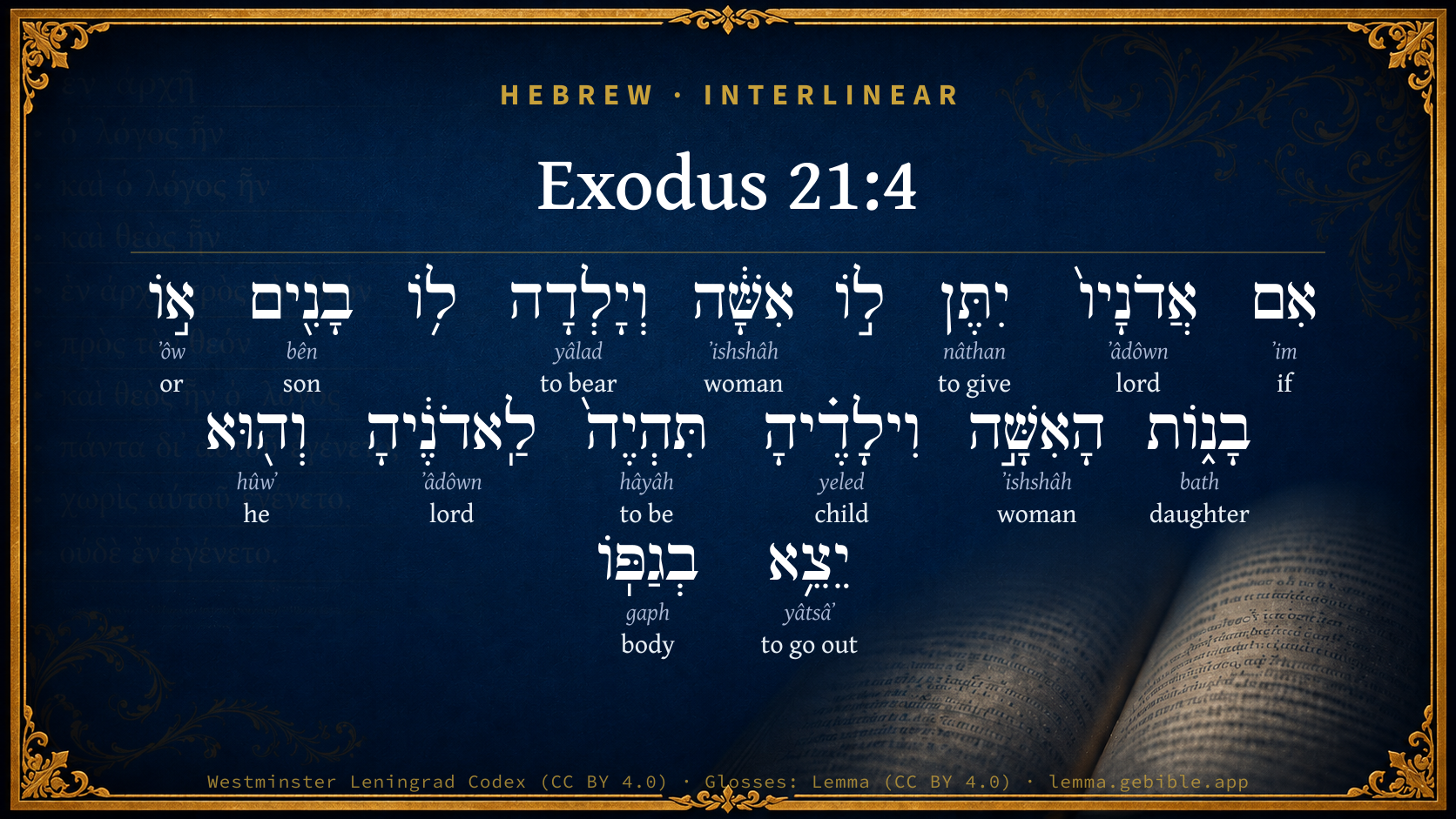
  1. אִם ʼim H518 “if” Conjunction
  2. אֲדֹנָיו֙ ʼâdôwn H113 “lords · his” Noun, Common, Masculine, Plural, Construct + Suffix, Personal, 3rd Person, Masculine, Singular
  3. יִתֶּן nâthan H5414 “to give” Verb, Qal, Imperfect, 3rd Person, Masculine, Singular
  4. אִשָּׁ֔ה ʼishshâh H802 “woman” Noun, Common, Feminine, Singular, Absolute
  5. וְיָלְדָה yâlad H3205 “and · to bear” Conjunction + Verb, Qal, Sequential Perfect, 3rd Person, Feminine, Singular
  6. בָנִ֖ים bên H1121 “sons” Noun, Common, Masculine, Plural, Absolute
  7. א֣וֹ ʼôw H176 “or” Conjunction
  8. בָנ֑וֹת bath H1323 “daughters” Noun, Common, Feminine, Plural, Absolute
  9. הָאִשָּׁ֣ה ʼishshâh H802 “the · woman” Particle, Definite Article + Noun, Common, Feminine, Singular, Absolute
  10. וִילָדֶ֗יהָ yeled H3206 “and · children · her” Conjunction + Noun, Common, Masculine, Plural, Construct + Suffix, Personal, 3rd Person, Feminine, Singular
  11. תִּהְיֶה֙ hâyâh H1961 “to be” Verb, Qal, Imperfect, 3rd Person, Feminine, Singular
  12. לַֽאדֹנֶ֔יהָ ʼâdôwn H113 “to/for · lords · her” Preposition + Noun, Common, Masculine, Plural, Construct + Suffix, Personal, 3rd Person, Feminine, Singular
  13. וְה֖וּא hûwʼ H1931 “and · he” Conjunction + Pronoun, Personal, 3rd Person, Masculine, Singular
  14. יֵצֵ֥א yâtsâʼ H3318 “to go out” Verb, Qal, Imperfect, 3rd Person, Masculine, Singular

About this verse

These counts appear in no published source. They are computed here, from the morphology-tagged text and Lemma’s own curated glosses. What Lemma adds →

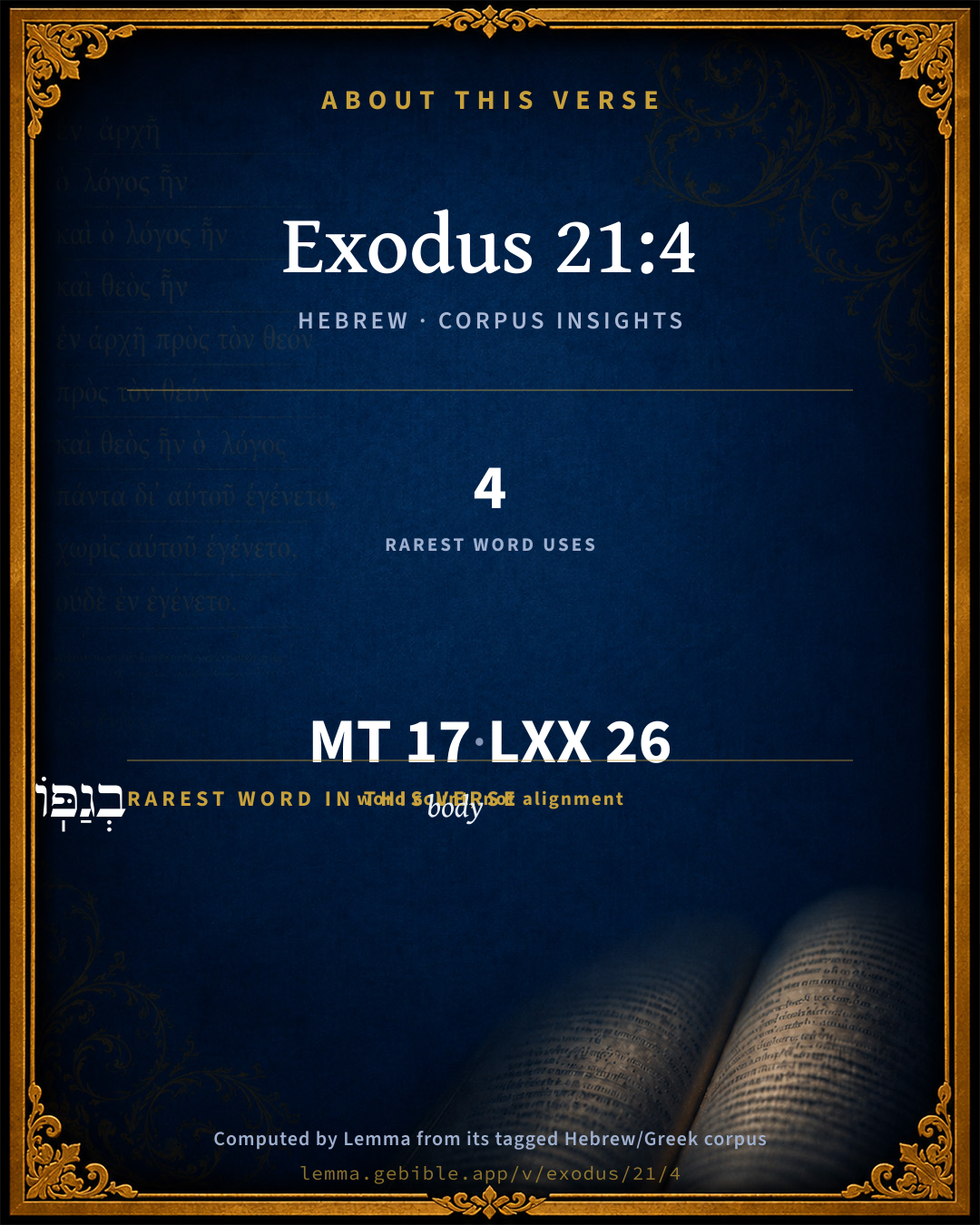
17
words
13
distinct lemmas
Pentateuch
section

Notable vocabulary

The rarest word here is בְגַפּֽוֹ body H1610 — appearing just 4 times in the whole Hebrew Bible.

Shared distinctive vocabulary

בְגַפּֽוֹ body H1610 occurs in 3 verses of the Hebrew Bible. Also found in:

Grammatical profile

  • 4 verbs
  • 8 nouns
  • 1 pronoun
  • 2 prepositions
  • 2 conjunctions

Verb forms

  • יִתֶּן Qal · Imperfect
  • וְיָלְדָה Qal · Sequential Perfect
  • תִּהְיֶה֙ Qal · Imperfect
  • יֵצֵ֥א Qal · Imperfect

Repetition

Words recur within this verse — often emphatic in Hebrew:

  • אֲדֹנָיו֙ lord H113 ×2
  • אִשָּׁ֔ה woman H802 ×2

Hebrew & Septuagint length

In English translation the verse runs 30 words from the Hebrew and 31 from the Septuagint (LXX English) — closely comparable.

A rough comparison of the two English renderings, which tokenize alike — not a word-level alignment.

Word counts can differ between the Hebrew and the Greek without any difference in meaning — e.g. the Hebrew direct-object marker אֵת has no separate Greek word, and Greek often adds the article ὁ.

In the original languages it is 17 Hebrew tokens and 26 Greek tokens — but the two are counted differently (Hebrew bundles its prefixes and suffixes into one token; the Greek is in lemma form), so that isn’t a like-for-like length.

Hebrew and Greek witnesses Masoretic Hebrew ↔ Greek Septuagint

The same verse in the two great witnesses to the Old Testament, shown verse-for-verse.

These are two independent witnesses, not word-aligned to each other, and the Septuagint is shown in lemma (dictionary) form.

Hebrew Exodus 21:4 Masoretic · Westminster Leningrad Codex

אִם אֲדֹנָיו֙ יִתֶּן ל֣וֹ אִשָּׁ֔ה וְיָלְדָה ל֥וֹ בָנִ֖ים א֣וֹ בָנ֑וֹת הָאִשָּׁ֣ה וִילָדֶ֗יהָ תִּהְיֶה֙ לַֽאדֹנֶ֔יהָ וְה֖וּא יֵצֵ֥א בְגַפּֽוֹ

If his master gives him a wife and she bears him sons or daughters, the wife and her children shall be her master's, and he shall go out by himself.

World English Bible · Public Domain

Greek LXX Exodus 21:4 Septuagint · lemma form

ἐάν δέ ὁ κύριος δίδωμι αὐτός γυνή καί τίκτω αὐτός υἱός ἤ θυγάτηρ ὁ γυνή καί ὁ παιδίον εἰμί ὁ κύριος αὐτός αὐτός δέ μόνος ἐκἔρχομαι

Moreover, if his master give him a wife, and she have born him sons or daughters, the wife and the children shall be his master's; and he shall go forth alone.

LXX2012 (modern English Septuagint) · Public Domain

Hebrew: Westminster Leningrad Codex (CC BY 4.0). Greek: Septuagint (public domain); English from LXX2012 (modern English Septuagint) (Public Domain). How the Septuagint differs from the Hebrew →

Targum (Aramaic paraphrase)

2

The Targum is the ancient Jewish Aramaic paraphrase of the Hebrew Scriptures — an interpretive translation, not the Hebrew text itself. Onkelos (literal) and Pseudo-Jonathan (expansive) render the Torah, and Jonathan the Prophets. Coverage is partial: where no permissively-licensed English translation exists for a verse, only the Aramaic is shown. This is verse-level text, not a word-by-word alignment to the Hebrew.

  1. Targum Onkelos Torah (Genesis–Deuteronomy)
    אִם רִבּוֹנֵהּ יִתֶּן לֵהּ אִתְּתָא וּתְלִיד לֵהּ בְּנִין אוֹ בְנָן אִתְּתָא וּבְנָהָא תְּהֵי לְרִבּוֹנָהָא וְהוּא יִפּוֹק בִּלְחוֹדוֹהִי:

    (no public-domain English translation for this verse)

    Targum Onkelos — Aramaic: “Onkelos Genesis” (public domain); “Onkelos Exodus” (public domain); “Onkelos Leviticus” (public domain); “Onkelos Numbers” (public domain); “Onkelos Deuteronomy” (public domain). English: “Sefaria Community Translation” (CC0 1.0 (public-domain dedication)); “J.W. Etheridge. The Targums of Onkelos and Jonathan Ben Uzziel on the Pentateuch. London: Longmans, Green, 1862” (public domain). Text via Sefaria.

  2. Targum Pseudo-Jonathan Torah (Genesis–Deuteronomy)
    אִין רִבּוֹנֵיהּ יִתֵּן לֵיהּ אִתְּתָא אַמְתָא וְתֵילִיד לֵיהּ בְּנִין אוֹ בְּנָן אִתְּתָא וּבְנָהָא תְּהֵא לְרִבּוֹנָהּ וְהוּא יִפּוֹק בִּלְחוֹדוֹי

    If his master give him a wife, an handmaid, and she bear him sons or daughters, the wife and her children shall belong to his master, and he may go out alone.

    Targum Pseudo-Jonathan — Aramaic: “Targum Jonathan on Genesis” (public domain); “Targum Jonathan on Exodus” (public domain); “Targum Jonathan on Leviticus” (public domain); “Targum Jonathan on Numbers” (public domain); “Targum Jonathan on Deuteronomy” (public domain). English: “The Targum of Jonathan ben Uzziel, trans. J. W. Etheridge, London, 1862” (public domain). Text via Sefaria.

Commentary

Notes on Exodus 21:4 from classic Christian and Jewish commentators (each source and its license shown beneath its notes). The classic Christian expositions comment on the surrounding passage and are grouped to its opening verse, so a note may address several verses; the Jewish commentaries on the Tanakh (Rashi and others) are per-verse, so they appear only where the commentator wrote on this verse.

Lemma curates 59 commentaries, every one of them public domain or Creative Commons licensed, each selected and text-cleaned for this edition rather than reprinted as found. About our sources →

Trapp's Complete Commentary

John Trapp

Exo 21:4 If his master have given him a wife, and she have born him sons or daughters; the wife and her children shall be her master’s, and he shall go out by himself.

Ver. 4. Have given him a wife,] viz., One of his heathen handmaids, whom to part with was no great punishment, because an unlawful couple.

John Trapp, A Commentary or Exposition upon All the Books of the Old and New Testament (1647–1656) — public domain. Text from a community e-Sword module.

Joseph Benson's Commentary

Exo 21:4. Her children shall be her master’s — Having become his in consequence of the right which he had to the parents. He shall go out by himself — But was not this separation of man and wife inconsistent with the first institution of marriage, by which that bond is made indissoluble? Answer, 1st, That bond was not necessarily dissolved by this law, both because the separation was at the man’s choice, who might have stayed if he pleased, and because the distinction of their habitations might consist with the right use of matrimony, which the master would probably permit for his own advantage.

Joseph Benson's Commentary on the Old and New Testaments (1811–1818) — public domain. Text from a community e-Sword module.

Tyndale Open Study Notes

Tyndale Open Resources

21:4-6 The master was not required to provide a slave with a wife who would then be freed with him. The slave in such a situation had to either abandon the family he began while he was a slave or become a permanent slave.

Tyndale Open Study Notes — © Tyndale Open Resources, licensed CC BY-SA 4.0. Text via the HelloAO Bible API.

Geneva Bible (1599)

Geneva Bible translators

Till her time of servitude was expired which might be the seventh year or the fiftieth.

Geneva Bible (1599) marginal notes — public domain. Text via Bolls.life.

Adam Clarke's Commentary

Verse 4. The wife and her children shall be her master's] It was a law among the Hebrews, that if a Hebrew had children by a Canannitish woman, those children must be considered as Canaanitish only, and might be sold and bought, and serve for ever. The law here refers to such a case only.

Adam Clarke's Commentary on the Bible (1810–1826) — public domain. Text from a community e-Sword/MySword module.

Ellicott's Commentary for English Readers

(4) If his master have given him a wife.—If, however, the Hebrew slave, being previously unmarried, had been allowed by his master to take to wife one of his female slaves, then, when the husband claimed his freedom the wife could not claim hers. Both she and her children remained in the slave condition.

A Bible Commentary for English Readers, edited by Charles John Ellicott (1878–1897) — public domain. Text from a community e-Sword module.

The Cambridge Bible for Schools and Colleges

gen. ed. J. J. S. Perowne

4. The third case. If the master marries a slave to one of his female slaves, the wife remains her master’s slave as she was before, and does not go free with her husband. If she has borne him children, the remain in servitude with their mother. At this early time, children’s relationship to their mother was held to be closer and more binding than that to their father.

give him] for the slave would not have the right to choose a wife for himself.

The Cambridge Bible for Schools and Colleges (gen. ed. J. J. S. Perowne; Cambridge University Press, 1878–1918) — public domain. Text from a community e-Sword module.

John Gill's Exposition

If his master have given him a wife,.... One of his slaves, a Canaanitish woman, on purpose to beget slaves on her, since all born in his house were his own; this is supposed to be after he was come into his house, and into his service:

and she have born him sons or daughters; as she might have born him several of the one sort, or the other, if she was given to him quickly after his servitude began:

the wife and her children shall be her master's: she being his slave, and bought with his money, he had a right unto her, and to the children belonging to her, the birth following the belly; and being born in his house, they were also his. Jarchi here observes, that the Scripture speaks of a Canaanitish woman, for an Hebrew woman went out at the sixth year, and even before the sixth, if she produced the signs, that is, of puberty:

and he shall go out by himself; without his wife and children: if it be objected to this law, that it is contrary to the law of marriage, which is indissoluble, but by this dissolved; it may be replied, that the servant was not obliged by it to leave his wife, unless he chose it; on complying with certain conditions after mentioned, he might continue with her; besides, she was, according to Jarchi, but his secondary wife, and not only so, the marriage was not lawful, being with a Canaanitish woman, and not agreeable to the Lord; and being also her master's slave, to whom he had a right, he could retain her if he pleased, having only given her to his servant to beget slaves on for him.

John Gill's Exposition of the Whole Bible (1746–1763) — public domain (CC PDM 1.0). Text via the HelloAO Bible API.

Matthew Poole's English Annotations

That being a true rule, and approved both by Scripture and by heathen authors, that the birth follows the belly, Gen 21:10; Gal 4:24,25; and he that owns the tree hath right to all its fruit.

Quest. How was this separation of man and wife agreeable with the first institution of marriage, by which that bond is made indissoluble?

Answ. 1. That bond was not necessarily dissolved by this law, both because the separation was at the man’s choice, who might have staid there if he so pleased; and because the distinction of their habitations might consist with the right and use of matrimony, which the master also would probably permit for his own advantage.

Answ. 2. God might here, as well as in the case of divorces, dispense with his own laws and institutions, especially in this case, where he might design this for a punishment to the man for marrying a stranger, which was not pleasing to God, as appears from Deu 21:11; Ezr 10:2; Neh 13:23. And that this woman was a stranger, and not a Hebrewess, is manifest, because then she also must have gone out free, Exo 21 7-9; Deu 15:12.

Matthew Poole's English Annotations on the Holy Bible (1683–1685) — public domain. Text from a community e-Sword/MySword module.

Whedon's Commentary on the Bible

Daniel D. Whedon

4. If his master have given him a wife — This condition involved certain rights of family and household possession. It contemplates the patriarchal family, in which servants were born, and may also have had in view the fact that the wife in the case supposed might often be a bondmaid acquired from among the heathen, whose legal term of service would not expire before the jubilee. “This may appear oppressive, but it was an equitable consequence of the possession of property in slaves at all.” — Keil.

Daniel D. Whedon (gen. ed.), Commentary on the Old and New Testaments (1874–1909) — public domain. Text from a community e-Sword module.

The Pulpit Commentary

If his master have given him a wife. If the slave was unmarried when he went into servitude, or if his wife died, and his master then gave him a wife from among his female slaves, the master was not to lose his property in his female slave by reason of having permitted the marriage. When the man claimed his freedom at the end of the sixth year, he was to "go out" alone. Should children have been born, they were also to be the property of the master and to remain members of his household. No doubt these provisos, which cannot be regarded as unjust, had the effect of inducing many Hebrew slaves not to claim their release (vers. 5, 6).

The Pulpit Commentary (1880–1919), ed. H.D.M. Spence-Jones & Joseph S. Exell — public domain. Text from a community e-Sword module.

Rashi

Rabbi Shlomo Yitzchaki (Rashi)

אם אדניו יתן לו אשה IF HIS LORD HAS GIVEN HIM A WIFE — From this we learn that if he has already an Israelite wife the master has the right to give him a Canaanitish handmaid with the object of raising slaves. Or perhaps this is not so, but Scripture by אשה is speaking about an Israelite woman?! Scripture, however, states: “the wife and her children shall be the master’s”, consequently the text can only be speaking of a Canaanitish woman, for a Hebrew maidservant goes free at the end of six years just as a Hebrew man-servant does — yea, even before the termination of six years she goes free if she shows symptoms of incipient puberty (cf. Rashi v. 7) — for it is said, (Deuteronomy 15:12) “[and if] thy brother, an Hebrew man, or an Hebrew woman, [be sold unto thee, and serve thee six years, then in the seventh year thou shalt let him go free from thee]”, which statement teaches you that a Hebrew woman also goes free after six years’ service (Mekhilta; Kiddushin 14b).

Rashi on the Tanakh — English translations: “The Judaica Press complete Tanach with Rashi, translated by A. J. Rosenberg” (CC BY 4.0); “Pentateuch with Rashi's commentary by M. Rosenbaum and A.M. Silbermann, 1929-1934” (public domain); “The Metsudah Tanach series, Lakewood, N.J” (CC BY 4.0); and “The Book of Joshua, Metsudah Publications, 1997” (CC BY 4.0). Text via Sefaria.

Ramban (Nachmanides)

Rabbi Moshe ben Nachman (Ramban / Nachmanides)

IF HIS MASTER GIVE HIM A WIFE. “Scripture is speaking of a Canaanite woman. Or perhaps this is not so; but Scripture here speaks only of an Israelite woman?! Scripture therefore says, the wife and her children shall be her master’s. Consequently, it must be speaking of a Canaanite woman.” This is the language of the Beraitha, Note 209. taught in the Mechilta. Now Rashi wrote [in explanation of this Mechilta]: “For a Hebrew maidservant also goes free at the end of six years [just as a Hebrew manservant does], or even before the end of six years if she shows signs of puberty, for it is said, If thy brother, a Hebrew man, or a Hebrew woman, be sold unto thee, he shall serve thee six years.” can only be speaking of a Canaanite woman.But this is not quite correct. For if we say [as the Beraitha above attempted to,] that the verse here speaks of an Israelite woman, it could no longer refer to the case of a father selling his minor daughter, about whom the law is given that when she shows signs of puberty she goes free, for how could the master give her as a wife to his Hebrew servant, since he has no power to hand her over to any other man [except to designate her to be his own wife, or that of his son — as is explained further in Verses 8-9]! who sold herself as a maidservant. So how then could Rashi support his argument [that if she were an Israelite woman, she would go free “if she shows signs of puberty],” when the Beraitha must of necessity be referring not to a minor but to a woman of age? (Mizrachi). Similarly, the proof that Rashi mentioned, namely that she also goes free at the end of six years, is only so in accordance with his own words which he wrote that a person who sells himself [on account of his destitution] is sold for a maximum of six years; but in the Talmud these are the words of a single Sage [Rabbi Eliezer], but the accepted opinion is that one who sells himself can be sold for six years or more. Now if so, the case of a woman who goes free at the end of six years can only be when her father sold her [as a minor, but in that case the master has no right to give her as a wife to his Hebrew servant, but only to designate her as his own wife or that of his son]! But that which the Rabbis have said [in the Beraitha above, on the basis of the verse, the wife and her children shall be the master’s]: “Consequently, Scripture must be speaking of a Canaanite woman” — the meaning thereof is as follows: Since He stated, the wife and her children shall be the master’s [it must be speaking only of a Canaanite woman], for the children of a Canaanite bondmaid are the master’s since her child has the same status as she does, but in the case of an Israelite woman — even if she were of age [in which case her master could give her to his Hebrew servant as a wife], and even if we were to say that a woman may sell herself as a maidservant (Verse 7) — a man can sell himself, but a woman cannot sell herself.” But Ramban is writing only on the assumption that the Beraitha introduced this as a hypothesis finally to be disproved. See my Hebrew commentary pp. 515-516. — her children are the father’s [not the master’s].

Ramban (Nachmanides) on the Tanakh — English translation: “Commentary on the Torah by Ramban (Nachmanides). Translated and annotated by Charles B. Chavel. New York, Shilo Pub. House, 1971-1976” (CC BY 4.0). Text via Sefaria.

Lesson kit

Teaching starters — assembled from the data on this page, not authored interpretation. Every prompt links to the verse data it draws on. Edit before teaching.

Exodus, in the Pentateuch, opens this verse with 17 words (13 distinct Hebrew lemmas). Its most distinctive word is gaph (“body”). A historical commentator’s framing appears above. Read the whole chapter for the surrounding context.

Discussion questions

  1. What does “body” (gaph) contribute to the verse as a whole?
  2. How does Exodus 21:3, which shares the word «body», read alongside this verse?
  3. What does the repetition of “lord” (2× in this one verse) do in this verse?
  4. These translations render this verse differently; the difference is in the English rendering, not the original. What questions does that raise?
  5. «יִתֶּן» is a Qal Imperfect verb. How does that grammatical form shape the action described?
  6. Compare how Trapp's Complete Commentary and Joseph Benson's Commentary read this verse. Where do they agree or differ?

Things to notice

Reading settings

Reading text

Shown beneath each verse's original-language words.

Old Testament
Old Testament edition

Read the OT as the Masoretic Hebrew (MT) or the Greek Septuagint (LXX).

English shown for the Greek Septuagint (in the Hebrew ↔ Greek comparison).

Comparing translations? Open the Compare panel on any verse page to stack up to four side by side.