
Exodus 29:20

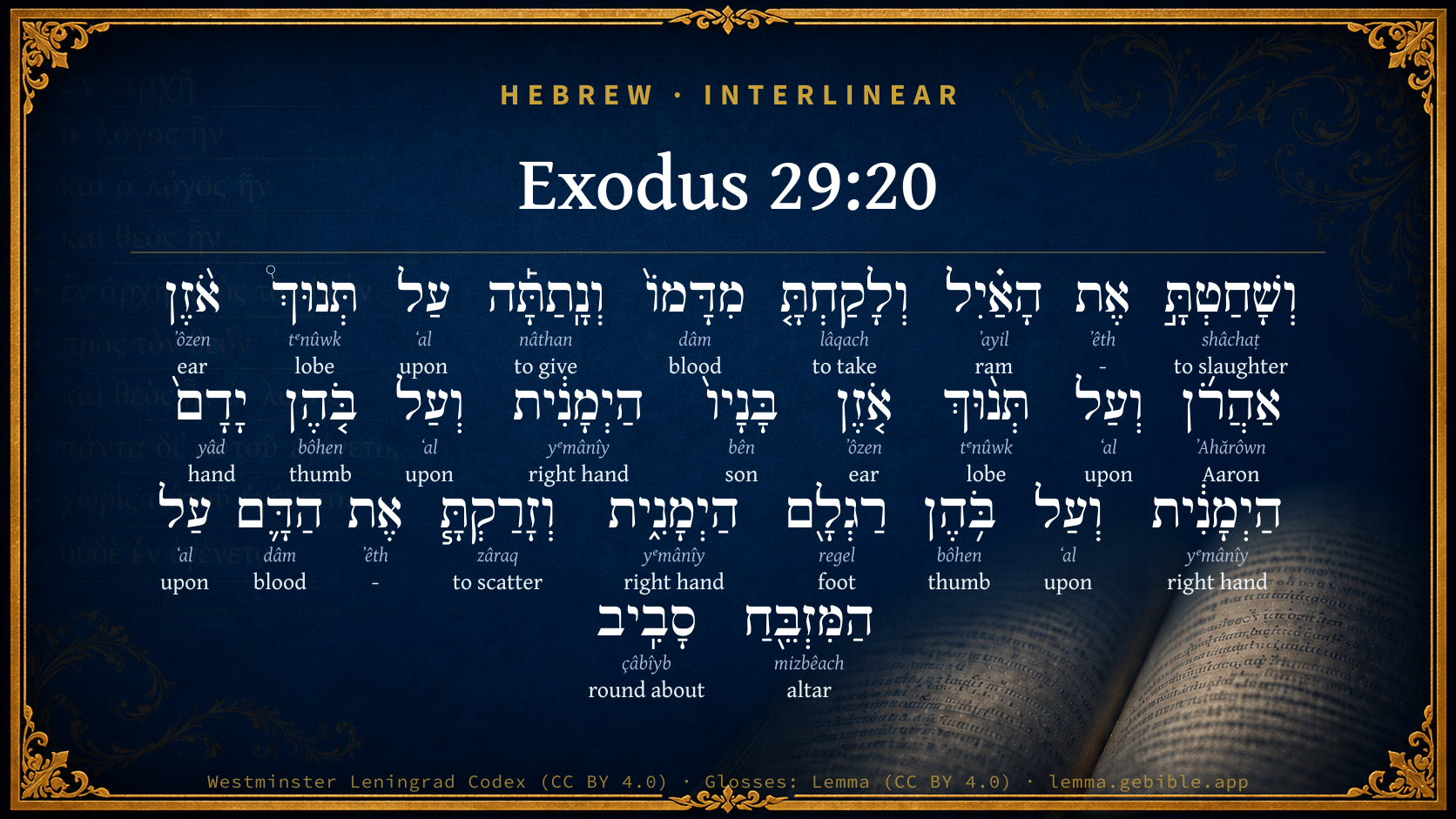
Hebrew (Westminster Leningrad Codex) Exodus 29:20 appears in the Hebrew Old Testament. The text above is from the Westminster Leningrad Codex. Each word links to its Strong’s number, a concise gloss, and parsing drawn from the Open Scriptures Hebrew Bible morphology. Click any word for its full Brown-Driver-Briggs (BDB) entry.
Download image
Cite this verse

Exodus 29:20 (World English Bible). Public Domain. Lemma interlinear Bible study tool, https://lemma.gebible.app/v/exodus/29/20.

Show BibTeX & RIS
BibTeX
RIS
English Translation
Then you shall kill the ram, and take some of its blood, and put it on the tip of the right ear of Aaron, and on the tip of the right ear of his sons, and on the thumb of their right hand, and on the big toe of their right foot, and sprinkle the blood on the altar round about.
World English Bible · Public Domain
Highlights
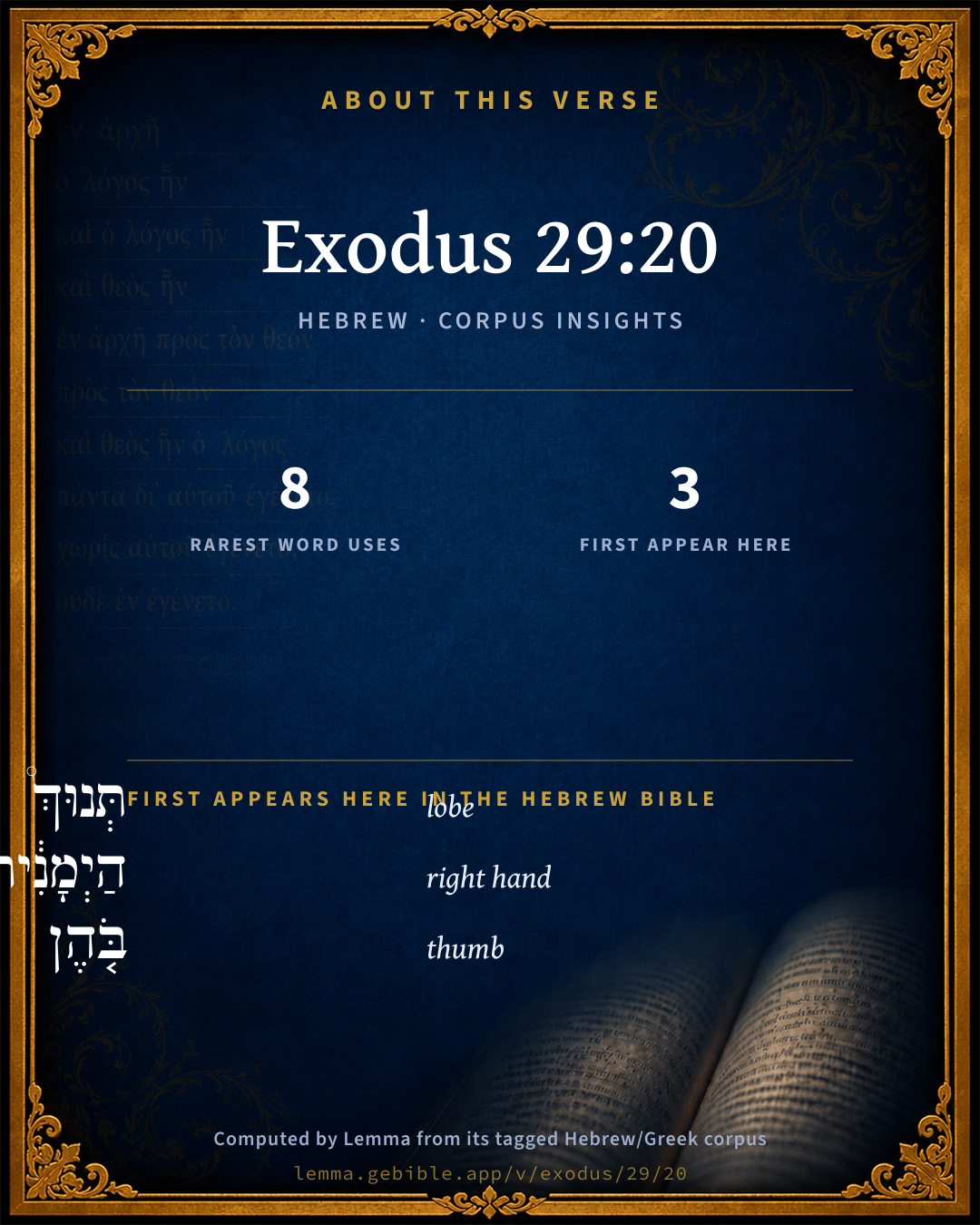
  • 3 first appearances in the Hebrew Bible
Full analysis ↓
Download a study sheet

One document with this verse’s original text, its word-by-word gloss line, the meaning frame, cross-references with their text, attributed commentary, and full source and license credits — printable, and it pastes into notes with its structure intact.

This verse Autodidact and up

Study sheet (.html) Plain text (.txt)

A passage Seminary Student

Up to 50 verses in one chapter. A passage sheet keeps up to 6 commentary sources and 12 cross-references per verse, in the order this page ranks them, and says so on the sheet whenever that leaves anything out. Ask for a single verse and you get the Autodidact verse sheet above.

Everything on this page stays free to read, with no account — the sheet is a download of what is already on screen, not access to it.

Want to remove ads? Support Godless Engineer
Compare translations 3

The same verse in 3 English versions, stacked beneath the original-language interlinear above. Click any original word for its lexicon entry.

Each is an independent rendering of the whole verse — the interlinear is not word-aligned to these translations.

Highlighted words mark where these versions differ — a whole-verse word diff, not a word-by-word alignment.

  • World English Bible Public Domain
    Then you shall kill the ram, and take some of its blood, and put it on the tip of the right ear of Aaron, and on the tip of the right ear of his sons, and on the thumb of their right hand, and on the big toe of their right foot, and sprinkle the blood on the altar round about.
  • King James Version Public Domain
    Then shalt thou kill the ram, and take of his blood, and put it upon the tip of the right ear of Aaron, and upon the tip of the right ear of his sons, and upon the thumb of their right hand, and upon the great toe of their right foot, and sprinkle the blood upon the altar round about.
  • unfoldingWord Literal Text CC BY-SA 4.0
    and you shall slaughter the ram and take some of its blood. And you shall put it on the tip of the right ear of Aaron and on the tip of the right ear of his sons and on the thumb of their right hand and on the great toe of their right foot. And you shall sprinkle the blood all around on the altar.

unfoldingWord Literal Text — © unfoldingWord, licensed CC BY-SA 4.0. Word-aligned USFM3 via Door43 (git.door43.org/unfoldingWord/en_ult).

Versions to compare (up to 4)

3 of 4 selected

Show all 18 translations

Every available English version of this verse, each an independent rendering of the whole verse.

  • World English Bible Public Domain
    Then you shall kill the ram, and take some of its blood, and put it on the tip of the right ear of Aaron, and on the tip of the right ear of his sons, and on the thumb of their right hand, and on the big toe of their right foot, and sprinkle the blood on the altar round about.
  • Berean Standard Bible Public Domain
    Slaughter the ram, take some of its blood, and put it on the right earlobes of Aaron and his sons, on the thumbs of their right hands, and on the big toes of their right feet. Sprinkle the remaining blood on all sides of the altar.
  • Majority Standard Bible Public Domain
    Slaughter the ram, take some of its blood, and put it on the right earlobes of Aaron and his sons, on the thumbs of their right hands, and on the big toes of their right feet. Splatter the remaining blood on all sides of the altar.
  • King James Version Public Domain
    Then shalt thou kill the ram, and take of his blood, and put it upon the tip of the right ear of Aaron, and upon the tip of the right ear of his sons, and upon the thumb of their right hand, and upon the great toe of their right foot, and sprinkle the blood upon the altar round about.
  • American Standard Version (1901) Public Domain
    Then shalt thou kill the ram, and take of its blood, and put it upon the tip of the right ear of Aaron, and upon the tip of the right ear of his sons, and upon the thumb of their right hand, and upon the great toe of their right foot, and sprinkle the blood upon the altar round about.
  • Revised Version (1885) Public Domain
    Then shalt thou kill the ram, and take of its blood, and put it upon the tip of the right ear of Aaron, and upon the tip of the right ear of his sons, and upon the thumb of their right hand, and upon the great toe of their right foot, and sprinkle the blood upon the altar round about.
  • Geneva Bible (1599) Public Domain
    Then thou shalt kill the ramme, and take of his blood and put it vpon the lappe of Aarons eare, and vpon the lappe of the right eare of his sonnes, and vpon the thumbe of their right hand, and vpon the great toe of their right foote, and shalt sprinkle the blood vpon ye altar roud about.
  • Douay-Rheims (1899) Public Domain
    And when thou hast sacrificed him, thou shalt take of his blood, and put upon the tip of the right ear of Aaron and of his sons, and upon the thumbs and great toes of their right hand and foot, and thou shalt pour the blood upon the altar round about.
  • Young's Literal Translation Public Domain
    and thou hast slaughtered the ram, and hast taken of its blood, and hast put on the tip of the right ear of Aaron, and on the tip of the right ear of his sons, and on the thumb of their right hand, and on the great toe of their right foot, and hast sprinkled the blood on the altar round about;
  • Literal Standard Version CC BY-SA 4.0
    and you have slaughtered the ram, and have taken of its blood, and have put [it] on the tip of the right ear of Aaron, and on the tip of the right ear of his sons, and on the thumb of their right hand, and on the great toe of their right foot, and have sprinkled the blood around the altar;
  • Unlocked Literal Bible CC BY-SA 4.0
    Then you must kill the ram and take some of its blood. Put it on the tip of Aaron's right ear, and on the tip of his sons' right ears, on the thumb of their right hands, and on the great toe of their right feet. Then you must sprinkle the blood against the altar on every side.
  • unfoldingWord Literal Text CC BY-SA 4.0
    and you shall slaughter the ram and take some of its blood. And you shall put it on the tip of the right ear of Aaron and on the tip of the right ear of his sons and on the thumb of their right hand and on the great toe of their right foot. And you shall sprinkle the blood all around on the altar.
  • Darby Bible Public Domain
    and thou shalt slaughter the ram, and take of its blood, and put [it] on the tip of the [right] ear of Aaron, and on the tip of the right ear of his sons, and on the thumb of their right hand, and on the great toe of their right foot; and thou shalt sprinkle the blood upon the altar round about.
  • World Messianic Bible Public Domain
    Then you shall kill the ram, and take some of its blood, and put it on the tip of the right ear of Aaron, and on the tip of the right ear of his sons, and on the thumb of their right hand, and on the big toe of their right foot; and sprinkle the blood around on the altar.
  • Webster's Bible Public Domain
    Then shalt thou kill the ram, and take of his blood, and put it upon the tip of the right ear of Aaron, and upon the tip of the right ear of his sons, and upon the thumb of their right hand, and upon the great toe of their right foot, and sprinkle the blood upon the altar round about.
  • Free Bible Version CC BY-SA 4.0
    Slaughter the ram, and put some of its blood on the right earlobes of Aaron and his sons, and on the thumbs of their right hands, and on the big toes of their right feet. Splash the rest of its blood all around the altar.
  • Bible in Basic English Public Domain
    You are to put the sheep to death, and take some of its blood and put it on the point of Aaron's right ear, and of the right ears of his sons, and on the thumbs of their right hands and the great toes of their right feet, dropping the rest of the blood on the sides of the altar.
  • JPS Tanakh (1917) Public Domain
    Then shalt thou kill the ram, and take of its blood, and put it upon the tip of the right ear of Aaron, and upon the tip of the right ear of his sons, and upon the thumb of their right hand, and upon the great toe of their right foot, and dash the blood against the altar round about.

Literal Standard Version (2020), Covenant Press — licensed CC BY-SA 4.0. Text via the HelloAO Bible API (eBible.org). Unlocked Literal Bible (unfoldingWord) — licensed CC BY-SA 4.0. Text via the HelloAO Bible API (eBible.org). unfoldingWord Literal Text — © unfoldingWord, licensed CC BY-SA 4.0. Word-aligned USFM3 via Door43 (git.door43.org/unfoldingWord/en_ult). Free Bible Version, Dr. Jonathan Gallagher — licensed CC BY-SA 4.0. Text via the HelloAO Bible API (eBible.org).

Word by word

More ways to search: Search by grammar → Find every occurrence → Compare this word →

Practice this passage: Drill this verse → Learn its vocabulary →

תְּנוּךְ֩
tᵉnûwk
H8571
“lobe of”
Noun, Common, Masculine, Singular, Construct
Part of Speech
Noun
Type
Common
Gender
Masculine
Number
Singular
State
Construct
Full BDB Definition

Origin: perhaps from the same as H594 through the idea of protraction

TWOT: 2527a

tip, lobe (of ear)
  1. וְשָׁחַטְתָּ֣ shâchaṭ H7819 “and · to slaughter” Conjunction + Verb, Qal, Sequential Perfect, 2nd Person, Masculine, Singular
  2. אֶת ʼêth H853 “-” Particle, Direct Object
  3. הָאַ֗יִל ʼayil H352 “the · ram” Particle, Definite Article + Noun, Common, Masculine, Singular, Absolute
  4. וְלָקַחְתָּ֤ lâqach H3947 “and · to take” Conjunction + Verb, Qal, Sequential Perfect, 2nd Person, Masculine, Singular
  5. מִדָּמוֹ֙ dâm H1818 “from · blood · his” Preposition + Noun, Common, Masculine, Singular, Construct + Suffix, Personal, 3rd Person, Masculine, Singular
  6. וְנָֽתַתָּ֡ה nâthan H5414 “and · to give” Conjunction + Verb, Qal, Sequential Perfect, 2nd Person, Masculine, Singular
  7. עַל ʻal H5921 “upon” Preposition
  8. אֹ֨זֶן ʼôzen H241 “ear of” Noun, Common, Feminine, Singular, Construct
  9. אַהֲרֹ֜ן ʼAhărôwn H175 “Aaron” Noun, Proper
  10. וְעַל ʻal H5921 “and · upon” Conjunction + Preposition
  11. תְּנ֨וּךְ tᵉnûwk H8571 “lobe of” Noun, Common, Masculine, Singular, Construct
  12. אֹ֤זֶן ʼôzen H241 “ear of” Noun, Common, Feminine, Singular, Construct
  13. בָּנָיו֙ bên H1121 “sons · his” Noun, Common, Masculine, Plural, Construct + Suffix, Personal, 3rd Person, Masculine, Singular
  14. הַיְמָנִ֔ית yᵉmânîy H3233 “the · right hand” Particle, Definite Article + Adjective, Adjective, Feminine, Singular, Absolute
  15. וְעַל ʻal H5921 “and · upon” Conjunction + Preposition
  16. בֹּ֤הֶן bôhen H931 “thumb of” Noun, Common, Feminine, Singular, Construct
  17. יָדָם֙ yâd H3027 “hand · their” Noun, Common, Both, Singular, Construct + Suffix, Personal, 3rd Person, Masculine, Plural
  18. הַיְמָנִ֔ית yᵉmânîy H3233 “the · right hand” Particle, Definite Article + Adjective, Adjective, Feminine, Singular, Absolute
  19. וְעַל ʻal H5921 “and · upon” Conjunction + Preposition
  20. בֹּ֥הֶן bôhen H931 “thumb of” Noun, Common, Feminine, Singular, Construct
  21. רַגְלָ֖ם regel H7272 “foot · their” Noun, Common, Feminine, Singular, Construct + Suffix, Personal, 3rd Person, Masculine, Plural
  22. הַיְמָנִ֑ית yᵉmânîy H3233 “the · right hand” Particle, Definite Article + Adjective, Adjective, Feminine, Singular, Absolute
  23. וְזָרַקְתָּ֧ zâraq H2236 “and · to scatter” Conjunction + Verb, Qal, Sequential Perfect, 2nd Person, Masculine, Singular
  24. אֶת ʼêth H853 “-” Particle, Direct Object
  25. הַדָּ֛ם dâm H1818 “the · blood” Particle, Definite Article + Noun, Common, Masculine, Singular, Absolute
  26. עַל ʻal H5921 “upon” Preposition
  27. הַמִּזְבֵּ֖חַ mizbêach H4196 “the · altar” Particle, Definite Article + Noun, Common, Masculine, Singular, Absolute
  28. סָבִֽיב çâbîyb H5439 “round about” Noun, Common, Both, Singular, Absolute

About this verse

These counts appear in no published source. They are computed here, from the morphology-tagged text and Lemma’s own curated glosses. What Lemma adds →

29
words
18
distinct lemmas
Pentateuch
section

Notable vocabulary

The rarest word here is תְּנוּךְ֩ lobe H8571 — appearing just 8 times in the whole Hebrew Bible.

First appearance in Scripture

These words make their first canonical appearance in the Hebrew Bible here:

  • תְּנוּךְ֩ lobe H8571
  • הַיְמָנִ֔ית right hand H3233
  • בֹּ֤הֶן thumb H931

Shared distinctive vocabulary

תְּנוּךְ֩ lobe H8571 occurs in 7 verses of the Hebrew Bible. Also found in:

Grammatical profile

  • 4 verbs
  • 15 nouns
  • 3 adjectives
  • 5 prepositions
  • 2 particles

Verb forms

  • וְשָׁחַטְתָּ֣ Qal · Sequential Perfect
  • וְלָקַחְתָּ֤ Qal · Sequential Perfect
  • וְנָֽתַתָּ֡ה Qal · Sequential Perfect
  • וְזָרַקְתָּ֧ Qal · Sequential Perfect

Repetition

Words recur within this verse — often emphatic in Hebrew:

  • עַל upon H5921 ×5
  • הַיְמָנִ֔ית right hand H3233 ×3
  • מִדָּמוֹ֙ blood H1818 ×2
  • תְּנוּךְ֩ lobe H8571 ×2
  • אֹ֨זֶן ear H241 ×2
  • בֹּ֤הֶן thumb H931 ×2

Hebrew & Septuagint length

In English translation the verse runs 61 words from the Hebrew and 67 from the Septuagint (LXX English) — closely comparable.

A rough comparison of the two English renderings, which tokenize alike — not a word-level alignment.

Word counts can differ between the Hebrew and the Greek without any difference in meaning — e.g. the Hebrew direct-object marker אֵת has no separate Greek word, and Greek often adds the article ὁ.

Cross-references

13

Topical passages linked to Exodus 29:20 in the Treasury of Scripture Knowledge — connected by theme and wording, ordered by reader-vote popularity; previews shown in the World English Bible.

  • Isaiah 50:5 The Lord Yahweh has opened my ear, and I was not rebellious, neither turned away backward.
  • Leviticus 8:24 He brought Aaron's sons; and Moses put some of the blood on the tip of their right ear, and on the thumb of their right hand, and on the great toe of their right foot; and Moses sprinkled the blood on the altar round about.
  • Leviticus 14:7 He shall sprinkle on him who is to be cleansed from the leprosy seven times, and shall pronounce him clean, and shall let the living bird go into the open field.
  • Leviticus 14:14 The priest shall take some of the blood of the trespass offering, and the priest shall put it on the tip of the right ear of him who is to be cleansed, and on the thumb of his right hand, and on the big toe of his right foot.
  • Leviticus 14:16 The priest shall dip his right finger in the oil that is in his left hand, and shall sprinkle some of the oil with his finger seven times before Yahweh.
  • Leviticus 16:14–15 He shall take some of the blood of the bull, and sprinkle it with his finger on the mercy seat on the east; and before the mercy seat he shall sprinkle some of the blood with his finger seven times.
  • Leviticus 16:19 He shall sprinkle some of the blood on it with his finger seven times, and cleanse it, and make it holy from the uncleanness of the children of Israel.
  • Isaiah 52:15 so shall he sprinkle many nations; kings shall shut their mouths at him: for that which had not been told them shall they see; and that which they had not heard shall they understand.
  • Mark 7:33 He took him aside from the multitude, privately, and put his fingers into his ears, and he spat, and touched his tongue.
  • Hebrews 9:19–23 For when every commandment had been spoken by Moses to all the people according to the law, he took the blood of the calves and the goats, with water and scarlet wool and hyssop, and sprinkled both the book itself and all the people,
  • Hebrews 10:22 let's draw near with a true heart in fullness of faith, having our hearts sprinkled from an evil conscience, and having our body washed with pure water,
  • Hebrews 12:24 to Jesus, the mediator of a new covenant, and to the blood of sprinkling that speaks better than that of Abel.
  • 1 Peter 1:2 according to the foreknowledge of God the Father, in sanctification of the Spirit, that you may obey Jesus Christ and be sprinkled in his blood: Grace to you and peace be multiplied.

Cross-references courtesy of OpenBible.info (CC BY 4.0).

Hebrew and Greek witnesses Masoretic Hebrew ↔ Greek Septuagint

The same verse in the two great witnesses to the Old Testament, shown verse-for-verse.

These are two independent witnesses, not word-aligned to each other, and the Septuagint is shown in lemma (dictionary) form.

Hebrew Exodus 29:20 Masoretic · Westminster Leningrad Codex

וְשָׁחַטְתָּ֣ אֶת הָאַ֗יִל וְלָקַחְתָּ֤ מִדָּמוֹ֙ וְנָֽתַתָּ֡ה עַל תְּנוּךְ֩ אֹ֨זֶן אַהֲרֹ֜ן וְעַל תְּנ֨וּךְ אֹ֤זֶן בָּנָיו֙ הַיְמָנִ֔ית וְעַל בֹּ֤הֶן יָדָם֙ הַיְמָנִ֔ית וְעַל בֹּ֥הֶן רַגְלָ֖ם הַיְמָנִ֑ית וְזָרַקְתָּ֧ אֶת הַדָּ֛ם עַל הַמִּזְבֵּ֖חַ סָבִֽיב

Then you shall kill the ram, and take some of its blood, and put it on the tip of the right ear of Aaron, and on the tip of the right ear of his sons, and on the thumb of their right hand, and on the big toe of their right foot, and sprinkle the blood on the altar round about.

World English Bible · Public Domain

Greek LXX Exodus 29:20 Septuagint · lemma form

καί σφάζω αὐτός καί λαμβάνω ὁ αἷμα αὐτός καί ἐπιτίθημι ἐπί ὁ λοβός ὁ οὖς ααρων ὁ δεξιός καί ἐπί ὁ ἄκρος ὁ χείρ ὁ δεξιός καί ἐπί ὁ ἄκρος ὁ πούς ὁ δεξιός καί ἐπί ὁ λοβός ὁ οὖς ὁ υἱός αὐτός ὁ δεξιός καί ἐπί ὁ ἄκρος ὁ χείρ αὐτός ὁ δεξιός καί ἐπί ὁ ἄκρος ὁ πούς αὐτός ὁ δεξιός

And you shall kill it, and take of the blood of it, and put it on the tip of Aaron's right ear, and on the thumb of his right hand, and on the great toe of his right foot, and on the tips of the right ears of his sons, and on the thumbs of their right hands, and on the great toes of their right feet.

LXX2012 (modern English Septuagint) · Public Domain

On this verse, Haydock's Catholic Bible Commentary discusses the Septuagint’s reading. Read the note in Commentary ↓

Hebrew: Westminster Leningrad Codex (CC BY 4.0). Greek: Septuagint (public domain); English from LXX2012 (modern English Septuagint) (Public Domain). How the Septuagint differs from the Hebrew →

Targum (Aramaic paraphrase)

2

The Targum is the ancient Jewish Aramaic paraphrase of the Hebrew Scriptures — an interpretive translation, not the Hebrew text itself. Onkelos (literal) and Pseudo-Jonathan (expansive) render the Torah, and Jonathan the Prophets. Coverage is partial: where no permissively-licensed English translation exists for a verse, only the Aramaic is shown. This is verse-level text, not a word-by-word alignment to the Hebrew.

  1. Targum Onkelos Torah (Genesis–Deuteronomy)
    וְתִכּוֹס יָת דִכְרָא וְתִסַב מִדְמֵהּ וְתִתֵּן עַל רוּם אוּדְנָא דְאַהֲרֹן וְעַל רוּם אוּדְנָא דִבְנוֹהִי דְיַמִינָא וְעַל אִלְיוֹן יְדֵיהוֹן דְיַמִינָא וְעַל אִלְיוֹן רַגְלֵיהוֹן דְיַמִינָא וְתִזְרוֹק יָת דְמָא עַל מַדְבְּחָא סְחוֹר סְחוֹר:

    (no public-domain English translation for this verse)

    Targum Onkelos — Aramaic: “Onkelos Genesis” (public domain); “Onkelos Exodus” (public domain); “Onkelos Leviticus” (public domain); “Onkelos Numbers” (public domain); “Onkelos Deuteronomy” (public domain). English: “Sefaria Community Translation” (CC0 1.0 (public-domain dedication)); “J.W. Etheridge. The Targums of Onkelos and Jonathan Ben Uzziel on the Pentateuch. London: Longmans, Green, 1862” (public domain). Text via Sefaria.

  2. Targum Pseudo-Jonathan Torah (Genesis–Deuteronomy)
    וְתִיכּוֹס יַת דִּכְרָא וְתִיסַב מִן אַדְמֵיהּ וְתִתֵּן עַל חַסְחוּס אוּדְנָא דְאַהֲרן דְּיַמִינָא וְעַל חַסְחוּס אוּדְנָא דִבְנוֹי דְיַמִינָא וְעַל אִילְיוֹן יְדֵיהוֹן דְּיַמִינָא וְעַל אִילְיוֹן רִיגְלֵיהוֹן דְּיַמִינָא וְתִדְרוֹק יַת מוֹתַר אַדְמָא עַל מַדְבְּחָא חֲזוֹר חֲזוֹר

    And thou shalt kill the ram, and take of his blood, and put upon the tip of Aharon's right ear, and upon the tip of the right ear of his sons, and upon the thumb of their right hands, and upon the toe of their right feet, and pour the rest of the blood upon the altar round about.

    Targum Pseudo-Jonathan — Aramaic: “Targum Jonathan on Genesis” (public domain); “Targum Jonathan on Exodus” (public domain); “Targum Jonathan on Leviticus” (public domain); “Targum Jonathan on Numbers” (public domain); “Targum Jonathan on Deuteronomy” (public domain). English: “The Targum of Jonathan ben Uzziel, trans. J. W. Etheridge, London, 1862” (public domain). Text via Sefaria.

Commentary

Notes on Exodus 29:20 from classic Christian and Jewish commentators (each source and its license shown beneath its notes). The classic Christian expositions comment on the surrounding passage and are grouped to its opening verse, so a note may address several verses; the Jewish commentaries on the Tanakh (Rashi and others) are per-verse, so they appear only where the commentator wrote on this verse.

Lemma curates 59 commentaries, every one of them public domain or Creative Commons licensed, each selected and text-cleaned for this edition rather than reprinted as found. About our sources →

Trapp's Complete Commentary

John Trapp

Exo 29:20 Then shalt thou kill the ram, and take of his blood, and put [it] upon the tip of the right ear of Aaron, and upon the tip of the right ear of his sons, and upon the thumb of their right hand, and upon the great toe of their right foot, and sprinkle the blood upon the altar round about.

Ver. 20. Upon the tip of the right ear.] To set the holy obedience required of them in all senses, actions, and motions. {Joh 13:5-6; Joh 13:9}

John Trapp, A Commentary or Exposition upon All the Books of the Old and New Testament (1647–1656) — public domain. Text from a community e-Sword module.

Tyndale Open Study Notes

Tyndale Open Resources

29:20-21 The placing of the blood on the earlobes, thumbs, and big toes represented dedication of the entire person to God. Sprinkling it on their clothes indicated that the clothing, too, could be used only for holy purposes.

Tyndale Open Study Notes — © Tyndale Open Resources, licensed CC BY-SA 4.0. Text via the HelloAO Bible API.

Geneva Bible (1599)

Geneva Bible translators

Meaning the soft and nether part of the ear.

Geneva Bible (1599) marginal notes — public domain. Text via Bolls.life.

Adam Clarke's Commentary

Verse 20. Take of his blood] The putting the blood of the sacrifice on the tip of the right ear, the thumb of the right hand, and the great toe of the right foot, was doubtless intended to signify that they should dedicate all their faculties and powers to the service of God; their ears to the hearing and study of his law, their hands to diligence in the sacred ministry and to all acts of obedience, and their feet to walking in the way of God's precepts. And this sprinkling appears to have been used to teach them that they could neither hear, work, nor walk profitably, uprightly, and well-pleasing in the sight of God, without this application of the blood of the sacrifice. And as the blood of rams, bulls, and goats, could never take away sin, does not this prove to us that something infinitely better is shadowed out, and that we can do nothing holy and pure in the sight of a just and holy God, but through the blood of atonement? See Clarke on Ex 30:20.

Adam Clarke's Commentary on the Bible (1810–1826) — public domain. Text from a community e-Sword/MySword module.

Ellicott's Commentary for English Readers

(20) Take of his blood.—The blood was regarded as the life (Gen_9:4). The life consecrated to God and accepted by Him was given back by Him to His ministers, that it might consecrate them wholly to His service, and so fit them for it. Placed upon the tip of the right ear, it reminded them that their ears were to be ever open and attentive to the whispers of the Divine voice; placed on the thumb of the right hand, it taught that they should take in hand nothing but what was sanctified; placed upon the great toe of the right foot, it was a warning that they were to walk thenceforth in the paths of holiness.

A Bible Commentary for English Readers, edited by Charles John Ellicott (1878–1897) — public domain. Text from a community e-Sword module.

The Cambridge Bible for Schools and Colleges

gen. ed. J. J. S. Perowne

20. The organs of hearing, handling, and walking are touched by the blood, implying that the priest is to have hallowed ears to listen to God’s commands, hallowed hands to perform his sacred offices, and hallowed feet to tread lightly the sacred places, as also to walk generally in holy ways (Kn. Di. Bä). Cf. Lev_8:23-24.

and sprinkle] and toss: see on v. 16.

21 (cf. Lev_8:30). A mixture of the sacrificial blood, and of the anointing oil (v. 7), to be sprinkled upon Aaron and his sons, and also upon their garments.

sprinkle] here this rend. is correct (Heb. hizzâh from nâzâh).

The Cambridge Bible for Schools and Colleges (gen. ed. J. J. S. Perowne; Cambridge University Press, 1878–1918) — public domain. Text from a community e-Sword module.

John Gill's Exposition

Then shall thou kill the ram,.... As the other:

and take of his blood, some part of it being received into a basin:

and put it upon the tip of the right ear of Aaron, and upon the tip of the right ear of his sons; according to Jarchi, this is the middle gristle within the ear; but Saadiah more rightly says it is the tender part which joins to the orb of the ear. The blood was put upon this part to sanctify it, and cleanse from sins that come thereby, and to teach the high priest that he ought attentively to listen to what should be said unto him of the Lord, that he might faithfully report it to the people; and as our great High Priest had his ear opened and awakened, to hear as the learned; and happy are his people who have ears to hear the joyful sound, and take pleasure in it, and who are cleansed from their hearing sins, by his precious blood:

and upon the thumb of their right hand; on the middle joint of it, as Jarchi:

and upon the great toe of the right foot; the hands and fingers being the instruments of action, and the feet and toes of walking, show that the life and conversation of the priests of the Lord ought to be pure and holy, and so their antitype perfectly was; and whereas there is imperfection in all the actions, and even in the best righteousness of the saints, and their walk and conversation is not without sin, they have need to have them sprinkled with, and their conversation garments washed and made white in the blood of the Lamb:

and sprinkle the blood upon the altar round about; as was done with the blood of the other ram, Exo 29:16.

John Gill's Exposition of the Whole Bible (1746–1763) — public domain (CC PDM 1.0). Text via the HelloAO Bible API.

Haydock's Catholic Bible Commentary

Tip, or "softer part," Septuagint. This ceremony insinuated, that the priests ought to be all attentive, and perform their office with diligence. (Philo, Vit. Mos. 3)

George Leo Haydock (1774–1849), Haydock's Catholic Family Bible and Commentary, 1859 edition — public domain. Excludes Psalms (Douay-Rheims chapter numbering differs from Protestant) and Deuterocanonical books (Catholic canon only).

Matthew Poole's English Annotations

These parts are consecrated in the name and stead of all the rest; the ear, as the instrument of hearing and receiving the mind and will of God in all their sacred administrations, and in their whole conversation; the hand and foot, as the instruments of action and execution of that which they hear and understand to be the mind of God; and the right parts are chosen rather than the left, as being usually more vigorous and expeditious. And all these parts are sprinkled with this blood, to show the absolute necessity of Christ’s blood to qualify them for an acceptable and successful discharge of their office.

Matthew Poole's English Annotations on the Holy Bible (1683–1685) — public domain. Text from a community e-Sword/MySword module.

Whedon's Commentary on the Bible

Daniel D. Whedon

20, 21. His blood… right ear… thumb… toe — Thus this peace offering for the priests served an exceptional purpose in consecrating them to their holy office and work. Their ears were thus consecrated to listen to the commandments of Jehovah; their hands to a faithful discharge of sacred functions, and their feet to an obedient walking in the ordinances of the house of God. The sprinkling of the blood, and also the anointing oil upon the garments of Aaron and his sons, was a like consecration of these to the holy services of the priesthood. Also, as in the burnt offering, the blood was sprinkled about the altar.

Daniel D. Whedon (gen. ed.), Commentary on the Old and New Testaments (1874–1909) — public domain. Text from a community e-Sword module.

The Pulpit Commentary

The victim having been offered and accepted, its blood had a sanctifying power. Placed upon the tip of the right ear of Aaron and his sons, it sanctified that organ, which was to be ever open to the Divine voice; placed upon the thumb of their right hand, it sanctified their ministerial actions; placed upon the great toe of their right foot, it sanctified their whole walk in life, their "going out," and their "coming in." The consecrated life of the victim which they had offered "was given back to them, in order that it might be devoted to the service of the Lord."

The Pulpit Commentary (1880–1919), ed. H.D.M. Spence-Jones & Joseph S. Exell — public domain. Text from a community e-Sword module.

Rashi

Rabbi Shlomo Yitzchaki (Rashi)

תנוך — This is the inner cartilage which is within the ear, which they call tendrons in old French (cf. Rashi on Leviticus 14:14).

בהן ידם — i. e. the thumb; and the blood was placed on the middle joint (Chullin 11a).

Rashi on the Tanakh — English translations: “The Judaica Press complete Tanach with Rashi, translated by A. J. Rosenberg” (CC BY 4.0); “Pentateuch with Rashi's commentary by M. Rosenbaum and A.M. Silbermann, 1929-1934” (public domain); “The Metsudah Tanach series, Lakewood, N.J” (CC BY 4.0); and “The Book of Joshua, Metsudah Publications, 1997” (CC BY 4.0). Text via Sefaria.

Lesson kit

Teaching starters — assembled from the data on this page, not authored interpretation. Every prompt links to the verse data it draws on. Edit before teaching.

Exodus, in the Pentateuch, opens this verse with 29 words (18 distinct Hebrew lemmas). Its most distinctive word is tᵉnûwk (“lobe”). A historical commentator’s framing appears above. Read the whole chapter for the surrounding context.

Discussion questions

  1. The word tᵉnûwk carries the sense “lobe.” How does it shape the verse?
  2. 3 words make their first appearance in Scripture here. What does this debut establish?
  3. How does Leviticus 8:23, which shares the word «lobe», read alongside this verse?
  4. What does the repetition of “upon” (5× in this one verse) do in this verse?
  5. These translations render this verse differently. What is at stake in choosing one wording over another?
  6. «וְשָׁחַטְתָּ֣» is a Qal Sequential Perfect verb. How does that grammatical form shape the action described?
  7. Compare how Trapp's Complete Commentary and Tyndale Open Study Notes read this verse. Where do they agree or differ?

Things to notice

  • 3 words make their first canonical appearance in Scripture here.
  • These translations choose different wording for 12 words in this verse.
  • “upon” occurs 5× in this single verse.
  • 18 distinct Hebrew lemmas span 29 words in this verse.

Reading settings

Reading text

Shown beneath each verse's original-language words.

Old Testament
Old Testament edition

Read the OT as the Masoretic Hebrew (MT) or the Greek Septuagint (LXX).

English shown for the Greek Septuagint (in the Hebrew ↔ Greek comparison).

Comparing translations? Open the Compare panel on any verse page to stack up to four side by side.