
Genesis 39:22

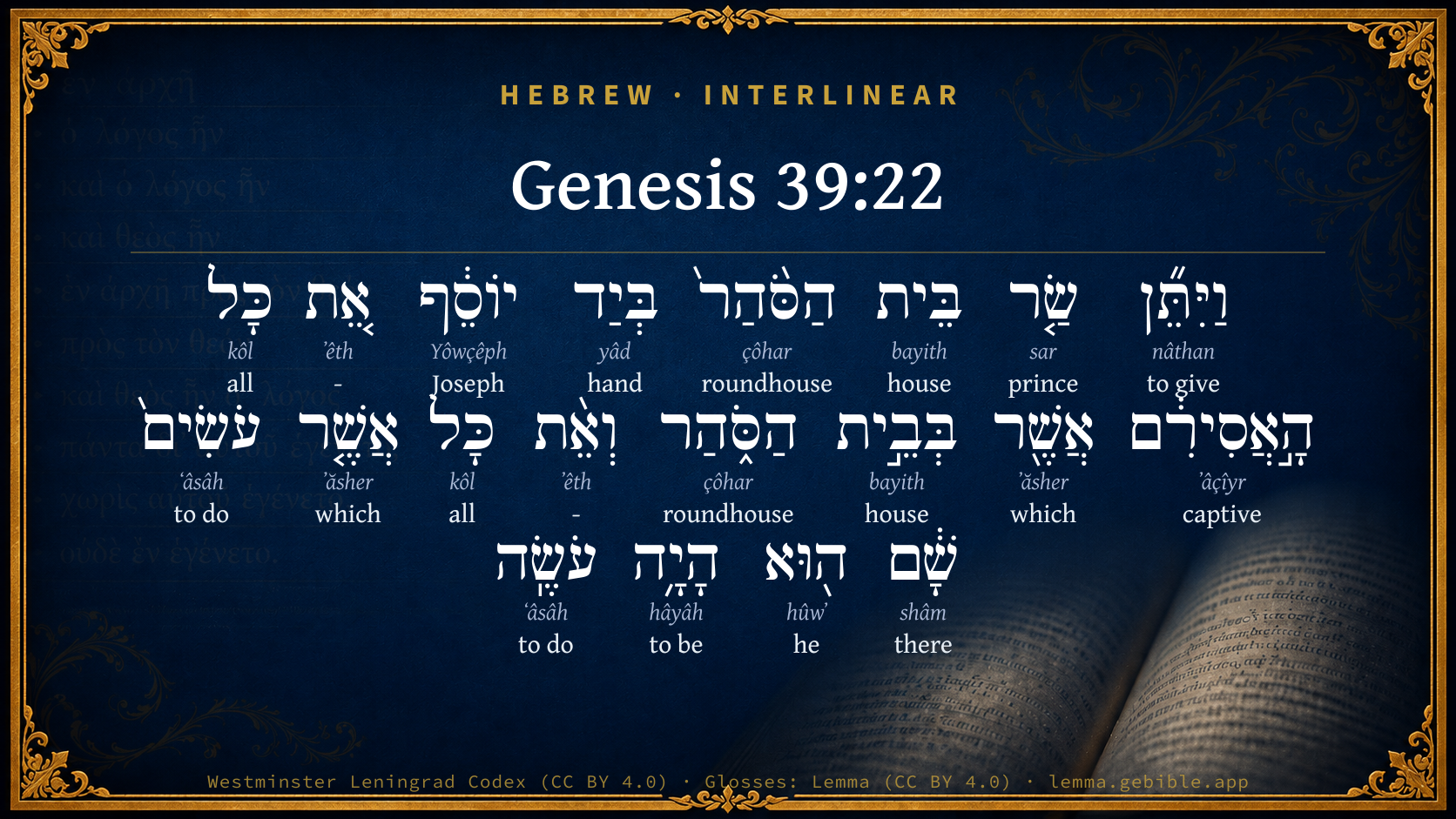
Hebrew (Westminster Leningrad Codex) Genesis 39:22 appears in the Hebrew Old Testament. The text above is from the Westminster Leningrad Codex. Each word links to its Strong’s number, a concise gloss, and parsing drawn from the Open Scriptures Hebrew Bible morphology. Click any word for its full Brown-Driver-Briggs (BDB) entry.
Download image
Cite this verse

Genesis 39:22 (World English Bible). Public Domain. Lemma interlinear Bible study tool, https://lemma.gebible.app/v/genesis/39/22.

Show BibTeX & RIS
BibTeX
RIS
English Translation
The keeper of the prison committed to Joseph's hand all the prisoners who were in the prison. Whatever they did there, he was the doer of it.
World English Bible · Public Domain
Download a study sheet

One document with this verse’s original text, its word-by-word gloss line, the meaning frame, cross-references with their text, attributed commentary, and full source and license credits — printable, and it pastes into notes with its structure intact.

This verse Autodidact and up

Study sheet (.html) Plain text (.txt)

A passage Seminary Student

Up to 50 verses in one chapter. A passage sheet keeps up to 6 commentary sources and 12 cross-references per verse, in the order this page ranks them, and says so on the sheet whenever that leaves anything out. Ask for a single verse and you get the Autodidact verse sheet above.

Everything on this page stays free to read, with no account — the sheet is a download of what is already on screen, not access to it.

Want to remove ads? Support Godless Engineer
Compare translations 3

The same verse in 3 English versions, stacked beneath the original-language interlinear above. Click any original word for its lexicon entry.

Each is an independent rendering of the whole verse — the interlinear is not word-aligned to these translations.

Highlighted words mark where these versions differ — a whole-verse word diff, not a word-by-word alignment.

  • World English Bible Public Domain
    The keeper of the prison committed to Joseph's hand all the prisoners who were in the prison. Whatever they did there, he was the doer of it.
  • King James Version Public Domain
    And the keeper of the prison committed to Joseph's hand all the prisoners that were in the prison; and whatsoever they did there, he was the doer of it.
  • unfoldingWord Literal Text CC BY-SA 4.0
    And the chief of the round-house gave into the hand of Joseph all the prisoners who in the round-house, and all that they were doing there, he was doing.

unfoldingWord Literal Text — © unfoldingWord, licensed CC BY-SA 4.0. Word-aligned USFM3 via Door43 (git.door43.org/unfoldingWord/en_ult).

Versions to compare (up to 4)

3 of 4 selected

Show all 18 translations

Every available English version of this verse, each an independent rendering of the whole verse.

  • World English Bible Public Domain
    The keeper of the prison committed to Joseph's hand all the prisoners who were in the prison. Whatever they did there, he was the doer of it.
  • Berean Standard Bible Public Domain
    And the warden put all the prisoners under Joseph’s care, so that he was responsible for all that was done in the prison.
  • Majority Standard Bible Public Domain
    And the warden put all the prisoners under Joseph’s care, so that he was responsible for all that was done in the prison.
  • King James Version Public Domain
    And the keeper of the prison committed to Joseph's hand all the prisoners that were in the prison; and whatsoever they did there, he was the doer of it.
  • American Standard Version (1901) Public Domain
    And the keeper of the prison committed to Joseph's hand all the prisoners that were in the prison; and whatsoever they did there, he was the doer of it.
  • Revised Version (1885) Public Domain
    And the keeper of the prison committed to Joseph’s hand all the prisoners that were in the prison; and whatsoever they did there, he was the doer of it.
  • Geneva Bible (1599) Public Domain
    And the keeper of the prison committed to Iosephs hande all the prisoners that were in the prison, and whatsoeuer they did there, that did he.
  • Douay-Rheims (1899) Public Domain
    And when he heard me cry, he left the garment which I held, and fled out.
  • Young's Literal Translation Public Domain
    and the chief of the round-house giveth into the hand of Joseph all the prisoners who `are' in the round-house, and of all that they are doing there, he hath been doer;
  • Literal Standard Version CC BY-SA 4.0
    and the chief of the round-house gives into the hand of Joseph all the prisoners who [are] in the round-house, and of all that they are doing there, he has been doer;
  • Unlocked Literal Bible CC BY-SA 4.0
    The prison warden gave into Joseph's hand all the prisoners who were in the prison. Whatever they did there, Joseph was in charge of it.
  • unfoldingWord Literal Text CC BY-SA 4.0
    And the chief of the round-house gave into the hand of Joseph all the prisoners who in the round-house, and all that they were doing there, he was doing.
  • Darby Bible Public Domain
    And the chief of the tower-house committed to Joseph's hand all the prisoners that were in the tower-house; and whatever they had to do there he did.
  • World Messianic Bible Public Domain
    The keeper of the prison committed to Joseph’s hand all the prisoners who were in the prison. Whatever they did there, he was responsible for it.
  • Webster's Bible Public Domain
    And the keeper of the prison committed to Joseph's hand all the prisoners that were in the prison; and whatever they did there, was done by him.
  • Free Bible Version CC BY-SA 4.0
    So the chief jailer put Joseph in charge of all the prisoners there and gave him the responsibility for running the prison.
  • Bible in Basic English Public Domain
    And the keeper of the prison put all the prisoners under Joseph's control, and he was responsible for whatever was done there.
  • JPS Tanakh (1917) Public Domain
    And the keeper of the prison committed to Joseph's hand all the prisoners that were in the prison; and whatsoever they did there, he was the doer of it.

Literal Standard Version (2020), Covenant Press — licensed CC BY-SA 4.0. Text via the HelloAO Bible API (eBible.org). Unlocked Literal Bible (unfoldingWord) — licensed CC BY-SA 4.0. Text via the HelloAO Bible API (eBible.org). unfoldingWord Literal Text — © unfoldingWord, licensed CC BY-SA 4.0. Word-aligned USFM3 via Door43 (git.door43.org/unfoldingWord/en_ult). Free Bible Version, Dr. Jonathan Gallagher — licensed CC BY-SA 4.0. Text via the HelloAO Bible API (eBible.org).

Word by word

More ways to search: Search by grammar → Find every occurrence → Compare this word →

Practice this passage: Drill this verse → Learn its vocabulary →

הַסֹּ֨הַר֙
çôhar
H5470
“the · roundhouse”
Particle, Definite Article + Noun, Common, Masculine, Singular, Absolute
Part of Speech
Particle + Noun
Type
Common
Gender
Masculine
Number
Singular
State
Absolute
Full BDB Definition

Origin: from the same as H5469

TWOT: 1468b

house of roundness, roundhouse, prison - name of a prison
  1. וַיִּתֵּ֞ן nâthan H5414 “and · to give” Conjunction + Verb, Qal, Sequential Imperfect, 3rd Person, Masculine, Singular
  2. שַׂ֤ר sar H8269 “prince of” Noun, Common, Masculine, Singular, Construct
  3. בֵּית bayith H1004 “house of” Noun, Common, Masculine, Singular, Construct
  4. בְּיַד yâd H3027 “in/at · hand of” Preposition + Noun, Common, Both, Singular, Construct
  5. יוֹסֵ֔ף Yôwçêph H3130 “Joseph” Noun, Proper
  6. אֵ֚ת ʼêth H853 “-” Particle, Direct Object
  7. כָּל kôl H3605 “all of” Noun, Common, Masculine, Singular, Construct
  8. הָ֣אֲסִירִ֔ם ʼâçîyr H615 “the · captives” Particle, Definite Article + Noun, Common, Masculine, Plural, Absolute
  9. אֲשֶׁ֖ר ʼăsher H834 “which” Particle, Relative
  10. בְּבֵ֣ית bayith H1004 “in/at · house of” Preposition + Noun, Common, Masculine, Singular, Construct
  11. הַסֹּ֑הַר çôhar H5470 “the · roundhouse” Particle, Definite Article + Noun, Common, Masculine, Singular, Absolute
  12. וְאֵ֨ת ʼêth H853 “and · -” Conjunction + Particle, Direct Object
  13. כָּל kôl H3605 “all of” Noun, Common, Masculine, Singular, Construct
  14. אֲשֶׁ֤ר ʼăsher H834 “which” Particle, Relative
  15. עֹשִׂים֙ ʻâsâh H6213 “doing” Verb, Qal, Participle Active, Masculine, Plural, Absolute
  16. שָׁ֔ם shâm H8033 “there” Adverb
  17. ה֖וּא hûwʼ H1931 “he” Pronoun, Personal, 3rd Person, Masculine, Singular
  18. הָיָ֥ה hâyâh H1961 “to be” Verb, Qal, Perfect, 3rd Person, Masculine, Singular
  19. עֹשֶֽׂה ʻâsâh H6213 “doing” Verb, Qal, Participle Active, Masculine, Singular, Absolute

About this verse

These counts appear in no published source. They are computed here, from the morphology-tagged text and Lemma’s own curated glosses. What Lemma adds →

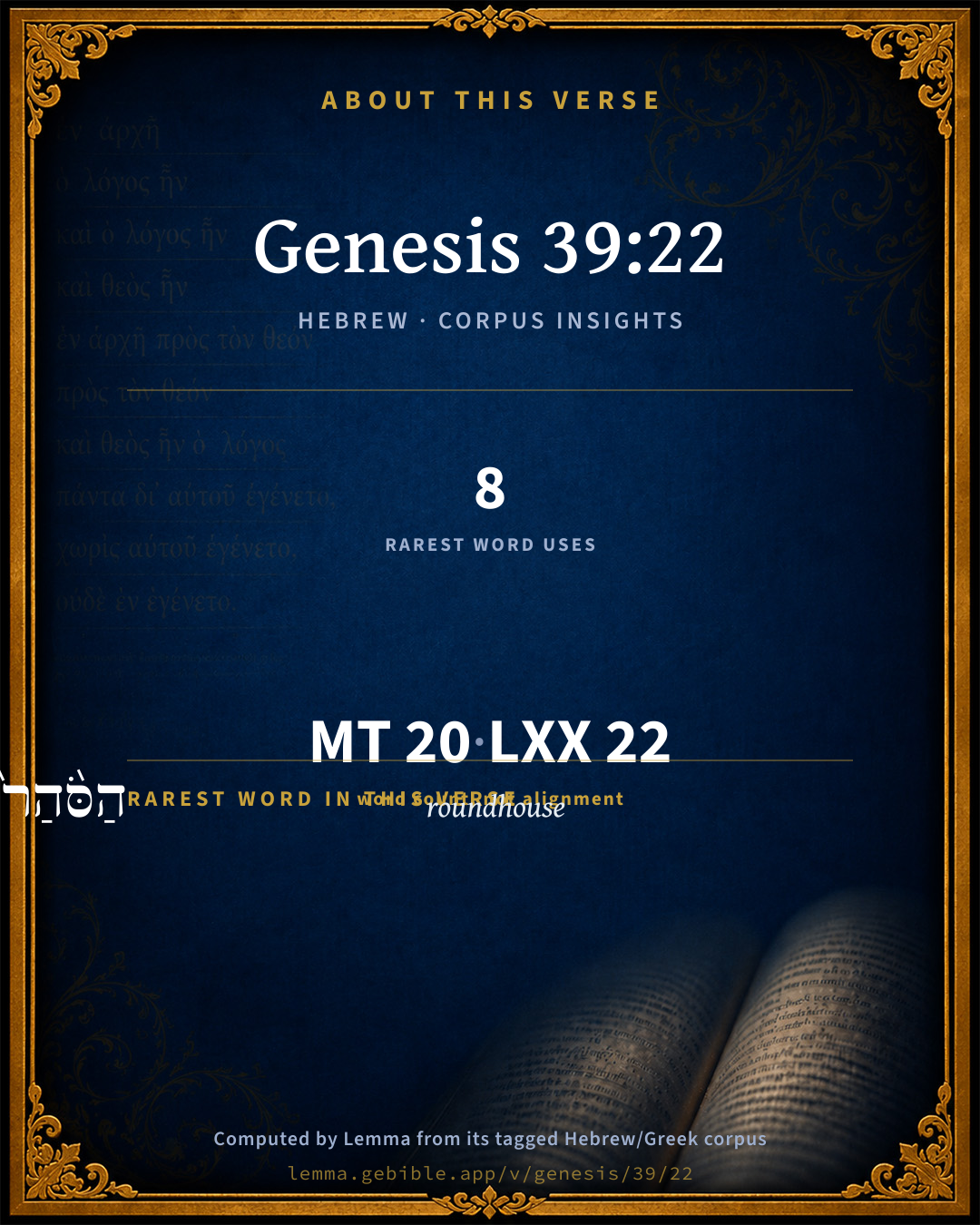
20
words
14
distinct lemmas
Pentateuch
section

Notable vocabulary

The rarest word here is הַסֹּ֨הַר֙ roundhouse H5470 — appearing just 8 times in the whole Hebrew Bible.

Shared distinctive vocabulary

הַסֹּ֨הַר֙ roundhouse H5470 occurs in 6 verses of the Hebrew Bible. Also found in:

Grammatical profile

  • 4 verbs
  • 10 nouns
  • 1 pronoun
  • 1 adverb
  • 4 particles

Verb forms

  • וַיִּתֵּ֞ן Qal · Sequential Imperfect
  • עֹשִׂים֙ Qal · Participle Active
  • הָיָ֥ה Qal · Perfect
  • עֹשֶֽׂה Qal · Participle Active

Repetition

Words recur within this verse — often emphatic in Hebrew:

  • בֵּית house H1004 ×2
  • הַסֹּ֨הַר֙ roundhouse H5470 ×2
  • כָּל all H3605 ×2
  • עֹשִׂים֙ to do H6213 ×2
  • אֲשֶׁ֖ר which H834 ×2

Hebrew & Septuagint length

In English translation the verse runs 27 words from the Hebrew and 36 from the Septuagint (LXX English) — closely comparable.

A rough comparison of the two English renderings, which tokenize alike — not a word-level alignment.

Word counts can differ between the Hebrew and the Greek without any difference in meaning — e.g. the Hebrew direct-object marker אֵת has no separate Greek word, and Greek often adds the article ὁ.

In the original languages it is 20 Hebrew tokens and 22 Greek tokens — but the two are counted differently (Hebrew bundles its prefixes and suffixes into one token; the Greek is in lemma form), so that isn’t a like-for-like length.

Cross-references

7

Topical passages linked to Genesis 39:22 in the Treasury of Scripture Knowledge — connected by theme and wording, ordered by reader-vote popularity; previews shown in the World English Bible.

  • Genesis 39:4 Joseph found favor in his sight. He ministered to him, and he made him overseer over his house, and all that he had he put into his hand.
  • Genesis 40:3–4 He put them in custody in the house of the captain of the guard, into the prison, the place where Joseph was bound.
  • Genesis 39:6–7 He left all that he had in Joseph's hand. He didn't concern himself with anything, except for the food which he ate. Joseph was well-built and handsome.
  • Genesis 39:9 He isn't greater in this house than I, neither has he kept back anything from me but you, because you are his wife. How then can I do this great wickedness, and sin against God?"
  • 1 Samuel 2:30 Therefore Yahweh, the God of Israel, says, I said indeed that your house, and the house of your father, should walk before me forever: but now Yahweh says, Be it far from me; for those who honor me I will honor, and those who despise me shall be lightly esteemed.
  • Psalms 37:3 Trust in Yahweh, and do good. Dwell in the land, and enjoy safe pasture.
  • Psalms 37:11 But the humble shall inherit the land, And shall delight themselves in the abundance of peace.

Cross-references courtesy of OpenBible.info (CC BY 4.0).

Hebrew and Greek witnesses Masoretic Hebrew ↔ Greek Septuagint

The same verse in the two great witnesses to the Old Testament, shown verse-for-verse.

These are two independent witnesses, not word-aligned to each other, and the Septuagint is shown in lemma (dictionary) form.

Hebrew Genesis 39:22 Masoretic · Westminster Leningrad Codex

וַיִּתֵּ֞ן שַׂ֤ר בֵּית הַסֹּ֨הַר֙ בְּיַד יוֹסֵ֔ף אֵ֚ת כָּל הָ֣אֲסִירִ֔ם אֲשֶׁ֖ר בְּבֵ֣ית הַסֹּ֑הַר וְאֵ֨ת כָּל אֲשֶׁ֤ר עֹשִׂים֙ שָׁ֔ם ה֖וּא הָיָ֥ה עֹשֶֽׂה

The keeper of the prison committed to Joseph's hand all the prisoners who were in the prison. Whatever they did there, he was the doer of it.

World English Bible · Public Domain

Greek LXX Genesis 39:22 Septuagint · lemma form

καί δίδωμι ὁ ἀρχιδεσμοφύλαξ ὁ δεσμωτήριον διά χείρ ιωσηφ καί πᾶς ὁ ἀποἄγω ὅσος ἐν ὁ δεσμωτήριον καί πᾶς ὅσος ποιέω ἐκεῖ

And the chief keeper of the prison gave the prison into the hand of Joseph, and all the prisoners as many as were in the prison; and all things whatever they do there, he did them.

LXX2012 (modern English Septuagint) · Public Domain

Hebrew: Westminster Leningrad Codex (CC BY 4.0). Greek: Septuagint (public domain); English from LXX2012 (modern English Septuagint) (Public Domain). How the Septuagint differs from the Hebrew →

Targum (Aramaic paraphrase)

2

The Targum is the ancient Jewish Aramaic paraphrase of the Hebrew Scriptures — an interpretive translation, not the Hebrew text itself. Onkelos (literal) and Pseudo-Jonathan (expansive) render the Torah, and Jonathan the Prophets. Coverage is partial: where no permissively-licensed English translation exists for a verse, only the Aramaic is shown. This is verse-level text, not a word-by-word alignment to the Hebrew.

  1. Targum Onkelos Torah (Genesis–Deuteronomy)
    וִיהַב רַב בֵּית אֲסִירֵי בִּידָא דְיוֹסֵף יָת כָּל אֲסִירַיָּא דִּי בְּבֵית אֲסִירֵי וְיָת כָּל דִּי עָבְדִין תַּמָּן עַל מֵימְרֵהּ הֲוָה מִתְעֲבֵד

    (no public-domain English translation for this verse)

    Targum Onkelos — Aramaic: “Onkelos Genesis” (public domain); “Onkelos Exodus” (public domain); “Onkelos Leviticus” (public domain); “Onkelos Numbers” (public domain); “Onkelos Deuteronomy” (public domain). English: “Sefaria Community Translation” (CC0 1.0 (public-domain dedication)); “J.W. Etheridge. The Targums of Onkelos and Jonathan Ben Uzziel on the Pentateuch. London: Longmans, Green, 1862” (public domain). Text via Sefaria.

  2. Targum Pseudo-Jonathan Torah (Genesis–Deuteronomy)
    וּמַנִי רַב בֵּית אֲסִירֵי בְּיַד יוֹסֵף יַת כָּל אֲסִירַיָא דִבְבֵית אֲסִירֵי וְיַת כָּל דְעָבְדִין תַּמָן הוּא מִפְקָד לְמֶעֱבַד

    And the captain of the prison confided all the prisoners who were in the house to Joseph's hands, and whatsoever was done there he commanded to be done.

    Targum Pseudo-Jonathan — Aramaic: “Targum Jonathan on Genesis” (public domain); “Targum Jonathan on Exodus” (public domain); “Targum Jonathan on Leviticus” (public domain); “Targum Jonathan on Numbers” (public domain); “Targum Jonathan on Deuteronomy” (public domain). English: “The Targum of Jonathan ben Uzziel, trans. J. W. Etheridge, London, 1862” (public domain). Text via Sefaria.

Commentary

Notes on Genesis 39:22 from classic Christian and Jewish commentators (each source and its license shown beneath its notes). The classic Christian expositions comment on the surrounding passage and are grouped to its opening verse, so a note may address several verses; the Jewish commentaries on the Tanakh (Rashi and others) are per-verse, so they appear only where the commentator wrote on this verse.

Lemma curates 59 commentaries, every one of them public domain or Creative Commons licensed, each selected and text-cleaned for this edition rather than reprinted as found. About our sources →

Trapp's Complete Commentary

John Trapp

Gen 39:22 And the keeper of the prison committed to Joseph’s hand all the prisoners that [were] in the prison; and whatsoever they did there, he was the doer [of it].

Ver. 22. And the keeper of the prison.] Here Joseph experimented that of St Peter. {1Pe 2:20}

John Trapp, A Commentary or Exposition upon All the Books of the Old and New Testament (1647–1656) — public domain. Text from a community e-Sword module.

Geneva Bible (1599)

Geneva Bible translators

That is, nothing was done without his commandment.

Geneva Bible (1599) marginal notes — public domain. Text via Bolls.life.

John Gill's Exposition

And the keeper of the prison committed to Joseph's hand all the prisoners that were in the prisons,.... Who, as they were state prisoners, were a considerable charge; and this gave Joseph great honour, credit, and influence in the prison:

and whatsoever they did there, he was the doer of it; not that he learned and exercised every trade the prisoners were of, to get a living by, which is the sense of some, as Aben Ezra relates; or that he in fact did everything that was done in the prison: but the meaning is, that he gave orders for the doing of everything, and there was nothing done without him; all that was done, as the Targum of Jonathan paraphrases it, he commanded it to be done; or, as Onkelos, all that was done was done by his word, that is, by his authority and command.

John Gill's Exposition of the Whole Bible (1746–1763) — public domain (CC PDM 1.0). Text via the HelloAO Bible API.

Matthew Poole's English Annotations

They did nothing but by Joseph’s command or permission.

Matthew Poole's English Annotations on the Holy Bible (1683–1685) — public domain. Text from a community e-Sword/MySword module.

The Pulpit Commentary

Vers. 22, 23. And the keeper of the prison (captain of the round house, or chief officer of the tower) committed to Joseph"s hand all the prisoners that were in the prison; and whatsoever they did there, he was the doer of it literally, and all that they (the prisoners) were doing there, he was the person doing it, or attending to it; i.e. the keeper gave him charge to see that the prisoners obeyed whatever orders were issued for their regulation; and, having implicit confidence in Joseph"s probity, the keeper of the prison looked not to anything that was under (or in) his hand (i.e. he did not trouble himself about anything entrusted to Joseph); because the Lord (Jehovah) was with him, and that which he did, the Lord (Jehovah) made it to prosper.

HOMILIES BY F. HASTINGS Ver. 22.

Joseph as prison warden.

the keeper of the prison committed to Joseph s hands all the prisoners that were in the prison," &c. Joseph is unjustly treated and thrown into prison. Here he makes the best of circumstances. He gains the confidence of the keeper. The keeper of the State prison is glad to find one like Joseph, to whom he can delegate much toil and responsibility. ;

I DUTY DISCHARGED IN A SYMPATHETIC SPIRIT. He admits many to prison, and feels for all. He sees that it is but a step from the presence-chamber of Pharaoh to a vile prison. To those who found higher places slippery, and those who found the temptations of poverty too strong, he shows his pity. His own bitter separation from friends makes him sympathetic.

II DUTY DISCHARGED IN A CHEERFUL SPIRIT. Generally he had a smile for the prisoners. They looked for it, and responded to it. The heart can give to the sad that which is better than gold a cheerful helpfulness. Our gloom can lay extra burdens on others.

III DUTY DISCHARGED IN A COURTEOUS SPIRIT. He would not trample on those already fallen. He inquires even into the cause of the sadness of the prisoners, and interprets for them dreams which had perplexed them. His own dreams had made him at one time elate, but they seem as yet far from being fulfilled. Still this only leads him to be more courteous to those who may also be doomed to disappointment. The sympathy, cheerfulness, and courtesy of Joseph made him eventually prime minister of Egypt. H.

The Pulpit Commentary (1880–1919), ed. H.D.M. Spence-Jones & Joseph S. Exell — public domain. Text from a community e-Sword module.

Rashi

Rabbi Shlomo Yitzchaki (Rashi)

הוא היה עושה HE WAS THE DOER OF IT — understand this as the Targum does: it was done at his command.

Rashi on the Tanakh — English translations: “The Judaica Press complete Tanach with Rashi, translated by A. J. Rosenberg” (CC BY 4.0); “Pentateuch with Rashi's commentary by M. Rosenbaum and A.M. Silbermann, 1929-1934” (public domain); “The Metsudah Tanach series, Lakewood, N.J” (CC BY 4.0); and “The Book of Joshua, Metsudah Publications, 1997” (CC BY 4.0). Text via Sefaria.

Lesson kit

Teaching starters — assembled from the data on this page, not authored interpretation. Every prompt links to the verse data it draws on. Edit before teaching.

Genesis, in the Pentateuch, opens this verse with 20 words (14 distinct Hebrew lemmas). Its most distinctive word is çôhar (“roundhouse”). A historical commentator’s framing appears above. Read the whole chapter for the surrounding context.

Discussion questions

  1. What does “roundhouse” (çôhar) contribute to the verse as a whole?
  2. Genesis 39:20 shares the word «roundhouse» with this verse. How do the two illuminate each other?
  3. “house” occurs 2× in this one verse. What is the effect of the repetition?
  4. The translations on this page render this verse differently — a whole-verse word diff, not a word-by-word alignment. What might account for the different wordings?
  5. The verb «וַיִּתֵּ֞ן» is Qal Sequential Imperfect. How does its form color the action?
  6. Reading how Trapp's Complete Commentary and Geneva Bible (1599) read this verse, where do the two commentators agree and where do they part?

Things to notice

Reading settings

Reading text

Shown beneath each verse's original-language words.

Old Testament
Old Testament edition

Read the OT as the Masoretic Hebrew (MT) or the Greek Septuagint (LXX).

English shown for the Greek Septuagint (in the Hebrew ↔ Greek comparison).

Comparing translations? Open the Compare panel on any verse page to stack up to four side by side.