
Deuteronomy 18:3

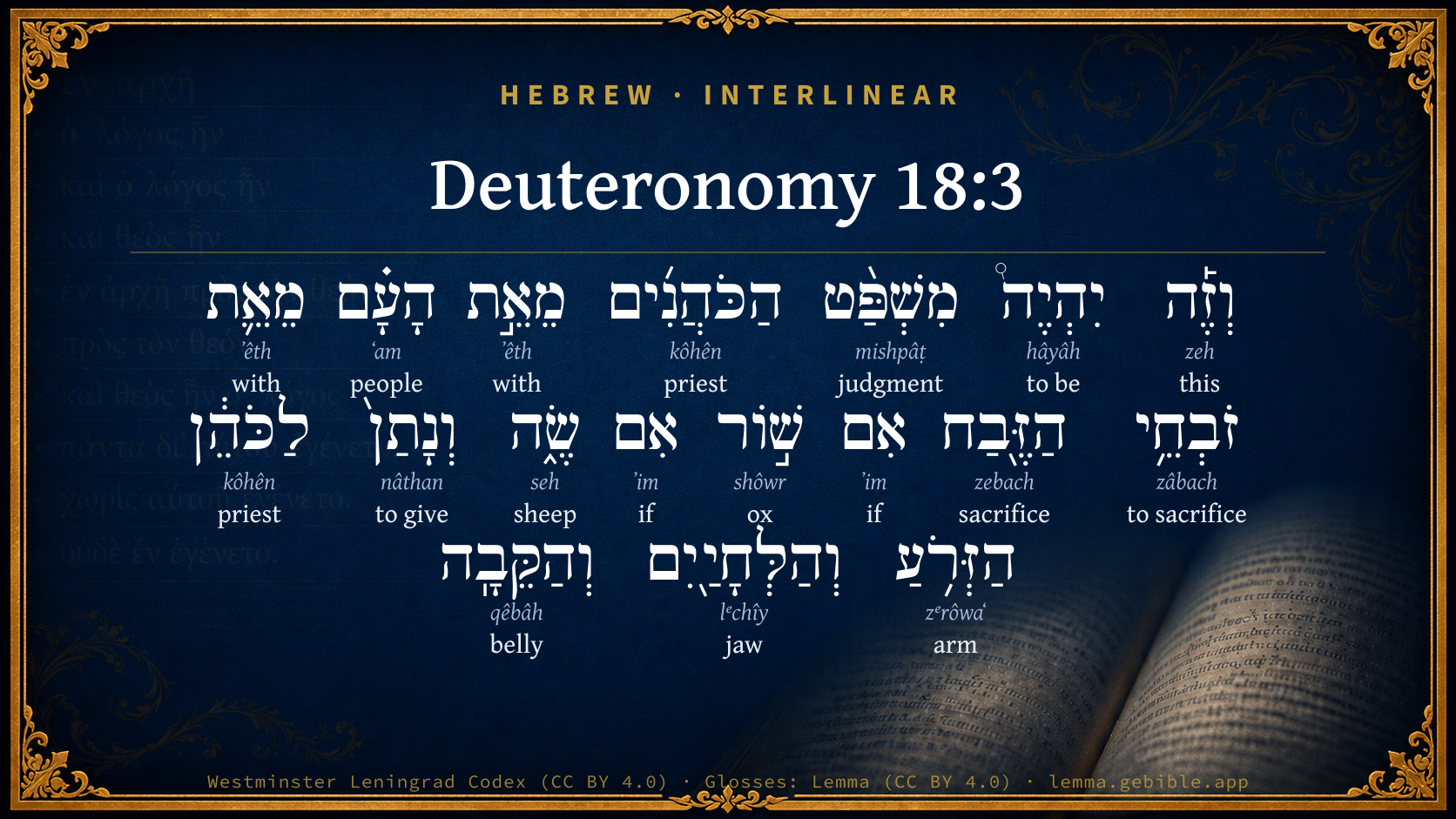
Hebrew (Westminster Leningrad Codex) Deuteronomy 18:3 appears in the Hebrew Old Testament. The text above is from the Westminster Leningrad Codex. Each word links to its Strong’s number, a concise gloss, and parsing drawn from the Open Scriptures Hebrew Bible morphology. Click any word for its full Brown-Driver-Briggs (BDB) entry.
Download image
Cite this verse

Deuteronomy 18:3 (World English Bible). Public Domain. Lemma interlinear Bible study tool, https://lemma.gebible.app/v/deuteronomy/18/3.

Show BibTeX & RIS
BibTeX
RIS
English Translation
This shall be the priests' due from the people, from those who offer a sacrifice, whether it be ox or sheep, that they shall give to the priest the shoulder, and the two cheeks, and the maw.
World English Bible · Public Domain
Highlights
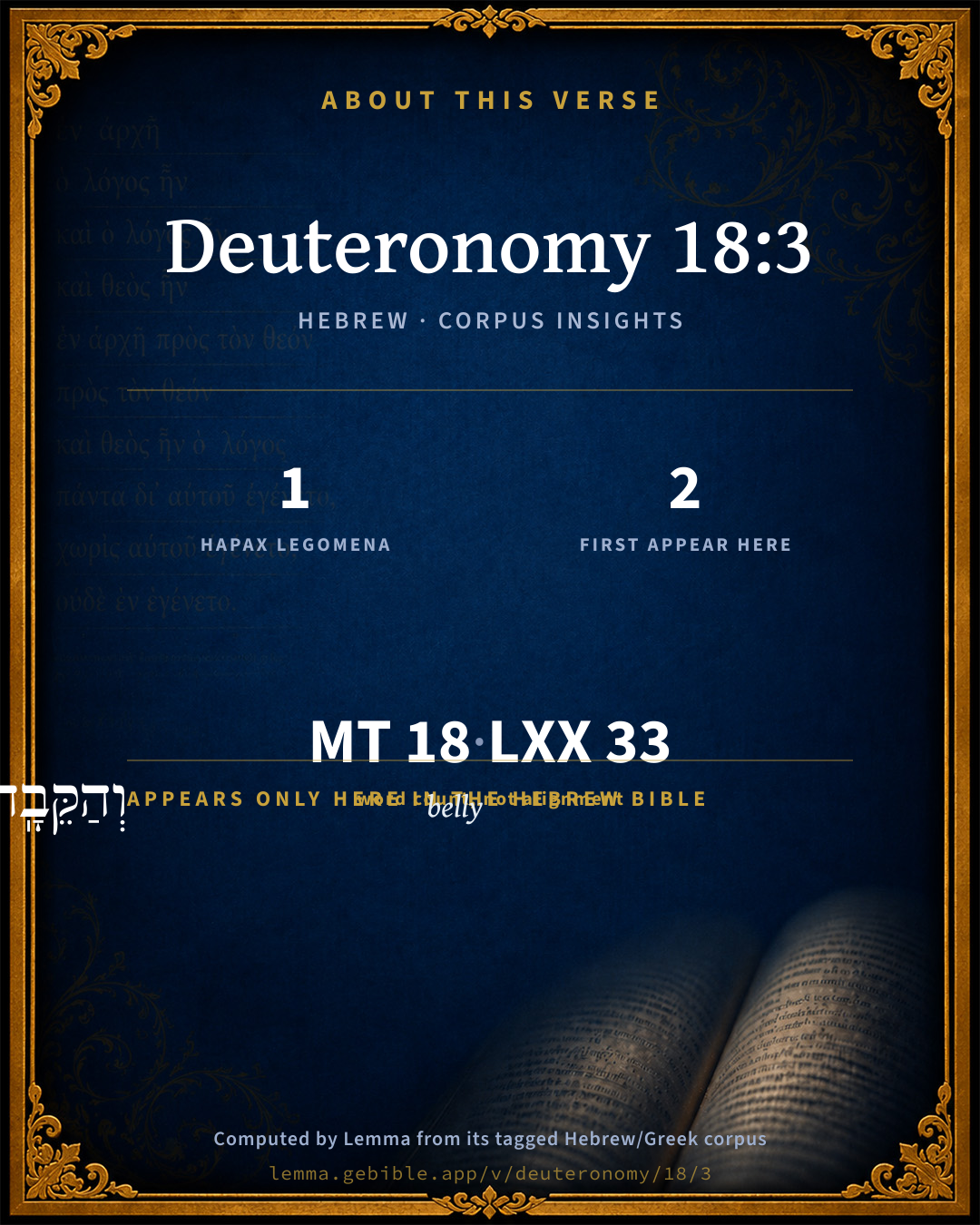
  • 1 hapax legomenon — only here in the Hebrew Bible
  • 2 first appearances in the Hebrew Bible
Full analysis ↓
Download a study sheet

One document with this verse’s original text, its word-by-word gloss line, the meaning frame, cross-references with their text, attributed commentary, and full source and license credits — printable, and it pastes into notes with its structure intact.

This verse Autodidact and up

Study sheet (.html) Plain text (.txt)

A passage Seminary Student

Up to 50 verses in one chapter. A passage sheet keeps up to 6 commentary sources and 12 cross-references per verse, in the order this page ranks them, and says so on the sheet whenever that leaves anything out. Ask for a single verse and you get the Autodidact verse sheet above.

Everything on this page stays free to read, with no account — the sheet is a download of what is already on screen, not access to it.

Want to remove ads? Support Godless Engineer
Compare translations 3

The same verse in 3 English versions, stacked beneath the original-language interlinear above. Click any original word for its lexicon entry.

Each is an independent rendering of the whole verse — the interlinear is not word-aligned to these translations.

Highlighted words mark where these versions differ — a whole-verse word diff, not a word-by-word alignment.

  • World English Bible Public Domain
    This shall be the priests' due from the people, from those who offer a sacrifice, whether it be ox or sheep, that they shall give to the priest the shoulder, and the two cheeks, and the maw.
  • King James Version Public Domain
    And this shall be the priest's due from the people, from them that offer a sacrifice, whether it be ox or sheep; and they shall give unto the priest the shoulder, and the two cheeks, and the maw.
  • unfoldingWord Literal Text CC BY-SA 4.0
    And this is the ordinance of the priests, from the people, from those who offer a sacrifice, whether an oxen or a sheep, and they shall give the shoulder and the two cheeks and the stomach to the priest.

unfoldingWord Literal Text — © unfoldingWord, licensed CC BY-SA 4.0. Word-aligned USFM3 via Door43 (git.door43.org/unfoldingWord/en_ult).

Versions to compare (up to 4)

3 of 4 selected

Show all 18 translations

Every available English version of this verse, each an independent rendering of the whole verse.

  • World English Bible Public Domain
    This shall be the priests' due from the people, from those who offer a sacrifice, whether it be ox or sheep, that they shall give to the priest the shoulder, and the two cheeks, and the maw.
  • Berean Standard Bible Public Domain
    This shall be the priests’ share from the people who offer a sacrifice, whether a bull or a sheep: the priests are to be given the shoulder, the jowls, and the stomach.
  • Majority Standard Bible Public Domain
    This shall be the priests’ share from the people who offer a sacrifice, whether a bull or a sheep: the priests are to be given the shoulder, the jowls, and the stomach.
  • King James Version Public Domain
    And this shall be the priest's due from the people, from them that offer a sacrifice, whether it be ox or sheep; and they shall give unto the priest the shoulder, and the two cheeks, and the maw.
  • American Standard Version (1901) Public Domain
    And this shall be the priests' due from the people, from them that offer a sacrifice, whether it be ox or sheep, that they shall give unto the priest the shoulder, and the two cheeks, and the maw.
  • Revised Version (1885) Public Domain
    And this shall be the priests’ due from the people, from them that offer a sacrifice, whether it be ox or sheep, that they shall give unto the priest the shoulder, and the two cheeks, and the maw.
  • Geneva Bible (1599) Public Domain
    And this shalbe the Priests duetie of the people, that they, which offer sacrifice, whether it be bullocke or sheepe, shall giue vnto the Priest the shoulder, and the two cheekes, and the mawe.
  • Douay-Rheims (1899) Public Domain
    This shall be the priest's due from the people, and from them that offer victims: whether they sacrifice an ox, or a sheep, they shall give to the priest the shoulder and the breast:
  • Young's Literal Translation Public Domain
    `And this is the priest's right from the people, from those sacrificing a sacrifice, whether ox or sheep, he hath even given to the priest the leg, and the two cheeks, and the stomach;
  • Literal Standard Version CC BY-SA 4.0
    And this is the priest’s right from the people, from those sacrificing a sacrifice, whether ox or sheep, he has even given to the priest the leg, and the two cheeks, and the stomach;
  • Unlocked Literal Bible CC BY-SA 4.0
    This is the share given to the priests, given to them from the people who offer a sacrifice, whether it be an oxen or a sheep: the shoulder, the two cheeks, and the inner parts.
  • unfoldingWord Literal Text CC BY-SA 4.0
    And this is the ordinance of the priests, from the people, from those who offer a sacrifice, whether an oxen or a sheep, and they shall give the shoulder and the two cheeks and the stomach to the priest.
  • Darby Bible Public Domain
    And this shall be the priest's due from the people, from them that sacrifice a sacrifice, whether ox, or sheep: they shall give unto the priest the shoulder, and the jawbones, and the maw.
  • World Messianic Bible Public Domain
    This shall be the priests’ due from the people, from those who offer a sacrifice, whether it be ox or sheep, that they shall give to the priest: the shoulder, the two cheeks, and the inner parts.
  • Webster's Bible Public Domain
    And this shall be the priest's due from the people, from them that offer a sacrifice, whether ox or sheep; and they shall give to the priest the shoulder, and the two cheeks, and the maw.
  • Free Bible Version CC BY-SA 4.0
    The priests' share of a sacrifice of a bull or a sheep that is brought by the people is as follows. The priests are to be given the shoulder, the jaw, and the insides.
  • Bible in Basic English Public Domain
    And this is to be the priests' right: those who make an offering of a sheep or an ox are to give to the priest the top part of the leg and the two sides of the head and the stomach.
  • JPS Tanakh (1917) Public Domain
    And this shall be the priests' due from the people, from them that offer a sacrifice, whether it be ox or sheep, that they shall give unto the priest the shoulder, and the two cheeks, and the maw.

Literal Standard Version (2020), Covenant Press — licensed CC BY-SA 4.0. Text via the HelloAO Bible API (eBible.org). Unlocked Literal Bible (unfoldingWord) — licensed CC BY-SA 4.0. Text via the HelloAO Bible API (eBible.org). unfoldingWord Literal Text — © unfoldingWord, licensed CC BY-SA 4.0. Word-aligned USFM3 via Door43 (git.door43.org/unfoldingWord/en_ult). Free Bible Version, Dr. Jonathan Gallagher — licensed CC BY-SA 4.0. Text via the HelloAO Bible API (eBible.org).

Word by word

More ways to search: Search by grammar → Find every occurrence → Compare this word →

Practice this passage: Drill this verse → Learn its vocabulary →

וְהַקֵּבָֽה
qêbâh
H6896
“and · the · belly”
Conjunction + Particle, Definite Article + Noun, Common, Feminine, Singular, Absolute
Part of Speech
Conjunction + Particle + Noun
Type
Common
Gender
Feminine
Number
Singular
State
Absolute
Full BDB Definition

Origin: from H6895

TWOT: 1979a

stomach, belly, maw - stomach (of sacrificial victim) - belly (of woman)
  1. וְזֶ֡ה zeh H2088 “and · this” Conjunction + Pronoun, Demonstrative, Masculine, Singular
  2. יִהְיֶה֩ hâyâh H1961 “to be” Verb, Qal, Imperfect, 3rd Person, Masculine, Singular
  3. מִשְׁפַּ֨ט mishpâṭ H4941 “judgment of” Noun, Common, Masculine, Singular, Construct
  4. הַכֹּהֲנִ֜ים kôhên H3548 “the · priests” Particle, Definite Article + Noun, Common, Masculine, Plural, Absolute
  5. מֵאֵ֣ת ʼêth H854 “from · with” Preposition + Preposition
  6. הָעָ֗ם ʻam H5971 “the · people” Particle, Definite Article + Noun, Common, Masculine, Singular, Absolute
  7. מֵאֵ֛ת ʼêth H854 “from · with” Preposition + Preposition
  8. זֹבְחֵ֥י zâbach H2076 “sacrificing” Verb, Qal, Participle Active, Masculine, Plural, Construct
  9. הַזֶּ֖בַח zebach H2077 “the · sacrifice” Particle, Definite Article + Noun, Common, Masculine, Singular, Absolute
  10. אִם ʼim H518 “if” Conjunction
  11. שׁ֣וֹר shôwr H7794 “ox” Noun, Common, Masculine, Singular, Absolute
  12. אִם ʼim H518 “if” Conjunction
  13. שֶׂ֑ה seh H7716 “sheep” Noun, Common, Both, Singular, Absolute
  14. וְנָתַן֙ nâthan H5414 “and · to give” Conjunction + Verb, Qal, Sequential Perfect, 3rd Person, Masculine, Singular
  15. לַכֹּהֵ֔ן kôhên H3548 “to/for the · priest” Preposition, Determined + Noun, Common, Masculine, Singular, Absolute
  16. הַזְּרֹ֥עַ zᵉrôwaʻ H2220 “the · arm” Particle, Definite Article + Noun, Common, Both, Singular, Absolute
  17. וְהַלְּחָיַ֖יִם lᵉchîy H3895 “and · the · jaws” Conjunction + Particle, Definite Article + Noun, Common, Both, Dual, Absolute

About this verse

These counts appear in no published source. They are computed here, from the morphology-tagged text and Lemma’s own curated glosses. What Lemma adds →

18
words
15
distinct lemmas
Pentateuch
section

Notable vocabulary

1 hapax legomenon — a word that appears only here in the entire Hebrew Bible:

  • וְהַקֵּבָֽה belly H6896

First appearance in Scripture

These words make their first canonical appearance in the Hebrew Bible here:

  • וְהַלְּחָיַ֖יִם jaw H3895
  • וְהַקֵּבָֽה belly H6896

Shared distinctive vocabulary

וְהַלְּחָיַ֖יִם jaw H3895 occurs in 20 verses of the Hebrew Bible. Also found in:

Grammatical profile

  • 3 verbs
  • 10 nouns
  • 1 pronoun
  • 2 prepositions
  • 2 conjunctions

Verb forms

  • יִהְיֶה֩ Qal · Imperfect
  • זֹבְחֵ֥י Qal · Participle Active
  • וְנָתַן֙ Qal · Sequential Perfect

Repetition

Words recur within this verse — often emphatic in Hebrew:

  • הַכֹּהֲנִ֜ים priest H3548 ×2
  • מֵאֵ֣ת with H854 ×2
  • אִם if H518 ×2

Hebrew & Septuagint length

In English translation the verse runs 37 words from the Hebrew and 44 from the Septuagint (LXX English) — closely comparable.

A rough comparison of the two English renderings, which tokenize alike — not a word-level alignment.

Word counts can differ between the Hebrew and the Greek without any difference in meaning — e.g. the Hebrew direct-object marker אֵת has no separate Greek word, and Greek often adds the article ὁ.

In the original languages it is 18 Hebrew tokens and 33 Greek tokens — but the two are counted differently (Hebrew bundles its prefixes and suffixes into one token; the Greek is in lemma form), so that isn’t a like-for-like length.

Cross-references

2

Topical passages linked to Deuteronomy 18:3 in the Treasury of Scripture Knowledge — connected by theme and wording, ordered by reader-vote popularity; previews shown in the World English Bible.

  • Leviticus 7:30–34 With his own hands he shall bring the offerings of Yahweh made by fire. He shall bring the fat with the breast, that the breast may be waved for a wave offering before Yahweh.
  • Deuteronomy 12:27 and you shall offer your burnt offerings, the flesh and the blood, on the altar of Yahweh your God; and the blood of your sacrifices shall be poured out on the altar of Yahweh your God; and you shall eat the flesh.

Cross-references courtesy of OpenBible.info (CC BY 4.0).

Hebrew and Greek witnesses Masoretic Hebrew ↔ Greek Septuagint

The same verse in the two great witnesses to the Old Testament, shown verse-for-verse.

These are two independent witnesses, not word-aligned to each other, and the Septuagint is shown in lemma (dictionary) form.

Hebrew Deuteronomy 18:3 Masoretic · Westminster Leningrad Codex

וְזֶ֡ה יִהְיֶה֩ מִשְׁפַּ֨ט הַכֹּהֲנִ֜ים מֵאֵ֣ת הָעָ֗ם מֵאֵ֛ת זֹבְחֵ֥י הַזֶּ֖בַח אִם שׁ֣וֹר אִם שֶׂ֑ה וְנָתַן֙ לַכֹּהֵ֔ן הַזְּרֹ֥עַ וְהַלְּחָיַ֖יִם וְהַקֵּבָֽה

This shall be the priests' due from the people, from those who offer a sacrifice, whether it be ox or sheep, that they shall give to the priest the shoulder, and the two cheeks, and the maw.

World English Bible · Public Domain

Greek LXX Deuteronomy 18:3 Septuagint · lemma form

καί οὗτος ὁ κρίσις ὁ ἱερεύς ὁ παρά ὁ λαός παρά ὁ θύω ὁ θῦμα ἐάν τε μόσχος ἐάν τε πρόβατον καί δίδωμι ὁ ἱερεύς ὁ βραχίων καί ὁ σιαγόνιον καί ὁ ἔνυστρον

And this is the due of the priests in the things coming from the people from those who offer sacrifices, whether it be a calf or a sheep; and you shall give the shoulder to the priest, and the cheeks, and the great intestine:

LXX2012 (modern English Septuagint) · Public Domain

On this verse, John Gill's Exposition discusses the Septuagint’s reading. Read the note in Commentary ↓

Hebrew: Westminster Leningrad Codex (CC BY 4.0). Greek: Septuagint (public domain); English from LXX2012 (modern English Septuagint) (Public Domain). How the Septuagint differs from the Hebrew →

Targum (Aramaic paraphrase)

2

The Targum is the ancient Jewish Aramaic paraphrase of the Hebrew Scriptures — an interpretive translation, not the Hebrew text itself. Onkelos (literal) and Pseudo-Jonathan (expansive) render the Torah, and Jonathan the Prophets. Coverage is partial: where no permissively-licensed English translation exists for a verse, only the Aramaic is shown. This is verse-level text, not a word-by-word alignment to the Hebrew.

  1. Targum Onkelos Torah (Genesis–Deuteronomy)
    וְדֵין יְהֵי דְחָזֵי לְכָהֲנַיָא מִן עַמָא מִן נָכְסֵי נִכְסָתָא אִם תּוֹר אִם אִמָר וְיִתֵּן לְכַהֲנָא דְרוֹעָא וְלוֹעָא וְקֻבְתָא

    (no public-domain English translation for this verse)

    Targum Onkelos — Aramaic: “Onkelos Genesis” (public domain); “Onkelos Exodus” (public domain); “Onkelos Leviticus” (public domain); “Onkelos Numbers” (public domain); “Onkelos Deuteronomy” (public domain). English: “Sefaria Community Translation” (CC0 1.0 (public-domain dedication)); “J.W. Etheridge. The Targums of Onkelos and Jonathan Ben Uzziel on the Pentateuch. London: Longmans, Green, 1862” (public domain). Text via Sefaria.

  2. Targum Pseudo-Jonathan Torah (Genesis–Deuteronomy)
    וְדֵין יְהֵי חוּלְקָא דְּחָמֵי לְכַהֲנַיָא מִן עַמָּא מִלְוַת דִּבְחֵי דִבְחִין אִין תּוֹר אִין אִימַר וְיִתְּנוּן לְכַהֲנָא אִדְרָעָא דְיַמִּינָא וְלוּחַיָא אַרְעֲיָא וְלוּחַיָא דִרְקִיתָא וְקֵיבְתָא

    And this shall be the portion belonging to the priest from the people, from them who offer sacrifices, whether bullock or lamb they shall give to the priest the right shoulder, the lower jaw, the cheeks, and the maw;

    Targum Pseudo-Jonathan — Aramaic: “Targum Jonathan on Genesis” (public domain); “Targum Jonathan on Exodus” (public domain); “Targum Jonathan on Leviticus” (public domain); “Targum Jonathan on Numbers” (public domain); “Targum Jonathan on Deuteronomy” (public domain). English: “The Targum of Jonathan ben Uzziel, trans. J. W. Etheridge, London, 1862” (public domain). Text via Sefaria.

Commentary

Notes on Deuteronomy 18:3 from classic Christian and Jewish commentators (each source and its license shown beneath its notes). The classic Christian expositions comment on the surrounding passage and are grouped to its opening verse, so a note may address several verses; the Jewish commentaries on the Tanakh (Rashi and others) are per-verse, so they appear only where the commentator wrote on this verse.

Lemma curates 59 commentaries, every one of them public domain or Creative Commons licensed, each selected and text-cleaned for this edition rather than reprinted as found. About our sources →

Joseph Benson's Commentary

Deu 18:3. The maw — The Hebrew word here rendered maw, or stomach, may have another signification; and some render it the breast; others take it for the part which lies under the breast.

Joseph Benson's Commentary on the Old and New Testaments (1811–1818) — public domain. Text from a community e-Sword module.

Tyndale Open Study Notes

Tyndale Open Resources

18:3 In the dietary fare of ancient Israel, the shoulder, the cheeks, and the stomach of oxen and sheep were the choice cuts. God’s priestly servants were to be honored by receiving the very best (see Lev 7:28-34).

Tyndale Open Study Notes — © Tyndale Open Resources, licensed CC BY-SA 4.0. Text via the HelloAO Bible API.

Geneva Bible (1599)

Geneva Bible translators

The right shoulder, Num. 28:18.

Geneva Bible (1599) marginal notes — public domain. Text via Bolls.life.

Jamieson, Fausset & Brown

Robert Jamieson, A. R. Fausset & David Brown

this shall be the priest's due from the people--All who offered sacrifices of thanksgiving or peace offerings (Lev 7:31-33) were ordered to give the breast and shoulder as perquisites to the priests. Here "the two cheeks" or head and "the maw" or stomach, deemed anciently a great dainty, are specified. But whether this is a new injunction, or a repetition of the old with the supplement of more details, it is not easy to determine.

Jamieson, Fausset & Brown — Commentary Critical and Explanatory on the Whole Bible (1871) — public domain (CC PDM 1.0). Text via the HelloAO Bible API.

Adam Clarke's Commentary

Verse 3. Offer a sacrifice] זבחי הזבח zobechey hazzebach. The word זבח zebach is used to signify, not only an animal sacrificed to the Lord, but also one killed for common use. See Ge 46:1; Pr 17:1; Eze 39:17. And in this latter sense it probably should be understood here; and, consequently, the command in this verse relates to what the people were to allow the priests and Levites from the animals slain for common use. The parts to be given to the priests were,

1. The shoulder, probably cut off from the beast with the skin on; so Maimonides.

2. The two cheeks, which may include the whole head.

3. The maw - the whole of those intestines which are commonly used for food.

Adam Clarke's Commentary on the Bible (1810–1826) — public domain. Text from a community e-Sword/MySword module.

The Cambridge Bible for Schools and Colleges

gen. ed. J. J. S. Perowne

3. And this shall be the priests’ due, etc.] Heb. mishpaṭ, as in 1Sa_2:13, where render: and the priests’ due from the people.

from them that offer a sacrifice] Heb. slay, or sacrifice, a sacrifice, a comprehensive phrase including every victim offered at the Altar where alone sacrifice was valid. This precludes the various theories suggested with the view of reconciling D’s law with that of P (see next note), viz. (1) that the law refers not to animals offered at the Temple but to those slain for food at home (Deu_12:15 f.); (2) that it refers only to the eating of firstlings (Deu_12:17 f., Deu_15:20); (3) that it refers to more dues to the priests, additional to those prescribed in P.

the shoulder, and the two cheeks, and the maw] According to 1Sa_2:12-17 the earlier practice had been that the priest’s servant with a three-pronged fork took what he could for his master out of the caldron in which the victim was being boiled for the worshippers; and it was regarded as a sinful innovation when the sons of Eli demanded to receive their portions while the flesh was still raw, no doubt in order that they might secure certain definite parts of the animal. This claim the law in D now legalises, naming the pieces of the victim to be given to the priest. P represents a later development, and prescribes still better pieces, the breast and the right thigh (Lev_7:31 ff; Lev_10:14 f., Num_18:18). For the gradual increase of the priests’ dues and of their other sources of revenue from D onwards, see Jerusalem, i. 354–366.

The Cambridge Bible for Schools and Colleges (gen. ed. J. J. S. Perowne; Cambridge University Press, 1878–1918) — public domain. Text from a community e-Sword module.

John Gill's Exposition

And this shall be the priest's due from the people, from them that offer sacrifice,.... Not from the priests, as Jarchi observes, but from those that bring the sacrifices to the priests, particularly the peace offerings:

whether it be ox or sheep; the one of the herd, the other of the flock, creatures used in sacrifice, and takes in goats and the kids of them, rams and lambs:

and they shall give unto the priest the shoulder, and the two cheeks, and the maw; the first of these designs the upper part of the arm that joins to the neck and back, and the next the two cheeks with the tongue, as both Jarchi and Aben Ezra observe, and indeed the whole head is meant; the maw, which the Septuagint interpreters call and other writers is, according to the philosopher (p), the fourth and last ventricle or stomach, and which he thus describes;"after the echinus or rough tripe is that which is called the maw, which is in size larger than the echinus, and in form longer, and has many large and smooth folds;''and , the maw of an ox, and the belly of a swine, are reckoned by the poet (q) as delicious food.

(p) Aristot. Hist. Animal. l. 2. c. 17. (q) Aristophan. Equites, Act. 1. Sc. 3. p. 307. & Act. 4. Sc. 1. p. 355.

John Gill's Exposition of the Whole Bible (1746–1763) — public domain (CC PDM 1.0). Text via the HelloAO Bible API.

Albert Barnes' Notes on the Bible

For “maw” read stomach, which was regarded as one of the richest and choicest parts. As the animal slain may be considered to consist of three principal parts, head, feet, and body, a portion of each is by the regulation in question to be given to the priest, thus representing the consecration of the whole; or, as some ancient commentators think, the dedication of the words, acts, and appetites of the worshipper to God.

The text probably refers to peace-offerings, and animals killed for the sacrificial meals held in connection with the peace-offerings.

Albert Barnes' Notes on the Bible (1834–1885) — public domain. Text from a community e-Sword/MySword module.

Haydock's Catholic Bible Commentary

Due, (judicium.) Moses only mentions a part, having explained the rest, Exodus xxix. 27., Leviticus vii. 32. --- Breast, (ventriculum.) In the other places pectusculum occurs. Hebrew, "the shoulder, the two cheeks, and the maw, or caul," called in Latin omasum, being the last and fattest of the four ventricles, and highly esteemed by the ancients. The cheeks or chaps are specified no where else; so that some think Moses here supplies what he had left imperfect, assigning to the priests the cheeks and tongue. Jansenius supposes that this is only a part of the breast, which appears to have two cheeks when the shoulders are cut off. But Moses here probably speaks not of the peace-offerings, but of the beasts which were killed by the Israelites at home for their own uses, &c., (Clerc) as Philo explains it, (de præm.) and Josephus ([Antiquities?] iv. 4) only specifies the right shoulder and the breast, which were given to the priests on these occasions. (Calmet) --- Septuagint, "the shoulder, the cheeks, and the last ventricle." The victims were not, therefore, of a sacred nature; as they were only sacrificed, inasmuch as the blood was to be offered to the Lord. (Haydock) See Genesis xliii. 16.

George Leo Haydock (1774–1849), Haydock's Catholic Family Bible and Commentary, 1859 edition — public domain. Excludes Psalms (Douay-Rheims chapter numbering differs from Protestant) and Deuterocanonical books (Catholic canon only).

Matthew Poole's English Annotations

A sacrifice, to wit, a sacrifice of thanksgiving, or a peace-offering, as appears from Lev 7:31,33, which is ofttimes called simply a sacrifice, as Exo 18:12; Lev 17:5,8; Num 15:3; Deu 12:27.

The shoulder, and the two cheeks, and the maw.

Quest. How doth this agree with other texts, in which the shoulder and the breast, and those parts only, are the priest’s due, not the cheeks and maw?

Answ.

1. Who shall tie God’s hands? what if he now makes an addition, and enlargeth the priest’s commons? Nothing more usual than for one scripture to supply what is lacking in another, and for a latter law of God to add to a former.

2. The breast may be here omitted, because it is comprehended under the shoulder, to which it is commonly joined, and with which it was waved before the Lord.

3. The Hebrew word here rendered maw or stomach, which was reckoned among dainties by the ancients, is not to my remembrance used elsewhere, and therefore it may have another signification, and some render it the breast, others take it for the uppermost part of the stomach, which lies under the breast.

Matthew Poole's English Annotations on the Holy Bible (1683–1685) — public domain. Text from a community e-Sword/MySword module.

Whedon's Commentary on the Bible

Daniel D. Whedon

3. The gifts which are here mentioned are to be given to the priests, for the distinction between priest and Levite is here observed.*

The shoulder, and the two cheeks, and the maw — By the word translated maw that stomach of ruminating animals which was considered a special delicacy is meant. “Of each of the three parts of the animal some valuable piece was to be presented.” — Schultz.

[* “The third verse, instead of containing, as some think, a modification of the old law, is simply a new regulation for the benefit of the priests just as they are about to enter the Promised Land.” — The Levitical Priests, by Samuel Ives Curtiss, p. 4.]

Daniel D. Whedon (gen. ed.), Commentary on the Old and New Testaments (1874–1909) — public domain. Text from a community e-Sword module.

John Wesley's Explanatory Notes

The maw - The Hebrew word here rendered maw or stomach, may have another signification, and some render it the breast, others take it for the part, which lies under the breast.

John Wesley, Explanatory Notes Upon the Whole Bible (1754–1765) — public domain. Text via the GEBible commentary corpus.

unfoldingWord translationNotes

Door43 World Missions Community

the inner parts

This is the stomach and intestines.

you must give him

"you must give to the priest"

has chosen him

Here "him" represents all the Levites. (See: Metonymy)

to stand to serve in the name of Yahweh

Here "the name of Yahweh" stands for Yahweh himself and his authority. AT: "to be his special servants" or "to serve as a representative of Yahweh" (See: Metonymy)

him and his sons forever

Here "him" represents all the Levites. AT: "the Levites and their descendants forever" (See: Synecdoche)

translationWords

priest

sacrifice

cow

ewe

firstfruits

grain

wine

oil

Yahweh

God

tribe

servant

name

eternity

unfoldingWord translationNotes — © Distant Shores Media and the Door43 World Missions Community, licensed CC BY-SA 4.0. Source: git.door43.org/Door43/en_tn.

Rashi

Rabbi Shlomo Yitzchaki (Rashi)

מאת העם [AND THIS SHALL BE THE PRIESTS’ DUE] FROM THE PEOPLE — but not from the priest (i.e. if a priest slaughters animals for his own use he is exempt from giving these dues to another priest) (Sifrei Devarim 165:3; cf. Chullin 132b).

אם שור אם שה WHETHER IT BE ONE OF THE HERD OR ONE OF THE FLOCK — this excludes an undomesticated beast (חיה).

הזרע THE SHOULDER is the portion from the knee-joint to the shoulder-blade that is called espalte in old French (cf. Rashi on Chullin 134b).

והלחיים THE TWO CHEEKS — together with the tongue. — Those who interpret the Bible text symbolically (cf. Chullin 134b) said: The זרוע of the animals, (termed יד in later Hebrew), became the due of the priests as a reward for the “hand’’ (יד) which Phineas, the priest, raised against the wrong-doers, as it is said. (Numbers 25:7) “and he took a javelin in his hand”; the “cheek-bones” together with the tongue are a reward for the prayer he offered, as it is said, (Psalms 106:30) “Then stood up Phineas and prayed”; והקבה AND THE MAW — as a reward for his act described thus (Numbers 25:8): “[And he thrust both of them through, the man of Israel] and the woman in her stomach (קבתה) (Chullin 134b).

Rashi on the Tanakh — English translations: “The Judaica Press complete Tanach with Rashi, translated by A. J. Rosenberg” (CC BY 4.0); “Pentateuch with Rashi's commentary by M. Rosenbaum and A.M. Silbermann, 1929-1934” (public domain); “The Metsudah Tanach series, Lakewood, N.J” (CC BY 4.0); and “The Book of Joshua, Metsudah Publications, 1997” (CC BY 4.0). Text via Sefaria.

Ramban (Nachmanides)

Rabbi Moshe ben Nachman (Ramban / Nachmanides)

AND THIS SHALL BE THE PRIESTS’ DUE FROM THE PEOPLE. This is a new commandment not mentioned in [the preceding books of] the Torah, for, in the wilderness where they did not slaughter oxen or sheep except as peace-offerings, He did not mention it because it does not apply to consecrated animals. Now, as they were about to enter the Land, he declared it to them for the first time. This is the sense of the expression [And this shall be the priests’ due from the people] from them that slaughter the animal. That is to say, when they will slaughter an animal as I have permitted you, [as it is said], then thou mayest slaughter of thy herd and of thy flock as I have commanded thee, and thou mayest eat in thy gates [you shall give the priest his due the shoulder, and the two cheeks, and the maw]. He did not allocate this [gift of the shoulder, cheeks, and maw] to Aaron in the section, And the Eternal said unto Aaron [wherein the other priestly gifts are enumerated], although there He assigned the heave-offerings and the first-fruits [despite the fact that they, like the gifts in the verse before us] apply only in the Land. The reason [for mentioning them there] is that there He stated all things that He gave the priests in sacred matters, for even things “devoted” are holy., Verse 14. See Leviticus 27:28. But the shoulder, and the two cheeks, and the maw, and the first of the fleece [mentioned here] are completely unconsecrated, since there are no special laws regarding them aside from the commandment of giving them to the priest. Similarly He did not mention there [in the chapter of the priestly gifts] the law of property wrongfully taken from a proselyte [which reverts to the priests if the proselyte died without leaving an heir, and the reason this law is not mentioned in the chapter of the priestly gifts is, as explained concerning the gift in the verse before us, that the reverted property of the proselyte is not sacred].But according to the interpretation of our Rabbis, all [of the twenty-four priestly gifts] are alluded to there [in the section, And the Eternal said unto Aaron]. Thus they have said: 117. “The first part of them — this refers to the first of the fleece. Which they give — this refers to the shoulder, and the two cheeks, and the maw. Unto the Eternal — this refers to the dough-offering.” (ibid., 15:19). If so, this also is an explanatory commandment [and not a new one].Based on a Midrash [a homiletic explanation] the Sages have said [that the shoulder, cheeks, and maw were awarded to the priests in the merit of the deed of Phinehas]: “The shoulder because he took a spear in his hand; the two cheeks because of his prayer, as it is said, Then stood up Phinehas and prayed etc.; the maw because of what it states, and he thrust both of them through etc. and the woman through her body.” Now, [if we are to say that this priestly gift had already been suggested in the section containing G-d’s words to Aaron, which occurred long before the story of Phinehas, we must say] on the basis of this Midrash that the merit that was destined [to be Phinehas’] was alluded to [in that section], and [G-d] rewarded the entire tribe for the merit of Phinehas’ when he [Phinehas] earned the privilege of being a priest with them.And the Rabbi [Moshe ben Maimon] said in the Moreh Nebuchim that the cheeks [are given to the priests] because they are the first part of the body [of the animal], the shoulder is the first of the extremities of the body, and the maw is the first of the inwards, for the first of them all is given to the ministers of the Most High in His honor.

Ramban (Nachmanides) on the Tanakh — English translation: “Commentary on the Torah by Ramban (Nachmanides). Translated and annotated by Charles B. Chavel. New York, Shilo Pub. House, 1971-1976” (CC BY 4.0). Text via Sefaria.

Lesson kit

Teaching starters — assembled from the data on this page, not authored interpretation. Every prompt links to the verse data it draws on. Edit before teaching.

Deuteronomy, in the Pentateuch, opens this verse with 18 words (15 distinct Hebrew lemmas). Its most distinctive word is qêbâh (“belly”). A historical commentator’s framing appears above. Read the whole chapter for the surrounding context.

Discussion questions

  1. What does “belly” (qêbâh) contribute to the verse as a whole?
  2. 1 word here appears nowhere else in the Hebrew Bible. Why might the author reach for such rare wording?
  3. 2 words make their first appearance in Scripture here. What does this debut establish?
  4. How does Judges 15:15, which shares the word «jaw», read alongside this verse?
  5. What does the repetition of “priest” (2× in this one verse) do in this verse?
  6. These translations render this verse differently. What is at stake in choosing one wording over another?
  7. «יִהְיֶה֩» is a Qal Imperfect verb. How does that grammatical form shape the action described?
  8. Compare how Joseph Benson's Commentary and Tyndale Open Study Notes read this verse. Where do they agree or differ?

Things to notice

  • 1 word in this verse appears nowhere else in the Hebrew Bible.
  • 2 words make their first canonical appearance in Scripture here.
  • This verse counts 18 Hebrew ↔ 33 Greek words.
  • These translations choose different wording for 9 words in this verse.
  • “priest” occurs 2× in this single verse.

Reading settings

Reading text

Shown beneath each verse's original-language words.

Old Testament
Old Testament edition

Read the OT as the Masoretic Hebrew (MT) or the Greek Septuagint (LXX).

English shown for the Greek Septuagint (in the Hebrew ↔ Greek comparison).

Comparing translations? Open the Compare panel on any verse page to stack up to four side by side.