
Exodus 30:16

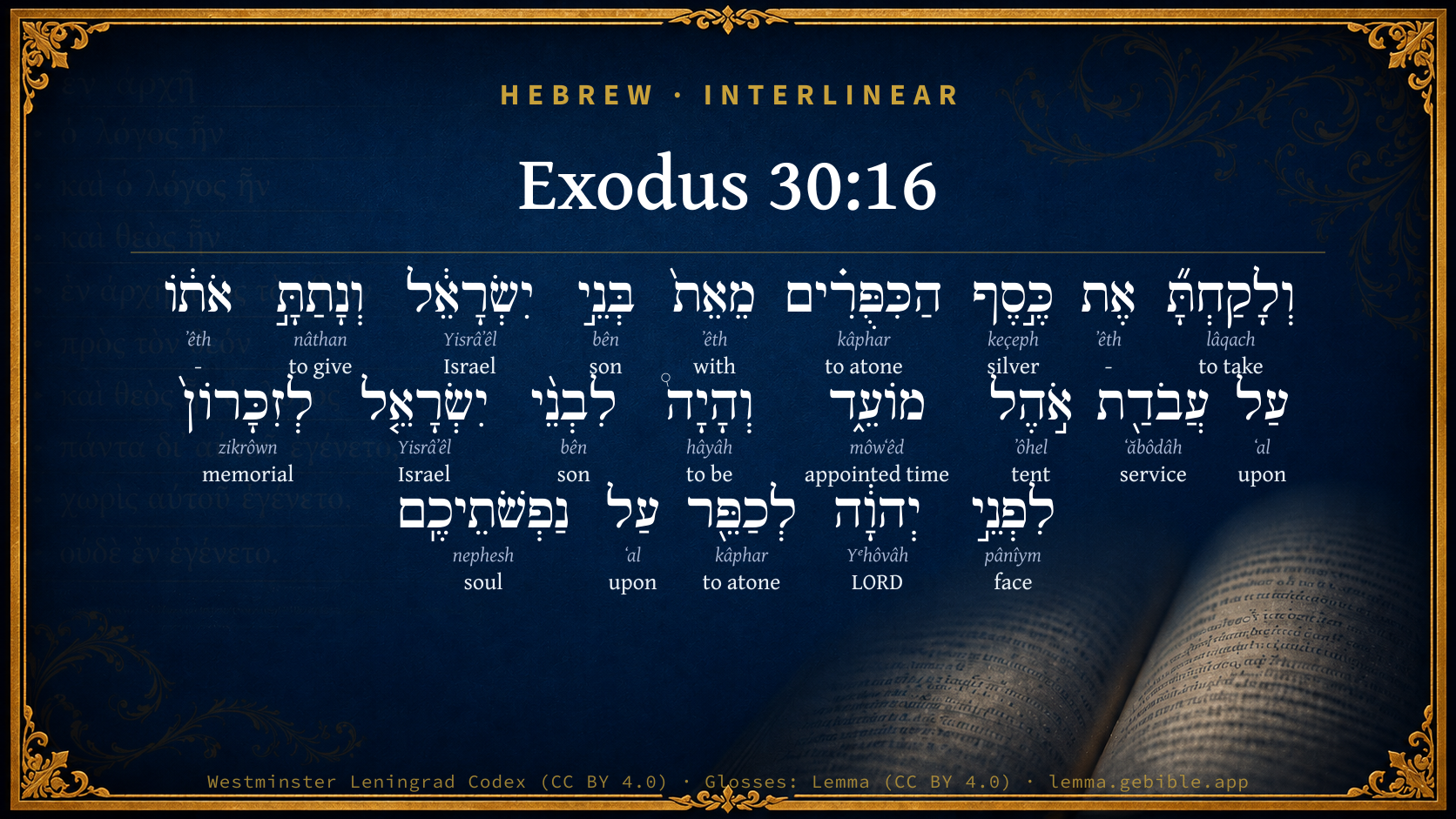
Hebrew (Westminster Leningrad Codex) Exodus 30:16 appears in the Hebrew Old Testament. The text above is from the Westminster Leningrad Codex. Each word links to its Strong’s number, a concise gloss, and parsing drawn from the Open Scriptures Hebrew Bible morphology. Click any word for its full Brown-Driver-Briggs (BDB) entry.
Download image
Cite this verse

Exodus 30:16 (World English Bible). Public Domain. Lemma interlinear Bible study tool, https://lemma.gebible.app/v/exodus/30/16.

Show BibTeX & RIS
BibTeX
RIS
English Translation
You shall take the atonement money from the children of Israel, and shall appoint it for the service of the tent of meeting; that it may be a memorial for the children of Israel before Yahweh, to make atonement for your souls."
World English Bible · Public Domain
Download a study sheet

One document with this verse’s original text, its word-by-word gloss line, the meaning frame, cross-references with their text, attributed commentary, and full source and license credits — printable, and it pastes into notes with its structure intact.

This verse Autodidact and up

Study sheet (.html) Plain text (.txt)

A passage Seminary Student

Up to 50 verses in one chapter. A passage sheet keeps up to 6 commentary sources and 12 cross-references per verse, in the order this page ranks them, and says so on the sheet whenever that leaves anything out. Ask for a single verse and you get the Autodidact verse sheet above.

Everything on this page stays free to read, with no account — the sheet is a download of what is already on screen, not access to it.

Want to remove ads? Support Godless Engineer
Compare translations 3

The same verse in 3 English versions, stacked beneath the original-language interlinear above. Click any original word for its lexicon entry.

Each is an independent rendering of the whole verse — the interlinear is not word-aligned to these translations.

Highlighted words mark where these versions differ — a whole-verse word diff, not a word-by-word alignment.

  • World English Bible Public Domain
    You shall take the atonement money from the children of Israel, and shall appoint it for the service of the tent of meeting; that it may be a memorial for the children of Israel before Yahweh, to make atonement for your souls."
  • King James Version Public Domain
    And thou shalt take the atonement money of the children of Israel, and shalt appoint it for the service of the tabernacle of the congregation; that it may be a memorial unto the children of Israel before the LORD, to make an atonement for your souls.
  • unfoldingWord Literal Text CC BY-SA 4.0
    And you shall take the silver of ransoms from the sons of Israel, and you shall give it to the work of the tent of meeting. And it shall be as a reminder for the sons of Israel before the face of Yahweh to cover over your lives.”

unfoldingWord Literal Text — © unfoldingWord, licensed CC BY-SA 4.0. Word-aligned USFM3 via Door43 (git.door43.org/unfoldingWord/en_ult).

Versions to compare (up to 4)

3 of 4 selected

Show all 18 translations

Every available English version of this verse, each an independent rendering of the whole verse.

  • World English Bible Public Domain
    You shall take the atonement money from the children of Israel, and shall appoint it for the service of the tent of meeting; that it may be a memorial for the children of Israel before Yahweh, to make atonement for your souls."
  • Berean Standard Bible Public Domain
    Take the atonement money from the Israelites and use it for the service of the Tent of Meeting. It will serve as a memorial for the Israelites before the LORD to make atonement for your lives.”
  • Majority Standard Bible Public Domain
    Take the atonement money from the Israelites and use it for the service of the Tent of Meeting. It will serve as a memorial for the Israelites before the LORD to make atonement for your lives.”
  • King James Version Public Domain
    And thou shalt take the atonement money of the children of Israel, and shalt appoint it for the service of the tabernacle of the congregation; that it may be a memorial unto the children of Israel before the LORD, to make an atonement for your souls.
  • American Standard Version (1901) Public Domain
    And thou shalt take the atonement money from the children of Israel, and shalt appoint it for the service of the tent of meeting; that it may be a memorial for the children of Israel before Jehovah, to make atonement for your souls.
  • Revised Version (1885) Public Domain
    And thou shalt take the atonement money from the children of Israel, and shalt appoint it for the service of the tent of meeting; that it may be a memorial for the children of Israel before the LORD, to make atonement for your souls.
  • Geneva Bible (1599) Public Domain
    So thou shalt take the money of the redemption of the children of Israel, and shalt put it vnto the vse of the Tabernacle of the Congregation, that it may be a memoriall vnto the children of Israel before the Lord for the redemption of your liues.
  • Douay-Rheims (1899) Public Domain
    And the money received which was contributed by the children of Israel, thou shalt deliver unto the uses of the tabernacle of the testimony, that it may be a memorial of them before the Lord, and he may be merciful to their souls.
  • Young's Literal Translation Public Domain
    `And thou hast taken the atonement-money from the sons of Israel, and hast given it for the service of the tent of meeting; and it hath been to the sons of Israel for a memorial before Jehovah, to make atonement for your souls.'
  • Literal Standard Version CC BY-SA 4.0
    And you have taken the atonement-money from the sons of Israel, and have given it for the service of the Tent of Meeting; and it has been to the sons of Israel for a memorial before YHWH, to make atonement for your souls.”
  • Unlocked Literal Bible CC BY-SA 4.0
    You must receive this atonement money from the Israelites and you must allocate it to the work of the tent of meeting. It must be a reminder to the Israelites before me, to make atonement for your lives.”
  • unfoldingWord Literal Text CC BY-SA 4.0
    And you shall take the silver of ransoms from the sons of Israel, and you shall give it to the work of the tent of meeting. And it shall be as a reminder for the sons of Israel before the face of Yahweh to cover over your lives.”
  • Darby Bible Public Domain
    And thou shalt take the atonement-money of the children of Israel, and devote it to the service of the tent of meeting; and it shall be a memorial to the children of Israel before Jehovah, to make atonement for your souls.
  • World Messianic Bible Public Domain
    You shall take the atonement money from the children of Israel, and shall appoint it for the service of the Tent of Meeting; that it may be a memorial for the children of Israel before the LORD, to make atonement for your souls.”
  • Webster's Bible Public Domain
    And thou shalt take the atonement-money of the children of Israel, and shalt appoint it for the service of the tabernacle of the congregation; that it may be a memorial to the children of Israel before the LORD, to make an atonement for your souls.
  • Free Bible Version CC BY-SA 4.0
    Take this money paid by the Israelites and use it for the expenses involved in the services of the Tent of Meeting. It will serve as a reminder for the Israelites to buy back your lives in the presence of the Lord.”
  • Bible in Basic English Public Domain
    And you are to take this money from the children of Israel to be used for the work of the Tent of meeting, to keep the memory of the children of Israel before the Lord and to be the price of your lives.
  • JPS Tanakh (1917) Public Domain
    And thou shalt take the atonement money from the children of Israel, and shalt appoint it for the service of the tent of meeting, that it may be a memorial for the children of Israel before the LORD, to make atonement for your souls.'

Literal Standard Version (2020), Covenant Press — licensed CC BY-SA 4.0. Text via the HelloAO Bible API (eBible.org). Unlocked Literal Bible (unfoldingWord) — licensed CC BY-SA 4.0. Text via the HelloAO Bible API (eBible.org). unfoldingWord Literal Text — © unfoldingWord, licensed CC BY-SA 4.0. Word-aligned USFM3 via Door43 (git.door43.org/unfoldingWord/en_ult). Free Bible Version, Dr. Jonathan Gallagher — licensed CC BY-SA 4.0. Text via the HelloAO Bible API (eBible.org).

Word by word

More ways to search: Search by grammar → Find every occurrence → Compare this word →

Practice this passage: Drill this verse → Learn its vocabulary →

לְזִכָּרוֹן֙
zikrôwn
H2146
“to/for · memorial”
Preposition + Noun, Common, Masculine, Singular, Absolute
Part of Speech
Preposition + Noun
Type
Common
Gender
Masculine
Number
Singular
State
Absolute
Full BDB Definition

Origin: from H2142

TWOT: 551b

memorial, reminder, remembrance
  1. וְלָקַחְתָּ֞ lâqach H3947 “and · to take” Conjunction + Verb, Qal, Sequential Perfect, 2nd Person, Masculine, Singular
  2. אֶת ʼêth H853 “-” Particle, Direct Object
  3. כֶּ֣סֶף keçeph H3701 “silver of” Noun, Common, Masculine, Singular, Construct
  4. הַכִּפֻּרִ֗ים kâphar H3722 “the · atonement” Particle, Definite Article + Noun, Common, Masculine, Plural, Absolute
  5. מֵאֵת֙ ʼêth H854 “from · with” Preposition + Preposition
  6. בְּנֵ֣י bên H1121 “sons of” Noun, Common, Masculine, Plural, Construct
  7. יִשְׂרָאֵ֔ל Yisrâʼêl H3478 “Israel” Noun, Proper
  8. וְנָתַתָּ֣ nâthan H5414 “and · to give” Conjunction + Verb, Qal, Sequential Perfect, 2nd Person, Masculine, Singular
  9. אֹת֔וֹ ʼêth H853 “- · him” Particle, Direct Object + Suffix, Personal, 3rd Person, Masculine, Singular
  10. עַל ʻal H5921 “upon” Preposition
  11. עֲבֹדַ֖ת ʻăbôdâh H5656 “service of” Noun, Common, Feminine, Singular, Construct
  12. אֹ֣הֶל ʼôhel H168 “tent of” Noun, Common, Masculine, Singular, Construct
  13. מוֹעֵ֑ד môwʻêd H4150 “appointed time” Noun, Common, Masculine, Singular, Absolute
  14. וְהָיָה֩ hâyâh H1961 “and · to be” Conjunction + Verb, Qal, Sequential Perfect, 3rd Person, Masculine, Singular
  15. לִבְנֵ֨י bên H1121 “to/for · sons of” Preposition + Noun, Common, Masculine, Plural, Construct
  16. יִשְׂרָאֵ֤ל Yisrâʼêl H3478 “Israel” Noun, Proper
  17. לִפְנֵ֣י pânîym H6440 “to/for · face(s) of” Preposition + Noun, Common, Both, Plural, Construct
  18. יְהוָ֔ה Yᵉhôvâh H3068 “LORD” Noun, Proper
  19. לְכַפֵּ֖ר kâphar H3722 “to atone” Preposition + Verb, Piel, Infinitive Construct
  20. עַל ʻal H5921 “upon” Preposition
  21. נַפְשֹׁתֵיכֶֽם nephesh H5315 “souls · your” Noun, Common, Both, Plural, Construct + Suffix, Personal, 2nd Person, Masculine, Plural

About this verse

These counts appear in no published source. They are computed here, from the morphology-tagged text and Lemma’s own curated glosses. What Lemma adds →

22
words
17
distinct lemmas
Pentateuch
section

Notable vocabulary

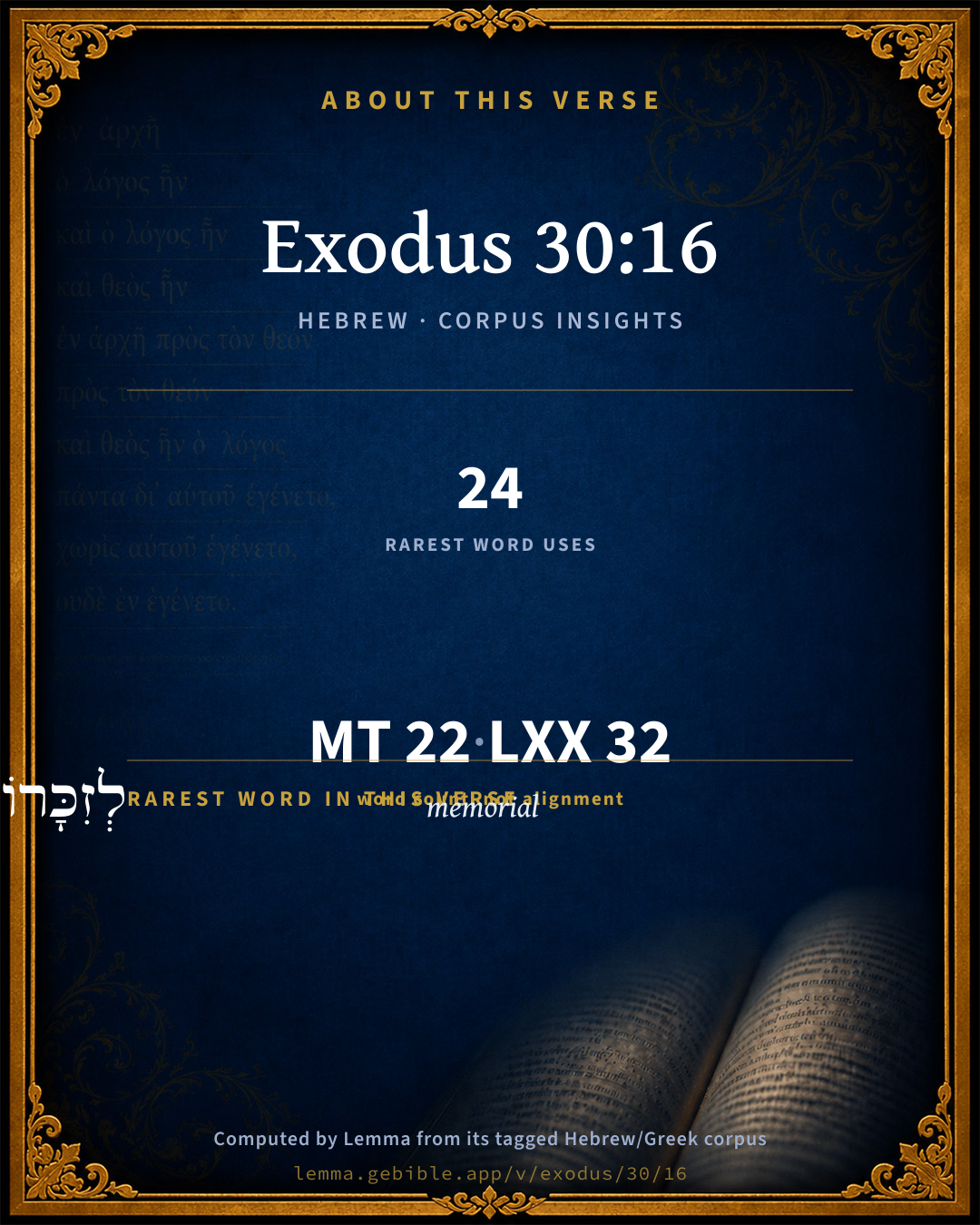
The rarest word here is לְזִכָּרוֹן֙ memorial H2146 — appearing just 24 times in the whole Hebrew Bible.

Shared distinctive vocabulary

לְזִכָּרוֹן֙ memorial H2146 occurs in 22 verses of the Hebrew Bible. Also found in:

Grammatical profile

  • 4 verbs
  • 13 nouns
  • 3 prepositions
  • 2 particles

Verb forms

  • וְלָקַחְתָּ֞ Qal · Sequential Perfect
  • וְנָתַתָּ֣ Qal · Sequential Perfect
  • וְהָיָה֩ Qal · Sequential Perfect
  • לְכַפֵּ֖ר Piel · Infinitive Construct

Repetition

Words recur within this verse — often emphatic in Hebrew:

  • הַכִּפֻּרִ֗ים to atone H3722 ×2
  • בְּנֵ֣י son H1121 ×2
  • יִשְׂרָאֵ֔ל Israel H3478 ×2
  • עַל upon H5921 ×2

Hebrew & Septuagint length

In English translation the verse runs 42 words from the Hebrew and 46 from the Septuagint (LXX English) — closely comparable.

A rough comparison of the two English renderings, which tokenize alike — not a word-level alignment.

Word counts can differ between the Hebrew and the Greek without any difference in meaning — e.g. the Hebrew direct-object marker אֵת has no separate Greek word, and Greek often adds the article ὁ.

In the original languages it is 22 Hebrew tokens and 32 Greek tokens — but the two are counted differently (Hebrew bundles its prefixes and suffixes into one token; the Greek is in lemma form), so that isn’t a like-for-like length.

Cross-references

5

Topical passages linked to Exodus 30:16 in the Treasury of Scripture Knowledge — connected by theme and wording, ordered by reader-vote popularity; previews shown in the World English Bible.

  • Numbers 16:40 to be a memorial to the children of Israel, to the end that no stranger, who isn't of the seed of Aaron, comes near to burn incense before Yahweh; that he not be as Korah, and as his company: as Yahweh spoke to him by Moses.
  • Nehemiah 10:32–33 Also we made ordinances for us, to charge ourselves yearly with the third part of a shekel for the service of the house of our God;
  • Exodus 12:14 This day shall be to you for a memorial, and you shall keep it a feast to Yahweh: throughout your generations you shall keep it a feast by an ordinance forever.
  • Exodus 38:25–31 The silver of those who were numbered of the congregation was one hundred talents, and one thousand seven hundred seventy-five shekels, after the shekel of the sanctuary:
  • Luke 22:19 He took bread, and when he had given thanks, he broke it, and gave to them, saying, "This is my body which is given for you. Do this in memory of me."

Cross-references courtesy of OpenBible.info (CC BY 4.0).

Hebrew and Greek witnesses Masoretic Hebrew ↔ Greek Septuagint

The same verse in the two great witnesses to the Old Testament, shown verse-for-verse.

These are two independent witnesses, not word-aligned to each other, and the Septuagint is shown in lemma (dictionary) form.

Hebrew Exodus 30:16 Masoretic · Westminster Leningrad Codex

וְלָקַחְתָּ֞ אֶת כֶּ֣סֶף הַכִּפֻּרִ֗ים מֵאֵת֙ בְּנֵ֣י יִשְׂרָאֵ֔ל וְנָתַתָּ֣ אֹת֔וֹ עַל עֲבֹדַ֖ת אֹ֣הֶל מוֹעֵ֑ד וְהָיָה֩ לִבְנֵ֨י יִשְׂרָאֵ֤ל לְזִכָּרוֹן֙ לִפְנֵ֣י יְהוָ֔ה לְכַפֵּ֖ר עַל נַפְשֹׁתֵיכֶֽם

You shall take the atonement money from the children of Israel, and shall appoint it for the service of the tent of meeting; that it may be a memorial for the children of Israel before Yahweh, to make atonement for your souls."

World English Bible · Public Domain

Greek LXX Exodus 30:16 Septuagint · lemma form

καί λαμβάνω ὁ ἀργύριον ὁ εἰσφορά παρά ὁ υἱός ἰσραήλ καί δίδωμι αὐτός εἰς κάτεργον ὁ σκηνή ὁ μαρτύριον καί εἰμί ὁ υἱός ἰσραήλ μνημόσυνον ἔναντι κύριος ἐκἱλάσκομαι περί ὁ ψυχή σύ

And you shall take the money of the offering from the children of Israel, and shall give it for the service of the tabernacle of testimony; and it shall be to the children of Israel a memorial before the Lord, to make atonement for your souls.

LXX2012 (modern English Septuagint) · Public Domain

Hebrew: Westminster Leningrad Codex (CC BY 4.0). Greek: Septuagint (public domain); English from LXX2012 (modern English Septuagint) (Public Domain). How the Septuagint differs from the Hebrew →

Targum (Aramaic paraphrase)

2

The Targum is the ancient Jewish Aramaic paraphrase of the Hebrew Scriptures — an interpretive translation, not the Hebrew text itself. Onkelos (literal) and Pseudo-Jonathan (expansive) render the Torah, and Jonathan the Prophets. Coverage is partial: where no permissively-licensed English translation exists for a verse, only the Aramaic is shown. This is verse-level text, not a word-by-word alignment to the Hebrew.

  1. Targum Onkelos Torah (Genesis–Deuteronomy)
    וְתִסַב יָת כְּסַף כִּפּוּרַיָא מִן בְּנֵי יִשְׂרָאֵל וְתִתֵּן יָתֵהּ עַל פָּלְחַן מַשְׁכַּן זִמְנָא וִיהֵי לִבְנֵי יִשְׂרָאֵל לְדָכְרָנָא קֳדָם יְיָ לְכַפָּרָא עַל נַפְשָׁתֵיכוֹן:

    (no public-domain English translation for this verse)

    Targum Onkelos — Aramaic: “Onkelos Genesis” (public domain); “Onkelos Exodus” (public domain); “Onkelos Leviticus” (public domain); “Onkelos Numbers” (public domain); “Onkelos Deuteronomy” (public domain). English: “Sefaria Community Translation” (CC0 1.0 (public-domain dedication)); “J.W. Etheridge. The Targums of Onkelos and Jonathan Ben Uzziel on the Pentateuch. London: Longmans, Green, 1862” (public domain). Text via Sefaria.

  2. Targum Pseudo-Jonathan Torah (Genesis–Deuteronomy)
    וְתִיסַב יַת כַּסְפָּא דְכִיפּוּרַיָא מִן בְּנֵי יִשְרָאֵל וְתִתֵּן יָתֵיהּ עַל עֲבִידַת מַשְׁכַּן זִימְנָא וִיהֵי לִבְנֵי יִשְרָאֵל לְדוּכְרַן טַב קֳדָם יְיָ לְכַפָּרָא עַל נַפְשָׁתֵיכוֹן

    And thou shalt take the silver of the ransom from the sons of Israel, and apply it to the work of the tabernacle of ordinance; that it may be for the sons of Israel for a good memorial before the Lord, as a ransom for your souls.

    Targum Pseudo-Jonathan — Aramaic: “Targum Jonathan on Genesis” (public domain); “Targum Jonathan on Exodus” (public domain); “Targum Jonathan on Leviticus” (public domain); “Targum Jonathan on Numbers” (public domain); “Targum Jonathan on Deuteronomy” (public domain). English: “The Targum of Jonathan ben Uzziel, trans. J. W. Etheridge, London, 1862” (public domain). Text via Sefaria.

Commentary

Notes on Exodus 30:16 from classic Christian and Jewish commentators (each source and its license shown beneath its notes). The classic Christian expositions comment on the surrounding passage and are grouped to its opening verse, so a note may address several verses; the Jewish commentaries on the Tanakh (Rashi and others) are per-verse, so they appear only where the commentator wrote on this verse.

Lemma curates 59 commentaries, every one of them public domain or Creative Commons licensed, each selected and text-cleaned for this edition rather than reprinted as found. About our sources →

Trapp's Complete Commentary

John Trapp

Exo 30:16 And thou shalt take the atonement money of the children of Israel, and shalt appoint it for the service of the tabernacle of the congregation; that it may be a memorial unto the children of Israel before the LORD, to make an atonement for your souls.

Ver. 16. That it may be a memorial.] A perpetual poll money, in token of homage and subjection to the Almighty.

John Trapp, A Commentary or Exposition upon All the Books of the Old and New Testament (1647–1656) — public domain. Text from a community e-Sword module.

Ellicott's Commentary for English Readers

(16) Thou shalt . . . appoint it for the service of the tabernacle.—It appears, by Exo_38:27-28, that the silver collected by this tax, which amounted to above a hundred talents, was employed for making the sockets which supported the boards of the tabernacle (Exo_26:19-25), and those of the pillars of the vail (Exo_26:32), together with the hooks for the pillars of the court, their capitals, and connecting rods. Thus, so long as the tabernacle stood, the precious metal paid as ransom remained in the sight of the people, and was a continual “memorial,” or reminder, to them of the position into which they were brought by covenant with God.

A Bible Commentary for English Readers, edited by Charles John Ellicott (1878–1897) — public domain. Text from a community e-Sword module.

The Cambridge Bible for Schools and Colleges

gen. ed. J. J. S. Perowne

16. for the service, &c.] i.e. for the maintenance of the daily worship in the Tent of Meeting, the morning and evening sacrifices, &c. The reference cannot be to the work of erecting the sanctuary; for (1) the injunction is general (When thou takest the sum, &c.), not specific (And thou shalt take, &c.); and (2) even supposing it were specific, the first census according to P is the one in Numbers 1, which (v. 1 compared with Exo_40:2; Exo_40:17) took place a month after the sanctuary was completed and put up.

be a memorial, &c.] to keep Jehovah in continual remembrance of the ransom which had been paid for their lives: cf. Exo_28:12; Exo_28:29, Num_10:10; Num_31:54.

The Cambridge Bible for Schools and Colleges (gen. ed. J. J. S. Perowne; Cambridge University Press, 1878–1918) — public domain. Text from a community e-Sword module.

John Gill's Exposition

And thou shall take the atonement money of the children of Israel,.... The half shekel, the ransom of their souls:

and shall appoint it for the service of the tabernacle of the congregation; for the building of the tabernacle, for the repairs of it, and for the sacrifices offered in it; particularly we find that this first collection this way was appropriated to the silver sockets of the sanctuary, and the vail, for the silver hooks, and for the pillars, Exo 38:27,

that it may be a memorial unto the children of Israel before the Lord, to make an atonement for your souls; to put them in mind that they were sinners, that their lives were forfeited, that a ransom price was given and accepted of God, that hereby atonement, in a typical sense, was made for them; and this was before the Lord, as a token of their gratitude to him, and of their acknowledgment of the favour.

John Gill's Exposition of the Whole Bible (1746–1763) — public domain (CC PDM 1.0). Text via the HelloAO Bible API.

Matthew Poole's English Annotations

For the service of the tabernacle; for the building and furniture of it, and the maintenance of God’s worship in it.

That it may be a memorial; either to the people, who hereby profess God to be their Lord and Owner, and themselves his subjects and tributaries; or to God, who hereby takes occasion to remember them, and to own them for his people.

Matthew Poole's English Annotations on the Holy Bible (1683–1685) — public domain. Text from a community e-Sword/MySword module.

Whedon's Commentary on the Bible

Daniel D. Whedon

16. A memorial — A constant reminder of their being covered and shielded from plague by complying with this command.

Daniel D. Whedon (gen. ed.), Commentary on the Old and New Testaments (1874–1909) — public domain. Text from a community e-Sword module.

The Pulpit Commentary

The application of the "atonement money" is stated more distinctly in Exo_38:27, Exo_38:28. It was employed for the silver sockets that supported the boards of the tabernacle, and for the hooks, capitals, and connecting rods of the pillars which surrounded the court. Thus employed, it was a continual "memorial" in the eyes of the people, reminding each man of his privileges and duties

The Pulpit Commentary (1880–1919), ed. H.D.M. Spence-Jones & Joseph S. Exell — public domain. Text from a community e-Sword module.

Rashi

Rabbi Shlomo Yitzchaki (Rashi)

ונתת אתו על עבדת אהל מועד AND THOU SHALT GIVE IT FOR THE SERVICE OF THE APPOINTED TENT — From this statement you may learn that he (Moses) was commanded to take their census when they began to contribute towards the building of the Tabernacle, after the incident of the golden calf, because the pestilence had befallen them, as it is said, (Exodus 32:35) “and the Lord plagued the people”. A parable: To what may this be compared? To a flock that is dear to its owner upon which there fell pestilence. As soon as it ceased he said to the shepherd, “I beg of you, count my sheep and ascertain how many of them are left”. He did this to show that it (the flock) was dear to him (Midrash Tanchuma, Ki Tisa 9). — It is, however, impossible to say that the census mentioned here is identical with that spoken of in the Book of Numbers (1:1), for there (in Numbers 1:1) Scripture states, “[And God spake to Moses …] on the first day of the second month … [Take ye the sum of all the congregation of the children of Israel etc.]”, whilst the Tabernacle was set up on the first day of the first month as it is said, (Exodus 40:2) “On the first day of the first month shalt thou set up [the Tabernacle etc.]”, and from this census (that mentioned in this paragraph) — from the shekels obtained by it — the sockets used for its boards were made, for it is said, (Exodus 38:27) and of the hundred talents of silver were cast [the sockets of the sanctuary]”. Consequently you learn from this that two censuses were taken, viz., one at the beginning of their contributing towards the Tabernacle, after the Day of Atonement (when Moses first commanded the people to engage in the construction of the Tabernacle; see Rashi on Exodus 33:11, last sentence), in the first year, and the other in the second year, in Iyar, after the Tabernacle had already been set up. If you ask, however: is it at all possible that on both of these occasions the number of the Israelites was exactly the same, viz., 603,550, for in the account of how the silver of those that were numbered of the congregation was used (Exodus 38:27) it is so stated, and in the Book of Numbers (1:46) exactly the same is stated, “Even all they that were numbered were six hundred thousand and three thousand and five hundred and fifty”; were not these censuses taken in two different years, and surely it is impossible that there were not at the time of the first census people nineteen years old who accordingly were not counted and who became twenty years old in the second year when the second census was taken and this must have added to the total?! The reply to this question is: As far as the years of men’s ages are concerned they were counted in the same year, but reckoning from the time of the exodus from Egypt they were two different years in which the censuses were held. For when we speak of a period beginning with the exodus from Egypt, which took place in Nisan, we calculate from Nisan, as we have learned in Treatise Rosh Hashanah 2b. Consequently the Tabernacle was being built in the first year and was erected in the second year, because a new year began on the first of Nisan following the exodus. The years of people’s ages, however, were counted according to the era of the creation of the world which begins with Tishri, consequently from this point of view both censuses took place in the same year: the first in Tishri after the Day of Atonement when the Omnipresent became reconciled with Israel to grant them His pardon and when they received the command regarding the construction of the Tabernacle, and the second on the first of Iyar, so that those who were only 19 years old after the Day of Atonement when the first census was taken, were not yet regarded as twenty in Iyar when the second census was held even though they were born between Tishri and Iyar.

על עבדת אהל מועד FOR THE SERVICE OF THE APPOINTED TENT — i. e. for the sockets that were made of it (the expiation money).

Rashi on the Tanakh — English translations: “The Judaica Press complete Tanach with Rashi, translated by A. J. Rosenberg” (CC BY 4.0); “Pentateuch with Rashi's commentary by M. Rosenbaum and A.M. Silbermann, 1929-1934” (public domain); “The Metsudah Tanach series, Lakewood, N.J” (CC BY 4.0); and “The Book of Joshua, Metsudah Publications, 1997” (CC BY 4.0). Text via Sefaria.

Lesson kit

Teaching starters — assembled from the data on this page, not authored interpretation. Every prompt links to the verse data it draws on. Edit before teaching.

Exodus, in the Pentateuch, opens this verse with 22 words (17 distinct Hebrew lemmas). Its most distinctive word is zikrôwn (“memorial”). A historical commentator’s framing appears above. Read the whole chapter for the surrounding context.

Discussion questions

  1. What does “memorial” (zikrôwn) contribute to the verse as a whole?
  2. Exodus 12:14 shares the word «memorial» with this verse. How do the two illuminate each other?
  3. “to atone” occurs 2× in this one verse. What is the effect of the repetition?
  4. The translations on this page render this verse differently — a whole-verse word diff, not a word-by-word alignment. What might account for the different wordings?
  5. The verb «וְלָקַחְתָּ֞» is Qal Sequential Perfect. How does its form color the action?
  6. Reading how Trapp's Complete Commentary and Ellicott's Commentary for English Readers read this verse, where do the two commentators agree and where do they part?

Things to notice

Reading settings

Reading text

Shown beneath each verse's original-language words.

Old Testament
Old Testament edition

Read the OT as the Masoretic Hebrew (MT) or the Greek Septuagint (LXX).

English shown for the Greek Septuagint (in the Hebrew ↔ Greek comparison).

Comparing translations? Open the Compare panel on any verse page to stack up to four side by side.