
Genesis 30:14

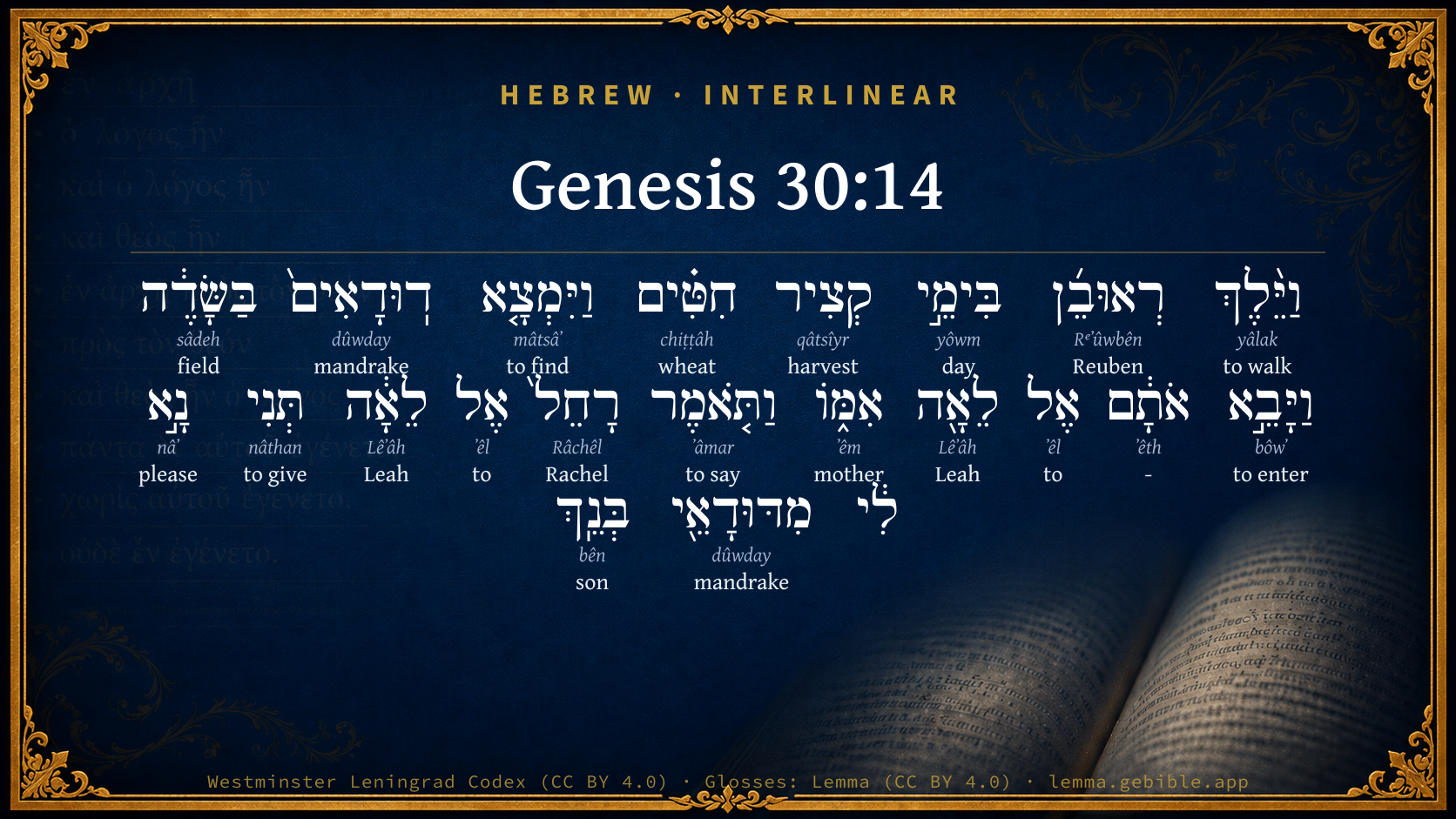
Hebrew (Westminster Leningrad Codex) Genesis 30:14 appears in the Hebrew Old Testament. The text above is from the Westminster Leningrad Codex. Each word links to its Strong’s number, a concise gloss, and parsing drawn from the Open Scriptures Hebrew Bible morphology. Click any word for its full Brown-Driver-Briggs (BDB) entry.
Download image
Cite this verse

Genesis 30:14 (World English Bible). Public Domain. Lemma interlinear Bible study tool, https://lemma.gebible.app/v/genesis/30/14.

Show BibTeX & RIS
BibTeX
RIS
English Translation
Reuben went in the days of wheat harvest, and found mandrakes in the field, and brought them to his mother, Leah. Then Rachel said to Leah, "Please give me some of your son's mandrakes."
World English Bible · Public Domain
Highlights
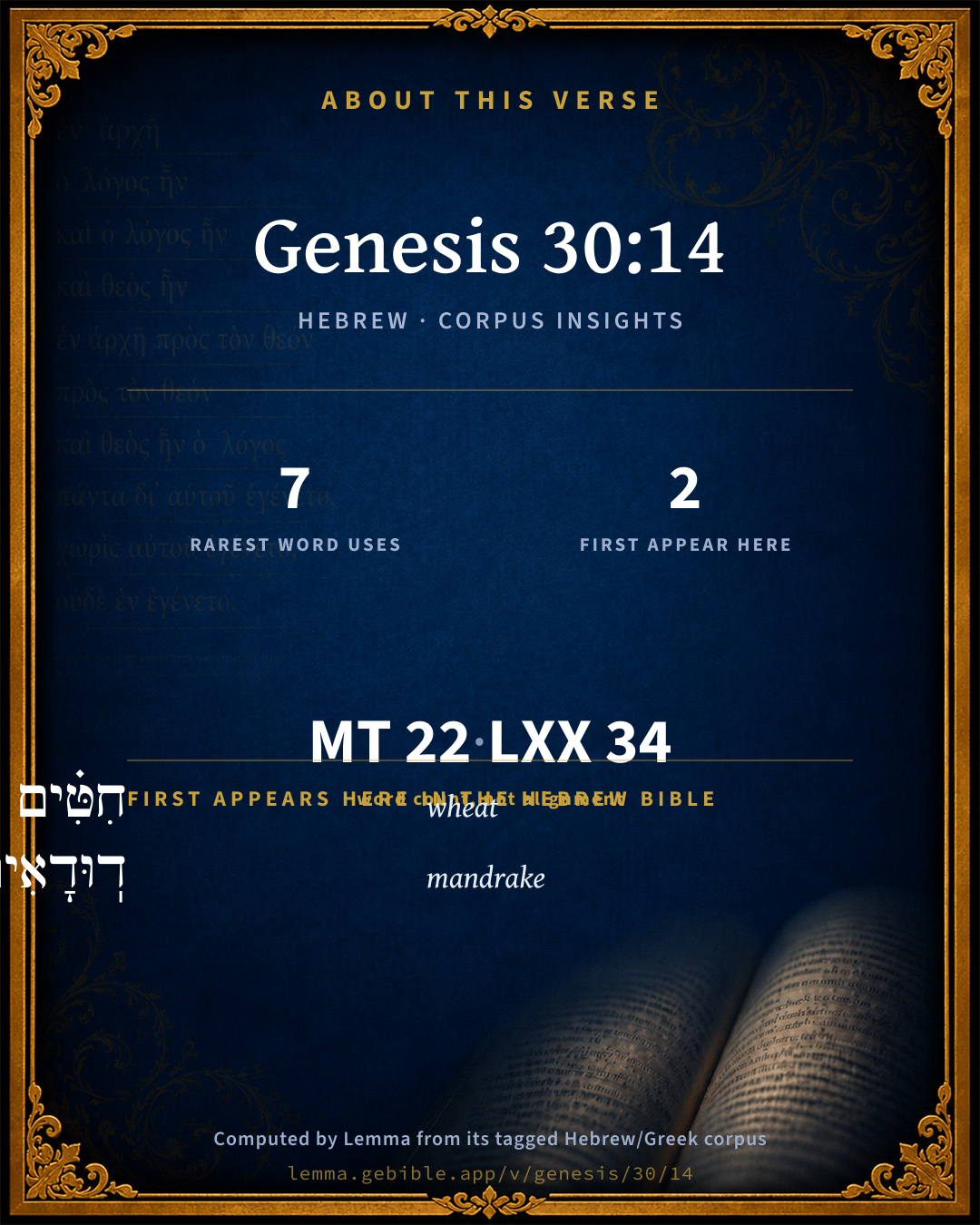
  • 2 first appearances in the Hebrew Bible
Full analysis ↓
Download a study sheet

One document with this verse’s original text, its word-by-word gloss line, the meaning frame, cross-references with their text, attributed commentary, and full source and license credits — printable, and it pastes into notes with its structure intact.

This verse Autodidact and up

Study sheet (.html) Plain text (.txt)

A passage Seminary Student

Up to 50 verses in one chapter. A passage sheet keeps up to 6 commentary sources and 12 cross-references per verse, in the order this page ranks them, and says so on the sheet whenever that leaves anything out. Ask for a single verse and you get the Autodidact verse sheet above.

Everything on this page stays free to read, with no account — the sheet is a download of what is already on screen, not access to it.

Want to remove ads? Support Godless Engineer
Compare translations 3

The same verse in 3 English versions, stacked beneath the original-language interlinear above. Click any original word for its lexicon entry.

Each is an independent rendering of the whole verse — the interlinear is not word-aligned to these translations.

Highlighted words mark where these versions differ — a whole-verse word diff, not a word-by-word alignment.

  • World English Bible Public Domain
    Reuben went in the days of wheat harvest, and found mandrakes in the field, and brought them to his mother, Leah. Then Rachel said to Leah, "Please give me some of your son's mandrakes."
  • King James Version Public Domain
    And Reuben went in the days of wheat harvest, and found mandrakes in the field, and brought them unto his mother Leah. Then Rachel said to Leah, Give me, I pray thee, of thy son's mandrakes.
  • unfoldingWord Literal Text CC BY-SA 4.0
    Then in the days of the wheat harvest, Reuben went out and found mandrakes in the field, and he brought them to Leah his mother. Then Rachel said to Leah, “Please give to me some of your son’s mandrakes.”

unfoldingWord Literal Text — © unfoldingWord, licensed CC BY-SA 4.0. Word-aligned USFM3 via Door43 (git.door43.org/unfoldingWord/en_ult).

Versions to compare (up to 4)

3 of 4 selected

Show all 18 translations

Every available English version of this verse, each an independent rendering of the whole verse.

  • World English Bible Public Domain
    Reuben went in the days of wheat harvest, and found mandrakes in the field, and brought them to his mother, Leah. Then Rachel said to Leah, "Please give me some of your son's mandrakes."
  • Berean Standard Bible Public Domain
    Now during the wheat harvest, Reuben went out and found some mandrakes in the field. When he brought them to his mother, Rachel begged Leah, “Please give me some of your son’s mandrakes.”
  • Majority Standard Bible Public Domain
    Now during the wheat harvest, Reuben went out and found some mandrakes in the field. When he brought them to his mother, Rachel begged Leah, “Please give me some of your son’s mandrakes.”
  • King James Version Public Domain
    And Reuben went in the days of wheat harvest, and found mandrakes in the field, and brought them unto his mother Leah. Then Rachel said to Leah, Give me, I pray thee, of thy son's mandrakes.
  • American Standard Version (1901) Public Domain
    And Reuben went in the days of wheat harvest, and found mandrakes in the field, and brought them unto his mother Leah. Then Rachel said to Leah, Give me, I pray thee, of thy son's mandrakes.
  • Revised Version (1885) Public Domain
    And Reuben went in the days of wheat harvest, and found mandrakes in the field, and brought them unto his mother Leah. Then Rachel said to Leah, Give me, I pray thee, of thy son’s mandrakes.
  • Geneva Bible (1599) Public Domain
    Nowe Reuben went in the dayes of the wheateharuest, and founde mandrakes in the fielde and brought them vnto his mother Leah. Then sayde Rahel to Leah, Giue me, I pray thee, of thy sonnes mandrakes.
  • Douay-Rheims (1899) Public Domain
    And Ruben, going out in the time of the wheat harvest into the field, found mandrakes: which he brought to his mother Lia. And Rachel said: Give me part of thy son's mandrakes.
  • Young's Literal Translation Public Domain
    And Reuben goeth in the days of wheat-harvest, and findeth love-apples in the field, and bringeth them in unto Leah, his mother, and Rachel saith unto Leah, `Give to me, I pray thee, of the love-apples of thy son.'
  • Literal Standard Version CC BY-SA 4.0
    And Reuben goes in the days of wheat-harvest, and finds love-apples in the field, and brings them to his mother Leah, and Rachel says to Leah, “Please give to me of the love-apples of your son.”
  • Unlocked Literal Bible CC BY-SA 4.0
    Reuben went in the days of wheat harvest and found mandrakes in the field. He brought them to his mother Leah. Then Rachel said to Leah, “Give me some of your son's mandrakes.”
  • unfoldingWord Literal Text CC BY-SA 4.0
    Then in the days of the wheat harvest, Reuben went out and found mandrakes in the field, and he brought them to Leah his mother. Then Rachel said to Leah, “Please give to me some of your son’s mandrakes.”
  • Darby Bible Public Domain
    And Reuben went out in the days of wheat-harvest, and found mandrakes in the fields; and he brought them to his mother Leah. And Rachel said to Leah, Give me, I pray thee, of thy son's mandrakes.
  • World Messianic Bible Public Domain
    Reuben went in the days of wheat harvest, and found mandrakes in the field, and brought them to his mother, Leah. Then Rachel said to Leah, “Please give me some of your son’s mandrakes.”
  • Webster's Bible Public Domain
    And Reuben went, in the days of wheat-harvest, and found mandrakes in the field, and brought them to his mother Leah. Then Rachel said to Leah, Give me, I pray thee, of thy son's mandrakes.
  • Free Bible Version CC BY-SA 4.0
    At the time of the wheat harvest Reuben found some mandrake plants when he was out in the fields. He took them back to his mother Leah. Rachel asked Leah, “Please give me some of the mandrakes your son found.”
  • Bible in Basic English Public Domain
    Now at the time of the grain-cutting, Reuben saw some love-fruits in the field, and took them to his mother Leah. And Rachel said to her, Let me have some of your son's love-fruits.
  • JPS Tanakh (1917) Public Domain
    And Reuben went in the days of wheat harvest, and found mandrakes in the field, and brought them unto his mother Leah. Then Rachel said to Leah: 'Give me, I pray thee, of thy son's mandrakes.'

Literal Standard Version (2020), Covenant Press — licensed CC BY-SA 4.0. Text via the HelloAO Bible API (eBible.org). Unlocked Literal Bible (unfoldingWord) — licensed CC BY-SA 4.0. Text via the HelloAO Bible API (eBible.org). unfoldingWord Literal Text — © unfoldingWord, licensed CC BY-SA 4.0. Word-aligned USFM3 via Door43 (git.door43.org/unfoldingWord/en_ult). Free Bible Version, Dr. Jonathan Gallagher — licensed CC BY-SA 4.0. Text via the HelloAO Bible API (eBible.org).

Word by word

More ways to search: Search by grammar → Find every occurrence → Compare this word →

Practice this passage: Drill this verse → Learn its vocabulary →

דֽוּדָאִים֙
dûwday
H1736
“mandrakes”
Noun, Common, Masculine, Plural, Absolute
Part of Speech
Noun
Type
Common
Gender
Masculine
Number
Plural
State
Absolute
Full BDB Definition

Origin: from H1731

TWOT: 410d

mandrake, love-apple - as exciting sexual desire, and favouring procreation
  1. וַיֵּ֨לֶךְ yâlak H3212 “and · to walk” Conjunction + Verb, Qal, Sequential Imperfect, 3rd Person, Masculine, Singular
  2. רְאוּבֵ֜ן Rᵉʼûwbên H7205 “Reuben” Noun, Proper
  3. בִּימֵ֣י yôwm H3117 “in/at · days of” Preposition + Noun, Common, Masculine, Plural, Construct
  4. קְצִיר qâtsîyr H7105 “harvest of” Noun, Common, Masculine, Singular, Construct
  5. חִטִּ֗ים chiṭṭâh H2406 “wheat” Noun, Common, Feminine, Plural, Absolute
  6. וַיִּמְצָ֤א mâtsâʼ H4672 “and · to find” Conjunction + Verb, Qal, Sequential Imperfect, 3rd Person, Masculine, Singular
  7. בַּשָּׂדֶ֔ה sâdeh H7704 “in/at the · field” Preposition, Determined + Noun, Common, Masculine, Singular, Absolute
  8. וַיָּבֵ֣א bôwʼ H935 “and · to enter” Conjunction + Verb, Hiphil, Sequential Imperfect, 3rd Person, Masculine, Singular
  9. אֹתָ֔ם ʼêth H853 “- · them” Particle, Direct Object + Suffix, Personal, 3rd Person, Masculine, Plural
  10. אֶל ʼêl H413 “to” Preposition
  11. לֵאָ֖ה Lêʼâh H3812 “Leah” Noun, Proper
  12. אִמּ֑וֹ ʼêm H517 “mother · his” Noun, Common, Feminine, Singular, Construct + Suffix, Personal, 3rd Person, Masculine, Singular
  13. וַתֹּ֤אמֶר ʼâmar H559 “and · to say” Conjunction + Verb, Qal, Sequential Imperfect, 3rd Person, Feminine, Singular
  14. רָחֵל֙ Râchêl H7354 “Rachel” Noun, Proper
  15. אֶל ʼêl H413 “to” Preposition
  16. לֵאָ֔ה Lêʼâh H3812 “Leah” Noun, Proper
  17. תְּנִי nâthan H5414 “give” Verb, Qal, Imperative, 2nd Person, Feminine, Singular
  18. נָ֣א nâʼ H4994 “please” Particle, Exhortation
  19. מִדּוּדָאֵ֖י dûwday H1736 “from · mandrakes of” Preposition + Noun, Common, Masculine, Plural, Construct
  20. בְּנֵֽךְ bên H1121 “son · your” Noun, Common, Masculine, Singular, Construct + Suffix, Personal, 2nd Person, Feminine, Singular

About this verse

These counts appear in no published source. They are computed here, from the morphology-tagged text and Lemma’s own curated glosses. What Lemma adds →

22
words
18
distinct lemmas
Pentateuch
section

Notable vocabulary

The rarest word here is דֽוּדָאִים֙ mandrake H1736 — appearing just 7 times in the whole Hebrew Bible.

First appearance in Scripture

These words make their first canonical appearance in the Hebrew Bible here:

  • חִטִּ֗ים wheat H2406
  • דֽוּדָאִים֙ mandrake H1736

Shared distinctive vocabulary

דֽוּדָאִים֙ mandrake H1736 occurs in 5 verses of the Hebrew Bible. Also found in:

Grammatical profile

  • 5 verbs
  • 12 nouns
  • 3 prepositions
  • 2 particles

Verb forms

  • וַיֵּ֨לֶךְ Qal · Sequential Imperfect
  • וַיִּמְצָ֤א Qal · Sequential Imperfect
  • וַיָּבֵ֣א Hiphil · Sequential Imperfect
  • וַתֹּ֤אמֶר Qal · Sequential Imperfect
  • תְּנִי Qal · Imperative

Repetition

Words recur within this verse — often emphatic in Hebrew:

  • דֽוּדָאִים֙ mandrake H1736 ×2
  • לֵאָ֖ה Leah H3812 ×2
  • אֶל to H413 ×2

Hebrew & Septuagint length

In English translation the verse runs 34 words from the Hebrew and 37 from the Septuagint (LXX English) — closely comparable.

A rough comparison of the two English renderings, which tokenize alike — not a word-level alignment.

Word counts can differ between the Hebrew and the Greek without any difference in meaning — e.g. the Hebrew direct-object marker אֵת has no separate Greek word, and Greek often adds the article ὁ.

In the original languages it is 22 Hebrew tokens and 34 Greek tokens — but the two are counted differently (Hebrew bundles its prefixes and suffixes into one token; the Greek is in lemma form), so that isn’t a like-for-like length.

Cross-references

2

Topical passages linked to Genesis 30:14 in the Treasury of Scripture Knowledge — connected by theme and wording, ordered by reader-vote popularity; previews shown in the World English Bible.

  • Song of Solomon 7:13 The mandrakes give forth fragrance. At our doors are all kinds of precious fruits, new and old, Which I have stored up for you, my beloved.
  • Genesis 25:30 Esau said to Jacob, "Please feed me with that same red stew, for I am famished." Therefore his name was called Edom.

Cross-references courtesy of OpenBible.info (CC BY 4.0).

Hebrew and Greek witnesses Masoretic Hebrew ↔ Greek Septuagint

The same verse in the two great witnesses to the Old Testament, shown verse-for-verse.

These are two independent witnesses, not word-aligned to each other, and the Septuagint is shown in lemma (dictionary) form.

Hebrew Genesis 30:14 Masoretic · Westminster Leningrad Codex

וַיֵּ֨לֶךְ רְאוּבֵ֜ן בִּימֵ֣י קְצִיר חִטִּ֗ים וַיִּמְצָ֤א דֽוּדָאִים֙ בַּשָּׂדֶ֔ה וַיָּבֵ֣א אֹתָ֔ם אֶל לֵאָ֖ה אִמּ֑וֹ וַתֹּ֤אמֶר רָחֵל֙ אֶל לֵאָ֔ה תְּנִי נָ֣א לִ֔י מִדּוּדָאֵ֖י בְּנֵֽךְ

Reuben went in the days of wheat harvest, and found mandrakes in the field, and brought them to his mother, Leah. Then Rachel said to Leah, "Please give me some of your son's mandrakes."

World English Bible · Public Domain

Greek LXX Genesis 30:14 Septuagint · lemma form

πορεύομαι δέ ρουβην ἐν ἡμέρα θερισμός πυρός καί εὑρίσκω μῆλον μανδραγόρας ἐν ὁ ἀγρός καί φέρω αὐτός πρός λεια ὁ μήτηρ αὐτός εἶπον δέ ραχηλ ὁ λεια δίδωμι ἐγώ ὁ μανδραγόρας ὁ υἱός σύ

And Ruben went in the day of barley harvest, and found apples of mandrakes in the field, and brought them to his mother Lea; and Rachel said to Lea her sister, Give me of your son's mandrakes.

LXX2012 (modern English Septuagint) · Public Domain

On this verse, The Pulpit Commentary discusses the Septuagint’s reading. Read the note in Commentary ↓

Hebrew: Westminster Leningrad Codex (CC BY 4.0). Greek: Septuagint (public domain); English from LXX2012 (modern English Septuagint) (Public Domain). How the Septuagint differs from the Hebrew →

Targum (Aramaic paraphrase)

2

The Targum is the ancient Jewish Aramaic paraphrase of the Hebrew Scriptures — an interpretive translation, not the Hebrew text itself. Onkelos (literal) and Pseudo-Jonathan (expansive) render the Torah, and Jonathan the Prophets. Coverage is partial: where no permissively-licensed English translation exists for a verse, only the Aramaic is shown. This is verse-level text, not a word-by-word alignment to the Hebrew.

  1. Targum Onkelos Torah (Genesis–Deuteronomy)
    וַאֲזַל רְאוּבֵן בְּיוֹמֵי חֲצַד חִטִּין וְאַשְׁכַּח יַבְרוּחִין בְּחַקְלָא וְאַיְתִי יָתְהוֹן לְלֵאָה אִמֵּהּ וַאֲמֶרֶת רָחֵל לְלֵאָה הָבִי כְעַן לִי מִיַּבְרוּחֵי דִּבְרִיךְ

    (no public-domain English translation for this verse)

    Targum Onkelos — Aramaic: “Onkelos Genesis” (public domain); “Onkelos Exodus” (public domain); “Onkelos Leviticus” (public domain); “Onkelos Numbers” (public domain); “Onkelos Deuteronomy” (public domain). English: “Sefaria Community Translation” (CC0 1.0 (public-domain dedication)); “J.W. Etheridge. The Targums of Onkelos and Jonathan Ben Uzziel on the Pentateuch. London: Longmans, Green, 1862” (public domain). Text via Sefaria.

  2. Targum Pseudo-Jonathan Torah (Genesis–Deuteronomy)
    וְאָזַל רְאוּבֵן בְּיוֹמֵי סִיוָן בִּזְמַן חֲצַד חִיטִין וְאַשְׁכַּח יַבְרוּחִין בְּחַקְלָא וְאַיְיתִי יַתְהוֹם לְלֵאָה אִמֵיהּ וַאֲמַרַת רָחֵל לְלֵאָה הֲבִי כְדוּן לִי מִן יַבְרוּחֵי דִבְרִיךְ

    And Reuben went in the days of Sivan, in the time of wheat harvest, and found (Yaveruchin) mandrakes in the field; and he brought them to Leah his mother. And Rahel said to Leah, Give me now of thy son's mandrakes.

    Targum Pseudo-Jonathan — Aramaic: “Targum Jonathan on Genesis” (public domain); “Targum Jonathan on Exodus” (public domain); “Targum Jonathan on Leviticus” (public domain); “Targum Jonathan on Numbers” (public domain); “Targum Jonathan on Deuteronomy” (public domain). English: “The Targum of Jonathan ben Uzziel, trans. J. W. Etheridge, London, 1862” (public domain). Text via Sefaria.

Commentary

Notes on Genesis 30:14 from classic Christian and Jewish commentators (each source and its license shown beneath its notes). The classic Christian expositions comment on the surrounding passage and are grouped to its opening verse, so a note may address several verses; the Jewish commentaries on the Tanakh (Rashi and others) are per-verse, so they appear only where the commentator wrote on this verse.

Lemma curates 59 commentaries, every one of them public domain or Creative Commons licensed, each selected and text-cleaned for this edition rather than reprinted as found. About our sources →

The Cambridge Bible for Schools and Colleges

gen. ed. J. J. S. Perowne

14. mandrakes] R.V. marg. love-apples. The mandrake (mandragora vernalis) is a tuberous plant, with yellow plumlike fruit. It was supposed to act as a love-charm. It ripens in May, which suits the mention (Gen_30:14) of wheat harvest. It has an odour of musk; cf. Son_7:13, “the mandrakes give forth fragrance.” It has been conjectured that the word duda’im is connected with the name of Dudah, the love-god mentioned on the inscription of Mesha (line 12); that Reubenites, adjoining the Moabites, were worshippers of Dudah; and that, on this account, Reuben is spoken of as the finder of the love-apples. The mandrake is called by the native inhabitants of Palestine baid el-jinn, “the eggs of the jinn.”

The Cambridge Bible for Schools and Colleges (gen. ed. J. J. S. Perowne; Cambridge University Press, 1878–1918) — public domain. Text from a community e-Sword module.

Trapp's Complete Commentary

John Trapp

Gen 30:14 And Reuben went in the days of wheat harvest, and found mandrakes in the field, and brought them unto his mother Leah. Then Rachel said to Leah, Give me, I pray thee, of thy son’s mandrakes.

Ver. 14. And found mandrakes.] Some render it, lovely flowers; others, violets; others, lilies; others again, cherries of Jury; the Greek, and most interpreters, mandrakes, or mandrake apples. It is a plant very amiable, according to the name, {a} both for sweetness of smell, {Son 7:13} the loveliness of the flower resembling a man; and for the peculiar virtue it hath, to cause sleep, affection, and conception.

{a} דודאים - Vide Drus. in fine Com. Ruth.

John Trapp, A Commentary or Exposition upon All the Books of the Old and New Testament (1647–1656) — public domain. Text from a community e-Sword module.

Joseph Benson's Commentary

Gen 30:14. Found mandrakes — The word דודאים, thus rendered, is only found here and Son 7:13; and it is not agreed among interpreters whether it signifies a fruit or a flower. It is thought, however, by many, that mandrake-apples are here meant, which, according to Pliny, are of the size of filberts. They were pleasant to the smell, (Son 7:13,) and probably also desirable for food. Whatever they were, Rachel could not see them in Leah’s hands, but she must covet them.

Joseph Benson's Commentary on the Old and New Testaments (1811–1818) — public domain. Text from a community e-Sword module.

Whedon's Commentary on the Bible

Daniel D. Whedon

OTHER CHILDREN OF LEAH, Gen_30:14-21.

Reuben went — He was now a boy of four or five years. Mandrakes דודאים, dudhaim, love-apples, a fruit, as appears from this context, believed to have the power of promoting conception. Hence the anxiety of Rachel to obtain them. The fruit here named is believed to be the Mandragora officinalis, described by Tristram as “one of the most striking plants of the country, with its flat disk of very broad primrose-like leaves, and its central bunch of dark blue bell-shaped blossom. The perfume of the flower we found by no means disagreeable, though it is said by some to be fetid. It has a certain pungency which is peculiar. We found it not uncommon in every part of Palestine, but chiefly in marshy plains.” — Land of Israel, 8vo edit., p. 103.

Daniel D. Whedon (gen. ed.), Commentary on the Old and New Testaments (1874–1909) — public domain. Text from a community e-Sword module.

The Pulpit Commentary

CHAPTER 30:14-24

And Reuben (at this time four or five years old) went (probably accompanying the reapers) in the days of wheat harvest (in the beginning of May), and found mandrakes mhla madragorwn, (LXX, Josephus), apples of the mandragora, a herb resembling belladonna, with a root like a carrot, having white and reddish blossoms of a sweet smell, and with yellow odoriferous apples, ripening in May and June, and supposed, according to Oriental superstition, to possess the virtue of conciliating love and promoting fruitfulness (vide Gesenius, p. 191, and cf. Rosenm "Seholia," and Kalisch in loco)in the field (when at his childish play), and brought them unto his mother Leah (which a son of more mature years would not have done). Then Rachel (not exempt from the prevailing superstition) said to Leah, Give me, I pray thee, of thy son"s mandrakes (in the hopes that they would remove her sterility).

Vers. 14-24.

The story of the mandrakes.

I A YOUNG CHILD"S INNOCENCE. "Reuben found mandrakes in the field, and brought them to his mother." Nature, with its beautiful sights and harmonious sounds, possesses a wonderful fascination for the infant mind. In proportion as man sinks beneath the power of sin does he fall out of sympathy with God"s fair world. Strong and tender is the bond of love which unites a child to its mother. The true depositary for a child"s treasures is the mother"s lap, for a child"s joys and sorrows the mother"s heart. Yet a child"s inexperience and simplicity may sometimes cause a parent to err, though the true source of temptation lies in the parent, and not in the child. "To the pure all things are pure; but to them that are defiled is nothing pure.

II A GROWN WOMAN"S SUPERSTITION. "Give me of thy son"s mandrakes." Rachel obviously shared the popular belief that Reuben"s fragrant herbs would have an influence in removing her sterility. It is useless inquiring bow such a notion originated. Superstitions commonly arise from mistaking as cause and effect what are only coincident occurrences. Of more importance it is to note that Rachel was of mature years, had been born and nurtured in what may be regarded as a religious home, was now the wife of an intelligent and pious (if also encompassed with infirmities) man, and yet she was the victim of delusive beliefs. In this Rachel was perhaps scarcely to be charged with blame. Superstition is essentially a fault of the intellect resulting from defective information. But Rachel erred in calling superstition to her aid in her unholy rivalry with Leah; all the more when she knew that God alone could remove her reproach.

III A JEALOUS WIFE"S BARGAIN. On the part both of Rachel and Leah it was a miserable compact; and a pitiable spectacle it surely was, that of two rival wives contracting with one another about their husband"s society. Rachel disposes of Jacob for a night in consideration of a handful of mandrakes, and Leah counts herself entitled to Jacob"s favors as a boon which she had purchased with Reuben"s yellow apples. Not to speak of the humiliation in all this to Jacob, and the continual misery to which he must have been subjected between his ardent sister-wives, think of the wretchedness it must have entailed upon the women themselves, and the dispeace it must have brought into the rival homes. A more powerful condemnation of polygamy it will be difficult to find, or a more signal illustration of the retribution which sooner or later follows on the heels of transgression.

IV A SOVEREIGN GOD"S-DECISION. The two wives were seemingly uncertain whether to ascribe virtue to the mandrakes or not. God determined the problem in a way that must have fully convinced them.

1. That the mandrakes could not remove sterility he demonstrated by allowing Rachel"s barrenness to continue at least two years longer, though she had made use of Reuben"s apples, and by opening Leah"s womb without them.

2. That he alone could bestow offspring on married people he showed by remembering Rachel in his own time, and causing her reproach to depart.

Learn

1. That things and persons innocent and pleasant in themselves may lead astray.

2. That out of small occasions great events may spring.

3. That much infirmity may cling to good men and women.

4. That things desirable in themselves may be sought in wrong ways.

5. That God"s hand should be recognized in the giving or withholding children.

The Pulpit Commentary (1880–1919), ed. H.D.M. Spence-Jones & Joseph S. Exell — public domain. Text from a community e-Sword module.

The Preacher's Complete Homiletical Commentary

Joseph S. Exell (gen. ed.)

CRITICAL NOTES.—

Gen_30:14. Mandrakes.] “The mandrake is universally distributed in all parts of Palestine, and its fruit is much valued by the natives, who still hold to the belief, as old as the time of Rachel, that when eaten it ensures conception. Wheat harvest is the period of its ripening.” [Tristram’s Natural History of the Bible]. The words occur only here and in Son_7:13.

Gen_30:17. God hearkened unto Leah.] These words presuppose a prayer on her part, or perhaps they are used merely in the more general sense of ch. Gen_16:11, “The Lord hath heard thy affliction.” (Alford.)—

Gen_30:18. Issachar.] Heb. “It is a reward.”—

Gen_30:20. Zebulon.] Heb. “Dwelling.” This vow should be the cause or occasion of the dwelling together of his parents.—

Gen_30:21. Dinah.] “Dinah, meaning judgment, from the same root as Dan.” This is the only daughter of Jacob mentioned, and that on account of her connection with the history of Jacob. (Ch. 34.) (Jacobus.) Jacob had more daughters: compare ch. Gen_37:35, with Gen_46:7.—

MAIN HOMILETICS OF THE PARAGRAPH.—Gen_30:14-21

TWO TYPES OF RELIGIOUS CHARACTER

I. The type represented by Rachel. This character consists mainly of two elements.

1. Distrust. Rachel had no strong faith in God. There was no disposition to abide by His will, or to wait patiently for its unfolding.

2. The tendency to rely upon carnal devices. Rachel was fruitful in expedients instead of depending upon the favours of Providence. This character is the opposite of that which belongs to the meek. It is the character of the wilful who strive to accomplish their own ends by any means, regardless of what God’s will may decide. The meek humbly submit themselves under the Lord’s hand.

II. The type represented by Leah. This also consists mainly of two elements.

1. Prayerful trust in God. Leah is content to forego the carnal means which would take the matter out of God’s hand. She will pray and trust in Him. “God hearkened unto Leah” (Gen_30:17), for she prayed, and has again the advantage over Rachel with all her expedients.

2. The spirit of gratitude. Leah ascribes her blessings to God. “God hath given me my hire.” (Gen_30:18.) “God hath endued me with a good dowry. (Gen_30:20).

SUGGESTIVE COMMENTS ON THE VERSES

Gen_30:14-17. Mandrakes, the fruit of the mandragora vernalis, which is to this day supposed to promote fruitfulness of the womb. Rachel therefore desires to partake of them, and obtains them by a compact with Leah.—(Murphy.)

Gen_30:18. God hath given me my hire. Wherein she was much mistaken, as having not her “senses exercised to discern good and evil.” Here she rejoiceth in that for which she should have repented; and was in the common error of measuring things by the success, as if God were not many times angry with men, though they outwardly prosper. Thus Dionysius, after the spoils of an idol-temple, finding the winds favourable—“Lo,” said he, “how the gods approve of sacrilege!”—(Trapp.)

Gen_30:19-21. Leah’s election is founded upon Jehovah’s grace. Without any doubt, however, she was fitted to become the ancestress of the Messianic line, not only by her apparent humility, but also by her innate powers of blessing, as well as by her quiet and true love for Jacob. The fulness of her life becomes apparent in the number and the power of her children; and with these, therefore, a greater strength of the mere natural life predominates. Joseph, on the contrary, the favourite son of the wife loved with a bridal love, is distinguished from his brethren as the separated (Ch. 49,) among them, as a child of a nobler spirit, whilst the import of his life is not as rich for the future as that of Judah.—(Lange.)

The Preacher's Complete Homiletical Commentary (gen. ed. Joseph S. Exell; Funk & Wagnalls, c. 1892) — public domain (pre-1929). A full-Bible homiletical/sermon-outline anthology covering 65 of 66 books (2 John is absent from the source module). Text from a community e-Sword module.

Tyndale Open Study Notes

Tyndale Open Resources

30:14-17 Mandrakes were considered an aphrodisiac and aid to procreation (see Song 7:13). Rachel thought they would help her get pregnant, so she traded Jacob for a night to get them. In the process, Leah got pregnant, not Rachel.

Tyndale Open Study Notes — © Tyndale Open Resources, licensed CC BY-SA 4.0. Text via the HelloAO Bible API.

Geneva Bible (1599)

Geneva Bible translators

Which is a kind of herb whose root hath a certain likeness of the figure of a man.

Geneva Bible (1599) marginal notes — public domain. Text via Bolls.life.

Matthew Henry's Commentary

Here is, I. Leah fruitful again, after she had, for some time, left off bearing. Jacob, it should seem, associated more with Rachel than with Leah. The law of Moses supposes it a common case that, if a man had two wives, one would be beloved and the other hated, Deu 21:15. But at length Rachel's strong passions betrayed her into a bargain with Leah that Jacob should return to her apartment. Reuben, a little lad, five or six years old, playing in the field, found mandrakes, dudaim. It is uncertain what they were, the critics are not agreed about them; we are sure they were some rarities, either fruits or flowers that were very pleasant to the smell, Sol 7:13. Note, The God of nature has provided, not only for our necessities, but for our delights; there are products of the earth in the exposed fields, as well as in the planted protected gardens, that are very valuable and useful. How plentifully is nature's house furnished and her table spread! Her precious fruits offer themselves to be gathered by the hands of little children. It is a laudable custom of the devout Jews, when they find pleasure, suppose in eating an apple, to lift their hearts, and say, "Blessed be he that made this fruit pleasant!" Or, in smelling a flower, "Blessed be he that made this flower sweet." Some think these mandrakes were jessamine flowers. Whatever they were, Rachel could not see them in Leah's hands, where the child had placed them, but she must covet them. She cannot bear the want of these pretty flowers, but will purchase them at any rate. Note, There may be great sin and folly in the inordinate desire of a small thing. Leah takes this advantage (as Jacob had of Esau's coveting his red pottage) to obtain that which was justly due to her, but to which Rachel would not otherwise have consented. Note, Strong passions often thwart one another, and those cannot but be continually uneasy that are hurried on by them. Leah is overjoyed that she shall have her husband's company again, that her family might yet further be built up, which is the blessing she desires and devoutly prays for, as is intimated, Gen 30:17, where it is said, God hearkened unto Leah. The learned bishop Patrick very well suggests here that the true reason of this contest between Jacob's wives for his company, and their giving him their maids to be his wives, was the earnest desire they had to fulfil the promise made to Abraham (and now lately renewed to Jacob), that his seed should be as the stars of heaven for multitude, and that in one seed of his, the Messiah, all the nations of the earth should be blessed. And he thinks it would have been below the dignity of this sacred history to take such particular notice of these things if there had not been some such great consideration in them. Leah was now blessed with two sons; the first she called Issachar (a hire), reckoning herself well repaid for her mandrakes, nay (which is a strange construction of the providence) rewarded for giving her maid to her husband. Note, We abuse God's mercy when we reckon that his favours countenance and patronize our follies. The other she called Zebulun (dwelling), owning God's bounty to her: God has endowed me with a good dowry, Gen 30:20. Jacob had not endowed her when he married her, nor had he wherewithal in possession; but she reckons a family of children not a bill of charges, but a good dowry, Psa 113:9. She promises herself more of her husband's company now that she had borne him six sons, and that, in love to his children at least, he would often visit her lodgings. Mention is made (Gen 30:21) of the birth of a daughter, Dinah, because of the following story concerning her, ch. 34. Perhaps Jacob had other daughters, though their names are not registered.

II. Rachel fruitful at last (Gen 30:22): God remembered Rachel, whom he seemed to have forgotten, and hearkened to her whose prayers had been long denied; and then she bore a son. Note, As God justly denies the mercy we have been inordinately desirous of, so sometimes he graciously grants, at length, that which we have long waited for. He corrects our folly, and yet considers our frame, and does not contend for ever. Rachel called her son Joseph, which in Hebrew is akin to two words of a contrary signification, Asaph (abstulit), He has taken away my reproach, as if the greatest mercy she had in this son was that she had saved her credit; and Jasaph (addidit), The Lord shall add to me another son, which may be looked upon either as the language of her inordinate desire (she scarcely knows how to be thankful for one unless she may be sure of another), or of her faith - she takes this mercy as an earnest of further mercy. "Has God given me his grace? I may call it Joseph, and say, He shall add more grace! Has he given me his joy? I may call it Joseph, and say, He will give me more joy. Has he begun, and shall he not make an end?"

Matthew Henry's Commentary on the Whole Bible (1708–1710) — public domain (CC PDM 1.0). Text via the HelloAO Bible API.

Adam Clarke's Commentary

Verse 14. Reuben - found mandrakes] דודאים dudaim. What these were is utterly unknown, and learned men have wasted much time and pains in endeavouring to guess out a probable meaning. Some translate the word lilies, others jessamine, others citrons, others mushrooms, others figs, and some think the word means flowers, or fine flowers in general. Hasselquist, the intimate friend and pupil of Linne, who travelled into the Holy Land to make discoveries in natural history, imagines that the plant commonly called mandrake is intended; speaking of Nazareth in Galilee he says: "What I found most remarkable at this village was a great number of mandrakes which grew in a vale below it. I had not the pleasure to see this plant in blossom, the fruit now (May 5th, O. S.) hanging ripe to the stem, which lay withered on the ground. From the season in which this mandrake blossoms and ripens fruit, one might form a conjecture that it was Rachel's dudaim. These were brought her in the wheat harvest, which in Galilee is in the month of May, about this time, and the mandrake was now in fruit." Both among the Greeks and orientals this plant was held in high repute, as being of a prolific virtue, and helping conception; and from it philtres were made, and this is favoured by the meaning of the original, loves, i.e., incentives to matrimonial connections: and it was probably on this account that Rachel desired them. The whole account however is very obscure.

Adam Clarke's Commentary on the Bible (1810–1826) — public domain. Text from a community e-Sword/MySword module.

John Calvin's Commentaries

14. And Reuben went in the days of wheat harvest. This narration of the fact that a boy brought home I know not what kind of fruit out of the fields, and presented it to his mother, by which she purchased of her sister one nigh with her husband, has the appearance of being light and puerile. Yet it contains a useful instruction. For we know how foolishly the Jews glory in extolling the origin of their own nation: for they scarcely deign to acknowledge that they leave sprung from Adam and Noah, with the rest of mankind. And certainly they do excel in the dignity of their ancestors, as Paul testifies, (Romans 9:5,) but they do not acknowledge this as coming from God. Wherefore the Spirit purposely aimed at beating down this arrogance, when he described their race as sprung from a beginning, so mean and abject. For he does not here erect a splendid stage on which they may exhibit themselves; but he humbles them and exalts the grace of God, seeing that he had brought forth his Church out of nothing. Respecting the kind of fruit mentioned, I leave nothing certain to adduce. That it was fragrant is gathered from Canticles 7:13 And whereas all translate it mandrakes, I do not contend on that point.

John Calvin's Commentaries (1540-1563) — public domain. Text from the Calvin Translation Society English edition (1840s-50s) via the Christian Classics Ethereal Library (ccel.org). Calvin's coverage is partial (roughly two-thirds of the Bible); uncommented books and verses are honest gaps, never fabricated. The 19th-century editor's footnotes and remarks are omitted so the notes are faithfully Calvin's own voice.

Ellicott's Commentary for English Readers

(14) Reuben went . . . —When Leah ceased from bearing, there would be a considerable interval before she and Jacob gave up all expectation of further seed by her. Slowly and unwillingly she would substitute Zilpah for herself, and there would then be a further period of three or four years, to give time for the birth of Gad and Asher: and as Jacob at this time utterly neglected Leah, we do not know but that even a longer space intervened. Moreover, Jacob had other daughters besides Dinah (Gen_37:35), and probably by these handmaids. We may well believe, therefore, that Reuben at this timewas from fifteen to twenty years of age, and might be trusted to wander at his will over the wild uncultivated waste.

In the days of wheat harvest.—This is mentioned to fix the time, namely, early in May. As Laban led a settled life, he may have grown wheat, as Jacob did in Canaan (Gen_37:7), but mandrakes would most assuredly not be found on tilled land.

Mandrakes.—Heb., love-apples. It is generally agreed that the fruit meant is that of the Atropa mandragora, which ripens in May, and is of the size of a small plum, round, yellow, and full of soft pulp. The plant belongs to the same family (the Solanaceœ) as the potato, and the egg plant, the fruit of which is largely used as a vegetable in North America.

The mandragora has a long carrot-shaped root, from which grows a mass of leaves of a greyish colour, not unlike those of the primrose, but larger, and which lie flat upon the ground, and from among them rise blossoms, singly, of a rich purple colour. Canon Tristram (Nat. Hist. of Bible, p. 467) says that the fruit is not unpleasant, and that he has often eaten of it without experiencing any soporific or other bad effect. But in the East it has been, and is, the subject of many superstitions, and its Hebrew name arose from the popular belief that it was a specific against barrenness. Rachel, therefore, who still hankered after children of her own, was anxious to obtain some of the fruit, and Leah consents only upon the proffered condition that Jacob shall spend the night in her tent.

A Bible Commentary for English Readers, edited by Charles John Ellicott (1878–1897) — public domain. Text from a community e-Sword module.

John Gill's Exposition

And God hearkened unto Leah,.... To the prayer of Leah, as the Targum of Jonathan, for more children: the desire of these good women for the company of their husband was not from lust, or an amorous desire in them, but for the sake of having many children, as appears by giving their maids to him; and the reason of this was, as Bishop Patrick well observes, that the promise made to Abraham of the multiplication of his seed, and of the Messiah springing from thence, might be fulfilled; and is the true reason of Moses's taking such particular notice of those things, which might seem below the dignity of such a sacred history:

and she conceived, and bare Jacob the fifth son; the fifth he had by her, but the ninth in all, that were born unto him.

John Gill's Exposition of the Whole Bible (1746–1763) — public domain (CC PDM 1.0). Text via the HelloAO Bible API.

Haydock's Catholic Bible Commentary

Ruben, now perhaps about four years old, playing in the fields, in the latter harvest time, (Exodus ix. 32) found mandrakes of an extraordinary beauty and flavour, (Canticle of Canticles vii. 13.) whether they were flowers, lilies, jasmine, &c. as some translate; or rather, fruits of the mandrake tree, according to all the ancient versions; or of the citron, lemon, or orange tree, if we believe Calmet. Dudaim designates two breasts, or something lovely and protuberant. The ancients have spoken with admiration, and have attributed wonderful effects to the mandrakes, which, though controverted by moderns, might suffice to make Rachel greatly desire to have them; at least, if she believed they would contribute to remove her sterility, as Pliny, Natural History xxv. 15. Aristotle (de Gener. ii.) and other naturalists of eminence, have maintained they did. (Haydock) --- The effect which she desired so much, was not, however, to be attributed to them, since she conceived only three years after, and that by the blessing of God. (Tirinus)

George Leo Haydock (1774–1849), Haydock's Catholic Family Bible and Commentary, 1859 edition — public domain. Excludes Psalms (Douay-Rheims chapter numbering differs from Protestant) and Deuterocanonical books (Catholic canon only).

Matthew Poole's English Annotations

cir. 1748

Mandrakes: the word is only found here and Son 7:13, whence it appears that it is a plant or fruit of pleasant smell, such as the mandrake is said to be by Dioscorides and Levinus Lemnius, and by St. Austin upon his own experience. If it be said this was too early for mandrakes to be ripe, it being now but wheat-harvest; it may be replied, that fruits ripen much sooner in those hot countries than elsewhere, and that they are not here said to be ripe, but only to be gathered.

Give me, I pray thee, of thy son’s mandrakes; which she might desire, either because they were pleasant to the eye or taste, or because they were thought helpful to conception.

Matthew Poole's English Annotations on the Holy Bible (1683–1685) — public domain. Text from a community e-Sword/MySword module.

John Wesley's Explanatory Notes

Reuben, a little lad of five or six years old, playing in the field, found mandrakes. It is uncertain what they were; the critics are not agreed about them: we are sure they were some rarities, either fruits or flowers that were very pleasant to the smell, So vii, 13. Some think these mandrakes were Jessamin flowers. Whatever they were, Rachel, could not see them in Leah's hands, but she must covet them.

John Wesley, Explanatory Notes Upon the Whole Bible (1754–1765) — public domain. Text via the GEBible commentary corpus.

Keil & Delitzsch

C. F. Keil & F. Delitzsch

The Other Children of Leah. - How thoroughly henceforth the two wives were carried away by constant jealousy of the love and attachment of their husband, is evident from the affair of the love-apples, which Leah's son Reuben, who was then four years old, found in the field and brought to his mother. דּוּדאים, μῆλα μανδραγορῶν (lxx), the yellow apples of the alraun (Mandragora vernalis), a mandrake very common in Palestine. They are about the size of a nutmeg, with a strong and agreeable odour, and were used by the ancients, as they still are by the Arabs, as a means of promoting child-bearing. To Rachel's request that she would give her some, Leah replied (Gen 30:15): "Is it too little, that thou hast taken (drawn away from me) my husband, to take also" (לקחת infin.), i.e., that thou wouldst also take, "my son's mandrakes?" At length she parted with them, on condition that Rachel would let Jacob sleep with her the next night. After relating how Leah conceived again, and Rachel continued barren in spite of the mandrakes, the writer justly observes (Gen 30:17), "Elohim hearkened unto Leah," to show that it was not from such natural means as love-apples, but from God the author of life, that she had received such fruitfulness. Leah saw in the birth of her fifth son a divine reward for having given her maid to her husband - a recompense, that is, for her self-denial; and she named him on that account Issaschar, ישּׂשׂכר, a strange form, to be understood either according to the Chethib שׂכר ישׁ "there is reward," or according to the Keri שׁכר ישּׂא "he bears (brings) reward." At length she bore her sixth son, and named him Zebulun, i.e., "dwelling;" for she hoped that now, after God had endowed her with a good portion, her husband, to whom she had born six sons, would dwell with her, i.e., become more warmly attached to her. The name is from זבל to dwell, with acc. constr. "to inhabit," formed with a play upon the alliteration in the word זבד to present - two ἅπαξ λεγόμενα. In connection with these two births, Leah mentions Elohim alone, the supernatural giver, and not Jehovah, the covenant God, whose grace had been forced out of her heart by jealousy. She afterwards bore a daughter, Dinah, who is mentioned simply because of the account in Gen 34; for, according to Gen 37:35 and Gen 46:7, Jacob had several daughters, though they were nowhere mentioned by name.

Keil & Delitzsch — Biblical Commentary on the Old Testament (1861–1891) — public domain (CC PDM 1.0). Text via the HelloAO Bible API. (Old Testament only.)

Kretzmann's Popular Commentary

Paul E. Kretzmann

The Last Children of Leah

v. 14. And Reuben went in the days of wheat harvest, and found mandrakes in the field, and brought them unto his mother Leah. Little Reuben, at that time about four or five years old, found the berries of the mandrake in the field. These berries are yellow, strong, but sweet-smelling, about the size of a nutmeg, and were generally believed to promote fruitfulness and to take the place of a love-potion. Then Rachel said to Leah, Give me, I pray thee, of thy son’s mandrakes. This shows to what point the mutual jealousy of the two women had grown, in placing their trust even in such supposed remedies.

v. 15. And she said unto her, Is it a small matter that thou hast taken my husband? And wouldest thou take away my son’s mandrakes also? Thus Leah was smarting under the sense of being unloved or merely suffered as a wife: Is a small matter thy taking of my husband? And Rachel said, Therefore he shall lie with thee to-night for thy son’s mandrakes. So these were the conditions of the trade: Rachel was to have the mandrakes, and she, in return, yielded Jacob to Leah for this one time.

v. 16. And Jacob came out of the field in the evening, and Leah went out to meet him, and said, Thou must come in unto me; for surely I have hired thee with my son’s mandrakes. So Leah insisted upon her bargain. And he lay with her that night.

v. 17. And God hearkened unto Leah, and she conceived, and bare Jacob the fifth son. So it was not the natural remedy of the mandrakes which produced fruitfulness, but the blessing of the Lord, the God of creation.

v. 18. And Leah said, God hath given me my hire, because I have given my maiden to my husband; and she called his name Issachar (he who brings reward). She believed this son to be the reward of God for her having yielded her servant to her husband.

v. 19. And Leah conceived again, and bare Jacob the sixth son.

v. 20. And Leah said, God hath endued me with a good dowry; now will my husband dwell with me, because I have born him six sons; and she called his name Zebulun (dwelling). Although this detailed account of the most intimate relations between Jacob and his wives shows the weakness and sinfulness of their natures, yet it was not mere carnal desire and jealousy that filled their hearts, but they always had in mind, more or less distinctly, the Messianic promise and its significance.

v. 21. And afterwards she bare a daughter, and called her name Dinah, mentioned here on account of her later history, Genesis 34.

Paul E. Kretzmann, Popular Commentary of the Bible (1921–1924) — public domain. Text from a community e-Sword module.

unfoldingWord translationNotes

Door43 World Missions Community

Reuben went

"Reuben went out"

in the days of wheat harvest

Here the phrase "in the days of" is an idiom that refers to the season or time of year. AT: "at the time of year of the wheat harvest" or "during the wheat harvest" (See: Idiom)

mandrakes

This is a fruit that was said to increase fertility and the desire to sleep with one's lover. AT: "love fruit" (See: Translate Unknowns)

Is it a small matter to you ... my husband?

"Do you not care ... my husband?" This is a rhetorical question used to scold Rachel. This question can be translated as a statement. AT: "It is bad enough ... my husband." (See: Rhetorical Question)

Do you now want ... too?

This is a rhetorical question, used to scold Rachel. This question can be translated as a statement. AT: "Now you want ... too!" (See: Rhetorical Question)

Then he will sleep

"Then Jacob will sleep" or "Then I will let Jacob sleep"

translationWords

Reuben

day

wheat

harvest

had relations with

unfoldingWord translationNotes — © Distant Shores Media and the Door43 World Missions Community, licensed CC BY-SA 4.0. Source: git.door43.org/Door43/en_tn.

Rashi

Rabbi Shlomo Yitzchaki (Rashi)

בימי קציר חטים IN THE DAYS OF WHEAT HARVEST — This is stated in praise of the tribes (שבטים a common term for Jacob’s twelve sons, the ancestors of the Tribes of Israel): it was harvest-time, yet he (Reuben) did not put forth his hand upon private property (literally, that which is stolen) by bringing home wheat or barley, but he brought home only ownerless things (such as were free for all to take) about which no one is particular (Genesis Rabbah 72:2).

דודאים are violets: it is a plant. In Arabic it is called Jasmin.

Rashi on the Tanakh — English translations: “The Judaica Press complete Tanach with Rashi, translated by A. J. Rosenberg” (CC BY 4.0); “Pentateuch with Rashi's commentary by M. Rosenbaum and A.M. Silbermann, 1929-1934” (public domain); “The Metsudah Tanach series, Lakewood, N.J” (CC BY 4.0); and “The Book of Joshua, Metsudah Publications, 1997” (CC BY 4.0). Text via Sefaria.

Ramban (Nachmanides)

Rabbi Moshe ben Nachman (Ramban / Nachmanides)

‘DUDA’IM.’ These are ‘sigli’ (violets). In Arabic it is called jasmin. So I found in Rashi’s commentary. But this is not so for the Arabic jasmin bears the same name in the words of our Rabbis, as they say in the chapter Bameh Tomnin: “Poppy pomace flavored with jasmin may be used [as a lotion on the Sabbath],” while they say sigli is an odorous herb concerning which they have said that on smelling it, one recites the blessing: “Blessed art Thou… who createst odorous plants.” However, their season is not in the days of the wheat, but perhaps Reuben found them there by chance. It is best to accept Onkelos’ opinion concerning the translation of duda’im, which he rendered as yavruchin (mandrakes). In Bereshith Rabbah it is also explained similarly: “Rabbi Chiya the son of Rabbi Abba said, ‘Yavruchin,’” and these are yavruach in Arabic.Now Rabbi Abraham ibn Ezra wrote: “Onkelos translated duda’im as ‘mandrakes,’ and so they are called in Arabic. They have a good odor. And it is so written: The mandrakes give forth fragrance. They resemble the human form as they have the shape of the human head and hands. Now some say that they are an aid to pregnancy, but I do not know it since their effect is to produce the cold fluid in the body.” These are Ibn Ezra’s words.The correct interpretation is that Rachel wanted the duda’im for delight and pleasure, for Rachel was visited with children through prayer, not by medicinal methods. And Reuben brought the branches of duda’im or the fruit, which resemble apples and have a good odor. The stem, however, which is shaped in the form of the human head and hands, he did not bring, and it is the stem which people say is an aid to pregnancy. And if the matter be true, it is by some peculiar effect, not by its natural quality. But I have not seen it thus in any of the medicinal books discussing mandrakes.

Ramban (Nachmanides) on the Tanakh — English translation: “Commentary on the Torah by Ramban (Nachmanides). Translated and annotated by Charles B. Chavel. New York, Shilo Pub. House, 1971-1976” (CC BY 4.0). Text via Sefaria.

Radak

Rabbi David Kimhi (Radak)

וילך ראובן, Reuven was about 6 or 7 years old at the time. He went out into the wheat fields, found these dudaim and brought them to his mother Leah. Dudaim are a kind of herb whose roots have a natural reddish appearance. Perhaps Reuven had heard some place that this herb is supposed to help women get pregnant, and that seeing his mother had not had any babies lately, he meant to help her in this regard. The popular belief in the efficacy of the dudaim in this respect is not based on fact. If it had been true, why did Rachel not get pregnant after eating them? Also Leah did not get pregnant as a result of eating dudaim, for the Torah says: וישמע אלוקים אל לאה, that G’d listened to Leah’s prayer. (verse 17)

ותאמר רחל, she was under the impression that the popularly held belief about dudaim was correct.

Radak on the Tanakh — English translations: “Sefaria Community Translation” (CC0 1.0 (public-domain dedication)); “Eliyahu Munk, HaChut Hameshulash” (CC BY 4.0); “Rabbi Mike Feuer, Jerusalem Anthology” (CC BY 4.0); and “R. David Kimhi on the first book of Psalms, Translated by R.G. Finch, London, 1919” (public domain). Text via Sefaria.

Lesson kit

Teaching starters — assembled from the data on this page, not authored interpretation. Every prompt links to the verse data it draws on. Edit before teaching.

Genesis, in the Pentateuch, opens this verse with 22 words (18 distinct Hebrew lemmas). Its most distinctive word is dûwday (“mandrake”). A historical commentator’s framing appears above. Read the whole chapter for the surrounding context.

Discussion questions

  1. The word dûwday carries the sense “mandrake.” How does it shape the verse?
  2. 2 words here appear for the first time in Scripture. What is being introduced at this debut?
  3. Genesis 30:15 shares the word «mandrake» with this verse. How do the two illuminate each other?
  4. “mandrake” occurs 2× in this one verse. What is the effect of the repetition?
  5. These translations render this verse differently. What is at stake in choosing one wording over another?
  6. The verb «וַיֵּ֨לֶךְ» is Qal Sequential Imperfect. How does its form color the action?
  7. Reading how The Cambridge Bible for Schools and Colleges and Trapp's Complete Commentary read this verse, where do the two commentators agree and where do they part?

Things to notice

Reading settings

Reading text

Shown beneath each verse's original-language words.

Old Testament
Old Testament edition

Read the OT as the Masoretic Hebrew (MT) or the Greek Septuagint (LXX).

English shown for the Greek Septuagint (in the Hebrew ↔ Greek comparison).

Comparing translations? Open the Compare panel on any verse page to stack up to four side by side.