
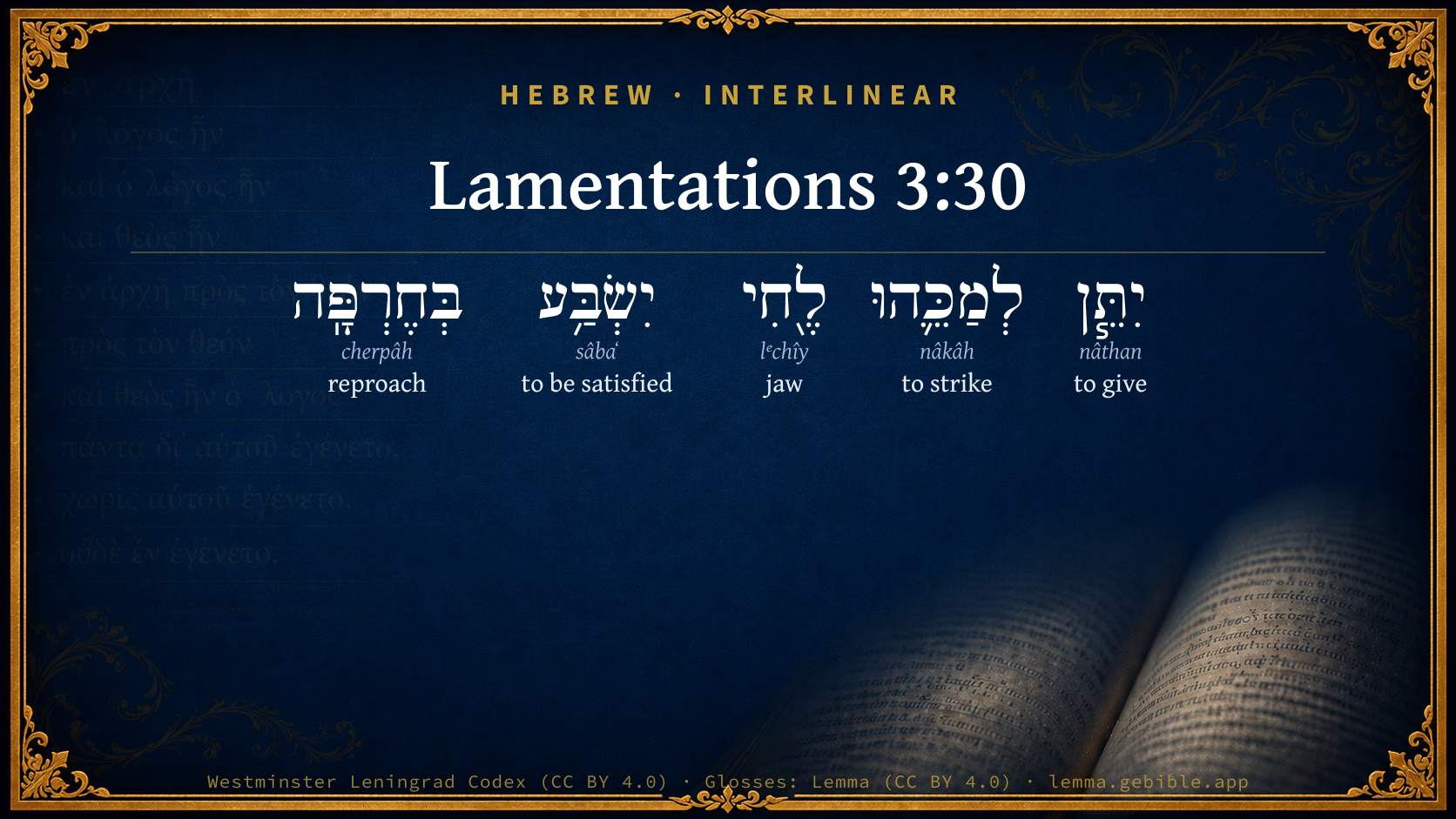
Lamentations 3:30

Hebrew (Westminster Leningrad Codex) Lamentations 3:30 appears in the Hebrew Old Testament. The text above is from the Westminster Leningrad Codex. Each word links to its Strong’s number, a concise gloss, and parsing drawn from the Open Scriptures Hebrew Bible morphology. Click any word for its full Brown-Driver-Briggs (BDB) entry.
Download image
Cite this verse

Lamentations 3:30 (World English Bible). Public Domain. Lemma interlinear Bible study tool, https://lemma.gebible.app/v/lamentations/3/30.

Show BibTeX & RIS
BibTeX
RIS
English Translation
Let him give his cheek to him who strikes him; let him be filled full with reproach.
World English Bible · Public Domain
Download a study sheet

One document with this verse’s original text, its word-by-word gloss line, the meaning frame, cross-references with their text, attributed commentary, and full source and license credits — printable, and it pastes into notes with its structure intact.

This verse Autodidact and up

Study sheet (.html) Plain text (.txt)

A passage Seminary Student

Up to 50 verses in one chapter. A passage sheet keeps up to 6 commentary sources and 12 cross-references per verse, in the order this page ranks them, and says so on the sheet whenever that leaves anything out. Ask for a single verse and you get the Autodidact verse sheet above.

Everything on this page stays free to read, with no account — the sheet is a download of what is already on screen, not access to it.

Want to remove ads? Support Godless Engineer
Compare translations 3

The same verse in 3 English versions, stacked beneath the original-language interlinear above. Click any original word for its lexicon entry.

Each is an independent rendering of the whole verse — the interlinear is not word-aligned to these translations.

Highlighted words mark where these versions differ — a whole-verse word diff, not a word-by-word alignment.

  • World English Bible Public Domain
    Let him give his cheek to him who strikes him; let him be filled full with reproach.
  • King James Version Public Domain
    He giveth his cheek to him that smiteth him: he is filled full with reproach.
  • unfoldingWord Literal Text CC BY-SA 4.0
    Let him give cheek to the one striking him; let fill him with reproach. KAPH

unfoldingWord Literal Text — © unfoldingWord, licensed CC BY-SA 4.0. Word-aligned USFM3 via Door43 (git.door43.org/unfoldingWord/en_ult).

Versions to compare (up to 4)

3 of 4 selected

Show all 18 translations

Every available English version of this verse, each an independent rendering of the whole verse.

  • World English Bible Public Domain
    Let him give his cheek to him who strikes him; let him be filled full with reproach.
  • Berean Standard Bible Public Domain
    Let him offer his cheek to the one who would strike him; let him be filled with reproach.
  • Majority Standard Bible Public Domain
    Let him offer his cheek to the one who would strike him; let him be filled with reproach.
  • King James Version Public Domain
    He giveth his cheek to him that smiteth him: he is filled full with reproach.
  • American Standard Version (1901) Public Domain
    Let him give his cheek to him that smiteth him; let him be filled full with reproach.
  • Revised Version (1885) Public Domain
    Let him give his cheek to him that smiteth him; let him be filled full with reproach.
  • Geneva Bible (1599) Public Domain
    Hee giueth his cheeke to him that smiteth him: he is filled full with reproches.
  • Douay-Rheims (1899) Public Domain
    Jod. He shall give his cheek to him that striketh him, he shall be filled with reproaches.
  • Young's Literal Translation Public Domain
    He giveth to his smiter the cheek, He is filled with reproach.
  • Literal Standard Version CC BY-SA 4.0
    He gives to his striker the cheek, || He is filled with reproach.
  • Unlocked Literal Bible CC BY-SA 4.0
    Let him offer his cheek to the one who strikes him, and let him be filled to the full with reproach.
  • unfoldingWord Literal Text CC BY-SA 4.0
    Let him give cheek to the one striking him; let fill him with reproach. KAPH
  • Darby Bible Public Domain
    he giveth his cheek to him that smiteth him; he is filled full with reproach.
  • World Messianic Bible Public Domain
    Let him give his cheek to him who strikes him. Let him be filled full of reproach.
  • Webster's Bible Public Domain
    He giveth his cheek to him that smiteth him: he is filled full with reproach.
  • Free Bible Version CC BY-SA 4.0
    They should turn a cheek to someone who wants to slap them; they should take the insults of others.
  • Bible in Basic English Public Domain
    Let his face be turned to him who gives him blows; let him be full of shame.
  • JPS Tanakh (1917) Public Domain
    Let him give his cheek to him that smiteth him, let him be filled full with reproach.

Literal Standard Version (2020), Covenant Press — licensed CC BY-SA 4.0. Text via the HelloAO Bible API (eBible.org). Unlocked Literal Bible (unfoldingWord) — licensed CC BY-SA 4.0. Text via the HelloAO Bible API (eBible.org). unfoldingWord Literal Text — © unfoldingWord, licensed CC BY-SA 4.0. Word-aligned USFM3 via Door43 (git.door43.org/unfoldingWord/en_ult). Free Bible Version, Dr. Jonathan Gallagher — licensed CC BY-SA 4.0. Text via the HelloAO Bible API (eBible.org).

Word by word

More ways to search: Search by grammar → Find every occurrence → Compare this word →

Practice this passage: Drill this verse → Learn its vocabulary →

About this verse

These counts appear in no published source. They are computed here, from the morphology-tagged text and Lemma’s own curated glosses. What Lemma adds →

5
words
5
distinct lemmas
Prophets
section

Notable vocabulary

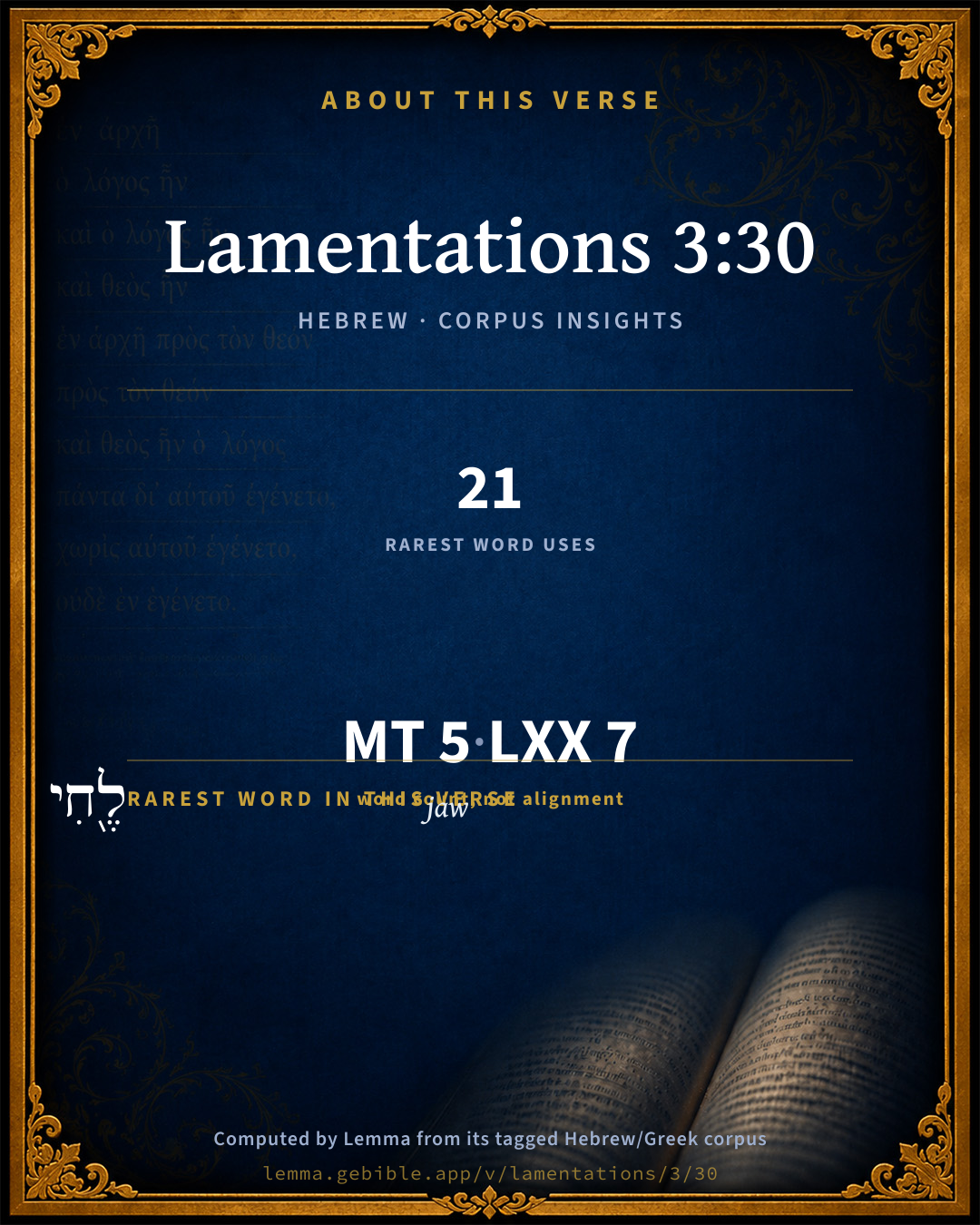
The rarest word here is לֶ֖חִי jaw H3895 — appearing just 21 times in the whole Hebrew Bible.

Shared distinctive vocabulary

לֶ֖חִי jaw H3895 occurs in 20 verses of the Hebrew Bible. Also found in:

Grammatical profile

  • 3 verbs
  • 2 nouns

Verb forms

  • יִתֵּ֧ן Qal · Imperfect
  • לְמַכֵּ֛הוּ Hiphil · Participle Active
  • יִשְׂבַּ֥ע Qal · Jussive

Hebrew & Septuagint length

In English translation the verse runs 17 words from the Hebrew and 18 from the Septuagint (LXX English) — closely comparable.

A rough comparison of the two English renderings, which tokenize alike — not a word-level alignment.

Word counts can differ between the Hebrew and the Greek without any difference in meaning — e.g. the Hebrew direct-object marker אֵת has no separate Greek word, and Greek often adds the article ὁ.

In the original languages it is 5 Hebrew tokens and 7 Greek tokens — but the two are counted differently (Hebrew bundles its prefixes and suffixes into one token; the Greek is in lemma form), so that isn’t a like-for-like length.

Cross-references

10

Topical passages linked to Lamentations 3:30 in the Treasury of Scripture Knowledge — connected by theme and wording, ordered by reader-vote popularity; previews shown in the World English Bible.

  • Job 16:10 They have gaped on me with their mouth; They have struck me on the cheek reproachfully. They gather themselves together against me.
  • Isaiah 50:6 I gave my back to the strikers, and my cheeks to those who plucked off the hair; I didn't hide my face from shame and spitting.
  • Matthew 5:39 But I tell you, don't resist him who is evil; but whoever strikes you on your right cheek, turn to him the other also.
  • Matthew 26:67 Then they spit in his face and beat him with their fists, and some slapped him,
  • 2 Corinthians 11:20 For you bear with a man, if he brings you into bondage, if he devours you, if he takes you captive, if he exalts himself, if he strikes you on the face.
  • Psalms 69:20 Reproach has broken my heart, and I am full of heaviness. I looked for some to take pity, but there was none; For comforters, but I found none.
  • Psalms 123:3 Have mercy on us, Yahweh, have mercy on us, For we have endured much contempt.
  • Micah 5:1 Now you shall gather yourself in troops, Daughter of troops. He has laid siege against us; They will strike the judge of Israel with a rod on the cheek.
  • Luke 6:29 To him who strikes you on the cheek, offer also the other; and from him who takes away your cloak, don't withhold your coat also.
  • Psalms 69:9 For the zeal of your house consumes me. The reproaches of those who reproach you have fallen on me.

Cross-references courtesy of OpenBible.info (CC BY 4.0).

Hebrew and Greek witnesses Masoretic Hebrew ↔ Greek Septuagint

The same verse in the two great witnesses to the Old Testament, shown verse-for-verse.

These are two independent witnesses, not word-aligned to each other, and the Septuagint is shown in lemma (dictionary) form.

Hebrew Lamentations 3:30 Masoretic · Westminster Leningrad Codex

יִתֵּ֧ן לְמַכֵּ֛הוּ לֶ֖חִי יִשְׂבַּ֥ע בְּחֶרְפָּֽה

Let him give his cheek to him who strikes him; let him be filled full with reproach.

World English Bible · Public Domain

Greek LXX Lamentations 3:30 Septuagint · lemma form

δίδωμι ὁ παίω αὐτός σιαγών χορτάζω ὀνειδισμός

JOD. He will give his cheek to him that smites him: he will be filled full with reproaches.

LXX2012 (modern English Septuagint) · Public Domain

Hebrew: Westminster Leningrad Codex (CC BY 4.0). Greek: Septuagint (public domain); English from LXX2012 (modern English Septuagint) (Public Domain). How the Septuagint differs from the Hebrew →

Commentary

Notes on Lamentations 3:30 from classic Christian and Jewish commentators (each source and its license shown beneath its notes). The classic Christian expositions comment on the surrounding passage and are grouped to its opening verse, so a note may address several verses; the Jewish commentaries on the Tanakh (Rashi and others) are per-verse, so they appear only where the commentator wrote on this verse.

Lemma curates 59 commentaries, every one of them public domain or Creative Commons licensed, each selected and text-cleaned for this edition rather than reprinted as found. About our sources →

Trapp's Complete Commentary

John Trapp

Lam 3:30 He giveth [his] cheek to him that smiteth him: he is filled full with reproach.

Ver. 30. He giveth his cheek to him that smiteth him.] Humility, the product of affliction sanctified, is still at her lesson, or rather practising what she hath learned. David, having suffered by Absalom, can well enough bear with Shimei’s tongue smitings; and the apostles, after they had been in prison, departed from the council, rejoicing that they were so far graced as to be disgraced for the name of Jesus. {Act 5:41}

He is filled full of reproach.] He can bravely bear all contumelies and contempts for his conscience, taking them as crowns and confirmations of his conformity to Christ.

John Trapp, A Commentary or Exposition upon All the Books of the Old and New Testament (1647–1656) — public domain. Text from a community e-Sword module.

Jamieson, Fausset & Brown

Robert Jamieson, A. R. Fausset & David Brown

Messiah, the Antitype, fulfilled this; His practice agreeing with His precept (Isa 50:6; Mat 5:39). Many take patiently afflictions from God, but when man wrongs them, they take it impatiently. The godly bear resignedly the latter, like the former, as sent by God (Psa 17:13).

Jamieson, Fausset & Brown — Commentary Critical and Explanatory on the Whole Bible (1871) — public domain (CC PDM 1.0). Text via the HelloAO Bible API.

Adam Clarke's Commentary

Verse 30. He giveth his cheek to him that smiteth] He has that love that is not provoked. He is not quarrelsome, nor apt to resent injuries; he suffers long and is kind. Or, it may be rendered, "let him give his cheek."

He is filled full with reproach.] Though all this take place, yet let his "trust be in God, who will not cast off for ever." God will take his part, and bring him safely through all hardships.

Adam Clarke's Commentary on the Bible (1810–1826) — public domain. Text from a community e-Sword/MySword module.

John Calvin's Commentaries

Here he mentions another fruit of patience, that the faithful, even when injuries are done to them by the wicked, would yet be calm and resigned. For there are many who submit to God when they perceive his hand; as, for instance, when any one is afflicted with a disease, he knows that it is a chastisement that proceeds from God; when pestilence happens, or famine, from the inclemency of the weather, the hand of God appears to them; and many then conduct themselves in a suitable manner: but when an enemy meets one, and when injured, he instantly says, “I have now nothing to do with God, but that wicked enemy treats me disgracefully.”

It is then for this reason that the Prophet shews that the patience of the godly ought to extend to injuries of this kind; and hence he says, He will give the cheek to the smiter, and will be filled with reproaches There are two kinds of injuries; for the wicked either treat us with violence, or assail us with reproaches; and reproach is the bitterest of all things, and inflicts a most grievous wound on all ingenuous minds. The Prophet, then, here declares that the children of God ought meekly to suffer when they are violently assailed, and not only so, but when they are dealt with reproachfully by the wicked. This, then, he says of patience. Now follows another confirmation, —

John Calvin's Commentaries (1540-1563) — public domain. Text from the Calvin Translation Society English edition (1840s-50s) via the Christian Classics Ethereal Library (ccel.org). Calvin's coverage is partial (roughly two-thirds of the Bible); uncommented books and verses are honest gaps, never fabricated. The 19th-century editor's footnotes and remarks are omitted so the notes are faithfully Calvin's own voice.

Ellicott's Commentary for English Readers

(30) He giveth his cheek . . .—The submission enjoined reaches its highest point—a patience like that of Job_16:10; we may add, like that of the Sermon on the Mount (Mat_5:39.) It was harder to accept the Divine chastisement when it came through human agents. Not so had Jeremiah once taught and acted (Jer_20:1-6; Jer_28:15). (Comp. Isa_1:6.)

A Bible Commentary for English Readers, edited by Charles John Ellicott (1878–1897) — public domain. Text from a community e-Sword module.

The Cambridge Bible for Schools and Colleges

gen. ed. J. J. S. Perowne

30. Let him give his cheek] Cp. Job_16:10; Isa_50:6; Mat_5:39.

The Cambridge Bible for Schools and Colleges (gen. ed. J. J. S. Perowne; Cambridge University Press, 1878–1918) — public domain. Text from a community e-Sword module.

John Gill's Exposition

For the Lord will not cast off for ever. Which is not to be understood of all his creatures; for there are some he does cast off for ever, as the angels that sinned; reprobate men, profligate and abandoned sinners, that live and die impenitent; and unbelievers, carnal professors, and apostates; but not his own special and peculiar people, the people whom he has foreknown and loved with an everlasting love, his spiritual Israel; or, as the Targum supplies it, "his servants"; see Psa 94:14; he may seem for a while to reject them, but not in reality and for ever; as when he hides his face from them, lays his afflicting hand on them, or suffers then, to be afflicted by others, and defers his help, and does not immediately appear to their deliverance and salvation; but in reality he never rejects them from being his people, his servants, and his sons; they have always a place in his heart, and are ever under his eye and care; they continue in his covenant, and abide in his family; and though they may be cast down in their souls, and cast out by men, yet are not cast off by God, neither in youth nor old age, in time or eternity; his love is unchangeable; his purposes firm and unalterable; his counsel, covenant, oath, and promise, immutable; and they are his jewels, his portion, and inheritance; and this is a ground and reason of bearing patiently all afflictions, injuries, and reproaches; for though men cast off, God will not.

; he may seem for a while to reject them, but not in reality and for ever; as when he hides his face from them, lays his afflicting hand on them, or suffers then, to be afflicted by others, and defers his help, and does not immediately appear to their deliverance and salvation; but in reality he never rejects them from being his people, his servants, and his sons; they have always a place in his heart, and are ever under his eye and care; they continue in his covenant, and abide in his family; and though they may be cast down in their souls, and cast out by men, yet are not cast off by God, neither in youth nor old age, in time or eternity; his love is unchangeable; his purposes firm and unalterable; his counsel, covenant, oath, and promise, immutable; and they are his jewels, his portion, and inheritance; and this is a ground and reason of bearing patiently all afflictions, injuries, and reproaches; for though men cast off, God will not.

Lamentations 3:32

lam 3:32

lam 3:32

lam 3:32But though he cause grief,.... As he sometimes does in his own people; by convincing them of sin, and producing in them godly sorrow, which worketh repentance unto life, not to be repented of; by correcting and chastising them for it, and by hiding his face from them; all which are grievous to them:

yet will he have compassion according to the multitude of his mercies; his mercies are many, both temporal and spiritual, and his compassion is answerable; which he shows to his people by an application of pardoning grace, through the blood of Christ, by sympathizing with them under their afflictions, and delivering from them; by granting them his gracious presence, and restoring to them the joys of his salvation; all which is not according to their merits, but his mercies.

John Gill's Exposition of the Whole Bible (1746–1763) — public domain (CC PDM 1.0). Text via the HelloAO Bible API.

Haydock's Catholic Bible Commentary

Him. We cannot verify this of the prophet as we can of Christ, (Matthew xxvi. 62.; Calmet) to whom this particularly refers. (Worthington)

George Leo Haydock (1774–1849), Haydock's Catholic Family Bible and Commentary, 1859 edition — public domain. Excludes Psalms (Douay-Rheims chapter numbering differs from Protestant) and Deuterocanonical books (Catholic canon only).

Matthew Poole's English Annotations

According to our Saviour’s precept, Mat 5:39, he doth not take any private revenge; he is reproached and reviled, but when he is so he revileth not again, 1Pe 2:23; he is filled with reproach from others, but his mouth is not filled with the reproachings of others.

Matthew Poole's English Annotations on the Holy Bible (1683–1685) — public domain. Text from a community e-Sword/MySword module.

The Pulpit Commentary

He giveth his cheek. Notice the striking affinity (which is hardly accidental) to Job_16:10 Isa_1:6. The ideal of the righteous man, according to these kindred books, contains, as one of its most prominent features, the patient endurance of affliction; and so too does the same ideal, received and amplified by the greatest "Servant of Jehovah". (Mat_5:39)

The cheek to the smiter.

Probably these verses should be translated by imperatives. The prophet, profiting by his own experience and by that of his country. men, admonishes all to meekness and submission. In resistance is neither peace nor deliverance; in patient subjection and waiting is true wisdom, for such is the way to contentment and to final salvation.

I SUCH MEEKNESS IS CONTRARY TO NATURAL INCLINATION, AND IS INDICATIVE OF A CHASTENED SPIRIT. He who is smitten naturally smites again. But to act upon this principle is to perpetuate a state of war and strife. Revenge is indeed often honored in the world, yet the world"s records are records of the wretchedness which this habit produces. On the other hand, the Christian principle, commended by our Lord in language which seems borrowed from this passage, is a principle of forgiveness and meek submission, the prevalence of which does much to mitigate asperity and to check wanton injuries.

II SUCH MEEKNESS IS INCULCATED BY THE LORD JESUS BOTH BY PRECEPT AND EXAMPLE. He was reviled, yet he reviled not again. And in taking without resentment or complaint the unjust stripes and blows and many indignities he endured, our Saviour has given the world the most glorious example of victory over self, of superhuman meekness.

III SUCH MEEKNESS IS CONTRIBUTIVE TO THE HAPPINESS OF THOSE WHO EXHIBIT IT AND TO THE EDIFICATION OF THOSE WHO WITNESS IT. The meek and lowly in heart find rest unto their soul. And society is profited by every illustration of the power and beauty of self-government and self-control, of conciliation and patience. T.

The Pulpit Commentary (1880–1919), ed. H.D.M. Spence-Jones & Joseph S. Exell — public domain. Text from a community e-Sword module.

unfoldingWord translationNotes

Door43 World Missions Community

General Information:

The writer speaks of the one who waits for Yahweh (Lamentations 3:25).

Let him offer his cheek to the one who strikes him

The word "him" refers to anyone who is suffering and who waits for Yahweh. Here "offer his cheek" represents allowing someone to strike his cheek. AT: "Let him allow people to hit him on the face" (See: Metaphor)

let him be filled to the full with reproach

The author speaks of a person as if he were a container and reproach were a liquid. Being filled with reproach represents being reproached much. The implication is that he should be patient when this happens. AT: "let him be insulted much" or "let him be patient when people reproach him" (See: Metaphor)

though he causes grief

"though the Lord causes people to suffer" or "though he afflicts people"

he will have compassion

"he will be compassionate to them"

For he does not afflict from his heart

Here the heart represents desire or pleasure, and afflicting from the heart represents afflicting with pleasure. AT: "For it does not make him happy to afflict people" or "He does not take pleasure in afflicting people" (See: Metonymy)

the children of mankind

This refers to people in general. AT: "human beings" or "people" (See: Idiom)

translationWords

disgrace

lord

reject

eternity

compassion

afflicted

heart

torment

unfoldingWord translationNotes — © Distant Shores Media and the Door43 World Missions Community, licensed CC BY-SA 4.0. Source: git.door43.org/Door43/en_tn.

Lesson kit

Teaching starters — assembled from the data on this page, not authored interpretation. Every prompt links to the verse data it draws on. Edit before teaching.

Lamentations, in the Prophets, opens this verse with 5 words (5 distinct Hebrew lemmas). Its most distinctive word is lᵉchîy (“jaw”). A historical commentator’s framing appears above. Read the whole chapter for the surrounding context.

Discussion questions

  1. How does “jaw” (lᵉchîy) shape what this verse is saying?
  2. How does Deuteronomy 18:3, which shares the word «jaw», read alongside this verse?
  3. The translations on this page render this verse differently — a whole-verse word diff, not a word-by-word alignment. What might account for the different wordings?
  4. «יִתֵּ֧ן» is a Qal Imperfect verb. How does that grammatical form shape the action described?
  5. Compare how Trapp's Complete Commentary and Jamieson, Fausset & Brown read this verse. Where do they agree or differ?

Things to notice

Reading settings

Reading text

Shown beneath each verse's original-language words.

Old Testament
Old Testament edition

Read the OT as the Masoretic Hebrew (MT) or the Greek Septuagint (LXX).

English shown for the Greek Septuagint (in the Hebrew ↔ Greek comparison).

Comparing translations? Open the Compare panel on any verse page to stack up to four side by side.