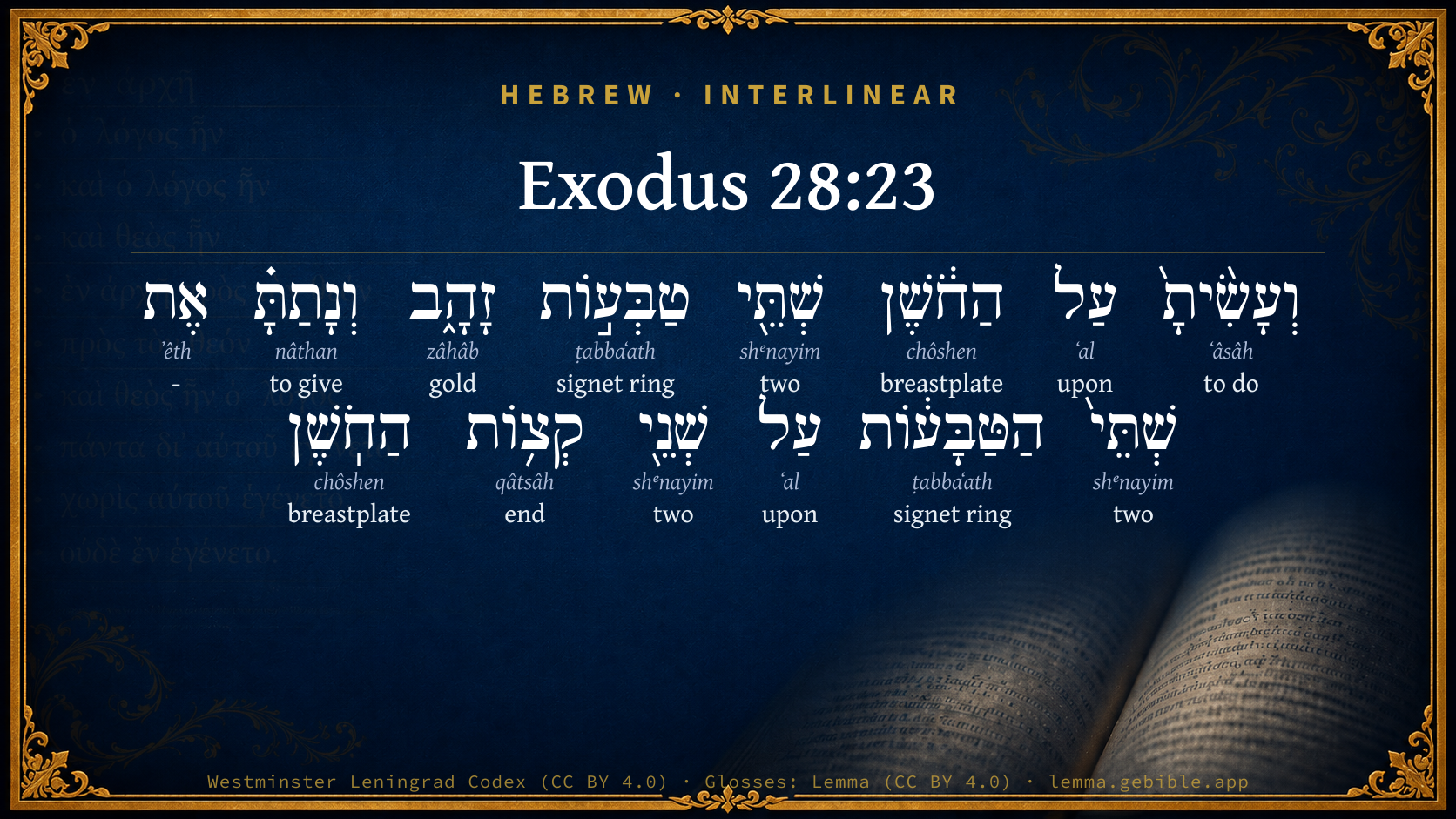
Exodus 28:23

Hebrew (Westminster Leningrad Codex) Exodus 28:23 appears in the Hebrew Old Testament. The text above is from the Westminster Leningrad Codex. Each word links to its Strong’s number, a concise gloss, and parsing drawn from the Open Scriptures Hebrew Bible morphology. Click any word for its full Brown-Driver-Briggs (BDB) entry.
Download image
Cite this verse

Exodus 28:23 (World English Bible). Public Domain. Lemma interlinear Bible study tool, https://lemma.gebible.app/v/exodus/28/23.

Show BibTeX & RIS
BibTeX
RIS
English Translation
You shall make on the breastplate two rings of gold, and shall put the two rings on the two ends of the breastplate.
World English Bible · Public Domain
Download a study sheet

One document with this verse’s original text, its word-by-word gloss line, the meaning frame, cross-references with their text, attributed commentary, and full source and license credits — printable, and it pastes into notes with its structure intact.

This verse Autodidact and up

Study sheet (.html) Plain text (.txt)

A passage Seminary Student

Up to 50 verses in one chapter. A passage sheet keeps up to 6 commentary sources and 12 cross-references per verse, in the order this page ranks them, and says so on the sheet whenever that leaves anything out. Ask for a single verse and you get the Autodidact verse sheet above.

Everything on this page stays free to read, with no account — the sheet is a download of what is already on screen, not access to it.

Want to remove ads? Support Godless Engineer
Compare translations 3

The same verse in 3 English versions, stacked beneath the original-language interlinear above. Click any original word for its lexicon entry.

Each is an independent rendering of the whole verse — the interlinear is not word-aligned to these translations.

Highlighted words mark where these versions differ — a whole-verse word diff, not a word-by-word alignment.

  • World English Bible Public Domain
    You shall make on the breastplate two rings of gold, and shall put the two rings on the two ends of the breastplate.
  • King James Version Public Domain
    And thou shalt make upon the breastplate two rings of gold, and shalt put the two rings on the two ends of the breastplate.
  • unfoldingWord Literal Text CC BY-SA 4.0
    And you shall make two rings of gold for the breastpiece, and you shall put the two rings on the two ends of the breastpiece.

unfoldingWord Literal Text — © unfoldingWord, licensed CC BY-SA 4.0. Word-aligned USFM3 via Door43 (git.door43.org/unfoldingWord/en_ult).

Versions to compare (up to 4)

3 of 4 selected

Show all 18 translations

Every available English version of this verse, each an independent rendering of the whole verse.

  • World English Bible Public Domain
    You shall make on the breastplate two rings of gold, and shall put the two rings on the two ends of the breastplate.
  • Berean Standard Bible Public Domain
    You are also to make two gold rings and fasten them to the two corners of the breastpiece.
  • Majority Standard Bible Public Domain
    You are also to make two gold rings and fasten them to the two corners of the breastpiece.
  • King James Version Public Domain
    And thou shalt make upon the breastplate two rings of gold, and shalt put the two rings on the two ends of the breastplate.
  • American Standard Version (1901) Public Domain
    And thou shalt make upon the breastplate two rings of gold, and shalt put the two rings on the two ends of the breastplate.
  • Revised Version (1885) Public Domain
    And thou shalt make upon the breastplate two rings of gold, and shalt put the two rings on the two ends of the breastplate.
  • Geneva Bible (1599) Public Domain
    Thou shalt make also vpon the brest plate two rings of golde, and put the two rings on the two endes of the brest plate.
  • Douay-Rheims (1899) Public Domain
    And two rings of gold, which thou shalt put in the two ends at the top of the rational.
  • Young's Literal Translation Public Domain
    and thou hast made on the breastplate two rings of gold, and hast put the two rings on the two ends of the breastplate;
  • Literal Standard Version CC BY-SA 4.0
    and you have made two rings of gold on the breastplate, and have put the two rings on the two ends of the breastplate;
  • Unlocked Literal Bible CC BY-SA 4.0
    You must make two rings of gold for the breastpiece and must attach them to the two ends of the breastpiece.
  • unfoldingWord Literal Text CC BY-SA 4.0
    And you shall make two rings of gold for the breastpiece, and you shall put the two rings on the two ends of the breastpiece.
  • Darby Bible Public Domain
    And thou shalt make on the breastplate two rings of gold, and shalt put the two rings on the two ends of the breastplate.
  • World Messianic Bible Public Domain
    You shall make on the breastplate two rings of gold, and shall put the two rings on the two ends of the breastplate.
  • Webster's Bible Public Domain
    And thou shalt make upon the breast-plate two rings of gold, and shalt put the two rings on the two ends of the breast-plate.
  • Free Bible Version CC BY-SA 4.0
    Make two gold rings and fasten them to the two top corners of the breastpiece.
  • Bible in Basic English Public Domain
    And put two gold rings on the two ends of the bag.
  • JPS Tanakh (1917) Public Domain
    And thou shalt make upon the breastplate two rings of gold, and shalt put the two rings on the two ends of the breastplate.

Literal Standard Version (2020), Covenant Press — licensed CC BY-SA 4.0. Text via the HelloAO Bible API (eBible.org). Unlocked Literal Bible (unfoldingWord) — licensed CC BY-SA 4.0. Text via the HelloAO Bible API (eBible.org). unfoldingWord Literal Text — © unfoldingWord, licensed CC BY-SA 4.0. Word-aligned USFM3 via Door43 (git.door43.org/unfoldingWord/en_ult). Free Bible Version, Dr. Jonathan Gallagher — licensed CC BY-SA 4.0. Text via the HelloAO Bible API (eBible.org).

Word by word

More ways to search: Search by grammar → Find every occurrence → Compare this word →

Practice this passage: Drill this verse → Learn its vocabulary →

הַחֹ֔שֶׁן
chôshen
H2833
“the · breastplate”
Particle, Definite Article + Noun, Common, Masculine, Singular, Absolute
Part of Speech
Particle + Noun
Type
Common
Gender
Masculine
Number
Singular
State
Absolute
Full BDB Definition

Origin: from an unused root probably meaning to contain or sparkle

TWOT: 772a

breastplate, breastpiece - sacred pouch of the high priest designed to hold the Urim and Thummim
  1. וְעָשִׂ֨יתָ֙ ʻâsâh H6213 “and · to do” Conjunction + Verb, Qal, Sequential Perfect, 2nd Person, Masculine, Singular
  2. עַל ʻal H5921 “upon” Preposition
  3. שְׁתֵּ֖י shᵉnayim H8147 “two” Adjective, Cardinal number, Feminine, Dual, Construct
  4. טַבְּע֣וֹת ṭabbaʻath H2885 “signet rings of” Noun, Common, Feminine, Plural, Construct
  5. זָהָ֑ב zâhâb H2091 “gold” Noun, Common, Masculine, Singular, Absolute
  6. וְנָתַתָּ֗ nâthan H5414 “and · to give” Conjunction + Verb, Qal, Sequential Perfect, 2nd Person, Masculine, Singular
  7. אֶת ʼêth H853 “-” Particle, Direct Object
  8. שְׁתֵּי֙ shᵉnayim H8147 “two” Adjective, Cardinal number, Feminine, Dual, Construct
  9. הַטַּבָּע֔וֹת ṭabbaʻath H2885 “the · signet rings” Particle, Definite Article + Noun, Common, Feminine, Plural, Absolute
  10. עַל ʻal H5921 “upon” Preposition
  11. שְׁנֵ֖י shᵉnayim H8147 “two” Adjective, Cardinal number, Masculine, Dual, Construct
  12. קְצ֥וֹת qâtsâh H7098 “ends of” Noun, Common, Both, Plural, Construct
  13. הַחֹֽשֶׁן chôshen H2833 “the · breastplate” Particle, Definite Article + Noun, Common, Masculine, Singular, Absolute

About this verse

These counts appear in no published source. They are computed here, from the morphology-tagged text and Lemma’s own curated glosses. What Lemma adds →

14
words
9
distinct lemmas
Pentateuch
section

Notable vocabulary

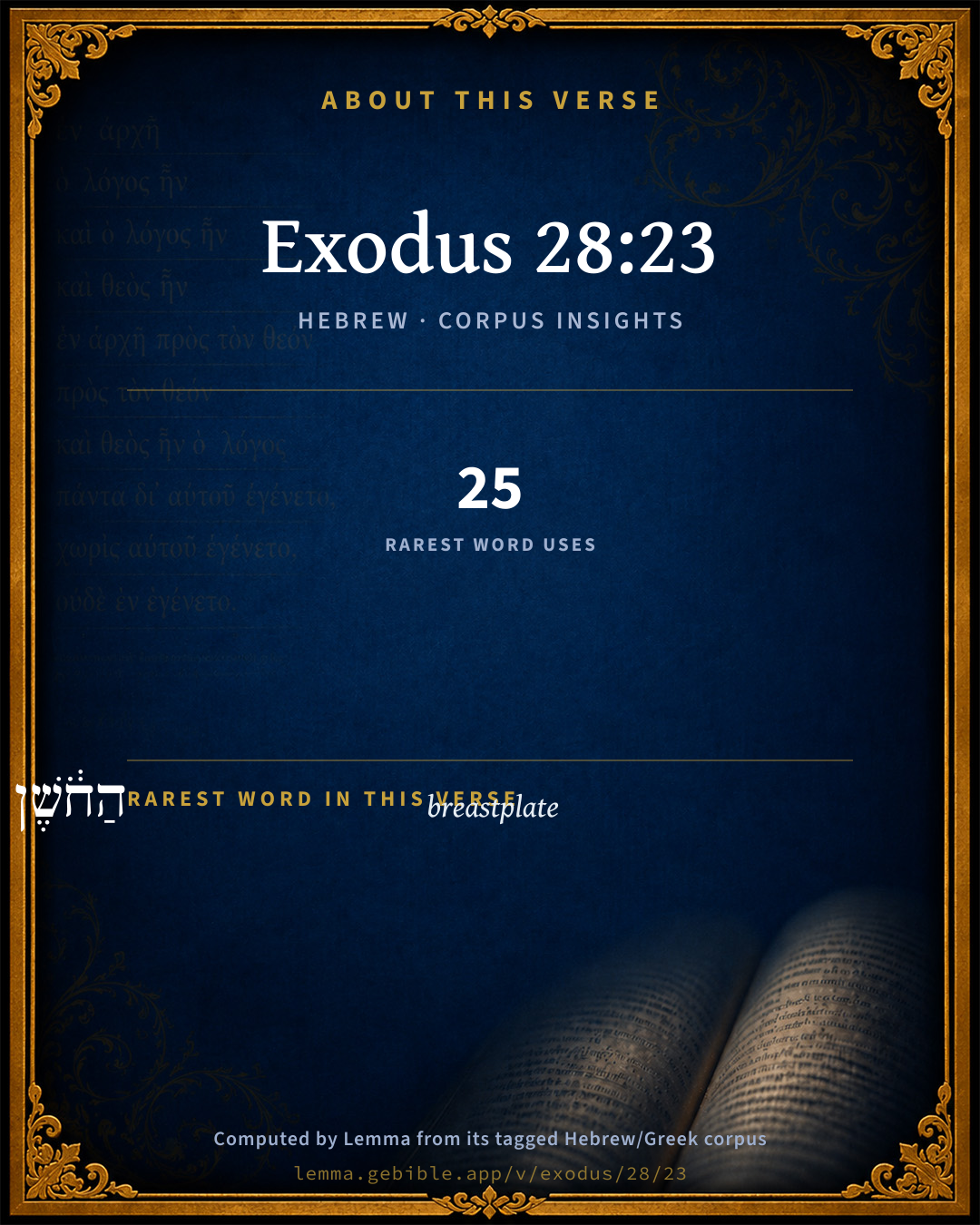
The rarest word here is הַחֹ֔שֶׁן breastplate H2833 — appearing just 25 times in the whole Hebrew Bible.

Shared distinctive vocabulary

הַחֹ֔שֶׁן breastplate H2833 occurs in 21 verses of the Hebrew Bible. Also found in:

Grammatical profile

  • 2 verbs
  • 6 nouns
  • 3 adjectives
  • 2 prepositions
  • 1 particle

Verb forms

  • וְעָשִׂ֨יתָ֙ Qal · Sequential Perfect
  • וְנָתַתָּ֗ Qal · Sequential Perfect

Repetition

Words recur within this verse — often emphatic in Hebrew:

  • שְׁתֵּ֖י two H8147 ×3
  • עַל upon H5921 ×2
  • הַחֹ֔שֶׁן breastplate H2833 ×2
  • טַבְּע֣וֹת signet ring H2885 ×2

Hebrew & Septuagint length

In English translation the verse runs 23 words from the Hebrew and 31 from the Septuagint (LXX English) — closely comparable.

A rough comparison of the two English renderings, which tokenize alike — not a word-level alignment.

Word counts can differ between the Hebrew and the Greek without any difference in meaning — e.g. the Hebrew direct-object marker אֵת has no separate Greek word, and Greek often adds the article ὁ.

Cross-references

1

Topical passages linked to Exodus 28:23 in the Treasury of Scripture Knowledge — connected by theme and wording, ordered by reader-vote popularity; previews shown in the World English Bible.

  • Exodus 25:11–15 You shall overlay it with pure gold. Inside and outside shall you overlay it, and shall make a gold molding around it.

Cross-references courtesy of OpenBible.info (CC BY 4.0).

Hebrew and Greek witnesses Masoretic Hebrew ↔ Greek Septuagint

The same verse in the two great witnesses to the Old Testament, shown verse-for-verse.

These are two independent witnesses, not word-aligned to each other, and the Septuagint is shown in lemma (dictionary) form.

Hebrew Exodus 28:23 Masoretic · Westminster Leningrad Codex

וְעָשִׂ֨יתָ֙ עַל הַחֹ֔שֶׁן שְׁתֵּ֖י טַבְּע֣וֹת זָהָ֑ב וְנָתַתָּ֗ אֶת שְׁתֵּי֙ הַטַּבָּע֔וֹת עַל שְׁנֵ֖י קְצ֥וֹת הַחֹֽשֶׁן

You shall make on the breastplate two rings of gold, and shall put the two rings on the two ends of the breastplate.

World English Bible · Public Domain

Greek LXX Exodus 28:23 Septuagint · lemma form
And Aaron shall take the names of the children of Israel, on the oracle of judgment on his breast; a memorial before God for him as he goes into the sanctuary.

LXX2012 (modern English Septuagint) · Public Domain

Hebrew: Westminster Leningrad Codex (CC BY 4.0). Greek: Septuagint (public domain); English from LXX2012 (modern English Septuagint) (Public Domain). How the Septuagint differs from the Hebrew →

Targum (Aramaic paraphrase)

2

The Targum is the ancient Jewish Aramaic paraphrase of the Hebrew Scriptures — an interpretive translation, not the Hebrew text itself. Onkelos (literal) and Pseudo-Jonathan (expansive) render the Torah, and Jonathan the Prophets. Coverage is partial: where no permissively-licensed English translation exists for a verse, only the Aramaic is shown. This is verse-level text, not a word-by-word alignment to the Hebrew.

  1. Targum Onkelos Torah (Genesis–Deuteronomy)
    וְתַעְבֵּד עַל חוּשְׁנָא תַּרְתֵּין עִזְקָן דִדְהַב וְתִתֵּן יָת תַּרְתֵּין עִזְקָתָא עַל תְּרֵין סִטְרֵי חוּשְׁנָא:

    (no public-domain English translation for this verse)

    Targum Onkelos — Aramaic: “Onkelos Genesis” (public domain); “Onkelos Exodus” (public domain); “Onkelos Leviticus” (public domain); “Onkelos Numbers” (public domain); “Onkelos Deuteronomy” (public domain). English: “Sefaria Community Translation” (CC0 1.0 (public-domain dedication)); “J.W. Etheridge. The Targums of Onkelos and Jonathan Ben Uzziel on the Pentateuch. London: Longmans, Green, 1862” (public domain). Text via Sefaria.

  2. Targum Pseudo-Jonathan Torah (Genesis–Deuteronomy)
    וְתַעֲבֵיד עַל חוּשְׁנָא תַּרְתֵּין עִזְקַן דִּדְהַב דְּכֵי וְתִתֵּן יַת תַּרְתֵּין עִזְקָתָא עַל תַּרְתֵּין סִטְרֵי חוּשְׁנָא

    and shalt make upon the breastplate two rings of pure gold, and put the two rings upon the two sides of the breastplate.

    Targum Pseudo-Jonathan — Aramaic: “Targum Jonathan on Genesis” (public domain); “Targum Jonathan on Exodus” (public domain); “Targum Jonathan on Leviticus” (public domain); “Targum Jonathan on Numbers” (public domain); “Targum Jonathan on Deuteronomy” (public domain). English: “The Targum of Jonathan ben Uzziel, trans. J. W. Etheridge, London, 1862” (public domain). Text via Sefaria.

Commentary

Notes on Exodus 28:23 from classic Christian and Jewish commentators (each source and its license shown beneath its notes). The classic Christian expositions comment on the surrounding passage and are grouped to its opening verse, so a note may address several verses; the Jewish commentaries on the Tanakh (Rashi and others) are per-verse, so they appear only where the commentator wrote on this verse.

Lemma curates 59 commentaries, every one of them public domain or Creative Commons licensed, each selected and text-cleaned for this edition rather than reprinted as found. About our sources →

Geneva Bible (1599)

Geneva Bible translators

Which are upmost toward the shoulder.

Geneva Bible (1599) marginal notes — public domain. Text via Bolls.life.

Ellicott's Commentary for English Readers

(23) Two rings on the two ends—i.e., on the two upper corners of the breastplate. The chains were to be passed through the two rings, which they were then to unite with the “ouches” of the ephod. (See Exo_28:13-14.)

A Bible Commentary for English Readers, edited by Charles John Ellicott (1878–1897) — public domain. Text from a community e-Sword module.

The Cambridge Bible for Schools and Colleges

gen. ed. J. J. S. Perowne

23. put] i.e. fasten, as v. 14: so vv. 24, 25, 26, 27.

the two ends] i.e. the two upper corners.

The Cambridge Bible for Schools and Colleges (gen. ed. J. J. S. Perowne; Cambridge University Press, 1878–1918) — public domain. Text from a community e-Sword module.

John Gill's Exposition

And thou shalt put two wreathen chains of gold in the two rings,.... This expresses both how many chains were to be made, which is not before said, and the use of them, or where they were to be put, as well as the use of the rings:

which are on the ends of the breastplate; the two uppermost ends or corners of it.

John Gill's Exposition of the Whole Bible (1746–1763) — public domain (CC PDM 1.0). Text via the HelloAO Bible API.

The Pulpit Commentary

Vers. 23-28. These verses present no difficulty. They describe very minutely, and with some tautology, the mode in which the breast-plate was to be fastened to the ephod. It was to have four rings, two at its two upper corners (ver. 23), and two just behind its two lower corners (ver. 20); a gold twist or cord was to be passed through each of the two upper rings, and then attached to the" ouches" or settings of the shoulder stones (ver. 25; compare vers. 11-14). A blue lace or ribbon was to be passed through each of the two lower rings, and these laces were to be tied to two rings, sewn for the purpose on to the front of the ephod a little above the "curious girdle" (vers. 26, 27). By these four fastenings at its four corners, the breast-plate was securely attached to the ephod, and could not readily get loose from it.

The Pulpit Commentary (1880–1919), ed. H.D.M. Spence-Jones & Joseph S. Exell — public domain. Text from a community e-Sword module.

Rashi

Rabbi Shlomo Yitzchaki (Rashi)

על החשן means [AND THOU SHALT MAKE] FOR THE BREAST-PLATE (not upon it), — in order to fix them on it. And it would not be correct to say that this means that they should originally be made upon it (על), for if this were so why should it again say in this verse, “And thou shall put the two rings [on the two extremities]”? Would they not already have been lying upon it if they had been made together with the breast-plate? It should rather have written at the beginning of the verse, “And thou shalt make at the ends of the breast-plate two rings of gold.” In the case of chains, also, you must explain it similarly.

על שני קצת החשן ON THE TWO EXTREMITIES OF THE BREAST-PLATE — on its two corners that are close by his neck, on the right and on the left, which come opposite the shoulder-pieces of the ephod.

Rashi on the Tanakh — English translations: “The Judaica Press complete Tanach with Rashi, translated by A. J. Rosenberg” (CC BY 4.0); “Pentateuch with Rashi's commentary by M. Rosenbaum and A.M. Silbermann, 1929-1934” (public domain); “The Metsudah Tanach series, Lakewood, N.J” (CC BY 4.0); and “The Book of Joshua, Metsudah Publications, 1997” (CC BY 4.0). Text via Sefaria.

Lesson kit

Teaching starters — assembled from the data on this page, not authored interpretation. Every prompt links to the verse data it draws on. Edit before teaching.

Exodus, in the Pentateuch, opens this verse with 14 words (9 distinct Hebrew lemmas). Its most distinctive word is chôshen (“breastplate”). A historical commentator’s framing appears above. Read the whole chapter for the surrounding context.

Discussion questions

  1. How does “breastplate” (chôshen) shape what this verse is saying?
  2. How does Exodus 25:7, which shares the word «breastplate», read alongside this verse?
  3. What does the repetition of “two” (3× in this one verse) do in this verse?
  4. These translations render this verse differently. What is at stake in choosing one wording over another?
  5. «וְעָשִׂ֨יתָ֙» is a Qal Sequential Perfect verb. How does that grammatical form shape the action described?
  6. Compare how Geneva Bible (1599) and Ellicott's Commentary for English Readers read this verse. Where do they agree or differ?

Things to notice

Reading settings

Reading text

Shown beneath each verse's original-language words.

Old Testament
Old Testament edition

Read the OT as the Masoretic Hebrew (MT) or the Greek Septuagint (LXX).

English shown for the Greek Septuagint (in the Hebrew ↔ Greek comparison).

Comparing translations? Open the Compare panel on any verse page to stack up to four side by side.