Genesis 14:20

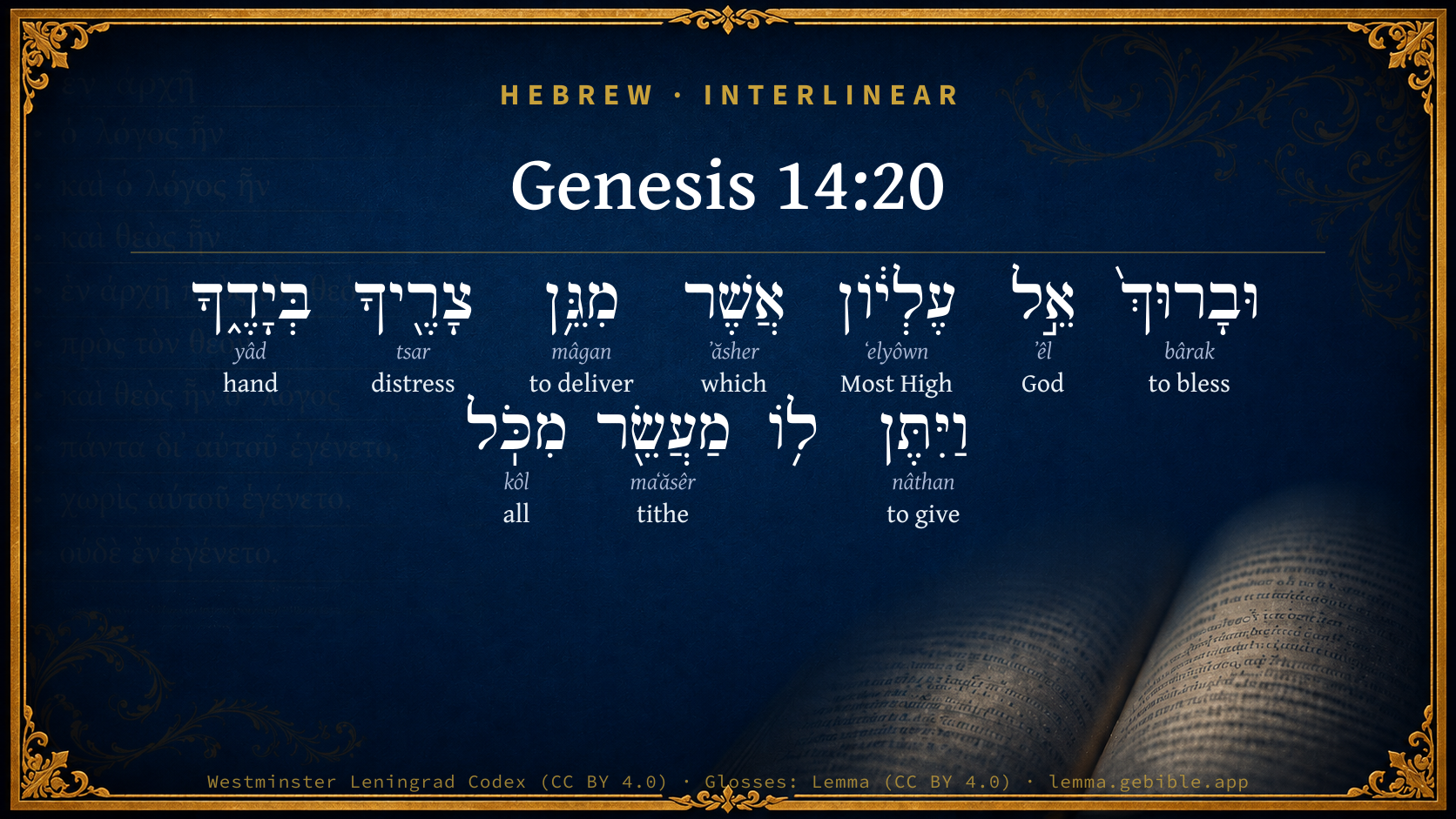
Hebrew (Westminster Leningrad Codex) Genesis 14:20 appears in the Hebrew Old Testament. The text above is from the Westminster Leningrad Codex. Each word links to its Strong’s number, a concise gloss, and parsing drawn from the Open Scriptures Hebrew Bible morphology. Click any word for its full Brown-Driver-Briggs (BDB) entry.
Download image
Cite this verse

Genesis 14:20 (World English Bible). Public Domain. Lemma interlinear Bible study tool, https://lemma.gebible.app/v/genesis/14/20.

Show BibTeX & RIS
BibTeX
RIS
English Translation
and blessed be God Most High, who has delivered your enemies into your hand." Abram gave him a tenth of all.
World English Bible · Public Domain
Highlights
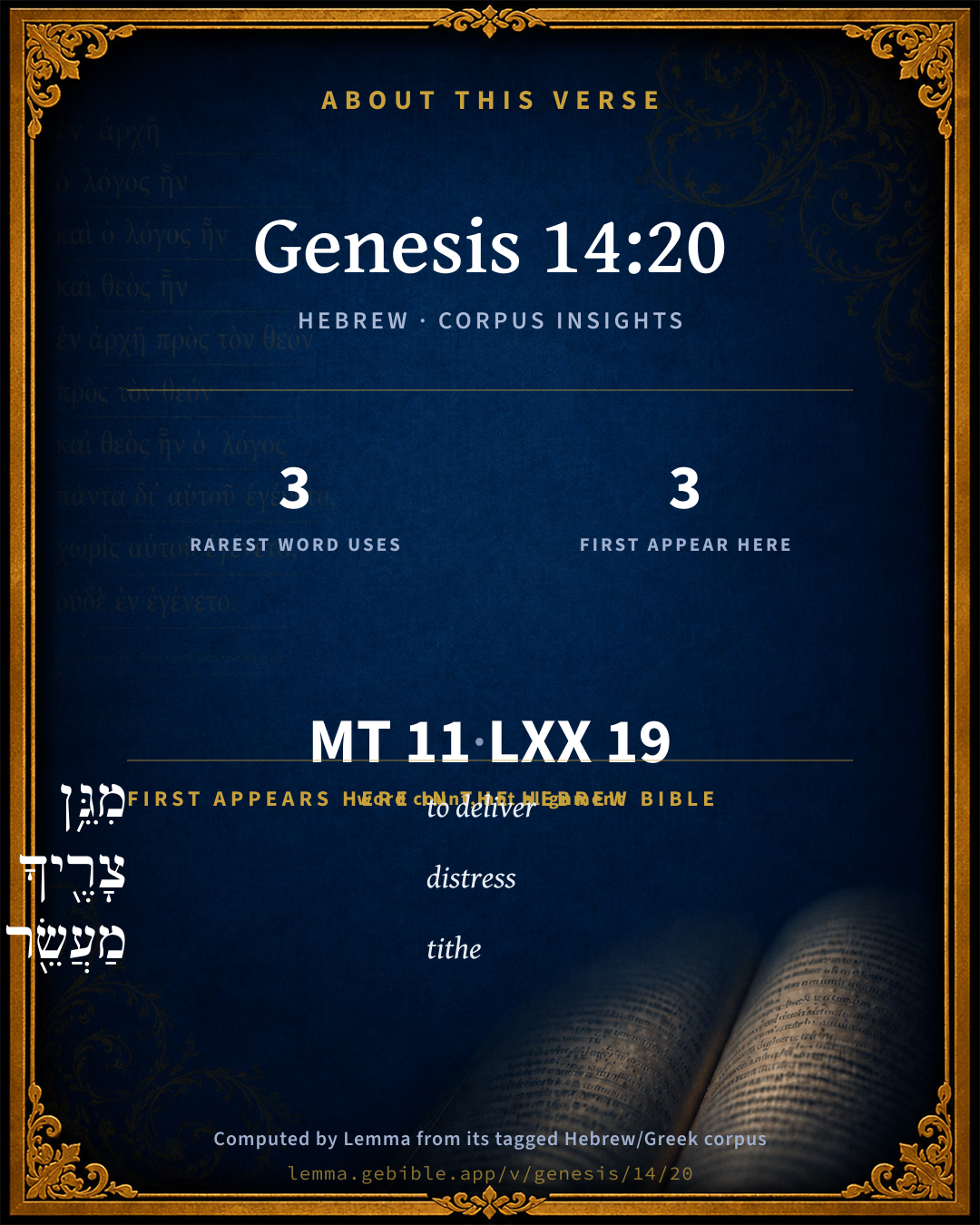
  • 3 first appearances in the Hebrew Bible
Full analysis ↓
Download a study sheet

One document with this verse’s original text, its word-by-word gloss line, the meaning frame, cross-references with their text, attributed commentary, and full source and license credits — printable, and it pastes into notes with its structure intact.

This verse Autodidact and up

Study sheet (.html) Plain text (.txt)

A passage Seminary Student

Up to 50 verses in one chapter. A passage sheet keeps up to 6 commentary sources and 12 cross-references per verse, in the order this page ranks them, and says so on the sheet whenever that leaves anything out. Ask for a single verse and you get the Autodidact verse sheet above.

Everything on this page stays free to read, with no account — the sheet is a download of what is already on screen, not access to it.

Want to remove ads? Support Godless Engineer
Compare translations 3

The same verse in 3 English versions, stacked beneath the original-language interlinear above. Click any original word for its lexicon entry.

Each is an independent rendering of the whole verse — the interlinear is not word-aligned to these translations.

Highlighted words mark where these versions differ — a whole-verse word diff, not a word-by-word alignment.

  • World English Bible Public Domain
    and blessed be God Most High, who has delivered your enemies into your hand." Abram gave him a tenth of all.
  • King James Version Public Domain
    And blessed be the most high God, which hath delivered thine enemies into thy hand. And he gave him tithes of all.
  • unfoldingWord Literal Text CC BY-SA 4.0
    And praised be God Most High, who delivered your enemies into your hand!” Then he gave to him a tenth of everything.

unfoldingWord Literal Text — © unfoldingWord, licensed CC BY-SA 4.0. Word-aligned USFM3 via Door43 (git.door43.org/unfoldingWord/en_ult).

Versions to compare (up to 4)

3 of 4 selected

Show all 18 translations

Every available English version of this verse, each an independent rendering of the whole verse.

  • World English Bible Public Domain
    and blessed be God Most High, who has delivered your enemies into your hand." Abram gave him a tenth of all.
  • Berean Standard Bible Public Domain
    and blessed be God Most High, who has delivered your enemies into your hand.” Then Abram gave Melchizedek a tenth of everything.
  • Majority Standard Bible Public Domain
    and blessed be God Most High, who has delivered your enemies into your hand.” Then Abram gave Melchizedek a tenth of everything.
  • King James Version Public Domain
    And blessed be the most high God, which hath delivered thine enemies into thy hand. And he gave him tithes of all.
  • American Standard Version (1901) Public Domain
    and blessed be God Most High, who hath delivered thine enemies into thy hand. And he gave him a tenth of all.
  • Revised Version (1885) Public Domain
    and blessed be God Most High, which hath delivered thine enemies into thy hand. And he gave him a tenth of all.
  • Geneva Bible (1599) Public Domain
    And blessed be the most high God, which hath deliuered thine enemies into thine hand. And Abram gaue him tythe of all.
  • Douay-Rheims (1899) Public Domain
    And blessed be the most high God, by whose protection the enemies are in thy hands. And he gace him the tithes of all.
  • Young's Literal Translation Public Domain
    and blessed `is' God Most High, who hath delivered thine adversaries into thy hand;' and he giveth to him a tenth of all.
  • Literal Standard Version CC BY-SA 4.0
    and blessed [is] God Most High, who has delivered your adversaries into your hand”; and he gives to him a tenth of all.
  • Unlocked Literal Bible CC BY-SA 4.0
    Blessed be God Most High, who has given your enemies into your hand.” Then Abram gave him a tenth of everything.
  • unfoldingWord Literal Text CC BY-SA 4.0
    And praised be God Most High, who delivered your enemies into your hand!” Then he gave to him a tenth of everything.
  • Darby Bible Public Domain
    And blessed be the Most High ùGod, who has delivered thine enemies into thy hand. And he gave him the tenth of all.
  • World Messianic Bible Public Domain
    Blessed be God Most High, who has delivered your enemies into your hand.” Abram gave him a tenth of all.
  • Webster's Bible Public Domain
    And blessed be the most high God, who hath delivered thy enemies into thy hand. And he gave him tithes of all.
  • Free Bible Version CC BY-SA 4.0
    May the Most High God be praised, who handed your enemies over to you.” Then Abram gave Melchizedek one tenth of everything.
  • Bible in Basic English Public Domain
    And let the Most High God be praised, who has given into your hands those who were against you. Then Abram gave him a tenth of all the goods he had taken.
  • JPS Tanakh (1917) Public Domain
    and blessed be God the Most High, who hath delivered thine enemies into thy hand.' And he gave him a tenth of all.

Literal Standard Version (2020), Covenant Press — licensed CC BY-SA 4.0. Text via the HelloAO Bible API (eBible.org). Unlocked Literal Bible (unfoldingWord) — licensed CC BY-SA 4.0. Text via the HelloAO Bible API (eBible.org). unfoldingWord Literal Text — © unfoldingWord, licensed CC BY-SA 4.0. Word-aligned USFM3 via Door43 (git.door43.org/unfoldingWord/en_ult). Free Bible Version, Dr. Jonathan Gallagher — licensed CC BY-SA 4.0. Text via the HelloAO Bible API (eBible.org).

Word by word

More ways to search: Search by grammar → Find every occurrence → Compare this word →

Practice this passage: Drill this verse → Learn its vocabulary →

מִגֵּ֥ן
mâgan
H4042
“to deliver”
Verb, Piel, Perfect, 3rd Person, Masculine, Singular
Part of Speech
Verb
Stem
Piel
Form
Perfect
Person
3rd Person
Gender
Masculine
Number
Singular
Full BDB Definition

Origin: a denominative from H4043

TWOT: 367e

(Piel) to deliver up, give, deliver
  1. וּבָרוּךְ֙ bârak H1288 “and · blessed” Conjunction + Verb, Qal, Participle Passive, Masculine, Singular, Absolute
  2. אֵ֣ל ʼêl H410 “God” Noun, Common, Masculine, Singular, Absolute
  3. עֶלְי֔וֹן ʻelyôwn H5945 “Most High” Adjective, Adjective, Masculine, Singular, Absolute
  4. אֲשֶׁר ʼăsher H834 “which” Particle, Relative
  5. צָרֶ֖יךָ tsar H6862 “distresses · your” Noun, Common, Masculine, Plural, Construct + Suffix, Personal, 2nd Person, Masculine, Singular
  6. בְּיָדֶ֑ךָ yâd H3027 “in/at · hand · your” Preposition + Noun, Common, Both, Singular, Construct + Suffix, Personal, 2nd Person, Masculine, Singular
  7. וַיִּתֶּן nâthan H5414 “and · to give” Conjunction + Verb, Qal, Sequential Imperfect, 3rd Person, Masculine, Singular
  8. מַעֲשֵׂ֖ר maʻăsêr H4643 “tithe” Noun, Common, Masculine, Singular, Absolute
  9. מִכֹּֽל kôl H3605 “from · all” Preposition + Noun, Common, Masculine, Singular, Absolute

About this verse

These counts appear in no published source. They are computed here, from the morphology-tagged text and Lemma’s own curated glosses. What Lemma adds →

11
words
10
distinct lemmas
Pentateuch
section

Notable vocabulary

The rarest word here is מִגֵּ֥ן to deliver H4042 — appearing just 3 times in the whole Hebrew Bible.

First appearance in Scripture

These words make their first canonical appearance in the Hebrew Bible here:

  • מִגֵּ֥ן to deliver H4042
  • צָרֶ֖יךָ distress H6862
  • מַעֲשֵׂ֖ר tithe H4643

Shared distinctive vocabulary

מִגֵּ֥ן to deliver H4042 occurs in 3 verses of the Hebrew Bible. Also found in:

Grammatical profile

  • 3 verbs
  • 5 nouns
  • 1 adjective
  • 1 preposition
  • 1 particle

Verb forms

  • וּבָרוּךְ֙ Qal · Participle Passive
  • מִגֵּ֥ן Piel · Perfect
  • וַיִּתֶּן Qal · Sequential Imperfect

Hebrew & Septuagint length

In English translation the verse runs 21 words from the Hebrew and 22 from the Septuagint (LXX English) — closely comparable.

A rough comparison of the two English renderings, which tokenize alike — not a word-level alignment.

Word counts can differ between the Hebrew and the Greek without any difference in meaning — e.g. the Hebrew direct-object marker אֵת has no separate Greek word, and Greek often adds the article ὁ.

In the original languages it is 11 Hebrew tokens and 19 Greek tokens — but the two are counted differently (Hebrew bundles its prefixes and suffixes into one token; the Greek is in lemma form), so that isn’t a like-for-like length.

Cross-references

25

Topical passages linked to Genesis 14:20 in the Treasury of Scripture Knowledge — connected by theme and wording, ordered by reader-vote popularity; previews shown in the World English Bible.

  • Genesis 28:22 then this stone, which I have set up for a pillar, will be God's house. Of all that you will give me I will surely give the tenth to you."
  • Nehemiah 13:12 Then brought all Judah the tithe of the grain and the new wine and the oil to the treasuries.
  • Hebrews 7:4–9 Now consider how great this man was, to whom even Abraham, the patriarch, gave a tenth out of the best spoils.
  • Deuteronomy 14:28 At the end of every three years you shall bring forth all the tithe of your increase in the same year, and shall lay it up within your gates:
  • Malachi 3:10 Bring the whole tithe into the store-house, that there may be food in my house, and test me now in this," says Yahweh of hosts, "if I will not open you the windows of heaven, and pour you out a blessing, that there shall not be room enough for.
  • Genesis 24:27 He said, "Blessed be Yahweh, the God of my master Abraham, who has not forsaken his loving kindness and his truth toward my master. As for me, Yahweh has led me in the way to the house of my master's relatives."
  • Numbers 28:26 Also in the day of the first fruits, when you offer a new meal-offering to Yahweh in your [feast of] weeks, you shall have a holy convocation; you shall do no servile work;
  • Deuteronomy 12:17 You may not eat within your gates the tithe of your grain, or of your new wine, or of your oil, or the firstborn of your herd or of your flock, nor any of your vows which you vow, nor your freewill-offerings, nor the heave-offering of your hand;
  • Deuteronomy 14:23 You shall eat before Yahweh your God, in the place which he shall choose, to cause his name to dwell there, the tithe of your grain, of your new wine, and of your oil, and the firstborn of your herd and of your flock; that you may learn to fear Yahweh your God always.
  • Leviticus 27:30–32 "'All the tithe of the land, whether of the seed of the land or of the fruit of the trees, is Yahweh's. It is holy to Yahweh.
  • Joshua 10:42 All these kings and their land did Joshua take at one time, because Yahweh, the God of Israel, fought for Israel.
  • 2 Chronicles 31:5–6 As soon as the commandment came abroad, the children of Israel gave in abundance the first fruits of grain, new wine, and oil, and honey, and of all the increase of the field; and the tithe of all things brought they in abundantly.
  • 2 Chronicles 31:12 They brought in the offerings and the tithes and the dedicated things faithfully: and over them Conaniah the Levite was ruler, and Shimei his brother was second.
  • Nehemiah 10:37 and that we should bring the first fruits of our dough, and our heave-offerings, and the fruit of all manner of trees, the new wine and the oil, to the priests, to the chambers of the house of our God; and the tithes of our ground to the Levites; for they, the Levites, take the tithes in all the cities of our tillage.
  • Psalms 44:3 For they didn't get the land in possession by their own sword, Neither did their own arm save them; But your right hand, and your arm, and the light of your face, Because you were favorable to them.
  • Psalms 68:19 Blessed be the Lord, who daily bears our burdens, Even the God who is our salvation. Selah.
  • Psalms 72:17–19 His name endures forever. His name continues as long as the sun. Men shall be blessed by him. All nations will call him blessed.
  • Psalms 144:1 Blessed be Yahweh, my rock, Who teaches my hands to war, And my fingers to battle:
  • Amos 4:4 "Go to Bethel, and sin; To Gilgal, and sin more. Bring your sacrifices every morning, Your tithes every three days,
  • Malachi 3:8 Will a man rob God? Yet you rob me! But you say, 'How have we robbed you?' In tithes and offerings.
  • Luke 18:12 I fast twice a week. I give tithes of all that I get.'
  • Romans 15:16 that I should be a servant of Christ Jesus to the Gentiles, ministering as a priest the Gospel of God, that the offering up of the Gentiles might be made acceptable, sanctified by the Holy Spirit.
  • Ephesians 1:3 Blessed be the God and Father of our Lord Jesus Christ, who has blessed us with every spiritual blessing in the heavenly places in Christ;
  • Genesis 9:26 He said, "Blessed be Yahweh, the God of Shem; Let Canaan be his servant.
  • 1 Peter 1:3–4 Blessed be the God and Father of our Lord Jesus Christ, who according to his great mercy became our father again to a living hope through the resurrection of Jesus Christ from the dead,

Cross-references courtesy of OpenBible.info (CC BY 4.0).

Hebrew and Greek witnesses Masoretic Hebrew ↔ Greek Septuagint

The same verse in the two great witnesses to the Old Testament, shown verse-for-verse.

These are two independent witnesses, not word-aligned to each other, and the Septuagint is shown in lemma (dictionary) form.

Hebrew Genesis 14:20 Masoretic · Westminster Leningrad Codex

וּבָרוּךְ֙ אֵ֣ל עֶלְי֔וֹן אֲשֶׁר מִגֵּ֥ן צָרֶ֖יךָ בְּיָדֶ֑ךָ וַיִּתֶּן ל֥וֹ מַעֲשֵׂ֖ר מִכֹּֽל

and blessed be God Most High, who has delivered your enemies into your hand." Abram gave him a tenth of all.

World English Bible · Public Domain

Greek LXX Genesis 14:20 Septuagint · lemma form

καί εὐλογητός ὁ θεός ὁ ὕψιστος ὅς παραδίδωμι ὁ ἐχθρός σύ ὑποχείριος σύ καί δίδωμι αὐτός δέκατος ἀπό πᾶς

and blessed be the most high God who delivered your enemies into your power. And Abram gave him the tithe of all.

LXX2012 (modern English Septuagint) · Public Domain

On this verse, The Pulpit Commentary discusses the Septuagint’s reading. Read the note in Commentary ↓

Hebrew: Westminster Leningrad Codex (CC BY 4.0). Greek: Septuagint (public domain); English from LXX2012 (modern English Septuagint) (Public Domain). How the Septuagint differs from the Hebrew →

Targum (Aramaic paraphrase)

2

The Targum is the ancient Jewish Aramaic paraphrase of the Hebrew Scriptures — an interpretive translation, not the Hebrew text itself. Onkelos (literal) and Pseudo-Jonathan (expansive) render the Torah, and Jonathan the Prophets. Coverage is partial: where no permissively-licensed English translation exists for a verse, only the Aramaic is shown. This is verse-level text, not a word-by-word alignment to the Hebrew.

  1. Targum Onkelos Torah (Genesis–Deuteronomy)
    וּבְרִיךְ אֵל עִלָאָה דִמְסַר סָנְאָיךְ בִּידָךְ וִיהַב לֵיהּ חַד מִן עַשְׂרָא מִכֹּלָא

    And blessed be El Illah, who hath delivered thine enemies into thine hand." And he gave him one in ten of the whole.

    Targum Onkelos — Aramaic: “Onkelos Genesis” (public domain); “Onkelos Exodus” (public domain); “Onkelos Leviticus” (public domain); “Onkelos Numbers” (public domain); “Onkelos Deuteronomy” (public domain). English: “Sefaria Community Translation” (CC0 1.0 (public-domain dedication)); “J.W. Etheridge. The Targums of Onkelos and Jonathan Ben Uzziel on the Pentateuch. London: Longmans, Green, 1862” (public domain). Text via Sefaria.

  2. Targum Pseudo-Jonathan Torah (Genesis–Deuteronomy)
    וּבְרִיךְ אֱלָהָא עִילָאָה דְעָבַד סַנְאָךְ כִּתְרֵיסָא דִמְקַבֵּל מַחְתָּא וִיהַב לֵיהּ חַד מִן עַסְרָא מִכָּל מַה דְאָתֵיב

    And blessed be Eloha Ilaha, who hath made thine enemies as a shield which receiveth a blow. And he gave to him one of ten, of all which he brought back.

    Targum Pseudo-Jonathan — Aramaic: “Targum Jonathan on Genesis” (public domain); “Targum Jonathan on Exodus” (public domain); “Targum Jonathan on Leviticus” (public domain); “Targum Jonathan on Numbers” (public domain); “Targum Jonathan on Deuteronomy” (public domain). English: “The Targum of Jonathan ben Uzziel, trans. J. W. Etheridge, London, 1862” (public domain). Text via Sefaria.

Commentary

Notes on Genesis 14:20 from classic Christian and Jewish commentators (each source and its license shown beneath its notes). The classic Christian expositions comment on the surrounding passage and are grouped to its opening verse, so a note may address several verses; the Jewish commentaries on the Tanakh (Rashi and others) are per-verse, so they appear only where the commentator wrote on this verse.

Lemma curates 59 commentaries, every one of them public domain or Creative Commons licensed, each selected and text-cleaned for this edition rather than reprinted as found. About our sources →

Trapp's Complete Commentary

John Trapp

Gen 14:20 And blessed be the most high God, which hath delivered thine enemies into thy hand. And he gave him tithes of all.

Ver. 20. And he gave him tithes of all.] Not of the Sodomites’ goods, which he restored wholly, {Gen 14:23} but of the other lawful spoil he had taken from the four conquered kings; in testimony of his thankfulness to God, the giver of all victory.

John Trapp, A Commentary or Exposition upon All the Books of the Old and New Testament (1647–1656) — public domain. Text from a community e-Sword module.

Joseph Benson's Commentary

Gen 14:20. And blessed be the most high God — Observe, 1st, In all our prayers we must praise God, and join hallelujahs with all our hosannas. These are the spiritual sacrifices we must offer up daily, and upon particular occasions. 2d, God, as the most high God, must have the glory of all our victories. In them he shows himself higher than our enemies, and higher than we, for without him we could do nothing. And he gave him tithes of all — That is, of the spoils, Heb 7:4. This may be looked upon, 1st, As a gratuity presented to Melchizedek, by way of return for his respects. 2d, As an offering dedicated to the most high God, and therefore put into the hands of Melchizedek his priest. Jesus Christ, our great Melchizedek, is to be humbly acknowledged by every one of us as our King and Priest, and not only the tithe of all, but all we have, must be given up to him.

Joseph Benson's Commentary on the Old and New Testaments (1811–1818) — public domain. Text from a community e-Sword module.

Jamieson, Fausset & Brown

Robert Jamieson, A. R. Fausset & David Brown

he gave him tithes of all--Here is an evidence of Abram's piety, as well as of his valor; for it was to a priest or official mediator between God and him that Abram gave a tenth of the spoil--a token of his gratitude and in honor of a divine ordinance (Pro 3:9).

Jamieson, Fausset & Brown — Commentary Critical and Explanatory on the Whole Bible (1871) — public domain (CC PDM 1.0). Text via the HelloAO Bible API.

Adam Clarke's Commentary

Verse 20. And he gave him tithes] A tenth part of all the spoils he had taken from the confederate kings. These Abram gave as a tribute to the most high God, who, being the possessor of heaven and earth, dispenses all spiritual and temporal favours, and demands the gratitude, and submissive, loving obedience, of all his subjects. Almost all nations of the earth have agreed in giving a tenth part of their property to be employed in religious uses. The tithes were afterwards granted to the Levites for the use of the sanctuary, and the maintenance of themselves and their families, as they had no other inheritance in Israel.

Adam Clarke's Commentary on the Bible (1810–1826) — public domain. Text from a community e-Sword/MySword module.

John Calvin's Commentaries

20. And he gave him tithes of all. There are those who understand that the tithes were given to Abram; but the Apostle speaks otherwise, in declaring that Levi had paid tithes in the loins of Abram, (Hebrews 7:9,) when Abram offered tithes to a more excellent Priest. And truly what the expositors above-mentioned mean, would be most absurd; because, if Melchizedek was the priest of God, it behaved him to receive tithes rather than to give them. Nor is it to be doubted but Abram offered the gift to God, in the person of Melchizedek, in order that, by such first-fruits, he might dedicate all his possessions to God. Abram therefore voluntarily gave tithes to Melchizedek, to do honor to his priesthood. Moreover, since it appears that this was not done wrongfully nor rashly, the Apostle properly infers, that, in this figure, the Levitical priesthood is subordinate to the priesthood of Christ. For other reasons, God afterwards commanded tithes to be given to Levi under the Law; but, in the age of Abram, they were only a holy offering, given as a pledge and proof of gratitude. It is however uncertain whether he offered the title of the spoils or of the goods which he possessed at home. But, since it is improbable that he should have been liberal with other persons’ goods, and should have given a very a tenth part of the prey, of which he had resolved not to touch even a thread, I rather conjecture, that these tithes were taken out of his own property. I do not, however, admit that they were paid annually, as some imagine, but rather, in my judgment, he dedicated this present to Melchizedek once, for the purpose of acknowledging him as the high priest of God: nor could he, at that time, (as we say,) hand it over; but there was a solemn stipulation, of which the effect shortly after followed.

John Calvin's Commentaries (1540-1563) — public domain. Text from the Calvin Translation Society English edition (1840s-50s) via the Christian Classics Ethereal Library (ccel.org). Calvin's coverage is partial (roughly two-thirds of the Bible); uncommented books and verses are honest gaps, never fabricated. The 19th-century editor's footnotes and remarks are omitted so the notes are faithfully Calvin's own voice.

Ellicott's Commentary for English Readers

(20) He gave him tithes.—Abram thus consecrated the war by a thank-offering to God, Who had given him the victory. But he also, by paying tithes, acknowledged the priesthood of Melchizedek, and that the God Whom he served was the true God. See Heb_7:4-11.

A Bible Commentary for English Readers, edited by Charles John Ellicott (1878–1897) — public domain. Text from a community e-Sword module.

The Cambridge Bible for Schools and Colleges

gen. ed. J. J. S. Perowne

20. blessed be God Most High]—“praised be El Elyon.” The verb has a different sense when applied to the Deity from what it has when applied to man. To “bless God” means devoutly to acknowledge, that He has been the source of goodness which demands man’s thankfulness and praise. Melchizedek blesses the God, whose priest he is, for the great victory which his God has granted Abram.

And he gave him a tenth of all] Note once more a change of subject. It is Abram who gives Melchizedek a tenth part “of all,” i.e. the spoil; not of his own property, as he was at a distance from home, and was only in light marching order. The custom of paying a tithe, or tenth part, to the priesthood, or to the sanctuary, was very general in ancient times. Traces of it are found in Assyria and Babylonia. It prevailed among the Greeks. For the custom in Israel, see note on Gen_28:22. Abram, the father of the Israelite people, performs symbolically an action which recognizes for future time their obligation to the sanctuary of Jerusalem.

The two statements that Melchizedek, king of Salem and priest of God Most High, (1) blessed Abram, (2) received tithes from Abram, led to the figurative employment of Melchizedek in Psa_110:4 as the ideal of a priest-king appointed by God to rule over the kingdom of Judah; and in Heb_5:9; Heb_7:4, as the type of the great kingly High Priest, raised above the Aaronic priesthood, at once king and priest receiving tithe from Abram, who impersonated the people and religion of Israel. See Special Note in the chapter comments for Genesis 14

The Cambridge Bible for Schools and Colleges (gen. ed. J. J. S. Perowne; Cambridge University Press, 1878–1918) — public domain. Text from a community e-Sword module.

John Gill's Exposition

And blessed be the most high God,.... Let his name be praised, and thanks be given to him for all mercies temporal and spiritual, since all flow from him, and particularly for the mercies Abram and others through him were now made partakers of; for whoever were the instruments, God was the efficient cause, and to him all the glory was to be given:

which hath delivered thine enemies into thine hand; the four kings, who are called Abram's enemies, because the enemies of God and of true religion, and because they had been injurious to a relation of his; and especially they may be so called, if their intention was, as, say the Jewish writers (q) to slay him, beginning first with Lot: and those four kings, according to them, signify the four monarchies, the Babylonian, Persian, Grecian, and Roman (r) who in their turns distressed his posterity, but in the latter day shall fall into their hands, as those did into Abram's, and fall by them:

and he gave him tithes of all; not Melchizedek to Abram, but Abram to Melchizedek, as appears from Heb 7:4; and these tithes were given not out of the goods that were recovered, for they were restored to the proprietors of them, but out of the spoils that were taken from the enemy, as is evident from the same place referred to; and these were given both as a return for the respect shown him by Melchizedek, and by way of thankfulness to God for the victory, whose priest he was; otherwise, as a king, he stood in no need of such a present; nor was it for his maintenance as a priest, or what Abram was obliged unto, but was a voluntary action, and not out of his own substance, but out of the spoils of the enemy, and to testify his gratitude to God: this was imitated by the Heathens in later times; so the Tarentines, having got a victory over the Peucetians, sent the tenth (of the spoil) to Delphos (s): the Jews (t) say Abraham was the first in the world that began to offer tithes; but they are mistaken, when they say in the same place, that he took all the tithes of Sodom and Gomorrah, and of Lot his brother's son, and gave them to Shem the son of Noah. Eupolemus (u) makes mention of this interview between Abram and Melchizedek by name; he says, Abram was hospitably entertained in the holy city Argarizin, which is by interpretation the mountain of the most High (but seems to be the Mount Gerizzim) and that he received gifts from Melchizedek, the priest of God, who reigned there.

(q) Pirke Eliezer, c. 27. (r) Bereshit Rabba, sect. 42. fol. 37. 1. (s) Pausan. Phocica, sive l. 10. p. 633. (t) Pirke Eliezer, c. 27. (u) Apud Euseb. Evang. Praepar. l. 9. c. 17. p. 419.

John Gill's Exposition of the Whole Bible (1746–1763) — public domain (CC PDM 1.0). Text via the HelloAO Bible API.

Matthew Poole's English Annotations

Not Melchizedek gave to Abram, as some Jews foolishly understand it; for Abram swears that he would not keep nor take any of the recovered goods of the kings of Sodom, or his brethren, Gen 14:23. But Abram gave to Melchizedek, as appears both from Heb 4:7, and from the nature of the thing, for the tithes confessedly belong to the priest, such as Melchizedek, and not Abram, is here described to be.

All, not of all the recovered goods, but of all the spoils taken from the enemies.

Matthew Poole's English Annotations on the Holy Bible (1683–1685) — public domain. Text from a community e-Sword/MySword module.

The Pulpit Commentary

And blessed be the most high God, (cf. Gen_9:5-6) who hath deliveredmiggen, a word peculiar to poetrynathan (cf. Pro_4:9; Hos_11:8) thine enemies tsarecha, also a poetical expressionoyeb (cf. Deu_32:27; Job_16:9; Psa_81:15) into thy hand. And he not Melchisedeck (Jewish interpreters), but Abram (Josephus, LXX, Jonathan, Heb_7:6) gave him (not Abram, but Melchisedeck) tithes "tenths." These, being the customary offering to the Deity, were an acknowledgment of the Divine priesthood of Melchisedeck. The practice of paying tithes, primarily a voluntary tax for the servants of the sanctuary, appears to have obtained among different nations from the remotest antiquity (vide Dr. Ginsburg in "Kitto"s Cyclopedia," art. Tithes). The tithal law was afterwards incorporated among the Mosaic statutes (Lev_27:30-33; Num_18:31-32) of all the spoils which he had taken (Heb_7:4)

HOMILIES BY W. ROBERTS Ver. 20.

The Church militant.

I THE ENEMIES OF THE CHURCH. Like Abram"s

1. Numerous.

2. Formidable.

3. Exulting.

II THE TRIUMPH OF THE CHURCH. Like Abram"s

1. Certain.

2. Complete.

3. Final.

III THE THANKSGIVING OF THE CHURCH. Like Abram"s

1. Due to God most high.

2. Offered through the priest of the most high God.

3. Expressed in self-consecration to the service of God. W.

The Pulpit Commentary (1880–1919), ed. H.D.M. Spence-Jones & Joseph S. Exell — public domain. Text from a community e-Sword module.

John Wesley's Explanatory Notes

And blessed be the most high God - Note,

1. In all our prayers we must praise God, and join hallelujahs with all our hosannas. These are the spiritual sacrifices we must offer up daily, and upon particular occasions.

2. God as the most high God must have the glory of all our victories. In them he shews himself higher than our enemies, and higher than we, for without him we could do nothing. And he gave him tithes of all - That is, of the spoils, Heb. vii, 4. This may be looked upon, (1.) As a gratuity presented to Melchizedek, by way of return for his respects. (2.) As an offering dedicated to the most high God, and therefore put into the hands of Melchizedek his priest. Jesus Christ, our great Melchizedek, is to be humbly acknowledged by every one of us as our king and priest, and not only the tithe of all, but all we have, must be given up to him.

John Wesley, Explanatory Notes Upon the Whole Bible (1754–1765) — public domain. Text via the GEBible commentary corpus.

Rashi

Rabbi Shlomo Yitzchaki (Rashi)

אשר מגן WHO HATH DELIVERED [THY ENEMIES INTO THY HANDS] — מגן means who has handed over or surrendered, as (Hosea 11:8) “How shall I give thee over, (אמגנך) Israel”

ויתן לו AND HE — Abraham — GAVE HIM מעשר מכל A TITHE OF EVERYTHING that he had, because he was a priest.

Rashi on the Tanakh — English translations: “The Judaica Press complete Tanach with Rashi, translated by A. J. Rosenberg” (CC BY 4.0); “Pentateuch with Rashi's commentary by M. Rosenbaum and A.M. Silbermann, 1929-1934” (public domain); “The Metsudah Tanach series, Lakewood, N.J” (CC BY 4.0); and “The Book of Joshua, Metsudah Publications, 1997” (CC BY 4.0). Text via Sefaria.

Ramban (Nachmanides)

Rabbi Moshe ben Nachman (Ramban / Nachmanides)

AND HE GAVE HIM A TENTH OF ALL. Abraham did not wish to take for himself from a thread even to a sandal tie. But the part of the Most High he set aside in order to give it to the priest. Now the king of Sodom went out to meet Abraham at the vale of Shaveh in his honor, and he accompanied him to the city of Salem where Melchizedek brought out bread and wine for the people that followed him. The king of Sodom did not ask anything of Abraham, but when he saw his generosity and righteousness in giving the tithe to the priest, then he also asked for the souls by way of charity. Abraham, trusting that his G-d will give him riches, possessions and honor, did not wish to take anything from him, and so he returned all the wealth of Sodom which belonged to him, and all the wealth of Gomorrah for it to be returned to its owners. The king of Sodom had asked above all for the souls, but Abraham’s consideration above all was that they should not say that they made Abram rich. Now the other places mentioned had been destroyed by the enemy in battle; only the wealth of Sodom and Gomorrah, among the cities of the five kings, fell into the hands of the enemy because since their kings were lost in the slime pits, their cities remained defenseless. It is possible that [the plunder from the other three cities is alluded to] in the words of Abraham: “If from a thread even to a sandal tie will remain with me of all the wealth that has come to me from all of you; and if I take anything that is thine of your wealth which you, the king of Sodom, gave me.”

Ramban (Nachmanides) on the Tanakh — English translation: “Commentary on the Torah by Ramban (Nachmanides). Translated and annotated by Charles B. Chavel. New York, Shilo Pub. House, 1971-1976” (CC BY 4.0). Text via Sefaria.

Radak

Rabbi David Kimhi (Radak)

וברוך אל עליון, he described G’d in terms of a different attribute, i.e. “the supreme G’d.” In due course, Avraham also used this attribute to describe G’d in order to make plain to any listener that any other so-called deities are all subservient to this G’d, so that they are totally unfree and cannot be considered deities.

מגן צריך, “He delivered them into your hands.” We find this verb used in a similar sense in Hoseah 11,8 אמגנך ישראל, “How can I surrender you, Israel? The choice of the word צריך”your oppressors,” is strange, seeing that no one had mistreated Avram or oppressed him. Since the 4 kings had singled out one of Avram’s relatives their action was interpreted as a potential attack on Avram, to lure him to come to the defense of his nephew.

ויתן לו מעשר מכל, according to most commentators, Avram was the subject in this verse and Malki Tzedek was the recipient. Avraham supposedly gave Malki Tzedek 10% of the cattle captured, in his capacity of being a priest of G’d. My late revered father, Rabbi Joseph Kimchi, explained that actually Malki Tzedek “gave” Avram the tithe as a legal claim. He pronounced it as Avram’s by right, seeing that the King of Sodom had had the effrontery to claim that which Avram had captured as his. In the conversation between Avram and the King, Avram had insisted that he would not accept anything for himself from the King of Sodom, not even a shoelace. What he meant was that the King was in no position to even make an offer of something that was not his. (verse 21) At that point, Malki Tzedek intervened, telling Avram (and the King) that at least 10% of the loot was Avram’s by right, as it is the right of anyone who frees property stolen or forcefully taken from its rightful owner to retain this as a kind of fee for services rendered. This interpretation is correct; if we accept the interpretation of the commentators, by what legal right Avram could give away to Malki Tzedek property that legally belonged to the King of Sodom an d had been illegally taken from him? If he did not think it was right for him to accept same, why would it be in order to give it instead to Malki Tzedek?

Radak on the Tanakh — English translations: “Sefaria Community Translation” (CC0 1.0 (public-domain dedication)); “Eliyahu Munk, HaChut Hameshulash” (CC BY 4.0); “Rabbi Mike Feuer, Jerusalem Anthology” (CC BY 4.0); and “R. David Kimhi on the first book of Psalms, Translated by R.G. Finch, London, 1919” (public domain). Text via Sefaria.

Lesson kit

Teaching starters — assembled from the data on this page, not authored interpretation. Every prompt links to the verse data it draws on. Edit before teaching.

Genesis, in the Pentateuch, opens this verse with 11 words (10 distinct Hebrew lemmas). Its most distinctive word is mâgan (“to deliver”). A historical commentator’s framing appears above. Read the whole chapter for the surrounding context.

Discussion questions

  1. How does “to deliver” (mâgan) shape what this verse is saying?
  2. 3 words make their first appearance in Scripture here. What does this debut establish?
  3. How does Proverbs 4:9, which shares the word «to deliver», read alongside this verse?
  4. These translations render this verse differently. What is at stake in choosing one wording over another?
  5. «וּבָרוּךְ֙» is a Qal Participle Passive verb. How does that grammatical form shape the action described?
  6. Compare how Trapp's Complete Commentary and Joseph Benson's Commentary read this verse. Where do they agree or differ?

Things to notice

Reading settings

Reading text

Shown beneath each verse's original-language words.

Old Testament
Old Testament edition

Read the OT as the Masoretic Hebrew (MT) or the Greek Septuagint (LXX).

English shown for the Greek Septuagint (in the Hebrew ↔ Greek comparison).

Comparing translations? Open the Compare panel on any verse page to stack up to four side by side.