Exodus 32:24

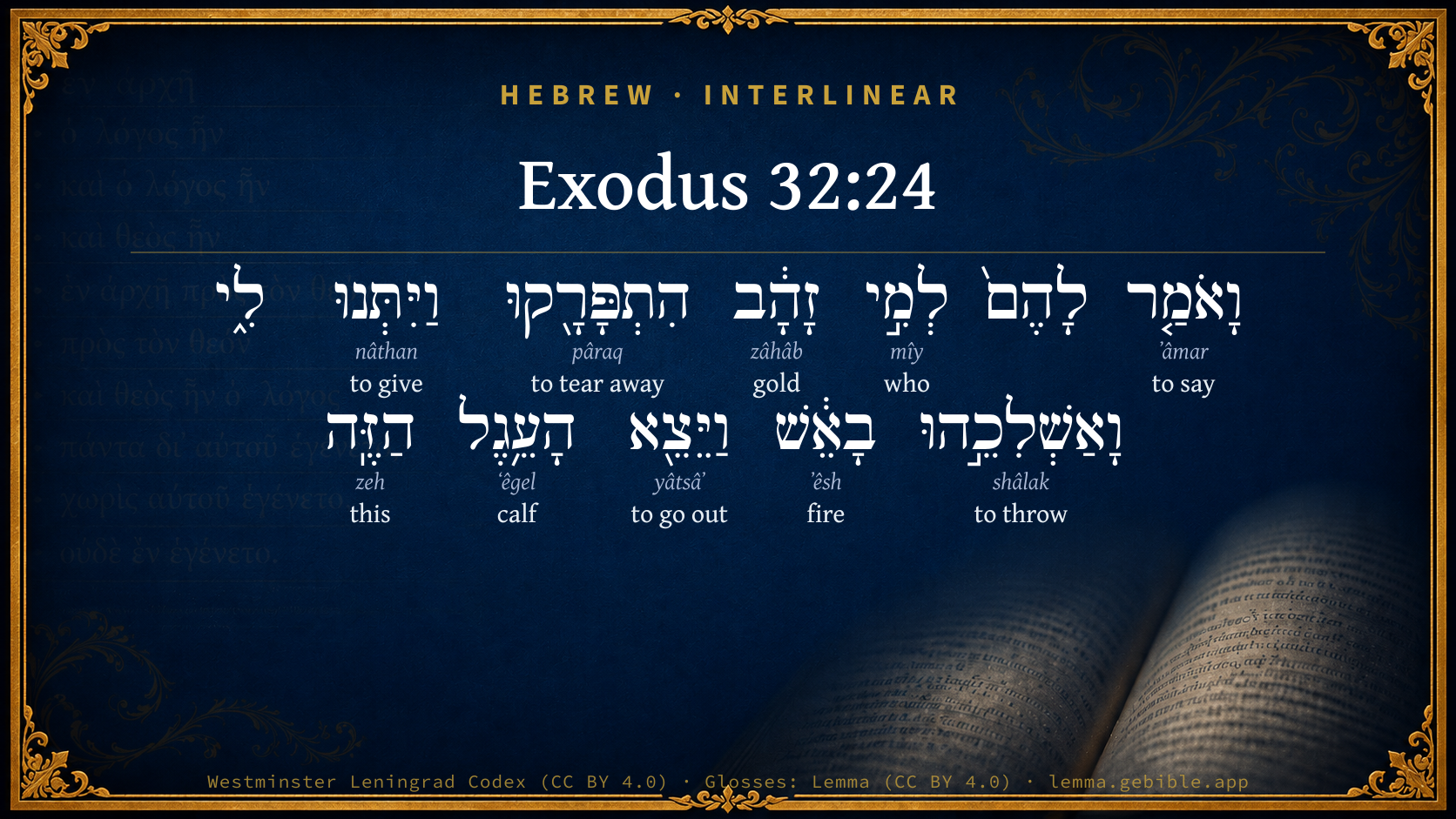
Hebrew (Westminster Leningrad Codex) Exodus 32:24 appears in the Hebrew Old Testament. The text above is from the Westminster Leningrad Codex. Each word links to its Strong’s number, a concise gloss, and parsing drawn from the Open Scriptures Hebrew Bible morphology. Click any word for its full Brown-Driver-Briggs (BDB) entry.
Download image
Cite this verse

Exodus 32:24 (World English Bible). Public Domain. Lemma interlinear Bible study tool, https://lemma.gebible.app/v/exodus/32/24.

Show BibTeX & RIS
BibTeX
RIS
English Translation
I said to them, 'Whoever has any gold, let them take it off:' so they gave it me; and I threw it into the fire, and out came this calf."
World English Bible · Public Domain
Download a study sheet

One document with this verse’s original text, its word-by-word gloss line, the meaning frame, cross-references with their text, attributed commentary, and full source and license credits — printable, and it pastes into notes with its structure intact.

This verse Autodidact and up

Study sheet (.html) Plain text (.txt)

A passage Seminary Student

Up to 50 verses in one chapter. A passage sheet keeps up to 6 commentary sources and 12 cross-references per verse, in the order this page ranks them, and says so on the sheet whenever that leaves anything out. Ask for a single verse and you get the Autodidact verse sheet above.

Everything on this page stays free to read, with no account — the sheet is a download of what is already on screen, not access to it.

Want to remove ads? Support Godless Engineer
Compare translations 3

The same verse in 3 English versions, stacked beneath the original-language interlinear above. Click any original word for its lexicon entry.

Each is an independent rendering of the whole verse — the interlinear is not word-aligned to these translations.

Highlighted words mark where these versions differ — a whole-verse word diff, not a word-by-word alignment.

  • World English Bible Public Domain
    I said to them, 'Whoever has any gold, let them take it off:' so they gave it me; and I threw it into the fire, and out came this calf."
  • King James Version Public Domain
    And I said unto them, Whosoever hath any gold, let them break it off. So they gave it me: then I cast it into the fire, and there came out this calf.
  • unfoldingWord Literal Text CC BY-SA 4.0
    And I said to them, ‘Whoever has gold, take it off yourself.’ And they gave to me, and I threw it in the fire, and this calf came out.”

unfoldingWord Literal Text — © unfoldingWord, licensed CC BY-SA 4.0. Word-aligned USFM3 via Door43 (git.door43.org/unfoldingWord/en_ult).

Versions to compare (up to 4)

3 of 4 selected

Show all 18 translations

Every available English version of this verse, each an independent rendering of the whole verse.

  • World English Bible Public Domain
    I said to them, 'Whoever has any gold, let them take it off:' so they gave it me; and I threw it into the fire, and out came this calf."
  • Berean Standard Bible Public Domain
    So I said to them, ‘Whoever has gold, let him take it off,’ and they gave it to me. And when I threw it into the fire, out came this calf!”
  • Majority Standard Bible Public Domain
    So I said to them, ‘Whoever has gold, let him take it off,’ and they gave it to me. And when I threw it into the fire, out came this calf!”
  • King James Version Public Domain
    And I said unto them, Whosoever hath any gold, let them break it off. So they gave it me: then I cast it into the fire, and there came out this calf.
  • American Standard Version (1901) Public Domain
    And I said unto them, Whosoever hath any gold, let them break it off: so they gave it me; and I cast it into the fire, and there came out this calf.
  • Revised Version (1885) Public Domain
    And I said unto them, Whosoever hath any gold, let them break it off; so they gave it me: and I cast it into the fire, and there came out this calf.
  • Geneva Bible (1599) Public Domain
    Then I sayde to them, Ye that haue golde, plucke it off: and they brought it me, and I did cast it into the fire, and thereof came this calfe.
  • Douay-Rheims (1899) Public Domain
    And I said to them: Which of you hath any gold? and they took and brought it to me: and I cast it into the fire, and this calf came out.
  • Young's Literal Translation Public Domain
    and I say to them, Whoso hath gold, let them break `it' off, and they give to me, and I cast it into the fire, and this calf cometh out.'
  • Literal Standard Version CC BY-SA 4.0
    and I say to them, Whoever has gold, let them break [it] off, and they give [it] to me, and I cast it into the fire, and this calf comes out.”
  • Unlocked Literal Bible CC BY-SA 4.0
    So I said to them, 'Whoever has any gold, let him take it off.' They gave me the gold and I threw it into the fire, and out came this calf.”
  • unfoldingWord Literal Text CC BY-SA 4.0
    And I said to them, ‘Whoever has gold, take it off yourself.’ And they gave to me, and I threw it in the fire, and this calf came out.”
  • Darby Bible Public Domain
    And I said to them, Who has gold? They broke [it] off, and gave [it] me, and I cast it into the fire, and there came out this calf.
  • World Messianic Bible Public Domain
    I said to them, ‘Whoever has any gold, let them take it off.’ So they gave it to me; and I threw it into the fire, and out came this calf.”
  • Webster's Bible Public Domain
    And I said to them, Whoever hath any gold, let them break it off: So they gave it to me: then I cast it into the fire, and there came out this calf.
  • Free Bible Version CC BY-SA 4.0
    So I said to them, ‘Anybody who has gold jewelry, take it off and give it to me.’ I threw the gold into the furnace and out came this bull calf.”
  • Bible in Basic English Public Domain
    Then I said to them, Whoever has any gold, let him take it off; so they gave it to me, and I put it in the fire, and this image of an ox came out.
  • JPS Tanakh (1917) Public Domain
    And I said unto them: Whosoever hath any gold, let them break it off; so they gave it me; and I cast it into the fire, and there came out this calf.'

Literal Standard Version (2020), Covenant Press — licensed CC BY-SA 4.0. Text via the HelloAO Bible API (eBible.org). Unlocked Literal Bible (unfoldingWord) — licensed CC BY-SA 4.0. Text via the HelloAO Bible API (eBible.org). unfoldingWord Literal Text — © unfoldingWord, licensed CC BY-SA 4.0. Word-aligned USFM3 via Door43 (git.door43.org/unfoldingWord/en_ult). Free Bible Version, Dr. Jonathan Gallagher — licensed CC BY-SA 4.0. Text via the HelloAO Bible API (eBible.org).

Word by word

More ways to search: Search by grammar → Find every occurrence → Compare this word →

Practice this passage: Drill this verse → Learn its vocabulary →

הִתְפָּרָ֖קוּ
pâraq
H6561
“tear away”
Verb, Hithpael, Imperative, 2nd Person, Masculine, Plural
Part of Speech
Verb
Stem
Hithpael
Form
Imperative
Person
2nd Person
Gender
Masculine
Number
Plural
Full BDB Definition

Origin: a primitive root

TWOT: 1828

to tear apart or away, tear off, break away - (Qal) to tear away, snatch, rescue - (Piel) to tear off - (Hithpael) to tear off from oneself, be broken off, be broken in pieces
  1. וָאֹמַ֤ר ʼâmar H559 “and · to say” Conjunction + Verb, Qal, Sequential Imperfect, 1st Person, Common, Singular
  2. לְמִ֣י mîy H4310 “to/for · who” Preposition + Particle, Interrogative
  3. זָהָ֔ב zâhâb H2091 “gold” Noun, Common, Masculine, Singular, Absolute
  4. וַיִּתְּנוּ nâthan H5414 “and · to give” Conjunction + Verb, Qal, Sequential Imperfect, 3rd Person, Masculine, Plural
  5. וָאַשְׁלִכֵ֣הוּ shâlak H7993 “and · to throw · them” Conjunction + Verb, Hiphil, Sequential Imperfect, 1st Person, Common, Singular + Suffix, Personal, 3rd Person, Masculine, Plural
  6. בָאֵ֔שׁ ʼêsh H784 “in/at the · fire” Preposition, Determined + Noun, Common, Both, Singular, Absolute
  7. וַיֵּצֵ֖א yâtsâʼ H3318 “and · to go out” Conjunction + Verb, Qal, Sequential Imperfect, 3rd Person, Masculine, Singular
  8. הָעֵ֥גֶל ʻêgel H5695 “the · calf” Particle, Definite Article + Noun, Common, Masculine, Singular, Absolute
  9. הַזֶּֽה zeh H2088 “the · this” Particle, Definite Article + Pronoun, Demonstrative, Masculine, Singular

About this verse

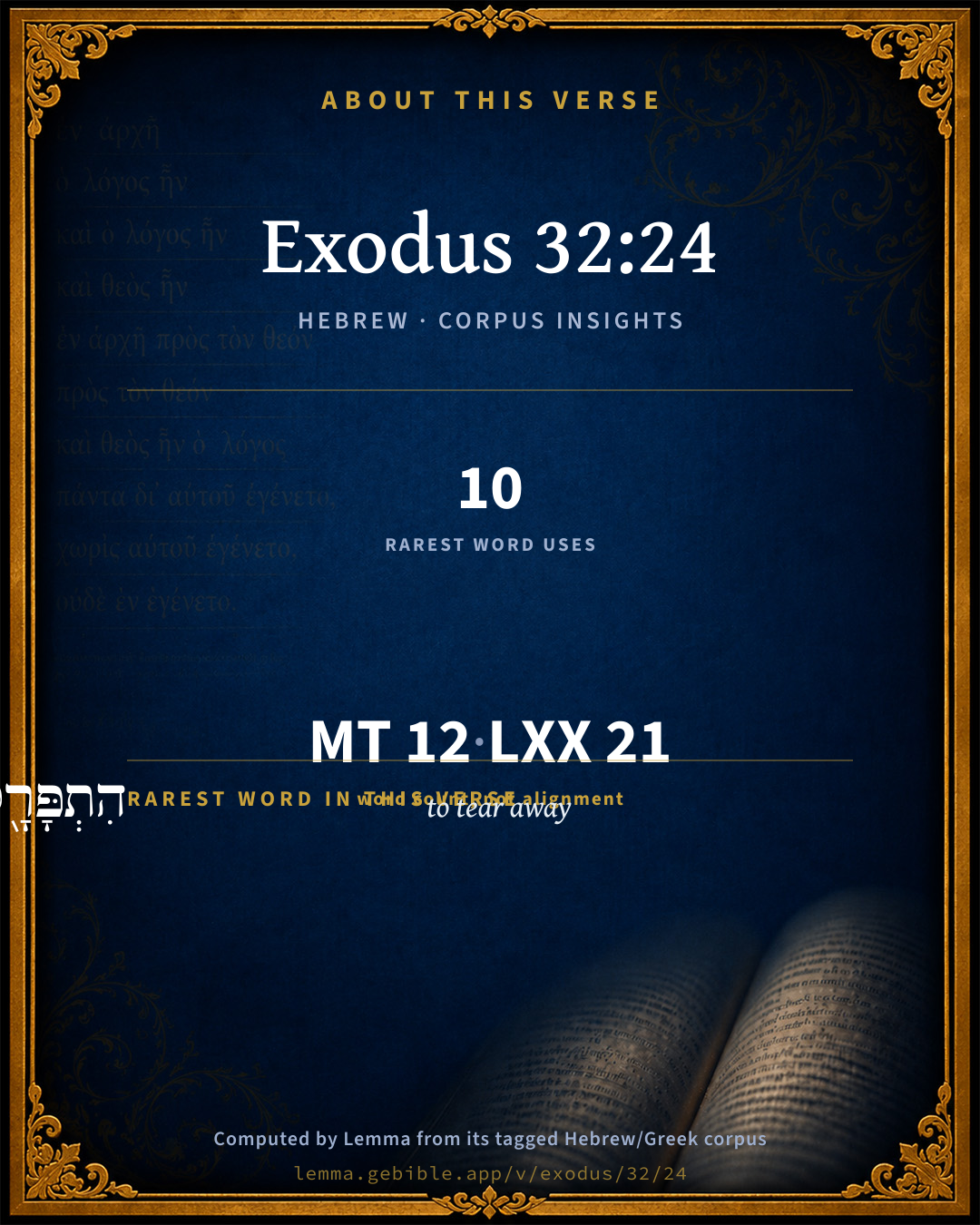
These counts appear in no published source. They are computed here, from the morphology-tagged text and Lemma’s own curated glosses. What Lemma adds →

12
words
10
distinct lemmas
Pentateuch
section

Notable vocabulary

The rarest word here is הִתְפָּרָ֖קוּ to tear away H6561 — appearing just 10 times in the whole Hebrew Bible.

Shared distinctive vocabulary

הִתְפָּרָ֖קוּ to tear away H6561 occurs in 10 verses of the Hebrew Bible. Also found in:

Grammatical profile

  • 5 verbs
  • 3 nouns
  • 1 pronoun
  • 2 prepositions
  • 1 particle

Verb forms

  • וָאֹמַ֤ר Qal · Sequential Imperfect
  • הִתְפָּרָ֖קוּ Hithpael · Imperative
  • וַיִּתְּנוּ Qal · Sequential Imperfect
  • וָאַשְׁלִכֵ֣הוּ Hiphil · Sequential Imperfect
  • וַיֵּצֵ֖א Qal · Sequential Imperfect

Hebrew & Septuagint length

In English translation the verse runs 30 words from the Hebrew and 32 from the Septuagint (LXX English) — closely comparable.

A rough comparison of the two English renderings, which tokenize alike — not a word-level alignment.

Word counts can differ between the Hebrew and the Greek without any difference in meaning — e.g. the Hebrew direct-object marker אֵת has no separate Greek word, and Greek often adds the article ὁ.

In the original languages it is 12 Hebrew tokens and 21 Greek tokens — but the two are counted differently (Hebrew bundles its prefixes and suffixes into one token; the Greek is in lemma form), so that isn’t a like-for-like length.

Cross-references

4

Topical passages linked to Exodus 32:24 in the Treasury of Scripture Knowledge — connected by theme and wording, ordered by reader-vote popularity; previews shown in the World English Bible.

  • Exodus 32:4 He received what they handed him, and fashioned it with an engraving tool, and made it a molten calf; and they said, "These are your gods, Israel, which brought you up out of the land of Egypt."
  • Genesis 3:12–13 The man said, "The woman whom you gave to be with me, she gave me of the tree, and I ate."
  • Luke 10:29 But he, desiring to justify himself, asked Jesus, "Who is my neighbor?"
  • Romans 3:10 As it is written, "There is no one righteous. No, not one.

Cross-references courtesy of OpenBible.info (CC BY 4.0).

Hebrew and Greek witnesses Masoretic Hebrew ↔ Greek Septuagint

The same verse in the two great witnesses to the Old Testament, shown verse-for-verse.

These are two independent witnesses, not word-aligned to each other, and the Septuagint is shown in lemma (dictionary) form.

Hebrew Exodus 32:24 Masoretic · Westminster Leningrad Codex

וָאֹמַ֤ר לָהֶם֙ לְמִ֣י זָהָ֔ב הִתְפָּרָ֖קוּ וַיִּתְּנוּ לִ֑י וָאַשְׁלִכֵ֣הוּ בָאֵ֔שׁ וַיֵּצֵ֖א הָעֵ֥גֶל הַזֶּֽה

I said to them, 'Whoever has any gold, let them take it off:' so they gave it me; and I threw it into the fire, and out came this calf."

World English Bible · Public Domain

Greek LXX Exodus 32:24 Septuagint · lemma form

καί εἶπον αὐτός εἰ τις ὑποἄρχω χρυσίον περιαἱρέω καί δίδωμι ἐγώ καί ῥίπτω εἰς ὁ πῦρ καί ἐκἔρχομαι ὁ μόσχος οὗτος

And I said to them, If any one has golden ornaments, take them off; and they gave them me, and I cast them into the fire, and there came out this calf.

LXX2012 (modern English Septuagint) · Public Domain

Hebrew: Westminster Leningrad Codex (CC BY 4.0). Greek: Septuagint (public domain); English from LXX2012 (modern English Septuagint) (Public Domain). How the Septuagint differs from the Hebrew →

Targum (Aramaic paraphrase)

2

The Targum is the ancient Jewish Aramaic paraphrase of the Hebrew Scriptures — an interpretive translation, not the Hebrew text itself. Onkelos (literal) and Pseudo-Jonathan (expansive) render the Torah, and Jonathan the Prophets. Coverage is partial: where no permissively-licensed English translation exists for a verse, only the Aramaic is shown. This is verse-level text, not a word-by-word alignment to the Hebrew.

  1. Targum Onkelos Torah (Genesis–Deuteronomy)
    וַאֲמָרִית לְהוֹן לְמָן דַהֲבָא פְּרִיקוּ וִיהָבוּ לִי וּרְמִיתֵהּ בְּנוּרָא וּנְפַק עֶגְלָא הָדֵין:

    (no public-domain English translation for this verse)

    Targum Onkelos — Aramaic: “Onkelos Genesis” (public domain); “Onkelos Exodus” (public domain); “Onkelos Leviticus” (public domain); “Onkelos Numbers” (public domain); “Onkelos Deuteronomy” (public domain). English: “Sefaria Community Translation” (CC0 1.0 (public-domain dedication)); “J.W. Etheridge. The Targums of Onkelos and Jonathan Ben Uzziel on the Pentateuch. London: Longmans, Green, 1862” (public domain). Text via Sefaria.

  2. Targum Pseudo-Jonathan Torah (Genesis–Deuteronomy)
    וַאֲמָרִית לְהוֹן לְמַאן אִית דְּהַב פְּרִיקוּ וִיהָבוּ לִי וּטְלֵיקְתֵיהּ בְּנוּרָא וְעָאַל סִטְנָא בְּגַוֵּיהּ וּנְפַק מִינֵיהּ דְּמוּת עֵיגְלָא הָדֵין

    And I said to them, Whoever hath gold, let him deliver and give it to me; and I cast it into the fire, and Satana entered into it, and there came out of it the similitude of this calf!

    Targum Pseudo-Jonathan — Aramaic: “Targum Jonathan on Genesis” (public domain); “Targum Jonathan on Exodus” (public domain); “Targum Jonathan on Leviticus” (public domain); “Targum Jonathan on Numbers” (public domain); “Targum Jonathan on Deuteronomy” (public domain). English: “The Targum of Jonathan ben Uzziel, trans. J. W. Etheridge, London, 1862” (public domain). Text via Sefaria.

Commentary

Notes on Exodus 32:24 from classic Christian and Jewish commentators (each source and its license shown beneath its notes). The classic Christian expositions comment on the surrounding passage and are grouped to its opening verse, so a note may address several verses; the Jewish commentaries on the Tanakh (Rashi and others) are per-verse, so they appear only where the commentator wrote on this verse.

Lemma curates 59 commentaries, every one of them public domain or Creative Commons licensed, each selected and text-cleaned for this edition rather than reprinted as found. About our sources →

Trapp's Complete Commentary

John Trapp

Exo 32:24 And I said unto them, Whosoever hath any gold, let them break [it] off. So they gave [it] me: then I cast it into the fire, and there came out this calf.

Ver. 24. There came out this calf.] A very poor excuse. Something he would have said, if he had known what. Here he "hid his sin as Adam," {Job 31:33} being too much his child.

John Trapp, A Commentary or Exposition upon All the Books of the Old and New Testament (1647–1656) — public domain. Text from a community e-Sword module.

The Biblical Illustrator

Joseph S. Exell

Exo_32:24

There came out this calf.

Aarons excuse

I. There never was a speech more true to one disposition of our human nature than this of Aaron. We are all ready to lay the blame on the furnaces. The fire did it, we are all of us ready enough to say. In better times we might have been better, broader men, but now, behold, God puts us into the fire, and we came out thus. Our age, our society, is what, with this figure taken out of the old story of Exodus, we have been calling it. It is the furnace. Its fire can set, and fix, and fasten what the man puts into it. But, properly speaking, it can create no character. It can make no truly faithful soul a doubter. It never did. It never can.

II. The subtlety and attractiveness of this excuse extends not only to the results which we see coming forth in ourselves; it covers also the fortunes of those for whom we are responsible. Everywhere there is this cowardly casting off of responsibilities upon the dead circumstances around us. It is a very hard treatment of the poor, dumb, helpless world which cannot answer to defend itself. It takes us as we give ourselves to it. It is our minister, fulfilling our commissions for us upon our own souls.

III. There is delusion and self-deception in this excuse. Very rarely indeed does a man excuse himself to other men and yet remain absolutely unexcused in his own eyes. Often the very way to help ourselves most to a result which we have set before ourselves is just to put ourselves into a current which is sweeping on that way, and then lie still, and let the current do the rest, and in all such cases it is so easy to ignore or to forget the first step, and so to say that it is only the drift of the current which is to blame for the dreary shore on which at last our lives are cast up by the stream.

IV. If the world is thus full of the Aaron spirit, where are we to find its cure? Its source is a vague and defective sense of personality. I cannot look for its cure anywhere short of that great assertion of the human personality which is made when a man personally enters into the power of Jesus Christ. (Bp. Phillips Brooks.)

Shifting responsibility

I. Aaron blamed society. Thus is it with men now. Yielding to the pressure of society, we do not live out our highest convictions.

1. We defer to public opinion. Great is the tyranny of public opinion, and many dare not brave it. Aaron dare not in the text, and thousands still are overawed by it. We like to be talked about, but not against. We stay short of being what we ought to be, of doing what we ought to do, for fear of the adverse criticism of our neighbours, work-fellows, countrymen.

2. We defer to public custom. The Jewish rabble wanted images, such as were in Egypt, and Aaron had not courage to resist the demand. So we often bow to the questionable customs of society. Our convictions are otherwise, but we have not the bravery to be singular--we cast a grain of incense on the worlds altar when we ought to hurl a stone at its gods.

3. We defer to public violence. They gathered themselves together unto (verse 1)--rather against--Aaron in a tumultuous manner, to compel him to do what they wished. And Aaron was coerced by them. So we often fear the anger, menace, violence of those around us, and act a consciously unworthy part. Aaron in the text blaming the people is a picture of thousands of us to-day! We do not wish to act thus and thus, but we are the victims of our social surroundings. It is not I, but the people. We, none of us, are guilty; it is the crowd behind which pushes us.

II. He blamed nature. I cast it into the fire, and there came out this calf. As if it were not his fault, but natures. He says nothing about the mould that he made; nothing about the graving tool that he used (verse 4); but nature has done it--it has done itself. So do we reason still.

1. We blame nature for our sins. We ignore the fact that we failed to interpose our will; that we fed the fires of passion; that in making preparation for the flesh, to fulfil the lusts thereof, we constructed the mould.

2. We blame nature for our miseries.

Lessons:

1. The childishness of this method of shifting responsibility.

2. The foolishness of it.

3. The uselessness of it. (W. L. Watkinson.)

Aarons apology

Aarons excuse is the standing excuse of at least one large class among us. Servants use it every day. Who has not heard them plead? Please, maam, I couldnt help it; it broke in my hands. As if it were not they, but the wilful jug or dish which was responsible for the fracture, or some malign fate which mocks at human endeavour and care. It was an accident has been their sigh ever since domestic service became an institution among us. But is the plea confined to them? Do you not also hear it from the lips of every child? I didnt do it--they are all quite sure of that; though, if they did not do it, it would be hard indeed to say who did. Here are two large classes, then, to whom Aarons excuse is familiar; and to one of these classes we all belonged in our time. But are there no more? Most of you will remember that inimitable scene in Adam Bede in which Mrs. Poyser, while rating the clumsy Molly for her broken jug of beer, herself drops a still more precious jug from her angry fingers, and exclaims: Did anybody ever see the like? The jugs are bewitched, I think. You will remember how she proceeds to argue that theres times when the crockery seems alive, an flies out o your hand like a bird, and concludes, philosophically enough, that what is to be broke will be broke. Possibly most of us have known mistresses who, while indignantly repudiating the common excuse of their maids, have nevertheless condescended to employ it in their own behalf. And what bankrupt tradesman, or broken merchant, or fraudulent banker is there who does not plead the same, or a similar, excuse? It is hardly ever their fault that they cannot pay twenty shillings in the pound; it is their misfortune. Things have gone against them. Circumstances over which they have no control have been their ruin--not their own rashness, or dishonest discounts, or risky speculations. They put their capital into that shop, that firm, that bank, and, lo, there came out this ugly calf of bankruptcy! But you must not blame them; it is the furnace that was in fault. And if mistresses no less than their maids, and men of business no less than their wives, attribute to accident, mischance, or a malignant and mysterious fate, results of which the cause might be found much nearer home, scholars no less than men of business, men of science no less than scholars, Christian commentators no less than men of science, too often betake themselves to the same egregrious line of argument and excuse. There are illustrations and repetitions and modifications of Aarons apology which touch us closer home. The man who is a sinner--as which of us is not?--has it perpetually on his lips. How often, when arraigned at the bar of Conscience or taken to task by Authority, have we urged that we really could not help ourselves; that, to use Mrs. Poysers word, we were bewitched by some evil and malignant power; that it was impossible to keep the law we had transgressed, and that what is to be broken will and must be broken? A hot temper leaps oer a cold decree. With passions so fierce and strong as mine, with a natural and hereditary bias to evil, exposed to temptations so numerous and so nicely adjusted to my temperament, why should I be blamed, why should I overmuch blame myself, if now and then I have overleaped the cold and strict requirements of the law? Such as I am, in such a world as this, with a passionate craving for immediate enjoyment, exposed to forces so powerful and so constant in their operation, hampered by conditions so inauspicious, how could I do otherwise than I have done? Is it my fault that, with desire and opportunity conspiring against me, I have sometimes been overmastered or betrayed by them, and broken a commandment which no man has always kept?. . . Well, Aarons excuse for himself has reminded us of a good many excuses as irrational and absurd as his which men make to this day. And we have seen and acknowledged that there is some element of truth in them; that what we call accident does play a certain part in our life and the lives of our fellows. But though, in the abstract, we cannot define this mysterious power, or determine exactly how far we are subject to it, in conduct and practice we have no great difficulty in dealing with it. We make allowance for our servants; we admit that even the most careful must meet with an accident sometimes, and that there are times even when a small series of such accidents are almost certain to tread on each others heels. Nevertheless, if, after due trial, we find that a servant has contracted a constant and incorrigible habit of breaking whatever is breakable, we promptly dismiss her as too unfortunate for us, or as abnormally clumsy, or as wilfully negligent. We make allowance, too, for the accidents of commerce; we confess that now and then a man may fail honourably because he fails through no fault of his own. But if we meet with a man who has failed in almost everything he has undertaken, and who has spent half his time in the Court of Insolvency and its purlieus, we are in no hurry to associate ourselves with him or to assist him; nay, unless he can bring surprisingly good evidence to the contrary, we set him down as a lazy vagabond or an unscrupulous rogue. Just so we make, or ought to make, allowance for a man who is overtaken by a sin. And for ourselves, my brethren, let us have done with this poor subterfuge, which we know to be, for us at least, a mere refuge of lies even as we run into it. (S. Cox, D. D.)

Excuses for sin

Here is a man all gross and sensual, a man still young who has already lost the freshness, glory, and purity of youth. Suppose you question him about his life. You expect him to be ashamed, repentant. There is not a sign of anything like that! He says: I am the victim of circumstances. What a corrupt, licentious, profane age this is in which we live! When I was in college I got into a bad set. When I went into business I was surrounded by bad influences. When I grew rich, men flattered me. When I grew poor, men bullied me. The world has made me what I am, this fiery, passionate, wicked world. I had in my hands the gold of my boyhood which God gave me. Then I cast it into the fire, and there came out this calf. Another man is not a profligate, but is a miser, or a mere business machine. What can you ask of me? he says; this is a mercantile community. The business man who does not attend to his business goes to the wall. I am what this intense commercial life has made me. I put my life in there, and it came out this. And then he gazes fondly at his golden calf, and his knees bend under him with the old long habit of worshipping it, and he loves it still, even while he abuses and disowns it. And so with the woman of society. The fire made me this, she says of her frivolity and pride. And so of the politician and his selfishness and partisanship. I put my principles into the furnace, and this came out. And so of the bigot and his bigotry, the one-sided Conservative with his stubborn resistance to all progress, the one-sided Radical with his ruthless iconoclasm. So of all partial and fanatical men. The furnace made us, they are ready to declare. Remember that the subtlety and attractiveness of this excuse, this plausible attributing of power to inanimate things and exterior conditions to create what only man can make, extends not only to the results which we see coming forth in ourselves; it covers also the fortunes of those for whom we are responsible. The father says of his profligate son, for whom he has never done one wise or vigorous thing to make a noble and pure-minded man: I cannot tell how it has come. It has not been my fault. I put him into the world, and this came out. The father whose faith has been mean and selfish says the same of his boy who is a sceptic. Everywhere there is this cowardly casting off of responsibilities upon the dead circumstances around us. It is a very hard treatment of the poor, dumb, helpless world which cannot answer to defend itself. It takes us as we give ourselves to it. It is our minister fulfilling our commissions for us upon our own souls. If we say to it, Make us noble, it does make us noble. If we say to it, Make us mean, it does make us mean. And then we take the nobility and say, Behold, how noble I have made myself. And we take the meanness and say, See how mean the world has made me.. . . The only hope for any of us is in a perfectly honest manliness to claim our sins. I did it, I did it, let me say of all my wickedness. Let me refuse to listen for one moment to any voice which would make my sins less mine. It is the only honest and the only hopeful way, the only way to know and be ourselves. When we have done that, then we are ready for the gospel, ready for all that Christ wants to show us that we may become, and for all the powerful grace by which He wants to make us be it perfectly. (Bp. Phillips Brooks.)

The Biblical Illustrator, edited by Joseph S. Exell (c. 1880s–1900s) — public domain. Text from a community e-Sword module.

Adam Clarke's Commentary

Verse 24. I cast it into the fire and there came out this calf.] What a silly and ridiculous subterfuge! He seems to insinuate that he only threw the metal into the fire, and that the calf came unexpectedly out by mere accident. The Targum of Jonathan ben Uzziel makes a similar excuse for him: "And I said unto them, Whosoever hath gold, let him break it off and give it to me; and I cast it into the fire, and Satan entered into it, and it came out in the form of this calf!" Just like the popish legend of the falling of the shrine of our Lady of Loretta out of heaven! These legends come from the same quarter. Satan can provide more when necessary for his purpose.

Adam Clarke's Commentary on the Bible (1810–1826) — public domain. Text from a community e-Sword/MySword module.

The Cambridge Bible for Schools and Colleges

gen. ed. J. J. S. Perowne

24. He next excuses himself by declaring that he merely threw the gold which they gave him into the fire, and the calf came out—as it were spontaneously, without any cooperation on his part.

Jehovah’s anger with Aaron individually, His threat to destroy him, and Moses’ intercession for him, narrated in Deu_9:20, are not mentioned in the extant parts of J or E in Exodus.

The Cambridge Bible for Schools and Colleges (gen. ed. J. J. S. Perowne; Cambridge University Press, 1878–1918) — public domain. Text from a community e-Sword module.

John Gill's Exposition

And when Moses saw that the people were naked,.... Not in their bodies, being stripped of their ear rings; for parting with them was not sufficient to denominate them naked in a corporeal sense; nor as being without their armour, which was laid aside while they were eating, and drinking, and dancing about the calf, and so might be thought a proper opportunity for the Levites to fall upon them, by the order of Moses, and slay them: but it can hardly be thought that all the people bore arms, and that Moses took the advantage of their being without them: but rather they were naked in their souls, through their sin, and the shame of their nakedness appeared; their sin was made manifest, and they were discovered to be what they were; and they were now deprived of the divine protection; the cloud was departing from them, the symbol of the divine Presence, God being provoked by their sins; unless it is to be understood of their ceasing from work, and keeping holy day in honour of the calf, and so were loitering about, and not attending to the business of their callings, in which sense the word sometimes seems to be used, see Exo 5:4.

for Aaron had made them naked unto their shame amongst their enemies; to part with their ear rings, or lay aside their armour while feasting, could not be so much to their shame among their enemies; but to sin against God, in the manner they did, was to their shame, which Aaron was a means of by not doing all he could to hinder it, and by doing what he did to encourage it; and now he made them naked to their shame by exposing it, saying they were a people set on mischief, and given up to sin and wickedness; and what they had now done served to expose them to shame even among their enemies, both now and hereafter; when they should hear of their shameful revolt from God, after so many great and good things done for them, and of the change of their gods, and of their fickleness about them, which was not usual with the Gentiles: though the last word may be rendered, "among those that rise up from you"; that should spring from them, come up in their room, and succeed them, their posterity, as in Num 32:14 and so Onkelos renders it, "to your generations", and is so to be understood, as Abendana observes; and then the sense is, that this sin of making and worshipping the golden calf, and keeping a holy day, would be to their shame and disgrace, among their posterity, in all succeeding ages. (If is quite possible the people were physically naked, having taken off all their clothes to indulge in the idolatrous worship of the calf and sexual immorality that usually is associated with such wicked practices. Editor.)

John Gill's Exposition of the Whole Bible (1746–1763) — public domain (CC PDM 1.0). Text via the HelloAO Bible API.

Haydock's Catholic Bible Commentary

Came out. The Rabbins pretend alive, and able to walk. Hence they say Aaron was filled with astonishment, and induced to erect the altar in its honour. (R. Salomo and Burgens.) But these are Jewish fables, injurious to God, and invented to hide, in some degree, the shame of their ancestors. For the same reason, Josephus passes over the whole in silence, and Philo throws the blame on a few Egyptian converts. They might very probably be the ringleaders, as Numbers xi. 4. But the Hebrews in general readily gave in to the delusion, 1 Corinthians x. 7. (Haydock)

George Leo Haydock (1774–1849), Haydock's Catholic Family Bible and Commentary, 1859 edition — public domain. Excludes Psalms (Douay-Rheims chapter numbering differs from Protestant) and Deuterocanonical books (Catholic canon only).

Matthew Poole's English Annotations

Not that he meant or thought to persuade Moses that the melted gold came out of the fire in the form of a calf by accident, without any art or industry of his, which was a ridiculous conceit, and easily confuted; but only he conceals his own sin in the forming and graving of it, and lays the whole blame upon the people.

Matthew Poole's English Annotations on the Holy Bible (1683–1685) — public domain. Text from a community e-Sword/MySword module.

The Pulpit Commentary

There came out this calf. Aaron speaks as if he had prepared no mould, but simply thrown the gold into the hot furnace, from which there issued forth, to his surprise, the golden calf. This was not only a suppressio veri , but a suggestio falsi. Having no even plausible defence to make, he is driven to the weakest of subterfuges.

The Pulpit Commentary (1880–1919), ed. H.D.M. Spence-Jones & Joseph S. Exell — public domain. Text from a community e-Sword module.

Rashi

Rabbi Shlomo Yitzchaki (Rashi)

ואמר להם AND I SAID UNTO THEM one single thing, — simply, “Who has any gold?” — but they hastened and broke it off from themselves and gave it to me.

ואשלכהו באש AND I CAST IT INTO THE FIRE, and I did not know that this (i. e. this living) calf would come out, ויצא — BUT IT DID COME OUT.

Rashi on the Tanakh — English translations: “The Judaica Press complete Tanach with Rashi, translated by A. J. Rosenberg” (CC BY 4.0); “Pentateuch with Rashi's commentary by M. Rosenbaum and A.M. Silbermann, 1929-1934” (public domain); “The Metsudah Tanach series, Lakewood, N.J” (CC BY 4.0); and “The Book of Joshua, Metsudah Publications, 1997” (CC BY 4.0). Text via Sefaria.

Lesson kit

Teaching starters — assembled from the data on this page, not authored interpretation. Every prompt links to the verse data it draws on. Edit before teaching.

Exodus, in the Pentateuch, opens this verse with 12 words (10 distinct Hebrew lemmas). Its most distinctive word is pâraq (“to tear away”). A historical commentator’s framing appears above. Read the whole chapter for the surrounding context.

Discussion questions

  1. The word pâraq carries the sense “to tear away.” How does it shape the verse?
  2. How does Genesis 27:40, which shares the word «to tear away», read alongside this verse?
  3. These translations render this verse differently; the difference is in the English rendering, not the original. What questions does that raise?
  4. «וָאֹמַ֤ר» is a Qal Sequential Imperfect verb. How does that grammatical form shape the action described?
  5. Compare how Trapp's Complete Commentary and The Biblical Illustrator read this verse. Where do they agree or differ?

Things to notice

Reading settings

Reading text

Shown beneath each verse's original-language words.

Old Testament
Old Testament edition

Read the OT as the Masoretic Hebrew (MT) or the Greek Septuagint (LXX).

English shown for the Greek Septuagint (in the Hebrew ↔ Greek comparison).

Comparing translations? Open the Compare panel on any verse page to stack up to four side by side.