
Deuteronomy 17:15

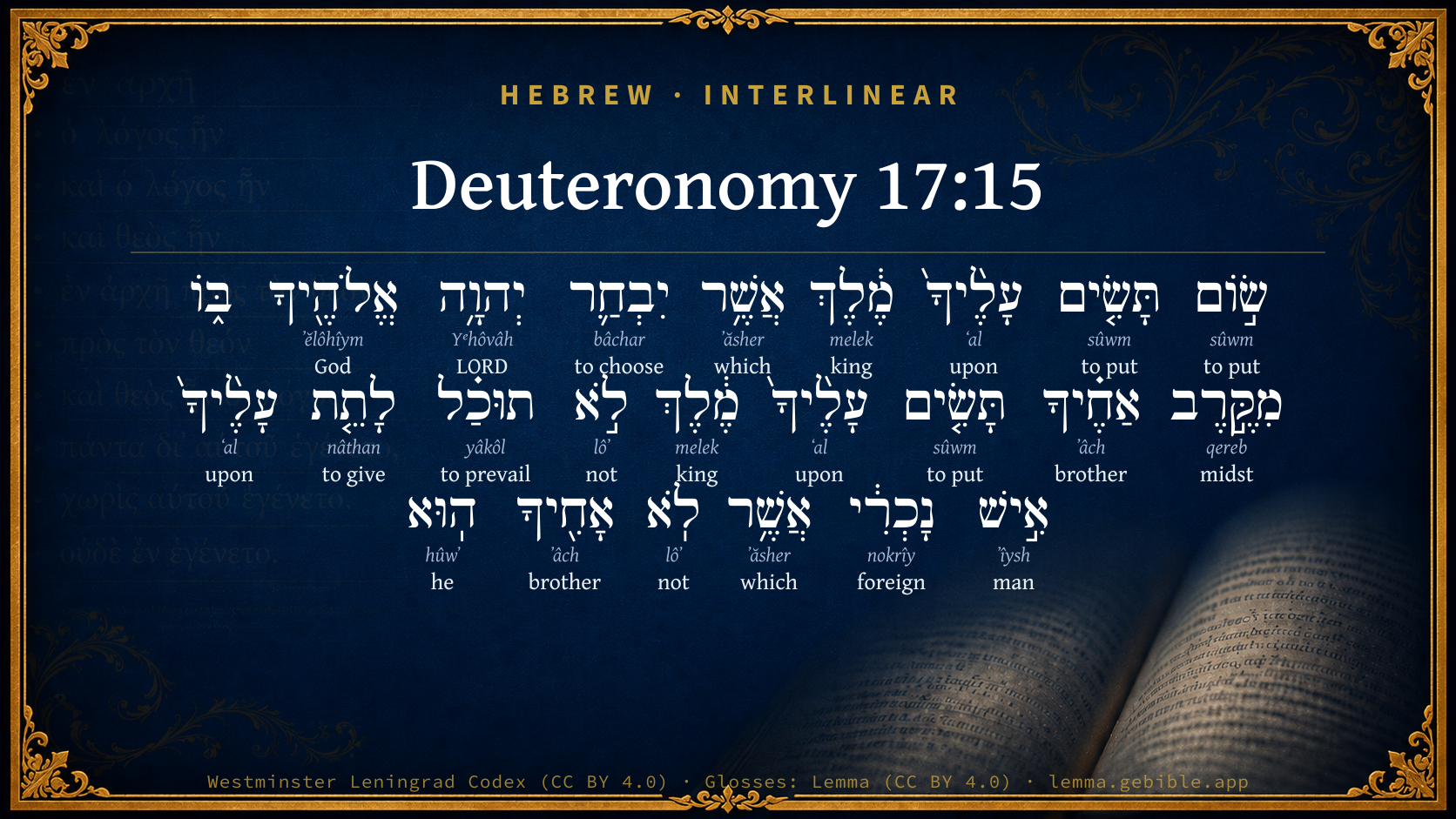
Hebrew (Westminster Leningrad Codex) Deuteronomy 17:15 appears in the Hebrew Old Testament. The text above is from the Westminster Leningrad Codex. Each word links to its Strong’s number, a concise gloss, and parsing drawn from the Open Scriptures Hebrew Bible morphology. Click any word for its full Brown-Driver-Briggs (BDB) entry.
Download image
Cite this verse

Deuteronomy 17:15 (World English Bible). Public Domain. Lemma interlinear Bible study tool, https://lemma.gebible.app/v/deuteronomy/17/15.

Show BibTeX & RIS
BibTeX
RIS
English Translation
you shall surely set him king over you, whom Yahweh your God shall choose: one from among your brothers shall you set king over you; you may not put a foreigner over you, who is not your brother.
World English Bible · Public Domain
Download a study sheet

One document with this verse’s original text, its word-by-word gloss line, the meaning frame, cross-references with their text, attributed commentary, and full source and license credits — printable, and it pastes into notes with its structure intact.

This verse Autodidact and up

Study sheet (.html) Plain text (.txt)

A passage Seminary Student

Up to 50 verses in one chapter. A passage sheet keeps up to 6 commentary sources and 12 cross-references per verse, in the order this page ranks them, and says so on the sheet whenever that leaves anything out. Ask for a single verse and you get the Autodidact verse sheet above.

Everything on this page stays free to read, with no account — the sheet is a download of what is already on screen, not access to it.

Want to remove ads? Support Godless Engineer
Compare translations 3

The same verse in 3 English versions, stacked beneath the original-language interlinear above. Click any original word for its lexicon entry.

Each is an independent rendering of the whole verse — the interlinear is not word-aligned to these translations.

Highlighted words mark where these versions differ — a whole-verse word diff, not a word-by-word alignment.

  • World English Bible Public Domain
    you shall surely set him king over you, whom Yahweh your God shall choose: one from among your brothers shall you set king over you; you may not put a foreigner over you, who is not your brother.
  • King James Version Public Domain
    Thou shalt in any wise set him king over thee, whom the LORD thy God shall choose: one from among thy brethren shalt thou set king over thee: thou mayest not set a stranger over thee, which is not thy brother.
  • unfoldingWord Literal Text CC BY-SA 4.0
    setting, you shall set as king over yourself him whom Yahweh your God will choose. You shall set as king over yourself from among your brothers. You shall not put a foreign man, who is not your brother, over yourself.

unfoldingWord Literal Text — © unfoldingWord, licensed CC BY-SA 4.0. Word-aligned USFM3 via Door43 (git.door43.org/unfoldingWord/en_ult).

Versions to compare (up to 4)

3 of 4 selected

Show all 18 translations

Every available English version of this verse, each an independent rendering of the whole verse.

  • World English Bible Public Domain
    you shall surely set him king over you, whom Yahweh your God shall choose: one from among your brothers shall you set king over you; you may not put a foreigner over you, who is not your brother.
  • Berean Standard Bible Public Domain
    you are to appoint over yourselves the king whom the LORD your God shall choose. Appoint a king from among your brothers; you are not to set over yourselves a foreigner who is not one of your brothers.
  • Majority Standard Bible Public Domain
    you are to appoint over yourselves the king whom the LORD your God shall choose. Appoint a king from among your brothers; you are not to set over yourselves a foreigner who is not one of your brothers.
  • King James Version Public Domain
    Thou shalt in any wise set him king over thee, whom the LORD thy God shall choose: one from among thy brethren shalt thou set king over thee: thou mayest not set a stranger over thee, which is not thy brother.
  • American Standard Version (1901) Public Domain
    thou shalt surely set him king over thee, whom Jehovah thy God shall choose: one from among thy brethren shalt thou set king over thee; thou mayest not put a foreigner over thee, who is not thy brother.
  • Revised Version (1885) Public Domain
    thou shalt in any wise set him king over thee, whom the LORD thy God shall choose: one from among thy brethren shalt thou set king over thee: thou mayest not put a foreigner over thee, which is not thy brother.
  • Geneva Bible (1599) Public Domain
    Then thou shalt make him King ouer thee, whome the Lord thy God shall chuse: from among thy brethren shalt thou make a King ouer thee: thou shalt not set a stranger ouer thee, which is not thy brother.
  • Douay-Rheims (1899) Public Domain
    Thou shalt set him whom the Lord thy God shall choose out of the number of thy brethren. Thou mayst not make a man of another nation king, that is not thy brother.
  • Young's Literal Translation Public Domain
    thou dost certainly set over thee a king on whom Jehovah doth fix; from the midst of thy brethren thou dost set over thee a king; thou art not able to set over thee a stranger, who is not thy brother.
  • Literal Standard Version CC BY-SA 4.0
    you certainly set a king over you on whom YHWH fixes; you set a king over you from the midst of your brothers; you are not able to set a stranger over you, who is not your brother.
  • Unlocked Literal Bible CC BY-SA 4.0
    then you must surely set as king over yourself someone whom Yahweh your God will choose. You must set as king over yourself someone from among your brothers. You may not put a foreigner, who is not your brother, over yourself.
  • unfoldingWord Literal Text CC BY-SA 4.0
    setting, you shall set as king over yourself him whom Yahweh your God will choose. You shall set as king over yourself from among your brothers. You shall not put a foreign man, who is not your brother, over yourself.
  • Darby Bible Public Domain
    thou shalt only set him king over thee whom Jehovah thy God will choose: from among thy brethren shalt thou set a king over thee; thou mayest not set a foreigner over thee, who is not thy brother.
  • World Messianic Bible Public Domain
    you shall surely set him whom the LORD your God chooses as king over yourselves. You shall set as king over you one from among your brothers. You may not put a foreigner over you, who is not your brother.
  • Webster's Bible Public Domain
    Thou shalt in any wise set him king over thee whom the LORD thy God shall choose: one from among thy brethren shalt thou set king over thee: thou mayest not set a stranger over thee, who is not thy brother.
  • Free Bible Version CC BY-SA 4.0
    you can have a king but only one chosen by the Lord your God. He must be an Israelite. You must not have a king who is a foreigner; someone who is not an Israelite.
  • Bible in Basic English Public Domain
    Then see that you take as your king the man named by the Lord your God: let your king be one of your countrymen, not a man of another nation who is not one of yourselves.
  • JPS Tanakh (1917) Public Domain
    thou shalt in any wise set him king over thee, whom the LORD thy God shall choose; one from among thy brethren shalt thou set king over thee; thou mayest not put a foreigner over thee, who is not thy brother.

Literal Standard Version (2020), Covenant Press — licensed CC BY-SA 4.0. Text via the HelloAO Bible API (eBible.org). Unlocked Literal Bible (unfoldingWord) — licensed CC BY-SA 4.0. Text via the HelloAO Bible API (eBible.org). unfoldingWord Literal Text — © unfoldingWord, licensed CC BY-SA 4.0. Word-aligned USFM3 via Door43 (git.door43.org/unfoldingWord/en_ult). Free Bible Version, Dr. Jonathan Gallagher — licensed CC BY-SA 4.0. Text via the HelloAO Bible API (eBible.org).

Word by word

More ways to search: Search by grammar → Find every occurrence → Compare this word →

Practice this passage: Drill this verse → Learn its vocabulary →

נָכְרִ֔י
nokrîy
H5237
“foreign”
Adjective, Adjective, Masculine, Singular, Absolute
Part of Speech
Adjective
Type
Adjective
Gender
Masculine
Number
Singular
State
Absolute
Full BDB Definition

Origin: from H5235 (second form)

TWOT: 1368c

foreign, alien - foreign - foreigner (substantive) - foreign woman, harlot - unknown, unfamiliar (figuratively)
  1. שׂ֣וֹם sûwm H7760 “to put” Verb, Qal, Infinitive Absolute
  2. תָּשִׂ֤ים sûwm H7760 “to put” Verb, Qal, Imperfect, 2nd Person, Masculine, Singular
  3. עָלֶ֨יךָ֙ ʻal H5921 “upon · you” Preposition + Suffix, Personal, 2nd Person, Masculine, Singular
  4. מֶ֔לֶךְ melek H4428 “king” Noun, Common, Masculine, Singular, Absolute
  5. אֲשֶׁ֥ר ʼăsher H834 “which” Particle, Relative
  6. יִבְחַ֛ר bâchar H977 “to choose” Verb, Qal, Imperfect, 3rd Person, Masculine, Singular
  7. יְהוָ֥ה Yᵉhôvâh H3068 “LORD” Noun, Proper
  8. אֱלֹהֶ֖יךָ ʼĕlôhîym H430 “God(s) · your” Noun, Common, Masculine, Plural, Construct + Suffix, Personal, 2nd Person, Masculine, Singular
  9. מִקֶּ֣רֶב qereb H7130 “from · midst of” Preposition + Noun, Common, Masculine, Singular, Construct
  10. אַחֶ֗יךָ ʼâch H251 “brothers · your” Noun, Common, Masculine, Plural, Construct + Suffix, Personal, 2nd Person, Masculine, Singular
  11. תָּשִׂ֤ים sûwm H7760 “to put” Verb, Qal, Imperfect, 2nd Person, Masculine, Singular
  12. עָלֶ֨יךָ֙ ʻal H5921 “upon · you” Preposition + Suffix, Personal, 2nd Person, Masculine, Singular
  13. מֶ֔לֶךְ melek H4428 “king” Noun, Common, Masculine, Singular, Absolute
  14. לֹ֣א lôʼ H3808 “not” Particle, Negative
  15. תוּכַ֗ל yâkôl H3201 “to prevail” Verb, Qal, Imperfect, 2nd Person, Masculine, Singular
  16. לָתֵ֤ת nâthan H5414 “to give” Preposition + Verb, Qal, Infinitive Construct
  17. עָלֶ֨יךָ֙ ʻal H5921 “upon · you” Preposition + Suffix, Personal, 2nd Person, Masculine, Singular
  18. אִ֣ישׁ ʼîysh H376 “man” Noun, Common, Masculine, Singular, Absolute
  19. אֲשֶׁ֥ר ʼăsher H834 “which” Particle, Relative
  20. לֹֽא lôʼ H3808 “not” Particle, Negative
  21. אָחִ֖יךָ ʼâch H251 “brother · your” Noun, Common, Masculine, Singular, Construct + Suffix, Personal, 2nd Person, Masculine, Singular
  22. הֽוּא hûwʼ H1931 “he” Pronoun, Personal, 3rd Person, Masculine, Singular

About this verse

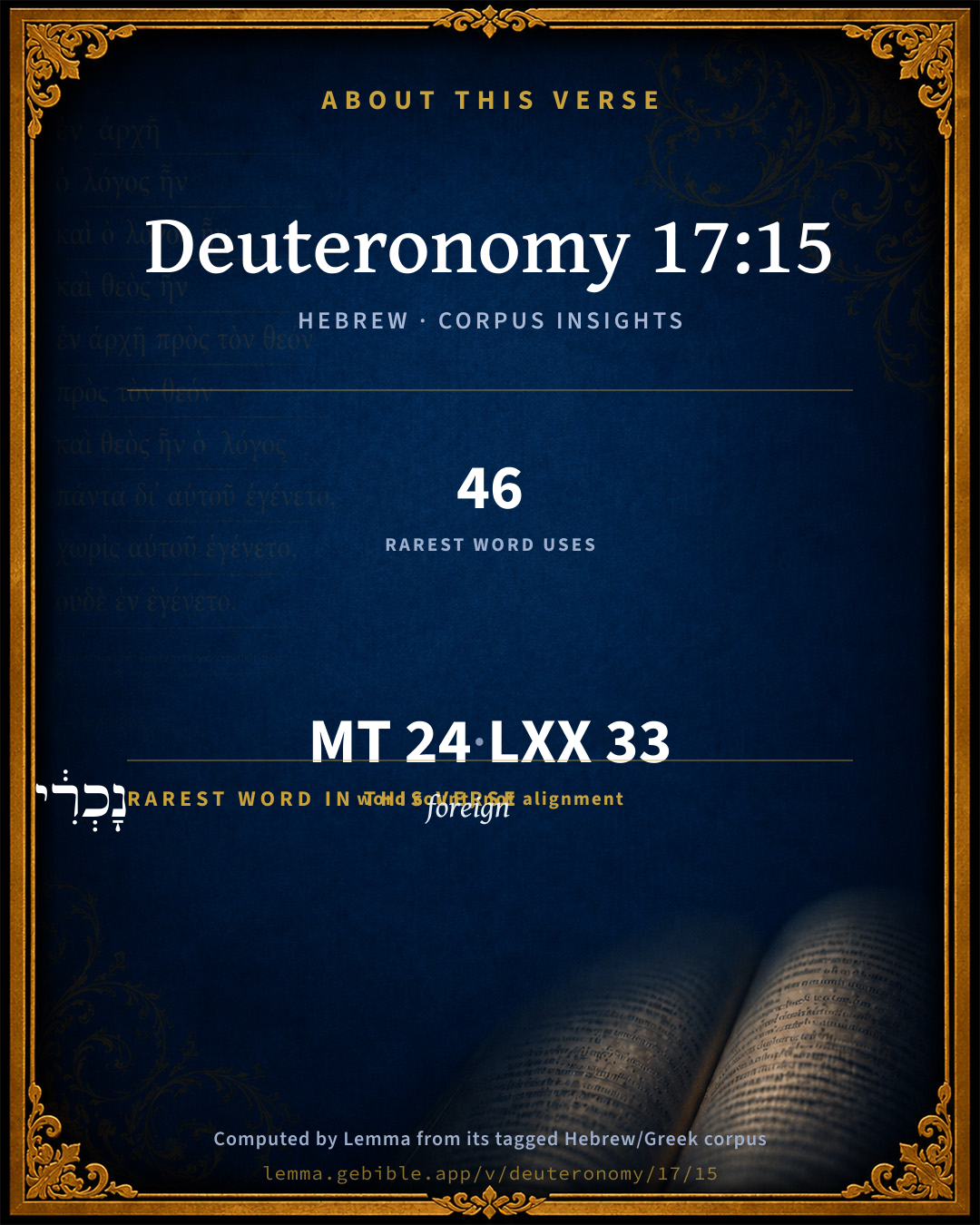
These counts appear in no published source. They are computed here, from the morphology-tagged text and Lemma’s own curated glosses. What Lemma adds →

24
words
15
distinct lemmas
Pentateuch
section

Shared distinctive vocabulary

נָכְרִ֔י foreign H5237 occurs in 45 verses of the Hebrew Bible. Also found in:

Grammatical profile

  • 6 verbs
  • 8 nouns
  • 1 adjective
  • 1 pronoun
  • 4 prepositions
  • 4 particles

Verb forms

  • שׂ֣וֹם Qal · Infinitive Absolute
  • תָּשִׂ֤ים Qal · Imperfect
  • יִבְחַ֛ר Qal · Imperfect
  • תָּשִׂ֤ים Qal · Imperfect
  • תוּכַ֗ל Qal · Imperfect
  • לָתֵ֤ת Qal · Infinitive Construct

Repetition

Words recur within this verse — often emphatic in Hebrew:

  • שׂ֣וֹם to put H7760 ×3
  • עָלֶ֨יךָ֙ upon H5921 ×3
  • מֶ֔לֶךְ king H4428 ×2
  • אַחֶ֗יךָ brother H251 ×2
  • אֲשֶׁ֥ר which H834 ×2
  • לֹ֣א not H3808 ×2

Hebrew & Septuagint length

In English translation the verse runs 38 words from the Hebrew and 41 from the Septuagint (LXX English) — closely comparable.

A rough comparison of the two English renderings, which tokenize alike — not a word-level alignment.

Word counts can differ between the Hebrew and the Greek without any difference in meaning — e.g. the Hebrew direct-object marker אֵת has no separate Greek word, and Greek often adds the article ὁ.

In the original languages it is 24 Hebrew tokens and 33 Greek tokens — but the two are counted differently (Hebrew bundles its prefixes and suffixes into one token; the Greek is in lemma form), so that isn’t a like-for-like length.

Cross-references

12

Topical passages linked to Deuteronomy 17:15 in the Treasury of Scripture Knowledge — connected by theme and wording, ordered by reader-vote popularity; previews shown in the World English Bible.

  • Jeremiah 30:21 Their prince shall be of themselves, and their ruler shall proceed from the midst of them; and I will cause him to draw near, and he shall approach to me: for who is he who has had boldness to approach to me? says Yahweh.
  • 1 Chronicles 22:10 he shall build a house for my name; and he shall be my son, and I will be his father; and I will establish the throne of his kingdom over Israel for ever.
  • 1 Samuel 9:15–17 Now Yahweh had revealed to Samuel a day before Saul came, saying,
  • 1 Samuel 10:24 Samuel said to all the people, "You see him whom Yahweh has chosen, that there is none like him among all the people?" All the people shouted, and said, [Long] live the king.
  • 1 Samuel 16:12–13 He sent, and brought him in. Now he was ruddy, and withal of a beautiful face, and goodly to look on. Yahweh said, Arise, anoint him; for this is he.
  • 1 Chronicles 12:23 These are the numbers of the heads of those who were armed for war, who came to David to Hebron, to turn the kingdom of Saul to him, according to the word of Yahweh.
  • 2 Samuel 5:2 In times past, when Saul was king over us, it was you who led out and brought in Israel: and Yahweh said to you, You shall be shepherd of my people Israel, and you shall be prince over Israel.
  • Psalms 2:2 The kings of the earth take a stand, And the rulers take counsel together, Against Yahweh, and against his anointed, saying,
  • Psalms 2:6 "Yet I have set my king on my holy hill of Zion."
  • Jeremiah 2:25 Withhold your foot from being unshod, and your throat from thirst: but you said, It is in vain; no, for I have loved strangers, and after them will I go.
  • 1 Chronicles 28:5 Of all my sons (for Yahweh has given me many sons), he has chosen Solomon my son to sit on the throne of the kingdom of Yahweh over Israel.
  • Matthew 22:17 Tell us therefore, what do you think? Is it lawful to pay taxes to Caesar, or not?"

Cross-references courtesy of OpenBible.info (CC BY 4.0).

Hebrew and Greek witnesses Masoretic Hebrew ↔ Greek Septuagint

The same verse in the two great witnesses to the Old Testament, shown verse-for-verse.

These are two independent witnesses, not word-aligned to each other, and the Septuagint is shown in lemma (dictionary) form.

Hebrew Deuteronomy 17:15 Masoretic · Westminster Leningrad Codex

שׂ֣וֹם תָּשִׂ֤ים עָלֶ֨יךָ֙ מֶ֔לֶךְ אֲשֶׁ֥ר יִבְחַ֛ר יְהוָ֥ה אֱלֹהֶ֖יךָ בּ֑וֹ מִקֶּ֣רֶב אַחֶ֗יךָ תָּשִׂ֤ים עָלֶ֨יךָ֙ מֶ֔לֶךְ לֹ֣א תוּכַ֗ל לָתֵ֤ת עָלֶ֨יךָ֙ אִ֣ישׁ נָכְרִ֔י אֲשֶׁ֥ר לֹֽא אָחִ֖יךָ הֽוּא

you shall surely set him king over you, whom Yahweh your God shall choose: one from among your brothers shall you set king over you; you may not put a foreigner over you, who is not your brother.

World English Bible · Public Domain

Greek LXX Deuteronomy 17:15 Septuagint · lemma form

καταἵστημι καταἵστημι ἐπί σεαυτοῦ ἄρχων ὅς ἄν ἐκλέγω κύριος ὁ θεός σύ αὐτός ἐκ ὁ ἀδελφός σύ καταἵστημι ἐπί σεαυτοῦ ἄρχων οὐ δύναμαι καταἵστημι ἐπί σεαυτοῦ ἄνθρωπος ἀλλότριος ὅτι οὐ ἀδελφός σύ εἰμί

you shall surely set over you the ruler whom the Lord God shall choose: of your brethren you shall set over you a ruler; you shall not have power to set over you a stranger, because he is not your brother.

LXX2012 (modern English Septuagint) · Public Domain

Hebrew: Westminster Leningrad Codex (CC BY 4.0). Greek: Septuagint (public domain); English from LXX2012 (modern English Septuagint) (Public Domain). How the Septuagint differs from the Hebrew →

Targum (Aramaic paraphrase)

2

The Targum is the ancient Jewish Aramaic paraphrase of the Hebrew Scriptures — an interpretive translation, not the Hebrew text itself. Onkelos (literal) and Pseudo-Jonathan (expansive) render the Torah, and Jonathan the Prophets. Coverage is partial: where no permissively-licensed English translation exists for a verse, only the Aramaic is shown. This is verse-level text, not a word-by-word alignment to the Hebrew.

  1. Targum Onkelos Torah (Genesis–Deuteronomy)
    מַנָאָה תְמַנֵי עֲלָךְ מַלְכָּא דִי יִתִּרְעֵי יְיָ אֱלָהָךְ בֵּהּ מִגוֹ אַחָיךְ תְּמַנֵי עֲלָךְ מַלְכָּא לֵת לָךְ רְשׁוּ לְמַנָאָה עֲלָךְ גְבַר נוּכְרַי דִי לָא אֲחוּךְ הוּא

    (no public-domain English translation for this verse)

    Targum Onkelos — Aramaic: “Onkelos Genesis” (public domain); “Onkelos Exodus” (public domain); “Onkelos Leviticus” (public domain); “Onkelos Numbers” (public domain); “Onkelos Deuteronomy” (public domain). English: “Sefaria Community Translation” (CC0 1.0 (public-domain dedication)); “J.W. Etheridge. The Targums of Onkelos and Jonathan Ben Uzziel on the Pentateuch. London: Longmans, Green, 1862” (public domain). Text via Sefaria.

  2. Targum Pseudo-Jonathan Torah (Genesis–Deuteronomy)
    תִּתְבְּעוּן אוּלְפַן מִן קֳדָם יְיָ וּמִבָּתַר כְּדֵין תִּמְנוּן עֲלֵיכוֹן מַלְכָּא לֵית לְכוֹן רְשׁוּ לְמַנָּאָה עֲלֵיכוֹן גְּבַר חִילוֹנַי דְלָא מִן אֲחוּכוֹן הוּא

    you shall inquire for instruction before the Lord and afterward appoint the king over you: but it will not be lawful to set over you a foreign man who is not of your brethren.

    Targum Pseudo-Jonathan — Aramaic: “Targum Jonathan on Genesis” (public domain); “Targum Jonathan on Exodus” (public domain); “Targum Jonathan on Leviticus” (public domain); “Targum Jonathan on Numbers” (public domain); “Targum Jonathan on Deuteronomy” (public domain). English: “The Targum of Jonathan ben Uzziel, trans. J. W. Etheridge, London, 1862” (public domain). Text via Sefaria.

Commentary

Notes on Deuteronomy 17:15 from classic Christian and Jewish commentators (each source and its license shown beneath its notes). The classic Christian expositions comment on the surrounding passage and are grouped to its opening verse, so a note may address several verses; the Jewish commentaries on the Tanakh (Rashi and others) are per-verse, so they appear only where the commentator wrote on this verse.

Lemma curates 59 commentaries, every one of them public domain or Creative Commons licensed, each selected and text-cleaned for this edition rather than reprinted as found. About our sources →

Trapp's Complete Commentary

John Trapp

Deu 17:15 Thou shalt in any wise set [him] king over thee, whom the LORD thy God shall choose: [one] from among thy brethren shalt thou set king over thee: thou mayest not set a stranger over thee, which [is] not thy brother.

Ver. 15. Whom the Lord shall choose.] As he did Saul, but especially David and his progeny, types of Christ. {Psa 2:6}

John Trapp, A Commentary or Exposition upon All the Books of the Old and New Testament (1647–1656) — public domain. Text from a community e-Sword module.

Joseph Benson's Commentary

Deu 17:15. Whom the Lord thy God shall choose — Approve of, or appoint. So it was in Saul and David. God reserved to himself the nomination both of the family and of the person. Thy brethren — Of the same nation and religion; because such a person was most likely to maintain true religion, and to rule with righteousness, gentleness, and kindness to his subjects; and that he might be a fit type of Christ, their supreme king, who was to be one of their brethren.

Joseph Benson's Commentary on the Old and New Testaments (1811–1818) — public domain. Text from a community e-Sword module.

Tyndale Open Study Notes

Tyndale Open Resources

17:15 the man the Lord your God chooses: Human monarchy was not contrary to God’s will for Israel (cp. 1 Sam 8:6-7)—God promised Abraham and Sarah that their descendants would include kings (Gen 17:6, 16; see also Gen 35:11). But the abuses of kingship were condemned. The theology that views the Messiah in a kingly role (2 Sam 7:11-15; Pss 2; 110; Isa 9:6-7) provides for both human and divine royalty.

Tyndale Open Study Notes — © Tyndale Open Resources, licensed CC BY-SA 4.0. Text via the HelloAO Bible API.

Geneva Bible (1599)

Geneva Bible translators

Or, mayest not.

Who is not of thy nation, lest he change true religion into idolatry, and bring thee to slavery.

Geneva Bible (1599) marginal notes — public domain. Text via Bolls.life.

Jamieson, Fausset & Brown

Robert Jamieson, A. R. Fausset & David Brown

thou mayest not set a stranger over thee, which is not thy brother--that is, by their free and voluntary choice. But God, in the retributions of His providence, did allow foreign princes to usurp the dominion (Jer 38:17; Mat 22:17).

Jamieson, Fausset & Brown — Commentary Critical and Explanatory on the Whole Bible (1871) — public domain (CC PDM 1.0). Text via the HelloAO Bible API.

Adam Clarke's Commentary

Verse 15. One from among thy brethren shalt thou set king over thee] It was on the ground of this command that the Jews proposed that insidious question to our Lord, Is it lawful to give tribute to Caesar, OR NO? Mt 22:17; for they were then under the authority of a foreign power. Had Christ said Yes, then they would have condemned him by this law; had he said No, then they would have accused him to Caesar. See this subject discussed in great detail in the notes, See Clarke on Mt 22:16, &c.

Adam Clarke's Commentary on the Bible (1810–1826) — public domain. Text from a community e-Sword/MySword module.

The Cambridge Bible for Schools and Colleges

gen. ed. J. J. S. Perowne

15. thou shalt in any wise set] The emphatic Heb. means either thou mayest certainly, or thou shalt only, set.

thy God shall choose] So of Saul and David, 1Sa_9:15 f., 1Sa_10:24, 1Sa_16:1; 1Sa_16:12, 2Sa_6:21, on which precedents D’s law seems based.

one from among thy brethren] a Hebrew, see on Deu_15:12.

thou mayest not put a foreigner, etc.] No such attempt, or temptation, on the part of Israel is recorded; the veto upon it can hardly be intended to cover, or have found its motive in, the nomination of an Israelite king by a foreign power, e.g. Zedekiah. It was this law which caused Agrippa I. to burst into tears as he remembered his Edomite origin. Contrast Cyrus as the Shepherd and the Anointed, of Jehovah—of course, in relation to Israel (Isa_44:28; Isa_45:1).

The Cambridge Bible for Schools and Colleges (gen. ed. J. J. S. Perowne; Cambridge University Press, 1878–1918) — public domain. Text from a community e-Sword module.

John Gill's Exposition

Thou shalt in any wise set him king over thee whom the Lord thy God shall choose,.... The Jews take this to be a command to set a king over them: whereas it is only a permission in case they should desire and determine on having one, as God foresaw they would; and this with a limitation and restriction to appoint none but whom God should choose, and which was their duty and interest to attend unto; for none could choose better for them, and was what he had a right unto, and it became them to submit to it, since he was their King in a civil and special sense, and another was only his viceregent; accordingly we find, when they expressed their desire to have a king in the time of Samuel, and it was granted, though not without some resentment, the Lord chose their first king for them, Saul, and, after him, David, and even Solomon, David's son; and though, in later times, they appointed kings without consulting him, it is complained of, Hos 8:4 hence this clause is prefaced in the Targum of Jonathan,

"ye shall seek instruction from the Lord, and after set him king, &c.''which was to be done by the mouth of a prophet, or by Urim, as Aben Ezra observes:

one from among thy brethren shall thou set king over thee: that is, one of their own nation, an Israelite, a brother both by nation and religion:

thou mayest not set a stranger over thee that is not thy brother; one of another nation, that is not of the family of Israel, as Aben Ezra notes, even not an Edomite, though called sometimes their brother; and Herod, who was an Idumean, was set up, not by them, but by the Romans; now in this their king was a type of the King Messiah, of whom it is said, "their nobles shall be of themselves", Jer 30:21.

John Gill's Exposition of the Whole Bible (1746–1763) — public domain (CC PDM 1.0). Text via the HelloAO Bible API.

Albert Barnes' Notes on the Bible

The king, like the judges and officers (compare Deu 16:18), is to be chosen by the people; but their choice is to be in accordance with the will of God, and to be made from among “their brethren.” Compare 1Sa 9:15; 1Sa 10:24; 1Sa 16:1; 1Ki 19:16.

Thou mayest not set a stranger over thee - The Jews extended this prohibition to all offices whatsoever (compare Jer 30:21); and naturally attached the greatest importance to it: from where the significance of the question proposed to our Lord, “Is it lawful to give tribute to Caesar?” Mat 22:17. A Gentile head for the Jewish people, which it was a principal aim of the Law to keep special and distinct from others, was an anomaly.

Albert Barnes' Notes on the Bible (1834–1885) — public domain. Text from a community e-Sword/MySword module.

Haydock's Catholic Bible Commentary

Choose, as he did Saul, David, and Solomon, who succeeded to the throne of his father, though he was not the eldest son. (Menochius) --- Then the throne began to be hereditary, in virtue of God’s promise to David. (Calmet) --- Brother. The Jews neglected this law, when they willingly recognized the authority of Herod, two years after the birth of Christ. See Genesis xlix. 10. (Haydock) --- A stranger might attempt to draw off the people from the service of the true God, and mutual love would not so easily subsist between them. (Menochius)

George Leo Haydock (1774–1849), Haydock's Catholic Family Bible and Commentary, 1859 edition — public domain. Excludes Psalms (Douay-Rheims chapter numbering differs from Protestant) and Deuterocanonical books (Catholic canon only).

Matthew Poole's English Annotations

Thou shalt set him, i.e. appoint, or install. If you will choose a king, which I shall suffer you to do, I command you to mind this in your choice.

Whom the Lord shall choose, approve of, or appoint. So it was in Saul, and in David. God reserved to himself the nomination both of the family and of the person. See 1Sa 9:15; 10:24; 1Sa 16:12; 1Ch 28:4,5.

From among thy brethren; of the same nation and religion; partly because such a person was most likely to maintain true religion, and to rule with righteousness, gentleness, and kindness to his subjects; and partly that he might be a fit type of Christ, their supreme King, who was to be one of their brethren.

Mayest not set a stranger over thee, to wit, by thy own choice and consent; but if God by his providence and for their sins should set a stranger over them, they might submit to him, as appears from Jer 38:17; Eze 17:12; Mat 22:17.

Matthew Poole's English Annotations on the Holy Bible (1683–1685) — public domain. Text from a community e-Sword/MySword module.

Whedon's Commentary on the Bible

Daniel D. Whedon

15. Whom the Lord thy God shall choose — The manner in which the divine appointment was to be designated is not stated here. A prophet was the medium of the divine communication in the case of the first king, Saul.

1Sa_9:17; 1Sa_10:24. Also in the case of David. 1Sa_16:12. When Solomon was designated, the choice of the Lord was announced directly to his father David. 1Ch_22:10.

Thou mayest not set a stranger over thee, which is not thy brother — The Jews placed great stress upon this prohibition. This is one of the passages of Scripture that were read at the feast of tabernacles in the sabbatical year by the king or high priest. It is related that when King Agrippa came to this passage, while reading the portions of Scripture, tears dropped from his eyes. The people then cried out, to encourage him, “Thou art our brother! Thou art our brother!” — BARCLAY’S Talmud, p. 82.

Daniel D. Whedon (gen. ed.), Commentary on the Old and New Testaments (1874–1909) — public domain. Text from a community e-Sword module.

The Pulpit Commentary

The prohibition to choose a foreigner indicates that the people had the right of election. In what way this was to be exercised, and how it was subject to the Divine choice, is not declared. Judging from what actually happened in subsequent history, it would appear that only on special occasions, such as the election of the first king or a change of dynasty, did God take the initiative, and through a prophet direct the choice of the people; ultimately the monarchy became hereditary, and it was understood that the prince who succeeded to the throne did so with the Divine approval, unless the opposite was expressly intimated by a message from God.

The Pulpit Commentary (1880–1919), ed. H.D.M. Spence-Jones & Joseph S. Exell — public domain. Text from a community e-Sword module.

John Wesley's Explanatory Notes

Thy God shall chuse - Approve of, or appoint. So it was in Saul and David. God reserved to himself the nomination both of the family, and of the person. Thy brethren -- of the same nation and religion; because such a person was most likely to maintain true religion, and to rule with righteousness, gentleness, and kindness to his subjects; and that he might be a fit type of Christ their supreme king, who was to be one of their brethren.

John Wesley, Explanatory Notes Upon the Whole Bible (1754–1765) — public domain. Text via the GEBible commentary corpus.

Ramban (Nachmanides)

Rabbi Moshe ben Nachman (Ramban / Nachmanides)

THOU SHALT BY ALL MEANS SET HIM KING OVER THEE, WHOM THE ETERNAL THY G-D SHALL CHOOSE. In the opinion of the commentators this means that he is to be chosen according to the word of a prophet or the judgment of the Urim. Scripture is thus commanding: “You shall set up a king over you, whom the Eternal thy G-d shall choose, for it is He Who will choose and not you.” And in the Sifre it is stated: 157. “Thou shalt by all means set him king over thee. If he dies, appoint another one in his place. A king — but not a queen. Whom the Eternal thy G-d shall choose — according to the word of the prophet.” But, if so, what sense is there to warn [in the verse before us], thou mayest not put a foreigner over thee, who is not thy brother, when G-d would not choose a foreigner? However, in the opinion of our Rabbis there is in this verse a hidden condition, stating: “you shall by all means set a king over you, whom G-d shall choose provided you can do so — if G-d will answer you through prophets; but a foreigner you may never appoint as king over you.”And in line with the plain meaning of Scripture they have said, “thou shalt by all means set him king over thee, whom the Eternal thy G-d will choose and not him whom the Eternal thy G-d hateth, for He will choose an Israelite to be king over His chosen ones and not from among the other peoples.” In my opinion the simple meaning of the expression whom He will choose is that every ruler over people receives his position from G-d, as it is written until thou wilt know that the Most High ruleth in the kingdom of men, and giveth it to whomsoever He will. Similarly the Rabbis have said: “Even a superintendent of the well is appointed in heaven.” Thus the verse is stating: “thou shalt by all means set him king over thee — whoever it be decreed by Heaven that he is to reign, even if he be of the smallest of the tribes of Israel and of the least of all the families of the tribe — but you are never to invest a foreigner with regal power.” Similarly, by way of the plain meaning of Scripture, the expression the place which the Eternal thy G-d shall choose means “wherever G-d’s Sanctuary shall be built, was all the Will of G-d.”

Ramban (Nachmanides) on the Tanakh — English translation: “Commentary on the Torah by Ramban (Nachmanides). Translated and annotated by Charles B. Chavel. New York, Shilo Pub. House, 1971-1976” (CC BY 4.0). Text via Sefaria.

Lesson kit

Teaching starters — assembled from the data on this page, not authored interpretation. Every prompt links to the verse data it draws on. Edit before teaching.

Deuteronomy, in the Pentateuch, opens this verse with 24 words (15 distinct Hebrew lemmas). Its most distinctive word is nokrîy (“foreign”). A historical commentator’s framing appears above. Read the whole chapter for the surrounding context.

Discussion questions

  1. What does “foreign” (nokrîy) contribute to the verse as a whole?
  2. How does Genesis 31:15, which shares the word «foreign», read alongside this verse?
  3. What does the repetition of “to put” (3× in this one verse) do in this verse?
  4. These translations render this verse differently. What is at stake in choosing one wording over another?
  5. «שׂ֣וֹם» is a Qal Infinitive Absolute verb. How does that grammatical form shape the action described?
  6. Compare how Trapp's Complete Commentary and Joseph Benson's Commentary read this verse. Where do they agree or differ?

Things to notice

Reading settings

Reading text

Shown beneath each verse's original-language words.

Old Testament
Old Testament edition

Read the OT as the Masoretic Hebrew (MT) or the Greek Septuagint (LXX).

English shown for the Greek Septuagint (in the Hebrew ↔ Greek comparison).

Comparing translations? Open the Compare panel on any verse page to stack up to four side by side.