Genesis 29:27

Hebrew (Westminster Leningrad Codex) Genesis 29:27 appears in the Hebrew Old Testament. The text above is from the Westminster Leningrad Codex. Each word links to its Strong’s number, a concise gloss, and parsing drawn from the Open Scriptures Hebrew Bible morphology. Click any word for its full Brown-Driver-Briggs (BDB) entry.
Download image
Cite this verse

Genesis 29:27 (World English Bible). Public Domain. Lemma interlinear Bible study tool, https://lemma.gebible.app/v/genesis/29/27.

Show BibTeX & RIS
BibTeX
RIS
English Translation
Fulfill the week of this one, and we will give you the other also for the service which you will serve with me yet seven other years."
World English Bible · Public Domain
Highlights
  • 2 first appearances in the Hebrew Bible
Full analysis ↓
Download a study sheet

One document with this verse’s original text, its word-by-word gloss line, the meaning frame, cross-references with their text, attributed commentary, and full source and license credits — printable, and it pastes into notes with its structure intact.

This verse Autodidact and up

Study sheet (.html) Plain text (.txt)

A passage Seminary Student

Up to 50 verses in one chapter. A passage sheet keeps up to 6 commentary sources and 12 cross-references per verse, in the order this page ranks them, and says so on the sheet whenever that leaves anything out. Ask for a single verse and you get the Autodidact verse sheet above.

Everything on this page stays free to read, with no account — the sheet is a download of what is already on screen, not access to it.

Want to remove ads? Support Godless Engineer
Compare translations 3

The same verse in 3 English versions, stacked beneath the original-language interlinear above. Click any original word for its lexicon entry.

Each is an independent rendering of the whole verse — the interlinear is not word-aligned to these translations.

Highlighted words mark where these versions differ — a whole-verse word diff, not a word-by-word alignment.

  • World English Bible Public Domain
    Fulfill the week of this one, and we will give you the other also for the service which you will serve with me yet seven other years."
  • King James Version Public Domain
    Fulfil her week, and we will give thee this also for the service which thou shalt serve with me yet seven other years.
  • unfoldingWord Literal Text CC BY-SA 4.0
    Fulfill the week of this, then we will also give you this for service that you will serve with me for another seven years.”

unfoldingWord Literal Text — © unfoldingWord, licensed CC BY-SA 4.0. Word-aligned USFM3 via Door43 (git.door43.org/unfoldingWord/en_ult).

Versions to compare (up to 4)

3 of 4 selected

Show all 18 translations

Every available English version of this verse, each an independent rendering of the whole verse.

  • World English Bible Public Domain
    Fulfill the week of this one, and we will give you the other also for the service which you will serve with me yet seven other years."
  • Berean Standard Bible Public Domain
    Finish this week’s celebration, and we will give you the younger one in return for another seven years of work.”
  • Majority Standard Bible Public Domain
    Finish this week’s celebration, and we will give you the younger one in return for another seven years of work.”
  • King James Version Public Domain
    Fulfil her week, and we will give thee this also for the service which thou shalt serve with me yet seven other years.
  • American Standard Version (1901) Public Domain
    Fulfil the week of this one, and we will give thee the other also for the service which thou shalt serve with me yet seven other years.
  • Revised Version (1885) Public Domain
    Fulfill the week of this one, and we will give thee the other also for the service which thou shalt serve with me yet seven other years.
  • Geneva Bible (1599) Public Domain
    Fulfill seuen yeeres for her, and we wil also giue thee this for the seruice, which thou shalt serue me yet seuen yeeres more.
  • Douay-Rheims (1899) Public Domain
    Make up the week of days of this match: and I will give thee her also, for the service that thou shalt render me other seven years.
  • Young's Literal Translation Public Domain
    fulfil the week of this one, and we give to thee also this one, for the service which thou dost serve with me yet seven other years.'
  • Literal Standard Version CC BY-SA 4.0
    fulfill the period of seven [for] this one, and we also give to you this one, for the service which you serve with me yet seven other years.”
  • Unlocked Literal Bible CC BY-SA 4.0
    Complete the bridal week of this daughter, and we will give you the other also in return for serving me another seven years.”
  • unfoldingWord Literal Text CC BY-SA 4.0
    Fulfill the week of this, then we will also give you this for service that you will serve with me for another seven years.”
  • Darby Bible Public Domain
    Fulfil the week [with] this one: then we will give thee the other one also, for the service that thou shalt serve me yet seven other years.
  • World Messianic Bible Public Domain
    Fulfill the week of this one, and we will give you the other also for the service which you will serve with me for seven more years.”
  • Webster's Bible Public Domain
    Fulfill her week, and we will give thee this also, for the service which thou shalt serve with me yet seven other years.
  • Free Bible Version CC BY-SA 4.0
    “Finish this week of wedding celebrations and then I'll give you the other daughter as well, as long as you work another seven years for me.”
  • Bible in Basic English Public Domain
    Let the week of the bride-feast come to its end and then we will give you the other in addition, if you will be my servant for another seven years.
  • JPS Tanakh (1917) Public Domain
    Fulfil the week of this one, and we will give thee the other also for the service which thou shalt serve with me yet seven other years.'

Literal Standard Version (2020), Covenant Press — licensed CC BY-SA 4.0. Text via the HelloAO Bible API (eBible.org). Unlocked Literal Bible (unfoldingWord) — licensed CC BY-SA 4.0. Text via the HelloAO Bible API (eBible.org). unfoldingWord Literal Text — © unfoldingWord, licensed CC BY-SA 4.0. Word-aligned USFM3 via Door43 (git.door43.org/unfoldingWord/en_ult). Free Bible Version, Dr. Jonathan Gallagher — licensed CC BY-SA 4.0. Text via the HelloAO Bible API (eBible.org).

Word by word

More ways to search: Search by grammar → Find every occurrence → Compare this word →

Practice this passage: Drill this verse → Learn its vocabulary →

שְׁבֻ֣עַ
shâbûwaʻ
H7620
“week of”
Noun, Common, Masculine, Singular, Construct
Part of Speech
Noun
Type
Common
Gender
Masculine
Number
Singular
State
Construct
Full BDB Definition

Origin: properly, pass part of H7650 as a denom. of H7651

TWOT: 2318d

seven, period of seven (days or years), heptad, week - period of seven days, a week - Feast of Weeks - heptad, seven (of years)
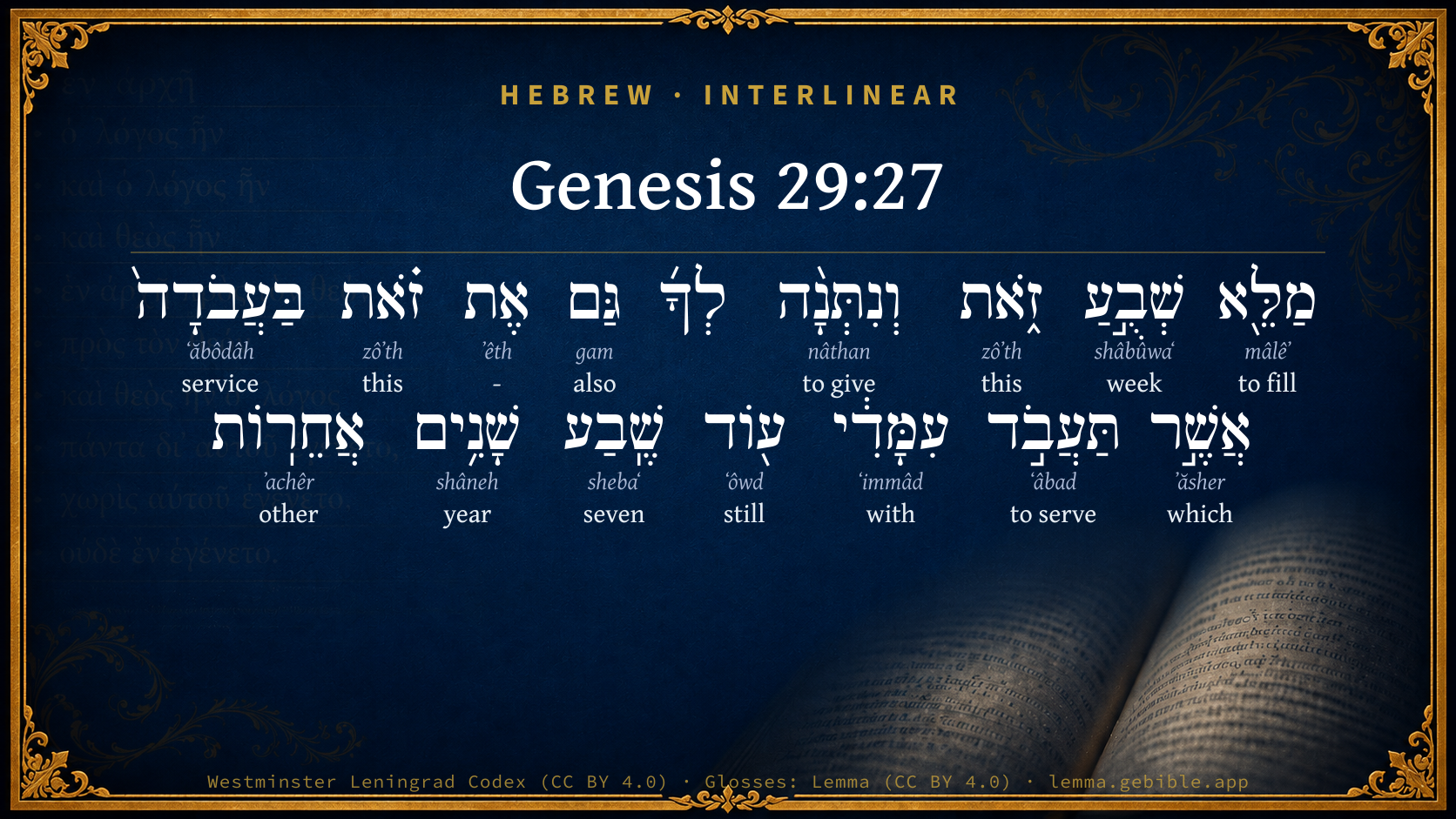
  1. מַלֵּ֖א mâlêʼ H4390 “fill” Verb, Piel, Imperative, 2nd Person, Masculine, Singular
  2. זֹ֑את zôʼth H2063 “this” Pronoun, Demonstrative, Feminine, Singular
  3. וְנִתְּנָ֨ה nâthan H5414 “and · to give” Conjunction + Verb, Niphal, Sequential Perfect, 3rd Person, Feminine, Singular
  4. גַּם gam H1571 “also” Particle, Accusative
  5. אֶת ʼêth H853 “-” Particle, Direct Object
  6. זֹ֗את zôʼth H2063 “this” Pronoun, Demonstrative, Feminine, Singular
  7. בַּעֲבֹדָה֙ ʻăbôdâh H5656 “in/at · service” Preposition + Noun, Common, Feminine, Singular, Absolute
  8. אֲשֶׁ֣ר ʼăsher H834 “which” Particle, Relative
  9. תַּעֲבֹ֣ד ʻâbad H5647 “to serve” Verb, Qal, Imperfect, 2nd Person, Masculine, Singular
  10. עִמָּדִ֔י ʻimmâd H5978 “with · me” Preposition + Suffix, Personal, 1st Person, Common, Singular
  11. ע֖וֹד ʻôwd H5750 “still” Adverb
  12. שֶֽׁבַע shebaʻ H7651 “seven” Adjective, Cardinal number, Feminine, Singular, Absolute
  13. שָׁנִ֥ים shâneh H8141 “years” Noun, Common, Feminine, Plural, Absolute
  14. אֲחֵרֽוֹת ʼachêr H312 “other” Adjective, Adjective, Feminine, Plural, Absolute

About this verse

These counts appear in no published source. They are computed here, from the morphology-tagged text and Lemma’s own curated glosses. What Lemma adds →

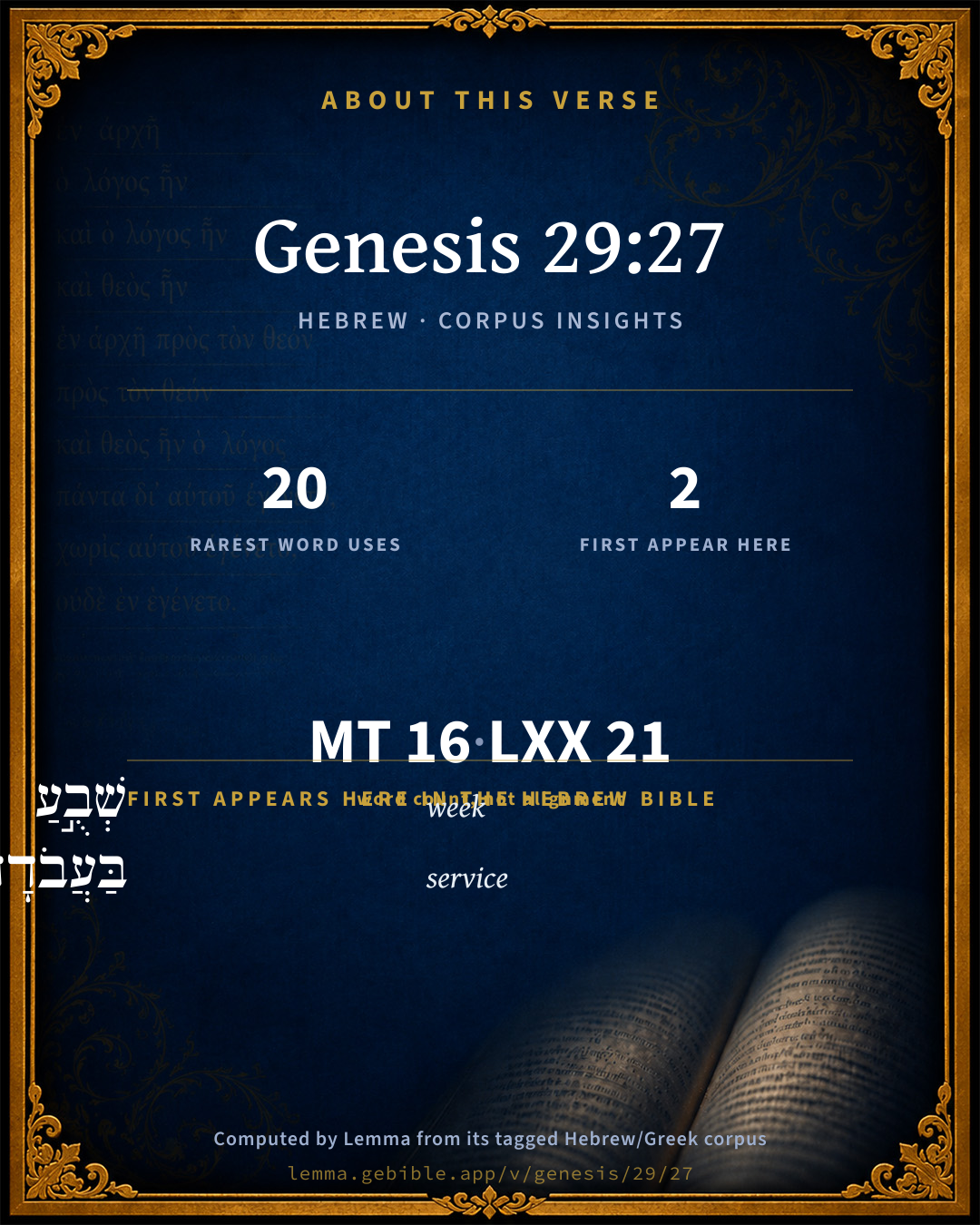
16
words
14
distinct lemmas
Pentateuch
section

Notable vocabulary

The rarest word here is שְׁבֻ֣עַ week H7620 — appearing just 20 times in the whole Hebrew Bible.

First appearance in Scripture

These words make their first canonical appearance in the Hebrew Bible here:

  • שְׁבֻ֣עַ week H7620
  • בַּעֲבֹדָה֙ service H5656

Shared distinctive vocabulary

שְׁבֻ֣עַ week H7620 occurs in 17 verses of the Hebrew Bible. Also found in:

Grammatical profile

  • 3 verbs
  • 3 nouns
  • 2 adjectives
  • 2 pronouns
  • 2 prepositions
  • 1 adverb
  • 3 particles

Verb forms

  • מַלֵּ֖א Piel · Imperative
  • וְנִתְּנָ֨ה Niphal · Sequential Perfect
  • תַּעֲבֹ֣ד Qal · Imperfect

Repetition

A word recurs within this verse — often emphatic in Hebrew:

  • זֹ֑את this H2063 ×2

Hebrew & Septuagint length

In English translation the verse runs 27 words from the Hebrew and 26 from the Septuagint (LXX English) — closely comparable.

A rough comparison of the two English renderings, which tokenize alike — not a word-level alignment.

Word counts can differ between the Hebrew and the Greek without any difference in meaning — e.g. the Hebrew direct-object marker אֵת has no separate Greek word, and Greek often adds the article ὁ.

In the original languages it is 16 Hebrew tokens and 21 Greek tokens — but the two are counted differently (Hebrew bundles its prefixes and suffixes into one token; the Greek is in lemma form), so that isn’t a like-for-like length.

Cross-references

7

Topical passages linked to Genesis 29:27 in the Treasury of Scripture Knowledge — connected by theme and wording, ordered by reader-vote popularity; previews shown in the World English Bible.

  • Leviticus 18:18 "'You shall not take a wife to her sister, to be a rival, to uncover her nakedness, while her sister is yet alive.
  • Judges 14:12 Samson said to them, Let me now put forth a riddle to you: if you can declare it to me within the seven days of the feast, and find it out, then I will give you thirty linen garments and thirty changes of clothing;
  • Genesis 2:2–3 On the seventh day God finished his work which he had made; and he rested on the seventh day from all his work which he had made.
  • Genesis 8:10–12 He stayed yet another seven days; and again he sent forth the dove out of the ark.
  • Judges 14:10 His father went down to the woman: and Samson made there a feast; for so used the young men to do.
  • Malachi 2:15 Did he not make one, although he had the residue of the Spirit? Why one? He sought a godly seed. Therefore take heed to your spirit, and let none deal treacherously against the wife of his youth.
  • 1 Timothy 6:10 For the love of money is a root of all kinds of evil. Some have been led astray from the faith in their greed, and have pierced themselves through with many sorrows.

Cross-references courtesy of OpenBible.info (CC BY 4.0).

Hebrew and Greek witnesses Masoretic Hebrew ↔ Greek Septuagint

The same verse in the two great witnesses to the Old Testament, shown verse-for-verse.

These are two independent witnesses, not word-aligned to each other, and the Septuagint is shown in lemma (dictionary) form.

Hebrew Genesis 29:27 Masoretic · Westminster Leningrad Codex

מַלֵּ֖א שְׁבֻ֣עַ זֹ֑את וְנִתְּנָ֨ה לְךָ֜ גַּם אֶת זֹ֗את בַּעֲבֹדָה֙ אֲשֶׁ֣ר תַּעֲבֹ֣ד עִמָּדִ֔י ע֖וֹד שֶֽׁבַע שָׁנִ֥ים אֲחֵרֽוֹת

Fulfill the week of this one, and we will give you the other also for the service which you will serve with me yet seven other years."

World English Bible · Public Domain

Greek LXX Genesis 29:27 Septuagint · lemma form

συντελέω οὖν ὁ ἕβδομος οὗτος καί δίδωμι σύ καί οὗτος ἀντί ὁ ἐργασία ὅς ἐργάζομαι παρά ἐγώ ἔτι ἑπτά ἔτος ἕτερος

Fulfil then her sevens, and I will give to you her also in return for your labor, which you labor with me, yet seven other years.

LXX2012 (modern English Septuagint) · Public Domain

Hebrew: Westminster Leningrad Codex (CC BY 4.0). Greek: Septuagint (public domain); English from LXX2012 (modern English Septuagint) (Public Domain). How the Septuagint differs from the Hebrew →

Targum (Aramaic paraphrase)

2

The Targum is the ancient Jewish Aramaic paraphrase of the Hebrew Scriptures — an interpretive translation, not the Hebrew text itself. Onkelos (literal) and Pseudo-Jonathan (expansive) render the Torah, and Jonathan the Prophets. Coverage is partial: where no permissively-licensed English translation exists for a verse, only the Aramaic is shown. This is verse-level text, not a word-by-word alignment to the Hebrew.

  1. Targum Onkelos Torah (Genesis–Deuteronomy)
    אַשְׁלִים שְׁבוּעֲתָא דְדָא וְנִתֵּן לָךְ אַף יָת דָּא בְּפָלְחָנָא דִּי תִפְלַח עִמִּי עוֹד שְׁבַע שְׁנִין אָחֳרָנִין

    (no public-domain English translation for this verse)

    Targum Onkelos — Aramaic: “Onkelos Genesis” (public domain); “Onkelos Exodus” (public domain); “Onkelos Leviticus” (public domain); “Onkelos Numbers” (public domain); “Onkelos Deuteronomy” (public domain). English: “Sefaria Community Translation” (CC0 1.0 (public-domain dedication)); “J.W. Etheridge. The Targums of Onkelos and Jonathan Ben Uzziel on the Pentateuch. London: Longmans, Green, 1862” (public domain). Text via Sefaria.

  2. Targum Pseudo-Jonathan Torah (Genesis–Deuteronomy)
    אַשְׁלִים כְּדוּן שִׁבְעָתֵי יוֹמֵי מִשְׁתַּיָא דְדָא וְנִיתַּן לָךְ אוּף יַת דָא בְּפוּלְחָנָא דְתִפְלַח עִמִי תוּב שֵׁב שְׁנִין אוֹחֲרָנִין

    Fulfil now the seven days of the feast of this, and I will give thee also that for the service which thou shalt serve with me yet seven other years.

    Targum Pseudo-Jonathan — Aramaic: “Targum Jonathan on Genesis” (public domain); “Targum Jonathan on Exodus” (public domain); “Targum Jonathan on Leviticus” (public domain); “Targum Jonathan on Numbers” (public domain); “Targum Jonathan on Deuteronomy” (public domain). English: “The Targum of Jonathan ben Uzziel, trans. J. W. Etheridge, London, 1862” (public domain). Text via Sefaria.

Commentary

Notes on Genesis 29:27 from classic Christian and Jewish commentators (each source and its license shown beneath its notes). The classic Christian expositions comment on the surrounding passage and are grouped to its opening verse, so a note may address several verses; the Jewish commentaries on the Tanakh (Rashi and others) are per-verse, so they appear only where the commentator wrote on this verse.

Lemma curates 59 commentaries, every one of them public domain or Creative Commons licensed, each selected and text-cleaned for this edition rather than reprinted as found. About our sources →

Trapp's Complete Commentary

John Trapp

Gen 29:27 Fulfil her week, and we will give thee this also for the service which thou shalt serve with me yet seven other years.

Ver. 27. We will give thee this also.] See here the guise of wicked and deceitful men: when one fetch has been born in their minds, they devise another; and make no end of overreaching; there never wanting (as the proverb hath it) a new knack in a knave’s cap. They will search the devil’s skull, but they will find out one slippery trick or another, to cheat and go beyond those they deal with. But let them look to it; "God is the avenger of all such," {1Th 4:6} whose, not heads only, but "bellies prepare deceit". {Job 15:35}

John Trapp, A Commentary or Exposition upon All the Books of the Old and New Testament (1647–1656) — public domain. Text from a community e-Sword module.

Joseph Benson's Commentary

Gen 29:27. Fulfil her week — The seven days usually devoted to the feast and solemnity of marriage, Jdg 14:12-17; for it does not appear that it relates to the seven years Jacob afterward served. This Laban seems to have desired, that by a week’s cohabitation with Leah, his affections might be knit to her, and the marriage with her confirmed. We will give thee this also — Hereby he drew Jacob into the sin, and snare, and disquiet of multiplying wives. Jacob did not design it, but to have kept as true to Rachel as his father had done to Rebekah; he that had lived without a wife to the eighty-fourth year of his age, could then have been very well content with one: but Laban, to dispose of his two daughters without portions, and to get seven years’ service more out of Jacob, thus imposeth upon him, and draws him into such a strait, that he had some colourable reason for marrying them both.

Joseph Benson's Commentary on the Old and New Testaments (1811–1818) — public domain. Text from a community e-Sword module.

Adam Clarke's Commentary

Verse 27. Fulfil her week] The marriage feast, it appears, lasted seven days; it would not therefore have been proper to break off the solemnities to which all the men of the place had been invited, Ge 29:22, and probably Laban wished to keep his fraud from the public eye; therefore he informs Jacob that if he will fulfil the marriage week for Leah, he will give him Rachel at the end of it, on condition of his serving seven other years. To this the necessity of the case caused Jacob to agree; and thus Laban had fourteen years' service instead of seven: for it is not likely that Jacob would have served even seven days for Leah, as his affection was wholly set on Rachel, the wife of his own choice. By this stratagem Laban gained a settlement for both his daughters. What a man soweth, that shall he reap. Jacob had before practised deceit, and is now deceived; and Laban, the instrument of it, was afterwards deceived himself.

Adam Clarke's Commentary on the Bible (1810–1826) — public domain. Text from a community e-Sword/MySword module.

John Calvin's Commentaries

27. Fulfil her week. Laban now is become callous in wickedness, for he extorts other seven years from his nephew to allow him to marry his other daughter. If he had had ten more daughters, he would have been ready thus to dispose of them all: yea, of his own accord, he obtrudes his daughter as an object of merchandise, thinking nothing of the disgrace of this illicit sale, if only he may make it a source of gain. In this truly he grievously sins, that he not only involves his nephew in polygamy, but pollutes both him and his own daughters by incestuous nuptials. If by any means a wife is not loved by her husband, it is better to repudiate her than that she should be retained as a captive, and consumed with grief by the introduction of a second wife. Therefore the Lord, by Malachi, pronounces divorce to be more tolerable than polygamy. (Malachi 2:14.) Laban, blinded by avarice, so sets his daughters together, that they spend their whole lives in mutual hostility. He also perverts all the laws of nature by casting two sisters into one marriage-bed, so that the one is the competitor of the other. Since Moses sets these crimes before the Israelites in the very commencement of their history, it is not for them to be inflated by the sense of their nobility, so that they should boast of their descent from holy fathers. For, however excellent Jacob might be, he had no other offspring than that which sprung from an impure source; since, contrary to nature, two sisters are mixed together in one bed; in the mode of beasts; and two concubines are afterwards added to the mass. We have seen indeed, above, that this license was too common among oriental nations; but it was not allowable for men, at their own pleasure, to subvert, by a depraved custom, the law of marriage divinely sanctioned from the beginning. Therefore, Laban is, in every way, inexcusable. And although necessity may, in some degree, excuse the fault of Jacob, it cannot altogether absolve him from blame. For he might have dismissed Leah, because she had not been his lawful wife: because the mutual consent of the man and the woman, respecting which mistake is impossible, constitutes marriage. But Jacob reluctantly retains her as his wife, from whom he was released and free, and thus doubles his fault by polygamy, and trebles it by an incestuous marriage. Thus we see that the inordinate love of Rachel, which had been once excited in his mind, was inflamed to such a degree, that he possessed neither moderation nor judgment. With respect to the words made use of, interpreters ascribe to them different meanings. Some refer the demonstrative pronoun to the week; others to Leah, as if it had been said, that he should not have Rachel until he had lived with her sister one week. But I rather explain it of Rachel, that he should purchase a marriage with her by another seven years’ service; not that Laban deferred the nuptials to the end of that time, but that Jacob was compelled to engage himself in a new servitude.

John Calvin's Commentaries (1540-1563) — public domain. Text from the Calvin Translation Society English edition (1840s-50s) via the Christian Classics Ethereal Library (ccel.org). Calvin's coverage is partial (roughly two-thirds of the Bible); uncommented books and verses are honest gaps, never fabricated. The 19th-century editor's footnotes and remarks are omitted so the notes are faithfully Calvin's own voice.

Ellicott's Commentary for English Readers

(27) Fulfil her week.—The marriage festival seems to have lasted a week, as was the custom in later times (Jdg_14:12), and. to have forsaken Leah during this period would have been to offer her an insult which her brothers must have avenged. Appeased, therefore, by the promise of Rachel as soon as the seven days are over, Jacob, rather than quarrel with the whole family, submits to the wrong. The Hebrew is remarkable, “Fulfil the week of this, and we will give to thee also the this for the service.” But in Hebrew this . . . this means the one and the other (Gen_31:38; Gen_31:41), and it is a mistake to suppose that the language will allow the first this to be understood of any one but Leah, and the second this of any one but Rachel.

A Bible Commentary for English Readers, edited by Charles John Ellicott (1878–1897) — public domain. Text from a community e-Sword module.

The Cambridge Bible for Schools and Colleges

gen. ed. J. J. S. Perowne

27. Fulfil the week] Laban’s proposal is that when the week’s marriage festivities for Leah are over, Jacob shall take Rachel as his second wife, on condition that he gives his services for another period of seven years. Nothing would justify the interruption of the seven days’ marriage ceremonial.

Marriage with two sisters was evidently free from objection in the primitive days of the Israelites; and, perhaps for that reason, it is introduced into the prophetical symbolism of Jer_3:6 ff. and Ezekiel 23. But, in the Levitical law, marriage with two sisters simultaneously is forbidden; Lev_18:18.

The Cambridge Bible for Schools and Colleges (gen. ed. J. J. S. Perowne; Cambridge University Press, 1878–1918) — public domain. Text from a community e-Sword module.

John Gill's Exposition

Fulfil her week,.... Not Rachel's week, or a week of years of servitude for her, but Leah's week, or the week of seven days of feasting for her marriage; for a marriage feast used to be kept seven days, according to the Jewish writers (t), and as it seems from Jdg 14:17; and the Targum of Jerusalem fully expresses this sense,"fulfil the week of the days of the feast of Leah;''and to the same sense the Targum of Jonathan, Aben Ezra and Jarchi:

and we will give this also; meaning Rachel that stood by; and the sense is, that he and his wife, if he had any, or his friends about him, would give to Jacob Rachel also to be his wife, upon the following condition:

for the service which thou shall serve with me yet seven other years; which shows the avaricious temper of the man.

(t) T. Hieros. Moed Katon, fol. 80. 4. Pirke Eliezer, c. 16, 36.

John Gill's Exposition of the Whole Bible (1746–1763) — public domain (CC PDM 1.0). Text via the HelloAO Bible API.

Matthew Poole's English Annotations

Fulfil her week, the seven days usually devoted to the feast and solemnity of marriage, as Jdg 14:12,15,17. And this he desired, that a week’s cohabitation with Leah might either knit his affections to her, or at least confirm the contract and marriage with her.

Matthew Poole's English Annotations on the Holy Bible (1683–1685) — public domain. Text from a community e-Sword/MySword module.

Whedon's Commentary on the Bible

Daniel D. Whedon

27. Her week — The seven days of the marriage feast. Laban proposes, as a recompense, after the week has ended, to give him Rachel also, but on condition that he serve for her yet seven other years. Two wives in eight days, but fourteen years of service for them both. “This bigamy of Jacob must not be judged directly by the Mosaic law, which prohibits marriage with two sisters at the same time, (Lev_18:18,) or be set down as incest, (Calvin,) since there was no positive law on the point in existence then. At the same time it is not to be justified on the ground that the blessing of God made it the means of the fulfilment of his promise, namely, the multiplication of the seed of Abraham into a great nation. Just as it had arisen from Laban’s deception and Jacob’s love, which regarded outward beauty alone, and, therefore, from sinful infirmities, so did it become in its results a true school of affliction to Jacob, in which God showed to him by many a humiliation, that such conduct as his was quite unfitted to accomplish the divine counsels, and thus condemned the ungodliness of such a marriage, and prepared the way for the subsequent prohibition in the law.” — Keil.

Daniel D. Whedon (gen. ed.), Commentary on the Old and New Testaments (1874–1909) — public domain. Text from a community e-Sword module.

The Pulpit Commentary

Fulfill her week, literally, make full the week of this otis, i.e. of Leah, if Leah was given to Jacob on the first night of the festivities (Calmer, Rosenm Keil, Kalisch, Lange, Ainsworth); but id Leah was married at the close of the seven days, then it must refer to Rachel s week (Bush, Murphy)and we (including Laban"s wife and eldest son, as in Ge 14) will give thee this also (i.e. Rachel) for the service which thou shalt serve with me yet seven other years. Almost every motive that is mean, base, and despicable appears in this behavior of Laban"s; if he attached little value to his daughters" affections, he had a keen appreciation of Jacob"s qualities as a shepherd.

The Pulpit Commentary (1880–1919), ed. H.D.M. Spence-Jones & Joseph S. Exell — public domain. Text from a community e-Sword module.

John Wesley's Explanatory Notes

We will give thee this also - Hereby he drew Jacob into the sin and snare, and disquiet of multiplying wives. Jacob did not design it, but to have kept as true to Rachel as his father had done to Rebekah; he that had lived without a wife to the eighty fourth year of his age could then have been very well content with one: but Laban to dispose of his two daughters without portions, and to get seven years service more out of Jacob, thus imposeth upon him, and draws him into such a strait, that he had some colourable reason for marrying them both.

John Wesley, Explanatory Notes Upon the Whole Bible (1754–1765) — public domain. Text via the GEBible commentary corpus.

Keil & Delitzsch

C. F. Keil & F. Delitzsch

"Fulfil her week;" i.e., let Leah's marriage-week pass over. The wedding feast generally lasted a week (cf. Jdg 14:12; Job 11:19). After this week had passed, he received Rachel also: two wives in eight days. To each of these Laban gave one maid-servant to wait upon her; less, therefore, than Bethuel gave to his daughter (Gen 24:61). - This bigamy of Jacob must not be judged directly by the Mosaic law, which prohibits marriage with two sisters at the same time (Lev 18:18), or set down as incest (Calvin, etc.), since there was no positive law on the point in existence then. At the same time, it is not to be justified on the ground, that the blessing of God made it the means of the fulfilment of His promise, viz., the multiplication of the seed of Abraham into a great nation. Just as it had arisen from Laban's deception and Jacob's love, which regarded outward beauty alone, and therefore from sinful infirmities, so did it become in its results a true school of affliction to Jacob, in which God showed to him, by many a humiliation, that such conduct as his was quite unfitted to accomplish the divine counsels, and thus condemned the ungodliness of such a marriage, and prepared the way for the subsequent prohibition in the law.

Keil & Delitzsch — Biblical Commentary on the Old Testament (1861–1891) — public domain (CC PDM 1.0). Text via the HelloAO Bible API. (Old Testament only.)

Rashi

Rabbi Shlomo Yitzchaki (Rashi)

מלא שבע זאת FULFIL THE WEEK OF THIS ONE — The word is in the construct state for it is punctuated with Sheva, so that the meaning is “the seven days of this woman”, referring to the seven days of the marriage feast. Such is the statement in the Talmud Yerushalmi Moed Katan 1:7. It is impossible to say that it means an actual week, (i. e. a calendar week), so that it would mean “finish this week” in the sense “wait until this week be ended”) — for, if so, the ש should be punctuated with Patach (Rashi terms our Kametz a Patach) for the noun must be in the absolute state. Then, again, the word שָׁבֻעַ is masculine — as it is written (Deuteronomy 16:9) “Seven (שבעה) weeks shalt thou number unto thyself” (and here we should have had שָׁבֻעַ זֶה). Consequently the word שבוע can only mean “a period of seven days” old French septaine (cf. Rashi on Exodus 10:22).

ונתנה לך AND WE WILL GIVE THEE — The verb is plural 1st pers. like (נרדה) (Genesis 11:7) “let us go down”, ונבלה “and let us confuse and (Genesis 11:3) ונשרפה “and let us burn": so, also here, it is a form of וְנִתֵּן “and we will give”.

גם את זאת THIS ONE ALSO we shall give to you immediately after the seven days of the marriage-feast and you may serve for her after marriage with her.

Rashi on the Tanakh — English translations: “The Judaica Press complete Tanach with Rashi, translated by A. J. Rosenberg” (CC BY 4.0); “Pentateuch with Rashi's commentary by M. Rosenbaum and A.M. Silbermann, 1929-1934” (public domain); “The Metsudah Tanach series, Lakewood, N.J” (CC BY 4.0); and “The Book of Joshua, Metsudah Publications, 1997” (CC BY 4.0). Text via Sefaria.

Ramban (Nachmanides)

Rabbi Moshe ben Nachman (Ramban / Nachmanides)

FULFILL ‘SHVUA’ (THE WEEK OF) THIS ONE. The word shvua is in the construct state for it is punctuated with a sheva. It thus means the seven days of this wife, referring to the seven days of the wedding feast. These too are the words of Rashi.But if so, [i.e., if Rashi interprets shvua as referring to the seven days of the wedding feast rather than, more simply, the seven years of labor, thus implying that the seven years of work had been completed], why did not the Rabbi [Rashi] explain the verse above, my days are fulfilled, as referring to the years of work and the condition which were completed, as Onkelos has it, and which is the true sense of the verse, [instead of explaining it as referring to the length of time his mother told him to remain there or to his advanced age]? For merely because the days his mother told him to remain with him were completed or because of his advanced age, Laban would not give him his daughter before the mutually agreed time, and it is enough to expect of Laban that he fulfill his condition. It is according to Onkelos, [who says that Jacob’s seven years of work had been completed], that we are bound to explain, fulfill ‘shvua’ this one, as referring to the seven days of the wedding feast for as Jacob had told him, the days of work had already been completed. So also did Rabbi Abraham ibn Ezra explain it. And I do not know [how the reference here could be to “the seven days of the marriage feast,” as Rashi claims], for “the seven days of the wedding feast” is an ordinance established for Israel by our teacher Moses. Perhaps we may say that the dignitaries of the nations had already practiced this custom of old, just as was the case with mourning, as it is written, And he made a mourning for his father seven days. And that which the Rabbis have deduced from here in the Yerushalmi and in Bereshith Rabbah, “One must not mix one rejoicing with another,” that is merely a Scriptural intimation based upon the customary practices of the ancient ones prior to the giving of the Torah. But in our Gemara, the Rabbis did not derive it from here, [i.e., from Laban’s statement], but instead they deduced it from the verse, And Solomon held the feast etc.. The Rabbis explain that the first seven days were a feast of dedication of the new Temple, and the second seven days were the feast of Tabernacles, and he did not combine the two festivities into one because “we must not mix one rejoicing with another.” — The explanation for this principle is stated by Tosafoth Moed Katan 8b. “For just as we must not perform religious duties bundle-wise, but pay exclusive attention to each singly, so must we turn our heart completely toward one rejoicing only, without interference from another.”Now it is possible to say that this was part of “the changing of the hire ten times” of which Jacob accused Laban. For Jacob told Laban originally that the days were fulfilled, and Laban kept quiet and gave him Leah. Later, Laban told him, “Fulfill ‘shvua’ this one, for the work period for Leah has not been fulfilled, and I gave her to you before the time I had agreed upon.” And Jacob listened to Laban and completed the days as defined by Laban, for he desired Rachel, and what could he do? Therefore, Scripture does not say at first, “And it came to pass when the days were fulfilled, and Jacob said, etc.,” [for this would have indicated mutual agreement concerning the completion of the work period, whereas Laban, as explained, claimed that that time had not yet arrived].It is also possible to say that when the seventh year arrived, Jacob said to Laban, Give me my wife, for my days are fulfilled, meaning that this is the year in which the days will be fulfilled. Similarly, The aged with him that is full of days, which means, “he who is attaining his final year.” Similarly, Until the day of your consecration be fulfilled, which means, “until the seventh day in which the days of your consecration will be fulfilled.” It is possible that Jacob said, My days are fulfilled, because they were about to be fulfilled and are considered as if fulfilled. There are many similar examples in Scripture. Likewise, in the next Seder (portion of the Torah), As her soul was departing, for she died, which means, “when she was near death, and was considered as if she had already died.” And this is the meaning of the expression, that I may come unto her, that is to say, Jacob said, “My request is not that you give her to me and I will then leave, but rather that I marry her and complete the few days which are still obligatory upon me for now that the period is almost over, you will not be afraid that I might leave you.” Our Rabbis have given a Midrashic interpretation to the words, that I may come unto her, because it is not the ethical way to mention it in this manner, the more so with righteous people, but the intent is as I have said.Laban then told Jacob, “Fulfill the seven years of this one, Leah, for perhaps since I transgressed your will by giving you Leah instead of Rachel you will not fulfill them.” Perhaps he mentioned it in order that it be known when the days of work for Rachel begin, and then he told him, “I will give you the other daughter, Rachel, for the service which thou shalt serve with me after the wedding.”

‘VENITNAH’ (AND WE WILL GIVE) THEE. The verb is plural, as in, Let us go down, and let us confound there; And let us burn., Verse 3. Here too it is a form of venitein (and we will give). This is Rashi’s comment, but he did not say why an individual person [Laban] would use the plural form. Perhaps Rashi thought that this is the manner in which dignitaries speak in the Sacred Language, i.e., as if others are speaking. And Rabbi Abraham ibn Ezra said here that nitnah is in the (niphal) passive tense and the prefix vav converts it from the past to the future, thus meaning, “and it shall be given to you.”The correct interpretation appears to me to be that Laban’s words were spoken with cunning. He said to Jacob, “It is not so done in our place, for the people of the place will not let me do so, [i.e., to marry off the younger before the firstborn], for this would be a shameful act in their eyes. But you fulfill the week of this one, and we — I and all the people of the place — will give you also this one, for we will all consent to the matter, and we will give you honor and a feast as we have done with the first one.”

Ramban (Nachmanides) on the Tanakh — English translation: “Commentary on the Torah by Ramban (Nachmanides). Translated and annotated by Charles B. Chavel. New York, Shilo Pub. House, 1971-1976” (CC BY 4.0). Text via Sefaria.

Radak

Rabbi David Kimhi (Radak)

מלא שבוע זאת, conclude the days of the wedding celebration with this one as your exclusive wife,

ונתנה לך, it is possible to understand the word ונתנה as a passive construction in the feminine mode, or it could be understood as an active mode of the kal conjugation first person plural, meaning “we will give to you,” i.e. with the consent of the local inhabitants. Or, the letter נ represents what we know as the pluralis majestatis, the arrogant, pompous “we” employed by kings etc., people who consider their individual opinions as equivalent or superior to the collective wisdom of their subjects. In Scripture we find an example of this mode of speech in Song of Songs 1,4 משכני אחריך נרוצה, נגילה ונשמחה בך, “draw me after you! Let us run! Let us delight in your love.” There are a number of parallel examples in Scripture. After you will complete enjoying Leah for one week I will also give you Rachel and you may immediately celebrate another seven days of your nuptials with her. It is not proper to allow one celebration to interfere with another celebration at the same time.

Radak on the Tanakh — English translations: “Sefaria Community Translation” (CC0 1.0 (public-domain dedication)); “Eliyahu Munk, HaChut Hameshulash” (CC BY 4.0); “Rabbi Mike Feuer, Jerusalem Anthology” (CC BY 4.0); and “R. David Kimhi on the first book of Psalms, Translated by R.G. Finch, London, 1919” (public domain). Text via Sefaria.

Lesson kit

Teaching starters — assembled from the data on this page, not authored interpretation. Every prompt links to the verse data it draws on. Edit before teaching.

Genesis, in the Pentateuch, opens this verse with 16 words (14 distinct Hebrew lemmas). Its most distinctive word is shâbûwaʻ (“week”). A historical commentator’s framing appears above. Read the whole chapter for the surrounding context.

Discussion questions

  1. How does “week” (shâbûwaʻ) shape what this verse is saying?
  2. 2 words here appear for the first time in Scripture. What is being introduced at this debut?
  3. Genesis 29:28 shares the word «week» with this verse. How do the two illuminate each other?
  4. “this” occurs 2× in this one verse. What is the effect of the repetition?
  5. These translations render this verse differently; the difference is in the English rendering, not the original. What questions does that raise?
  6. The verb «מַלֵּ֖א» is Piel Imperative. How does its form color the action?
  7. Reading how Trapp's Complete Commentary and Joseph Benson's Commentary read this verse, where do the two commentators agree and where do they part?

Things to notice

Reading settings

Reading text

Shown beneath each verse's original-language words.

Old Testament
Old Testament edition

Read the OT as the Masoretic Hebrew (MT) or the Greek Septuagint (LXX).

English shown for the Greek Septuagint (in the Hebrew ↔ Greek comparison).

Comparing translations? Open the Compare panel on any verse page to stack up to four side by side.