
Deuteronomy 12:21

Hebrew (Westminster Leningrad Codex) Deuteronomy 12:21 appears in the Hebrew Old Testament. The text above is from the Westminster Leningrad Codex. Each word links to its Strong’s number, a concise gloss, and parsing drawn from the Open Scriptures Hebrew Bible morphology. Click any word for its full Brown-Driver-Briggs (BDB) entry.
Download image
Cite this verse

Deuteronomy 12:21 (World English Bible). Public Domain. Lemma interlinear Bible study tool, https://lemma.gebible.app/v/deuteronomy/12/21.

Show BibTeX & RIS
BibTeX
RIS
English Translation
If the place which Yahweh your God shall choose, to put his name there, be too far from you, then you shall kill of your herd and of your flock, which Yahweh has given you, as I have commanded you; and you may eat within your gates, after all the desire of your soul.
World English Bible · Public Domain
Download a study sheet

One document with this verse’s original text, its word-by-word gloss line, the meaning frame, cross-references with their text, attributed commentary, and full source and license credits — printable, and it pastes into notes with its structure intact.

This verse Autodidact and up

Study sheet (.html) Plain text (.txt)

A passage Seminary Student

Up to 50 verses in one chapter. A passage sheet keeps up to 6 commentary sources and 12 cross-references per verse, in the order this page ranks them, and says so on the sheet whenever that leaves anything out. Ask for a single verse and you get the Autodidact verse sheet above.

Everything on this page stays free to read, with no account — the sheet is a download of what is already on screen, not access to it.

Want to remove ads? Support Godless Engineer
Compare translations 3

The same verse in 3 English versions, stacked beneath the original-language interlinear above. Click any original word for its lexicon entry.

Each is an independent rendering of the whole verse — the interlinear is not word-aligned to these translations.

Highlighted words mark where these versions differ — a whole-verse word diff, not a word-by-word alignment.

  • World English Bible Public Domain
    If the place which Yahweh your God shall choose, to put his name there, be too far from you, then you shall kill of your herd and of your flock, which Yahweh has given you, as I have commanded you; and you may eat within your gates, after all the desire of your soul.
  • King James Version Public Domain
    If the place which the LORD thy God hath chosen to put his name there be too far from thee, then thou shalt kill of thy herd and of thy flock, which the LORD hath given thee, as I have commanded thee, and thou shalt eat in thy gates whatsoever thy soul lusteth after.
  • unfoldingWord Literal Text CC BY-SA 4.0
    If the place that Yahweh your God chooses to put his name there is too far from you, then you may sacrifice from your herd and from your flock that Yahweh has given to you, as I have commanded you; and you may eat within your gates, in all the desire of your soul.

unfoldingWord Literal Text — © unfoldingWord, licensed CC BY-SA 4.0. Word-aligned USFM3 via Door43 (git.door43.org/unfoldingWord/en_ult).

Versions to compare (up to 4)

3 of 4 selected

Show all 18 translations

Every available English version of this verse, each an independent rendering of the whole verse.

  • World English Bible Public Domain
    If the place which Yahweh your God shall choose, to put his name there, be too far from you, then you shall kill of your herd and of your flock, which Yahweh has given you, as I have commanded you; and you may eat within your gates, after all the desire of your soul.
  • Berean Standard Bible Public Domain
    If the place where the LORD your God chooses to put His Name is too far from you, then you may slaughter any of the herd or flock He has given you, as I have commanded you, and you may eat it within your gates whenever you want.
  • Majority Standard Bible Public Domain
    If the place where the LORD your God chooses to put His Name is too far from you, then you may slaughter any of the herd or flock He has given you, as I have commanded you, and you may eat it within your gates whenever you want.
  • King James Version Public Domain
    If the place which the LORD thy God hath chosen to put his name there be too far from thee, then thou shalt kill of thy herd and of thy flock, which the LORD hath given thee, as I have commanded thee, and thou shalt eat in thy gates whatsoever thy soul lusteth after.
  • American Standard Version (1901) Public Domain
    If the place which Jehovah thy God shall choose, to put his name there, be too far from thee, then thou shalt kill of thy herd and of thy flock, which Jehovah hath given thee, as I have commanded thee; and thou mayest eat within thy gates, after all the desire of thy soul.
  • Revised Version (1885) Public Domain
    If the place which the LORD thy God shall choose to put his name there be too far from thee, then thou shalt kill of thy herd and of thy flock, which the LORD hath given thee, as I have commanded thee, and thou shalt eat within thy gates, after all the desire of thy soul.
  • Geneva Bible (1599) Public Domain
    If the place which the Lord thy God hath chosen to put his Name there, be farre from thee, then thou shalt kill of thy bullockes, and of thy sheepe which the Lord hath giuen thee, as I haue commanded thee, and thou shalt eat in thy gates, whatsoeuer thine heart desireth.
  • Douay-Rheims (1899) Public Domain
    And if the place which the Lord thy God shall choose, that his name should be there, be far off, thou shalt kill of thy herds and of thy docks, as I have commanded thee, and shalt eat in thy towns, as it pleaseth thee.
  • Young's Literal Translation Public Domain
    `When the place is far from thee which Jehovah thy God doth choose to put His name there, then thou hast sacrificed of thy herd and of thy flock which Jehovah hath given to thee, as I have commanded thee, and hast eaten within thy gates, of all the desire of thy soul;
  • Literal Standard Version CC BY-SA 4.0
    When the place is far from you [in] which your God YHWH chooses to put His Name there, then you have sacrificed from your herd and from your flock which YHWH has given to you, as I have commanded you, and have eaten within your gates, of all the desire of your soul;
  • Unlocked Literal Bible CC BY-SA 4.0
    If the place that Yahweh your God chooses to put his name is too far from you, then you will kill some of your herd and your flock that Yahweh has given you, as I have commanded you; you may eat within your gates, as your soul desires.
  • unfoldingWord Literal Text CC BY-SA 4.0
    If the place that Yahweh your God chooses to put his name there is too far from you, then you may sacrifice from your herd and from your flock that Yahweh has given to you, as I have commanded you; and you may eat within your gates, in all the desire of your soul.
  • Darby Bible Public Domain
    If the place which Jehovah thy God will choose to set his name there be too far from thee, then thou shalt slay of thy kine and of thy sheep which Jehovah hath given thee, as I have commanded thee, and thou shalt eat in thy gates according to all the desire of thy soul.
  • World Messianic Bible Public Domain
    If the place which the LORD your God shall choose to put his name is too far from you, then you shall kill of your herd and of your flock, which the LORD has given you, as I have commanded you; and you may eat within your gates, after all the desire of your soul.
  • Webster's Bible Public Domain
    If the place which the LORD thy God hath chosen to put his name there, shall be too far from thee, then thou shalt kill of thy herd and of thy flock, which the LORD hath given thee, as I have commanded thee, and thou shalt eat in thy gates whatever thy soul desireth.
  • Free Bible Version CC BY-SA 4.0
    If the place where the Lord your God chooses to live with you is a long way away, then you can slaughter any animal from the herd or flock he has given you, following the regulations I have given you, and you can eat it in your town whenever you want.
  • Bible in Basic English Public Domain
    If the place marked out by the Lord your God as the resting-place for his name is far away from you, then take from your herds and from your flocks which the Lord has given you, as I have said, and have a meal of it in the towns where you may be living.
  • JPS Tanakh (1917) Public Domain
    If the place which the LORD thy God shall choose to put His name there be too far from thee, then thou shalt kill of thy herd and of thy flock, which the LORD hath given thee, as I have commanded thee, and thou shalt eat within thy gates, after all the desire of thy soul.

Literal Standard Version (2020), Covenant Press — licensed CC BY-SA 4.0. Text via the HelloAO Bible API (eBible.org). Unlocked Literal Bible (unfoldingWord) — licensed CC BY-SA 4.0. Text via the HelloAO Bible API (eBible.org). unfoldingWord Literal Text — © unfoldingWord, licensed CC BY-SA 4.0. Word-aligned USFM3 via Door43 (git.door43.org/unfoldingWord/en_ult). Free Bible Version, Dr. Jonathan Gallagher — licensed CC BY-SA 4.0. Text via the HelloAO Bible API (eBible.org).

Word by word

More ways to search: Search by grammar → Find every occurrence → Compare this word →

Practice this passage: Drill this verse → Learn its vocabulary →

אַוַּ֥ת
ʼavvâh
H185
“desire of”
Noun, Common, Feminine, Singular, Construct
Part of Speech
Noun
Type
Common
Gender
Feminine
Number
Singular
State
Construct
Full BDB Definition

Origin: from H183

TWOT: 40b

desire, lust, will (not necessarily evil)
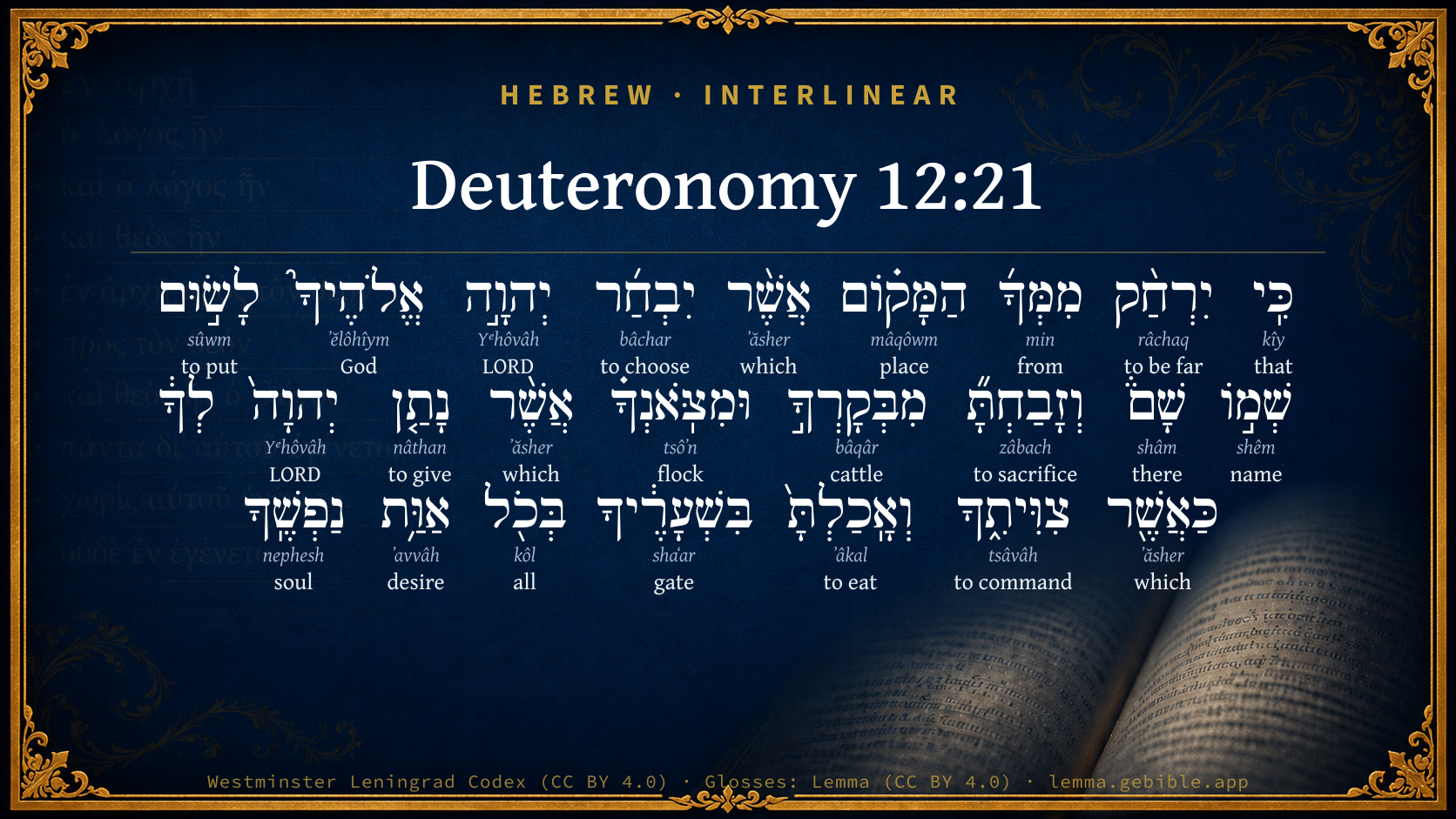
  1. כִּֽי kîy H3588 “that” Conjunction
  2. יִרְחַ֨ק râchaq H7368 “to be far” Verb, Qal, Imperfect, 3rd Person, Masculine, Singular
  3. מִמְּךָ֜ min H4480 “from · you” Preposition + Suffix, Personal, 2nd Person, Masculine, Singular
  4. הַמָּק֗וֹם mâqôwm H4725 “the · place” Particle, Definite Article + Noun, Common, Masculine, Singular, Absolute
  5. אֲשֶׁ֨ר ʼăsher H834 “which” Particle, Relative
  6. יִבְחַ֜ר bâchar H977 “to choose” Verb, Qal, Imperfect, 3rd Person, Masculine, Singular
  7. יְהוָ֣ה Yᵉhôvâh H3068 “LORD” Noun, Proper
  8. אֱלֹהֶיךָ֮ ʼĕlôhîym H430 “God(s) · your” Noun, Common, Masculine, Plural, Construct + Suffix, Personal, 2nd Person, Masculine, Singular
  9. לָשׂ֣וּם sûwm H7760 “to put” Preposition + Verb, Qal, Infinitive Construct
  10. שְׁמ֣וֹ shêm H8034 “name · his” Noun, Common, Masculine, Singular, Construct + Suffix, Personal, 3rd Person, Masculine, Singular
  11. שָׁם֒ shâm H8033 “there” Adverb
  12. וְזָבַחְתָּ֞ zâbach H2076 “and · to sacrifice” Conjunction + Verb, Qal, Sequential Perfect, 2nd Person, Masculine, Singular
  13. מִבְּקָרְךָ֣ bâqâr H1241 “from · cattle · your” Preposition + Noun, Common, Both, Singular, Construct + Suffix, Personal, 2nd Person, Masculine, Singular
  14. וּמִצֹּֽאנְךָ֗ tsôʼn H6629 “and · from · flock · your” Conjunction + Preposition + Noun, Common, Both, Singular, Construct + Suffix, Personal, 2nd Person, Masculine, Singular
  15. אֲשֶׁ֨ר ʼăsher H834 “which” Particle, Relative
  16. נָתַ֤ן nâthan H5414 “to give” Verb, Qal, Perfect, 3rd Person, Masculine, Singular
  17. יְהוָה֙ Yᵉhôvâh H3068 “LORD” Noun, Proper
  18. כַּאֲשֶׁ֖ר ʼăsher H834 “like/as · which” Preposition + Particle, Relative
  19. צִוִּיתִ֑ךָ tsâvâh H6680 “to command · you” Verb, Piel, Perfect, 1st Person, Common, Singular + Suffix, Personal, 2nd Person, Masculine, Singular
  20. וְאָֽכַלְתָּ֙ ʼâkal H398 “and · to eat” Conjunction + Verb, Qal, Sequential Perfect, 2nd Person, Masculine, Singular
  21. בִּשְׁעָרֶ֔יךָ shaʻar H8179 “in/at · gates · your” Preposition + Noun, Common, Masculine, Plural, Construct + Suffix, Personal, 2nd Person, Masculine, Singular
  22. בְּכֹ֖ל kôl H3605 “in/at · all of” Preposition + Noun, Common, Masculine, Singular, Construct
  23. נַפְשֶֽׁךָ nephesh H5315 “soul · your” Noun, Common, Both, Singular, Construct + Suffix, Personal, 2nd Person, Masculine, Singular

About this verse

These counts appear in no published source. They are computed here, from the morphology-tagged text and Lemma’s own curated glosses. What Lemma adds →

25
words
21
distinct lemmas
Pentateuch
section

Notable vocabulary

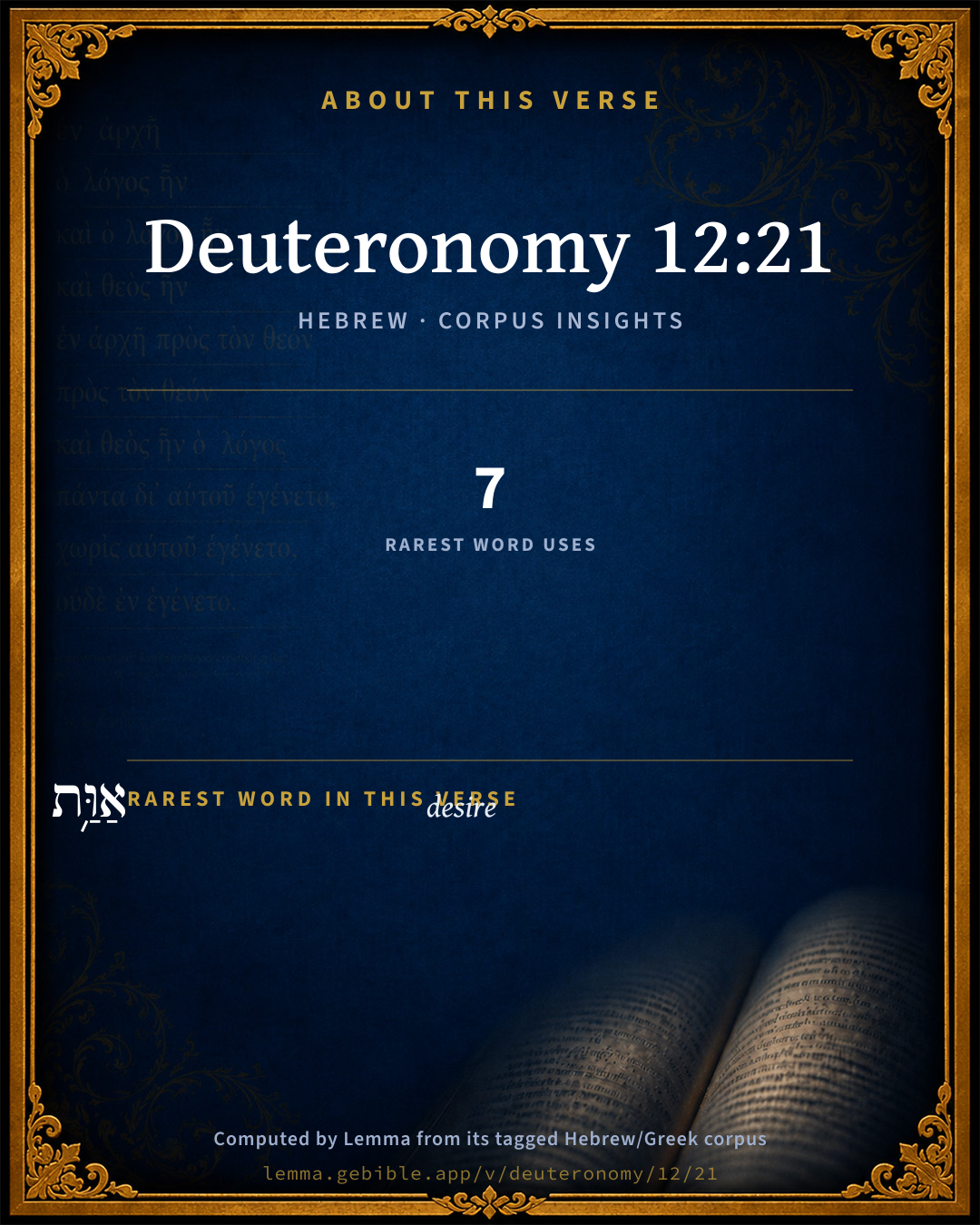
The rarest word here is אַוַּ֥ת desire H185 — appearing just 7 times in the whole Hebrew Bible.

Shared distinctive vocabulary

אַוַּ֥ת desire H185 occurs in 7 verses of the Hebrew Bible. Also found in:

Grammatical profile

  • 7 verbs
  • 11 nouns
  • 2 prepositions
  • 1 conjunction
  • 1 adverb
  • 3 particles

Verb forms

  • יִרְחַ֨ק Qal · Imperfect
  • יִבְחַ֜ר Qal · Imperfect
  • לָשׂ֣וּם Qal · Infinitive Construct
  • וְזָבַחְתָּ֞ Qal · Sequential Perfect
  • נָתַ֤ן Qal · Perfect
  • צִוִּיתִ֑ךָ Piel · Perfect
  • וְאָֽכַלְתָּ֙ Qal · Sequential Perfect

Repetition

Words recur within this verse — often emphatic in Hebrew:

  • יְהוָ֣ה LORD H3068 ×2
  • אֲשֶׁ֨ר which H834 ×3

Hebrew & Septuagint length

In English translation the verse runs 54 words from the Hebrew and 60 from the Septuagint (LXX English) — closely comparable.

A rough comparison of the two English renderings, which tokenize alike — not a word-level alignment.

Word counts can differ between the Hebrew and the Greek without any difference in meaning — e.g. the Hebrew direct-object marker אֵת has no separate Greek word, and Greek often adds the article ὁ.

Cross-references

11

Topical passages linked to Deuteronomy 12:21 in the Treasury of Scripture Knowledge — connected by theme and wording, ordered by reader-vote popularity; previews shown in the World English Bible.

  • Deuteronomy 12:5 But to the place which Yahweh your God shall choose out of all your tribes, to put his name there, even to his habitation shall you seek, and there you shall come;
  • Exodus 20:24 You shall make an altar of earth for me, and shall sacrifice on it your burnt offerings and your peace-offerings, your sheep and your oxen. In every place where I record my name I will come to you and I will bless you.
  • Deuteronomy 12:11 then it shall happen that to the place which Yahweh your God shall choose, to cause his name to dwell there, there shall you bring all that I command you: your burnt offerings, and your sacrifices, your tithes, and the heave-offering of your hand, and all your choice vows which you vow to Yahweh.
  • Deuteronomy 12:15 Notwithstanding, you may kill and eat flesh within all your gates, after all the desire of your soul, according to the blessing of Yahweh your God which he has given you: the unclean and the clean may eat of it, as of the gazelle, and as of the hart.
  • Deuteronomy 14:23–24 You shall eat before Yahweh your God, in the place which he shall choose, to cause his name to dwell there, the tithe of your grain, of your new wine, and of your oil, and the firstborn of your herd and of your flock; that you may learn to fear Yahweh your God always.
  • Deuteronomy 16:6 but at the place which Yahweh your God shall choose, to cause his name to dwell in, there you shall sacrifice the Passover at even, at the going down of the sun, at the season that you came forth out of Egypt.
  • Deuteronomy 16:11 and you shall rejoice before Yahweh your God, you, and your son, and your daughter, and your man-servant, and your maid-servant, and the Levite who is within your gates, and the foreigner, and the fatherless, and the widow, who are in the midst of you, in the place which Yahweh your God shall choose, to cause his name to dwell there.
  • Deuteronomy 26:2 that you shall take of the first of all the fruit of the ground, which you shall bring in from your land that Yahweh your God gives you; and you shall put it in a basket, and shall go to the place which Yahweh your God shall choose, to cause his name to dwell there.
  • 1 Kings 14:21 Rehoboam the son of Solomon reigned in Judah. Rehoboam was forty-one years old when he began to reign, and he reigned seventeen years in Jerusalem, the city which Yahweh had chosen out of all the tribes of Israel, to put his name there: and his mother's name was Naamah the Ammonitess.
  • 2 Chronicles 12:13 So king Rehoboam strengthened himself in Jerusalem, and reigned: for Rehoboam was forty-one years old when he began to reign, and he reigned seventeen years in Jerusalem, the city which Yahweh had chosen out of all the tribes of Israel, to put his name there: and his mother's name was Naamah the Ammonitess.
  • Ezra 6:12 and the God who has caused his name to dwell there overthrow all kings and peoples who shall put forth their hand to alter [the same], to destroy this house of God which is at Jerusalem. I Darius have made a decree; let it be done with all diligence.

Cross-references courtesy of OpenBible.info (CC BY 4.0).

Hebrew and Greek witnesses Masoretic Hebrew ↔ Greek Septuagint

The same verse in the two great witnesses to the Old Testament, shown verse-for-verse.

These are two independent witnesses, not word-aligned to each other, and the Septuagint is shown in lemma (dictionary) form.

Hebrew Deuteronomy 12:21 Masoretic · Westminster Leningrad Codex

כִּֽי יִרְחַ֨ק מִמְּךָ֜ הַמָּק֗וֹם אֲשֶׁ֨ר יִבְחַ֜ר יְהוָ֣ה אֱלֹהֶיךָ֮ לָשׂ֣וּם שְׁמ֣וֹ שָׁם֒ וְזָבַחְתָּ֞ מִבְּקָרְךָ֣ וּמִצֹּֽאנְךָ֗ אֲשֶׁ֨ר נָתַ֤ן יְהוָה֙ לְךָ֔ כַּאֲשֶׁ֖ר צִוִּיתִ֑ךָ וְאָֽכַלְתָּ֙ בִּשְׁעָרֶ֔יךָ בְּכֹ֖ל אַוַּ֥ת נַפְשֶֽׁךָ

If the place which Yahweh your God shall choose, to put his name there, be too far from you, then you shall kill of your herd and of your flock, which Yahweh has given you, as I have commanded you; and you may eat within your gates, after all the desire of your soul.

World English Bible · Public Domain

Greek LXX Deuteronomy 12:21 Septuagint · lemma form

ἐάν δέ μακρότερον ἀποἔχω σύ ὁ τόπος ὅς ἄν ἐκλέγω κύριος ὁ θεός σύ ἐπικαλέω ὁ ὄνομα αὐτός ἐκεῖ καί θύω ἀπό ὁ βοῦς σύ καί ἀπό ὁ πρόβατον σύ ὅς ἄν δίδωμι ὁ θεός σύ ὅς τρόπος ἐντέλλομαι σύ καί ἐσθίω ἐν ὁ πόλις σύ κατά ὁ ἐπιθυμία ὁ ψυχή σύ

And if the place be far from you, which the Lord your God shall choose for himself, that his name be called upon it, then you shall kill of your herd and of your flock which God shall have given you, even as I commanded you, and you shall eat in your cities according to the desire of your soul.

LXX2012 (modern English Septuagint) · Public Domain

Hebrew: Westminster Leningrad Codex (CC BY 4.0). Greek: Septuagint (public domain); English from LXX2012 (modern English Septuagint) (Public Domain). How the Septuagint differs from the Hebrew →

Targum (Aramaic paraphrase)

2

The Targum is the ancient Jewish Aramaic paraphrase of the Hebrew Scriptures — an interpretive translation, not the Hebrew text itself. Onkelos (literal) and Pseudo-Jonathan (expansive) render the Torah, and Jonathan the Prophets. Coverage is partial: where no permissively-licensed English translation exists for a verse, only the Aramaic is shown. This is verse-level text, not a word-by-word alignment to the Hebrew.

  1. Targum Onkelos Torah (Genesis–Deuteronomy)
    אֲרֵי יִתְרָחַק מִנָךְ אַתְרָא דִי יִתִּרְעֵי יְיָ אֱלָהָךְ לְאַשְׁרָאָה שְׁכִנְתֵּהּ תַּמָן וְתִכּוֹס מִתּוֹרָךְ וּמֵעָנָךְ דִי יְהַב יְיָ לָךְ כְּמָא דִי פַּקֵדִתָּךְ וְתֵיכוּל בְּקִרְוָיךְ בְּכֹל רְעוּת נַפְשָׁךְ

    If the place which the Lord thy God will choose for His Shekinah to dwell there, is too far from you, you may kill your oxen and sheep which the Lord will give you, as I have commanded you, and eat in your cities as your soul desires.

    Targum Onkelos — Aramaic: “Onkelos Genesis” (public domain); “Onkelos Exodus” (public domain); “Onkelos Leviticus” (public domain); “Onkelos Numbers” (public domain); “Onkelos Deuteronomy” (public domain). English: “Sefaria Community Translation” (CC0 1.0 (public-domain dedication)); “J.W. Etheridge. The Targums of Onkelos and Jonathan Ben Uzziel on the Pentateuch. London: Longmans, Green, 1862” (public domain). Text via Sefaria.

  2. Targum Pseudo-Jonathan Torah (Genesis–Deuteronomy)
    אֲרוּם יִתְרְחַק מִנְכוֹן אַתְרָא דְיִתְרְעֵי יְיָ אֱלָהָכוֹן לְאַשְׁרָאָה שְׁכִינְתֵּיהּ תַּמָּן וְתִכְסוּן מִן תּוֹרֵיכוֹן וּמִן עָנֵיכוֹן דִּיהַב יְיָ אֱלָהָכוֹן לְכוֹן הֵיכְמָא דְפַקֵּדִית יַתְכוֹן וְתֵיכְלוּן בְּקִירְוֵיכוֹן בְּכָל רִיגוֹג נַפְשֵׁיכוֹן

    But if the place which the Lord your God will have chosen that His Shekinah may dwell there be too far off, then may you eat of your herds and flocks which the Lord your God shall give you, as I have com- manded you, in your cities you may eat, according to all the desire of your soul:

    Targum Pseudo-Jonathan — Aramaic: “Targum Jonathan on Genesis” (public domain); “Targum Jonathan on Exodus” (public domain); “Targum Jonathan on Leviticus” (public domain); “Targum Jonathan on Numbers” (public domain); “Targum Jonathan on Deuteronomy” (public domain). English: “The Targum of Jonathan ben Uzziel, trans. J. W. Etheridge, London, 1862” (public domain). Text via Sefaria.

Commentary

Notes on Deuteronomy 12:21 from classic Christian and Jewish commentators (each source and its license shown beneath its notes). The classic Christian expositions comment on the surrounding passage and are grouped to its opening verse, so a note may address several verses; the Jewish commentaries on the Tanakh (Rashi and others) are per-verse, so they appear only where the commentator wrote on this verse.

Lemma curates 59 commentaries, every one of them public domain or Creative Commons licensed, each selected and text-cleaned for this edition rather than reprinted as found. About our sources →

Tyndale Open Study Notes

Tyndale Open Resources

12:21 you may butcher: Because an animal’s blood was considered sacred (see Gen 9:4-6), even meat intended for human consumption was to be slaughtered at the central designated place of worship if that was at all practical (cp. Lev 17:8-9); if not, the animal could be sacrificed locally, but the blood still had to be disposed of in a ritually appropriate manner (Deut 12:23-25; cp. Lev 17:10-12).

Tyndale Open Study Notes — © Tyndale Open Resources, licensed CC BY-SA 4.0. Text via the HelloAO Bible API.

John Gill's Exposition

If the place which the Lord thy God hath chosen to put his name be too far from thee,.... Or rather "for" (h), or "seeing" the place will be too far from thee; for it is allowed before that they might kill and eat flesh for common food in their gates, Deu 12:15.

then thou shalt kill of thy herd and of thy flock; of thy oxen and of thy sheep, creatures used in sacrifice; but this was no bar to the use of them for common food also:

which the Lord hath given thee, as I have commanded thee; Deu 12:15.

and thou shalt eat in thy gates whatsoever thy soul lusteth after; flesh of any sort, lawful to be eaten.

(h) "cum", Pagninus, Montanus.

John Gill's Exposition of the Whole Bible (1746–1763) — public domain (CC PDM 1.0). Text via the HelloAO Bible API.

Albert Barnes' Notes on the Bible

If the place ... - Rather, “Because, or since, the place will be too far from thee.” The permission given in Deu 12:15-16 is repeated, and the reason of it assigned.

Albert Barnes' Notes on the Bible (1834–1885) — public domain. Text from a community e-Sword/MySword module.

Haydock's Catholic Bible Commentary

Far off. Hence many conclude, that those who lived near the tabernacle, were bound to bring the animals which they designed for their own use, to be slain there, as they did in the desert. Others suppose that all were under the same predicament, and are hereby authorized to follow the same regulations, and to eat the flesh, whether they be clean or otherwise, provided they abstain from the blood. See Leviticus xvii. 3. (Calmet) --- The custom of bringing the beasts to be slain before the door of the tabernacle, was to be no longer obligatory. (Menochius)

George Leo Haydock (1774–1849), Haydock's Catholic Family Bible and Commentary, 1859 edition — public domain. Excludes Psalms (Douay-Rheims chapter numbering differs from Protestant) and Deuterocanonical books (Catholic canon only).

Matthew Poole's English Annotations

Be too far from thee; in which case, being obliged to carry their sacrifice to the place of worship, that the blood might be there poured forth, &c., they might think themselves obliged, for the same reason, to carry their other cattle thither to be killed. They are therefore released from all such obligations, and left at liberty to kill them at home, whether they lived nearer to that place, or further from it; only the latter is here mentioned, as being the matter of the scruple, and as containing the former in it.

As I have commanded thee; in such manner as the blood may be poured forth, as above, Deu 12:16, and below, Deu 12:24.

Matthew Poole's English Annotations on the Holy Bible (1683–1685) — public domain. Text from a community e-Sword/MySword module.

Whedon's Commentary on the Bible

Daniel D. Whedon

21. If the place… be too far — Here is given the reason for the modification of the law, as in Lev_17:3, etc., which required that all animals be slaughtered at the sanctuary.

Daniel D. Whedon (gen. ed.), Commentary on the Old and New Testaments (1874–1909) — public domain. Text from a community e-Sword module.

The Pulpit Commentary

Vers. 21-23. If the place, be too far from thee; this supplies the reason for the alteration of the law in Lev_17:3. Only be sure; literally, only be strong; i.e. be firm and resolute, steadfastly resisting the temptation to eat it. The blood is the life (cf. Gen_9:4; Lev_11:1 Lev_17:11) The word used is nephesh (vpn). By this word the Hebrews designated the animal life-principle in men and in beasts; and as without this the body was a mere inert mass, the word came to be used for "life" generally. Of this life the blood was believed to be the seat, and was regarded as the symbol, so that to shed blood was tantamount to the taking away of life. As the blood, moreover, was the life, in it was supposed to lie the propitiatory power the power, when shed, of atoning for sin, as the giving of life for life. The prohibition of eating it doubtless had respect to this. It was not merely to prevent ferocity in men towards the lower animals (as Rosenm suggests) that the eating of blood was interdicted, but specially because there was in this a sort of profanation, a putting to a common use of what appertained to a sacred rite.

The Pulpit Commentary (1880–1919), ed. H.D.M. Spence-Jones & Joseph S. Exell — public domain. Text from a community e-Sword module.

John Wesley's Explanatory Notes

If the place be too far - Being obliged to carry their sacrifices to the place of worship, they might think themselves obliged to carry their other cattle thither to be killed. They are therefore released from all such obligations, and left at liberty to kill them at home, whether they lived nearer that place, or farther from it; only the latter is here mentioned, as being the matter of the scruple. As I have commanded - In such a manner as the blood may be poured forth.

John Wesley, Explanatory Notes Upon the Whole Bible (1754–1765) — public domain. Text via the GEBible commentary corpus.

unfoldingWord translationNotes

Door43 World Missions Community

General Information:

Moses continues speaking to the people of Israel.

chooses to put his name

Here "name" refers to God himself. Yahweh would choose a place where he will live and the people will come to worship him. AT: "chooses to dwell" (See: Metonymy)

within your gates

Here "gates" represents the whole city." AT: "inside your city" or "within your community" (See: Synecdoche)

as your soul desires

Here "soul" refers to the whole person. AT: "as you desire" (See: Synecdoche)

Like the gazelle and the deer are eaten

This can be translated in active form. AT: "Just like you eat the gazelle and the deer" (See: Active or Passive)

gazelle and the deer

These are wild animals with long thin legs that can run quickly. See how you translated these in Deuteronomy 12:15.

the unclean ... persons

A person who is not acceptable for God's purposes is spoken of as if the person were physically unclean. (See: Metaphor)

the clean persons

A person who is acceptable for God's purposes is spoken of as if the person were physically clean. (See: Metaphor)

translationWords

name

flocks

command

gate

clean

clean

unfoldingWord translationNotes — © Distant Shores Media and the Door43 World Missions Community, licensed CC BY-SA 4.0. Source: git.door43.org/Door43/en_tn.

Rashi

Rabbi Shlomo Yitzchaki (Rashi)

כי ירחק ממך המקום IF THE PLACE [WHICH THE LORD THY GOD HAS CHOSEN TO PUT HIS NAME THERE] BE TOO FAR FROM THEE and thou therefore art unable to come and prepare peace-offerings at any time, as thou doest now when the Tabernacle accompanies you,

וזבחת … כאשר צויתך THEN THOU MAYEST SLAUGHTER … AS I HAVE COMMANDED THEE — This teaches us that there was already a commandment regarding the slaughtering of animals — as to how one should slaughter; it is not written in the Torah but it comprises the traditional regulations regarding the slaughter of animals that were given orally (נאמרו) to Moses on Mount Sinai (Sifrei Devarim 75:7; Chullin 28a).

Rashi on the Tanakh — English translations: “The Judaica Press complete Tanach with Rashi, translated by A. J. Rosenberg” (CC BY 4.0); “Pentateuch with Rashi's commentary by M. Rosenbaum and A.M. Silbermann, 1929-1934” (public domain); “The Metsudah Tanach series, Lakewood, N.J” (CC BY 4.0); and “The Book of Joshua, Metsudah Publications, 1997” (CC BY 4.0). Text via Sefaria.

Ramban (Nachmanides)

Rabbi Moshe ben Nachman (Ramban / Nachmanides)

AND THOU SHALT SLAUGHTER etc. AS I HAVE COMMANDED THEE. The meaning thereof according to the opinion of our Rabbis is as follows: “As I have commanded thee — orally, by law declared to Moses on Sinai This teaches us that he was commanded with regard to [severing] the windpipe and the gullet, and [severing] the greater part of one [either the windpipe or the gullet] in a bird, and [severing] the greater part of both in an animal.”Know that the term shechitah in the Sacred Language denotes the severing of the two organs in the neck [the windpipe and the gullet], and be not apprehensive because of what it says ‘vayishchateim’ (and He slew them) in the wilderness [which clearly does not signify severing the organs of the neck], for it is but a euphemism [as if to say] that He slaughtered them like sheep. Thus He commanded regarding the offerings, ‘v’shachat’ (and he shall slaughter), ‘v’shachatu’ (and they shall slaughter), which refer to the organs of the neck. Now at first [in the wilderness] He commanded that whatever [meat] they eat be of peace-offerings, that they be slaughtered according to the law of the offerings. Now, when he proceeded to permit the meat of unconsecrated animals, he said, and thou shalt slaughter of thy herd and of thy flock as I have commanded thee when such animals were brought as offerings, and you may eat them unconsecrated after all the desire of thy soul, meaning that He permits unconsecrated animals to be eaten everywhere, provided that they be slaughtered as He had commanded originally, when they were all [permitted only as] offerings. This is the correct meaning of the verse in line with the plain sense of Scripture. Perhaps our Rabbis intended this [thought] when they said in the Sifre: 75. “As I have commanded thee — just as the consecrated animals are slaughtered [in accordance with the traditional regulations] so must also the unconsecrated animals be slaughtered [with the same regulations].” Thus the commandment of slaughtering [animal and fowl] is here expressly stated and is explained in the words of our Rabbis on the basis of tradition.

Ramban (Nachmanides) on the Tanakh — English translation: “Commentary on the Torah by Ramban (Nachmanides). Translated and annotated by Charles B. Chavel. New York, Shilo Pub. House, 1971-1976” (CC BY 4.0). Text via Sefaria.

Lesson kit

Teaching starters — assembled from the data on this page, not authored interpretation. Every prompt links to the verse data it draws on. Edit before teaching.

Deuteronomy, in the Pentateuch, opens this verse with 25 words (21 distinct Hebrew lemmas). Its most distinctive word is ʼavvâh (“desire”). A historical commentator’s framing appears above. Read the whole chapter for the surrounding context.

Discussion questions

  1. How does “desire” (ʼavvâh) shape what this verse is saying?
  2. How does Deuteronomy 12:15, which shares the word «desire», read alongside this verse?
  3. What does the repetition of “LORD” (2× in this one verse) do in this verse?
  4. These translations render this verse differently; the difference is in the English rendering, not the original. What questions does that raise?
  5. «יִרְחַ֨ק» is a Qal Imperfect verb. How does that grammatical form shape the action described?
  6. Compare how Tyndale Open Study Notes and John Gill's Exposition read this verse. Where do they agree or differ?

Things to notice

Reading settings

Reading text

Shown beneath each verse's original-language words.

Old Testament
Old Testament edition

Read the OT as the Masoretic Hebrew (MT) or the Greek Septuagint (LXX).

English shown for the Greek Septuagint (in the Hebrew ↔ Greek comparison).

Comparing translations? Open the Compare panel on any verse page to stack up to four side by side.