Exodus 22:10

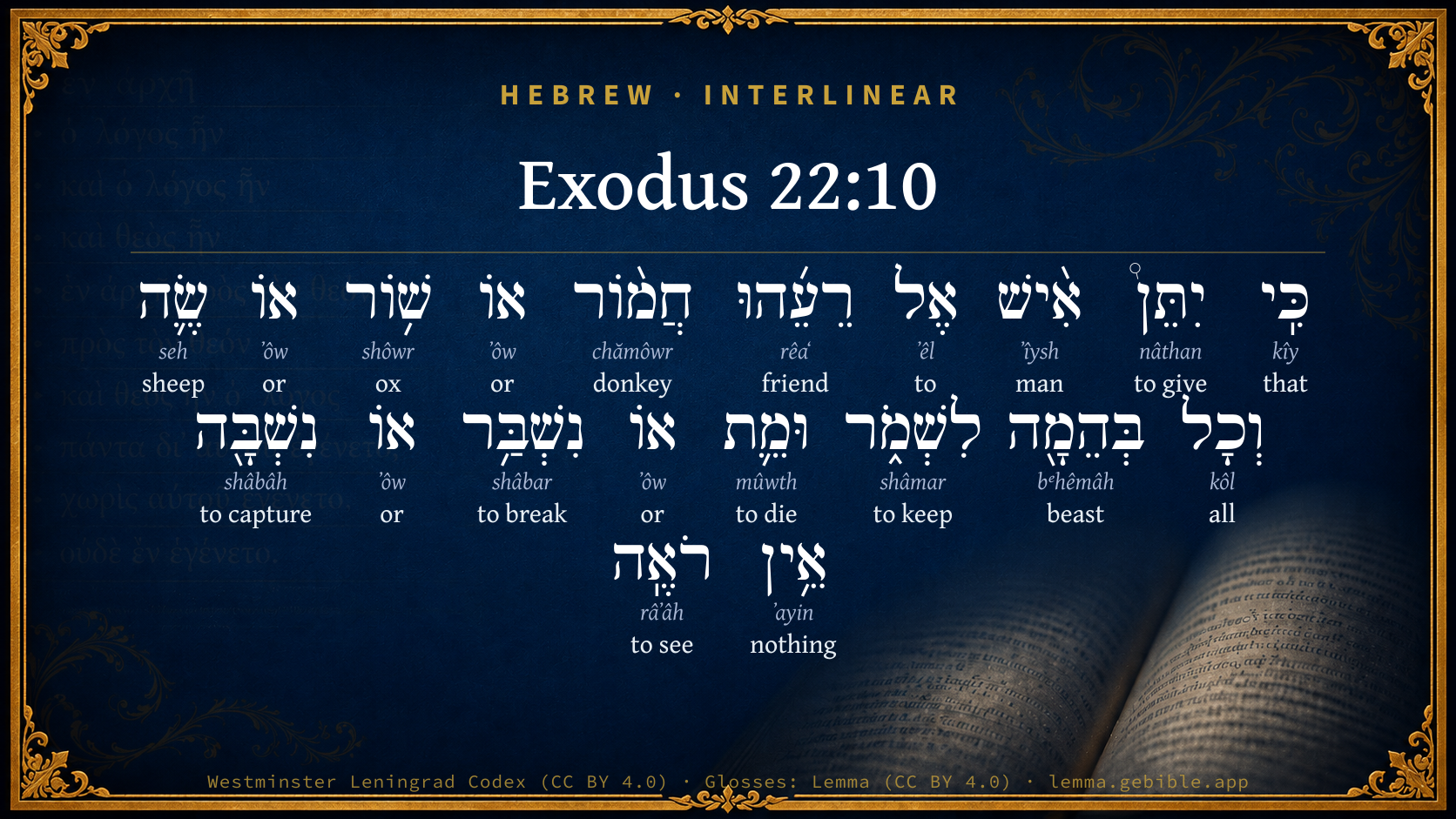
Hebrew (Westminster Leningrad Codex) Exodus 22:10 appears in the Hebrew Old Testament. The text above is from the Westminster Leningrad Codex. Each word links to its Strong’s number, a concise gloss, and parsing drawn from the Open Scriptures Hebrew Bible morphology. Click any word for its full Brown-Driver-Briggs (BDB) entry.
Download image
Cite this verse

Exodus 22:10 (World English Bible). Public Domain. Lemma interlinear Bible study tool, https://lemma.gebible.app/v/exodus/22/10.

Show BibTeX & RIS
BibTeX
RIS
English Translation
"If a man delivers to his neighbor a donkey, an ox, a sheep, or any animal to keep, and it dies or is injured, or driven away, no man seeing it;
World English Bible · Public Domain
Download a study sheet

One document with this verse’s original text, its word-by-word gloss line, the meaning frame, cross-references with their text, attributed commentary, and full source and license credits — printable, and it pastes into notes with its structure intact.

This verse Autodidact and up

Study sheet (.html) Plain text (.txt)

A passage Seminary Student

Up to 50 verses in one chapter. A passage sheet keeps up to 6 commentary sources and 12 cross-references per verse, in the order this page ranks them, and says so on the sheet whenever that leaves anything out. Ask for a single verse and you get the Autodidact verse sheet above.

Everything on this page stays free to read, with no account — the sheet is a download of what is already on screen, not access to it.

Want to remove ads? Support Godless Engineer
Compare translations 3

The same verse in 3 English versions, stacked beneath the original-language interlinear above. Click any original word for its lexicon entry.

Each is an independent rendering of the whole verse — the interlinear is not word-aligned to these translations.

Highlighted words mark where these versions differ — a whole-verse word diff, not a word-by-word alignment.

  • World English Bible Public Domain
    "If a man delivers to his neighbor a donkey, an ox, a sheep, or any animal to keep, and it dies or is injured, or driven away, no man seeing it;
  • King James Version Public Domain
    If a man deliver unto his neighbor an ass, or an ox, or a sheep, or any beast, to keep; and it die, or be hurt, or driven away, no man seeing it:
  • unfoldingWord Literal Text CC BY-SA 4.0
    If a man gives to his neighbor a donkey or an ox or a sheep or any animal to keep, and it dies or is hurt or is carried away without a witness,

unfoldingWord Literal Text — © unfoldingWord, licensed CC BY-SA 4.0. Word-aligned USFM3 via Door43 (git.door43.org/unfoldingWord/en_ult).

Versions to compare (up to 4)

3 of 4 selected

Show all 18 translations

Every available English version of this verse, each an independent rendering of the whole verse.

  • World English Bible Public Domain
    "If a man delivers to his neighbor a donkey, an ox, a sheep, or any animal to keep, and it dies or is injured, or driven away, no man seeing it;
  • Berean Standard Bible Public Domain
    If a man gives a donkey, an ox, a sheep, or any other animal to be cared for by his neighbor, but it dies or is injured or stolen while no one is watching,
  • Majority Standard Bible Public Domain
    If a man gives a donkey, an ox, a sheep, or any other animal to be cared for by his neighbor, but it dies or is injured or stolen while no one is watching,
  • King James Version Public Domain
    If a man deliver unto his neighbor an ass, or an ox, or a sheep, or any beast, to keep; and it die, or be hurt, or driven away, no man seeing it:
  • American Standard Version (1901) Public Domain
    If a man deliver unto his neighbor an ass, or an ox, or a sheep, or any beast, to keep; and it die, or be hurt, or driven away, no man seeing it:
  • Revised Version (1885) Public Domain
    If a man deliver unto his neighbour an ass, or an ox, or a sheep, or any beast, to keep; and it die, or be hurt, or driven away, no man seeing it:
  • Geneva Bible (1599) Public Domain
    If a man deliuer vnto his neighbour to keepe asse, or oxe, or sheepe, or any beast, and it die, or be hurt, or taken away by enemies, and no man see it,
  • Douay-Rheims (1899) Public Domain
    If a man deliver ass, ox, sheep, or any beast, to his neighbour's custody, and it die, or be hurt, or be taken by enemies, and no man saw it:
  • Young's Literal Translation Public Domain
    `When a man doth give unto his neighbour an ass, or ox, or sheep, or any beast to keep, and it hath died, or hath been hurt, or taken captive, none seeing --
  • Literal Standard Version CC BY-SA 4.0
    When a man gives to his neighbor a donkey, or ox, or sheep, or any beast to keep, and it has died, or has been hurt, or taken captive, [with] none seeing—
  • Unlocked Literal Bible CC BY-SA 4.0
    If a man gives his neighbor a donkey, an ox, a sheep, or any animal to keep, and if it dies or is hurt or is carried away without anyone seeing it,
  • unfoldingWord Literal Text CC BY-SA 4.0
    If a man gives to his neighbor a donkey or an ox or a sheep or any animal to keep, and it dies or is hurt or is carried away without a witness,
  • Darby Bible Public Domain
    If a man deliver unto his neighbour an ass, or an ox, or a sheep, or any cattle, to keep, and it die, or be hurt, or driven away, and no man see [it],
  • World Messianic Bible Public Domain
    “If a man delivers to his neighbor a donkey, an ox, a sheep, or any animal to keep, and it dies or is injured, or driven away, no man seeing it;
  • Webster's Bible Public Domain
    If a man shall deliver to his neighbor an ass, or an ox, or a sheep, or any beast to keep; and it shall die, or be hurt, or driven away, no man seeing it:
  • Free Bible Version CC BY-SA 4.0
    If someone asks a neighbor to look after a donkey, an ox, a sheep, or any other animal, but it dies or is injured or is stolen without anybody noticing,
  • Bible in Basic English Public Domain
    If a man puts an ass or an ox or a sheep or any beast into the keeping of his neighbour, and it comes to death or is damaged or is taken away, without any person seeing it:
  • JPS Tanakh (1917) Public Domain
    (22-9) If a man deliver unto his neighbour an ass, or an ox, or a sheep, or any beast, to keep, and it die, or be hurt, or driven away, no man seeing it;

Literal Standard Version (2020), Covenant Press — licensed CC BY-SA 4.0. Text via the HelloAO Bible API (eBible.org). Unlocked Literal Bible (unfoldingWord) — licensed CC BY-SA 4.0. Text via the HelloAO Bible API (eBible.org). unfoldingWord Literal Text — © unfoldingWord, licensed CC BY-SA 4.0. Word-aligned USFM3 via Door43 (git.door43.org/unfoldingWord/en_ult). Free Bible Version, Dr. Jonathan Gallagher — licensed CC BY-SA 4.0. Text via the HelloAO Bible API (eBible.org).

Word by word

More ways to search: Search by grammar → Find every occurrence → Compare this word →

Practice this passage: Drill this verse → Learn its vocabulary →

שֶׂ֛ה
seh
H7716
“sheep”
Noun, Common, Both, Singular, Absolute
Part of Speech
Noun
Type
Common
Gender
Both
Number
Singular
State
Absolute
Full BDB Definition

Origin: probably from H7582 through the idea of pushing out to graze

TWOT: 2237

one of a flock, lamb, sheep, goat, young sheep, young goat - sheep, goat - flock (collective)
  1. כִּֽי kîy H3588 “that” Conjunction
  2. יִתֵּן֩ nâthan H5414 “to give” Verb, Qal, Imperfect, 3rd Person, Masculine, Singular
  3. אִ֨ישׁ ʼîysh H376 “man” Noun, Common, Masculine, Singular, Absolute
  4. אֶל ʼêl H413 “to” Preposition
  5. רֵעֵ֜הוּ rêaʻ H7453 “friend · his” Noun, Common, Masculine, Singular, Construct + Suffix, Personal, 3rd Person, Masculine, Singular
  6. חֲמ֨וֹר chămôwr H2543 “donkey” Noun, Common, Both, Singular, Absolute
  7. אוֹ ʼôw H176 “or” Conjunction
  8. שׁ֥וֹר shôwr H7794 “ox” Noun, Common, Masculine, Singular, Absolute
  9. אוֹ ʼôw H176 “or” Conjunction
  10. וְכָל kôl H3605 “and · all of” Conjunction + Noun, Common, Masculine, Singular, Construct
  11. בְּהֵמָ֖ה bᵉhêmâh H929 “beast” Noun, Common, Feminine, Singular, Absolute
  12. לִשְׁמֹ֑ר shâmar H8104 “to keep” Preposition + Verb, Qal, Infinitive Construct
  13. וּמֵ֛ת mûwth H4191 “and · to die” Conjunction + Verb, Qal, Perfect, 3rd Person, Masculine, Singular
  14. אוֹ ʼôw H176 “or” Conjunction
  15. נִשְׁבַּ֥ר shâbar H7665 “to break” Verb, Niphal, Perfect, 3rd Person, Masculine, Singular
  16. אוֹ ʼôw H176 “or” Conjunction
  17. נִשְׁבָּ֖ה shâbâh H7617 “to capture” Verb, Niphal, Perfect, 3rd Person, Masculine, Singular
  18. אֵ֥ין ʼayin H369 “nothing” Particle, Negative
  19. רֹאֶֽה râʼâh H7200 “seeing” Verb, Qal, Participle Active, Masculine, Singular, Absolute

About this verse

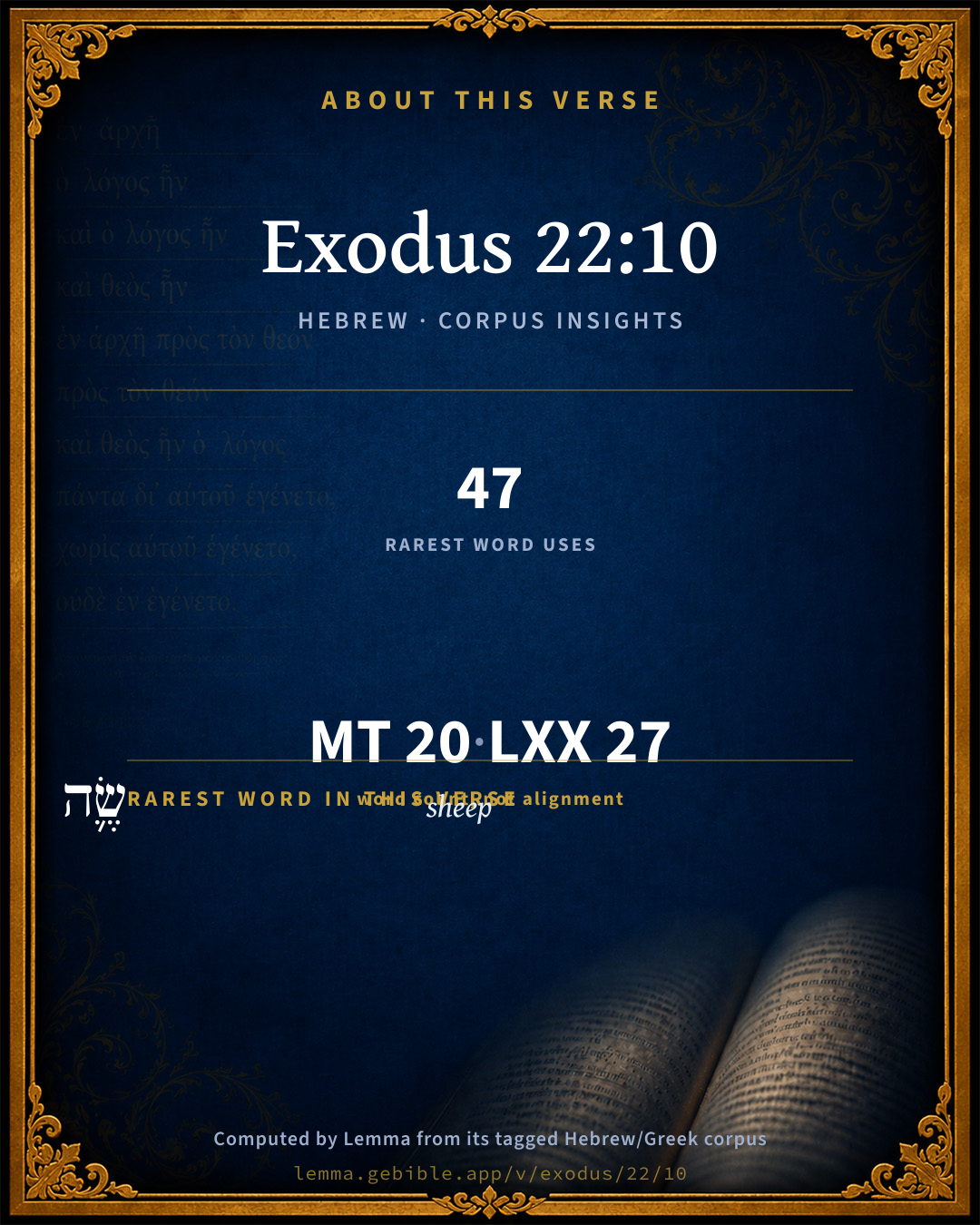
These counts appear in no published source. They are computed here, from the morphology-tagged text and Lemma’s own curated glosses. What Lemma adds →

20
words
17
distinct lemmas
Pentateuch
section

Shared distinctive vocabulary

שֶׂ֛ה sheep H7716 occurs in 39 verses of the Hebrew Bible. Also found in:

Grammatical profile

  • 6 verbs
  • 7 nouns
  • 1 preposition
  • 5 conjunctions
  • 1 particle

Verb forms

  • יִתֵּן֩ Qal · Imperfect
  • לִשְׁמֹ֑ר Qal · Infinitive Construct
  • וּמֵ֛ת Qal · Perfect
  • נִשְׁבַּ֥ר Niphal · Perfect
  • נִשְׁבָּ֖ה Niphal · Perfect
  • רֹאֶֽה Qal · Participle Active

Repetition

A word recurs within this verse — often emphatic in Hebrew:

  • אוֹ or H176 ×4

Hebrew & Septuagint length

In English translation the verse runs 31 words from the Hebrew and 30 from the Septuagint (LXX English) — closely comparable.

A rough comparison of the two English renderings, which tokenize alike — not a word-level alignment.

Word counts can differ between the Hebrew and the Greek without any difference in meaning — e.g. the Hebrew direct-object marker אֵת has no separate Greek word, and Greek often adds the article ὁ.

In the original languages it is 20 Hebrew tokens and 27 Greek tokens — but the two are counted differently (Hebrew bundles its prefixes and suffixes into one token; the Greek is in lemma form), so that isn’t a like-for-like length.

Cross-references

4

Topical passages linked to Exodus 22:10 in the Treasury of Scripture Knowledge — connected by theme and wording, ordered by reader-vote popularity; previews shown in the World English Bible.

  • Genesis 39:8 But he refused, and said to his master's wife, "Behold, my master doesn't know what is with me in the house, and he has put all that he has into my hand.
  • Luke 12:48 but he who didn't know, and did things worthy of stripes, will be beaten with few stripes. To whoever much is given, of him will much be required; and to whom much was entrusted, of him more will be asked.
  • Luke 16:11 If therefore you have not been faithful in the unrighteous mammon, who will commit to your trust the true riches?
  • 2 Timothy 1:12 For this cause I suffer also these things. Yet I am not ashamed, for I know him whom I have believed, and I am persuaded that he is able to guard that which I have committed to him against that day.

Cross-references courtesy of OpenBible.info (CC BY 4.0).

Hebrew and Greek witnesses Masoretic Hebrew ↔ Greek Septuagint

The same verse in the two great witnesses to the Old Testament, shown verse-for-verse.

These are two independent witnesses, not word-aligned to each other, and the Septuagint is shown in lemma (dictionary) form.

Hebrew Exodus 22:10 Masoretic · Westminster Leningrad Codex

כִּֽי יִתֵּן֩ אִ֨ישׁ אֶל רֵעֵ֜הוּ חֲמ֨וֹר אוֹ שׁ֥וֹר אוֹ שֶׂ֛ה וְכָל בְּהֵמָ֖ה לִשְׁמֹ֑ר וּמֵ֛ת אוֹ נִשְׁבַּ֥ר אוֹ נִשְׁבָּ֖ה אֵ֥ין רֹאֶֽה

"If a man delivers to his neighbor a donkey, an ox, a sheep, or any animal to keep, and it dies or is injured, or driven away, no man seeing it;

World English Bible · Public Domain

Greek LXX Exodus 22:10 Septuagint · lemma form

ὅρκος εἰμί ὁ θεός ἀνά μέσος ἀμφότεροι ἤ μήν μή αὐτός πονηρεύομαι κατά ὅλος ὁ παρακαταθήκη ὁ πλησίον καί οὕτως προςδέχομαι ὁ κύριος αὐτός καί οὐ ἀποτίνω

And if any one give to his neighbor to keep a calf or sheep or any beast, and it be wounded or die or be taken, and no one know,

LXX2012 (modern English Septuagint) · Public Domain

Hebrew: Westminster Leningrad Codex (CC BY 4.0). Greek: Septuagint (public domain); English from LXX2012 (modern English Septuagint) (Public Domain). How the Septuagint differs from the Hebrew →

Targum (Aramaic paraphrase)

2

The Targum is the ancient Jewish Aramaic paraphrase of the Hebrew Scriptures — an interpretive translation, not the Hebrew text itself. Onkelos (literal) and Pseudo-Jonathan (expansive) render the Torah, and Jonathan the Prophets. Coverage is partial: where no permissively-licensed English translation exists for a verse, only the Aramaic is shown. This is verse-level text, not a word-by-word alignment to the Hebrew.

  1. Targum Onkelos Torah (Genesis–Deuteronomy)
    מוֹמָתָא דַיְיָ תְּהֵי בֵּין תַּרְוֵיהוֹן אִם לָא אוֹשִׁיט יְדֵהּ בְּמָא דִמְסַר לֵהּ חַבְרֵהּ וִיקַבֵּל מָרֵהּ מִנֵהּ מוֹמָתָא וְלָא יְשַׁלֵם:

    (no public-domain English translation for this verse)

    Targum Onkelos — Aramaic: “Onkelos Genesis” (public domain); “Onkelos Exodus” (public domain); “Onkelos Leviticus” (public domain); “Onkelos Numbers” (public domain); “Onkelos Deuteronomy” (public domain). English: “Sefaria Community Translation” (CC0 1.0 (public-domain dedication)); “J.W. Etheridge. The Targums of Onkelos and Jonathan Ben Uzziel on the Pentateuch. London: Longmans, Green, 1862” (public domain). Text via Sefaria.

  2. Targum Pseudo-Jonathan Torah (Genesis–Deuteronomy)
    מוֹמָתָא דַיְיָ תְּהֵי בֵּין תַּרְוֵיהוֹם יוֹמֵי דְלָא אוֹשִׁיט יְדֵיהּ בְּעִיסְקָא דְחַבְרֵיהּ וִיקַבֵּל מָארֵיהּ מִנֵיהּ מוֹמָתָא וְלָא יְשַׁלֵּם

    an oath of the Lord shall be between them both, that he hath not put forth his hand upon the property of his neighbour; and the owner of the thing shall accept his oath, and he shall not (be required to) make it good.

    Targum Pseudo-Jonathan — Aramaic: “Targum Jonathan on Genesis” (public domain); “Targum Jonathan on Exodus” (public domain); “Targum Jonathan on Leviticus” (public domain); “Targum Jonathan on Numbers” (public domain); “Targum Jonathan on Deuteronomy” (public domain). English: “The Targum of Jonathan ben Uzziel, trans. J. W. Etheridge, London, 1862” (public domain). Text via Sefaria.

Commentary

Notes on Exodus 22:10 from classic Christian and Jewish commentators (each source and its license shown beneath its notes). The classic Christian expositions comment on the surrounding passage and are grouped to its opening verse, so a note may address several verses; the Jewish commentaries on the Tanakh (Rashi and others) are per-verse, so they appear only where the commentator wrote on this verse.

Lemma curates 59 commentaries, every one of them public domain or Creative Commons licensed, each selected and text-cleaned for this edition rather than reprinted as found. About our sources →

Trapp's Complete Commentary

John Trapp

Exo 22:10 If a man deliver unto his neighbour an ass, or an ox, or a sheep, or any beast, to keep; and it die, or be hurt, or driven away, no man seeing [it]:

Ver. 10. Or any beast, to keep.] As Jacob kept Laban’s cattle. {Gen 31:39}

John Trapp, A Commentary or Exposition upon All the Books of the Old and New Testament (1647–1656) — public domain. Text from a community e-Sword module.

Geneva Bible (1599)

Geneva Bible translators

Hebrew, broken.

Geneva Bible (1599) marginal notes — public domain. Text via Bolls.life.

Ellicott's Commentary for English Readers

(10) And it die, or be hurt, or driven away.—The animal might “die” naturally, or “be hurt” by a wild beast or a fall down the rocks, or “be driven away” by the marauding tribes of the desert. Both parties might be agreed on the fact of its disappearance; the dispute would be as to the mode of the disappearance. Here the trustee might bring proof, if he could (Exo_22:13); if not, he might clear himself by an “oath of the Lord” (Exo_22:11).

A Bible Commentary for English Readers, edited by Charles John Ellicott (1878–1897) — public domain. Text from a community e-Sword module.

The Cambridge Bible for Schools and Colleges

gen. ed. J. J. S. Perowne

10. be hurt] lit. be broken, i.e. be maimed or wounded: so v. 14, Eze_34:4; Eze_34:16, Zec_11:16, Lev_22:22.

or driven away] better, carried away, viz. by raiders (Job_1:15; Job_1:17); 1Ch_5:21 Heb., 2Ch_14:15. The word commonly rendered taken captive, 1Sa_30:3; 1Sa_30:5, &c.

10–13. Procedure to be followed, when the property deposited, and afterwards injured or lost, is an animal.

The Cambridge Bible for Schools and Colleges (gen. ed. J. J. S. Perowne; Cambridge University Press, 1878–1918) — public domain. Text from a community e-Sword module.

John Gill's Exposition

If a man deliver to his neighbour an ass, or an ox, or a sheep, or any beast to keep,.... And he keeps it without a reward, as the Targum of Jonathan; but Jarchi and Aben Ezra more rightly interpret this of one that keeps for hire, as herdsmen, shepherds, &c. The Jews say (t) there are"four sorts of keepers; he that keeps for nought (or freely), he that borrows, he that takes hire, and he that hires; he that keeps for nought swears in all cases (and is free), he that borrows pays for all (that is lost or stolen, &c.) he that takes hire, and he that hires, swear on account of that which is torn, or carried away, or dies, and they pay for that which is lost or stolen,''which are the cases after supposed:

and it die; either of the above, or any other under the care of another; that is, dies of itself, not being killed by any, and its death sudden, and not easily accounted for:

or be hurt; receive any damage in any part, though it die not; or "be broken" (u); have any of its limbs or bones broken; or be torn by a wild beast, as the Targum of Jonathan adds:

or driven away; from the flock or herd by thieves or robbers, or rather carried captive by an enemy in an hostile way, see Exo 22:12,

no man seeing it; die, or be hurt, or carried off; and so, as the above Targum paraphrases it, there is no witness that sees and can bear witness, that is, to any of the said things which have happened to it.

(t) Misn. Bava Metzia, c. 7. sect. 8. (u) "confractum", Pagninus, Montanus; "fractum", Junius & Tremelius, Piscator, Drusius; so Ainsworth.

John Gill's Exposition of the Whole Bible (1746–1763) — public domain (CC PDM 1.0). Text via the HelloAO Bible API.

Albert Barnes' Notes on the Bible

This law appears to relate chiefly to herdsmen employed by the owners of cattle. When an animal was stolen Exo 22:12, it was presumed either that the herdsman might have prevented it, or that he could find the thief and bring him to justice (see Exo 22:4). When an animal was killed by a wild beast, the keeper had to produce the mangled carcass, not only in proof of the fact, but to show that he had, by his vigilance and courage, deprived the wild beast of its prey.

Albert Barnes' Notes on the Bible (1834–1885) — public domain. Text from a community e-Sword/MySword module.

Matthew Poole's English Annotations

To keep, as his servant, not freely, but for wages.

Matthew Poole's English Annotations on the Holy Bible (1683–1685) — public domain. Text from a community e-Sword/MySword module.

The Pulpit Commentary

Vers. 10, 11. If a man deliver unto his neighbour an ass or an ox, etc. The deposit of cattle is unheard of in classical antiquity; but it might well be the usage of a pastoral race. (Gen_47:3) The parallelism of the verse with verse 6 indicates that a deposit of the same kind is intended. If it die, or be hurt, or driven away. The deposited beast might "die" naturally; or "he hurt" by a wild beast or a fall; or be "driven away "by thieves, without anyone seeing what had happened. In that case, if the man to whom the animal was entrusted would swear that he was no party to its disappearance, the owner had to put up with the loss.

The Pulpit Commentary (1880–1919), ed. H.D.M. Spence-Jones & Joseph S. Exell — public domain. Text from a community e-Sword module.

Keil & Delitzsch

C. F. Keil & F. Delitzsch

If an animal entrusted to a neighbour to take care of had either died or hurt itself (נשׁבּר, broken a limb), or been driven away by robbers when out at grass (Ch1 5:21; Ch2 14:14, cf. Job 1:15, Job 1:17), without any one (else) seeing it, an oath was to be taken before Jehovah between both (the owner and the keeper of it), "whether he had not stretched out his hand to his neighbour's property," i.e., either killed, or mutilated, or disposed of the animal. This case differs from the previous one, not only in the fact that the animal had either become useless to the owner or was altogether lost, but also in the fact that the keeper, if his statement were true, had not been at all to blame in the matter. The only way in which this could be decided, if there was ראה אין, i.e., no other eye-witness present than the keeper himself at the time when the fact occurred, was by the keeper taking an oath before Jehovah, that is to say, before the judicial court. And if he took the oath, the master (owner) of it (the animal that had perished, or been lost or injured) was to accept (sc., the oath), and he (the accused) was not to make reparation. "But if it had been stolen מעמּו from with him (i.e., from his house or stable), he was to make it good," because he might have prevented this with proper care (cf. Gen 31:39). On the other hand, if it had been torn in pieces (viz., by a beast of prey, while it was out at grass), he was not to make any compensation, but only to furnish a proof that he had not been wanting in proper care. עד יבאהוּ "let him bring it as a witness," viz., the animal that had been torn in pieces, or a portion of it, from which it might be seen that he had chased the wild beast to recover its prey (cf. Sa1 17:34-35; Amo 3:12).

Keil & Delitzsch — Biblical Commentary on the Old Testament (1861–1891) — public domain (CC PDM 1.0). Text via the HelloAO Bible API. (Old Testament only.)

unfoldingWord translationNotes

Door43 World Missions Community

an oath to Yahweh must be taken by them both

Only the man who is accused of stealing the animal must swear the oath. The owner of the lost animal must accept the oath that has been sworn. This can be stated in active form. AT: "the man who was caring for the animal must swear an oath before Yahweh and the owner must accept that oath" (See: Active or Passive)

But if it was stolen from him

This can be stated in active form. AT: "But if someone stole the animal from him" (See: Active or Passive)

If an animal was torn in pieces

This can be stated in active form. AT: "But if a wild beast tore the animal in pieces" (See: Active or Passive)

He will not have to pay for what was torn

This can be stated in active form. AT: "He will not have to pay for the animal that the wild beast destroyed" (See: Active or Passive)

translationWords

neighbor

donkey

cow

ewe

die

wrong

oath

Yahweh

unfoldingWord translationNotes — © Distant Shores Media and the Door43 World Missions Community, licensed CC BY-SA 4.0. Source: git.door43.org/Door43/en_tn.

Rashi

Rabbi Shlomo Yitzchaki (Rashi)

שבעת ה׳ תהיה THEN SHALL THE OATH OF THE LORD BE BETWEEN THEM BOTH — i. e. he (the bailee) must take an oath that the case was as he says (that it died or was injured or captured), and also that he had not previously put forth his hand against it (the object), using it for his own purposes. For if he had thus “put forth his hand” and afterwards some accident, as described, happened to it he is held liable for loss by accident (Bava Metzia 94b), since he has broken the terms of the contract. —

ולקח בעליו AND THE OWNER OF IT SHALL ACCEPT IT — i. e. shall accept the oath (Bava Kamma 106a),

ולא ישלם AND HE — the bailee — SHALL NOT PAY HIM (the bailor) anything, not even the capital (קרן).

Rashi on the Tanakh — English translations: “The Judaica Press complete Tanach with Rashi, translated by A. J. Rosenberg” (CC BY 4.0); “Pentateuch with Rashi's commentary by M. Rosenbaum and A.M. Silbermann, 1929-1934” (public domain); “The Metsudah Tanach series, Lakewood, N.J” (CC BY 4.0); and “The Book of Joshua, Metsudah Publications, 1997” (CC BY 4.0). Text via Sefaria.

Lesson kit

Teaching starters — assembled from the data on this page, not authored interpretation. Every prompt links to the verse data it draws on. Edit before teaching.

Exodus, in the Pentateuch, opens this verse with 20 words (17 distinct Hebrew lemmas). Its most distinctive word is seh (“sheep”). A historical commentator’s framing appears above. Read the whole chapter for the surrounding context.

Discussion questions

  1. What does “sheep” (seh) contribute to the verse as a whole?
  2. How does Genesis 22:7, which shares the word «sheep», read alongside this verse?
  3. What does the repetition of “or” (4× in this one verse) do in this verse?
  4. These translations render this verse differently. What is at stake in choosing one wording over another?
  5. «יִתֵּן֩» is a Qal Imperfect verb. How does that grammatical form shape the action described?
  6. Compare how Trapp's Complete Commentary and Geneva Bible (1599) read this verse. Where do they agree or differ?

Things to notice

Reading settings

Reading text

Shown beneath each verse's original-language words.

Old Testament
Old Testament edition

Read the OT as the Masoretic Hebrew (MT) or the Greek Septuagint (LXX).

English shown for the Greek Septuagint (in the Hebrew ↔ Greek comparison).

Comparing translations? Open the Compare panel on any verse page to stack up to four side by side.