Genesis 29:19

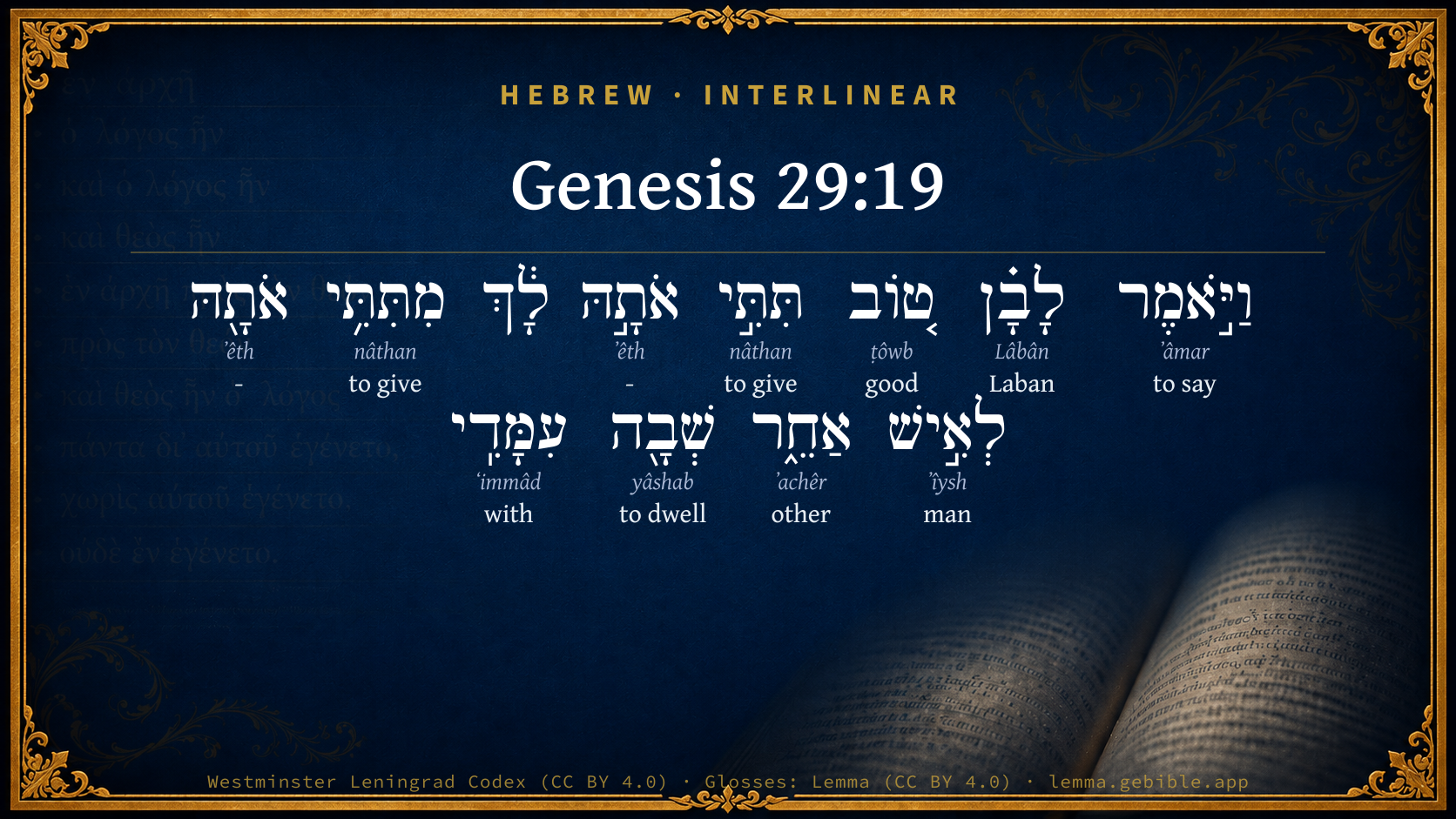
Hebrew (Westminster Leningrad Codex) Genesis 29:19 appears in the Hebrew Old Testament. The text above is from the Westminster Leningrad Codex. Each word links to its Strong’s number, a concise gloss, and parsing drawn from the Open Scriptures Hebrew Bible morphology. Click any word for its full Brown-Driver-Briggs (BDB) entry.
Download image
Cite this verse

Genesis 29:19 (World English Bible). Public Domain. Lemma interlinear Bible study tool, https://lemma.gebible.app/v/genesis/29/19.

Show BibTeX & RIS
BibTeX
RIS
English Translation
Laban said, "It is better that I give her to you, than that I should give her to another man. Stay with me."
World English Bible · Public Domain
Download a study sheet

One document with this verse’s original text, its word-by-word gloss line, the meaning frame, cross-references with their text, attributed commentary, and full source and license credits — printable, and it pastes into notes with its structure intact.

This verse Autodidact and up

Study sheet (.html) Plain text (.txt)

A passage Seminary Student

Up to 50 verses in one chapter. A passage sheet keeps up to 6 commentary sources and 12 cross-references per verse, in the order this page ranks them, and says so on the sheet whenever that leaves anything out. Ask for a single verse and you get the Autodidact verse sheet above.

Everything on this page stays free to read, with no account — the sheet is a download of what is already on screen, not access to it.

Want to remove ads? Support Godless Engineer
Compare translations 3

The same verse in 3 English versions, stacked beneath the original-language interlinear above. Click any original word for its lexicon entry.

Each is an independent rendering of the whole verse — the interlinear is not word-aligned to these translations.

Highlighted words mark where these versions differ — a whole-verse word diff, not a word-by-word alignment.

  • World English Bible Public Domain
    Laban said, "It is better that I give her to you, than that I should give her to another man. Stay with me."
  • King James Version Public Domain
    And Laban said, It is better that I give her to thee, than that I should give her to another man: abide with me.
  • unfoldingWord Literal Text CC BY-SA 4.0
    And Laban said, “ better for me to give her to you than for me to give her to another man. Stay with me.”

unfoldingWord Literal Text — © unfoldingWord, licensed CC BY-SA 4.0. Word-aligned USFM3 via Door43 (git.door43.org/unfoldingWord/en_ult).

Versions to compare (up to 4)

3 of 4 selected

Show all 18 translations

Every available English version of this verse, each an independent rendering of the whole verse.

  • World English Bible Public Domain
    Laban said, "It is better that I give her to you, than that I should give her to another man. Stay with me."
  • Berean Standard Bible Public Domain
    Laban replied, “Better that I give her to you than to another. Stay here with me.”
  • Majority Standard Bible Public Domain
    Laban replied, “Better that I give her to you than to another. Stay here with me.”
  • King James Version Public Domain
    And Laban said, It is better that I give her to thee, than that I should give her to another man: abide with me.
  • American Standard Version (1901) Public Domain
    And Laban said, It is better that I give her to thee, than that I should give her to another man. Abide with me.
  • Revised Version (1885) Public Domain
    And Laban said, It is better that I give her to thee, than that I should give her to another man: abide with me.
  • Geneva Bible (1599) Public Domain
    Then Laban answered, It is better that I giue her thee, then that I should giue her to another man: abide with me.
  • Douay-Rheims (1899) Public Domain
    Lahan answered: It is better that I give her thee than to another man; stay with me.
  • Young's Literal Translation Public Domain
    and Laban saith, `It is better for me to give her to thee than to give her to another man; dwell with me;'
  • Literal Standard Version CC BY-SA 4.0
    and Laban says, “It is better for me to give her to you than to give her to another man; dwell with me”;
  • Unlocked Literal Bible CC BY-SA 4.0
    Laban said, “It is better that I give her to you, than that I should give her to another man. Stay with me.”
  • unfoldingWord Literal Text CC BY-SA 4.0
    And Laban said, “ better for me to give her to you than for me to give her to another man. Stay with me.”
  • Darby Bible Public Domain
    And Laban said, It is better that I give her to thee than that I should give her to another man: abide with me.
  • World Messianic Bible Public Domain
    Laban said, “It is better that I give her to you, than that I should give her to another man. Stay with me.”
  • Webster's Bible Public Domain
    And Laban said, It is better that I give her to thee, than that I should give her to another man: abide with me.
  • Free Bible Version CC BY-SA 4.0
    “Well it's better for me to give her to you than anyone else,” Laban replied. “So stay here and work for me.”
  • Bible in Basic English Public Domain
    And Laban said, It is better for you to have her than another man: go on living here with me.
  • JPS Tanakh (1917) Public Domain
    And Laban said: 'It is better that I give her to thee, than that I should give her to another man; abide with me.'

Literal Standard Version (2020), Covenant Press — licensed CC BY-SA 4.0. Text via the HelloAO Bible API (eBible.org). Unlocked Literal Bible (unfoldingWord) — licensed CC BY-SA 4.0. Text via the HelloAO Bible API (eBible.org). unfoldingWord Literal Text — © unfoldingWord, licensed CC BY-SA 4.0. Word-aligned USFM3 via Door43 (git.door43.org/unfoldingWord/en_ult). Free Bible Version, Dr. Jonathan Gallagher — licensed CC BY-SA 4.0. Text via the HelloAO Bible API (eBible.org).

Word by word

More ways to search: Search by grammar → Find every occurrence → Compare this word →

Practice this passage: Drill this verse → Learn its vocabulary →

עִמָּדִֽי
ʻimmâd
H5978
“with · me”
Preposition + Suffix, Personal, 1st Person, Common, Singular
Part of Speech
Preposition
Full BDB Definition

Origin: prol for H5973

TWOT: 1640b

with
  1. וַיֹּ֣אמֶר ʼâmar H559 “and · to say” Conjunction + Verb, Qal, Sequential Imperfect, 3rd Person, Masculine, Singular
  2. לָבָ֗ן Lâbân H3837 “Laban” Noun, Proper
  3. ט֚וֹב ṭôwb H2896 “good” Adjective, Adjective, Masculine, Singular, Absolute
  4. תִּתִּ֣י nâthan H5414 “to give · me” Verb, Qal, Infinitive Construct + Suffix, Personal, 1st Person, Common, Singular
  5. אֹתָ֣הּ ʼêth H853 “- · her” Particle, Direct Object + Suffix, Personal, 3rd Person, Feminine, Singular
  6. מִתִּתִּ֥י nâthan H5414 “from · to give · me” Preposition + Verb, Qal, Infinitive Construct + Suffix, Personal, 1st Person, Common, Singular
  7. אֹתָ֖הּ ʼêth H853 “- · her” Particle, Direct Object + Suffix, Personal, 3rd Person, Feminine, Singular
  8. לְאִ֣ישׁ ʼîysh H376 “to/for · man” Preposition + Noun, Common, Masculine, Singular, Absolute
  9. אַחֵ֑ר ʼachêr H312 “other” Adjective, Adjective, Masculine, Singular, Absolute
  10. שְׁבָ֖ה yâshab H3427 “dwell” Verb, Qal, Imperative, 2nd Person, Masculine, Singular + Suffix, h

About this verse

These counts appear in no published source. They are computed here, from the morphology-tagged text and Lemma’s own curated glosses. What Lemma adds →

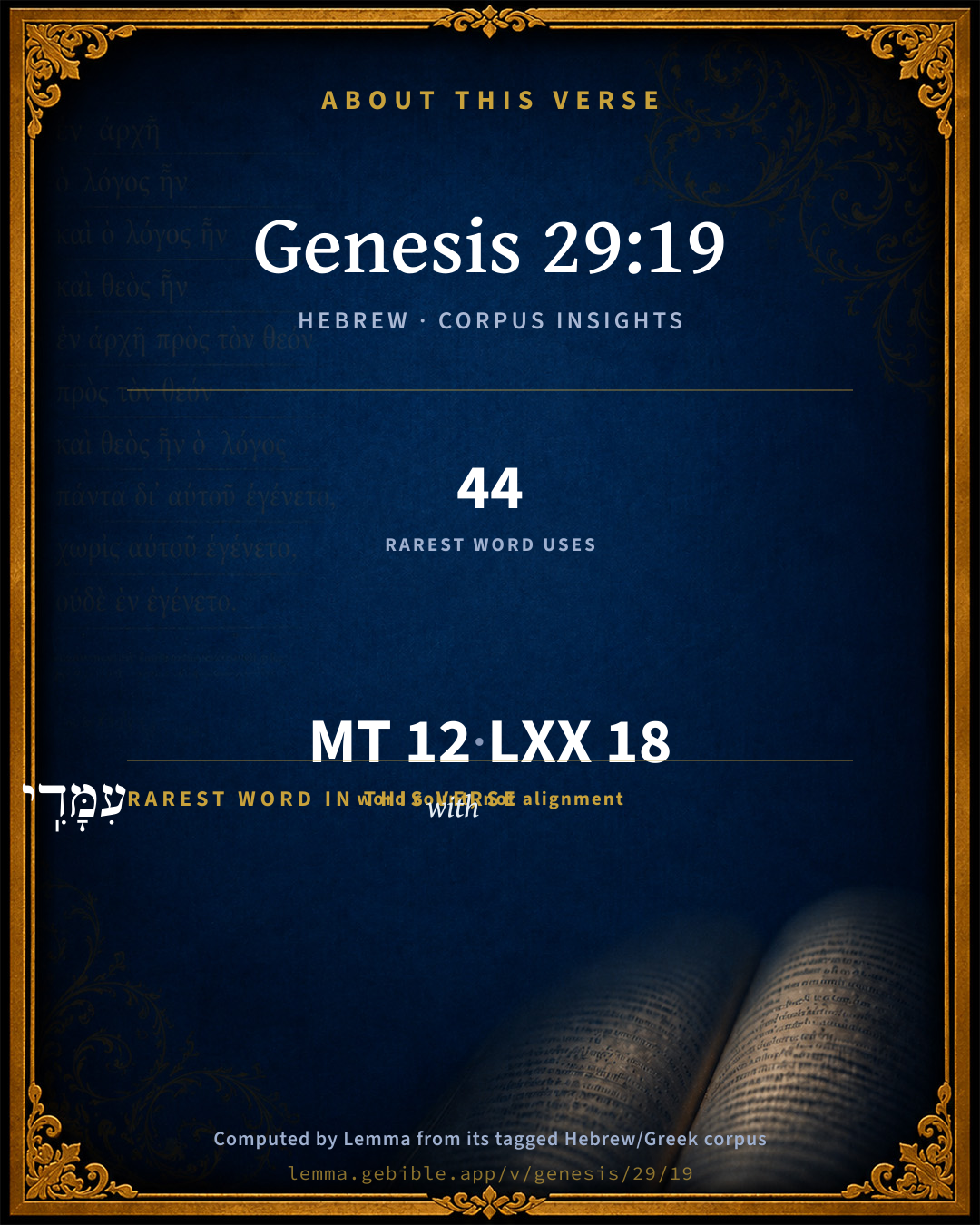
12
words
9
distinct lemmas
Pentateuch
section

Shared distinctive vocabulary

עִמָּדִֽי with H5978 occurs in 44 verses of the Hebrew Bible. Also found in:

Grammatical profile

  • 4 verbs
  • 2 nouns
  • 2 adjectives
  • 2 prepositions
  • 2 particles

Verb forms

  • וַיֹּ֣אמֶר Qal · Sequential Imperfect
  • תִּתִּ֣י Qal · Infinitive Construct
  • מִתִּתִּ֥י Qal · Infinitive Construct
  • שְׁבָ֖ה Qal · Imperative

Repetition

A word recurs within this verse — often emphatic in Hebrew:

  • תִּתִּ֣י to give H5414 ×2

Hebrew & Septuagint length

In English translation the verse runs 23 words from the Hebrew and 27 from the Septuagint (LXX English) — closely comparable.

A rough comparison of the two English renderings, which tokenize alike — not a word-level alignment.

Word counts can differ between the Hebrew and the Greek without any difference in meaning — e.g. the Hebrew direct-object marker אֵת has no separate Greek word, and Greek often adds the article ὁ.

In the original languages it is 12 Hebrew tokens and 18 Greek tokens — but the two are counted differently (Hebrew bundles its prefixes and suffixes into one token; the Greek is in lemma form), so that isn’t a like-for-like length.

Cross-references

3

Topical passages linked to Genesis 29:19 in the Treasury of Scripture Knowledge — connected by theme and wording, ordered by reader-vote popularity; previews shown in the World English Bible.

  • Isaiah 6:11 Then I said, "Lord, how long?" He answered, "Until cities are waste without inhabitant, And houses without man, And the land becomes utterly waste,
  • Psalms 12:2 Everyone lies to his neighbor. They speak with flattering lips, and with a double heart.
  • Isaiah 6:5 Then I said, "Woe is me! For I am undone, because I am a man of unclean lips, and I dwell in the midst of a people of unclean lips: for my eyes have seen the King, Yahweh of Hosts!"

Cross-references courtesy of OpenBible.info (CC BY 4.0).

Hebrew and Greek witnesses Masoretic Hebrew ↔ Greek Septuagint

The same verse in the two great witnesses to the Old Testament, shown verse-for-verse.

These are two independent witnesses, not word-aligned to each other, and the Septuagint is shown in lemma (dictionary) form.

Hebrew Genesis 29:19 Masoretic · Westminster Leningrad Codex

וַיֹּ֣אמֶר לָבָ֗ן ט֚וֹב תִּתִּ֣י אֹתָ֣הּ לָ֔ךְ מִתִּתִּ֥י אֹתָ֖הּ לְאִ֣ישׁ אַחֵ֑ר שְׁבָ֖ה עִמָּדִֽי

Laban said, "It is better that I give her to you, than that I should give her to another man. Stay with me."

World English Bible · Public Domain

Greek LXX Genesis 29:19 Septuagint · lemma form

εἶπον δέ αὐτός λαβαν βελτίων δίδωμι ἐγώ αὐτός σύ ἤ δίδωμι ἐγώ αὐτός ἀνήρ ἕτερος οἰκέω μετά ἐγώ

And Laban said to him, It is better that I should give her to you, than that I should give her to another man; dwell with me.

LXX2012 (modern English Septuagint) · Public Domain

Hebrew: Westminster Leningrad Codex (CC BY 4.0). Greek: Septuagint (public domain); English from LXX2012 (modern English Septuagint) (Public Domain). How the Septuagint differs from the Hebrew →

Targum (Aramaic paraphrase)

2

The Targum is the ancient Jewish Aramaic paraphrase of the Hebrew Scriptures — an interpretive translation, not the Hebrew text itself. Onkelos (literal) and Pseudo-Jonathan (expansive) render the Torah, and Jonathan the Prophets. Coverage is partial: where no permissively-licensed English translation exists for a verse, only the Aramaic is shown. This is verse-level text, not a word-by-word alignment to the Hebrew.

  1. Targum Onkelos Torah (Genesis–Deuteronomy)
    וַאֲמַר לָבָן טַב דְּאֶתֵּן יָתַהּ לָךְ מִדְּאֶתֵּן יָתַהּ לִגְבַר אָחֳרָן תִּיב עִמִּי

    (no public-domain English translation for this verse)

    Targum Onkelos — Aramaic: “Onkelos Genesis” (public domain); “Onkelos Exodus” (public domain); “Onkelos Leviticus” (public domain); “Onkelos Numbers” (public domain); “Onkelos Deuteronomy” (public domain). English: “Sefaria Community Translation” (CC0 1.0 (public-domain dedication)); “J.W. Etheridge. The Targums of Onkelos and Jonathan Ben Uzziel on the Pentateuch. London: Longmans, Green, 1862” (public domain). Text via Sefaria.

  2. Targum Pseudo-Jonathan Torah (Genesis–Deuteronomy)
    וַאֲמַר לָבָן בִּרְמִיוּ טַב דְאֶתֵּן יָתָהּ לָךְ מִן דְאֶתֵּן יָתָהּ לִגְבַר אוֹחֲרָן תִּיב עִמִי

    And Laban said with deceit, It is better that I give her to thee, than to another man abide with me.

    Targum Pseudo-Jonathan — Aramaic: “Targum Jonathan on Genesis” (public domain); “Targum Jonathan on Exodus” (public domain); “Targum Jonathan on Leviticus” (public domain); “Targum Jonathan on Numbers” (public domain); “Targum Jonathan on Deuteronomy” (public domain). English: “The Targum of Jonathan ben Uzziel, trans. J. W. Etheridge, London, 1862” (public domain). Text via Sefaria.

Commentary

Notes on Genesis 29:19 from classic Christian and Jewish commentators (each source and its license shown beneath its notes). The classic Christian expositions comment on the surrounding passage and are grouped to its opening verse, so a note may address several verses; the Jewish commentaries on the Tanakh (Rashi and others) are per-verse, so they appear only where the commentator wrote on this verse.

Lemma curates 59 commentaries, every one of them public domain or Creative Commons licensed, each selected and text-cleaned for this edition rather than reprinted as found. About our sources →

Trapp's Complete Commentary

John Trapp

Gen 29:19 And Laban said, [It is] better that I give her to thee, than that I should give her to another man: abide with me.

Ver. 19. It is better that I give her to thee.] Indeed, he sold her to him for seven years’ service. This was Laban, or Nabal, choose you which. Their names were not more like than their conditions. Laban’s daughters and Nabal’s wife were alike handled by their unkind parents. "He hath sold us," said they, "and hath also quite devoured our money". {Gen 31:15} And, He hath married me, might Abigail have said, to the money, and not to the man; and though he named me his joy, yet he hath caused me much sorrow. How many a child is so cast away by the covetous parents! It was better with Laban’s two daughters; but no thanks to their father.

John Trapp, A Commentary or Exposition upon All the Books of the Old and New Testament (1647–1656) — public domain. Text from a community e-Sword module.

Ellicott's Commentary for English Readers

(19) It is better that I give her to thee.—It is still the custom among the Arabs to prefer a relative as the husband of a daughter, and on giving a moderato dowry the elder cousins can claim the elder daughters in marriage, and the younger the younger. Thus Jacob, as the second son, had a claim upon Rachel. The Rabbins even say that Leah’s eyes were weak from weeping, because Esau had not come to marry her. This absurd idea bears witness, nevertheless, to the custom of the intermarriage of cousins being an established rule, and gives a reason for Laban’s acceptance of Jacob as the husband of his younger child. As Jacob offered seven years’ service for Rachel, and gave a second seven years’ service for her after he had been tricked into taking Leah, we may conclude that the length of time was not unreasonable.

A Bible Commentary for English Readers, edited by Charles John Ellicott (1878–1897) — public domain. Text from a community e-Sword module.

The Cambridge Bible for Schools and Colleges

gen. ed. J. J. S. Perowne

19. It is better] Laban means that it is in the interests of the family his daughter should be married to one of their own kindred. The marriage of first cousins is considered especially desirable among the Bedouin.

The Cambridge Bible for Schools and Colleges (gen. ed. J. J. S. Perowne; Cambridge University Press, 1878–1918) — public domain. Text from a community e-Sword module.

John Gill's Exposition

And Laban said,.... Deceitfully, as the Targum of Jonathan adds, pretending great respect for Jacob, and that what he had proposed was very agreeable to him, when he meant to impose upon him:

it is better that I should give her to thee, than that I should give her to another man; by which he not only intimates that he preferred him, a relation, to another man, a stranger; but as if he did not insist upon the servitude for her, but would give her to him; unless he means upon the terms proposed, and so it should seem by what follows:

abide with me: the term of seven years, and serve me; suggesting, that then he agreed Rachel should be his wife; and so Jacob, a plain hearted man, understood him; but he designed no such thing.

John Gill's Exposition of the Whole Bible (1746–1763) — public domain (CC PDM 1.0). Text via the HelloAO Bible API.

Matthew Poole's English Annotations

An ambiguous and crafty answer, wherein he doth not directly grant his desire, but only insinuates it in such terms as might hide his design, which the event showed.

Matthew Poole's English Annotations on the Holy Bible (1683–1685) — public domain. Text from a community e-Sword/MySword module.

Whedon's Commentary on the Bible

Daniel D. Whedon

19. Better… to thee, than… to another — Laban gladly accepts Jacob’s offer. It was worth more to him than gold. This custom of preferring marriage with one’s own kindred, and also the practice of receiving dowry for a daughter, illustrate the manners of the ancient East, which prevail largely even at the present day. While the daughter is not sold as a slave, the practice shows the comparatively low position of women in the East, and how little a wife had to say in the choice of a husband. But the dowry may be looked upon as a reward paid to parents for the care of a daughter’s training and bringing up to womanhood, and also a suitable expression of gratitude on the part of the husband towards the parents of his wife.

Daniel D. Whedon (gen. ed.), Commentary on the Old and New Testaments (1874–1909) — public domain. Text from a community e-Sword module.

The Pulpit Commentary

And Laban said, It is better that I give her to thee, than that I should give her to another man. Orientals commonly prefer alliances within the circle of their own relatives. Burckhardt, Volney, Layard, and Lane testify that this is still the case among the Bedouins, the Druses, and other Eastern tribes. Abide with me a formal ratification of the compact on the part of Laban.

The Pulpit Commentary (1880–1919), ed. H.D.M. Spence-Jones & Joseph S. Exell — public domain. Text from a community e-Sword module.

unfoldingWord translationNotes

Door43 World Missions Community

than that I should give her to another man

"rather than give her to another man"

and they seemed to him only a few days

"but the time seemed to him to be only a few days"

for the love he had for her

"on account of the love he had for her" or "because of his love for her"

translationWords

Laban

Jacob

year

Rachel

day

unfoldingWord translationNotes — © Distant Shores Media and the Door43 World Missions Community, licensed CC BY-SA 4.0. Source: git.door43.org/Door43/en_tn.

Radak

Rabbi David Kimhi (Radak)

ויאמר...טוב תתי, Lavan admitted that marrying members of one’s family was a good thing.

שבה עמדי, on the basis of the conditions which you yourself have suggested. After you have fulfilled these conditions I will give her to you.

Radak on the Tanakh — English translations: “Sefaria Community Translation” (CC0 1.0 (public-domain dedication)); “Eliyahu Munk, HaChut Hameshulash” (CC BY 4.0); “Rabbi Mike Feuer, Jerusalem Anthology” (CC BY 4.0); and “R. David Kimhi on the first book of Psalms, Translated by R.G. Finch, London, 1919” (public domain). Text via Sefaria.

Lesson kit

Teaching starters — assembled from the data on this page, not authored interpretation. Every prompt links to the verse data it draws on. Edit before teaching.

Genesis, in the Pentateuch, opens this verse with 12 words (9 distinct Hebrew lemmas). Its most distinctive word is ʻimmâd (“with”). A historical commentator’s framing appears above. Read the whole chapter for the surrounding context.

Discussion questions

  1. What does “with” (ʻimmâd) contribute to the verse as a whole?
  2. How does Genesis 3:12, which shares the word «with», read alongside this verse?
  3. What does the repetition of “to give” (2× in this one verse) do in this verse?
  4. These translations render this verse differently; the difference is in the English rendering, not the original. What questions does that raise?
  5. «וַיֹּ֣אמֶר» is a Qal Sequential Imperfect verb. How does that grammatical form shape the action described?
  6. Compare how Trapp's Complete Commentary and Ellicott's Commentary for English Readers read this verse. Where do they agree or differ?

Things to notice

Reading settings

Reading text

Shown beneath each verse's original-language words.

Old Testament
Old Testament edition

Read the OT as the Masoretic Hebrew (MT) or the Greek Septuagint (LXX).

English shown for the Greek Septuagint (in the Hebrew ↔ Greek comparison).

Comparing translations? Open the Compare panel on any verse page to stack up to four side by side.