
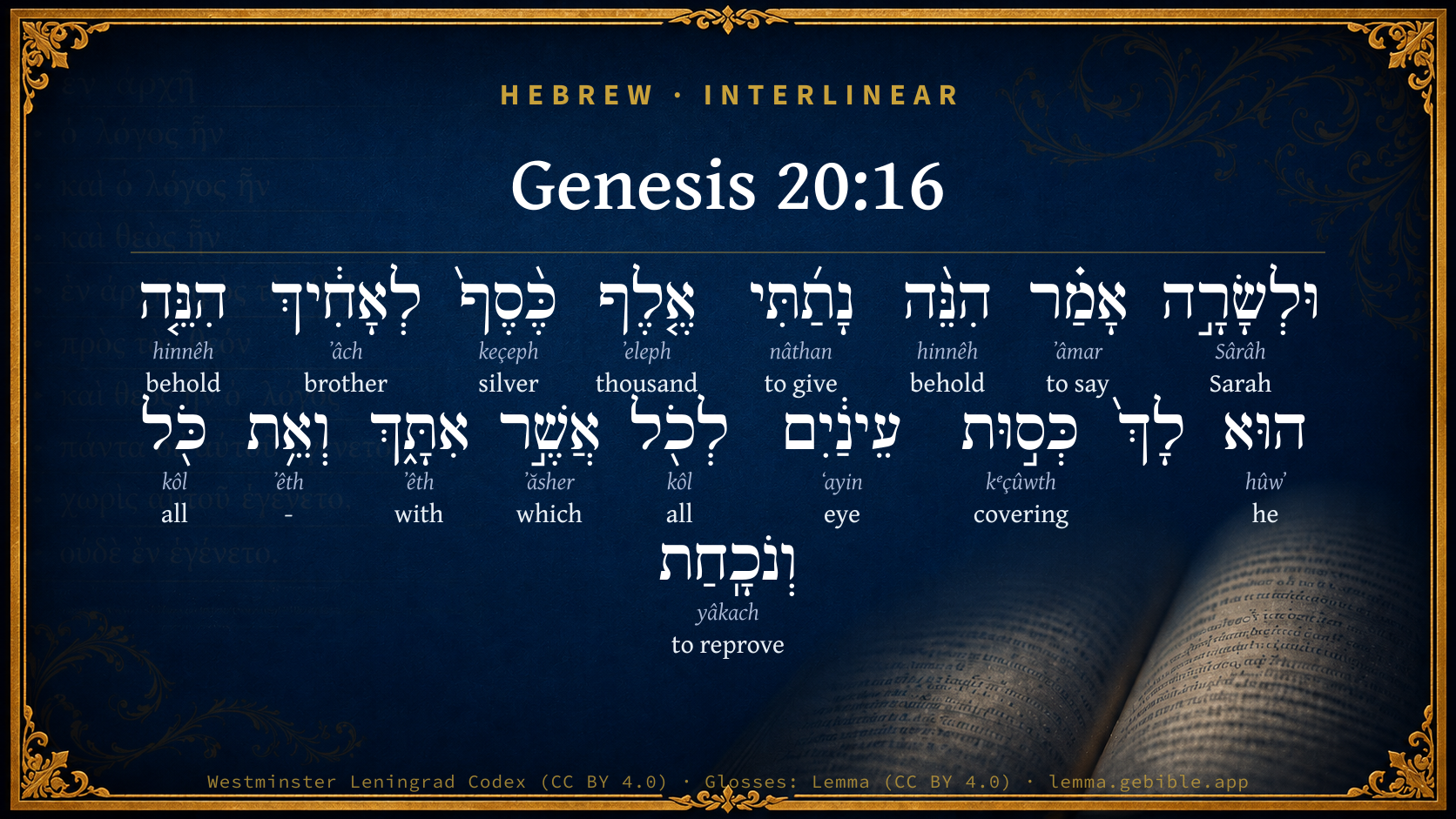
Genesis 20:16

Hebrew (Westminster Leningrad Codex) Genesis 20:16 appears in the Hebrew Old Testament. The text above is from the Westminster Leningrad Codex. Each word links to its Strong’s number, a concise gloss, and parsing drawn from the Open Scriptures Hebrew Bible morphology. Click any word for its full Brown-Driver-Briggs (BDB) entry.
Download image
Cite this verse

Genesis 20:16 (World English Bible). Public Domain. Lemma interlinear Bible study tool, https://lemma.gebible.app/v/genesis/20/16.

Show BibTeX & RIS
BibTeX
RIS
English Translation
To Sarah he said, "Behold, I have given your brother a thousand pieces of silver. Behold, it is for you a covering of the eyes to all that are with you. In front of all you are vindicated."
World English Bible · Public Domain
Highlights
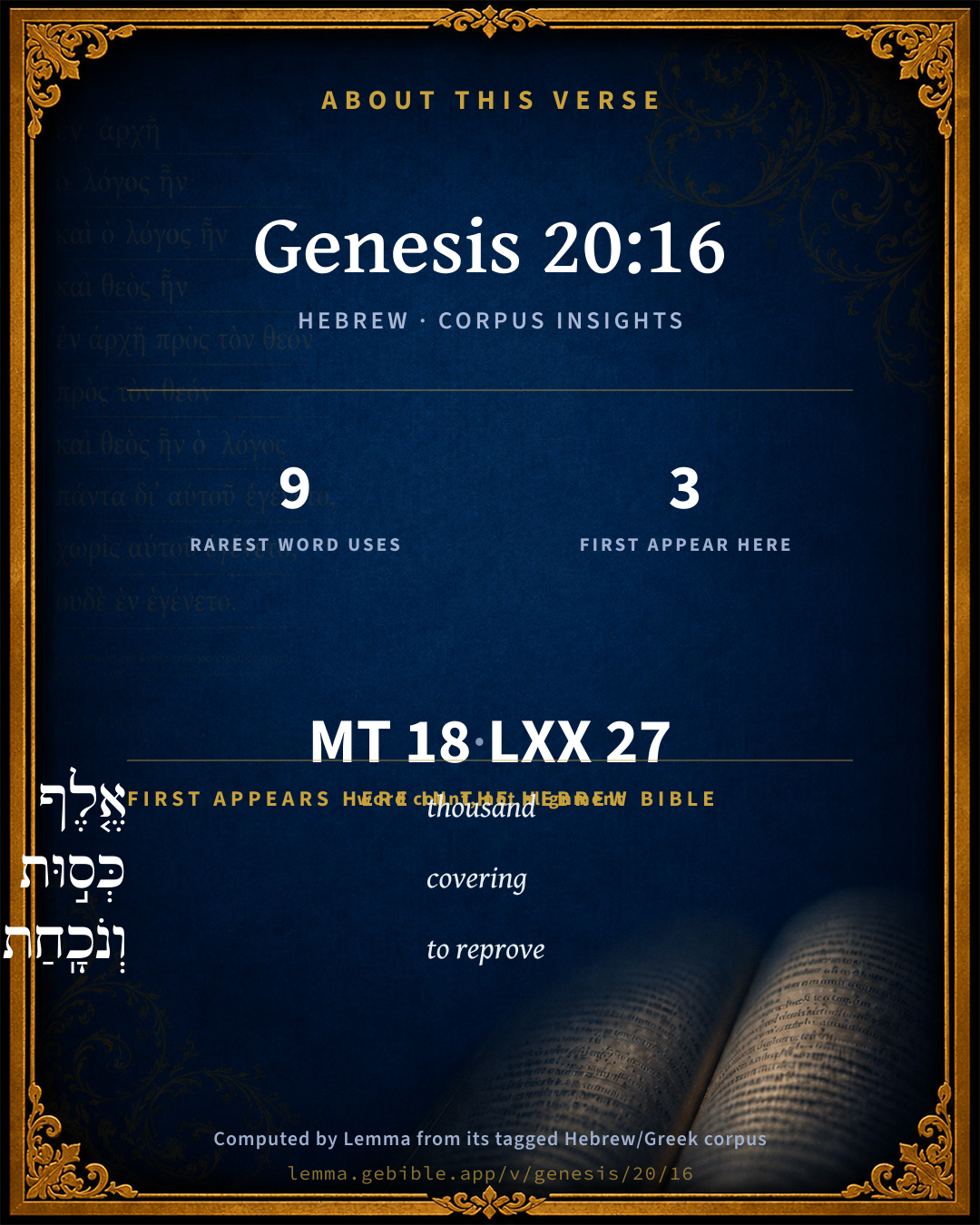
  • 3 first appearances in the Hebrew Bible
Full analysis ↓
Download a study sheet

One document with this verse’s original text, its word-by-word gloss line, the meaning frame, cross-references with their text, attributed commentary, and full source and license credits — printable, and it pastes into notes with its structure intact.

This verse Autodidact and up

Study sheet (.html) Plain text (.txt)

A passage Seminary Student

Up to 50 verses in one chapter. A passage sheet keeps up to 6 commentary sources and 12 cross-references per verse, in the order this page ranks them, and says so on the sheet whenever that leaves anything out. Ask for a single verse and you get the Autodidact verse sheet above.

Everything on this page stays free to read, with no account — the sheet is a download of what is already on screen, not access to it.

Want to remove ads? Support Godless Engineer
Compare translations 3

The same verse in 3 English versions, stacked beneath the original-language interlinear above. Click any original word for its lexicon entry.

Each is an independent rendering of the whole verse — the interlinear is not word-aligned to these translations.

Highlighted words mark where these versions differ — a whole-verse word diff, not a word-by-word alignment.

  • World English Bible Public Domain
    To Sarah he said, "Behold, I have given your brother a thousand pieces of silver. Behold, it is for you a covering of the eyes to all that are with you. In front of all you are vindicated."
  • King James Version Public Domain
    And unto Sarah he said, Behold, I have given thy brother a thousand pieces of silver: behold, he is to thee a covering of the eyes, unto all that are with thee, and with all other: thus she was reproved.
  • unfoldingWord Literal Text CC BY-SA 4.0
    And to Sarah he said, “Behold, I have given 1,000 silver to your brother. Behold, that for you a covering of the eyes before all who with you, so that you are vindicated for everything.”

unfoldingWord Literal Text — © unfoldingWord, licensed CC BY-SA 4.0. Word-aligned USFM3 via Door43 (git.door43.org/unfoldingWord/en_ult).

Versions to compare (up to 4)

3 of 4 selected

Show all 18 translations

Every available English version of this verse, each an independent rendering of the whole verse.

  • World English Bible Public Domain
    To Sarah he said, "Behold, I have given your brother a thousand pieces of silver. Behold, it is for you a covering of the eyes to all that are with you. In front of all you are vindicated."
  • Berean Standard Bible Public Domain
    And he said to Sarah, “See, I am giving your brother a thousand pieces of silver. It is your vindication before all who are with you; you are completely cleared.”
  • Majority Standard Bible Public Domain
    And he said to Sarah, “See, I am giving your brother a thousand pieces of silver. It is your vindication before all who are with you; you are completely cleared.”
  • King James Version Public Domain
    And unto Sarah he said, Behold, I have given thy brother a thousand pieces of silver: behold, he is to thee a covering of the eyes, unto all that are with thee, and with all other: thus she was reproved.
  • American Standard Version (1901) Public Domain
    And unto Sarah he said, Behold, I have given thy brother a thousand pieces of silver. Behold, it is for thee a covering of the eyes to all that are with thee. And in respect of all thou art righted.
  • Revised Version (1885) Public Domain
    And unto Sarah he said, Behold, I have given thy brother a thousand pieces of silver: behold, it is for thee a covering of the eyes to all that are with thee; and in respect of all thou art righted.
  • Geneva Bible (1599) Public Domain
    Likewise to Sarah he said, Beholde, I haue giuen thy brother a thousand pieces of siluer: behold, he is the vaile of thine eyes to all that are with thee, and to all others: and she was thus reproued.
  • Douay-Rheims (1899) Public Domain
    And said: The land is before you, dwell wheresoever it shall please thee.
  • Young's Literal Translation Public Domain
    and to Sarah he hath said, `Lo, I have given a thousand silverlings to thy brother; lo, it is to thee a covering of eyes, to all who are with thee;' and by all this she is reasoned with.
  • Literal Standard Version CC BY-SA 4.0
    and to Sarah he has said, “Behold, I have given one thousand pieces of silver to your brother; behold, it is to you a covering of eyes, to all who are with you”; and by all this she is reasoned with.
  • Unlocked Literal Bible CC BY-SA 4.0
    To Sarah he said, “Look, I have given your brother a thousand pieces of silver. It is to cover any offense against you in the eyes of all that are with you, and before everyone, you are completely made right.”
  • unfoldingWord Literal Text CC BY-SA 4.0
    And to Sarah he said, “Behold, I have given 1,000 silver to your brother. Behold, that for you a covering of the eyes before all who with you, so that you are vindicated for everything.”
  • Darby Bible Public Domain
    And to Sarah he said, Behold, I have given thy brother a thousand [pieces] of silver; behold, let that be to thee a covering of the eyes, in respect of all that are with thee, and with all; and she was reproved.
  • World Messianic Bible Public Domain
    To Sarah he said, “Behold, I have given your brother a thousand pieces of silver. Behold, it is for you a covering of the eyes to all that are with you. In front of all you are vindicated.”
  • Webster's Bible Public Domain
    And to Sarah he said, Behold, I have given thy brother a thousand pieces of silver: behold, he is to thee a covering of the eyes, to all that are with thee, and with all other: thus she was reproved.
  • Free Bible Version CC BY-SA 4.0
    Abimelech also told Sarah, “Notice that I'm giving your brother a thousand pieces of silver. This is to compensate you for the wrong done to you in the eyes of everyone with you, and to make sure that your name is publicly cleared.”
  • Bible in Basic English Public Domain
    And he said to Sarah, See, I have given to your brother a thousand bits of silver so that your wrong may be put right; now your honour is clear in the eyes of all.
  • JPS Tanakh (1917) Public Domain
    And unto Sarah he said: 'Behold, I have given thy brother a thousand pieces of silver; behold, it is for thee a covering of the eyes to all that are with thee; and before all men thou art righted.'

Literal Standard Version (2020), Covenant Press — licensed CC BY-SA 4.0. Text via the HelloAO Bible API (eBible.org). Unlocked Literal Bible (unfoldingWord) — licensed CC BY-SA 4.0. Text via the HelloAO Bible API (eBible.org). unfoldingWord Literal Text — © unfoldingWord, licensed CC BY-SA 4.0. Word-aligned USFM3 via Door43 (git.door43.org/unfoldingWord/en_ult). Free Bible Version, Dr. Jonathan Gallagher — licensed CC BY-SA 4.0. Text via the HelloAO Bible API (eBible.org).

Word by word

More ways to search: Search by grammar → Find every occurrence → Compare this word →

Practice this passage: Drill this verse → Learn its vocabulary →

כְּס֣וּת
kᵉçûwth
H3682
“covering of”
Noun, Common, Feminine, Singular, Construct
Part of Speech
Noun
Type
Common
Gender
Feminine
Number
Singular
State
Construct
Full BDB Definition

Origin: from H3680

TWOT: 1008b

covering, clothing - covering, clothing - covering (for concealment)
  1. וּלְשָׂרָ֣ה Sârâh H8283 “and · to/for · Sarah” Conjunction + Preposition + Noun, Proper
  2. אָמַ֗ר ʼâmar H559 “to say” Verb, Qal, Perfect, 3rd Person, Masculine, Singular
  3. הִנֵּ֨ה hinnêh H2009 “behold” Particle, Demonstrative
  4. נָתַ֜תִּי nâthan H5414 “to give” Verb, Qal, Perfect, 1st Person, Common, Singular
  5. אֶ֤לֶף ʼeleph H505 “thousand” Adjective, Cardinal number, Both, Singular, Absolute
  6. כֶּ֨סֶף֙ keçeph H3701 “silver” Noun, Common, Masculine, Singular, Absolute
  7. לְאָחִ֔יךְ ʼâch H251 “to/for · brother · your” Preposition + Noun, Common, Masculine, Singular, Construct + Suffix, Personal, 2nd Person, Feminine, Singular
  8. הִנֵּ֤ה hinnêh H2009 “behold” Particle, Demonstrative
  9. הוּא hûwʼ H1931 “he” Pronoun, Personal, 3rd Person, Masculine, Singular
  10. עֵינַ֔יִם ʻayin H5869 “eyes” Noun, Common, Both, Dual, Absolute
  11. לְכֹ֖ל kôl H3605 “to/for · all” Preposition + Noun, Common, Masculine, Singular, Absolute
  12. אֲשֶׁ֣ר ʼăsher H834 “which” Particle, Relative
  13. אִתָּ֑ךְ ʼêth H854 “with · you” Preposition + Suffix, Personal, 2nd Person, Feminine, Singular
  14. וְאֵ֥ת ʼêth H853 “and · -” Conjunction + Particle, Direct Object
  15. כֹּ֖ל kôl H3605 “all” Noun, Common, Masculine, Singular, Absolute
  16. וְנֹכָֽחַת yâkach H3198 “and · reproving” Conjunction + Verb, Niphal, Participle Active, Feminine, Singular, Absolute

About this verse

These counts appear in no published source. They are computed here, from the morphology-tagged text and Lemma’s own curated glosses. What Lemma adds →

18
words
15
distinct lemmas
Pentateuch
section

Notable vocabulary

The rarest word here is כְּס֣וּת covering H3682 — appearing just 9 times in the whole Hebrew Bible.

First appearance in Scripture

These words make their first canonical appearance in the Hebrew Bible here:

  • אֶ֤לֶף thousand H505
  • כְּס֣וּת covering H3682
  • וְנֹכָֽחַת to reprove H3198

Shared distinctive vocabulary

כְּס֣וּת covering H3682 occurs in 8 verses of the Hebrew Bible. Also found in:

Grammatical profile

  • 3 verbs
  • 7 nouns
  • 1 adjective
  • 1 pronoun
  • 2 prepositions
  • 4 particles

Verb forms

  • אָמַ֗ר Qal · Perfect
  • נָתַ֜תִּי Qal · Perfect
  • וְנֹכָֽחַת Niphal · Participle Active

Repetition

Words recur within this verse — often emphatic in Hebrew:

  • הִנֵּ֨ה behold H2009 ×2
  • לְכֹ֖ל all H3605 ×2

Hebrew & Septuagint length

In English translation the verse runs 38 words from the Hebrew and 41 from the Septuagint (LXX English) — closely comparable.

A rough comparison of the two English renderings, which tokenize alike — not a word-level alignment.

Word counts can differ between the Hebrew and the Greek without any difference in meaning — e.g. the Hebrew direct-object marker אֵת has no separate Greek word, and Greek often adds the article ὁ.

In the original languages it is 18 Hebrew tokens and 27 Greek tokens — but the two are counted differently (Hebrew bundles its prefixes and suffixes into one token; the Greek is in lemma form), so that isn’t a like-for-like length.

Cross-references

10

Topical passages linked to Genesis 20:16 in the Treasury of Scripture Knowledge — connected by theme and wording, ordered by reader-vote popularity; previews shown in the World English Bible.

  • Genesis 20:5 Didn't he tell me, 'She is my sister?' She, even she herself said, 'He is my brother.' In the integrity of my heart and the innocence of my hands have I done this."
  • Proverbs 27:5 Better is open rebuke Than hidden love.
  • Genesis 24:65 She said to the servant, "Who is the man who is walking in the field to meet us?" The servant said, "It is my master." She took her veil, and covered herself.
  • Genesis 26:11 Abimelech charged all the people, saying, "He who touches this man or his wife will surely be put to death."
  • 1 Chronicles 21:3–6 Joab said, Yahweh make his people a hundred times as many as they are: but, my lord the king, aren't they all my lord's servants? why does my lord require this thing? why will he be a cause of guilt to Israel?
  • Proverbs 9:8–9 Don't reprove a scoffer, lest he hate you. Reprove a wise man, and he will love you.
  • Proverbs 12:1 Whoever loves correction loves knowledge, But he who hates reproof is stupid.
  • Proverbs 25:12 As an ear-ring of gold, and an ornament of fine gold, So is a wise reprover to an obedient ear.
  • Jonah 1:6 So the shipmaster came to him, and said to him, "What do you mean, sleeper? Arise, call on your gods! Maybe the gods will notice us, so that we won't perish."
  • Revelation 3:19 As many as I love, I reprove and chasten. Be zealous therefore, and repent.

Cross-references courtesy of OpenBible.info (CC BY 4.0).

Hebrew and Greek witnesses Masoretic Hebrew ↔ Greek Septuagint

The same verse in the two great witnesses to the Old Testament, shown verse-for-verse.

These are two independent witnesses, not word-aligned to each other, and the Septuagint is shown in lemma (dictionary) form.

Hebrew Genesis 20:16 Masoretic · Westminster Leningrad Codex

וּלְשָׂרָ֣ה אָמַ֗ר הִנֵּ֨ה נָתַ֜תִּי אֶ֤לֶף כֶּ֨סֶף֙ לְאָחִ֔יךְ הִנֵּ֤ה הוּא לָךְ֙ כְּס֣וּת עֵינַ֔יִם לְכֹ֖ל אֲשֶׁ֣ר אִתָּ֑ךְ וְאֵ֥ת כֹּ֖ל וְנֹכָֽחַת

To Sarah he said, "Behold, I have given your brother a thousand pieces of silver. Behold, it is for you a covering of the eyes to all that are with you. In front of all you are vindicated."

World English Bible · Public Domain

Greek LXX Genesis 20:16 Septuagint · lemma form

ὁ δέ σαρρα εἶπον ἰδού δίδωμι χίλιοι δίδραγμον ὁ ἀδελφός σύ οὗτος εἰμί σύ εἰς τιμή ὁ πρόσωπον σύ καί πᾶς ὁ μετά σύ καί πᾶς ἀληθεύω

And to Sarrha he said, Behold, I have given your brother a thousand pieces of silver, those shall be to you for the price of your countenance, and to all the women with you, and speak the truth in all things.

LXX2012 (modern English Septuagint) · Public Domain

On this verse, Joseph Benson's Commentary discusses the Septuagint’s reading. Read the note in Commentary ↓

Hebrew: Westminster Leningrad Codex (CC BY 4.0). Greek: Septuagint (public domain); English from LXX2012 (modern English Septuagint) (Public Domain). How the Septuagint differs from the Hebrew →

Targum (Aramaic paraphrase)

2

The Targum is the ancient Jewish Aramaic paraphrase of the Hebrew Scriptures — an interpretive translation, not the Hebrew text itself. Onkelos (literal) and Pseudo-Jonathan (expansive) render the Torah, and Jonathan the Prophets. Coverage is partial: where no permissively-licensed English translation exists for a verse, only the Aramaic is shown. This is verse-level text, not a word-by-word alignment to the Hebrew.

  1. Targum Onkelos Torah (Genesis–Deuteronomy)
    וּלְשָׂרָה אֲמַר הָא יְהָבִית אֶלֶף סַלְעִין דִּכְסַף לְאָחִיךְ הָא הוּא לִיךְ כְּסוּת דִּיקָר עַיְנִין חֳלַף דִּשְׁלָחִית וּדְּבַרְתִּיךְ וַחֲזֵית יָתִיךְ וְיָת כָּל דְּעִמָּךְ וְעַל כָּל מָה דַּאֲמָרַת אִתּוֹכָחַת

    (no public-domain English translation for this verse)

    Targum Onkelos — Aramaic: “Onkelos Genesis” (public domain); “Onkelos Exodus” (public domain); “Onkelos Leviticus” (public domain); “Onkelos Numbers” (public domain); “Onkelos Deuteronomy” (public domain). English: “Sefaria Community Translation” (CC0 1.0 (public-domain dedication)); “J.W. Etheridge. The Targums of Onkelos and Jonathan Ben Uzziel on the Pentateuch. London: Longmans, Green, 1862” (public domain). Text via Sefaria.

  2. Targum Pseudo-Jonathan Torah (Genesis–Deuteronomy)
    וַאֲמַר אֲבִימֶלְךְ הָא אַרְעִי קַדְמָךְ וּבִדַתָקֵן בְּעֵינָךְ תִּיב

    And to Sarah he said, Behold, I have given a thousand sileen of silver to thy brother; behold, they are to thee a veil of the eyes, inasmuch as thou wast hidden from thine husband one night, and I would have seen thee: for were I to give all that I have it would not suffice (or be proportionate). And the words were debated. And Abraham knew that Abimelek had not come near Sarah his wife.

    Targum Pseudo-Jonathan — Aramaic: “Targum Jonathan on Genesis” (public domain); “Targum Jonathan on Exodus” (public domain); “Targum Jonathan on Leviticus” (public domain); “Targum Jonathan on Numbers” (public domain); “Targum Jonathan on Deuteronomy” (public domain). English: “The Targum of Jonathan ben Uzziel, trans. J. W. Etheridge, London, 1862” (public domain). Text via Sefaria.

Commentary

Notes on Genesis 20:16 from classic Christian and Jewish commentators (each source and its license shown beneath its notes). The classic Christian expositions comment on the surrounding passage and are grouped to its opening verse, so a note may address several verses; the Jewish commentaries on the Tanakh (Rashi and others) are per-verse, so they appear only where the commentator wrote on this verse.

Lemma curates 59 commentaries, every one of them public domain or Creative Commons licensed, each selected and text-cleaned for this edition rather than reprinted as found. About our sources →

Trapp's Complete Commentary

John Trapp

Gen 20:16 And unto Sarah he said, Behold, I have given thy brother a thousand [pieces] of silver: behold, he [is] to thee a covering of the eyes, unto all that [are] with thee, and with all [other]: thus she was reproved.

Ver. 16. I have given thy brother.] Not thee, to avoid suspicion, "Provide," we must, "things honest in the sight of all men"; {Rom 12:17} and not only keep a good conscience, but a good name as much as may be; learning this of the unjust steward, by lawful (though he did it by unlawful) means. For our Saviour noted this defect, when he said, "The children of this world," &c. {Luk 16:8} It was good counsel that Livia gave her husband Augustus. It behoveth thee not only not to do wrong, but not to seem to do so, &c. {a} We must shun, and be shy of, the very show and shadow of sin, if we tender either our credit abroad or comfort at home. The Church took it ill, that her veil was pulled off, and that she was judged to be a dishonest woman. {Son 5:7} As in the first chapter, she prays her spouse to tell her, where she may come to him: for "why should she be as one that turneth aside," or as one that was veiled or covered, a sign of lightness and dishonesty? {Gen 38:14-15} She was willing to eschew all appearance of evil. Some take the sense of the text thus: - I have given thy husband money to buy thee a veil, to cover thy face that all may know thee to be a married woman.

{a} Lει σε, ω Aυγουστε, μη μονον μηδεν αδικειν, αλλα μηδε δοκιεν. - Dio in Vita.

John Trapp, A Commentary or Exposition upon All the Books of the Old and New Testament (1647–1656) — public domain. Text from a community e-Sword module.

Joseph Benson's Commentary

Gen 20:16. He, or this, is to thee a covering of the eyes — For the words may be expounded either of the money given to Abraham to buy a veil for the covering of her face, and to be worn in token of her subjection to her husband; or of Abraham, that he must be a covering of her eyes, that she should look at no other, nor desire to be looked at by any other. Yoke- fellows must be to each other for a covering of the eyes. The marriage covenant is a covenant with the eyes, like Job’s; Job 31:1. Thus she was reproved — Or instructed. The Septuagint is και παντα αληθευσον, speak thou the truth in all things, referring, no doubt, to the equivocation she and Abraham had used.

Joseph Benson's Commentary on the Old and New Testaments (1811–1818) — public domain. Text from a community e-Sword module.

Geneva Bible (1599)

Geneva Bible translators

Such an head, as with whom thou mayest be preserved from all dangers.

God caused this heathen King to reprove her because she dissembled, seeing that God had given her an husband as her veil and defense.

Geneva Bible (1599) marginal notes — public domain. Text via Bolls.life.

Adam Clarke's Commentary

Verse 16. And unto Sarah he said] But what did he say? Here there is scarcely any agreement among interpreters; the Hebrew is exceedingly obscure, and every interpreter takes it in his own sense.

A thousand pieces of silver] SHEKELS are very probably meant here, and so the Targum understands it. The Septuagint has χιλια διδραχμα, a thousand didrachma, no doubt meaning shekels; for in Ge 23:15-16, this translation uses διδραχμα for the Hebrew שקל shekel. As shakal signifies literally to weigh, and the shekel was a coin of such a weight, Mr. Ainsworth and others think this to be the origin of our word scale, the instrument to weigh with.

The shekel of the sanctuary weighed twenty gerahs, Ex 30:13. And according to the Jews, the gerah weighed sixteen grains of barley. R. Maimon observes, that after the captivity the shekel was increased to three hundred and eighty-four grains or barley-corns. On the subject of ancient weights and measures, very little that is satisfactory is known.

Behold, he is to thee a covering of the eyes] It - the one thousand shekels, (not he-Abraham,) is to thee for a covering - to procure thee a veil to conceal thy beauty (unto all that are with thee, and with all other) from all thy own kindred and acquaintance, and from all strangers, that none, seeing thou art another mans wife; may covet thee on account of thy comeliness.

Thus she was reproved] The original is ונכחת venochachath, but the word is probably the second person preterite, used for the imperative mood, from the root נכח nachach, to make straight, direct, right; or to speak rightly, correctly; and may, in connection with the rest of the text, be thus paraphrased: Behold, I have given thy BROTHER (Abraham, gently alluding to the equivocation, Ge 20:2; Ge 20:5) a thousand shekels of silver; behold, IT is (that is, the silver is, or may be, or let it be) to thee a covering of the eyes (to procure a veil; see above) with regard to all those who are with thee; and to all (or and in all) speak thou the truth. Correctly translated by the Septuagint, και παντα αληθευσον, and in all things speak the truth-not only tell a part of the truth, but tell the whole; say not merely he is my brother, but say also, he is my husband too. Thus in ALL things speak the truth. I believe the above to be the sense of this difficult passage, and shall not puzzle my readers with criticisms. See Kennicott.

Adam Clarke's Commentary on the Bible (1810–1826) — public domain. Text from a community e-Sword/MySword module.

John Calvin's Commentaries

16. He is to thee a covering of the eyes. Because there is, in these words, some obscurity, the passage is variously explained. The beginning of the verse is free from difficulty. For when Abimelech had given a thousand pieces of silver; in order that his liberality might not be suspected, he declare6 that he had given them to Abraham; and that since Abraham had been honorably received, his wife was not to be regarded as a harlot. But what follows is more obscure, ‘He shall be a veil to thee.’ Many interpreters refer this to the gift; in which they seem to me to be wrong. The Hebrews, having no neuter gender, use the feminine instead of it. But Moses, in this place, rather points to the husband; and this best suits the sense. For Sarah is taught that the husband to whom she is joined was as a veil, with which she ought to be covered lest she should be exposed to others. Paul says, that the veil which the woman carries on her head, is the symbol of subjection. (1 Corinthians 11:10.) This also belongs to unmarried persons, as referring to the end for which the sex is ordained; but it applies more aptly to married women; because they are veiled, as by the very ordinance of marriage. I therefore thus explain the words, ‘Thou, if thou hadst no husband, wouldst be exposed to many dangers; but now, since God has appointed for thee a guardian of thy modesty, it behoves thee to conceal thyself under that veil. Why then hast thou of thine own accords thrown off this covering?’ This was a just censure; because Sarah, pretending that she was in the power of her husband, had deprived herself of the divine protection.

Thus she was reproved. Interpreters distort this clause also. The natural exposition seems to me to be, that the Lord had suffered Sarah to be reproved by a heathen king, that he might the more deeply affect her with a sense of shame. For Moses draws especial attention to the person of the speaker; because it seemed a disgrace that the mother of the faithful should be reprehended by such a master. Others suppose that Moses speaks of the profit which she had received; seeing that she, instructed by such a lesson, would henceforth learn to act differently. But Moses seems rather to point out that kind of correction of which I have spoken; namely, that Sarah was humbled, by being delivered over to the discipline of a heathen man.

John Calvin's Commentaries (1540-1563) — public domain. Text from the Calvin Translation Society English edition (1840s-50s) via the Christian Classics Ethereal Library (ccel.org). Calvin's coverage is partial (roughly two-thirds of the Bible); uncommented books and verses are honest gaps, never fabricated. The 19th-century editor's footnotes and remarks are omitted so the notes are faithfully Calvin's own voice.

Ellicott's Commentary for English Readers

(16) A thousand pieces of silver.—Heb., a thousand of silver. This was the total value of Abimelech’s present, and not an additional gift. A thousand shekels would be about £125, a large sum at a time when silver was scarce and dear.

He is to thee a covering of the eyes.—This speech of Abimelech is full of difficulty. It begins with a touch of irony in calling Abraham “thy brother.” Next, if the pronoun is translated in the masculine, he, the meaning would be that Abraham ought to have been Sarah’s protector, but had failed in this duty; but, more probably, it is neuter, and refers to the gift. The “covering of the eyes” may mean a veil to protect her from the wanton desires of others, or to conceal her shame at the wrong done to her. Finally, the verb rendered “reproved” is equivocal, and should rather be translated righted. It may also be the third person singular feminine, as in our version, or the second person, in which case it is part of Abimelech’s speech. The clause “and with all” must then be taken with this verb, and the whole be rendered, and in everything thou art even righted. The correct rendering probably is, “And unto Sarah he said, Behold, I have given thy brother (a gift worth) a thousand (pieces) of silver: behold, it shall be to thee for a covering of the eyes to all that are with thee (that is,—so large a compensation for the wrong done thee in taking thee from thy husband, will be a proof to all thy friends and attendants that thou hast not been disgraced, but treated with honour); and in respect of all that has happened thou art thus righted.”

A Bible Commentary for English Readers, edited by Charles John Ellicott (1878–1897) — public domain. Text from a community e-Sword module.

The Cambridge Bible for Schools and Colleges

gen. ed. J. J. S. Perowne

16. I have given thy brother] Abimelech emphasizes the word which Sarah had used (Gen_20:5), and which freed his conscience from any blame. By the sarcastic use of the word “brother,” Abimelech implies that compensation for wrong done to her is due to Abraham as one of her family, not as her husband.

a thousand pieces of silver] Lit. “1000 silver.” The word shekel, meaning “a weight,” is omitted. Money in the patriarchal times was reckoned by weight: there were no stamped coins. The standard weight was supplied, as a rule, by metal, generally silver. Hence the word “silver” is in Hebrew often used for “money”; and the word shekel, or weight, is equivalent to “a piece of money.” See note on Gen_23:16. 1000 shekels of silver would be worth about £137. 10s., reckoning a shekel = 2 Samuel 9 d. But the purchasing value of silver varies. A slave in Exo_21:32 is worth 30 shekels.

it is for thee a covering of the eyes] R.V. marg. he (= A.V.) is unsuitable and improbable. “A covering of the eyes” is a metaphor for a gift, which will have the effect of appeasing indignation and of causing the offended person to forget, or be blind to, the offence. Cf. Gen_32:20, “I will appease him,” lit. “cover his face”; 1Sa_12:3, “of whose hand have I taken a ransom to blind mine eyes therewith”; Job_9:24, “he covereth the faces of the judges.” There is no need to suppose that there is any reference to a woman’s veil (Gen_24:65), as if the money paid was to be in lieu of lost modesty, symbolized by the veil.

to all that are with thee] i.e. those of her family will recognize that full amends have been made. LXX καὶ πάσαις ταῖς μετὰ σοῦ introducing a special reference to Sarah’s personal attendants.

in respect of all] R.V. marg. before all men. The text in the original is very doubtful. The meaning is fairly clear. Sarah is righted, and her honour saved; but whether the translation should be “and in respect of all that has happened,” or “and in regard to all men, thou art put right,” remains uncertain.

LXX καὶ πάντα ἀλήθευσον = “and in all things observe truth,” furnishes a good moral, but a fantastic rendering. Lat. quocunque perrexeris: mementoque te deprehensam is no translation of our text.

The Cambridge Bible for Schools and Colleges (gen. ed. J. J. S. Perowne; Cambridge University Press, 1878–1918) — public domain. Text from a community e-Sword module.

John Gill's Exposition

And unto Sarah he said, behold, I have given thy brother a thousand pieces of silver,.... Or shekels of silver, as the Targums of Jonathan and Jerusalem, which, if two shillings and sixpence of our money, amount to one hundred and twenty five pounds; though perhaps little pieces of silver, current in this country, may be meant, that were not worth so much. Some think that the sheep, oxen, &c. Abimelech had given to Abraham, were worth so many pieces of silver: but it rather seems that he gave these over and above them, and chiefly for Sarah's use, as will be observed hereafter; since the words are directed to her, and in which there is a sharp cutting expression, calling Abraham her brother, and not her husband, thereby putting her in mind and upbraiding her with her equivocation and dissimulation:

behold, he is to thee a covering of the eyes, unto all that are with thee; a protection of her person and chastity: so an husband, in our language, is said to be a cover to his wife, and she under a cover: thus Abraham being now known to be the husband of Sarah, would for the future be a covering to her, that no one should look upon her, and desire her, and take her to be his wife; and he would also be a protection to her maidens that were with her, the wives of his servants, that these also might not be taken from him: but it seems best to refer this to the gift of the thousand pieces of silver, and read the words, "behold, this is to thee (h) a covering of the eyes"; so the Targums of Jonathan and Jerusalem; for the words are a continued biting sarcasm on Sarah; as Abimelech twits her with calling Abraham her brother in the preceding clause, so in this he tells her that he had given him so much money to buy her a veil with, and to supply her with veils from time to time to cover her eyes, that nobody might be tempted to lust after her, and that it might be known she was a married woman; for in these countries married women wore veils for distinction, Gen 24:65; and so not to be had by another, nor would any be deceived by her; and not only was this money given to buy veils for her, but for her female servants also that were married, that they might be knows to be another's property; though this latter phrase "unto", or "with all that are with thee" (i), may be understood, not of persons, but of things, even of all the girls which Abimelech had given her while in his house; these he did not, take back again, but continued them with her, either for the above use, or whatever she pleased; and the following phrase:

and with all other, as we render it, making a considerable stop, should, according to the accents, be read with what follows thus, "and with all this was she reproved" (k); so Aben Ezra; and so they are the words of Moses, observing, that by and with all this that Abimelech had said and done:

thus she was reproved; Sarah was reproved for saying that Abraham was her brother: or the words may be rendered thus, "and so before all she was reproved" (l); before her husband, and before Abimelech's courtiers, and perhaps before her own servants; though Ainsworth, and others, take them to be the words of Abimelech, and render them, "and all that", or "all this is that thou mayest be rebuked" (m), or instructed; all that I have said and done is for this end, that thou mayest be warned and be careful for the future to speak out truth, without any equivocation, and not call Abraham thy brother, when he is thy husband.

(h) , Sept. "hoe erit tibi", V. L. Schmidt; so Tigurine version, Montanus, Jarchi & Ben Melech. (i) "cum omni quod tecum est", Schmidt. (k) "et sic cum omnibus reprehensa est", Munster. (l) "Atque ita coram omnibus increpata fuit", Noldii Concord. Ebr. Part. p. 314. No. 1219. (m) "Atque haec omnia, ut erudita sis", Junius & Tremellius; "reprehensa es", De Dieu.

John Gill's Exposition of the Whole Bible (1746–1763) — public domain (CC PDM 1.0). Text via the HelloAO Bible API.

Haydock's Catholic Bible Commentary

Thy brother, as thou hast agreed to call thy husband. --- Pieces, or sicles of silver, worth a little above 2s. 3d. each; total £113 sterling. --- A covering, or veil, to shew thou art married, and prevent thee from being taken by any one hereafter. It was to be so rich, that all might know her quality. St. Paul (1 Corinthians xi. 5, 15.) orders women to be covered. (Calmet)

George Leo Haydock (1774–1849), Haydock's Catholic Family Bible and Commentary, 1859 edition — public domain. Excludes Psalms (Douay-Rheims chapter numbering differs from Protestant) and Deuterocanonical books (Catholic canon only).

Matthew Poole's English Annotations

Thy brother; a sharp rebuke and irony: q.d. he whom thou didst miscall thy brother.

A thousand pieces of silver, to wit, shekels, which is commonly understood when a sum of silver or gold is indefinitely mentioned, as Num 7:13,85; 2Sa 18:12; 2Ki 6:25.

He is to thee a covering of the eyes, i.e. a protection to thee from the wanton eyes and attempts of others, whilst they know thee to be the wife of another man, and he such a one whom they reverence and fear; and therefore thou didst take a very wrong course to disown him, whereby thou didst expose thyself to great danger. Or, this is to thee, & c., i.e. this I give to thee to buy thee a veil, wherewith thou mayst cover thy face, as it is fit and usual for married persons to do. Compare Gen 24:65; 1Co 11:3,6,7,10.

Unto all that are with thee; unto all that here live with thee, or near thee, and with all men whomsoever.

Thus she was reproved, or admonished to be more circumspect for the future; or, and be thou admonished; for they may be the words of Abimelech.

Matthew Poole's English Annotations on the Holy Bible (1683–1685) — public domain. Text from a community e-Sword/MySword module.

Whedon's Commentary on the Bible

Daniel D. Whedon

16. I have given thy brother — The use of the word brother, in this connexion, must have had for Sarah a pungent significance.

A thousand pieces of silver — Hebrews, a thousand of silver. Whether they were shekels, or other coin, is a matter of mere conjecture, and the exact value of “a thousand of silver” is, therefore, unknown. It is also uncertain whether the silver here spoken of was an additional gift, or merely a round estimate of the value of the gifts specified in Gen_20:14.

Behold, he is to thee a covering of the eyes — These words have been understood in three different ways: 1) The pronoun he should be translated it, or this, (so Sept. and Vulg.,) referring to the gift of silver, which was presented to Abraham to purchase a veil to cover Sarah’s face. It is alleged that in the ancient East it was a custom for married women to go veiled, and unmarried women to go unveiled — a custom which Sarah seems to have disregarded. 2) The silver was given as an expiation or atonement to make satisfaction for the wrong done to Sarah and all others connected with Abraham. The expression cover the eyes, is thus supposed to be equivalent with cover the face, in the Hebrews of Gen_32:20, and there translated “appease.” 3) Abraham himself is declared to be a veil unto Sarah; that is, an all-sufficient covering and protection from the eyes and hands of other men. For he was a prophet, and she a prophet’s wife, and God would not suffer them to come to harm. We believe this last to be the true interpretation. For the first would seem too much like trifling, and a thousand of silver would be an extravagant sum to name as the price of a veil. The second involves a notion too theological to be expressed by a heathen king; and the word for covering is כסות, (which is always used of a garment,) not כפר, which is used in Gen_32:20, and is the common word for cover, in the sense of making atonement. The third follows the simple and natural meaning of the words, and gives a suitable turn to the narrative by reminding Sarah and all connected with her that her lord, whom she had called her brother, and whom God so signally honoured, was a sufficient covering and defence.

With all other — As distinguished from all that are with thee. Happy all who may thus be covered with the garment of Abraham. Some critics construe the words ואת כל, and with all, with what follows, ונכחת, translated in our version, thus she was reproved, Keil renders: And with all — so art thou justified; and observes: “ ונכחתcan only be the second person, fem. sing. perf. Niphal, although the Daghesh lene is wanting in the ת; for the rules of syntax will hardly allow us to regard this form as a participle. The literal meaning is, so thou art judged; that is, justice has been done thee.”

Murphy renders: “And all this that thou mayest be righted.” But such a construction is contrary to the Masoretic pointing and accents, and is exceedingly awkward. It certainly has as much against it as for it, and we prefer the interpretation expressed in the common version. “thus she was reproved.” The words of Abimelech convicted her, set her right, (נוכח,) and thereafter we read no more of her resorting to such duplicity.

Daniel D. Whedon (gen. ed.), Commentary on the Old and New Testaments (1874–1909) — public domain. Text from a community e-Sword module.

The Pulpit Commentary

And unto Sarah he said, Behold, I have given thy Brother a thousand pieces of silver. Literally, a thousand of silver, the exact weight of each piece being uncertain. If sacred shekels (Gesenius, Keil, Kalisch) their value would be over if shekels ordinary somewhat less. Behold, hei.e. thy brother; or it, i.e. the present (LXX, Vulgate, Targums, Syriac)is to thee a covering of the eyes. tWsK (from a root signifying to cover over) has been understood as

(1) a propitiatory gift timh (LXX), or

(2) a veil for the protection of the face; and, according as the subject of the sentence has been regarded as Abraham or the sum of money, the sense of the clause has been given as either

(1) he, i.e. thy brother, will be to thee a protection, hiding thee like a veil, from the voluptuous desires of others (Aben Ezra, Cajetan, Calvin, Kalisch); or

(2) it, i.e. this present of mine, will be to thee a propitiatory offering to make thee overlook my offence (Chrysostom, Gesenius, Furst, Knobel, Delitzsch, Keil, Murphy); or

(3) a declaration of thy purity, and so a defense to thee against any calumnious aspersions (Castalio); or

(4) the purchase-money of a veil to hide thy beauty, lest others be ensnared (Vulgate, Amble, Kitto, Clark); or

(5) the means of procuring that bridal veil which married females should never lay aside (cf. Gen_24:65; Dathe, Vitringa, Michaelis, Baumgarten, Rosenm The exact sense of this difficult passage can scarcely be said to have been determined, though of the above interpretations the choice seems to lie between the first and second. Unto all that are with thee, and with all other. Ie. in presence of thy domestics and of all with whom thou mayest yet mingle, either Abraham will be thy best defense, or let my gift be an atonement, or a veil, &c. ;Thus she was reproved. tjk; nOw. If a third person singular niph. of jky (Onkelos, Arabic, Kimchi, Gesenius, Rosenm Furst), then it is the historian"s statement signifying that Sarah had been convicted, admonished, and left defenseless (Gesenius); or, connecting the preceding words lKoAta,wi, that, with regard to all, right had been obtained (Furst), or that all had been done that she might be righted (Murphy); but if a second person singular niph. (LXX, Vulgate, Delitzsch, Keil, Lange, Murphy, Kalisch), then it is a continuation of Abimelech"s address, meaning neither kainta ajlhqeuson (LXX), nor memento te deprehensam (Vulgate), but either, and thou art reproved" (Wordsworth), or, and thou wilt be recognized" (Kalisch), or, again connecting with the preceding words, "and with all, so thou art justified or set right" (Delitzsch, Keil, Lange), or, "and all this that thou mayest be righted" (Murphy) or reproved" (Ainsworth).

The Pulpit Commentary (1880–1919), ed. H.D.M. Spence-Jones & Joseph S. Exell — public domain. Text from a community e-Sword module.

John Wesley's Explanatory Notes

Thy brother is to thee a covering of the eyes - Thou must look at no other, nor desire to be looked at by any other. Yoke-fellows must be to each other for a covering of the eyes. The marriage- covenant is a covenant with the eyes, like Job's, Job xxxi, 1.

John Wesley, Explanatory Notes Upon the Whole Bible (1754–1765) — public domain. Text via the GEBible commentary corpus.

Rashi

Rabbi Shlomo Yitzchaki (Rashi)

ולשרה אמר AND UNTO SARAH HE SAID — Abimelech said — out of respect for her and to mollify her: “Behold I have shown you this mark of respect, viz., I have given money to your brother — to him of whom thou didst say “he is my brother”. הנה BEHOLD, this money and this evidence of respect

לך כסות עינים לכל אשר אתך SHALL BE UNTO THEE A COVERING OF THY EYES TO ALL WHO ARE WITH THEE — these will put a covering over the eyes of all who are with thee so that they shall not hold you in light esteem. But had I sent you back empty-handed, they might have said, “After he abused her he sent her back”; now, however, that I have had to lavish money and to mollify you they will understand that I have sent you back against my own will forced to do so by a miracle.

ואת כל AND WITH ALL — means and with all people in the world.

ונכחת AND THOU MAYEST FACE EVERY ONE — You will have an opening of the mouth (an opportunity) to defend yourself (להתוכח) and to point to these evident facts. This expression יכח in the Hiphil means everywhere making a thing plain; in old French éprouver; English to prove. Onkelos translated in a different manner, and the words of the text fit in with the Targum in the following way: Behold this shall be to you as a veil of honour on account of my eyes which have gazed upon (literally, ruled over) you and upon all who are with you; and that is why he translates it by: “because that I saw you and your people that are with you”. There are Midrashic explanations, but I have given the more exact meaning of the text.

Rashi on the Tanakh — English translations: “The Judaica Press complete Tanach with Rashi, translated by A. J. Rosenberg” (CC BY 4.0); “Pentateuch with Rashi's commentary by M. Rosenbaum and A.M. Silbermann, 1929-1934” (public domain); “The Metsudah Tanach series, Lakewood, N.J” (CC BY 4.0); and “The Book of Joshua, Metsudah Publications, 1997” (CC BY 4.0). Text via Sefaria.

Ramban (Nachmanides)

Rabbi Moshe ben Nachman (Ramban / Nachmanides)

BEHOLD, I HAVE GIVEN THY BROTHER A THOUSAND PIECES OF SILVER. The sheep, the cattle and the servants which he gave him were worth a thousand pieces of silver. He thus said to Sarah: “Behold, I have given much money to your brother. Now the money will serve you as a cause for the covering of the eyes of all those who look at your beauty, closing their eyes, and those of their leaders, the seers,. to prevent them looking at you and at all that belongs to you, even your manservants and maidservants. Thus your being taken forcibly to my house was for your benefit as they will fear you and cover their eyes to avoid looking at you, saying: ‘The king had to redeem himself for having stretched forth his hand to the prophet’s wife.’”The verse thus tells that Abimelech mollified Abraham with money, and Sarah with words, so that he should not be punished on account of either of them. The verse states in conclusion, venochachath, as Sarah did not accept his apology, for with all this, she yet continued arguing with him, saying that she would not forgive him. The verse thus speaks in her praise. Abraham, however, was appeased, and he prayed for the king. The word venochachath is similar in usage to these verses: And with Israel ‘yithvakach’ (He has an argument); But my ways ‘ochiach’ (will I argue) before Him; There the upright ‘nochach’ (might reason) with Him., 23:7.It is possible that the expression, a thousand pieces of silver to thy brother, means thousands of pieces of silver, much wealth, according to the bounty of the king. Similarly, The smallest shall become a thousand, [means that the smallest will become] a great people. Similarly: Restore, I pray you, to them even this day, their fields, their vineyards, their oliveyards, and their houses, also the hundred pieces of silver, and the corn, the wine, and oil, that ye exact of them — [here too the hundred pieces of silver refer to] many hundreds, a great deal of money.

Ramban (Nachmanides) on the Tanakh — English translation: “Commentary on the Torah by Ramban (Nachmanides). Translated and annotated by Charles B. Chavel. New York, Shilo Pub. House, 1971-1976” (CC BY 4.0). Text via Sefaria.

Radak

Rabbi David Kimhi (Radak)

ולשרה אמר הנה נתתי אלף כסף, in addition to the livestock, men and women servants he had given Avraham, mentioned in verse 14. The purpose of the cash was to enable her to buy herself elegant clothing.

וכל אשר אתך, all your entourage should also have been outfitted with elegant clothing. Anyone belonging to your household was meant to look their best thanks to this money I gave to your brother.

לאחיך, to the person you had described to me as “your brother.”

כסות עינים, something appealing to your eyes and all those who look at you. Your brother was supposed to use this money to buy such garments for you. What are meant are specifically coloured garments, as the word עינים frequently describes gay colours. Compare the Torah’s description of the appearance of the manna in Numbers 11,7 as ועינו כעין הבדולח, “and its colour like the colour of crystal.” Or, Ezekiel 1,16 כעין תרשיש, “as the colour of beryl.” It is possible that the embroidering on the garment consisted of a variety of colours.

ואת כל ונוכחת, the Torah tells its readers that after all that Sarah had experienced at the hands of Pharaoh and Avimelech, she never again described Avraham as her brother instead of as her husband. If the word ונוכחת were to be understood as part of what Avimelech had said to Sarah, the letter ת at the end of this word would have required to have a dot, dagesh in it, whereas it is spelled “weak,” i.e. without such a dagesh, to indicate that it is in a third person feminine mode and not part of direct speech, second person feminine. (compare a similar construction in Isaiah 23,15)

Radak on the Tanakh — English translations: “Sefaria Community Translation” (CC0 1.0 (public-domain dedication)); “Eliyahu Munk, HaChut Hameshulash” (CC BY 4.0); “Rabbi Mike Feuer, Jerusalem Anthology” (CC BY 4.0); and “R. David Kimhi on the first book of Psalms, Translated by R.G. Finch, London, 1919” (public domain). Text via Sefaria.

Lesson kit

Teaching starters — assembled from the data on this page, not authored interpretation. Every prompt links to the verse data it draws on. Edit before teaching.

Genesis, in the Pentateuch, opens this verse with 18 words (15 distinct Hebrew lemmas). Its most distinctive word is kᵉçûwth (“covering”). A historical commentator’s framing appears above. Read the whole chapter for the surrounding context.

Discussion questions

  1. What does “covering” (kᵉçûwth) contribute to the verse as a whole?
  2. 3 words make their first appearance in Scripture here. What does this debut establish?
  3. How does Exodus 21:10, which shares the word «covering», read alongside this verse?
  4. What does the repetition of “behold” (2× in this one verse) do in this verse?
  5. These translations render this verse differently; the difference is in the English rendering, not the original. What questions does that raise?
  6. «אָמַ֗ר» is a Qal Perfect verb. How does that grammatical form shape the action described?
  7. Compare how Trapp's Complete Commentary and Joseph Benson's Commentary read this verse. Where do they agree or differ?

Things to notice

Reading settings

Reading text

Shown beneath each verse's original-language words.

Old Testament
Old Testament edition

Read the OT as the Masoretic Hebrew (MT) or the Greek Septuagint (LXX).

English shown for the Greek Septuagint (in the Hebrew ↔ Greek comparison).

Comparing translations? Open the Compare panel on any verse page to stack up to four side by side.