Esther 3:5

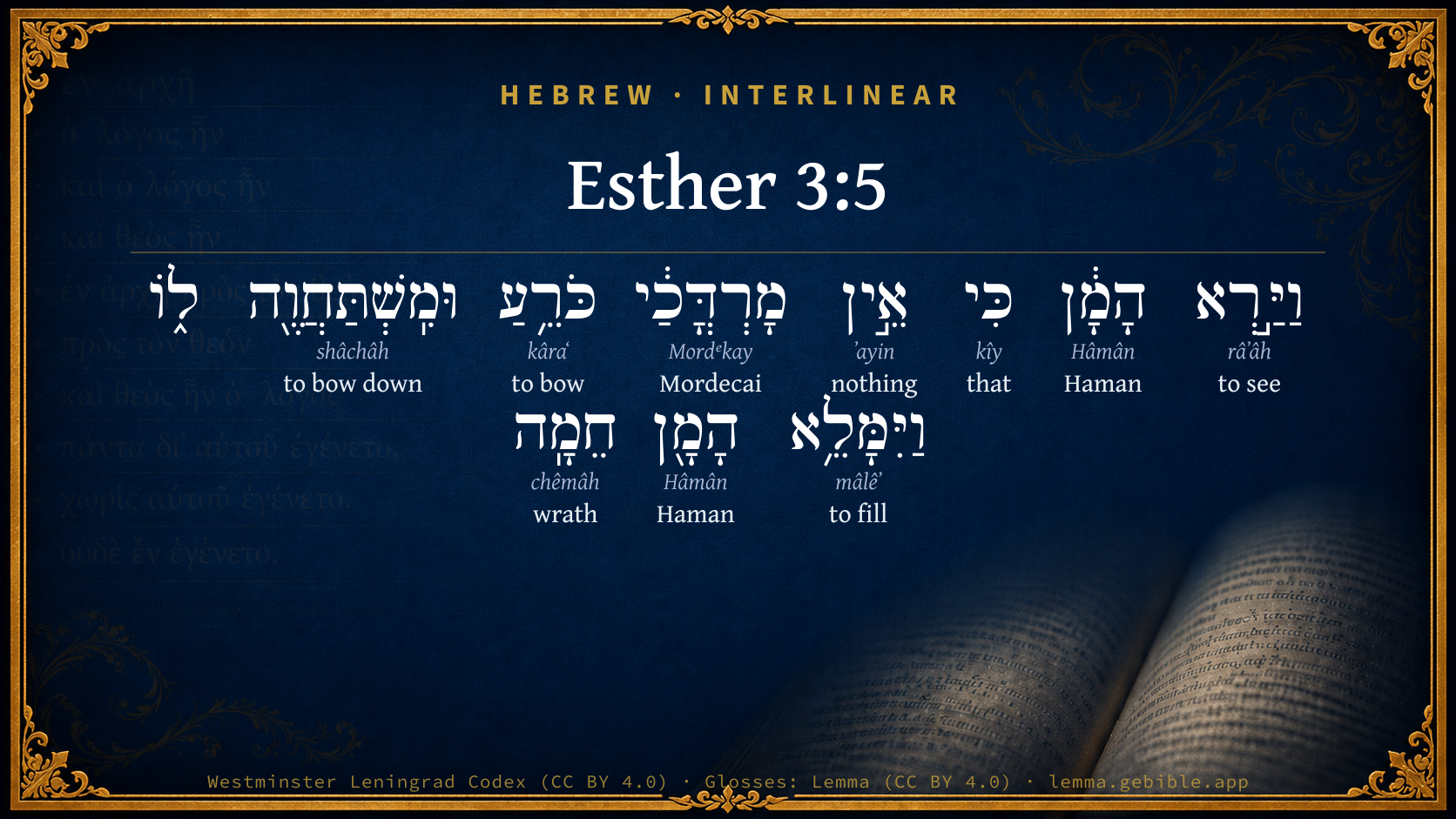
Hebrew (Westminster Leningrad Codex) Esther 3:5 appears in the Hebrew Old Testament. The text above is from the Westminster Leningrad Codex. Each word links to its Strong’s number, a concise gloss, and parsing drawn from the Open Scriptures Hebrew Bible morphology. Click any word for its full Brown-Driver-Briggs (BDB) entry.
Download image
Cite this verse

Esther 3:5 (World English Bible). Public Domain. Lemma interlinear Bible study tool, https://lemma.gebible.app/v/esther/3/5.

Show BibTeX & RIS
BibTeX
RIS
English Translation
When Haman saw that Mordecai didn't bow down, nor did him reverence, then was Haman full of wrath.
World English Bible · Public Domain
Download a study sheet

One document with this verse’s original text, its word-by-word gloss line, the meaning frame, cross-references with their text, attributed commentary, and full source and license credits — printable, and it pastes into notes with its structure intact.

This verse Autodidact and up

Study sheet (.html) Plain text (.txt)

A passage Seminary Student

Up to 50 verses in one chapter. A passage sheet keeps up to 6 commentary sources and 12 cross-references per verse, in the order this page ranks them, and says so on the sheet whenever that leaves anything out. Ask for a single verse and you get the Autodidact verse sheet above.

Everything on this page stays free to read, with no account — the sheet is a download of what is already on screen, not access to it.

Want to remove ads? Support Godless Engineer
Compare translations 3

The same verse in 3 English versions, stacked beneath the original-language interlinear above. Click any original word for its lexicon entry.

Each is an independent rendering of the whole verse — the interlinear is not word-aligned to these translations.

Highlighted words mark where these versions differ — a whole-verse word diff, not a word-by-word alignment.

  • World English Bible Public Domain
    When Haman saw that Mordecai didn't bow down, nor did him reverence, then was Haman full of wrath.
  • King James Version Public Domain
    And when Haman saw that Mordecai bowed not, nor did him reverence, then was Haman full of wrath.
  • unfoldingWord Literal Text CC BY-SA 4.0
    And Haman saw that Mordecai would neither bow down nor prostrate himself to him. And Haman was filled with rage.

unfoldingWord Literal Text — © unfoldingWord, licensed CC BY-SA 4.0. Word-aligned USFM3 via Door43 (git.door43.org/unfoldingWord/en_ult).

Versions to compare (up to 4)

3 of 4 selected

Show all 18 translations

Every available English version of this verse, each an independent rendering of the whole verse.

  • World English Bible Public Domain
    When Haman saw that Mordecai didn't bow down, nor did him reverence, then was Haman full of wrath.
  • Berean Standard Bible Public Domain
    When Haman saw that Mordecai would not bow down or pay him homage, he was filled with rage.
  • Majority Standard Bible Public Domain
    When Haman saw that Mordecai would not bow down or pay him homage, he was filled with rage.
  • King James Version Public Domain
    And when Haman saw that Mordecai bowed not, nor did him reverence, then was Haman full of wrath.
  • American Standard Version (1901) Public Domain
    And when Haman saw that Mordecai bowed not down, nor did him reverence, then was Haman full of wrath.
  • Revised Version (1885) Public Domain
    And when Haman saw that Mordecai bowed not down, nor did him reverence, then was Haman full of wrath.
  • Geneva Bible (1599) Public Domain
    And when Haman sawe that Mordecai bowed not the knee vnto him, nor did reuerence vnto him, then Haman was full of wrath.
  • Douay-Rheims (1899) Public Domain
    Now when Aman had heard this, and had proved by experience that Mardochai did not bend his knee to him, nor worship him, he was exceeding angry.
  • Young's Literal Translation Public Domain
    And Haman seeth that Mordecai is not bowing and doing obeisance to him, and Haman is full of fury,
  • Literal Standard Version CC BY-SA 4.0
    And Haman sees that Mordecai is not bowing and doing homage to him, and Haman is full of fury,
  • Unlocked Literal Bible CC BY-SA 4.0
    When Haman saw that Mordecai did not kneel and bow down to him, Haman was filled with rage.
  • unfoldingWord Literal Text CC BY-SA 4.0
    And Haman saw that Mordecai would neither bow down nor prostrate himself to him. And Haman was filled with rage.
  • Darby Bible Public Domain
    And when Haman saw that Mordecai bowed not, nor did him reverence, Haman was full of fury.
  • World Messianic Bible Public Domain
    When Haman saw that Mordecai didn’t bow down nor pay him homage, Haman was full of wrath.
  • Webster's Bible Public Domain
    And when Haman saw that Mordecai bowed not, nor did him reverence, then was Haman full of wrath.
  • Free Bible Version CC BY-SA 4.0
    Haman was furious when he saw that Mordecai did not bow down and show respect to him.
  • Bible in Basic English Public Domain
    And when Haman saw that Mordecai did not go down before him and give him honour, Haman was full of wrath.
  • JPS Tanakh (1917) Public Domain
    And when Haman saw that Mordecai bowed not down, nor prostrated himself before him, then was Haman full of wrath.

Literal Standard Version (2020), Covenant Press — licensed CC BY-SA 4.0. Text via the HelloAO Bible API (eBible.org). Unlocked Literal Bible (unfoldingWord) — licensed CC BY-SA 4.0. Text via the HelloAO Bible API (eBible.org). unfoldingWord Literal Text — © unfoldingWord, licensed CC BY-SA 4.0. Word-aligned USFM3 via Door43 (git.door43.org/unfoldingWord/en_ult). Free Bible Version, Dr. Jonathan Gallagher — licensed CC BY-SA 4.0. Text via the HelloAO Bible API (eBible.org).

Word by word

More ways to search: Search by grammar → Find every occurrence → Compare this word →

Practice this passage: Drill this verse → Learn its vocabulary →

כֹּרֵ֥עַ
kâraʻ
H3766
“bowing”
Verb, Qal, Participle Active, Masculine, Singular, Absolute
Part of Speech
Verb
Stem
Qal
Form
Participle Active
Gender
Masculine
Number
Singular
State
Absolute
Full BDB Definition

Origin: a primitive root

TWOT: 1044

to bend, kneel, bow, bow down, sink down to one's knees, kneel down to rest (of animals), kneel in reverence - (Qal) - to bow - to bow down, crouch - to bow down over - to tilt, lean - (Hiphil) to cause to bow
  1. וַיַּ֣רְא râʼâh H7200 “and · to see” Conjunction + Verb, Qal, Sequential Imperfect, 3rd Person, Masculine, Singular
  2. הָמָ֔ן Hâmân H2001 “Haman” Noun, Proper
  3. כִּי kîy H3588 “that” Conjunction
  4. אֵ֣ין ʼayin H369 “nothing” Particle, Negative
  5. מָרְדֳּכַ֔י Mordᵉkay H4782 “Mordecai” Noun, Proper
  6. וּמִֽשְׁתַּחֲוֶ֖ה shâchâh H7812 “and · bowing down” Conjunction + Verb, Hishtaphel, Participle Active, Masculine, Singular, Absolute
  7. וַיִּמָּלֵ֥א mâlêʼ H4390 “and · to fill” Conjunction + Verb, Niphal, Sequential Imperfect, 3rd Person, Masculine, Singular
  8. הָמָ֖ן Hâmân H2001 “Haman” Noun, Proper
  9. חֵמָֽה chêmâh H2534 “wrath” Noun, Common, Feminine, Singular, Absolute

About this verse

These counts appear in no published source. They are computed here, from the morphology-tagged text and Lemma’s own curated glosses. What Lemma adds →

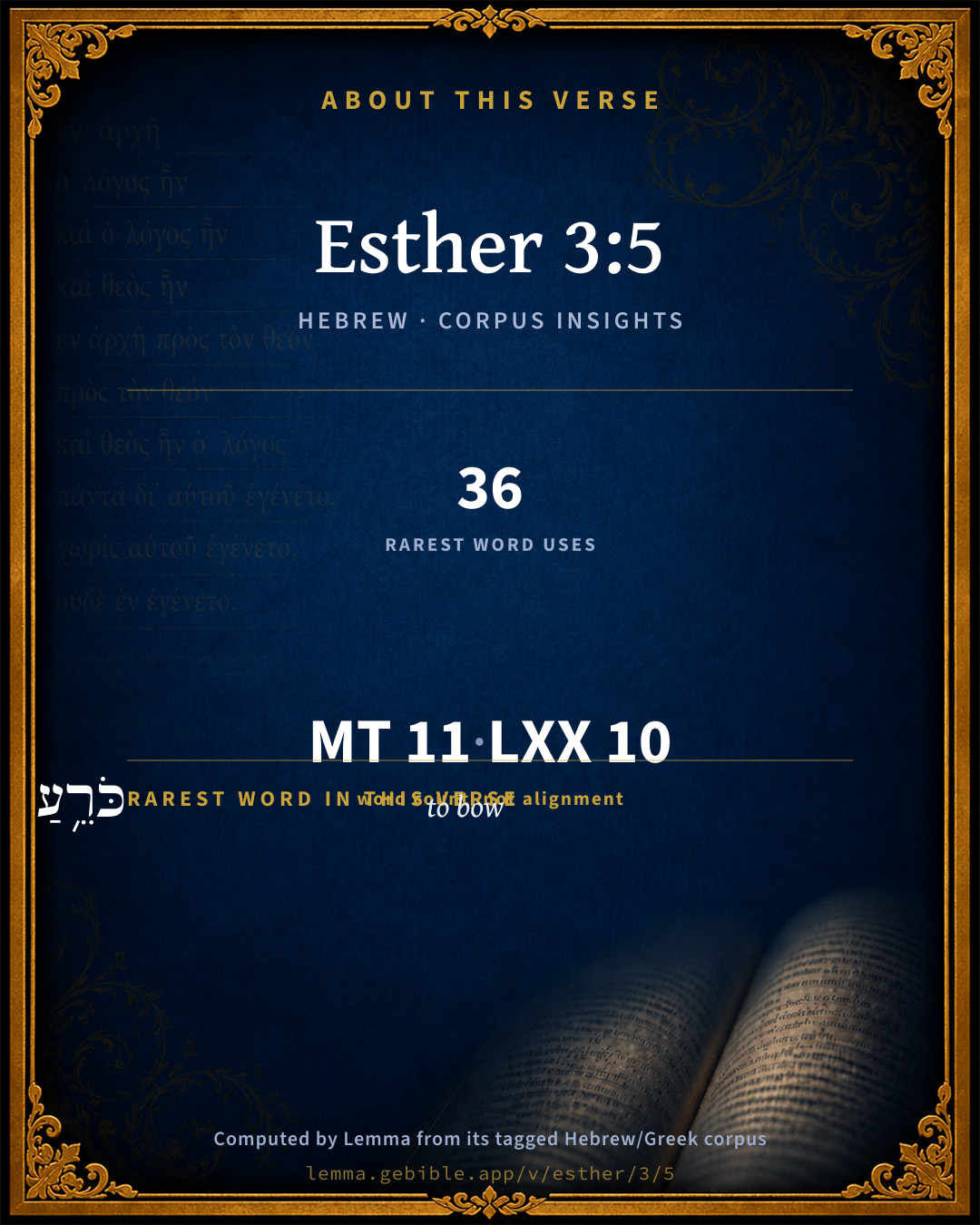
11
words
9
distinct lemmas
Historical
section

Shared distinctive vocabulary

כֹּרֵ֥עַ to bow H3766 occurs in 32 verses of the Hebrew Bible. Also found in:

Grammatical profile

  • 4 verbs
  • 4 nouns
  • 1 preposition
  • 1 conjunction
  • 1 particle

Verb forms

  • וַיַּ֣רְא Qal · Sequential Imperfect
  • כֹּרֵ֥עַ Qal · Participle Active
  • וּמִֽשְׁתַּחֲוֶ֖ה Hishtaphel · Participle Active
  • וַיִּמָּלֵ֥א Niphal · Sequential Imperfect

Repetition

A word recurs within this verse — often emphatic in Hebrew:

  • הָמָ֔ן Haman H2001 ×2

Hebrew & Septuagint length

In English translation the verse runs 18 words from the Hebrew and 15 from the Septuagint (LXX English) — closely comparable.

A rough comparison of the two English renderings, which tokenize alike — not a word-level alignment.

Word counts can differ between the Hebrew and the Greek without any difference in meaning — e.g. the Hebrew direct-object marker אֵת has no separate Greek word, and Greek often adds the article ὁ.

In the original languages it is 11 Hebrew tokens and 10 Greek tokens — but the two are counted differently (Hebrew bundles its prefixes and suffixes into one token; the Greek is in lemma form), so that isn’t a like-for-like length.

Cross-references

10

Topical passages linked to Esther 3:5 in the Treasury of Scripture Knowledge — connected by theme and wording, ordered by reader-vote popularity; previews shown in the World English Bible.

  • Esther 5:9 Then went Haman forth that day joyful and glad of heart: but when Haman saw Mordecai in the king's gate, that he didn't stand up nor move for him, he was filled with wrath against Mordecai.
  • Daniel 3:19 Then was Nebuchadnezzar full of fury, and the form of his visage was changed against Shadrach, Meshach, and Abednego: [therefore] he spoke, and commanded that they should heat the furnace seven times more than it was wont to be heated.
  • Esther 3:2 All the king's servants, who were in the king's gate, bowed down, and did reverence to Haman; for the king had so commanded concerning him. But Mordecai didn't bow down, nor did him reverence.
  • Proverbs 21:24 The proud and haughty man, "scoffer" is his name; He works in the arrogance of pride.
  • Genesis 4:5–6 but he didn't respect Cain and his offering. Cain was very angry, and the expression on his face fell.
  • Esther 1:12 But the queen Vashti refused to come at the king's commandment by the chamberlains: therefore was the king very angry, and his anger burned in him.
  • Job 5:2 For resentment kills the foolish man, And jealousy kills the simple.
  • Proverbs 12:16 A fool shows his annoyance the same day, But one who overlooks an insult is prudent.
  • Proverbs 19:19 A hot-tempered man must pay the penalty, For if you rescue him, you must do it again.
  • Proverbs 27:3–4 A stone is heavy, And sand is a burden; But a fool's provocation is heavier than both.

Cross-references courtesy of OpenBible.info (CC BY 4.0).

Hebrew and Greek witnesses Masoretic Hebrew ↔ Greek Septuagint

The same verse in the two great witnesses to the Old Testament, shown verse-for-verse.

These are two independent witnesses, not word-aligned to each other, and the Septuagint is shown in lemma (dictionary) form.

Hebrew Esther 3:5 Masoretic · Westminster Leningrad Codex

וַיַּ֣רְא הָמָ֔ן כִּי אֵ֣ין מָרְדֳּכַ֔י כֹּרֵ֥עַ וּמִֽשְׁתַּחֲוֶ֖ה ל֑וֹ וַיִּמָּלֵ֥א הָמָ֖ן חֵמָֽה

When Haman saw that Mordecai didn't bow down, nor did him reverence, then was Haman full of wrath.

World English Bible · Public Domain

Greek LXX Esther 3:5 Septuagint · lemma form

καί ἐπιγιγνώσκω αμαν ὅτι οὐ προςκυνέω αὐτός μαρδοχαῖος θυμόω σφόδρα

And when Aman understood that Mardochaeus did not obeisance to him, he was greatly enraged,

LXX2012 (modern English Septuagint) · Public Domain

Hebrew: Westminster Leningrad Codex (CC BY 4.0). Greek: Septuagint (public domain); English from LXX2012 (modern English Septuagint) (Public Domain). How the Septuagint differs from the Hebrew →

Commentary

Notes on Esther 3:5 from classic Christian and Jewish commentators (each source and its license shown beneath its notes). The classic Christian expositions comment on the surrounding passage and are grouped to its opening verse, so a note may address several verses; the Jewish commentaries on the Tanakh (Rashi and others) are per-verse, so they appear only where the commentator wrote on this verse.

Lemma curates 59 commentaries, every one of them public domain or Creative Commons licensed, each selected and text-cleaned for this edition rather than reprinted as found. About our sources →

Trapp's Complete Commentary

John Trapp

Est 3:5 And when Haman saw that Mordecai bowed not, nor did him reverence, then was Haman full of wrath.

Ver. 5. And when Haman saw] Stirred up by these pestilent flatterer, qui crabronem furiosum magis irritaverant, as one saith, he took special notice of Mordecai’s irreverence, which with more discretion he might have dissembled. When an inconsiderate fellow had stricken Cato in the bath, and afterwards cried him mercy, he replied, I remember not that thou didst strike me. It is a sign of weakness to be too soft and sensible of an indignity; "I was as a deaf man that heard not, and as one dumb, in whose mouth is no reproof," Psa 38:13-14. The best apology to words and carriages of scorn and petulance is that of Isaac to Ishmael, viz. patience and silence.

That Mordecai bowed not, &c.] A great business to enrage him so much, but that he was set on by that old man slayer.

Sic leve, sic parvum est, animum quod laudis avarum

Subruit, aut reficit -

So trivial, so small is it, the spirit because greedy of praise, will be undermined or restored. A small wind raiseth a bubble, ambition rideth without reins, and hath inhabitatorem Dracohere Apostatam, the devil at inn with it.

Then was Haman full of wrath] He swelled like a toad, glowed like a devil; being transformed as it were into a breathing devil, he seeks the utter extirpation of that people, of whom, concerning the flesh, Christ was to come, Rom 9:5, wishing the same to them which Caligula in a rage did to the people of Rome, I would ye had all but one neck, that I might cut you all off at one blow, Eιθ ενα αυχενα ειχετε. Josephus tells us, that he brake out into this blustering speech, Liberi Persae me adorant. Hic autem, servus cum sit, tamen hoc facere dedignatur: The Persians, though free men, reverence me, and yet this slave thinks himself too good to do it. This he uttered no doubt with a very harsh and hateful intention of the voice, such as was that of the two brethren in evil, whose anger was fierce and their wrath cruel, when, Gen 34:31, they answered their aggrieved father, Should he deal with our sister as a harlot? Gen 49:5; Gen 49:7; where the word Zonah (harlot) hath a great letter, to note their vehemency, rage, and rudeness.

John Trapp, A Commentary or Exposition upon All the Books of the Old and New Testament (1647–1656) — public domain. Text from a community e-Sword module.

The Biblical Illustrator

Joseph S. Exell

Est_3:5-6

And when Haman saw that Mordecai bowed not . . . then was Haman full of wrath.

Vanity and cruelty

Haman manifests by his behaviour the intimate connection there is between vanity and cruelty.

1. Vanity is a form of magnified egotism. When a vain man looks out on the world it is always through the medium of his own vastly magnified shadow. Like the Brocken Ghost, this shadow becomes a haunting presence standing out before him in huge proportions. He has no other standard of measurement. The good is what gives him pleasure; evil is what is noxious to him.

(1) Egoism utilises the sufferings of others for its own ends. No doubt cruelty is often the result of sheer callousness. It is not so in Hamans case; he is irritated, and vents his annoyance in a vast explosion of malignity that must take account of the agony it produces, for in that agony its own thirst for vengeance is to be slaked.

(2) Egoism promotes cruelty by destroying the sense of proportion. Self is not only regarded as the centre of the universe; like the sun surrounded by the planets, it is taken to be the greatest object, and everything else is insignificant when compared to it. What is the slaughter of a few thousand Jews to so great a man as Haman? It is no more than the destruction of as many flies in a forest fire that the settler has kindled to clear his ground. The same self-magnification is visibly presented by the Egyptian bas reliefs, on which the victorious Pharaohs appear as tremendous giants driving back hordes of enemies or dragging pigmy kings by their heads. It is but a step from this condition to insanity, which is the apotheosis of vanity. The chief characteristic of insanity is a diseased enlargement of self.

2. Vanity leads to cruelty through the entire dependence of the vain person on the good opinion of others. In this vanity differs from pride. A proud man is satisfied with himself, but the vain man is always looking outside himself with feverish eagerness to secure all the honours that the world can bestow upon him. While a proud man in an exalted position scarcely deigns to notice the dim, common people, the vain man betrays his vulgarity by caring supremely for popular adulation. Therefore, while the haughty person can afford to pass over a slight with contempt, the vain creature who lives on the breath of applause is mortally offended by it and roused to avenge the insult with corresponding rage. (W. F. Adeney, M. A.)

The misery of pride

A man of principle would have respected the conscientiousness of the act, even though he might have laughed at what he regarded the smallness of the scruple. A man of ordinary common sense would have treated the whole affair with indifference; but Haman valued his office just because it carried with it the right to such homage, and therefore what would have been a mole-hill, or hardly so much, to others, was a mountain to him. The proud man thus increases his own misery; and little slights, which other people would not so much as notice, are felt by him with great keenness. He whose arm has been recently vaccinated is very sensitive where the pustule is, so that a push which you would think nothing of is agony to him. Now, in precisely the same way the proud man is touchy, as we say; the slightest infringement on his dignity wounds him to the quick, and when other people are laughing he is vowing revenge; for, as this story illustrates, the passions are all near of kin, and one prepares the way for another. Brooding over the refusal of Mordecai to do him reverence, it became so magnified in his estimation that he determined to punish it; there was revenge. That he might gratify that revenge, it became necessary to bring the peculiarities of the Jewish nation before the king, and he requested their destruction on the ground that they were not profitable to the monarch, whereas the sole reason why he suggested their extirpa tion was that Mordecai had slighted him; there was falsehood. Then, in planning their massacre, there was murder. Here, therefore, were four sins all in a line, each rising above the other in enormity--pride, revenge, falsehood, murder. People think, sometimes, that pride is no great sin; some almost speak of it as if it were half a virtue; but, as this and other histories make plain, it is the germ of other evils that are worse than itself, and therefore we ought to be on our guard against allowing ourselves to become its victims. And how shall we best counteract it? I reply, by cultivating a sense of responsibility. That which we have, whether it be ability, or wealth, or exalted position, we have received as a trust, and we are to use it, as stewards for God, in the service of our fellow-men. Let us keep pressing the questions, Who hath made me to differ from others? What have I that I have not received? For what purpose have I been entrusted with these things? And the more we ponder these, the less we shall be inclined to plume ourselves on our possessions, and the more we shall be stirred up to the service of our generation by the will of God. (W. M. Taylor, D. D.)

Injured vanity

A man will forgive you anything, Professor Huxley said, if you do not injure his vanity. Once do that, and he will never forgive you.

Evil passion its own penalty

Now, it may be thought by some that the case of Haman allowing himself to be so chafed and perturbed by a trifle as to be made miserable in the midst of so many advantages, is to be regarded as altogether extreme and without parallel; but we believe that on examination it will be found that the wicked always receive part of their punishment in the violence of some unhallowed passion which blinds them to all the real benefits of their lot. Is there not a gnaw ing disease in the heart of the covetous man, for example, which prevents him from enjoying the good things which are placed within his reach, just because he has not yet acquired all that he wishes to possess? And still, as he gets more and more, is he not as far as ever from being satisfied, since he has not yet reached the point at which he aims? Or again, look to the man who is the slave of envy, and mark how miserable this base passion makes him. He has ample means of enjoyment, which he can call his own; but his neighbour has something which pleases him better, and just because that one thing is awanting to himself, he can find no satis faction in the varied blessings which a kind providence has showered upon him. His neighbours good is to him what Mordecai at the kings gate was to Haman. In like manner, I might advert to the working of the more violent passions of anger and revenge as a cause of intense torment to those who cherish them, and as altogether preventing them from taking advantage of many sources of happiness which lie open to them on every side. I might also allude to the misery which wounded vanity and affronted pride often bring to those who have high notions of their own importance, as when a trifling word or action will discompose them for many days together, and deprive them of their relish for the things that formerly pleased them, and made them happy. But enough has been said to show how by a just retribution the ungodly, following their natural tendencies and passions, work out their own passion. How different is the picture presented to us, where grace reigns in the heart. Although corruption is not altogether eradicated from the spiritual man, yet its power is subdued; the fierce passions are tamed, love takes the place of envy, malignity, and wrath; and the believer, seeking and finding his chief enjoyment in God, remains comparatively unruffled by those incidents which breed so much vexation and disquietude in the breast of the ungodly. (A. B. Davidson, D. D.)

Wounded pride

Wounded pride excites revenge, and this always burns hottest in the weakest minds. How insatiable is revenge, especially when it is associated with national and religious rancour! Haman learned that Mordecai was a Jew, a name that called up the bitterest recollections in the breast of an Amalekite, and he resolves at once on the total extermination of that people. (T. McCrie, D. D.)

A favourite lust

And it has always been one of the devices of the enemy to drive men into criminal excesses to their own ruin, through the instrumentality of some favourite lust or appetite. It was the covetous spirit of Judas that opened a way to the tempter to hurry him on to betray the Saviour. (A. B. Davidson, D. D.)

Then was Haman full of wrath.

The penalty of an evil passion

How dreadfully this wrath flamed in his bosom we learn from the method which he took to express it. We may observe, at present, what misery pride, by its own nature and inseparable consequences, brings upon men. No proud man ever received all that respect, or was treated with all that delicacy of regard, which he thought his due. Now pride mortified by neglect or contempt, kindles a fire in the soul which burns, and torments, and destroys. (G. Lawson.)

The Biblical Illustrator, edited by Joseph S. Exell (c. 1880s–1900s) — public domain. Text from a community e-Sword module.

Joseph Benson's Commentary

Est 3:5. Then was Haman full of rage — Josephus tells us, that Haman, taking notice of this singularity in Mordecai, asked him what countryman he was, and finding him to be a Jew, broke out into a violent exclamation at his insolence, and in his rage formed the desperate resolution, not only to be revenged on Mordecai, but to destroy the whole race of the Jews; well remembering that his ancestors, the Amalekites, had been formerly driven out of their country, and almost exterminated by the Jews.

Joseph Benson's Commentary on the Old and New Testaments (1811–1818) — public domain. Text from a community e-Sword module.

John Gill's Exposition

And when Haman saw that Mordecai bowed not, nor did him reverence,.... For, after the information given him, he observed and watched him, to see whether he bowed and did him reverence or not:

then was Haman full of wrath; exceedingly displeased and angry; it was such a mortification to him he could not bear.

John Gill's Exposition of the Whole Bible (1746–1763) — public domain (CC PDM 1.0). Text via the HelloAO Bible API.

The Pulpit Commentary

When Haman saw. Apparently Mordecai"s disrespect had not been observed by Haman until the "king"s servants" called his attention to it. Then, naturally enough, he was greatly offended, and felt exceedingly angry at what seemed to him a gross impertinence. Mordecai"s excuse did not pacify him perhaps seemed to him to make the matter worse, since, if allowed, it would justify all the Jews in the empire in withholding from him the respect that he considered his due.

The Pulpit Commentary (1880–1919), ed. H.D.M. Spence-Jones & Joseph S. Exell — public domain. Text from a community e-Sword module.

unfoldingWord translationNotes

Door43 World Missions Community

did not kneel and bow down

Mordecai showed disrespect for Haman's status in the government by not doing these actions. (See: Symbolic Action)

Haman was filled with rage

Here Haman's rage is spoken of as something that could fill him up. AT: "Haman became very angry" (See: Metaphor)

He had contempt for the idea of killing only Mordecai

"He rejected the idea of killing just Mordecai." This can also be stated in positive form. AT: "He decided to kill more than just Mordecai"

exterminate all the Jews

"get rid of all the Jews" or "kill all the Jews"

translationWords

Mordecai

kingdom

Ahasuerus

unfoldingWord translationNotes — © Distant Shores Media and the Door43 World Missions Community, licensed CC BY-SA 4.0. Source: git.door43.org/Door43/en_tn.

Lesson kit

Teaching starters — assembled from the data on this page, not authored interpretation. Every prompt links to the verse data it draws on. Edit before teaching.

Esther, in the Historical, opens this verse with 11 words (9 distinct Hebrew lemmas). Its most distinctive word is kâraʻ (“to bow”). A historical commentator’s framing appears above. Read the whole chapter for the surrounding context.

Discussion questions

  1. How does “to bow” (kâraʻ) shape what this verse is saying?
  2. How does Genesis 49:9, which shares the word «to bow», read alongside this verse?
  3. What does the repetition of “Haman” (2× in this one verse) do in this verse?
  4. These translations render this verse differently; the difference is in the English rendering, not the original. What questions does that raise?
  5. «וַיַּ֣רְא» is a Qal Sequential Imperfect verb. How does that grammatical form shape the action described?
  6. Compare how Trapp's Complete Commentary and The Biblical Illustrator read this verse. Where do they agree or differ?

Things to notice

Reading settings

Reading text

Shown beneath each verse's original-language words.

Old Testament
Old Testament edition

Read the OT as the Masoretic Hebrew (MT) or the Greek Septuagint (LXX).

English shown for the Greek Septuagint (in the Hebrew ↔ Greek comparison).

Comparing translations? Open the Compare panel on any verse page to stack up to four side by side.