
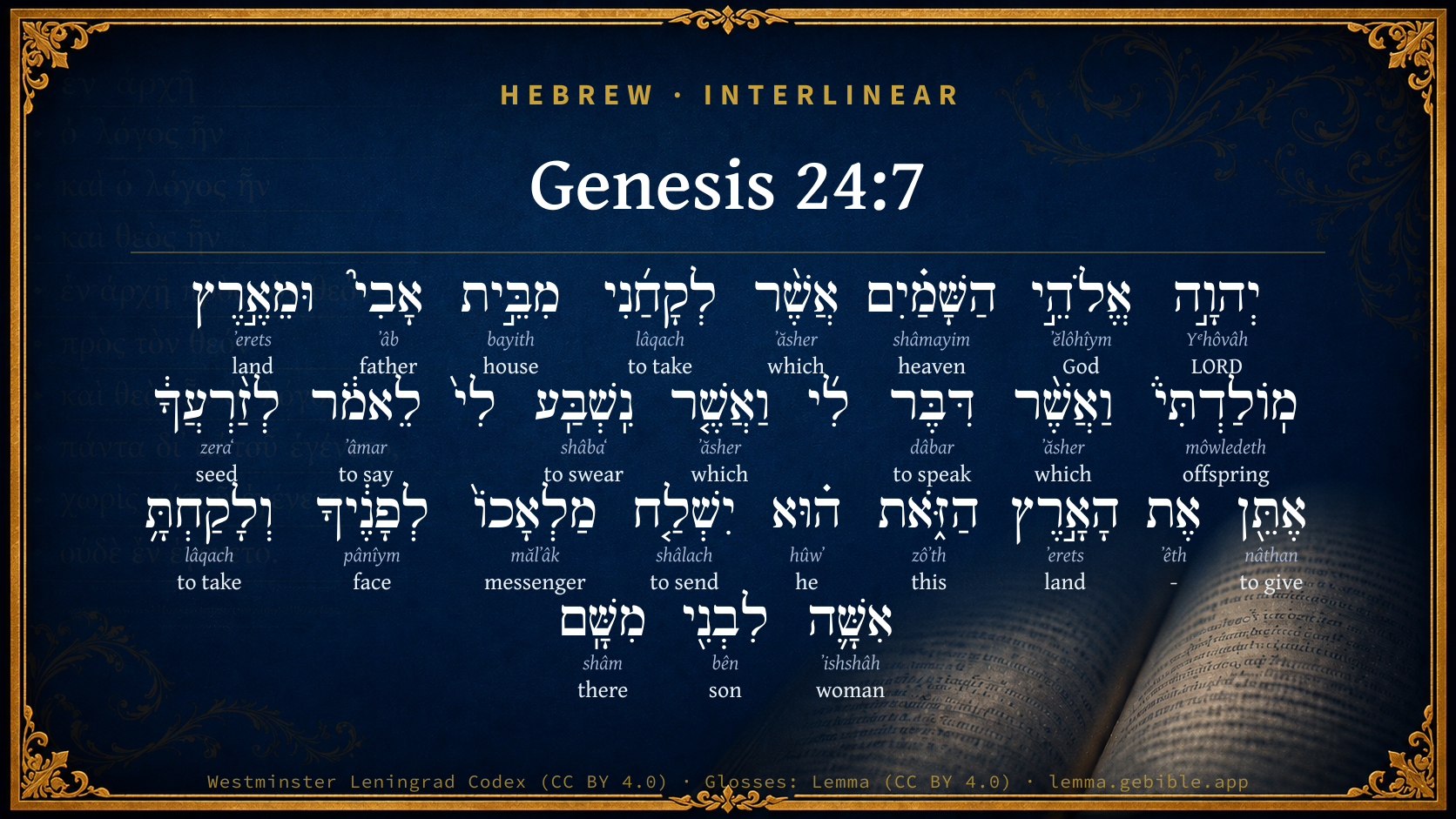
Genesis 24:7

Hebrew (Westminster Leningrad Codex) Genesis 24:7 appears in the Hebrew Old Testament. The text above is from the Westminster Leningrad Codex. Each word links to its Strong’s number, a concise gloss, and parsing drawn from the Open Scriptures Hebrew Bible morphology. Click any word for its full Brown-Driver-Briggs (BDB) entry.
Download image
Cite this verse

Genesis 24:7 (World English Bible). Public Domain. Lemma interlinear Bible study tool, https://lemma.gebible.app/v/genesis/24/7.

Show BibTeX & RIS
BibTeX
RIS
English Translation
Yahweh, the God of heaven, who took me from my father's house, and from the land of my birth, who spoke to me, and who swore to me, saying, 'I will give this land to your seed.' He will send his angel before you, and you shall take a wife for my son from there.
World English Bible · Public Domain
Download a study sheet

One document with this verse’s original text, its word-by-word gloss line, the meaning frame, cross-references with their text, attributed commentary, and full source and license credits — printable, and it pastes into notes with its structure intact.

This verse Autodidact and up

Study sheet (.html) Plain text (.txt)

A passage Seminary Student

Up to 50 verses in one chapter. A passage sheet keeps up to 6 commentary sources and 12 cross-references per verse, in the order this page ranks them, and says so on the sheet whenever that leaves anything out. Ask for a single verse and you get the Autodidact verse sheet above.

Everything on this page stays free to read, with no account — the sheet is a download of what is already on screen, not access to it.

Want to remove ads? Support Godless Engineer
Compare translations 3

The same verse in 3 English versions, stacked beneath the original-language interlinear above. Click any original word for its lexicon entry.

Each is an independent rendering of the whole verse — the interlinear is not word-aligned to these translations.

Highlighted words mark where these versions differ — a whole-verse word diff, not a word-by-word alignment.

  • World English Bible Public Domain
    Yahweh, the God of heaven, who took me from my father's house, and from the land of my birth, who spoke to me, and who swore to me, saying, 'I will give this land to your seed.' He will send his angel before you, and you shall take a wife for my son from there.
  • King James Version Public Domain
    The LORD God of heaven, which took me from my father's house, and from the land of my kindred, and which spake unto me, and that sware unto me, saying, Unto thy seed will I give this land; he shall send his angel before thee, and thou shalt take a wife unto my son from thence.
  • unfoldingWord Literal Text CC BY-SA 4.0
    Yahweh, the God of the heavens, who took me from the house of my father and from the land of my relatives and who spoke to me and who swore to me, saying, ‘To your offspring I will give this land,’ he will send his angel before you, and you will take a wife for my son from there.

unfoldingWord Literal Text — © unfoldingWord, licensed CC BY-SA 4.0. Word-aligned USFM3 via Door43 (git.door43.org/unfoldingWord/en_ult).

Versions to compare (up to 4)

3 of 4 selected

Show all 18 translations

Every available English version of this verse, each an independent rendering of the whole verse.

  • World English Bible Public Domain
    Yahweh, the God of heaven, who took me from my father's house, and from the land of my birth, who spoke to me, and who swore to me, saying, 'I will give this land to your seed.' He will send his angel before you, and you shall take a wife for my son from there.
  • Berean Standard Bible Public Domain
    The LORD, the God of heaven, who brought me from my father’s house and my native land, who spoke to me and promised me on oath, saying, ‘To your offspring I will give this land’—He will send His angel before you so that you can take a wife for my son from there.
  • Majority Standard Bible Public Domain
    The LORD, the God of heaven, who brought me from my father’s house and my native land, who spoke to me and promised me on oath, saying, ‘To your offspring I will give this land’—He will send His angel before you so that you can take a wife for my son from there.
  • King James Version Public Domain
    The LORD God of heaven, which took me from my father's house, and from the land of my kindred, and which spake unto me, and that sware unto me, saying, Unto thy seed will I give this land; he shall send his angel before thee, and thou shalt take a wife unto my son from thence.
  • American Standard Version (1901) Public Domain
    Jehovah, the God of heaven, who took me from my father's house, and from the land of my nativity, and who spake unto me, and who sware unto me, saying, Unto thy seed will I give this land. He will send his angel before thee, and thou shalt take a wife for my son from thence.
  • Revised Version (1885) Public Domain
    The LORD, the God of heaven, that took me from my father’s house, and from the land of my nativity, and that spake unto me, and that sware unto me, saying, Unto thy seed will I give this land; he shall send his angel before thee, and thou shalt take a wife for my son from thence.
  • Geneva Bible (1599) Public Domain
    The Lord God of heauen, who tooke me from my fathers house, and from the land where I was borne, and that spake vnto me, and that sware vnto me, saying, Vnto thy seede wil I giue this land, he shall send his Angel before thee, and thou shalt take a wife vnto my sonne from thence.
  • Douay-Rheims (1899) Public Domain
    The Lord God of heaven, who took me out of my father's house, and out of my native country, who spoke to me, and swore to me, saying: To thy seed will I give this land: he will send his angel before thee, and thou shalt take from thence a wife for my son.
  • Young's Literal Translation Public Domain
    Jehovah, God of the heavens, who hath taken me from the house of my father, and from the land of my birth, and who hath spoken to me, and who hath sworn to me, saying, To thy seed I give this land, He doth send His messenger before thee, and thou hast taken a wife for my son from thence;
  • Literal Standard Version CC BY-SA 4.0
    YHWH, God of the heavens, who has taken me from the house of my father, and from the land of my birth, and who has spoken to me, and who has sworn to me, saying, To your seed I give this land, He sends His messenger before you, and you have taken a wife for my son from there;
  • Unlocked Literal Bible CC BY-SA 4.0
    Yahweh, the God of heaven, who took me from my father's house and from the land of my relatives, and who promised me with a solemn oath saying, 'To your offspring I will give this land,' he will send his angel before you, and you will get a wife for my son from there.
  • unfoldingWord Literal Text CC BY-SA 4.0
    Yahweh, the God of the heavens, who took me from the house of my father and from the land of my relatives and who spoke to me and who swore to me, saying, ‘To your offspring I will give this land,’ he will send his angel before you, and you will take a wife for my son from there.
  • Darby Bible Public Domain
    Jehovah the God of the heavens, who took me out of my father's house, and out of the land of my nativity, and who has spoken to me, and who has sworn to me, saying, Unto thy seed will I give this land -- he will send his angel before thee, that thou mayest take a wife for my son thence.
  • World Messianic Bible Public Domain
    The LORD, the God of heaven—who took me from my father’s house, and from the land of my birth, who spoke to me, and who swore to me, saying, ‘I will give this land to your offspring—he will send his angel before you, and you shall take a wife for my son from there.
  • Webster's Bible Public Domain
    The LORD God of heaven, who took me from my father's house, and from the land of my kindred, and who spoke to me, and who swore to me, saying, To thy seed I will give this land: he will send his angel before thee, and thou shalt take a wife for my son from thence.
  • Free Bible Version CC BY-SA 4.0
    “The Lord, the God of heaven, took me from my family home and my own country. He spoke to me and swore an oath to me in which he promised, ‘I will give this land to your descendants.’ He is the one who will send his angel ahead of you so that you can find a wife there for my son.
  • Bible in Basic English Public Domain
    The Lord God of heaven, who took me from my father's house and from the land of my birth, and made an oath to me, saying, To your seed I will give this land: he will send his angel before you and give you a wife for my son in that land.
  • JPS Tanakh (1917) Public Domain
    The LORD, the God of heaven, who took me from my father's house, and from the land of my nativity, and who spoke unto me, and who swore unto me, saying: Unto thy seed will I give this land; He will send His angel before thee, and thou shalt take a wife for my son from thence.

Literal Standard Version (2020), Covenant Press — licensed CC BY-SA 4.0. Text via the HelloAO Bible API (eBible.org). Unlocked Literal Bible (unfoldingWord) — licensed CC BY-SA 4.0. Text via the HelloAO Bible API (eBible.org). unfoldingWord Literal Text — © unfoldingWord, licensed CC BY-SA 4.0. Word-aligned USFM3 via Door43 (git.door43.org/unfoldingWord/en_ult). Free Bible Version, Dr. Jonathan Gallagher — licensed CC BY-SA 4.0. Text via the HelloAO Bible API (eBible.org).

Word by word

More ways to search: Search by grammar → Find every occurrence → Compare this word →

Practice this passage: Drill this verse → Learn its vocabulary →

מֽוֹלַדְתִּי֒
môwledeth
H4138
“offspring · my”
Noun, Common, Feminine, Singular, Construct + Suffix, Personal, 1st Person, Common, Singular
Part of Speech
Noun
Type
Common
Gender
Feminine
Number
Singular
State
Construct
Full BDB Definition

Origin: from H3205

TWOT: 867f

kindred, birth, offspring, relatives - kindred - birth, circumstances of birth - one born, begotten, issue, offspring, female offspring
  1. יְהוָ֣ה Yᵉhôvâh H3068 “LORD” Noun, Proper
  2. אֱלֹהֵ֣י ʼĕlôhîym H430 “God(s) of” Noun, Common, Masculine, Plural, Construct
  3. הַשָּׁמַ֗יִם shâmayim H8064 “the · heaven(s)” Particle, Definite Article + Noun, Common, Masculine, Plural, Absolute
  4. אֲשֶׁ֨ר ʼăsher H834 “which” Particle, Relative
  5. לְקָחַ֜נִי lâqach H3947 “to take · me” Verb, Qal, Perfect, 3rd Person, Masculine, Singular + Suffix, Personal, 1st Person, Common, Singular
  6. מִבֵּ֣ית bayith H1004 “from · house of” Preposition + Noun, Common, Masculine, Singular, Construct
  7. אָבִי֮ ʼâb H1 “father · my” Noun, Common, Masculine, Singular, Construct + Suffix, Personal, 1st Person, Common, Singular
  8. וּמֵאֶ֣רֶץ ʼerets H776 “and · from · land of” Conjunction + Preposition + Noun, Common, Both, Singular, Construct
  9. וַאֲשֶׁ֨ר ʼăsher H834 “and · which” Conjunction + Particle, Relative
  10. דִּבֶּר dâbar H1696 “to speak” Verb, Piel, Perfect, 3rd Person, Masculine, Singular
  11. וַאֲשֶׁ֤ר ʼăsher H834 “and · which” Conjunction + Particle, Relative
  12. נִֽשְׁבַּֽע shâbaʻ H7650 “to swear” Verb, Niphal, Perfect, 3rd Person, Masculine, Singular
  13. לֵאמֹ֔ר ʼâmar H559 “to say” Preposition + Verb, Qal, Infinitive Construct
  14. לְזַ֨רְעֲךָ֔ zeraʻ H2233 “to/for · seed · your” Preposition + Noun, Common, Masculine, Singular, Construct + Suffix, Personal, 2nd Person, Masculine, Singular
  15. אֶתֵּ֖ן nâthan H5414 “to give” Verb, Qal, Imperfect, 1st Person, Common, Singular
  16. אֶת ʼêth H853 “-” Particle, Direct Object
  17. הָאָ֣רֶץ ʼerets H776 “the · land” Particle, Definite Article + Noun, Common, Both, Singular, Absolute
  18. הַזֹּ֑את zôʼth H2063 “the · this” Particle, Definite Article + Pronoun, Demonstrative, Feminine, Singular
  19. ה֗וּא hûwʼ H1931 “he” Pronoun, Personal, 3rd Person, Masculine, Singular
  20. יִשְׁלַ֤ח shâlach H7971 “to send” Verb, Qal, Imperfect, 3rd Person, Masculine, Singular
  21. מַלְאָכוֹ֙ mălʼâk H4397 “messenger · his” Noun, Common, Masculine, Singular, Construct + Suffix, Personal, 3rd Person, Masculine, Singular
  22. לְפָנֶ֔יךָ pânîym H6440 “to/for · face(s) · your” Preposition + Noun, Common, Both, Plural, Construct + Suffix, Personal, 2nd Person, Masculine, Singular
  23. וְלָקַחְתָּ֥ lâqach H3947 “and · to take” Conjunction + Verb, Qal, Sequential Perfect, 2nd Person, Masculine, Singular
  24. אִשָּׁ֛ה ʼishshâh H802 “woman” Noun, Common, Feminine, Singular, Absolute
  25. לִבְנִ֖י bên H1121 “to/for · son · my” Preposition + Noun, Common, Masculine, Singular, Construct + Suffix, Personal, 1st Person, Common, Singular
  26. מִשָּֽׁם shâm H8033 “from · there” Preposition + Adverb

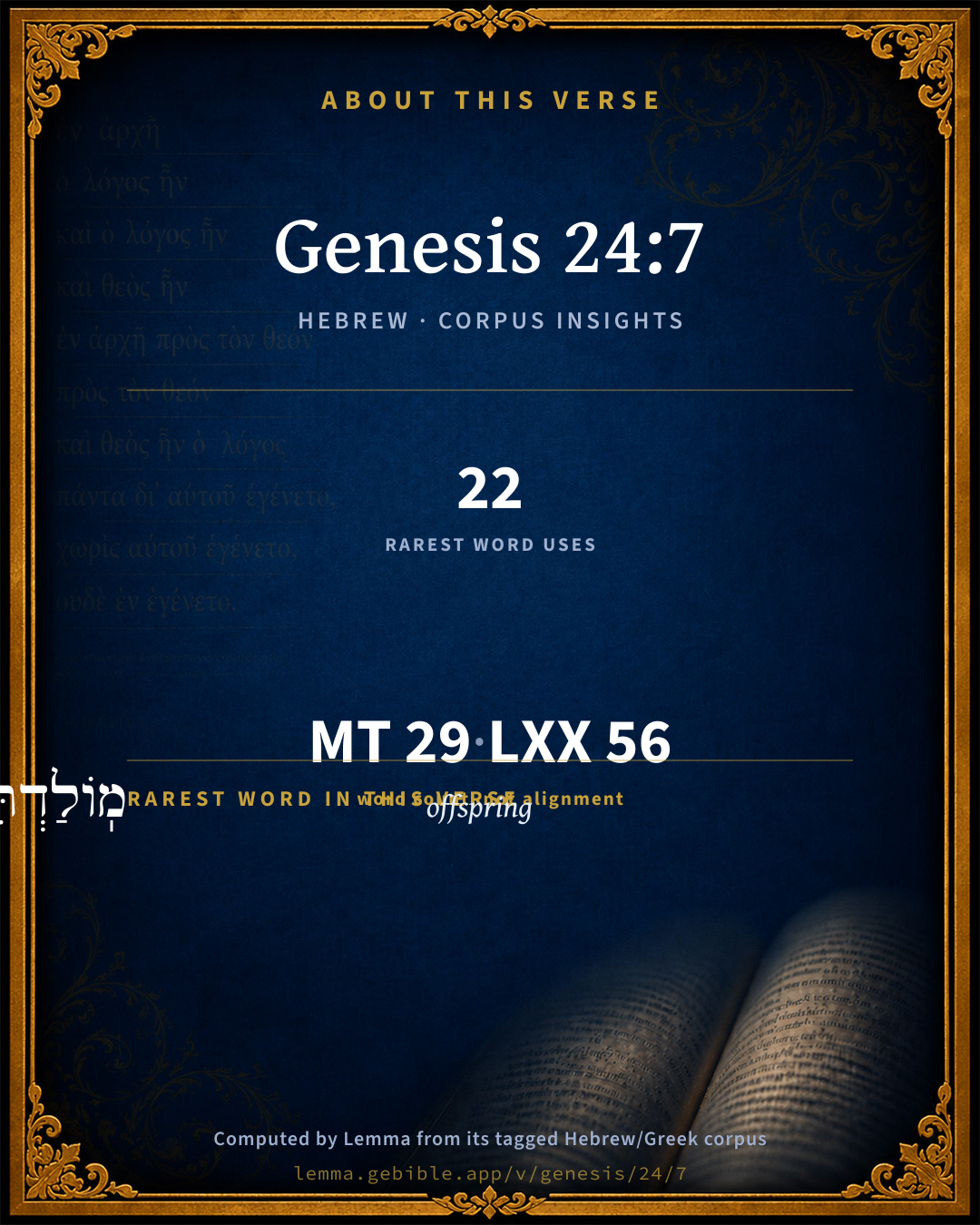
About this verse

These counts appear in no published source. They are computed here, from the morphology-tagged text and Lemma’s own curated glosses. What Lemma adds →

29
words
23
distinct lemmas
Pentateuch
section

Notable vocabulary

The rarest word here is מֽוֹלַדְתִּי֒ offspring H4138 — appearing just 22 times in the whole Hebrew Bible.

Shared distinctive vocabulary

מֽוֹלַדְתִּי֒ offspring H4138 occurs in 21 verses of the Hebrew Bible. Also found in:

Grammatical profile

  • 7 verbs
  • 13 nouns
  • 2 pronouns
  • 2 prepositions
  • 1 adverb
  • 4 particles

Verb forms

  • לְקָחַ֜נִי Qal · Perfect
  • דִּבֶּר Piel · Perfect
  • נִֽשְׁבַּֽע Niphal · Perfect
  • לֵאמֹ֔ר Qal · Infinitive Construct
  • אֶתֵּ֖ן Qal · Imperfect
  • יִשְׁלַ֤ח Qal · Imperfect
  • וְלָקַחְתָּ֥ Qal · Sequential Perfect

Repetition

Words recur within this verse — often emphatic in Hebrew:

  • לְקָחַ֜נִי to take H3947 ×2
  • וּמֵאֶ֣רֶץ land H776 ×2
  • אֲשֶׁ֨ר which H834 ×3

Hebrew & Septuagint length

In English translation the verse runs 55 words from the Hebrew and 67 from the Septuagint (LXX English) — closely comparable.

A rough comparison of the two English renderings, which tokenize alike — not a word-level alignment.

Word counts can differ between the Hebrew and the Greek without any difference in meaning — e.g. the Hebrew direct-object marker אֵת has no separate Greek word, and Greek often adds the article ὁ.

In the original languages it is 29 Hebrew tokens and 56 Greek tokens — but the two are counted differently (Hebrew bundles its prefixes and suffixes into one token; the Greek is in lemma form), so that isn’t a like-for-like length.

Cross-references

31

Topical passages linked to Genesis 24:7 in the Treasury of Scripture Knowledge — connected by theme and wording, ordered by reader-vote popularity; previews shown in the World English Bible.

  • Exodus 33:2 I will send an angel before you; and I will drive out the Canaanite, the Amorite, and the Hittite, and the Perizzite, the Hivite, and the Jebusite:
  • Psalms 34:7 The angel of Yahweh encamps round about those who fear him, And delivers them.
  • Genesis 13:15 for all the land which you see, I will give to you, and to your offspring forever.
  • Exodus 23:20–23 "Behold, I send an angel before you, to keep you by the way, and to bring you into the place which I have prepared.
  • Hebrews 1:14 Aren't they all ministering spirits, sent out to do service for the sake of those who will inherit salvation?
  • Genesis 15:18 In that day Yahweh made a covenant with Abram, saying, "To your seed have I given this land, from the river of Egypt to the great river, the river Euphrates:
  • Exodus 32:13 Remember Abraham, Isaac, and Israel, your servants, to whom you swore by your own self, and said to them, 'I will multiply your seed as the stars of the sky, and all this land that I have spoken of I will give to your seed, and they shall inherit it forever.'"
  • Psalms 32:8 I will instruct you and teach you in the way which you shall go. I will counsel you with my eye on you.
  • Psalms 73:24 You will guide me with your counsel, And afterward receive me to glory.
  • Psalms 103:20 Praise Yahweh, you angels of his, Who are mighty in strength, who fulfill his word, Obeying the voice of his word.
  • Genesis 17:8 I will give to you, and to your seed after you, the land where you are traveling, all the land of Canaan, for an everlasting possession. I will be their God."
  • Genesis 22:16–18 and said, "I have sworn by myself, says Yahweh, because you have done this thing, and have not withheld your son, your only son,
  • Genesis 26:3–4 Sojourn in this land, and I will be with you, and will bless you. For to you, and to your seed, I will give all these lands, and I will establish the oath which I swore to Abraham your father.
  • Genesis 26:24 Yahweh appeared to him the same night, and said, "I am the God of Abraham your father. Don't be afraid, for I am with you, and will bless you, and multiply your seed for my servant Abraham's sake."
  • Exodus 13:5 It shall be, when Yahweh shall bring you into the land of the Canaanite, and the Hittite, and the Amorite, and the Hivite, and the Jebusite, which he swore to your fathers to give you, a land flowing with milk and honey, that you shall keep this service in this month.
  • Numbers 14:16 Because Yahweh was not able to bring this people into the land which he swore to them, therefore he has slain them in the wilderness.
  • Numbers 14:30 surely you shall not come into the land, concerning which I swore that I would make you dwell therein, save Caleb the son of Jephunneh, and Joshua the son of Nun.
  • Numbers 32:11 Surely none of the men who came up out of Egypt, from twenty years old and upward, shall see the land which I swore to Abraham, to Isaac, and to Jacob; because they have not wholly followed me:
  • Deuteronomy 1:8 Behold, I have set the land before you: go in and possess the land which Yahweh swore to your fathers, to Abraham, to Isaac, and to Jacob, to give to them and to their seed after them.
  • Deuteronomy 34:4 Yahweh said to him, This is the land which I swore to Abraham, to Isaac, and to Jacob, saying, I will give it to your seed: I have caused you to see it with your eyes, but you shall not go over there.
  • Joshua 1:6 Be strong and of good courage; for you shall cause this people to inherit the land which I swore to their fathers to give them.
  • Proverbs 3:5–6 Trust in Yahweh with all your heart, And don't lean on your own understanding.
  • Daniel 2:44 In the days of those kings shall the God of heaven set up a kingdom which shall never be destroyed, nor shall the sovereignty of it be left to another people; but it shall break in pieces and consume all these kingdoms, and it shall stand forever.
  • Acts 7:5 He gave him no inheritance in it, no, not so much as to set his foot on. He promised that he would give it to him for a possession, and to his seed after him, when he still had no child.
  • Hebrews 11:9 By faith, he lived as an alien in the land of promise, as in a land not his own, dwelling in tents, with Isaac and Jacob, the heirs with him of the same promise.
  • Revelation 11:13 In that day there was a great earthquake, and a tenth of the city fell. Seven thousand people were killed in the earthquake, and the rest were terrified, and gave glory to the God of heaven.
  • Genesis 12:1–7 Now Yahweh said to Abram, "Get out of your country, and from your relatives, and from your father's house, to the land that I will show you.
  • Judges 2:1 The angel of Yahweh came up from Gilgal to Bochim. He said, I made you to go up out of Egypt, and have brought you to the land which I swore to your fathers; and I said, I will never break my covenant with you:
  • Isaiah 63:9 In all their affliction he was afflicted, and the angel of his presence saved them: in his love and in his pity he redeemed them; and he bore them, and carried them all the days of old.
  • Ezra 1:2 Thus says Cyrus king of Persia, All the kingdoms of the earth has Yahweh, the God of heaven, given me; and he has charged me to build him a house in Jerusalem, which is in Judah.
  • Jonah 1:9 He said to them, "I am a Hebrew, and I fear Yahweh, the God of heaven, who has made the sea and the dry land."

Cross-references courtesy of OpenBible.info (CC BY 4.0).

Hebrew and Greek witnesses Masoretic Hebrew ↔ Greek Septuagint

The same verse in the two great witnesses to the Old Testament, shown verse-for-verse.

These are two independent witnesses, not word-aligned to each other, and the Septuagint is shown in lemma (dictionary) form.

Hebrew Genesis 24:7 Masoretic · Westminster Leningrad Codex

יְהוָ֣ה אֱלֹהֵ֣י הַשָּׁמַ֗יִם אֲשֶׁ֨ר לְקָחַ֜נִי מִבֵּ֣ית אָבִי֮ וּמֵאֶ֣רֶץ מֽוֹלַדְתִּי֒ וַאֲשֶׁ֨ר דִּבֶּר לִ֜י וַאֲשֶׁ֤ר נִֽשְׁבַּֽע לִי֙ לֵאמֹ֔ר לְזַ֨רְעֲךָ֔ אֶתֵּ֖ן אֶת הָאָ֣רֶץ הַזֹּ֑את ה֗וּא יִשְׁלַ֤ח מַלְאָכוֹ֙ לְפָנֶ֔יךָ וְלָקַחְתָּ֥ אִשָּׁ֛ה לִבְנִ֖י מִשָּֽׁם

Yahweh, the God of heaven, who took me from my father's house, and from the land of my birth, who spoke to me, and who swore to me, saying, 'I will give this land to your seed.' He will send his angel before you, and you shall take a wife for my son from there.

World English Bible · Public Domain

Greek LXX Genesis 24:7 Septuagint · lemma form

κύριος ὁ θεός ὁ οὐρανός καί ὁ θεός ὁ γῆ ὅς λαμβάνω ἐγώ ἐκ ὁ οἶκος ὁ πατήρ ἐγώ καί ἐκ ὁ γῆ ὅς γίγνομαι ὅς λαλέω ἐγώ καί ὄμνυμι ἐγώ λέγω σύ δίδωμι ὁ γῆ οὗτος καί ὁ σπέρμα σύ αὐτός ἀποστέλλω ὁ ἄγγελος αὐτός ἔμπροσθεν σύ καί λαμβάνω γυνή ὁ υἱός ἐγώ ισαακ ἐκεῖθεν

The Lord the God of heaven, and the God of the earth, who took me out of my father's house, and out of the land whence I sprang, who spoke to me, and who swore to me, saying, I will give this land to you and to your seed, he shall send his angel before you, and you shall take a wife to my son from thence.

LXX2012 (modern English Septuagint) · Public Domain

On this verse, The Cambridge Bible for Schools and Colleges discusses the Septuagint’s reading. Read the note in Commentary ↓

Hebrew: Westminster Leningrad Codex (CC BY 4.0). Greek: Septuagint (public domain); English from LXX2012 (modern English Septuagint) (Public Domain). How the Septuagint differs from the Hebrew →

Targum (Aramaic paraphrase)

2

The Targum is the ancient Jewish Aramaic paraphrase of the Hebrew Scriptures — an interpretive translation, not the Hebrew text itself. Onkelos (literal) and Pseudo-Jonathan (expansive) render the Torah, and Jonathan the Prophets. Coverage is partial: where no permissively-licensed English translation exists for a verse, only the Aramaic is shown. This is verse-level text, not a word-by-word alignment to the Hebrew.

  1. Targum Onkelos Torah (Genesis–Deuteronomy)
    יְיָ אֱלָהָא דִּשְׁמַיָּא דִּי דַּבְּרַנִי מִבֵּית אַבָּא וּמֵאֲרַע יַלְדוּתִי וְדִי מַלֵּל לִי וְדִי קַיֵּם לִי לְמֵימַר לִבְרָךְ אֶתֵּן יָת אַרְעָא הָדָא הוּא יִשְׁלַח מַלְאָכֵהּ קֳדָמָךְ וְתִסַּב אִתְּתָא לִבְרִי מִתַּמָּן

    (no public-domain English translation for this verse)

    Targum Onkelos — Aramaic: “Onkelos Genesis” (public domain); “Onkelos Exodus” (public domain); “Onkelos Leviticus” (public domain); “Onkelos Numbers” (public domain); “Onkelos Deuteronomy” (public domain). English: “Sefaria Community Translation” (CC0 1.0 (public-domain dedication)); “J.W. Etheridge. The Targums of Onkelos and Jonathan Ben Uzziel on the Pentateuch. London: Longmans, Green, 1862” (public domain). Text via Sefaria.

  2. Targum Pseudo-Jonathan Torah (Genesis–Deuteronomy)
    יְיָ אֱלָהָא דְמוֹתְבֵיהּ בִּשְׁמֵי מְרוֹמָא דְדַבְּרַנִי מִן בֵּית אַבָּא וּמִן אֲרַע יַלְדוּתִי וּדְמַלֵיל לִי וּדְקַיֵים עָלַי לְמֵימַר לִבְנָךְ אֶתֵּן יַת אַרְעָא הָדָא הוּא יַזְמִין מַלְאֲכִי לְקָמָךְ וְתִיסַב אִיתָא לִבְרִי מִתַּמָן

    The Lord God, whose seat is in heaven on high, who took me from my father's house, and from the land of my birth; and who spake to me, and sware to me, saying, To thy son will I give this land; He will seasonably send His angel, and thou shalt take a wife for my son from thence.

    Targum Pseudo-Jonathan — Aramaic: “Targum Jonathan on Genesis” (public domain); “Targum Jonathan on Exodus” (public domain); “Targum Jonathan on Leviticus” (public domain); “Targum Jonathan on Numbers” (public domain); “Targum Jonathan on Deuteronomy” (public domain). English: “The Targum of Jonathan ben Uzziel, trans. J. W. Etheridge, London, 1862” (public domain). Text via Sefaria.

Commentary

Notes on Genesis 24:7 from classic Christian and Jewish commentators (each source and its license shown beneath its notes). The classic Christian expositions comment on the surrounding passage and are grouped to its opening verse, so a note may address several verses; the Jewish commentaries on the Tanakh (Rashi and others) are per-verse, so they appear only where the commentator wrote on this verse.

Lemma curates 59 commentaries, every one of them public domain or Creative Commons licensed, each selected and text-cleaned for this edition rather than reprinted as found. About our sources →

Trapp's Complete Commentary

John Trapp

Gen 24:7 The LORD God of heaven, which took me from my father’s house, and from the land of my kindred, and which spake unto me, and that sware unto me, saying, Unto thy seed will I give this land; he shall send his angel before thee, and thou shalt take a wife unto my son from thence.

Ver. 7. He shall send his angel.] There are myriads of angels, {Dan 7:10} and all sent out for the solace and safe conduct of the saints. {Heb 1:14} Oh, the dignity and safety of a child of God!

Thou shalt take a wife.] He argues from what God hath done for him, to what he will do. Every former favour is a pledge of a future. Thou hast, thou wilt, is a Scripture demonstration. {see Psa 85:1-4} Six thou hasts; whereupon he infers and enforceth his, "Turn us, O God of our salvation," &c.

John Trapp, A Commentary or Exposition upon All the Books of the Old and New Testament (1647–1656) — public domain. Text from a community e-Sword module.

Joseph Benson's Commentary

Gen 24:7. He shall send his angel before thee — God’s angels are ministering spirits, sent forth, not only for the protection, but guidance of the heirs of promise, Heb 1:14. And they who are thus guided are sure to speed well.

Joseph Benson's Commentary on the Old and New Testaments (1811–1818) — public domain. Text from a community e-Sword module.

Adam Clarke's Commentary

Verse 7. The Lord God, c.] He expresses the strongest confidence in God, that the great designs for which he had brought him from his own kindred to propagate the true religion in the earth would be accomplished and that therefore, when earthly instruments failed, heavenly ones should be employed. He shall send his angel, probably meaning the Angel of the Covenant, of whom see Ge 15:7.

Adam Clarke's Commentary on the Bible (1810–1826) — public domain. Text from a community e-Sword/MySword module.

John Calvin's Commentaries

7. The Lord God of heaven. By a twofold argument Abraham infers, that what he is deliberating respecting the marriage of his son will, by the grace of God, have a prosperous issue. First, because God had not led him forth in vain from his own country into a foreign land; and secondly, because God had not falsely promised to give the land, in which he was dwelling as a stranger, to his seed. He might also with propriety be confident that his design should succeed, because he had undertaken it only by the authority, and, as it were, under the auspices of God; for it was his exclusive regard for God which turned away his mind from the daughters of Canaan. He may, however, be thought to have inferred without reason that God would give his son a wife from that country and kindred to which he himself had bidden farewell. But whereas he had left his relatives only at the divine command, he hopes that God will incline their minds to be propitious and favorable to him. Meanwhile he concludes, from the past kindnesses of God, that his hand would not fail him in the present business; as if he would say, “I, who at the command of God left my country, and have experienced his continued help in my pilgrimage, do not doubt that he will also be the guide of thy journey, because it is in reliance on his promise that I lay upon thee this injunction.” He then describes the mode in which assistance would be granted; namely, that God would send his angel, for he knew that God helps his servants by the ministration of angels, of which he had already received many proofs. By calling God the God of heaven, he celebrates that divine power which was the ground of his confidence.

John Calvin's Commentaries (1540-1563) — public domain. Text from the Calvin Translation Society English edition (1840s-50s) via the Christian Classics Ethereal Library (ccel.org). Calvin's coverage is partial (roughly two-thirds of the Bible); uncommented books and verses are honest gaps, never fabricated. The 19th-century editor's footnotes and remarks are omitted so the notes are faithfully Calvin's own voice.

The Cambridge Bible for Schools and Colleges

gen. ed. J. J. S. Perowne

7. the God of heaven] The LXX adds “and the God of the earth,” from Gen_24:3. The phrase “the God of heaven” occurs in Ezr_5:12; Neh_1:4-5; Neh_2:4; Jon_1:9; Tob_5:16.

the land of my nativity] See Gen_12:1 (J). The land of Haran is clearly intended.

that sware unto me, &c.] The reference is to Gen_12:7; cf. also Gen_13:15, Gen_15:18, Gen_22:16.

he shall send his angel] It is noteworthy that Abraham does not here speak of Jehovah being present with the servant on his mission. The servant of Abraham will be guided by “the messenger, or angel,” of Abraham’s God. For “the angel of Jehovah” going before His people, cf. Exo_14:19; Exo_23:20; Exo_32:34; Psa_91:11.

The Cambridge Bible for Schools and Colleges (gen. ed. J. J. S. Perowne; Cambridge University Press, 1878–1918) — public domain. Text from a community e-Sword module.

John Gill's Exposition

The Lord God of heaven, which took from my father's house, and from the land of my kindred,.... Jarchi distinguishes between his father's house, and the land of his kindred; the former he takes to be Haran, in which he seems to be right; for his father and his family came with him from Ur of the Chaldees to Haran, and there stayed, from whence Abraham was taken and separated from them; by the latter he understands Ur of the Chaldees, interpreting the phrase of the land in which he was born, as Onkelos and Jonathan, and the Septuagint version render it: but the same is meant as before, for Haran was the land of his kindred, where Terah his father died, and Nahor his brother and family lived; from whence he was taken and removed into the land of Canaan, by the call, direction, and providence of the Lord God, who made the heavens, and dwells therein:

which spake unto me, and that swore unto me; made a promise to him, and confirmed it with an oath, Gen 15:18,

saying, unto thy seed will I give this land; the land of Canaan; and therefore his son, in whom his seed was to be called, must not be removed from hence, and settled in another country:

he shall send his angel before thee; Aben Ezra takes this to be a prayer or wish, "may he send his angel before thee"; for if it was a prophecy, he adds, why did he say "if the woman will not be willing?" but from Gen 24:10; and from what follows, that the servant should take a wife to his son from thence, and the encouragement he had for his faith in it, and from what God bad done for him, and said unto him, it seems as if he was fully assured in his own mind of the event: this angel may be either understood of a created angel, such being frequently made use of in the affairs of Providence, directing and succeeding men, or of the uncreated Angel, the Son of God, since the servant attributes his direction and success wholly to the Lord.

John Gill's Exposition of the Whole Bible (1746–1763) — public domain (CC PDM 1.0). Text via the HelloAO Bible API.

Haydock's Catholic Bible Commentary

He will send his angel before thee. This shews that the Hebrews believed that God gave them guardian angels for their protection. (Challoner) --- Angel. A proof of the antiquity of our belief respecting angel guardians. (Calmet)

George Leo Haydock (1774–1849), Haydock's Catholic Family Bible and Commentary, 1859 edition — public domain. Excludes Psalms (Douay-Rheims chapter numbering differs from Protestant) and Deuterocanonical books (Catholic canon only).

Matthew Poole's English Annotations

He shall send his angel before thee, to direct and succeed thee in this enterprise. Compare Exo 14:19; 23:20.

Thou shalt take a wife unto my son from thence; I doubt not of the success. He might say so, either by rational conjecture, both from the nature of the thing, and from the constant course of God’s providence blessing him in all his concerns; or by particular assurance and inspiration from God.

Matthew Poole's English Annotations on the Holy Bible (1683–1685) — public domain. Text from a community e-Sword/MySword module.

Whedon's Commentary on the Bible

Daniel D. Whedon

7. He shall send his angel before thee — Abraham is confident that the Angel of the Covenant (see note on Gen_16:7) will prepare his servant’s way. Too many have been the divine interpositions for him now to doubt. He is perfectly willing to rest with the understanding that if the woman be unwilling, his servant shall be released from his oath.

Daniel D. Whedon (gen. ed.), Commentary on the Old and New Testaments (1874–1909) — public domain. Text from a community e-Sword module.

John Wesley's Explanatory Notes

God's angels are ministering spirits, sent forth, not only for the protection, but guidance of the heirs of promise, Heb. i, 14. He shall send his angel before thee - And then thou shalt speed well.

John Wesley, Explanatory Notes Upon the Whole Bible (1754–1765) — public domain. Text via the GEBible commentary corpus.

Scofield Reference Notes

C. I. Scofield

angel

(See Scofield "Heb 1:4").

The Scofield Reference Bible (1917 edition), notes by C. I. Scofield — public domain. Text from a community e-Sword module.

Rashi

Rabbi Shlomo Yitzchaki (Rashi)

'ה אלהי השמים אשר לקחני מבית אבי THE LORD, GOD OF HEAVEN, WHO TOOK ME FROM MY FATHER'S HOUSE — Here he did not say “[The God of heaven] and the God of the earth”, whereas above (v. 3) he said, “And I will make thee swear etc. … [and the God of the earth]’’. But, in effect, Abraham said to him: Now He is the God of heaven and the God of the earth, because I have made him (i. e. His Name) a familiar one in peoples’ mouths: but at the time when He took me from my father’s house He was God of heaven only and not God of the earth for people did not acknowledge Him and His Name was not commonly known on earth (Genesis Rabbah 59:7).

מבית אבי FROM MY FATHER S HOUSE — from Haran.

ומארץ מולדתי AND FROM THE LAND OF MY NATIVITY — from Ur-Kasdim.

ואשר דבר לי AND WHO SPOKE לי—The word לי means “in my interest”, just as (1 Kings 2:4) “which He spake concerning me (עלי)”. In the same way, in every case where לי or לו or להם follow after the verb דבר they must be explained in the sense of על “concerning” — and in the Targum they should be rendered by עלי or עלוהי or עליהון regarding me etc. — for with this verb דבר in the sense of speaking to a person, the expressions לי and לו and להם are not the appropriate ones, but אלי and אליו and אליהן, and their renderings in the Targum should be עמי and עמיה and עמהן i. e., to speak with me or him or them. In the case of the verb אמר, however, the expressions לי and לו and להם are the appropriate ones.

ואשר נשבע לי AND WHO SWORE UNTO ME at the Covenant between the Pieces (Genesis Rabbah 59:10).

Rashi on the Tanakh — English translations: “The Judaica Press complete Tanach with Rashi, translated by A. J. Rosenberg” (CC BY 4.0); “Pentateuch with Rashi's commentary by M. Rosenbaum and A.M. Silbermann, 1929-1934” (public domain); “The Metsudah Tanach series, Lakewood, N.J” (CC BY 4.0); and “The Book of Joshua, Metsudah Publications, 1997” (CC BY 4.0). Text via Sefaria.

Ramban (Nachmanides)

Rabbi Moshe ben Nachman (Ramban / Nachmanides)

FROM MY FATHER’s HOUSE, ‘UMEI’ERETZ MOLAD’TI’ (AND FROM THE LAND OF MY NATIVITY). Rashi comments: “From my father’s house — from Haran. And from the land of my nativity — from Ur of the Chaldees.” If this is so, the expression, Unto my country and to ‘molad’ti’ thou shalt go, must also refer to Ur of the Chaldees. But Heaven forbid that the sacred seed should mix with the sons of Ham, the sinful one! Even if one would say that Abraham had some family there from the seed of Shem, the fact is however that the servant went to Haran as his master said! Now perhaps the Rabbi [Rashi] thinks that eretz molad’to (the land of his birth) was Ur of the Chaldees, but molad’ti means “my family,” and my country means the land wherein he lived. But all these are futile words since here, in the verse before us, he said, And thou shalt take a wife for my son from there, [and according to Rashi, who explained ume’eretz molad’ti, mentioned in this verse, as meaning Ur of the Chaldees, it would follow that Abraham commanded Eliezer to go there to get a wife from the children of Ham]! Moreover, Abraham stayed in the land of Canaan for a longer period than he did in Haran, and so why should Haran be called his country simply because he lived there for some time? Instead, the meaning of the expression, unto my country and to ‘molad’ti’, is “unto my country in which I was born,” [namely, Haran in Mesopotamia], for there he stayed and from there his ancestors came, as was already explained. In Bereshith Rabbah we find: “From my father’s house — this is the house of his father. And from the land of my birth — this is the environs [of his father’s house].”It is possible that unto my country and unto ‘molad’ti’ means “Unto my country and unto my family,” for he did not want a wife to be taken for Isaac even from the people of his country but only from his family. Similarly in the verse, And thou shalt take a wife for my son from there, [the word misham (from there)] alludes to the expression, from my father’s house, mentioned at the beginning of the verse. And so did the servant say when quoting Abraham, And thou shalt take a wife for my son of my family, and of my father’s house, and again he said, quoting his master. Then shalt thou be clear from my oath when thou comest to my family., Verse 41. These words were said by the servant to honor them so that they would listen to him.

AND WHO SPOKE ‘LI’ (UNTO ME). Rashi comments: “The word li means ‘in my interest,’ just as in the verse, which He spoke ‘alai’ (concerning me). In the same way, in every case where li and lo and lahem follow the word dibur (speaking), they are to be explained in the sense of al (concerning). For proper usage of the verb dibur [in the sense of speaking to a person, the pronouns li and lo and lahem are not appropriate, and] only eilai and eilav and aleihem are appropriate, and their renderings in the Targum are imi and imei and imhon. In the case of the word amirah, however, the expressions li and lo and lahem are appropriate.”In the section of Vayeitzei Yaakov, Rashi brought [proof of his above mentioned principle which states that li or lecha, etc., following the word dibur, must be explained in the sense of al (concerning)] from that which is written there, that which ‘dibarti’ (I have spoken) ‘lach,’ [which must be interpreted to mean “in thy interest and concerning thee”] since He had never spoken to Jacob before this occasion.But this difference is not valid for we find: And now go, lead the people unto the place of which ‘dibarti’ (I have spoken) ‘lach’; is found in connection with lach, and yet it means “to you,” and not “concerning you,” as Rashi claimed. And the Chaldeans spoke to the king in Aramaic; And thou shalt drive them out, and make them to perish quickly, as the Eternal hath spoken unto thee. Similarly the verb amirah is used with both li and eilai: And they shall say ‘li’ (to me), What is His name? What shall I say ‘aleihem’ (to them)? And as for [the verse which Rashi mentioned as his proof], that which ‘dibarti’ (I have spoken) ‘lach,’ [which must mean, as Rashi said, “concerning thee,” since He had never spoken to Jacob before this occasion], its interpretation is as follows: “that which I have said to you now that I will give the land to you and to your seed, and I will bless you.” [Thus the word lach (to you) follows the understood verb “give” and is not related to dibarti.]

Ramban (Nachmanides) on the Tanakh — English translation: “Commentary on the Torah by Ramban (Nachmanides). Translated and annotated by Charles B. Chavel. New York, Shilo Pub. House, 1971-1976” (CC BY 4.0). Text via Sefaria.

Radak

Rabbi David Kimhi (Radak)

אשר לקחני, since He took me out from there to give this land to my offspring, He would surely not want me to bring my son back there.

הוא ישלח מלאכו, to ensure the success of your errand to take a wife for my son from there.

ואשר דבר לי, both before I left that country and afterwards.

ואשר נשבע לי, at the time when I had bound Yitzchok.

Radak on the Tanakh — English translations: “Sefaria Community Translation” (CC0 1.0 (public-domain dedication)); “Eliyahu Munk, HaChut Hameshulash” (CC BY 4.0); “Rabbi Mike Feuer, Jerusalem Anthology” (CC BY 4.0); and “R. David Kimhi on the first book of Psalms, Translated by R.G. Finch, London, 1919” (public domain). Text via Sefaria.

Lesson kit

Teaching starters — assembled from the data on this page, not authored interpretation. Every prompt links to the verse data it draws on. Edit before teaching.

Genesis, in the Pentateuch, opens this verse with 29 words (23 distinct Hebrew lemmas). Its most distinctive word is môwledeth (“offspring”). A historical commentator’s framing appears above. Read the whole chapter for the surrounding context.

Discussion questions

  1. The word môwledeth carries the sense “offspring.” How does it shape the verse?
  2. How does Genesis 11:28, which shares the word «offspring», read alongside this verse?
  3. What does the repetition of “to take” (2× in this one verse) do in this verse?
  4. The translations on this page render this verse differently — a whole-verse word diff, not a word-by-word alignment. What might account for the different wordings?
  5. «לְקָחַ֜נִי» is a Qal Perfect verb. How does that grammatical form shape the action described?
  6. Compare how Trapp's Complete Commentary and Joseph Benson's Commentary read this verse. Where do they agree or differ?

Things to notice

Reading settings

Reading text

Shown beneath each verse's original-language words.

Old Testament
Old Testament edition

Read the OT as the Masoretic Hebrew (MT) or the Greek Septuagint (LXX).

English shown for the Greek Septuagint (in the Hebrew ↔ Greek comparison).

Comparing translations? Open the Compare panel on any verse page to stack up to four side by side.