Genesis 46:18

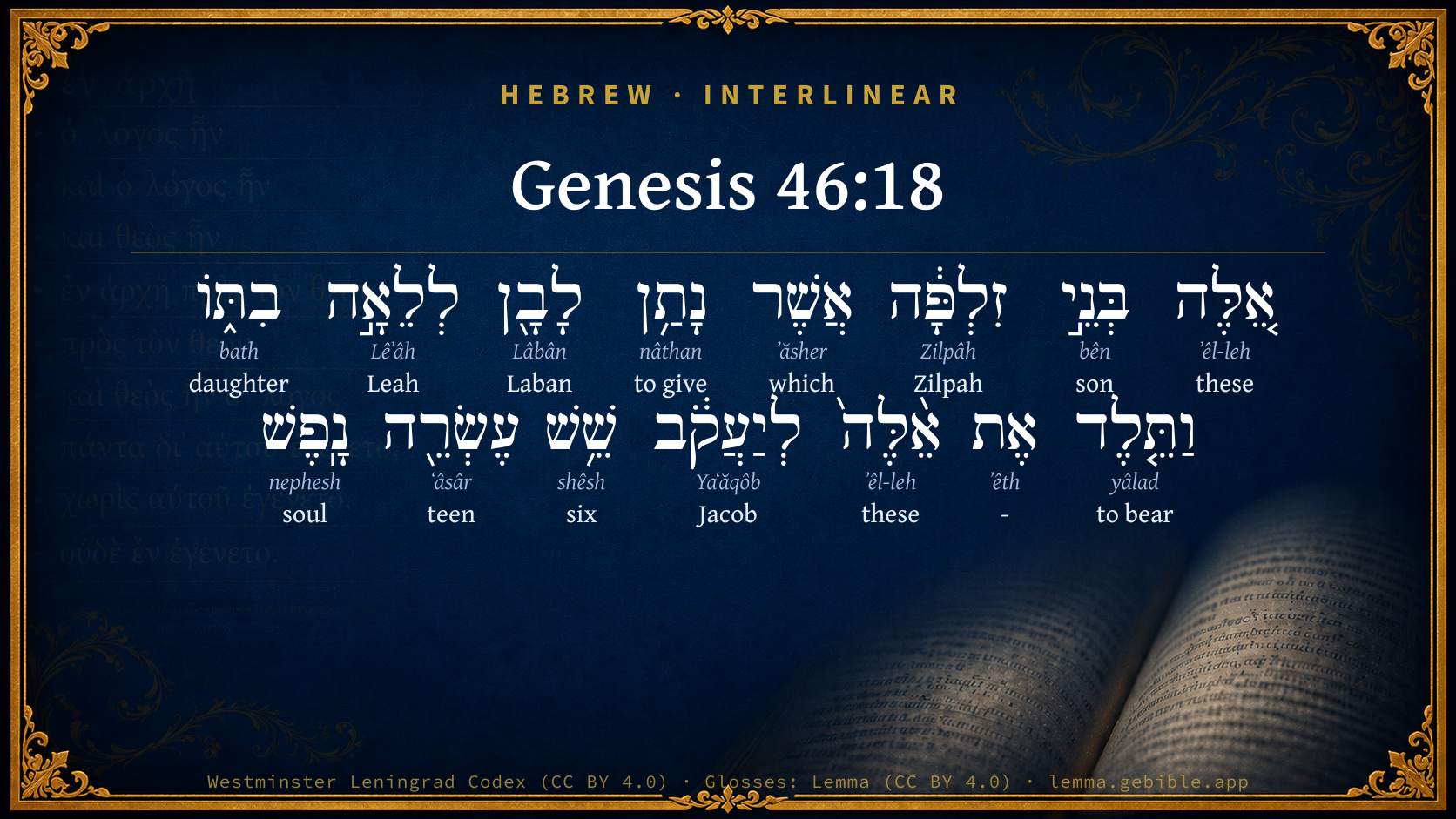
Hebrew (Westminster Leningrad Codex) Genesis 46:18 appears in the Hebrew Old Testament. The text above is from the Westminster Leningrad Codex. Each word links to its Strong’s number, a concise gloss, and parsing drawn from the Open Scriptures Hebrew Bible morphology. Click any word for its full Brown-Driver-Briggs (BDB) entry.
Download image
Cite this verse

Genesis 46:18 (World English Bible). Public Domain. Lemma interlinear Bible study tool, https://lemma.gebible.app/v/genesis/46/18.

Show BibTeX & RIS
BibTeX
RIS
English Translation
These are the sons of Zilpah, whom Laban gave to Leah, his daughter, and these she bore to Jacob, even sixteen souls.
World English Bible · Public Domain
Download a study sheet

One document with this verse’s original text, its word-by-word gloss line, the meaning frame, cross-references with their text, attributed commentary, and full source and license credits — printable, and it pastes into notes with its structure intact.

This verse Autodidact and up

Study sheet (.html) Plain text (.txt)

A passage Seminary Student

Up to 50 verses in one chapter. A passage sheet keeps up to 6 commentary sources and 12 cross-references per verse, in the order this page ranks them, and says so on the sheet whenever that leaves anything out. Ask for a single verse and you get the Autodidact verse sheet above.

Everything on this page stays free to read, with no account — the sheet is a download of what is already on screen, not access to it.

Want to remove ads? Support Godless Engineer
Compare translations 3

The same verse in 3 English versions, stacked beneath the original-language interlinear above. Click any original word for its lexicon entry.

Each is an independent rendering of the whole verse — the interlinear is not word-aligned to these translations.

Highlighted words mark where these versions differ — a whole-verse word diff, not a word-by-word alignment.

  • World English Bible Public Domain
    These are the sons of Zilpah, whom Laban gave to Leah, his daughter, and these she bore to Jacob, even sixteen souls.
  • King James Version Public Domain
    These are the sons of Zilpah, whom Laban gave to Leah his daughter, and these she bare unto Jacob, even sixteen souls.
  • unfoldingWord Literal Text CC BY-SA 4.0
    Those the sons of Zilpah, whom Laban had given to Leah his daughter. And she bore those sixteen souls for Jacob.

unfoldingWord Literal Text — © unfoldingWord, licensed CC BY-SA 4.0. Word-aligned USFM3 via Door43 (git.door43.org/unfoldingWord/en_ult).

Versions to compare (up to 4)

3 of 4 selected

Show all 18 translations

Every available English version of this verse, each an independent rendering of the whole verse.

  • World English Bible Public Domain
    These are the sons of Zilpah, whom Laban gave to Leah, his daughter, and these she bore to Jacob, even sixteen souls.
  • Berean Standard Bible Public Domain
    These are the sons of Jacob born to Zilpah—whom Laban gave to his daughter Leah—sixteen in all.
  • Majority Standard Bible Public Domain
    These are the sons of Jacob born to Zilpah—whom Laban gave to his daughter Leah—sixteen in all.
  • King James Version Public Domain
    These are the sons of Zilpah, whom Laban gave to Leah his daughter, and these she bare unto Jacob, even sixteen souls.
  • American Standard Version (1901) Public Domain
    These are the sons of Zilpah, whom Laban gave to Leah his daughter; and these she bare unto Jacob, even sixteen souls.
  • Revised Version (1885) Public Domain
    These are the sons of Zilpah, which Laban gave to Leah his daughter, and these she bare unto Jacob, even sixteen souls.
  • Geneva Bible (1599) Public Domain
    These are the children of Zilpah, whome Laban gaue to Leah his daughter: and these shee bare vnto Iaakob, euen sixtene soules.
  • Douay-Rheims (1899) Public Domain
    These are the sons of Zelpha, whom Laban gave to Lia his daughter. And these she bore to Jacob, sixteen souls.
  • Young's Literal Translation Public Domain
    These `are' sons of Zilpah, whom Laban gave to Leah his daughter, and she beareth these to Jacob -- sixteen persons.
  • Literal Standard Version CC BY-SA 4.0
    These [are] sons of Zilpah, whom Laban gave to his daughter Leah, and she bears these to Jacob—sixteen persons.
  • Unlocked Literal Bible CC BY-SA 4.0
    These were the sons of Zilpah, whom Laban had given to Leah his daughter. These sons she bore to Jacob—sixteen in all.
  • unfoldingWord Literal Text CC BY-SA 4.0
    Those the sons of Zilpah, whom Laban had given to Leah his daughter. And she bore those sixteen souls for Jacob.
  • Darby Bible Public Domain
    -- These are the sons of Zilpah, whom Laban gave to Leah his daughter; and she bore these to Jacob: sixteen souls.
  • World Messianic Bible Public Domain
    These are the sons of Zilpah, whom Laban gave to Leah, his daughter, and these she bore to Jacob, even sixteen souls.
  • Webster's Bible Public Domain
    These are the sons of Zilpah, whom Laban gave to Leah his daughter: and these she bore to Jacob, even sixteen souls.
  • Free Bible Version CC BY-SA 4.0
    These are the sons of Jacob Zilpah had, the servant given by Laban to his daughter Leah, a total of sixteen children and grandchildren.
  • Bible in Basic English Public Domain
    These are the children of Zilpah, whom Laban gave to his daughter Leah, and Jacob had these sixteen children by her.
  • JPS Tanakh (1917) Public Domain
    These are the sons of Zilpah, whom Laban gave to Leah his daughter, and these she bore unto Jacob, even sixteen souls.

Literal Standard Version (2020), Covenant Press — licensed CC BY-SA 4.0. Text via the HelloAO Bible API (eBible.org). Unlocked Literal Bible (unfoldingWord) — licensed CC BY-SA 4.0. Text via the HelloAO Bible API (eBible.org). unfoldingWord Literal Text — © unfoldingWord, licensed CC BY-SA 4.0. Word-aligned USFM3 via Door43 (git.door43.org/unfoldingWord/en_ult). Free Bible Version, Dr. Jonathan Gallagher — licensed CC BY-SA 4.0. Text via the HelloAO Bible API (eBible.org).

Word by word

More ways to search: Search by grammar → Find every occurrence → Compare this word →

Practice this passage: Drill this verse → Learn its vocabulary →

זִלְפָּ֔ה
Zilpâh
H2153
“Zilpah”
Noun, Proper
Part of Speech
Noun
Type
Proper
Full BDB Definition

Origin: from an unused root apparently mean to trickle, as myrrh

TWOT: None

Zilpah = "a trickling" - the Syrian given by Laban to Leah as a handmaid, a concubine of Jacob, mother of Asher and Gad
  1. אֵ֚לֶּה ʼêl-leh H428 “these” Pronoun, Demonstrative, Common, Plural
  2. בְּנֵ֣י bên H1121 “sons of” Noun, Common, Masculine, Plural, Construct
  3. אֲשֶׁר ʼăsher H834 “which” Particle, Relative
  4. נָתַ֥ן nâthan H5414 “to give” Verb, Qal, Perfect, 3rd Person, Masculine, Singular
  5. לָבָ֖ן Lâbân H3837 “Laban” Noun, Proper
  6. לְלֵאָ֣ה Lêʼâh H3812 “to/for · Leah” Preposition + Noun, Proper
  7. בִתּ֑וֹ bath H1323 “daughter · his” Noun, Common, Feminine, Singular, Construct + Suffix, Personal, 3rd Person, Masculine, Singular
  8. וַתֵּ֤לֶד yâlad H3205 “and · to bear” Conjunction + Verb, Qal, Sequential Imperfect, 3rd Person, Feminine, Singular
  9. אֶת ʼêth H853 “-” Particle, Direct Object
  10. אֵ֨לֶּה֙ ʼêl-leh H428 “these” Pronoun, Demonstrative, Common, Plural
  11. לְיַעֲקֹ֔ב Yaʻăqôb H3290 “to/for · Jacob” Preposition + Noun, Proper
  12. שֵׁ֥שׁ shêsh H8337 “six” Adjective, Cardinal number, Feminine, Singular, Absolute
  13. עֶשְׂרֵ֖ה ʻâsâr H6240 “teen” Adjective, Cardinal number, Feminine, Singular, Absolute
  14. נָֽפֶשׁ nephesh H5315 “soul” Noun, Common, Both, Singular, Absolute

About this verse

These counts appear in no published source. They are computed here, from the morphology-tagged text and Lemma’s own curated glosses. What Lemma adds →

15
words
14
distinct lemmas
Pentateuch
section

Notable vocabulary

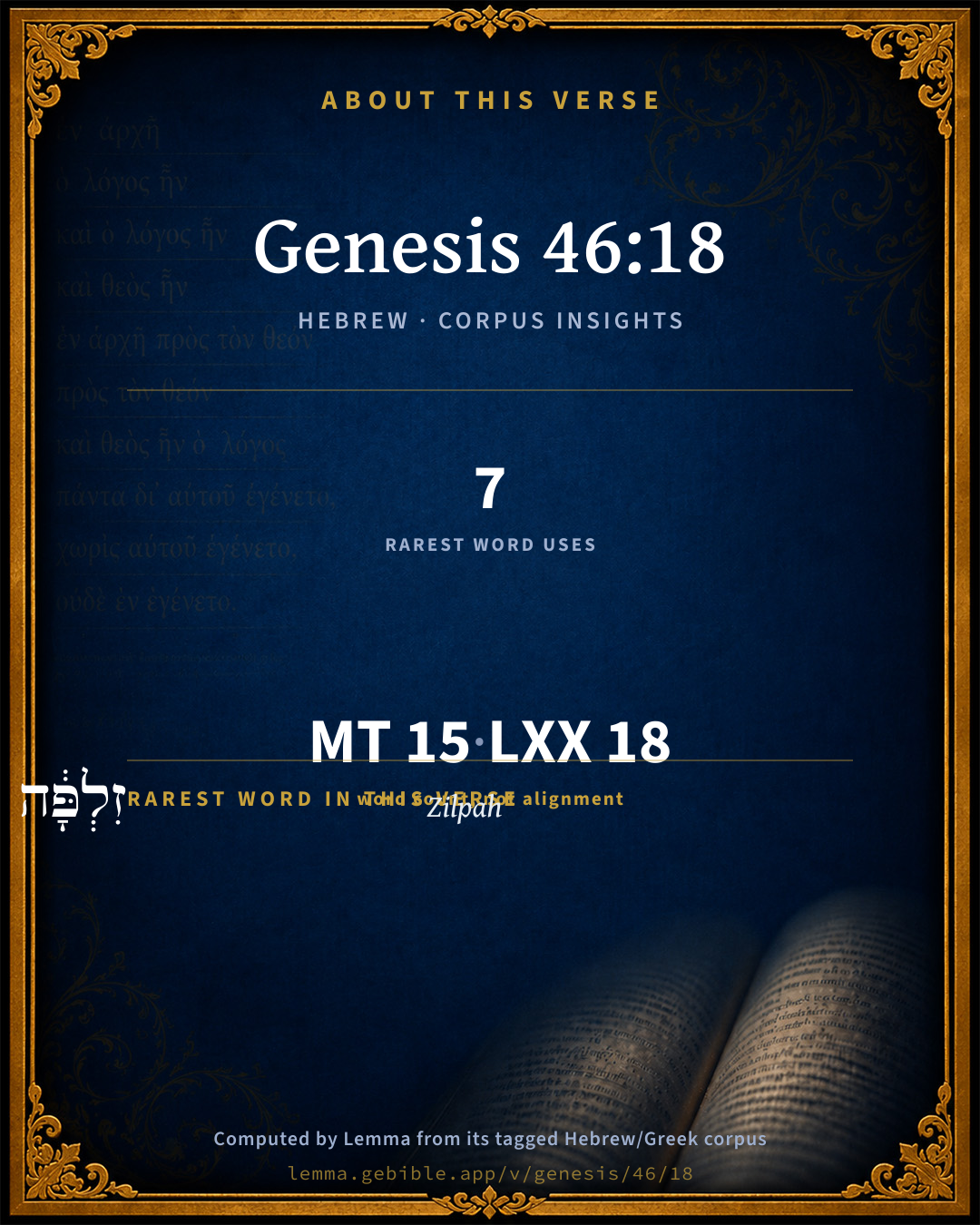
The rarest word here is זִלְפָּ֔ה Zilpah H2153 — appearing just 7 times in the whole Hebrew Bible.

Shared distinctive vocabulary

זִלְפָּ֔ה Zilpah H2153 occurs in 7 verses of the Hebrew Bible. Also found in:

Grammatical profile

  • 2 verbs
  • 7 nouns
  • 2 adjectives
  • 2 pronouns
  • 2 particles

Verb forms

  • נָתַ֥ן Qal · Perfect
  • וַתֵּ֤לֶד Qal · Sequential Imperfect

Repetition

A word recurs within this verse — often emphatic in Hebrew:

  • אֵ֚לֶּה these H428 ×2

Hebrew & Septuagint length

In English translation the verse runs 22 words from the Hebrew and 20 from the Septuagint (LXX English) — closely comparable.

A rough comparison of the two English renderings, which tokenize alike — not a word-level alignment.

Word counts can differ between the Hebrew and the Greek without any difference in meaning — e.g. the Hebrew direct-object marker אֵת has no separate Greek word, and Greek often adds the article ὁ.

In the original languages it is 15 Hebrew tokens and 18 Greek tokens — but the two are counted differently (Hebrew bundles its prefixes and suffixes into one token; the Greek is in lemma form), so that isn’t a like-for-like length.

Cross-references

4

Topical passages linked to Genesis 46:18 in the Treasury of Scripture Knowledge — connected by theme and wording, ordered by reader-vote popularity; previews shown in the World English Bible.

  • Genesis 29:24 Laban gave Zilpah his handmaid to his daughter Leah for a handmaid.
  • Genesis 30:9–13 When Leah saw that she had finished bearing, she took Zilpah, her handmaid, and gave her to Jacob as a wife.
  • Genesis 35:26 The sons of Zilpah (Leah's handmaid): Gad and Asher. These are the sons of Jacob, who were born to him in Paddan Aram.
  • Exodus 1:4 Dan and Naphtali, Gad and Asher.

Cross-references courtesy of OpenBible.info (CC BY 4.0).

Hebrew and Greek witnesses Masoretic Hebrew ↔ Greek Septuagint

The same verse in the two great witnesses to the Old Testament, shown verse-for-verse.

These are two independent witnesses, not word-aligned to each other, and the Septuagint is shown in lemma (dictionary) form.

Hebrew Genesis 46:18 Masoretic · Westminster Leningrad Codex

אֵ֚לֶּה בְּנֵ֣י זִלְפָּ֔ה אֲשֶׁר נָתַ֥ן לָבָ֖ן לְלֵאָ֣ה בִתּ֑וֹ וַתֵּ֤לֶד אֶת אֵ֨לֶּה֙ לְיַעֲקֹ֔ב שֵׁ֥שׁ עֶשְׂרֵ֖ה נָֽפֶשׁ

These are the sons of Zilpah, whom Laban gave to Leah, his daughter, and these she bore to Jacob, even sixteen souls.

World English Bible · Public Domain

Greek LXX Genesis 46:18 Septuagint · lemma form

οὗτος υἱός ζελφα ὅς δίδωμι λαβαν λεια ὁ θυγάτηρ αὐτός ὅς τίκτω οὗτος ὁ ἰακώβ δέκα ἕξ ψυχή

These are the sons of Zelpha, which Laban gave to his daughter Lea, who bore these to Jacob, sixteen souls.

LXX2012 (modern English Septuagint) · Public Domain

Hebrew: Westminster Leningrad Codex (CC BY 4.0). Greek: Septuagint (public domain); English from LXX2012 (modern English Septuagint) (Public Domain). How the Septuagint differs from the Hebrew →

Targum (Aramaic paraphrase)

2

The Targum is the ancient Jewish Aramaic paraphrase of the Hebrew Scriptures — an interpretive translation, not the Hebrew text itself. Onkelos (literal) and Pseudo-Jonathan (expansive) render the Torah, and Jonathan the Prophets. Coverage is partial: where no permissively-licensed English translation exists for a verse, only the Aramaic is shown. This is verse-level text, not a word-by-word alignment to the Hebrew.

  1. Targum Onkelos Torah (Genesis–Deuteronomy)
    אִלֵּין בְּנֵי זִלְפָּה דִי יְהַב לָבָן לְלֵאָה בְרַתֵּהּ וִילִידַת יָת אִלֵּין לְיַעֲקֹב שִׁית עֶשְׂרֵי נַפְשָׁא

    (no public-domain English translation for this verse)

    Targum Onkelos — Aramaic: “Onkelos Genesis” (public domain); “Onkelos Exodus” (public domain); “Onkelos Leviticus” (public domain); “Onkelos Numbers” (public domain); “Onkelos Deuteronomy” (public domain). English: “Sefaria Community Translation” (CC0 1.0 (public-domain dedication)); “J.W. Etheridge. The Targums of Onkelos and Jonathan Ben Uzziel on the Pentateuch. London: Longmans, Green, 1862” (public domain). Text via Sefaria.

  2. Targum Pseudo-Jonathan Torah (Genesis–Deuteronomy)
    אִלֵין בְּנֵי זִלְפָּה דִיהַב לָבָן לְלֵאָה בְּרַתֵּיהּ וִילֵידַת יַת אִילֵין לְיַעֲקב שִׁיתְּסַר נַפְשִׁין

    These are the children of Zilpha, whom Laban gave to Leah his daughter, and she bare them to Jakob; sixteen souls.

    Targum Pseudo-Jonathan — Aramaic: “Targum Jonathan on Genesis” (public domain); “Targum Jonathan on Exodus” (public domain); “Targum Jonathan on Leviticus” (public domain); “Targum Jonathan on Numbers” (public domain); “Targum Jonathan on Deuteronomy” (public domain). English: “The Targum of Jonathan ben Uzziel, trans. J. W. Etheridge, London, 1862” (public domain). Text via Sefaria.

Commentary

Notes on Genesis 46:18 from classic Christian and Jewish commentators (each source and its license shown beneath its notes). The classic Christian expositions comment on the surrounding passage and are grouped to its opening verse, so a note may address several verses; the Jewish commentaries on the Tanakh (Rashi and others) are per-verse, so they appear only where the commentator wrote on this verse.

Lemma curates 59 commentaries, every one of them public domain or Creative Commons licensed, each selected and text-cleaned for this edition rather than reprinted as found. About our sources →

Ellicott's Commentary for English Readers

(18) Sixteen souls.—That is, Gad and his seven sons, Asher and his four sons, the two grandsons and Serach.

A Bible Commentary for English Readers, edited by Charles John Ellicott (1878–1897) — public domain. Text from a community e-Sword module.

John Gill's Exposition

And the sons of Benjamin,.... The second son of Jacob by his wife Rachel; whose sons

were Belah, and Becher, and Ashbel, Gera, and Naaman, Ehi, and Rosh,

Muppim, and Huppim, and Ard; in all one hundred and ten. It is a difficulty to account for it, that Benjamin, Jacob's youngest son, often called a lad at this time, and generally supposed to be about twenty three or four years of age, should have so many sons: some think he had more wives than one, which is not likely, since we never read of any of Jacob's sons that had more than one at a time; and others, that his sons were born twins, and so had them in a little time, which is a much better solution of the difficulty: but others are of opinion, that though the greater part of them might be born in Canaan, yet others might be born in Egypt; and being denominated from the greater part, and that being put for the whole, may be reckoned among the descendants into Egypt; and even those that were in Egypt, being born while Jacob was alive, might be said to descend there in his loins; which may be the best of the ways proposed for removing this difficulty: though I should rather think they were all born before the descent into Egypt, the whole narrative seems to require this of them all; for otherwise many more might be, said to descend in the loins of Jacob, or in the loins of his sons, which would greatly increase the number of those said to go down with him, after mentioned: to which it may be added, that Benjamin was at least thirty two years of age, and so may very well be thought to have had these children before he went to Egypt.

John Gill's Exposition of the Whole Bible (1746–1763) — public domain (CC PDM 1.0). Text via the HelloAO Bible API.

The Pulpit Commentary

These arc the sons of Zilpah, whom Laban gave to Leah his daughter, and these she bare unto Jacob, even sixteen souls.

The Pulpit Commentary (1880–1919), ed. H.D.M. Spence-Jones & Joseph S. Exell — public domain. Text from a community e-Sword module.

Ramban (Nachmanides)

Rabbi Moshe ben Nachman (Ramban / Nachmanides)

THESE ARE THE SONS OF ZILPAH, etc. 19. THE SONS OF RACHEL JACOB’s WIFE, etc. It is customary for Scripture to first enumerate the sons of the mistresses together, just as it said in the Seder Vayishlach Yaakov and in the Seder V’eileh Shmoth bnei Yisrael, or else to enumerate them according to the order of their birth, the firstborn according to his birthright and the youngest according to his youth, as Scripture did when they were blessed by Jacob in the Seder Vayechi Yaakov. and in Shmoth, or according to their age, as it did in Vayechi. Ramban is attempting to explain why they are mentioned here after Zilpah’s children. Here, however, because Scripture’s purpose was to enumerate their numbers and to state that with seventy souls they went down to Egypt, it gave precedence to those who were more numerous. This was why Scripture mentioned Rachel among the concubines, and hence it was necessary to mention her with respect, saying, Jacob’s wife, as I have mentioned above.

Ramban (Nachmanides) on the Tanakh — English translation: “Commentary on the Torah by Ramban (Nachmanides). Translated and annotated by Charles B. Chavel. New York, Shilo Pub. House, 1971-1976” (CC BY 4.0). Text via Sefaria.

Lesson kit

Teaching starters — assembled from the data on this page, not authored interpretation. Every prompt links to the verse data it draws on. Edit before teaching.

Genesis, in the Pentateuch, opens this verse with 15 words (14 distinct Hebrew lemmas). Its most distinctive word is Zilpâh (“Zilpah”). A historical commentator’s framing appears above. Read the whole chapter for the surrounding context.

Discussion questions

  1. The word Zilpâh carries the sense “Zilpah.” How does it shape the verse?
  2. How does Genesis 29:24, which shares the word «Zilpah», read alongside this verse?
  3. What does the repetition of “these” (2× in this one verse) do in this verse?
  4. The translations on this page render this verse differently — a whole-verse word diff, not a word-by-word alignment. What might account for the different wordings?
  5. «נָתַ֥ן» is a Qal Perfect verb. How does that grammatical form shape the action described?
  6. Compare how Ellicott's Commentary for English Readers and John Gill's Exposition read this verse. Where do they agree or differ?

Things to notice

Reading settings

Reading text

Shown beneath each verse's original-language words.

Old Testament
Old Testament edition

Read the OT as the Masoretic Hebrew (MT) or the Greek Septuagint (LXX).

English shown for the Greek Septuagint (in the Hebrew ↔ Greek comparison).

Comparing translations? Open the Compare panel on any verse page to stack up to four side by side.