Genesis 34:14

Hebrew (Westminster Leningrad Codex) Genesis 34:14 appears in the Hebrew Old Testament. The text above is from the Westminster Leningrad Codex. Each word links to its Strong’s number, a concise gloss, and parsing drawn from the Open Scriptures Hebrew Bible morphology. Click any word for its full Brown-Driver-Briggs (BDB) entry.
Download image
Cite this verse

Genesis 34:14 (World English Bible). Public Domain. Lemma interlinear Bible study tool, https://lemma.gebible.app/v/genesis/34/14.

Show BibTeX & RIS
BibTeX
RIS
English Translation
and said to them, "We can't do this thing, to give our sister to one who is uncircumcised; for that is a reproach to us.
World English Bible · Public Domain
Download a study sheet

One document with this verse’s original text, its word-by-word gloss line, the meaning frame, cross-references with their text, attributed commentary, and full source and license credits — printable, and it pastes into notes with its structure intact.

This verse Autodidact and up

Study sheet (.html) Plain text (.txt)

A passage Seminary Student

Up to 50 verses in one chapter. A passage sheet keeps up to 6 commentary sources and 12 cross-references per verse, in the order this page ranks them, and says so on the sheet whenever that leaves anything out. Ask for a single verse and you get the Autodidact verse sheet above.

Everything on this page stays free to read, with no account — the sheet is a download of what is already on screen, not access to it.

Want to remove ads? Support Godless Engineer
Compare translations 3

The same verse in 3 English versions, stacked beneath the original-language interlinear above. Click any original word for its lexicon entry.

Each is an independent rendering of the whole verse — the interlinear is not word-aligned to these translations.

Highlighted words mark where these versions differ — a whole-verse word diff, not a word-by-word alignment.

  • World English Bible Public Domain
    and said to them, "We can't do this thing, to give our sister to one who is uncircumcised; for that is a reproach to us.
  • King James Version Public Domain
    And they said unto them, We cannot do this thing, to give our sister to one that is uncircumcised; for that were a reproach unto us:
  • unfoldingWord Literal Text CC BY-SA 4.0
    And they said to them, “We are not able to do this thing, to give our sister to a man who has a foreskin, because that a disgrace to us!

unfoldingWord Literal Text — © unfoldingWord, licensed CC BY-SA 4.0. Word-aligned USFM3 via Door43 (git.door43.org/unfoldingWord/en_ult).

Versions to compare (up to 4)

3 of 4 selected

Show all 18 translations

Every available English version of this verse, each an independent rendering of the whole verse.

  • World English Bible Public Domain
    and said to them, "We can't do this thing, to give our sister to one who is uncircumcised; for that is a reproach to us.
  • Berean Standard Bible Public Domain
    “We cannot do such a thing,” they said. “To give our sister to an uncircumcised man would be a disgrace to us.
  • Majority Standard Bible Public Domain
    “We cannot do such a thing,” they said. “To give our sister to an uncircumcised man would be a disgrace to us.
  • King James Version Public Domain
    And they said unto them, We cannot do this thing, to give our sister to one that is uncircumcised; for that were a reproach unto us:
  • American Standard Version (1901) Public Domain
    and said unto them, We cannot do this thing, to give our sister to one that is uncircumcised; for that were a reproach unto us.
  • Revised Version (1885) Public Domain
    and said unto them, We cannot do this thing, to give our sister to one that is uncircumcised; for that were a reproach unto us:
  • Geneva Bible (1599) Public Domain
    And they said vnto them, We can not do this thing, to giue our sister to an vncircumcised man: for that were a reproofe vnto vs.
  • Douay-Rheims (1899) Public Domain
    We cannot do what you demand, nor give our sister to one that is uncircumcised, which with us is unlawful and abominable.
  • Young's Literal Translation Public Domain
    and say unto them, `We are not able to do this thing, to give our sister to one who hath a foreskin: for it `is' a reproach to us.
  • Literal Standard Version CC BY-SA 4.0
    and say to them, “We are not able to do this thing, to give our sister to one who has a foreskin, for it [is] a reproach to us.
  • Unlocked Literal Bible CC BY-SA 4.0
    They said to them, “We cannot do this thing, to give our sister to anyone who is uncircumcised; for that would be a disgrace to us.
  • unfoldingWord Literal Text CC BY-SA 4.0
    And they said to them, “We are not able to do this thing, to give our sister to a man who has a foreskin, because that a disgrace to us!
  • Darby Bible Public Domain
    and said to them, We cannot do this, to give our sister to one that is uncircumcised; for that [were] a reproach to us.
  • World Messianic Bible Public Domain
    and said to them, “We can’t do this thing, to give our sister to one who is uncircumcised; for that is a reproach to us.
  • Webster's Bible Public Domain
    And they said to them, We cannot do this thing, to give our sister to one that is uncircumcised: for that would be a reproach to us:
  • Free Bible Version CC BY-SA 4.0
    They told them, “We can't do this! We can't allow our sister to marry a man who's not circumcised. That would bring disgrace on us.
  • Bible in Basic English Public Domain
    And they said, It is not possible for us to give our sister to one who is without circumcision, for that would be a cause of shame to us:
  • JPS Tanakh (1917) Public Domain
    and said unto them: 'We cannot do this thing, to give our sister to one that is uncircumcised; for that were a reproach unto us.

Literal Standard Version (2020), Covenant Press — licensed CC BY-SA 4.0. Text via the HelloAO Bible API (eBible.org). Unlocked Literal Bible (unfoldingWord) — licensed CC BY-SA 4.0. Text via the HelloAO Bible API (eBible.org). unfoldingWord Literal Text — © unfoldingWord, licensed CC BY-SA 4.0. Word-aligned USFM3 via Door43 (git.door43.org/unfoldingWord/en_ult). Free Bible Version, Dr. Jonathan Gallagher — licensed CC BY-SA 4.0. Text via the HelloAO Bible API (eBible.org).

Word by word

More ways to search: Search by grammar → Find every occurrence → Compare this word →

Practice this passage: Drill this verse → Learn its vocabulary →

עָרְלָ֑ה
ʻorlâh
H6190
“foreskin”
Noun, Common, Feminine, Singular, Absolute
Part of Speech
Noun
Type
Common
Gender
Feminine
Number
Singular
State
Absolute
Full BDB Definition

Origin: from H6189

TWOT: 1695a

foreskin, uncircumcised
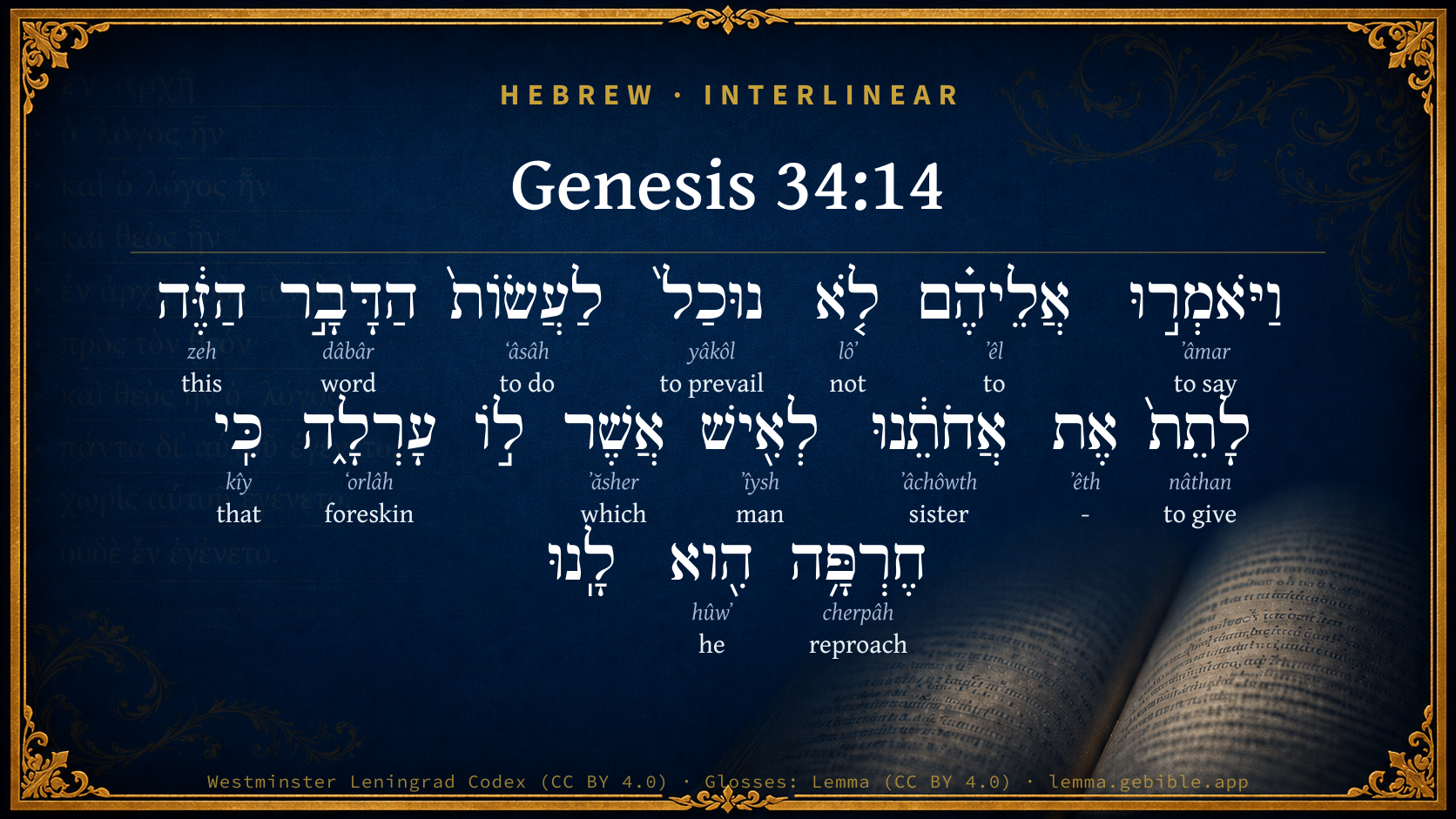
  1. וַיֹּאמְר֣וּ ʼâmar H559 “and · to say” Conjunction + Verb, Qal, Sequential Imperfect, 3rd Person, Masculine, Plural
  2. אֲלֵיהֶ֗ם ʼêl H413 “to · them” Preposition + Suffix, Personal, 3rd Person, Masculine, Plural
  3. לֹ֤א lôʼ H3808 “not” Particle, Negative
  4. נוּכַל֙ yâkôl H3201 “to prevail” Verb, Qal, Imperfect, 1st Person, Common, Plural
  5. לַעֲשׂוֹת֙ ʻâsâh H6213 “to do” Preposition + Verb, Qal, Infinitive Construct
  6. הַדָּבָ֣ר dâbâr H1697 “the · word” Particle, Definite Article + Noun, Common, Masculine, Singular, Absolute
  7. הַזֶּ֔ה zeh H2088 “the · this” Particle, Definite Article + Pronoun, Demonstrative, Masculine, Singular
  8. לָתֵת֙ nâthan H5414 “to give” Preposition + Verb, Qal, Infinitive Construct
  9. אֶת ʼêth H853 “-” Particle, Direct Object
  10. אֲחֹתֵ֔נוּ ʼâchôwth H269 “sister · our” Noun, Common, Feminine, Singular, Construct + Suffix, Personal, 1st Person, Common, Plural
  11. לְאִ֖ישׁ ʼîysh H376 “to/for · man” Preposition + Noun, Common, Masculine, Singular, Absolute
  12. אֲשֶׁר ʼăsher H834 “which” Particle, Relative
  13. כִּֽי kîy H3588 “that” Conjunction
  14. חֶרְפָּ֥ה cherpâh H2781 “reproach” Noun, Common, Feminine, Singular, Absolute
  15. הִ֖וא hûwʼ H1931 “he” Pronoun, Personal, 3rd Person, Feminine, Singular

About this verse

These counts appear in no published source. They are computed here, from the morphology-tagged text and Lemma’s own curated glosses. What Lemma adds →

18
words
16
distinct lemmas
Pentateuch
section

Notable vocabulary

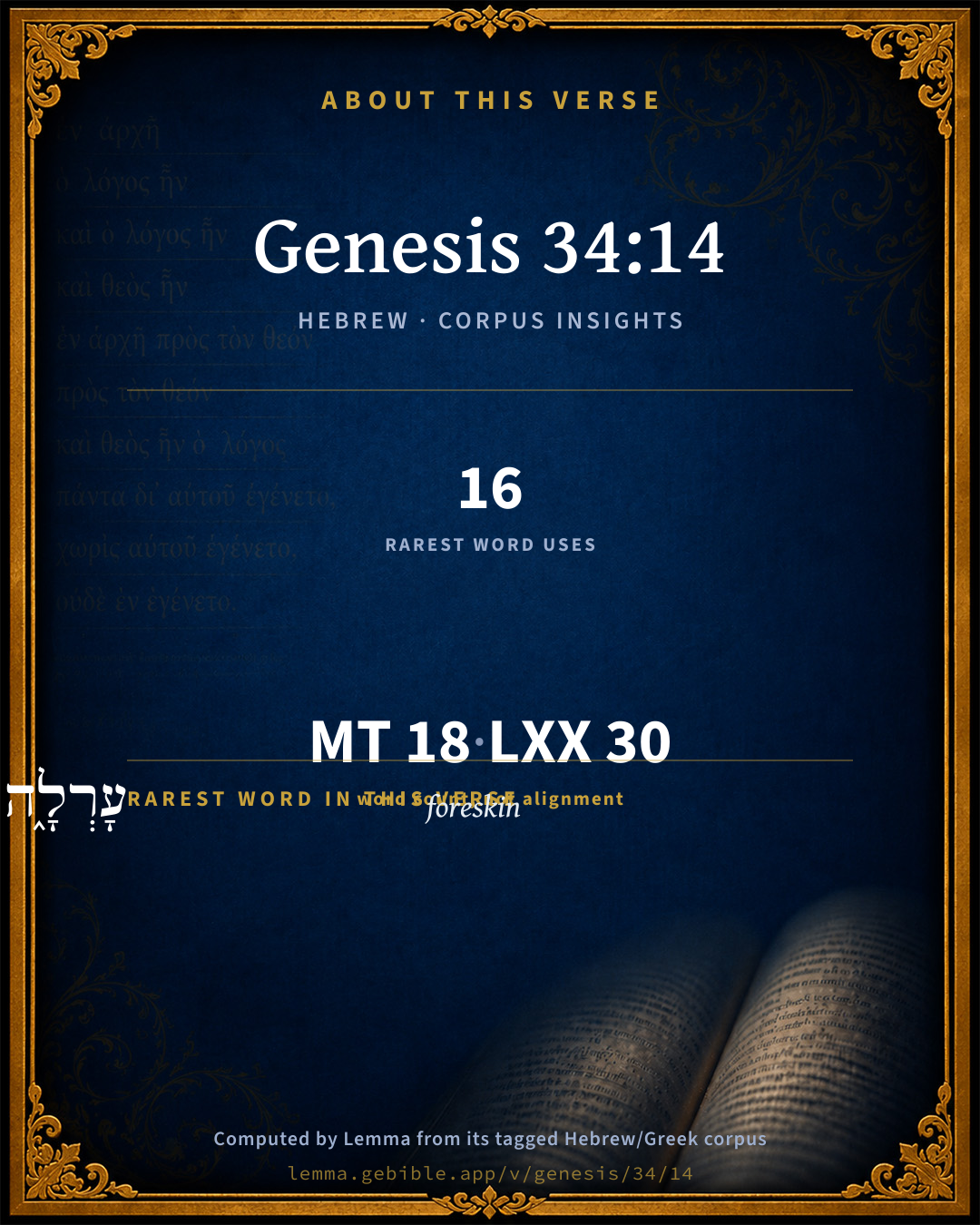
The rarest word here is עָרְלָ֑ה foreskin H6190 — appearing just 16 times in the whole Hebrew Bible.

Shared distinctive vocabulary

עָרְלָ֑ה foreskin H6190 occurs in 16 verses of the Hebrew Bible. Also found in:

Grammatical profile

  • 4 verbs
  • 5 nouns
  • 2 pronouns
  • 3 prepositions
  • 1 conjunction
  • 3 particles

Verb forms

  • וַיֹּאמְר֣וּ Qal · Sequential Imperfect
  • נוּכַל֙ Qal · Imperfect
  • לַעֲשׂוֹת֙ Qal · Infinitive Construct
  • לָתֵת֙ Qal · Infinitive Construct

Hebrew & Septuagint length

In English translation the verse runs 25 words from the Hebrew and 37 from the Septuagint (LXX English) — the Septuagint runs noticeably longer here. See the side-by-side →

A rough comparison of the two English renderings, which tokenize alike — not a word-level alignment.

Word counts can differ between the Hebrew and the Greek without any difference in meaning — e.g. the Hebrew direct-object marker אֵת has no separate Greek word, and Greek often adds the article ὁ.

In the original languages it is 18 Hebrew tokens and 30 Greek tokens — but the two are counted differently (Hebrew bundles its prefixes and suffixes into one token; the Greek is in lemma form), so that isn’t a like-for-like length.

Cross-references

13

Topical passages linked to Genesis 34:14 in the Treasury of Scripture Knowledge — connected by theme and wording, ordered by reader-vote popularity; previews shown in the World English Bible.

  • Genesis 17:11 You shall be circumcised in the flesh of your foreskin. It will be a token of a covenant between me and you.
  • Genesis 17:14 The uncircumcised male who is not circumcised in the flesh of his foreskin, that soul shall be cut off from his people. He has broken my covenant."
  • Joshua 5:2–9 At that time Yahweh said to Joshua, Make you flint knives, and circumcise again the children of Israel the second time.
  • 1 Samuel 14:6 Jonathan said to the young man who bore his armor, Come, and let us go over to the garrison of these uncircumcised: it may be that Yahweh will work for us; for there is no restraint to Yahweh to save by many or by few.
  • 1 Samuel 17:26 David spoke to the men who stood by him, saying, What shall be done to the man who kills this Philistine, and takes away the reproach from Israel? for who is this uncircumcised Philistine, that he should defy the armies of the living God?
  • 1 Samuel 17:36 Your servant struck both the lion and the bear: and this uncircumcised Philistine shall be as one of them, seeing he has defied the armies of the living God.
  • 2 Samuel 1:20 Don't tell it in Gath, Don't publish it in the streets of Ashkelon; Lest the daughters of the Philistines rejoice, Lest the daughters of the uncircumcised triumph.
  • 2 Samuel 15:7 It happened at the end of forty years, that Absalom said to the king, please let me go and pay my vow, which I have vowed to Yahweh, in Hebron.
  • 1 Kings 21:9 She wrote in the letters, saying, Proclaim a fast, and set Naboth on high among the people:
  • Matthew 2:8 He sent them to Bethlehem, and said, "Go and search diligently for the young child. When you have found him, bring me word, so that I also may come and worship him."
  • Matthew 2:13 Now when they had departed, behold, an angel of the Lord appeared to Joseph in a dream, saying, "Arise and take the young child and his mother, and flee into Egypt, and stay there until I tell you, for Herod will seek the young child to destroy him."
  • Matthew 23:1–39 Then Jesus spoke to the multitudes and to his disciples,
  • Romans 4:11 He received the sign of circumcision, a seal of the righteousness of the faith which he had while he was in uncircumcision, that he might be the father of all those who believe, though they be in uncircumcision, that righteousness might also be accounted to them.

Cross-references courtesy of OpenBible.info (CC BY 4.0).

Hebrew and Greek witnesses Masoretic Hebrew ↔ Greek Septuagint

The same verse in the two great witnesses to the Old Testament, shown verse-for-verse.

Here the Septuagint runs noticeably longer than the Hebrew — LXX2012 (modern English Septuagint) 37 words vs World English Bible 25. A rough length comparison of the two English translations, not a word-level alignment — read both below.

These are two independent witnesses, not word-aligned to each other, and the Septuagint is shown in lemma (dictionary) form.

Hebrew Genesis 34:14 Masoretic · Westminster Leningrad Codex

וַיֹּאמְר֣וּ אֲלֵיהֶ֗ם לֹ֤א נוּכַל֙ לַעֲשׂוֹת֙ הַדָּבָ֣ר הַזֶּ֔ה לָתֵת֙ אֶת אֲחֹתֵ֔נוּ לְאִ֖ישׁ אֲשֶׁר ל֣וֹ עָרְלָ֑ה כִּֽי חֶרְפָּ֥ה הִ֖וא לָֽנוּ

and said to them, "We can't do this thing, to give our sister to one who is uncircumcised; for that is a reproach to us.

World English Bible · Public Domain

Greek LXX Genesis 34:14 Septuagint · lemma form

καί εἶπον αὐτός συμεων καί λευί ὁ ἀδελφός δινα υἱός δέ λεια οὐ δύναμαι ποιέω ὁ ῥῆμα οὗτος δίδωμι ὁ ἀδελφή ἐγώ ἄνθρωπος ὅς ἔχω ἀκροβυστία εἰμί γάρ ὄνειδος ἐγώ

And Symeon and Levi, the brothers of Dina, said to them, We shall not be able to do this thing, to give our sister to a man who is uncircumcised, for it is a reproach to us.

LXX2012 (modern English Septuagint) · Public Domain

Hebrew: Westminster Leningrad Codex (CC BY 4.0). Greek: Septuagint (public domain); English from LXX2012 (modern English Septuagint) (Public Domain). How the Septuagint differs from the Hebrew →

Targum (Aramaic paraphrase)

2

The Targum is the ancient Jewish Aramaic paraphrase of the Hebrew Scriptures — an interpretive translation, not the Hebrew text itself. Onkelos (literal) and Pseudo-Jonathan (expansive) render the Torah, and Jonathan the Prophets. Coverage is partial: where no permissively-licensed English translation exists for a verse, only the Aramaic is shown. This is verse-level text, not a word-by-word alignment to the Hebrew.

  1. Targum Onkelos Torah (Genesis–Deuteronomy)
    וַאֲמָרוּ לְהוֹן לָא נִכּוּל לְמֶעְבַּד פִּתְגָּמָא הָדֵין לְמִתַּן יָת אֲחָתָנָא לִגְבַר דִּי לֵיהּ עָרְלְתָא אֲרֵי חִסּוּדָא הִיא לָנָא

    (no public-domain English translation for this verse)

    Targum Onkelos — Aramaic: “Onkelos Genesis” (public domain); “Onkelos Exodus” (public domain); “Onkelos Leviticus” (public domain); “Onkelos Numbers” (public domain); “Onkelos Deuteronomy” (public domain). English: “Sefaria Community Translation” (CC0 1.0 (public-domain dedication)); “J.W. Etheridge. The Targums of Onkelos and Jonathan Ben Uzziel on the Pentateuch. London: Longmans, Green, 1862” (public domain). Text via Sefaria.

  2. Targum Pseudo-Jonathan Torah (Genesis–Deuteronomy)
    וַאֲמָרוּ לְהוֹם לָא נֵיכוֹל לְמֶעֱבַד יַת פִּתְגָמָא הָדֵין לְמִתַּן יַת אַחֲתָנָא לִגְבַר דִילֵיהּ עוּרְלְתָא אֲרוּם גְנוּתָא הוּא לָנָא

    and said to them, We cannot do this thing, to give our sister to a man who is uncircumcised, because that would be a disgrace to us.

    Targum Pseudo-Jonathan — Aramaic: “Targum Jonathan on Genesis” (public domain); “Targum Jonathan on Exodus” (public domain); “Targum Jonathan on Leviticus” (public domain); “Targum Jonathan on Numbers” (public domain); “Targum Jonathan on Deuteronomy” (public domain). English: “The Targum of Jonathan ben Uzziel, trans. J. W. Etheridge, London, 1862” (public domain). Text via Sefaria.

Commentary

Notes on Genesis 34:14 from classic Christian and Jewish commentators (each source and its license shown beneath its notes). The classic Christian expositions comment on the surrounding passage and are grouped to its opening verse, so a note may address several verses; the Jewish commentaries on the Tanakh (Rashi and others) are per-verse, so they appear only where the commentator wrote on this verse.

Lemma curates 59 commentaries, every one of them public domain or Creative Commons licensed, each selected and text-cleaned for this edition rather than reprinted as found. About our sources →

Trapp's Complete Commentary

John Trapp

Gen 34:14 And they said unto them, We cannot do this thing, to give our sister to one that is uncircumcised; for that [were] a reproach unto us:

Ver. 14. That were a reproach unto us.] And yet the world reproached them with nothing more than with their circumcision; as it is to be seen in Horace, Juvenal, Tacitus. Appion scoffs at it, and is answered by Josephus. But, as he were a fool that would be mocked out of his inheritance; so he, much more, that would be mocked out of his religion. "Ye have shamed the counsel of the poor," saith David, "because the Lord is his refuge"; because he runs to God by prayer. But to show how little he regarded their reproaches, he falls presently a-praying, "Oh that the salvation of Israel," &c. {Psa 14:6-7} So Nazareth was a reproach cast upon Christ; and he glories in it: {Act 22:8} "I am Jesus of Nazareth, whom thou persecutest." He saith not; I am the Son of God, heir of all things, King of the Church, &c.; but, "I am Jesus of Nazareth." "If this be to be vile," said David, "I will be yet more vile." {2Sa 6:22}

John Trapp, A Commentary or Exposition upon All the Books of the Old and New Testament (1647–1656) — public domain. Text from a community e-Sword module.

Joseph Benson's Commentary

Gen 34:14. We cannot give our sister to one who is uncircumcised — They were not prohibited from doing this by any law yet in force, as the examples of Isaac and Jacob show, who both married the daughters of uncircumcised persons; and therefore they do not here reject the proposal as simply unlawful, but only as dishonourable and reproachful. Religion is too often pleaded for the vilest practices.

Joseph Benson's Commentary on the Old and New Testaments (1811–1818) — public domain. Text from a community e-Sword module.

Geneva Bible (1599)

Geneva Bible translators

They made the holy ordinance of God a means to compasse their wicked purpose.

As it is abomination for them that are baptized to join with Infidels.

Geneva Bible (1599) marginal notes — public domain. Text via Bolls.life.

Adam Clarke's Commentary

Verse 14. That were a reproach unto us] Because the uncircumcised were not in the covenant of God; and to have given an heiress of the promise to one who had no kind of right to its spiritual blessings, from whom might spring children who would naturally walk in the way of their father would have been absurd, reproachful and wicked. Thus far they were perfectly right; but to make this holy principle a cloak for their deceitful and murderous purposes, was the full sum of all wickedness.

Adam Clarke's Commentary on the Bible (1810–1826) — public domain. Text from a community e-Sword/MySword module.

The Cambridge Bible for Schools and Colleges

gen. ed. J. J. S. Perowne

14. uncircumcised] The passage contains the interesting and early tradition, that circumcision was not practised by the Canaanite dwellers in Shechem. On the widespread prevalence of this rite, see note on ch. 15. In J and E, Israelite circumcision is specially connected with the names of Moses and Joshua (Exo_4:25; Jos_5:2). The peculiar treachery of Jacob’s sons is made to turn upon their insistence on the sacred national rite of circumcision. The condition which Shechem, in Gen_34:19 (J), undertakes to satisfy, is not explained, in view of E’s account (Gen_34:13-18).

a reproach] Compare the similar expression in Jos_5:9, where it appears that the Egyptians reproached the Israelites for their neglect of circumcision.

The Cambridge Bible for Schools and Colleges (gen. ed. J. J. S. Perowne; Cambridge University Press, 1878–1918) — public domain. Text from a community e-Sword module.

John Gill's Exposition

And they said unto them,.... Levi and Simeon, to Hamor and Shechem:

we cannot do this thing, to give our sister to one that is uncircumcised; not that there was any law against it at that time; and there were, on the other hand, precedents for it both in Isaac and Jacob, who had married the daughters of uncircumcised persons; nor indeed do they plead any law, only that it was not becoming their character, nor agreeably to their religion, nor honourable in their esteem:

for that were a reproach unto us; and they should be reflected upon for slighting the institution of circumcision, which was of God: so they pretend it might be interpreted, should they enter into affinity with uncircumcised persons.

John Gill's Exposition of the Whole Bible (1746–1763) — public domain (CC PDM 1.0). Text via the HelloAO Bible API.

Haydock's Catholic Bible Commentary

Abominable. To be uncircumcised, was a reproach among the Hebrews. Yet there was no law forbidding to marry such. Laban was of this description, and the Chanaanites also; whose daughters the sons of Jacob themselves espoused, at least Juda and this very Simeon, as the Scripture assures us.

George Leo Haydock (1774–1849), Haydock's Catholic Family Bible and Commentary, 1859 edition — public domain. Excludes Psalms (Douay-Rheims chapter numbering differs from Protestant) and Deuterocanonical books (Catholic canon only).

Matthew Poole's English Annotations

There was no such law yet in force, as the examples of Isaac and Jacob show, who married the daughters of uncircumcised persons; and therefore they do not here reject it as simply unlawful, but only as dishonourable and reproachful.

Matthew Poole's English Annotations on the Holy Bible (1683–1685) — public domain. Text from a community e-Sword/MySword module.

unfoldingWord translationNotes

Door43 World Missions Community

They said to them

"Jacob's sons said to Shechem and Hamor"

We cannot do this thing, to give our sister

"We cannot agree to give Dinah in marriage"

for that would be a disgrace to us

"for that would cause us shame." Here "us" refers to Jacob's sons and all the people of Israel. (See: Exclusive and Inclusive "We")

give our daughters to you ... take your daughters to ourselves

This means they will allow a person from Jacob's family to marry a person who lives in Hamor's land.

translationWords

circumcise

circumcise

people group

unfoldingWord translationNotes — © Distant Shores Media and the Door43 World Missions Community, licensed CC BY-SA 4.0. Source: git.door43.org/Door43/en_tn.

Rashi

Rabbi Shlomo Yitzchaki (Rashi)

חרפה הוא THAT WERE A DISGRACE — Amongst us it is somewhat of a blot on our pedigree, for if one wishes to revile another, he says to him: “You are an uncircumcised person”, or “the son of an uncircumcised person”. The word חרפה always means “reviling”.

Rashi on the Tanakh — English translations: “The Judaica Press complete Tanach with Rashi, translated by A. J. Rosenberg” (CC BY 4.0); “Pentateuch with Rashi's commentary by M. Rosenbaum and A.M. Silbermann, 1929-1934” (public domain); “The Metsudah Tanach series, Lakewood, N.J” (CC BY 4.0); and “The Book of Joshua, Metsudah Publications, 1997” (CC BY 4.0). Text via Sefaria.

Radak

Rabbi David Kimhi (Radak)

ויאמרו...כי חרפה היא לנו, to be intermarried with the uncircumcised, seeing that our males are all circumcised.

Radak on the Tanakh — English translations: “Sefaria Community Translation” (CC0 1.0 (public-domain dedication)); “Eliyahu Munk, HaChut Hameshulash” (CC BY 4.0); “Rabbi Mike Feuer, Jerusalem Anthology” (CC BY 4.0); and “R. David Kimhi on the first book of Psalms, Translated by R.G. Finch, London, 1919” (public domain). Text via Sefaria.

Lesson kit

Teaching starters — assembled from the data on this page, not authored interpretation. Every prompt links to the verse data it draws on. Edit before teaching.

Genesis, in the Pentateuch, opens this verse with 18 words (16 distinct Hebrew lemmas). Its most distinctive word is ʻorlâh (“foreskin”). The Greek Septuagint runs longer here. A historical commentator’s framing appears above. Read the whole chapter for the surrounding context.

Discussion questions

  1. How does “foreskin” (ʻorlâh) shape what this verse is saying?
  2. Genesis 17:11 shares the word «foreskin» with this verse. How do the two illuminate each other?
  3. Compared with the Hebrew, the Septuagint runs longer here. What questions does that raise?
  4. These translations render this verse differently. What is at stake in choosing one wording over another?
  5. The verb «וַיֹּאמְר֣וּ» is Qal Sequential Imperfect. How does its form color the action?
  6. Reading how Trapp's Complete Commentary and Joseph Benson's Commentary read this verse, where do the two commentators agree and where do they part?

Things to notice

Reading settings

Reading text

Shown beneath each verse's original-language words.

Old Testament
Old Testament edition

Read the OT as the Masoretic Hebrew (MT) or the Greek Septuagint (LXX).

English shown for the Greek Septuagint (in the Hebrew ↔ Greek comparison).

Comparing translations? Open the Compare panel on any verse page to stack up to four side by side.