
2 Kings 18:30

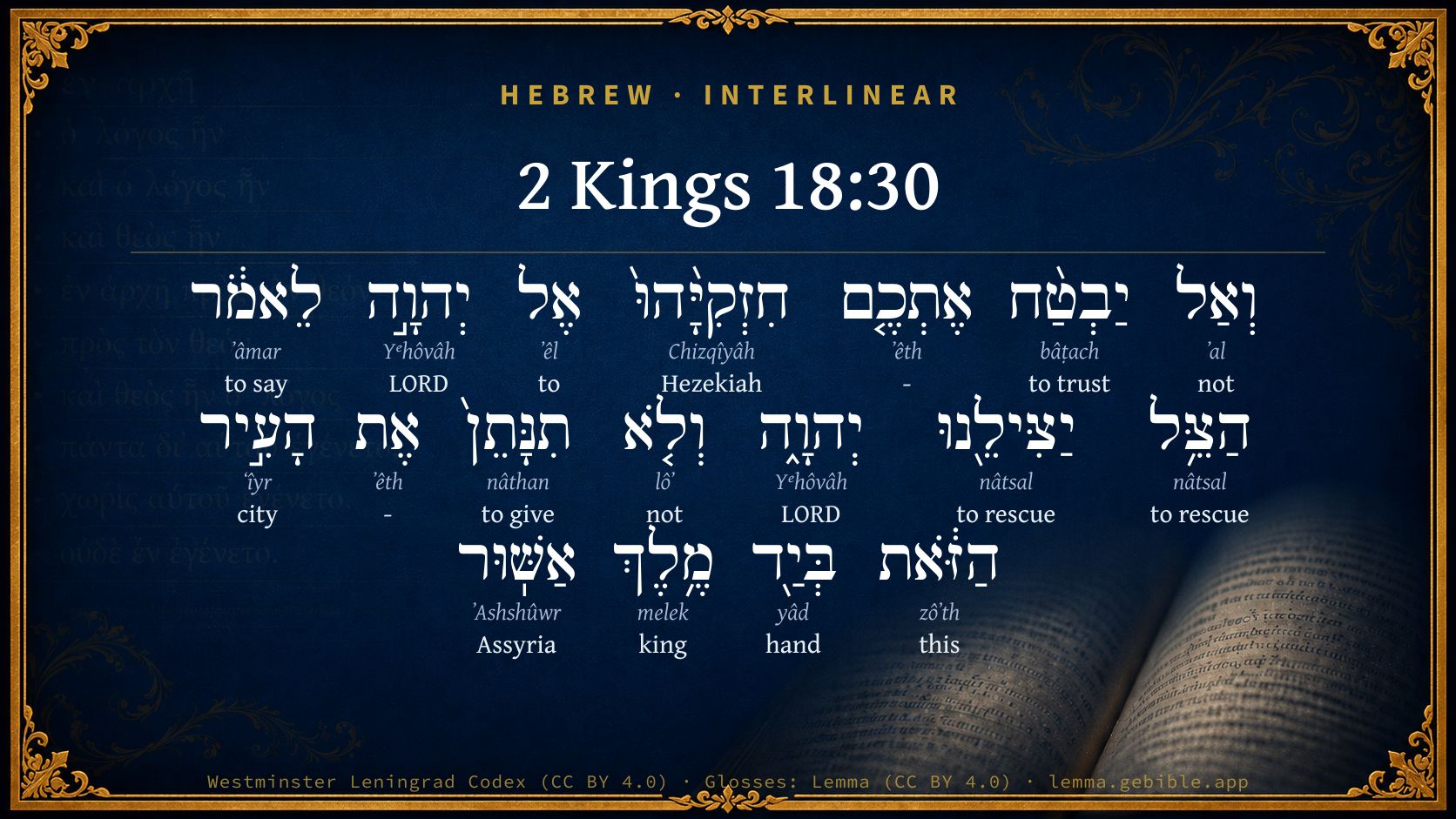
Hebrew (Westminster Leningrad Codex) 2 Kings 18:30 appears in the Hebrew Old Testament. The text above is from the Westminster Leningrad Codex. Each word links to its Strong’s number, a concise gloss, and parsing drawn from the Open Scriptures Hebrew Bible morphology. Click any word for its full Brown-Driver-Briggs (BDB) entry.
Download image
Cite this verse

2 Kings 18:30 (World English Bible). Public Domain. Lemma interlinear Bible study tool, https://lemma.gebible.app/v/2-kings/18/30.

Show BibTeX & RIS
BibTeX
RIS
English Translation
neither let Hezekiah make you trust in Yahweh, saying, Yahweh will surely deliver us, and this city shall not be given into the hand of the king of Assyria.
World English Bible · Public Domain
Download a study sheet

One document with this verse’s original text, its word-by-word gloss line, the meaning frame, cross-references with their text, attributed commentary, and full source and license credits — printable, and it pastes into notes with its structure intact.

This verse Autodidact and up

Study sheet (.html) Plain text (.txt)

A passage Seminary Student

Up to 50 verses in one chapter. A passage sheet keeps up to 6 commentary sources and 12 cross-references per verse, in the order this page ranks them, and says so on the sheet whenever that leaves anything out. Ask for a single verse and you get the Autodidact verse sheet above.

Everything on this page stays free to read, with no account — the sheet is a download of what is already on screen, not access to it.

Want to remove ads? Support Godless Engineer
Compare translations 3

The same verse in 3 English versions, stacked beneath the original-language interlinear above. Click any original word for its lexicon entry.

Each is an independent rendering of the whole verse — the interlinear is not word-aligned to these translations.

Highlighted words mark where these versions differ — a whole-verse word diff, not a word-by-word alignment.

  • World English Bible Public Domain
    neither let Hezekiah make you trust in Yahweh, saying, Yahweh will surely deliver us, and this city shall not be given into the hand of the king of Assyria.
  • King James Version Public Domain
    Neither let Hezekiah make you trust in the LORD, saying, The LORD will surely deliver us, and this city shall not be delivered into the hand of the king of Assyria.
  • unfoldingWord Literal Text CC BY-SA 4.0
    And do not let Hezekiah make you trust in Yahweh, saying, “Delivering, Yahweh will deliver us, and this city will not be given into the hand of the king of Assyria.”’

unfoldingWord Literal Text — © unfoldingWord, licensed CC BY-SA 4.0. Word-aligned USFM3 via Door43 (git.door43.org/unfoldingWord/en_ult).

Versions to compare (up to 4)

3 of 4 selected

Show all 18 translations

Every available English version of this verse, each an independent rendering of the whole verse.

  • World English Bible Public Domain
    neither let Hezekiah make you trust in Yahweh, saying, Yahweh will surely deliver us, and this city shall not be given into the hand of the king of Assyria.
  • Berean Standard Bible Public Domain
    Do not let Hezekiah persuade you to trust in the LORD when he says, ‘The LORD will surely deliver us; this city will not be given into the hand of the king of Assyria.’
  • Majority Standard Bible Public Domain
    Do not let Hezekiah persuade you to trust in the LORD when he says, ‘The LORD will surely deliver us; this city will not be given into the hand of the king of Assyria.’
  • King James Version Public Domain
    Neither let Hezekiah make you trust in the LORD, saying, The LORD will surely deliver us, and this city shall not be delivered into the hand of the king of Assyria.
  • American Standard Version (1901) Public Domain
    neither let Hezekiah make you trust in Jehovah, saying, Jehovah will surely deliver us, and this city shall not be given into the hand of the king of Assyria.
  • Revised Version (1885) Public Domain
    neither let Hezekiah make you trust in the LORD, saying, The LORD will surely deliver us, and this city shall not be given into the hand of the king of Assyria.
  • Geneva Bible (1599) Public Domain
    Neither let Hezekiah make you to trust in the Lord, saying, The Lord will surely deliuer vs, and this citie shall not be giuen ouer into the hand of the king of Asshur.
  • Douay-Rheims (1899) Public Domain
    Neither let him make you trust in the Lord, saying: The Lord will surely deliver us, and this city shall not be given into the hand of the king of the Assyrians.
  • Young's Literal Translation Public Domain
    and let not Hezekiah make you trust unto Jehovah, saying, Jehovah doth certainly deliver us, and this city is not given into the hand of the king of Asshur.
  • Literal Standard Version CC BY-SA 4.0
    and do not let Hezekiah make you trust in YHWH, saying, YHWH certainly delivers us, and this city is not given into the hand of the king of Asshur.
  • Unlocked Literal Bible CC BY-SA 4.0
    Do not let Hezekiah make you trust in Yahweh, saying, “Yahweh will surely rescue us, and this city will not be given into the hand of the king of Assyria.”'
  • unfoldingWord Literal Text CC BY-SA 4.0
    And do not let Hezekiah make you trust in Yahweh, saying, “Delivering, Yahweh will deliver us, and this city will not be given into the hand of the king of Assyria.”’
  • Darby Bible Public Domain
    Neither let Hezekiah make you rely upon Jehovah, saying, Jehovah will certainly deliver us, and this city shall not be given into the hand of the king of Assyria.
  • World Messianic Bible Public Domain
    Don’t let Hezekiah make you trust in the LORD, saying, “The LORD will surely deliver us, and this city shall not be given into the hand of the king of Assyria.”
  • Webster's Bible Public Domain
    Neither let Hezekiah make you trust in the LORD, saying, The LORD will surely deliver us, and this city shall not be delivered into the hand of the king of Assyria.
  • Free Bible Version CC BY-SA 4.0
    Don't believe Hezekiah when he tells you to trust in the Lord, saying, ‘I'm certain the Lord will save us. This city will never fall into the hands of the king of Assyria.’
  • Bible in Basic English Public Domain
    And do not let Hezekiah make you put your faith in the Lord, saying, The Lord will certainly keep us safe, and this town will not be given into the hands of the king of Assyria.
  • JPS Tanakh (1917) Public Domain
    neither let Hezekiah make you trust in the LORD, saying: The LORD will surely deliver us, and this city shall not be given into the hand of the king of Assyria.

Literal Standard Version (2020), Covenant Press — licensed CC BY-SA 4.0. Text via the HelloAO Bible API (eBible.org). Unlocked Literal Bible (unfoldingWord) — licensed CC BY-SA 4.0. Text via the HelloAO Bible API (eBible.org). unfoldingWord Literal Text — © unfoldingWord, licensed CC BY-SA 4.0. Word-aligned USFM3 via Door43 (git.door43.org/unfoldingWord/en_ult). Free Bible Version, Dr. Jonathan Gallagher — licensed CC BY-SA 4.0. Text via the HelloAO Bible API (eBible.org).

Word by word

More ways to search: Search by grammar → Find every occurrence → Compare this word →

Practice this passage: Drill this verse → Learn its vocabulary →

יַבְטַ֨ח
bâṭach
H982
“to trust”
Verb, Hiphil, Jussive, 3rd Person, Masculine, Singular
Part of Speech
Verb
Stem
Hiphil
Form
Jussive
Person
3rd Person
Gender
Masculine
Number
Singular
Full BDB Definition

Origin: a primitive root

TWOT: 233

to trust - (Qal) - to trust, trust in - to have confidence, be confident - to be bold - to be secure - (Hiphil) - to cause to trust, make secure - (TWOT) to feel safe, be careless
  1. וְאַל ʼal H408 “and · not” Conjunction + Particle, Negative
  2. אֶתְכֶ֤ם ʼêth H853 “- · you” Particle, Direct Object + Suffix, Personal, 2nd Person, Masculine, Plural
  3. חִזְקִיָּ֨הוּ֙ Chizqîyâh H2396 “Hezekiah” Noun, Proper
  4. אֶל ʼêl H413 “to” Preposition
  5. יְהוָ֣ה Yᵉhôvâh H3068 “LORD” Noun, Proper
  6. לֵאמֹ֔ר ʼâmar H559 “to say” Preposition + Verb, Qal, Infinitive Construct
  7. הַצֵּ֥ל nâtsal H5337 “to rescue” Verb, Hiphil, Infinitive Absolute
  8. יַצִּילֵ֖נוּ nâtsal H5337 “to rescue · us” Verb, Hiphil, Imperfect, 3rd Person, Masculine, Singular + Suffix, Personal, 1st Person, Common, Plural
  9. יְהוָ֑ה Yᵉhôvâh H3068 “LORD” Noun, Proper
  10. וְלֹ֤א lôʼ H3808 “and · not” Conjunction + Particle, Negative
  11. תִנָּתֵן֙ nâthan H5414 “to give” Verb, Niphal, Imperfect, 3rd Person, Feminine, Singular
  12. אֶת ʼêth H853 “-” Particle, Direct Object
  13. הָעִ֣יר ʻîyr H5892 “the · city” Particle, Definite Article + Noun, Common, Feminine, Singular, Absolute
  14. הַזֹּ֔את zôʼth H2063 “the · this” Particle, Definite Article + Pronoun, Demonstrative, Feminine, Singular
  15. בְּיַ֖ד yâd H3027 “in/at · hand of” Preposition + Noun, Common, Both, Singular, Construct
  16. מֶ֥לֶךְ melek H4428 “king of” Noun, Common, Masculine, Singular, Construct
  17. אַשּֽׁוּר ʼAshshûwr H804 “Assyria” Noun, Proper

About this verse

These counts appear in no published source. They are computed here, from the morphology-tagged text and Lemma’s own curated glosses. What Lemma adds →

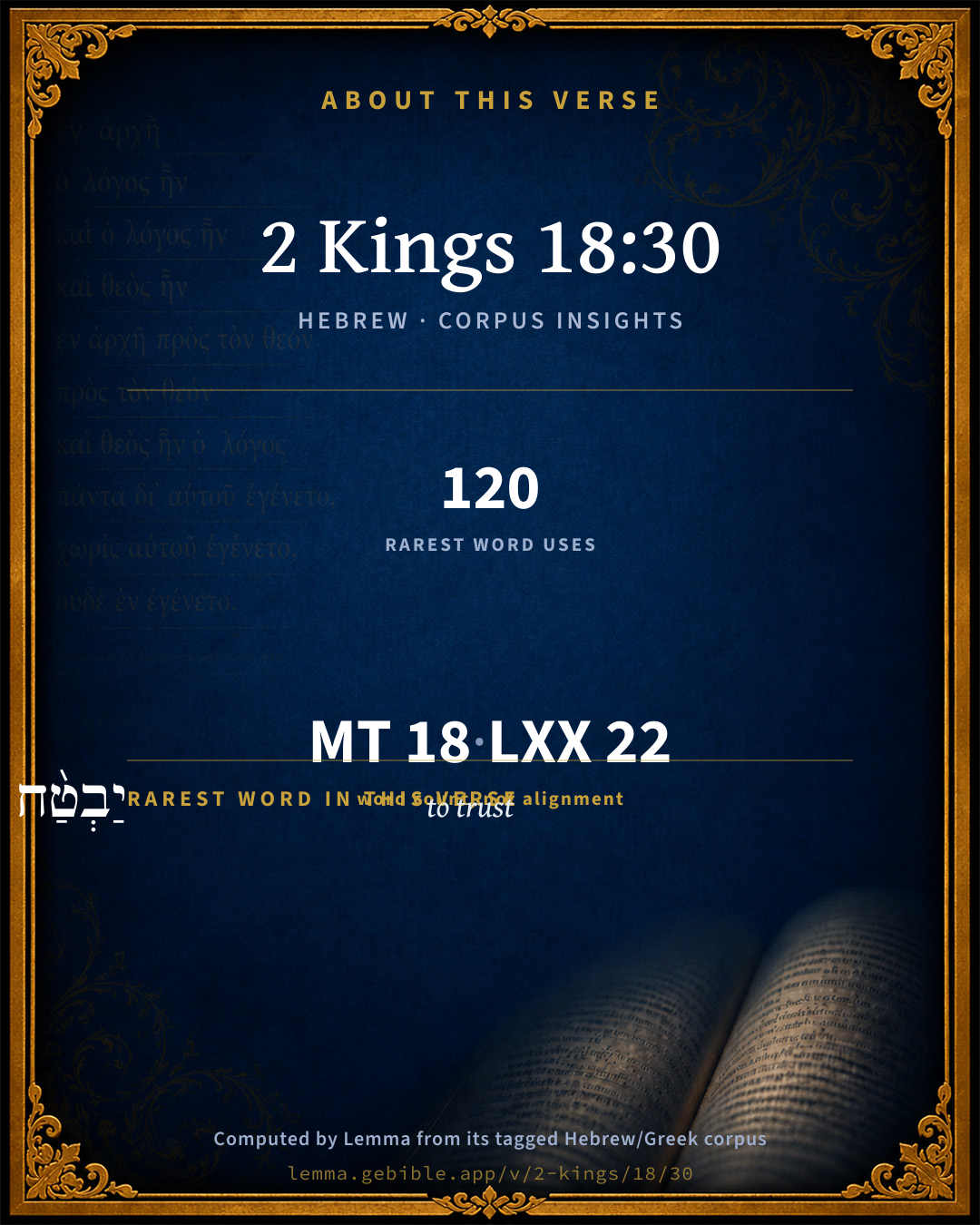
18
words
15
distinct lemmas
Historical
section

Grammatical profile

  • 5 verbs
  • 7 nouns
  • 1 pronoun
  • 1 preposition
  • 4 particles

Verb forms

  • יַבְטַ֨ח Hiphil · Jussive
  • לֵאמֹ֔ר Qal · Infinitive Construct
  • הַצֵּ֥ל Hiphil · Infinitive Absolute
  • יַצִּילֵ֖נוּ Hiphil · Imperfect
  • תִנָּתֵן֙ Niphal · Imperfect

Repetition

Words recur within this verse — often emphatic in Hebrew:

  • יְהוָ֣ה LORD H3068 ×2
  • הַצֵּ֥ל to rescue H5337 ×2

Hebrew & Septuagint length

In English translation the verse runs 29 words from the Hebrew and 37 from the Septuagint (LXX English) — closely comparable.

A rough comparison of the two English renderings, which tokenize alike — not a word-level alignment.

Word counts can differ between the Hebrew and the Greek without any difference in meaning — e.g. the Hebrew direct-object marker אֵת has no separate Greek word, and Greek often adds the article ὁ.

In the original languages it is 18 Hebrew tokens and 22 Greek tokens — but the two are counted differently (Hebrew bundles its prefixes and suffixes into one token; the Greek is in lemma form), so that isn’t a like-for-like length.

Cross-references

11

Topical passages linked to 2 Kings 18:30 in the Treasury of Scripture Knowledge — connected by theme and wording, ordered by reader-vote popularity; previews shown in the World English Bible.

  • 2 Kings 19:10 Thus shall you speak to Hezekiah king of Judah, saying, Don't let your God in whom you trust deceive you, saying, Jerusalem shall not be given into the hand of the king of Assyria.
  • 2 Kings 19:22 Whom have you defied and blasphemed? and against whom have you exalted your voice and lifted up your eyes on high? [even] against the Holy One of Israel.
  • 2 Kings 19:32–34 Therefore thus says Yahweh concerning the king of Assyria, He shall not come to this city, nor shoot an arrow there, neither shall he come before it with shield, nor cast up a mound against it.
  • Psalms 4:2 You sons of men, how long shall my glory be turned into dishonor? Will you love vanity, and seek after falsehood? Selah.
  • Psalms 11:1 In Yahweh, I take refuge. How can you say to my soul, "Flee as a bird to your mountain!"
  • Psalms 22:7–8 All those who see me mock me. They insult me with their lips. They shake their heads, saying,
  • Psalms 71:9 Don't reject me in my old age. Don't forsake me when my strength fails.
  • Psalms 71:11 Saying, "God has forsaken him. Pursue and take him, for no one will rescue him."
  • Psalms 125:1–2 Those who trust in Yahweh are as Mount Zion, Which can't be moved, but remains forever.
  • Matthew 27:43 He trusts in God. Let God deliver him now, if he wants him; for he said, 'I am the Son of God.'"
  • Luke 23:35 The people stood watching. The rulers with them also scoffed at him, saying, "He saved others. Let him save himself, if this is the Christ of God, his chosen one!"

Cross-references courtesy of OpenBible.info (CC BY 4.0).

Hebrew and Greek witnesses Masoretic Hebrew ↔ Greek Septuagint

The same verse in the two great witnesses to the Old Testament, shown verse-for-verse.

These are two independent witnesses, not word-aligned to each other, and the Septuagint is shown in lemma (dictionary) form.

Hebrew 2 Kings 18:30 Masoretic · Westminster Leningrad Codex

וְאַל יַבְטַ֨ח אֶתְכֶ֤ם חִזְקִיָּ֨הוּ֙ אֶל יְהוָ֣ה לֵאמֹ֔ר הַצֵּ֥ל יַצִּילֵ֖נוּ יְהוָ֑ה וְלֹ֤א תִנָּתֵן֙ אֶת הָעִ֣יר הַזֹּ֔את בְּיַ֖ד מֶ֥לֶךְ אַשּֽׁוּר

neither let Hezekiah make you trust in Yahweh, saying, Yahweh will surely deliver us, and this city shall not be given into the hand of the king of Assyria.

World English Bible · Public Domain

Greek LXX 2 Kings 18:30 Septuagint · lemma form

καί μή ἐπιἐλπίζω σύ εζεκιας πρός κύριος λέγω ἐκαἱρέω ἐκαἱρέω ἐγώ κύριος οὐ μή παραδίδωμι ὁ πόλις οὗτος ἐν χείρ βασιλεύς ἀσσύριος

And let not Ezekias cause you to trust on the Lord, saying, The Lord will certainly deliver us; this city shall not be delivered into the hand of the king of the Assyrians: listen not to Ezekias:

LXX2012 (modern English Septuagint) · Public Domain

Hebrew: Westminster Leningrad Codex (CC BY 4.0). Greek: Septuagint (public domain); English from LXX2012 (modern English Septuagint) (Public Domain). How the Septuagint differs from the Hebrew →

Targum (Aramaic paraphrase)

1

The Targum is the ancient Jewish Aramaic paraphrase of the Hebrew Scriptures — an interpretive translation, not the Hebrew text itself. Onkelos (literal) and Pseudo-Jonathan (expansive) render the Torah, and Jonathan the Prophets. Coverage is partial: where no permissively-licensed English translation exists for a verse, only the Aramaic is shown. This is verse-level text, not a word-by-word alignment to the Hebrew.

  1. Targum Jonathan Prophets (Joshua–Malachi)
    וְלָא יַרְחִיץ יַתְכוֹן חִזְקִיָה עַל מֵימְרָא דַייָ לְמֵימָר שֵׁיזָבָא יְשֵׁיזְבִינָנָא יְיָ וְלָא תִתְמְסַר קַרְתָּא הָדָא בְּיַד מַלְכָּא דְאַתּוּר:

    (no public-domain English translation for this verse)

    Targum Jonathan — Aramaic: “Mikraot Gedolot” (public domain). English: “Sefaria Community Translation” (CC0 1.0 (public-domain dedication)); “London "Chaldee Paraphrase," 1871” (public domain). Text via Sefaria.

Commentary

Notes on 2 Kings 18:30 from classic Christian and Jewish commentators (each source and its license shown beneath its notes). The classic Christian expositions comment on the surrounding passage and are grouped to its opening verse, so a note may address several verses; the Jewish commentaries on the Tanakh (Rashi and others) are per-verse, so they appear only where the commentator wrote on this verse.

Lemma curates 59 commentaries, every one of them public domain or Creative Commons licensed, each selected and text-cleaned for this edition rather than reprinted as found. About our sources →

Trapp's Complete Commentary

John Trapp

2Ki 18:30 Neither let Hezekiah make you trust in the LORD, saying, The LORD will surely deliver us, and this city shall not be delivered into the hand of the king of Assyria.

Ver. 30. Neither let Hezekiah make you trust in the Lord.] Of whom these pagans had the like base and bald conceits as they had of the dunghill deities of other countries. "But our God is in heaven," saith the psalmist; "he doeth whatsoever he willeth in heaven and in earth": and "those that trust in him shall never be confounded." "It is better to trust in the Lord than to put confidence in men" or means.

John Trapp, A Commentary or Exposition upon All the Books of the Old and New Testament (1647–1656) — public domain. Text from a community e-Sword module.

Joseph Benson's Commentary

2Ki 18:30-31. Neither let Hezekiah make you trust in the Lord — This was high presumption indeed, to endeavour to persuade them not to place their confidence in God, as if his master were stronger than God. Make an agreement with me by a present — To redeem yourselves from all the calamities of a close siege, and from that death and destruction which will certainly follow on them: or, according to the marginal reading, make with me a blessing, that is, a blessed peace, whereby you may be delivered out of your distressed and miserable condition, and may receive from me the blessings of protection and provision, which your king cannot afford you. Then eat ye every man of his own vine — Upon these terms I will give you no disturbance; but quietly suffer each of you to enjoy his own possessions.

Joseph Benson's Commentary on the Old and New Testaments (1811–1818) — public domain. Text from a community e-Sword module.

Ellicott's Commentary for English Readers

(30) Neither let Hezekiah make you trust in the Lord.—Hezekiah cannot save you himself (2Ki_18:29); Jehovah will not do so (2Ki_18:25). The “Jewish colouring” of the verse is not apparent to the present writer. If Rab-shakeh could speak Hebrew, he would almost certainly know the name of the god of the Jews; and it was perfectly natural for him to assume that Hezekiah and his prophets would encourage the people to trust in the God who had His sanctuary on Zion, and was bound to defend His own dwelling-place. The words are not so exact a reproduction of Isaiah’s language (Isa_37:35) as to preclude this view.

Delivered.—Rather, given, yielded up.

A Bible Commentary for English Readers, edited by Charles John Ellicott (1878–1897) — public domain. Text from a community e-Sword module.

The Cambridge Bible for Schools and Colleges

gen. ed. J. J. S. Perowne

30. this city shall not be delivered] R.V. given. The Hebrew word is not the same as that rendered ‘deliver’ in this verse and the previous one. It is desirable that the difference should be made plain to the English reader.

The Cambridge Bible for Schools and Colleges (gen. ed. J. J. S. Perowne; Cambridge University Press, 1878–1918) — public domain. Text from a community e-Sword module.

The Pulpit Commentary

Neither let Hezekiah make you trust in the Lord. Rabshakeh seems to be aware that this is the argument which Hezekiah is, in point of fact, mainly urging. If at one time he had trusted in Egypt, that trust was now quite or well-nigh gone. The tone of his exhortations was that recorded in Chronicles, (2Ch_32:6-8) "He set captains of war over the people, and gathered them together to him in the street of the gate of the city, and spake comfortably to them, saying, Be strong and courageous, be not afraid nor dismayed for the King of Assyria, nor for all the multi-rude that is with him: for there be more with us than with him; (2Ki_6:16) with him is an arm of flesh; but with us is the Lord our God to help us, and to fight our battles. And the people rested themselves upon the words of Hezekiah King of Judah." Saying, The Lord will surely deliver us, and this city shall not be delivered into the hand of the King of Assyria. Hezekiah"s was, in part, a general conviction that God would not forsake his people, who had recently turned to him, if not with absolute sincerity, yet at any rate with public confession of sin, and public acknowledgment of his mercies, and public profession of an intention to serve him; in part, probably, a special reliance on some definite prophecies of Isaiah, that the city should not be taken. (see Isa_31:4-6)

The Pulpit Commentary (1880–1919), ed. H.D.M. Spence-Jones & Joseph S. Exell — public domain. Text from a community e-Sword module.

Lesson kit

Teaching starters — assembled from the data on this page, not authored interpretation. Every prompt links to the verse data it draws on. Edit before teaching.

2 Kings, in the Historical, opens this verse with 18 words (15 distinct Hebrew lemmas). Its most distinctive word is bâṭach (“to trust”). A historical commentator’s framing appears above. Read the whole chapter for the surrounding context.

Discussion questions

  1. What does “to trust” (bâṭach) contribute to the verse as a whole?
  2. 2 Kings 19:10 shares this passage’s theme. How do the two illuminate each other?
  3. “LORD” occurs 2× in this one verse. What is the effect of the repetition?
  4. These translations render this verse differently; the difference is in the English rendering, not the original. What questions does that raise?
  5. The verb «יַבְטַ֨ח» is Hiphil Jussive. How does its form color the action?
  6. Reading how Trapp's Complete Commentary and Joseph Benson's Commentary read this verse, where do the two commentators agree and where do they part?

Things to notice

Reading settings

Reading text

Shown beneath each verse's original-language words.

Old Testament
Old Testament edition

Read the OT as the Masoretic Hebrew (MT) or the Greek Septuagint (LXX).

English shown for the Greek Septuagint (in the Hebrew ↔ Greek comparison).

Comparing translations? Open the Compare panel on any verse page to stack up to four side by side.