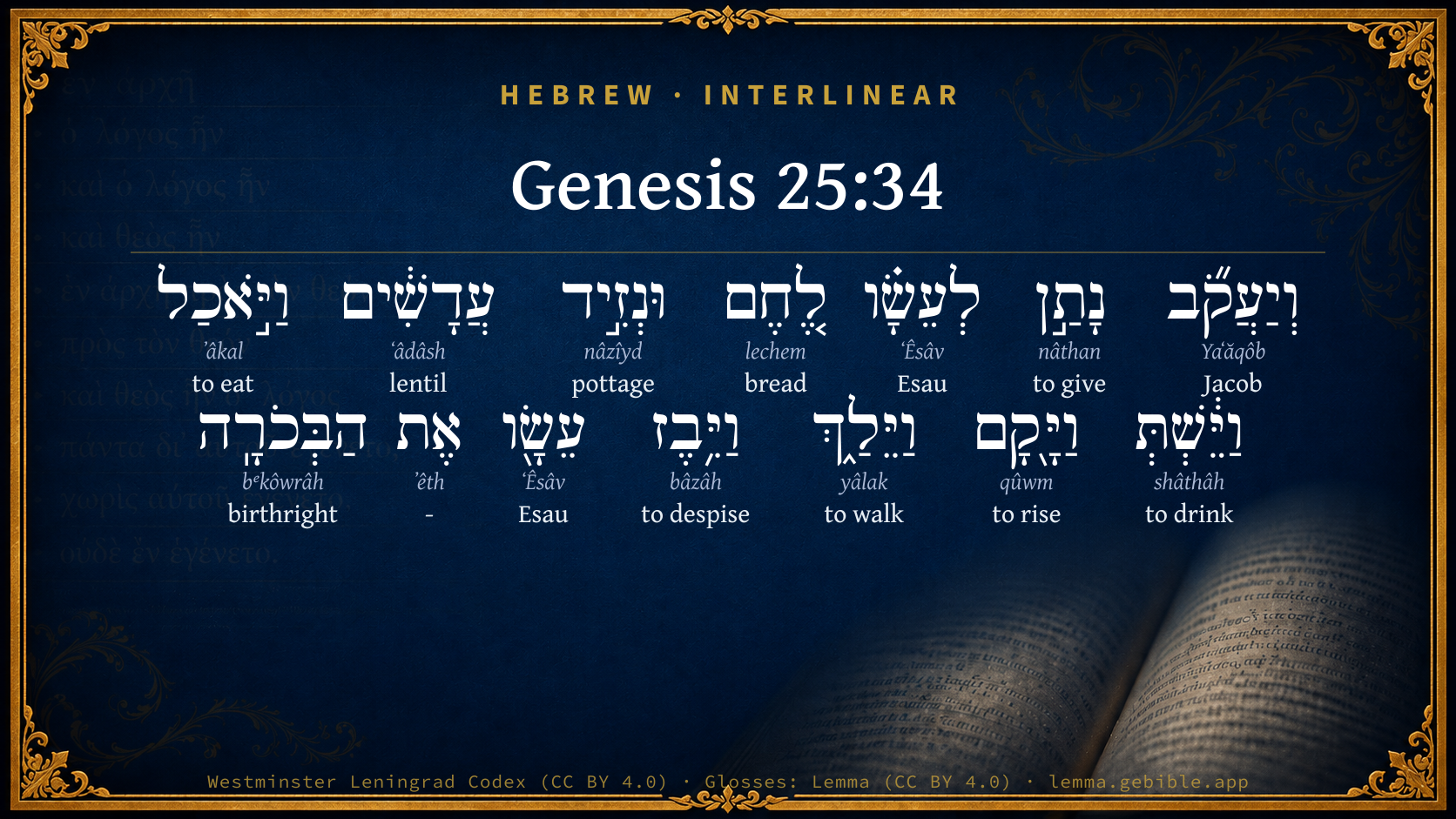
Genesis 25:34

Hebrew (Westminster Leningrad Codex) Genesis 25:34 appears in the Hebrew Old Testament. The text above is from the Westminster Leningrad Codex. Each word links to its Strong’s number, a concise gloss, and parsing drawn from the Open Scriptures Hebrew Bible morphology. Click any word for its full Brown-Driver-Briggs (BDB) entry.
Download image
Cite this verse

Genesis 25:34 (World English Bible). Public Domain. Lemma interlinear Bible study tool, https://lemma.gebible.app/v/genesis/25/34.

Show BibTeX & RIS
BibTeX
RIS
English Translation
Jacob gave Esau bread and stew of lentils. He ate and drank, rose up, and went his way. So Esau despised his birthright.
World English Bible · Public Domain
Highlights
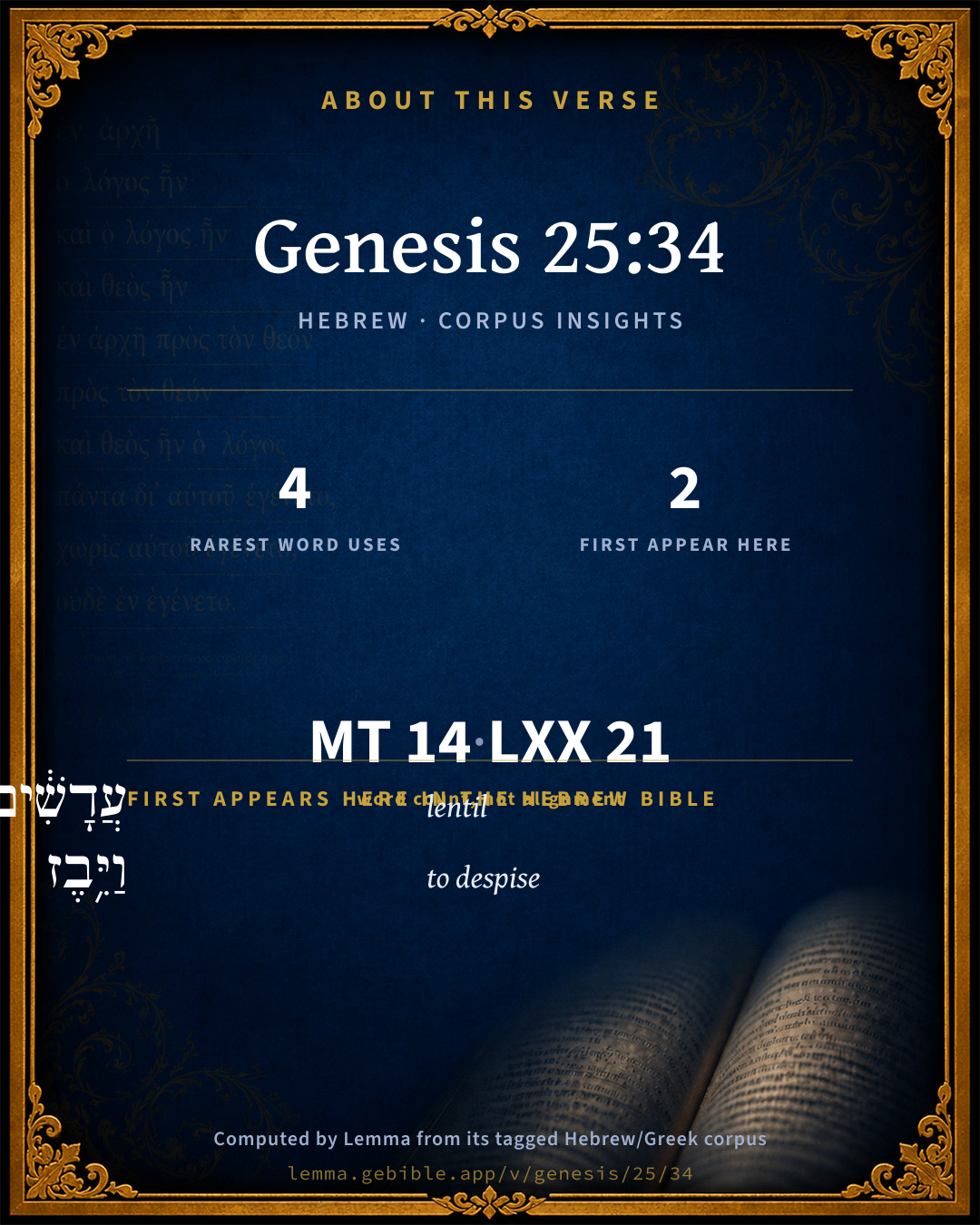
  • 2 first appearances in the Hebrew Bible
Full analysis ↓
Download a study sheet

One document with this verse’s original text, its word-by-word gloss line, the meaning frame, cross-references with their text, attributed commentary, and full source and license credits — printable, and it pastes into notes with its structure intact.

This verse Autodidact and up

Study sheet (.html) Plain text (.txt)

A passage Seminary Student

Up to 50 verses in one chapter. A passage sheet keeps up to 6 commentary sources and 12 cross-references per verse, in the order this page ranks them, and says so on the sheet whenever that leaves anything out. Ask for a single verse and you get the Autodidact verse sheet above.

Everything on this page stays free to read, with no account — the sheet is a download of what is already on screen, not access to it.

Want to remove ads? Support Godless Engineer
Compare translations 3

The same verse in 3 English versions, stacked beneath the original-language interlinear above. Click any original word for its lexicon entry.

Each is an independent rendering of the whole verse — the interlinear is not word-aligned to these translations.

Highlighted words mark where these versions differ — a whole-verse word diff, not a word-by-word alignment.

  • World English Bible Public Domain
    Jacob gave Esau bread and stew of lentils. He ate and drank, rose up, and went his way. So Esau despised his birthright.
  • King James Version Public Domain
    Then Jacob gave Esau bread and pottage of lentils; and he did eat and drink, and rose up, and went his way: thus Esau despised his birthright.
  • unfoldingWord Literal Text CC BY-SA 4.0
    Then Jacob gave to Esau bread and lentil stew, and he ate and drank, and got up and left. So Esau despised his birthright.

unfoldingWord Literal Text — © unfoldingWord, licensed CC BY-SA 4.0. Word-aligned USFM3 via Door43 (git.door43.org/unfoldingWord/en_ult).

Versions to compare (up to 4)

3 of 4 selected

Show all 18 translations

Every available English version of this verse, each an independent rendering of the whole verse.

  • World English Bible Public Domain
    Jacob gave Esau bread and stew of lentils. He ate and drank, rose up, and went his way. So Esau despised his birthright.
  • Berean Standard Bible Public Domain
    Then Jacob gave some bread and lentil stew to Esau, who ate and drank and then got up and went away. Thus Esau despised his birthright.
  • Majority Standard Bible Public Domain
    Then Jacob gave some bread and lentil stew to Esau, who ate and drank and then got up and went away. Thus Esau despised his birthright.
  • King James Version Public Domain
    Then Jacob gave Esau bread and pottage of lentils; and he did eat and drink, and rose up, and went his way: thus Esau despised his birthright.
  • American Standard Version (1901) Public Domain
    And Jacob gave Esau bread and pottage of lentils. And he did eat and drink, and rose up, and went his way. So Esau despised his birthright.
  • Revised Version (1885) Public Domain
    And Jacob gave Esau bread and pottage of lentils; and he did eat and drink, and rose up, and went his way: so Esau despised his birthright.
  • Geneva Bible (1599) Public Domain
    Then Iaakob gaue Esau bread and pottage of lentiles: and he did eate and drinke, and rose vp, and went his way: So Esau contemned his birthright.
  • Douay-Rheims (1899) Public Domain
    And so taking bread and the pottage of lentils, he ate, and drank, and went his way; making little account of having sold his first birthright.
  • Young's Literal Translation Public Domain
    and Jacob hath given to Esau bread and pottage of lentiles, and he eateth, and drinketh, and riseth, and goeth; and Esau despiseth the birthright.
  • Literal Standard Version CC BY-SA 4.0
    and Jacob has given bread and stew of lentils to Esau, and he eats, and drinks, and rises, and goes; and Esau despises the birthright.
  • Unlocked Literal Bible CC BY-SA 4.0
    Jacob gave Esau bread and stew of lentils. He ate and drank, then got up and went on his way. In this manner Esau despised his birthright.
  • unfoldingWord Literal Text CC BY-SA 4.0
    Then Jacob gave to Esau bread and lentil stew, and he ate and drank, and got up and left. So Esau despised his birthright.
  • Darby Bible Public Domain
    And Jacob gave Esau bread and the dish of lentils; and he ate and drank, and rose up and went away. Thus Esau despised the birthright.
  • World Messianic Bible Public Domain
    Jacob gave Esau bread and lentil stew. He ate and drank, rose up, and went his way. So Esau despised his birthright.
  • Webster's Bible Public Domain
    Then Jacob gave Esau bread and pottage of lentiles; and he ate and drank, and rose and went his way: thus Esau despised his birth-right.
  • Free Bible Version CC BY-SA 4.0
    Then Jacob gave Esau some bread and lentil stew. He ate and drank, and then he got up and left. By doing this Esau showed how little he cared for his rights as the firstborn son.
  • Bible in Basic English Public Domain
    Then Jacob gave him bread and soup; and he took food and drink and went away, caring little for his birthright.
  • JPS Tanakh (1917) Public Domain
    And Jacob gave Esau bread and pottage of lentils; and he did eat and drink, and rose up, and went his way. So Esau despised his birthright.

Literal Standard Version (2020), Covenant Press — licensed CC BY-SA 4.0. Text via the HelloAO Bible API (eBible.org). Unlocked Literal Bible (unfoldingWord) — licensed CC BY-SA 4.0. Text via the HelloAO Bible API (eBible.org). unfoldingWord Literal Text — © unfoldingWord, licensed CC BY-SA 4.0. Word-aligned USFM3 via Door43 (git.door43.org/unfoldingWord/en_ult). Free Bible Version, Dr. Jonathan Gallagher — licensed CC BY-SA 4.0. Text via the HelloAO Bible API (eBible.org).

Word by word

More ways to search: Search by grammar → Find every occurrence → Compare this word →

Practice this passage: Drill this verse → Learn its vocabulary →

עֲדָשִׁ֔ים
ʻâdâsh
H5742
“lentils”
Noun, Common, Feminine, Plural, Absolute
Part of Speech
Noun
Type
Common
Gender
Feminine
Number
Plural
State
Absolute
Full BDB Definition

Origin: from an unused root of uncertain meaning

TWOT: 1573

lentil
  1. וְיַעֲקֹ֞ב Yaʻăqôb H3290 “and · Jacob” Conjunction + Noun, Proper
  2. נָתַ֣ן nâthan H5414 “to give” Verb, Qal, Perfect, 3rd Person, Masculine, Singular
  3. לְעֵשָׂ֗ו ʻÊsâv H6215 “to/for · Esau” Preposition + Noun, Proper
  4. לֶ֚חֶם lechem H3899 “bread” Noun, Common, Both, Singular, Absolute
  5. וּנְזִ֣יד nâzîyd H5138 “and · pottage of” Conjunction + Noun, Common, Masculine, Singular, Construct
  6. וַיֹּ֣אכַל ʼâkal H398 “and · to eat” Conjunction + Verb, Qal, Sequential Imperfect, 3rd Person, Masculine, Singular
  7. וַיֵּ֔שְׁתְּ shâthâh H8354 “and · to drink” Conjunction + Verb, Qal, Sequential Imperfect, 3rd Person, Masculine, Singular
  8. וַיָּ֖קָם qûwm H6965 “and · to rise” Conjunction + Verb, Qal, Sequential Imperfect, 3rd Person, Masculine, Singular
  9. וַיֵּלַ֑ךְ yâlak H3212 “and · to walk” Conjunction + Verb, Qal, Sequential Imperfect, 3rd Person, Masculine, Singular
  10. וַיִּ֥בֶז bâzâh H959 “and · to despise” Conjunction + Verb, Qal, Sequential Imperfect, 3rd Person, Masculine, Singular
  11. עֵשָׂ֖ו ʻÊsâv H6215 “Esau” Noun, Proper
  12. אֶת ʼêth H853 “-” Particle, Direct Object
  13. הַבְּכֹרָֽה bᵉkôwrâh H1062 “the · birthright” Particle, Definite Article + Noun, Common, Both, Singular, Absolute

About this verse

These counts appear in no published source. They are computed here, from the morphology-tagged text and Lemma’s own curated glosses. What Lemma adds →

14
words
13
distinct lemmas
Pentateuch
section

Notable vocabulary

The rarest word here is עֲדָשִׁ֔ים lentil H5742 — appearing just 4 times in the whole Hebrew Bible.

First appearance in Scripture

These words make their first canonical appearance in the Hebrew Bible here:

  • עֲדָשִׁ֔ים lentil H5742
  • וַיִּ֥בֶז to despise H959

Shared distinctive vocabulary

עֲדָשִׁ֔ים lentil H5742 occurs in 4 verses of the Hebrew Bible. Also found in:

Grammatical profile

  • 6 verbs
  • 7 nouns
  • 1 particle

Verb forms

  • נָתַ֣ן Qal · Perfect
  • וַיֹּ֣אכַל Qal · Sequential Imperfect
  • וַיֵּ֔שְׁתְּ Qal · Sequential Imperfect
  • וַיָּ֖קָם Qal · Sequential Imperfect
  • וַיֵּלַ֑ךְ Qal · Sequential Imperfect
  • וַיִּ֥בֶז Qal · Sequential Imperfect

Repetition

A word recurs within this verse — often emphatic in Hebrew:

  • לְעֵשָׂ֗ו Esau H6215 ×2

Hebrew & Septuagint length

In English translation the verse runs 23 words from the Hebrew and 25 from the Septuagint (LXX English) — closely comparable.

A rough comparison of the two English renderings, which tokenize alike — not a word-level alignment.

Word counts can differ between the Hebrew and the Greek without any difference in meaning — e.g. the Hebrew direct-object marker אֵת has no separate Greek word, and Greek often adds the article ὁ.

In the original languages it is 14 Hebrew tokens and 21 Greek tokens — but the two are counted differently (Hebrew bundles its prefixes and suffixes into one token; the Greek is in lemma form), so that isn’t a like-for-like length.

Cross-references

11

Topical passages linked to Genesis 25:34 in the Treasury of Scripture Knowledge — connected by theme and wording, ordered by reader-vote popularity; previews shown in the World English Bible.

  • Hebrews 12:16–17 lest there be any sexually immoral person, or profane person, as Esau, who sold his birthright for one meal.
  • Philippians 3:18–19 For many walk, of whom I told you often, and now tell you even weeping, as the enemies of the cross of Christ,
  • Isaiah 22:13 and behold, joy and gladness, killing oxen and killing sheep, eating flesh and drinking wine: let us eat and drink, for tomorrow we shall die.
  • Matthew 26:15 and said, "What are you willing to give me, that I should deliver him to you?" They weighed out for him thirty pieces of silver.
  • 1 Corinthians 15:32 If I fought with animals at Ephesus for human purposes, what does it profit me? If the dead are not raised, then "let us eat and drink, for tomorrow we die."
  • Psalms 106:24 Yes, they despised the pleasant land. They didn't believe his word,
  • Zechariah 11:13 Yahweh said to me, "Throw it to the potter, the handsome price that I was valued at by them!" I took the thirty pieces of silver, and threw them to the potter, in the house of Yahweh.
  • Matthew 22:5 But they made light of it, and went their ways, one to his own farm, another to his merchandise,
  • Luke 14:18–20 They all as one began to make excuses. "The first said to him, 'I have bought a field, and I must go and see it. Please have me excused.'
  • Acts 13:41 'Behold, you scoffers, and wonder, and perish; For I work a work in your days, A work which you will in no way believe, if one declares it to you.'"
  • Ecclesiastes 8:15 Then I commended mirth, because a man has no better thing under the sun, than to eat, and to drink, and to be joyful: for that will accompany him in his labor all the days of his life which God has given him under the sun.

Cross-references courtesy of OpenBible.info (CC BY 4.0).

Hebrew and Greek witnesses Masoretic Hebrew ↔ Greek Septuagint

The same verse in the two great witnesses to the Old Testament, shown verse-for-verse.

These are two independent witnesses, not word-aligned to each other, and the Septuagint is shown in lemma (dictionary) form.

Hebrew Genesis 25:34 Masoretic · Westminster Leningrad Codex

וְיַעֲקֹ֞ב נָתַ֣ן לְעֵשָׂ֗ו לֶ֚חֶם וּנְזִ֣יד עֲדָשִׁ֔ים וַיֹּ֣אכַל וַיֵּ֔שְׁתְּ וַיָּ֖קָם וַיֵּלַ֑ךְ וַיִּ֥בֶז עֵשָׂ֖ו אֶת הַבְּכֹרָֽה

Jacob gave Esau bread and stew of lentils. He ate and drank, rose up, and went his way. So Esau despised his birthright.

World English Bible · Public Domain

Greek LXX Genesis 25:34 Septuagint · lemma form

ἰακώβ δέ δίδωμι ὁ ησαυ ἄρτος καί ἕψεμα φακός καί ἐσθίω καί πίνω καί ἀναἵστημι οἴχομαι καί φαυλίζω ησαυ ὁ πρωτοτόκιον

And Jacob gave bread to Esau, and pottage of lentiles; and he ate and drank, and he arose and departed; so Esau slighted his birthright.

LXX2012 (modern English Septuagint) · Public Domain

Hebrew: Westminster Leningrad Codex (CC BY 4.0). Greek: Septuagint (public domain); English from LXX2012 (modern English Septuagint) (Public Domain). How the Septuagint differs from the Hebrew →

Targum (Aramaic paraphrase)

2

The Targum is the ancient Jewish Aramaic paraphrase of the Hebrew Scriptures — an interpretive translation, not the Hebrew text itself. Onkelos (literal) and Pseudo-Jonathan (expansive) render the Torah, and Jonathan the Prophets. Coverage is partial: where no permissively-licensed English translation exists for a verse, only the Aramaic is shown. This is verse-level text, not a word-by-word alignment to the Hebrew.

  1. Targum Onkelos Torah (Genesis–Deuteronomy)
    וְיַעֲקֹב יְהַב לְעֵשָׂו לְחֵם וְתַבְשִׁיל דִּטְלוֹפְחִין וַאֲכַל וּשְׁתִי וְקָם וַאֲזָל וְשָׁט עֵשָׂו יָת בְּכֵרוּתָא

    (no public-domain English translation for this verse)

    Targum Onkelos — Aramaic: “Onkelos Genesis” (public domain); “Onkelos Exodus” (public domain); “Onkelos Leviticus” (public domain); “Onkelos Numbers” (public domain); “Onkelos Deuteronomy” (public domain). English: “Sefaria Community Translation” (CC0 1.0 (public-domain dedication)); “J.W. Etheridge. The Targums of Onkelos and Jonathan Ben Uzziel on the Pentateuch. London: Longmans, Green, 1862” (public domain). Text via Sefaria.

  2. Targum Pseudo-Jonathan Torah (Genesis–Deuteronomy)
    וְיַעֲקב נָתַן לְעֵשָו לֶחֶם וְתַבְשִׁיל דִטְלוֹפְחִי וְאָכַל וּשְׁתִי וְקָם וַאֲזַל וְשַׁט עֵשָו יַת בְּכֵירוּתָא וְחוֹלַק עַלְמָא דְאָתִי

    And Jakob gave to Esau bread and pottage fo lentiles. And he ate and drank, and arose and went. And Esau scorned the birthright, and the portion of the world that commeth.

    Targum Pseudo-Jonathan — Aramaic: “Targum Jonathan on Genesis” (public domain); “Targum Jonathan on Exodus” (public domain); “Targum Jonathan on Leviticus” (public domain); “Targum Jonathan on Numbers” (public domain); “Targum Jonathan on Deuteronomy” (public domain). English: “The Targum of Jonathan ben Uzziel, trans. J. W. Etheridge, London, 1862” (public domain). Text via Sefaria.

Commentary

Notes on Genesis 25:34 from classic Christian and Jewish commentators (each source and its license shown beneath its notes). The classic Christian expositions comment on the surrounding passage and are grouped to its opening verse, so a note may address several verses; the Jewish commentaries on the Tanakh (Rashi and others) are per-verse, so they appear only where the commentator wrote on this verse.

Lemma curates 59 commentaries, every one of them public domain or Creative Commons licensed, each selected and text-cleaned for this edition rather than reprinted as found. About our sources →

Trapp's Complete Commentary

John Trapp

Gen 25:34 Then Jacob gave Esau bread and pottage of lentiles; and he did eat and drink, and rose up, and went his way: thus Esau despised [his] birthright.

Ver. 34. He did eat and drink, and rose up, &c.] Hac verborum congeri, impoenitentia Esaui deseribitur. {a} Away he went, without showing the least remorse or regret for what he had done. Lysimachus soon repented him for parting with his crown for a draught of cold water, in his extreme thirst. {b} Wine is a prohibited ware among Turks; which makes some drink with scruple, others with danger. The baser sort, when taken drunk, are often caned on the soles of their bare feet. And I have seen some, saith mine author, {c} after a fit of drunkenness, lie a whole night, crying and praying to Mohammed for intercession, that I could not sleep near them; so strong is conscience, even where the foundation is but imaginary, to the shame of many profligate professors - cauterised Christians.

{a} Piscator.

{b} O dii, quam brevis voluptatis gratia ex rege me feci servum!

{c} Blount’s Voyage, p. 105.

John Trapp, A Commentary or Exposition upon All the Books of the Old and New Testament (1647–1656) — public domain. Text from a community e-Sword module.

Joseph Benson's Commentary

Gen 25:34. He did eat and drink, and rose up, and went his way — Without any serious reflections upon the ill bargain he had made, or any show of regret. Thus Esau despised his birthright — He used no means to get the bargain revoked, made no appeal to his father about it; but the bargain which his necessity had made, (supposing it were so,) his profaneness confirmed, and by his subsequent neglect and contempt, he put the matter past recall.

Joseph Benson's Commentary on the Old and New Testaments (1811–1818) — public domain. Text from a community e-Sword module.

MacLaren's Expositions of Holy Scripture

Alexander MacLaren

Genesis

A BAD BARGAIN

POTTAGE VERSUS BIRTHRIGHT

Gen 25:34.

Broad lessons unmistakable, but points strange and difficult to throw oneself back to so different a set of ideas. So

I. Deal with the narrative.

Not to tell it over again, but bring out the following points:-

{a} Birthright.-What?

None of them any notion of sacred, spiritual aspect of it.

To all, merely material advantages: headship of the clan. All the loftier aspects gone from Isaac, who thought he could give it for venison, from Esau, and from the scheming Rebekah and the crafty Jacob.

{b} The Bargain.

It is not clear whether the transaction was seriously meant, or whether it only shows Jacob’s wish to possess the birthright and Esau’s indifference to it.

At any rate, the barter was not supposed to complete Jacob’s title, as is shown by a subsequent piece of trickery.

Isaac’s blessing was conceived to confer it; that blessing, if once given, could not be revoked, even if procured by fraud and given in error.

The belief would fulfil itself, as far as the chieftainship was concerned.

It is significant of the purely ‘secular’ tone of all the parties concerned that only temporal blessings are included in Isaac’s words.

{c} The Scripture judgment on all parties concerned.

Great mistakes are made by forgetting that the Bible is a passionless narrator of its heroes’ acts, and seldom pauses to censure or praise-so people have thought that Scripture gave its vote for Jacob as against Esau.

The character of the two men.

Esau-frank, impulsive, generous, chivalrous, careless, and sensuous.

Jacob-meditative, reflective, pastoral, timid, crafty, selfish. Each has the defects of his qualities.

But the subsequent history of Jacob shows what heaven thought of him.

This dirty transaction marred his life, sent him a terrified exile from Isaac’s tent, and shook his soul long years after with guilty apprehensions when he had to meet Esau.

All subsequent career to beat his crafty selfishness out of him and to lift him to higher level.

II. Broad General Lessons.

1. The Choice.-Birthright versus Pottage.

{a} The Present versus The Future.

Suppose it true that to both brothers the birthright seemed to secure merely material advantage, yet even so the better part would have been to sacrifice material present for material future. Even on plane of worldly things, to live for to-morrow ennobles a man, and he is the higher style of man who ‘spurns delights and lives laborious days’ for some issue to be realised in the far future.

The very same principle extended leads to the conviction that the highest wisdom is his who lives for the furthest, which is also the most certain, Future.

{b} The Seen versus The Unseen.

However material the advantages of the birthright were supposed to be, they then appealed to imagination, not sense. There was the pottage in the pan: ‘I can see that and smell it. This birthright, can I eat it? Let me get the solid realities, and let who will have the imaginary.’

So the unseen good things, such as intellectual culture, fair reputation, and the like, are better than the gross satisfactions that can be handled, or tasted, or seen.

And, on the very same principle, high above the seeker after these-as high as he is above the drunkard-is the Christian, whose life is shaped by the loftiest Unseen, even ‘Him who is invisible.’

2. The grim absurdity of the choice.

The story seems to have a certain undertone of sarcasm, and a keen perception of the immense stupidity of the man.

Pottage and a full belly to-day-that was all he got for such a sacrifice.

‘This their way is their folly.’

3. How well the bargain worked at first, and what came of it at last.

No doubt Esau had his meal, and, no doubt, when a man sells his soul to the devil {the mediaeval form of the story}, he generally gets the price for which he bargained, more or less, and oftentimes with a dash of vinegar in the porridge, which makes it less palatable.

What comes of it at last. Put side by side the pictures of Esau’s animal contentment at the moment when he had eaten up his mess, and of his despair when he wailed, ‘Hast thou not one blessing?’

He finds out his mistake. A sense of the preciousness of the despised thing wakes in him.

And it is too late. There are irrevocable consequences of every false choice. Youth is gone: cannot alter that. Opportunities gone: cannot alter that. Strength gone: cannot alter that. Habits formed, associations, reputation, position, character, are all determined.

But there is a blessed contrast between Esau’s experience and what may be ours. The desire to have the birthright is sure to bring it to us. No matter how late the desire is of springing, nor how long and insultingly we have suppressed it, we never go to our Father in vain with the cry, ‘Bless me, even me also.’

‘What shall it profit a man if he gain the whole world and lose his own soul?’

Alexander MacLaren, Expositions of Holy Scripture (1904–1910) — public domain. Text from a community e-Sword module.

Adam Clarke's Commentary

Verse 34. Pottage of lentiles] See Clarke on Ge 25:29.

Thus Esau despised his birthright.] On this account the apostle, Heb 12:16, calls Esau a profane person, because he had, by this act, alienated from himself and family those spiritual offices connected with the rights of primogeniture. While we condemn Esau for this bad action, (for he should rather have perished than have alienated this right,) and while we consider it as a proof that his mind was little affected with Divine or spiritual things, what shall we say of his most unnatural brother Jacob, who refused to let him have a morsel of food to preserve him from death, unless he gave him up his birthright? Surely he who bought it, in such circumstances, was as bad as he who sold it. Thus Jacob verified his right to the name of supplanter, a name which in its first imposition appears to have had no other object in view than the circumstance of his catching his brother by the heel; but all his subsequent conduct proved that it was truly descriptive of the qualities of his mind, as his whole life, till the time his name was changed, (and then he had a change of nature,) was a tissue of cunning and deception, the principles of which had been very early instilled into him by a mother whose regard for truth and righteousness appears to have been very superficial. See on Ge 27:6-27

THE death of Abraham, recorded in this chapter, naturally calls to mind the virtues and excellences of this extraordinary man. His obedience to the call of God, and faith in his promises, stand supereminent. No wonders, signs, or miraculous displays of the great and terrible God, as Israel required in Egypt, were used or were necessary to cause Abraham to believe and obey. He left his own land, not knowing where he was going, or for what purpose God had called him to remove. Exposed to various hardships, in danger of losing his life, and of witnessing the violation of his wife, he still obeyed and went on; courageous, humane, and disinterested, he cheerfully risked his life for the welfare of others; and, contented with having rescued the captives and avenged the oppressed, he refused to accept even the spoils he had taken from the enemy whom his skill and valour had vanquished. At the same time he considers the excellency of the power to be of God, and acknowledges this by giving to him the tenth of those spoils of which he would reserve nothing for his private use. His obedience to God, in offering up his son Isaac, we have already seen and admired; together with the generosity of his temper, and that respectful decency of conduct towards superiors and inferiors for which he was so peculiarly remarkable; see on Ge 23:3-7, See Clarke on Ge 23:17. Without disputing with his Maker, or doubting in his heart, he credited every thing that God had spoken; hence he always walked in a plain way. The authority of God was always sufficient for Abraham; he did not weary himself to find reasons for any line of conduct which he knew God had prescribed; it was his duty to obey; the success and the event he left with God. His obedience was as prompt as it was complete. As soon as he hears the voice of God, he girds himself to his work! Not a moment is lost! How rare is such conduct! But should not we do likewise? The present moment and its duties are ours; every past moment was once present; every future will be present; and, while we are thinking on the subject, the present is past, for life is made up of the past and the present. Are our past moments the cause of deep regret and humiliation? Then let us use the present so as not to increase this lamentable cause of our distresses. In other words, let us now believe-love-obey. Regardless of all consequences, let us, like Abraham, follow the directions of God's word, and the openings of his providence, and leave all events to Him who doth all things well.

See to what a state of moral excellence the grace of God can exalt a character, when there is simple, implicit faith, and prompt obedience! Abraham walked before God, and Abraham was perfect. Perhaps no human being ever exhibited a fairer, fuller portrait of the perfect man than Abraham. The more I consider the character of this most amiable patriarch, the more I think the saying of Calmet justifiable: "In the life of Abraham," says he, "we find an epitome of the whole law of nature, of the written law, and of the Gospel of Christ. He has manifested in his own person those virtues, for which reason and philosophy could scarcely find out names, when striving to sketch the character of their sophist - wise or perfect man. St. Ambrose very properly observes that 'philosophy itself could not equal, in its descriptions and wishes, what was exemplified by this great man in the whole of his conduct.' Magnus plane vir, quem votis suis philosophia non potuit aequare; denique minus est quod illa finxit quam quod ille gessit. The LAW which God gave to Moses, and in which he has proposed the great duties of the law of nature, seems to be a copy of the life of Abraham. This patriarch, without being under the law, has performed the most essential duties it requires; and as to the GOSPEL, its grand object was that on which he had fixed his eye - that JESUS whose day he rejoiced to see; and as to its spirit and design, they were wondrously exemplified in that faith which was imputed to him for righteousness, receiving that grace which conformed his whole heart and life to the will of his Maker, and enabled him to persevere unto death. 'Abraham,' says the writer of Ecclesiasticus, 44:20, c., 'was a great father of many people: in glory was there none like unto him, who kept the law of the Most high, and was in covenant with him. He established the covenant in his flesh, and when he was tried he was found faithful.'" See Calmet.

As a son, as a husband, as a father, as a neighbour, as a sovereign, and above all as a man of God, he stands unrivalled so that under the most exalted and perfect of all dispensations, the Gospel of Jesus Christ, he is proposed and recommended as the model and pattern according to which the faith, obedience, and perseverance of the followers of the Messiah are to be formed. Reader, while you admire the man, do not forget the God that made him so great, so good, and so useful. Even Abraham had nothing but what he had received; from the free unmerited mercy of God proceeded all his excellences; but he was a worker together with God, and therefore did not receive the grace of God in vain. Go thou, believe, love, obey, and persevere in like manner.

Adam Clarke's Commentary on the Bible (1810–1826) — public domain. Text from a community e-Sword/MySword module.

John Calvin's Commentaries

34. Then Jacob gave. Although, at first sight, this statement seems to be cold and superfluous, it is nevertheless of great weight. For, in the first place, Moses commends the piety of holy Jacob, who in aspiring to a heavenly life, was able to bridle the appetite for food. Certainly he was not a log of wood; in preparing the food for the satisfying of his hunger, he would the more sharpen his appetite. Wherefore he must of necessity do violence to himself in order to bear his hunger. But he would never have been able in this manner to subdue his flesh, unless a spiritual desire of a better life had flourished within him. On the other side, the remarkable indifference of his brother Esau is emphatically described in few words, he did eat and drink, and rose up and went his way. For what reason are these four things stated? Truly, that we may know what is declared immediately after, that he accounted the incomparable benefit of which he was deprived as nothing. The complaint of the Lacedemonian captive is celebrated by the historians. The army, which had long sustained a siege, surrendered to the enemy for want of water. After they had drunk out of the river, O comrades, (he exclaimed,) for what a little pleasure have we lost an incomparable good! He, miserable man, having quenched his thirst, returned to his senses, and mourned over his lost liberty. But Esau having satisfied his appetite, did not consider that he had sacrificed a blessing far more valuable than a hundred lives, to purchase a repast which would be ended in half an hour. Thus are all profane persons accustomed to act: alienated from the celestial life, they do not perceive that they have lost anything, till God thunders upon them out of heaven. As long as they enjoy their carnal wishes, they cast the anger of God behind them; and hence it happens that they go stupidly forward to their own destruction. Wherefore let us learn, if, at any time, we, being deceived by the allurements of the world, swerve from the right way, quickly to rouse ourselves from our slumber.

John Calvin's Commentaries (1540-1563) — public domain. Text from the Calvin Translation Society English edition (1840s-50s) via the Christian Classics Ethereal Library (ccel.org). Calvin's coverage is partial (roughly two-thirds of the Bible); uncommented books and verses are honest gaps, never fabricated. The 19th-century editor's footnotes and remarks are omitted so the notes are faithfully Calvin's own voice.

Ellicott's Commentary for English Readers

(34) He did eat and drink, and rose up, and went his way.—These words graphically describe Esau’s complete indifference to the spiritual privileges of which he had denuded himself. There is no regret, no sad feeling that he had prolonged his life at too high a cost. And if Jacob is cunning, and mean in the advantage he took of his brother, still he valued these privileges, and in the sequel he had his reward and his punishment. He was confirmed in the possession of the birthright, and became the progenitor of the chosen race, and of the Messiah; but henceforward his life was full of danger and difficulty. He had to flee from his brother’s enmity, and was perpetually the victim of fraud and the most cruel deceit. But gradually his character ripened for good. He ceased to be a scheming, worldly-minded Jacob, and became an Israel, and in his pious old age we see a man full of trust and faith in God, unworldly and unselfish, and animated by tender and loving feeling. Purified from his early infirmities, and with all his better nature strengthened and sanctified by sorrow, he shows himself worthy of his second name, and becomes “a prince with God.”

A Bible Commentary for English Readers, edited by Charles John Ellicott (1878–1897) — public domain. Text from a community e-Sword module.

The Cambridge Bible for Schools and Colleges

gen. ed. J. J. S. Perowne

34. lentils] The pottage here described is made of a small reddish kind of bean much in use for food in Palestine, Arab. ‘adas. Cf. 2Sa_17:28; 2Sa_23:11; Eze_4:9. It makes the reddish pottage now called in Palestine mujedderah, a very popular dish.

so Esau despised his birthright] These words summarize the narrative. Esau’s character is portrayed as that of a careless, shallow man, living from hand to mouth, and paying no regard to things of higher or spiritual significance. It is this trait which is referred to in Heb_12:16, “or profane person as Esau, who for one mess of meat sold his own birthright.” The advantage of the birthright may have been indefinite. But, as we may judge not only from the story in ch. 27, but also from that of Gen_38:28-30 and Gen_48:13-19 (cf. Deu_21:15-17), the privilege of the birthright was accounted sacred in the social life of the early Israelite. The Lat. paraphrases the sense of the last clause, parvi pendens quod primogenita vendidisset.

The birthright was Esau’s by God’s gift, not by his own merit. Hence it symbolized eternal blessing. Esau’s repudiation of the unseen and intangible, for the sake of immediate self-gratification, is the symbol of a large proportion of human sin and thoughtlessness.

The Cambridge Bible for Schools and Colleges (gen. ed. J. J. S. Perowne; Cambridge University Press, 1878–1918) — public domain. Text from a community e-Sword module.

John Gill's Exposition

Then Jacob gave Esau bread and pottage of lentiles,.... This shows what the pottage was made of, of which see Gen 25:30; and that Jacob gave to Esau more than he asked and bargained for, bread as well as pottage; but neither of them until the bargain was made and swore to, and be had got the birthright secured unto him; as cunning as Esau, and as simple and plain as Jacob were, the latter outwitted the former, and was too crafty for him:

and he did eat, and drink, and rose up, and went his way; following his former course of life, without any remorse of conscience, reflection of mind, or repentance for what he had done; for though he afterwards carefully sought the blessing with tears he had parted with, yet not until his father was upon his deathbed, Heb 12:17,

thus Esau despised his birthright; by setting it at so mean a price, and by not repenting of it when he had so done; having no regard especially to spiritual blessings, to the Messiah, and to the heavenly inheritance, eternal glory and happiness by Christ: the Jerusalem Targum adds,"and he despised his part in the world to come, and denied the resurrection of the dead;''and the Targum of Jonathan on Gen 25:29 says, that"on that day he committed five transgressions; he performed strange worship (or committed idolatry), he shed innocent blood, he lay with a virgin betrothed, he denied the life of the world to come (or a future state), and despised the birthright;''which confirms the character the apostle gives of him, that he was a fornicator and a profane person, Heb 12:16.

Next: Genesis Chapter 26

John Gill's Exposition of the Whole Bible (1746–1763) — public domain (CC PDM 1.0). Text via the HelloAO Bible API.

Matthew Poole's English Annotations

Secure and impenitent, without any remorse for his ingratitude to God, or the injury which he had done to himself and to all his posterity,

he went his way, despising his birthright, preferring the present and momentary satisfaction of his lust and appetite before God’s and his father’s blessing, and all the glorious privileges of the birthright.

Matthew Poole's English Annotations on the Holy Bible (1683–1685) — public domain. Text from a community e-Sword/MySword module.

Whedon's Commentary on the Bible

Daniel D. Whedon

34. Esau despised his birthright — “In these graphic touches the sacred writer paints the ‘profane’ Esau’s unfitness for the spiritual headship of the chosen people, yet with equal faithfulness depicts the craft and selfishness of the ‘supplanter,’ who afterwards became the ‘warrior of God’ (Israel.)” — Newhall.

In these growing divergences of character, here manifest in the two brothers, Lange observes what he calls “the Hebraic, or profoundest conception of history. All history develops itself from personal beginnings. The personal is predominant in history.”

Daniel D. Whedon (gen. ed.), Commentary on the Old and New Testaments (1874–1909) — public domain. Text from a community e-Sword module.

The Pulpit Commentary

Then Jacob gave Esau bread and pottage of lentils. "Lentiles ( Ervum lens) were and are extensively and carefully grown in Egypt, Syria, and Palestine; (2Sa_17:28 2Sa_23:11) those of Egypt were, at a later period particularly famous; and the manner of cooking them is even immortalized on monuments" (Kalisch). "The lentil does not grow more than six or eight inches high, and is pulled like flax, not cut with the sickle, When green it resembles an incipient pea-vine, only the leaves are differently arranged, smaller and more delicate-somewhat like those of the mimosa, or sensitive plant" (Thomson, "Land and Book," p. 596). And he did eat and drink, and rose up, and went his way. A graphic portrait of an utterly carnal mind, which lives solely in and for the immediate gratification of appetite. Thus Esau despised his birthright and thus Scripture both proclaims his guilt and describes his offence.

HOMILIES BY J.F. MONTGOMERY

Ver. 34.

Neglect of heavenly things.

Esau despised his birthright." Strange and sad that truths so important as those bearing on eternal life, even where believed, often exercise so slight influence. Yet so it is. How many like to hear the gospel in its fullness, and to be warned against neglecting it, yet in their lives show little of its power. (Eze_33:32) How many live, content to know truth, forgetting that all our daily life tells for good or ill on our eternal life, and that opportunities are passing away. How many, believing that in every being there is a soul to be saved or lost, can yet see multitudes living in ungodliness without effort or even prayer for their recovery (cf. Luk_19:41) Is not the spirit of Esau in these? He is called (Heb_12:16) a "profane person." Yet no crime or great fault is laid to his charge. There is an attractiveness in his character. We see in him an impulsive, thoughtless man; not what would be called a bad son; his father"s favorite; having some regard to his parent"s wishes; (Gen_28:8, Gen_28:9) but swayed by passing things, and without self-denial. Hungry and weary with the chase, he craved the food he saw (cf. Mat_4:3) But the price? His birthright, the claim to a special benediction, the domestic priesthood, (Exo_22:29) were as nothing. He did not realize their value (cf. Heb_11:1) The present was everything (cf. 1Co_15:32) The pleasant, genial, headlong man is pronounced "profane." Observe

I THE GRADUAL EFFECT OF SELF-INDULGENCE (cf. Mat_19:24) The birthright despised not through sudden temptation or any marked step of sin, but by worldly interests taking up the thoughts. Customs and maxims of the world tend to neglecting the birthright (cf. Mat_6:33) This is no ideal danger. No sharp line to tell when danger begins. Things perfectly allowable, even laudable, may choke spiritual life. Even in good work the mind may be so engrossed in the work itself that communion with God fades. There is need of habitual self-denial; (Joh_6:38) of keeping guard over the tendencies of daily life; of definite aims, not passing wishes; of making personal communion with God an essential part of each day"s work.

II THE DEADENING EFFECT IN RELATION TO REPENTANCE. "Time enough, is a fatal mistake (Act_24:25; 2Co_6:2)

So far as we know Esau never repented. Even when Jacob received the blessing he was sorry, but there was no real change, no confession of error. Self was still the ruling power.

III THE CALL TO CONSIDER OUR BIRTHRIGHT (Rom_8:17; 1Jn_3:2) Not merely a future blessing. Thinking of it thus leads to its being left out of view. Now there is reconciliation, peace, spirit of adoption, the Spirit"s witness in our hearts, freedom of access in prayer, and promises to be realized in growing likeness to Christ and communion with him. Few would deliberately postpone to the end of life the claiming their birthright and making sure of it, the work of repentance and faith, and the casting away what has hindered. But many without set purpose do delay. Each time the call is put away is a victory for the tempter. M.

The Pulpit Commentary (1880–1919), ed. H.D.M. Spence-Jones & Joseph S. Exell — public domain. Text from a community e-Sword module.

John Wesley's Explanatory Notes

He did eat and drink, and rise up and went his way - Without any serious reflections upon the ill bargain he had made, or any shew of regret. Thus Esau despised his birth-right - He used no means to get the bargain revoked, made no appeal to his father about it but the bargain which his necessity had made, (supposing it were so) his profaneness confirmed, and by his subsequent neglect and contempt, he put the bargain past recall.

John Wesley, Explanatory Notes Upon the Whole Bible (1754–1765) — public domain. Text via the GEBible commentary corpus.

Rashi

Rabbi Shlomo Yitzchaki (Rashi)

ויבז עשו THUS ESAU DESPISED—Scripture testifies to his wickedness: that he despised the Service of the Omnipresent!

Rashi on the Tanakh — English translations: “The Judaica Press complete Tanach with Rashi, translated by A. J. Rosenberg” (CC BY 4.0); “Pentateuch with Rashi's commentary by M. Rosenbaum and A.M. Silbermann, 1929-1934” (public domain); “The Metsudah Tanach series, Lakewood, N.J” (CC BY 4.0); and “The Book of Joshua, Metsudah Publications, 1997” (CC BY 4.0). Text via Sefaria.

Ramban (Nachmanides)

Rabbi Moshe ben Nachman (Ramban / Nachmanides)

SO ESAU DESPISED HIS BIRTHRIGHT. Who so despiseth the word shall suffer thereby. since, as is clearly indicated in Scripture later on, Esau regretted his action and complained that he [Jacob] took my birthright. (Further, 27:36.) Scripture therefore justifies what befell Esau later on by saying here, So Esau ‘despised’ the birthright, and he who despises the word shall suffer thereby. But, indeed, Scripture has already explained the reason that Esau consented to the sale. This was because he was in mortal danger from his hunting animals, and it was likely that he would die while his father was alive, and the birthright carried with it no distinction except after the passing of the father. So of what benefit was the birthright to him? This then is what Scripture says: And he did eat and drink, and he rose and went, and he despised, for, after having eaten and drunk, he returned to his hunt in the field which was the cause of the despising of the birthright. For there is no desire in fools except to eat and drink and to fulfill their momentary desire, not giving a care for tomorrow.Now Rabbi Abraham ibn Ezra has erred here exceedingly by saying that Esau despised the birthright because he saw his father destitute of wealth. Now, [continues Ibn Ezra,] many wonder about Isaac’s poverty since Abraham left him with great wealth. But have they never seen a person who was wealthy in his younger years and became poor in his old age? An indication that Isaac was indeed poor is the fact that Isaac loved Esau because of his venison. Furthermore, had there been abundant food in his father’s house and he [Esau] “the honorable one in his sight,” he would not have sold his birthright for pottage. Also, if his father ate savory meat every day, what reason was there for him to say to Esau, “Bring me some venison?” Why did Jacob not have costly garments as Esau had?, Verse 15. Why did his mother not give Jacob some silver and gold for his journey when he fled to Haran so that he had to say, And He will give me bread to eat, and a garment to put on?, 28:20. Why did she not send him some money — since she loved him — so that he was required to tend Laban’s flock? The verse which states, Thus the man grew [in wealth], must refer to the period before he became old. Now ignorant people think that wealth is a great distinction for the righteous. Let Elijah prove the contrary. These ignorant people further ask, “Why did G-d cause Isaac to lack wealth?” Perhaps they could also inform us why He caused Isaac’s vision to be diminished? And let them not dismiss me with a reply based upon a d’rash (Aggadic) answer is that Isaac’s eyes became dim as a result of Esau’s wives offering incense to the idols. See Rashi further, 27:1, where this is one of several reasons mentioned. for there is indeed a secret in the matter, and we must not probe since the thoughts of G-d are deep and no man has the power to understand them. All these are Abraham ibn Ezra’s words.Now I wonder who has blinded Abraham ibn Ezra’s reasoning in this matter, causing him to say that Abraham left Isaac great wealth, and he lost it just prior to this event, [that is, the sale of the birthright], and for this reason, Esau despised the birthright, for this matter of the sale of the birthright took place when Jacob and Esau were still young, before Esau married, as Scripture tells,. (26:34). and after the sale of the birthright, Isaac again became wealthy in the land of the Philistines until he became very great… and the Philistines were jealous of him. Following that, [according to Ibn Ezra, we must say that Isaac] again became poor, and he desired the venison of his son Esau and the savory meats. All this is laughable. Furthermore, the verse says, And it came to pass after the death of Abraham, that G-d blessed his son Isaac. Now the blessing refers to increase of wealth, possessions and honor, but where was His blessing if he lost the wealth of his father and became impoverished? Afterwards it says, And I will be with Thee, and I will bless thee, [but according to Ibn Ezra you will have to say that Isaac] became rich and then poor! And if it be true that in matters of wealth, There are righteous men unto whom it happeneth according to the work of the wicked, this does not apply to those righteous men who have been expressly blessed by the Holy One, blessed be He, since the blessing of the Eternal maketh rich, and no sorrow is added thereto. Rather, the patriarchs all were as kings before whom kings of the nations came and with whom they made covenants. Now it is written concerning Isaac and Abimelech, And they swore one to another. But if Isaac had suffered bad fortune and lost his father’s wealth, how did [Abimelech, King of the Philistines, and Phichol, the head of his army], say, we saw plainly that the Eternal was with thee, Verse 28. when he was already in financial difficulty? Rather, Esau’s disdain of the birthright was due to his brutal nature.It is possible that the law of double portion to which the firstborn is entitled according to the statutes of the Torah was not in effect in ancient times. [At that time the birthright] was only a matter of inheriting the pre-eminence of the father and his authority so that he [the firstborn] would receive honor and distinction in relation to his younger brother. It is for this reason that Esau said to Isaac, I am thy son, thy firstborn, meaning to say that he is the firstborn who deserves to be blessed. Similarly, [Joseph said to his father, Jacob], For this is the firstborn; put thy hand upon his head, 48:18. thereby meaning that Jacob should give him precedence in the blessing. Perhaps the firstborn also took slightly more of the inheritance since the law of double portion is an innovation of the statutes of the Torah. And as for the venison in his mouth which Isaac desired so strongly, this is in keeping with the custom of princes and kings. They prefer venison above all food, and out of fear, all nations bring them gifts of venison. Esau flattered his father by bringing him all the venison so that he may always eat of it to his heart’s content, and the love of a father for his firstborn is easily understood.As for Isaac’s saying that he would bless Esau after he had prepared the savory meats for him, that was not a reward or a recompense for the food. Instead, he wanted to derive some benefit from him so that his very soul would be bound up in his at the time that he brought him the food so that he would then bless him with a complete desire and a perfect will. Perhaps Isaac discerned in himself that following the meal his soul would be delighted and joyous, and then the Ruach Hakodesh would come upon him, [as was the case with Elisha the prophet, who said], ‘But now bring me a minstrel. And it came to pass, when the minstrel played, that the hand of the Eternal came upon him. And as for not giving wealth to Jacob, that was [not due to Isaac’s poverty but rather] because Jacob was fleeing for his life. He left the country alone without his brother’s knowledge, and had he been given along wealth, servants and camels, they would have increased his enemies’ jealousy and resulted in their ambushing him and killing him. Our Rabbis do indeed say that Jacob was robbed [at the outset of his journey favor Ibn Ezra’s thesis that Isaac was poverty stricken is resolved. of whatever possessions he had].And who has told Rabbi Abraham ibn Ezra that Jacob had no costly garments, fine linen and silk and embroidered robes? Rather, Scripture states that when going to the field to hunt, Esau would change his garments for his hunting clothes, and due to the fact that [because of his dim eyesight], Isaac always touched his son and his clothes with his hands, Rebekah clothed Jacob with them lest he recognize him by his clothes. You see that this is precisely what Isaac did: And he smelled the odor of his garments because he had put them among calamus and cinnamon, even as it is written, Myrrh and aloes, and cassia are all thy garments. The spices grew in the Land of Israel, and it is for this reason that Isaac said, The odor of my son is as the odor of a field. Because he was a man of the field his garments had the odor of the field or that of the blossoms of the trees, just as our Rabbis explained it: As the odor of a field of apples. And as for the question raised above concerning the quality of Isaac’s lack of vision, it is a question raised by the ignorant, for if it was brought about.” it was brought about especially by G-d, it was in order that Isaac bless Jacob, this being the purport of the verse, And it came to pass, that when Isaac was old, and his eyes were dim, he called Esau. And in line with the natural meaning of Scripture, this was but a manifestation of old age, the explanation of the verse being as follows: And it came to pass, that when Isaac was old, and his eyes were dim in his old age, he called Esau. Now of Jacob himself it is said later on, Now the eyes of Israel were dim for age, so that he could not see., 48:10. Of Achiyah the Shilonite it is also written, Now Achiyah could not see; for his eyes were set by reason of his age, and concerning Moses our teacher it is related with wonder that his eye was not dim.

Ramban (Nachmanides) on the Tanakh — English translation: “Commentary on the Torah by Ramban (Nachmanides). Translated and annotated by Charles B. Chavel. New York, Shilo Pub. House, 1971-1976” (CC BY 4.0). Text via Sefaria.

Sforno

Rabbi Ovadia Sforno

Eisov scorned the birthright. Even after the sale he did not consider the birthright to be worth the money he received for it. Therefore it is not correct to say that he was cheated.

Sforno on the Tanakh — English translation: “Yalkut, Sifsei Chachomim Chumash, Metsudah Publications, 2009” (CC BY 4.0). Text via Sefaria.

Radak

Rabbi David Kimhi (Radak)

ויעקב נתן לעשו, as the price for the birthright. He is not reported as having given Esau wine, as the wine he drank was that belonging to the household of his father. However, fresh bread, which Yaakov had baked for himself, he did give him together with the dish of lentils. My father, of blessed memory, wrote that Yaakov positively compensated Esau with money, and that the dish of lentils and the bread he gave him and which they both ate together was only to seal the bargain between them, a custom to which we have already referred. [It is difficult to know whether our author adopted this interpretation, or whether he did not consider it as the plain meaning of the text as written. Personally, seeing that the author generally distinguishes between a past tense constructed with a letter ו when appearing as a prefix to a future mode, and the ordinary past tense, the word נתן instead of ויתן should have made him adopt his father’s interpretation as the plain meaning. Ed.]

וילך, he returned to the field to continue hunting.

ויבז, even after he had eaten and drunk he did not feel that Yaakov had tricked him and taken advantage of him when he had felt hungry.

Radak on the Tanakh — English translations: “Sefaria Community Translation” (CC0 1.0 (public-domain dedication)); “Eliyahu Munk, HaChut Hameshulash” (CC BY 4.0); “Rabbi Mike Feuer, Jerusalem Anthology” (CC BY 4.0); and “R. David Kimhi on the first book of Psalms, Translated by R.G. Finch, London, 1919” (public domain). Text via Sefaria.

Ibn Ezra

Rabbi Abraham ibn Ezra

Eisov scorned the birthright. He saw that his father had become poor in his old age and that there was little for him to inherit.

Ibn Ezra on the Tanakh — English translations: “Sefaria Community Translation” (CC0 1.0 (public-domain dedication)); “Yalkut, Sifsei Chachomim Chumash, Metsudah Publications, 2009” (CC BY 4.0); and “Commentary of Ibn Ezra on Isaiah - trans. by M. Friedlander, 1873” (public domain). Text via Sefaria.

Lesson kit

Teaching starters — assembled from the data on this page, not authored interpretation. Every prompt links to the verse data it draws on. Edit before teaching.

Genesis, in the Pentateuch, opens this verse with 14 words (13 distinct Hebrew lemmas). Its most distinctive word is ʻâdâsh (“lentil”). A historical commentator’s framing appears above. Read the whole chapter for the surrounding context.

Discussion questions

  1. The word ʻâdâsh carries the sense “lentil.” How does it shape the verse?
  2. 2 words here appear for the first time in Scripture. What is being introduced at this debut?
  3. 2 Samuel 17:28 shares the word «lentil» with this verse. How do the two illuminate each other?
  4. “Esau” occurs 2× in this one verse. What is the effect of the repetition?
  5. These translations render this verse differently; the difference is in the English rendering, not the original. What questions does that raise?
  6. The verb «נָתַ֣ן» is Qal Perfect. How does its form color the action?
  7. Reading how Trapp's Complete Commentary and Joseph Benson's Commentary read this verse, where do the two commentators agree and where do they part?

Things to notice

Reading settings

Reading text

Shown beneath each verse's original-language words.

Old Testament
Old Testament edition

Read the OT as the Masoretic Hebrew (MT) or the Greek Septuagint (LXX).

English shown for the Greek Septuagint (in the Hebrew ↔ Greek comparison).

Comparing translations? Open the Compare panel on any verse page to stack up to four side by side.