Isaiah 9:5

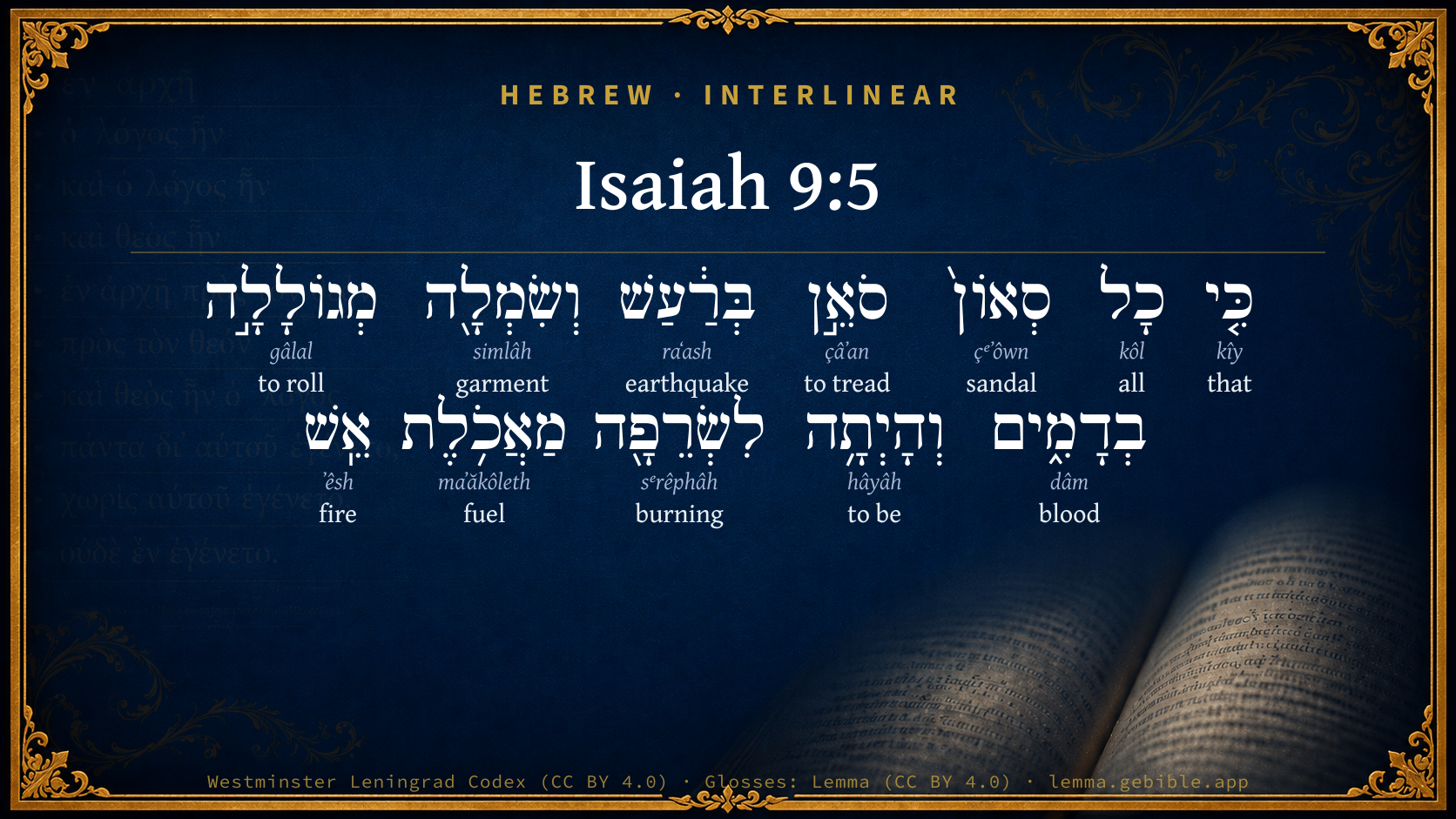
Hebrew (Westminster Leningrad Codex) Isaiah 9:5 appears in the Hebrew Old Testament. The text above is from the Westminster Leningrad Codex. Each word links to its Strong’s number, a concise gloss, and parsing drawn from the Open Scriptures Hebrew Bible morphology. Click any word for its full Brown-Driver-Briggs (BDB) entry.
Download image
Cite this verse

Isaiah 9:5 (World English Bible). Public Domain. Lemma interlinear Bible study tool, https://lemma.gebible.app/v/isaiah/9/5.

Show BibTeX & RIS
BibTeX
RIS
English Translation
For all the armor of the armed man in the tumult, and the garments rolled in blood, shall be for burning, for fuel of fire.
World English Bible · Public Domain
Highlights
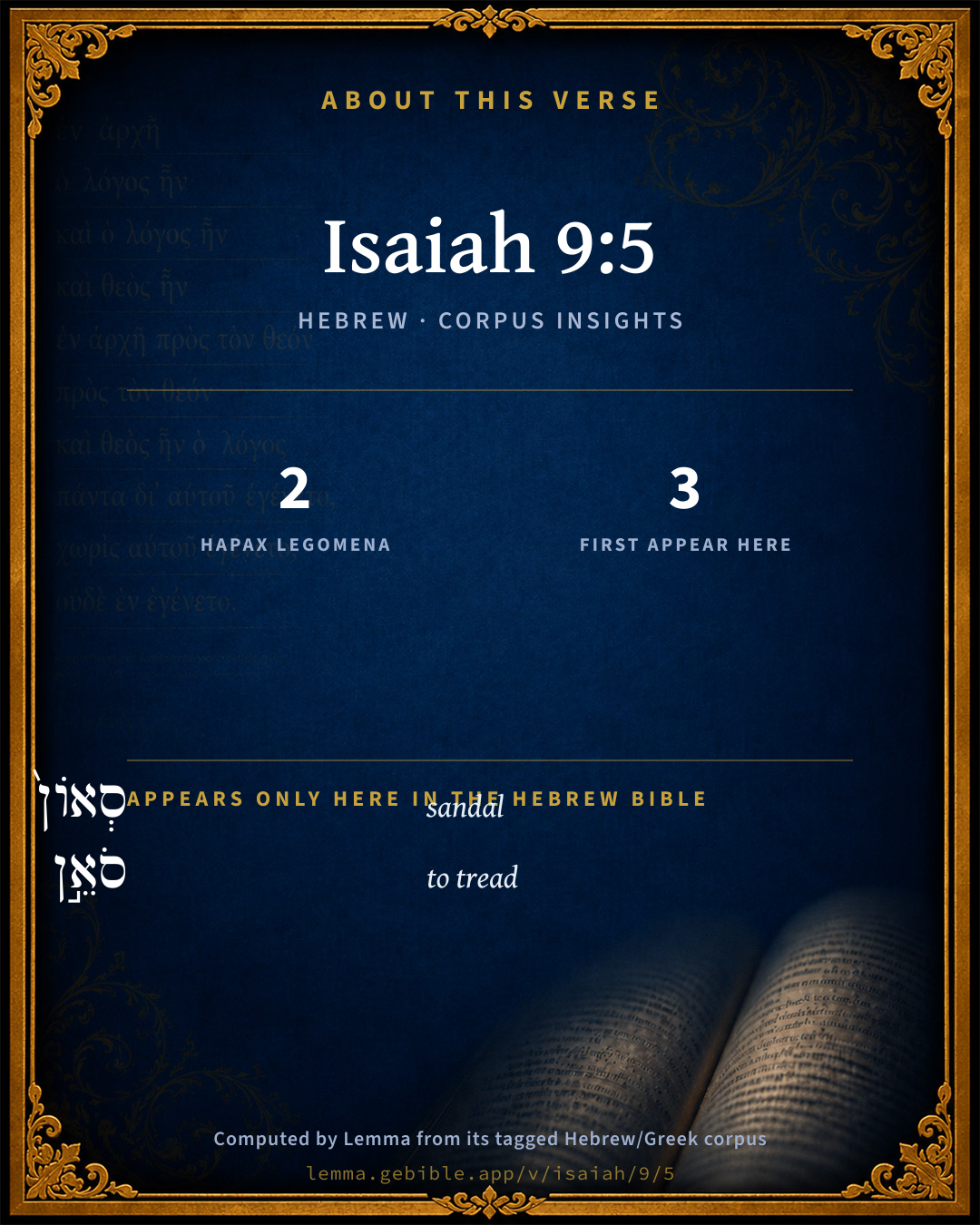
  • 2 hapax legomena — only here in the Hebrew Bible
  • 3 first appearances in the Hebrew Bible
Full analysis ↓
Download a study sheet

One document with this verse’s original text, its word-by-word gloss line, the meaning frame, cross-references with their text, attributed commentary, and full source and license credits — printable, and it pastes into notes with its structure intact.

This verse Autodidact and up

Study sheet (.html) Plain text (.txt)

A passage Seminary Student

Up to 50 verses in one chapter. A passage sheet keeps up to 6 commentary sources and 12 cross-references per verse, in the order this page ranks them, and says so on the sheet whenever that leaves anything out. Ask for a single verse and you get the Autodidact verse sheet above.

Everything on this page stays free to read, with no account — the sheet is a download of what is already on screen, not access to it.

Want to remove ads? Support Godless Engineer
Compare translations 3

The same verse in 3 English versions, stacked beneath the original-language interlinear above. Click any original word for its lexicon entry.

Each is an independent rendering of the whole verse — the interlinear is not word-aligned to these translations.

Highlighted words mark where these versions differ — a whole-verse word diff, not a word-by-word alignment.

  • World English Bible Public Domain
    For all the armor of the armed man in the tumult, and the garments rolled in blood, shall be for burning, for fuel of fire.
  • King James Version Public Domain
    For every battle of the warrior is with confused noise, and garments rolled in blood; but this shall be with burning and fuel of fire.
  • unfoldingWord Literal Text CC BY-SA 4.0
    For every boot of one booting in commotion and the garment rolled in blood will be for burning, fuel of fire. q1

unfoldingWord Literal Text — © unfoldingWord, licensed CC BY-SA 4.0. Word-aligned USFM3 via Door43 (git.door43.org/unfoldingWord/en_ult).

Versions to compare (up to 4)

3 of 4 selected

Show all 18 translations

Every available English version of this verse, each an independent rendering of the whole verse.

  • World English Bible Public Domain
    For all the armor of the armed man in the tumult, and the garments rolled in blood, shall be for burning, for fuel of fire.
  • Berean Standard Bible Public Domain
    For every trampling boot of battle and every garment rolled in blood will be burned as fuel for the fire.
  • Majority Standard Bible Public Domain
    For every trampling boot of battle and every garment rolled in blood will be burned as fuel for the fire.
  • King James Version Public Domain
    For every battle of the warrior is with confused noise, and garments rolled in blood; but this shall be with burning and fuel of fire.
  • American Standard Version (1901) Public Domain
    For all the armor of the armed man in the tumult, and the garments rolled in blood, shall be for burning, for fuel of fire.
  • Revised Version (1885) Public Domain
    For all the armour of the armed man in the tumult, and the garments rolled in blood, shall even be for burning, for fuel of fire.
  • Geneva Bible (1599) Public Domain
    Surely euery battell of the warriour is with noyse, and with tumbling of garments in blood: but this shall be with burning and deuouring of fire.
  • Douay-Rheims (1899) Public Domain
    For every violent taking of spoils, with tumult, and garment mingled with blood, shall be burnt, and be fuel for the fire.
  • Young's Literal Translation Public Domain
    For every battle of a warrior `is' with rushing, and raiment rolled in blood, And it hath been for burning -- fuel of fire.
  • Literal Standard Version CC BY-SA 4.0
    For every battle of a warrior [is] with rushing, and raiment rolled in blood, || And it has been for burning—fuel of fire.
  • Unlocked Literal Bible CC BY-SA 4.0
    For every boot treading in the tumult and the garments rolled in blood will be burned, fuel for the fire.
  • unfoldingWord Literal Text CC BY-SA 4.0
    For every boot of one booting in commotion and the garment rolled in blood will be for burning, fuel of fire. q1
  • Darby Bible Public Domain
    For every boot of him that is shod for the tumult, and the garment rolled in blood, shall be for burning, fuel for fire.
  • World Messianic Bible Public Domain
    For all the armor of the armed man in the noisy battle, and the garments rolled in blood, will be for burning, fuel for the fire.
  • Webster's Bible Public Domain
    For every battle of the warrior is with confused noise, and garments rolled in blood; but this shall be with burning and fuel of fire.
  • Free Bible Version CC BY-SA 4.0
    For every army boot that noisily trampled people down, and every uniform soaked in blood—they are going to be burned, fuel for the fire.
  • Bible in Basic English Public Domain
    For every boot of the man of war with his sounding step, and the clothing rolled in blood, will be for burning, food for the fire.
  • JPS Tanakh (1917) Public Domain
    (9-4) For every boot stamped with fierceness, and every cloak rolled in blood, shall even be for burning, for fuel of fire.

Literal Standard Version (2020), Covenant Press — licensed CC BY-SA 4.0. Text via the HelloAO Bible API (eBible.org). Unlocked Literal Bible (unfoldingWord) — licensed CC BY-SA 4.0. Text via the HelloAO Bible API (eBible.org). unfoldingWord Literal Text — © unfoldingWord, licensed CC BY-SA 4.0. Word-aligned USFM3 via Door43 (git.door43.org/unfoldingWord/en_ult). Free Bible Version, Dr. Jonathan Gallagher — licensed CC BY-SA 4.0. Text via the HelloAO Bible API (eBible.org).

Word by word

More ways to search: Search by grammar → Find every occurrence → Compare this word →

Practice this passage: Drill this verse → Learn its vocabulary →

סְאוֹן֙
çᵉʼôwn
H5430
“sandal”
Noun, Common, Masculine, Singular, Absolute
Part of Speech
Noun
Type
Common
Gender
Masculine
Number
Singular
State
Absolute
Full BDB Definition

Origin: from H5431

TWOT: 1453a

sandal, boot (of soldier)
  1. כִּ֤י kîy H3588 “that” Conjunction
  2. כָל kôl H3605 “all of” Noun, Common, Masculine, Singular, Construct
  3. סֹאֵ֣ן çâʼan H5431 “treading” Verb, Qal, Participle Active, Masculine, Singular, Absolute
  4. בְּרַ֔עַשׁ raʻash H7494 “in/at · earthquake” Preposition + Noun, Common, Masculine, Singular, Absolute
  5. וְשִׂמְלָ֖ה simlâh H8071 “and · garment” Conjunction + Noun, Common, Feminine, Singular, Absolute
  6. מְגוֹלָלָ֣ה gâlal H1556 “rolled” Verb, Poal, Participle Passive, Feminine, Singular, Absolute
  7. בְדָמִ֑ים dâm H1818 “in/at · blood” Preposition + Noun, Common, Masculine, Plural, Absolute
  8. וְהָיְתָ֥ה hâyâh H1961 “and · to be” Conjunction + Verb, Qal, Sequential Perfect, 3rd Person, Feminine, Singular
  9. לִשְׂרֵפָ֖ה sᵉrêphâh H8316 “to/for · burning” Preposition + Noun, Common, Feminine, Singular, Absolute
  10. מַאֲכֹ֥לֶת maʼăkôleth H3980 “fuel of” Noun, Common, Feminine, Singular, Construct
  11. אֵֽשׁ ʼêsh H784 “fire” Noun, Common, Both, Singular, Absolute

About this verse

These counts appear in no published source. They are computed here, from the morphology-tagged text and Lemma’s own curated glosses. What Lemma adds →

12
words
12
distinct lemmas
Prophets
section

Notable vocabulary

2 hapax legomena — words that appear only here in the entire Hebrew Bible:

  • סְאוֹן֙ sandal H5430
  • סֹאֵ֣ן to tread H5431

First appearance in Scripture

These words make their first canonical appearance in the Hebrew Bible here:

  • סְאוֹן֙ sandal H5430
  • סֹאֵ֣ן to tread H5431
  • מַאֲכֹ֥לֶת fuel H3980

Shared distinctive vocabulary

מַאֲכֹ֥לֶת fuel H3980 occurs in 2 verses of the Hebrew Bible. Also found in:

Grammatical profile

  • 3 verbs
  • 8 nouns
  • 1 conjunction

Verb forms

  • סֹאֵ֣ן Qal · Participle Active
  • מְגוֹלָלָ֣ה Poal · Participle Passive
  • וְהָיְתָ֥ה Qal · Sequential Perfect

Hebrew & Septuagint length

In English translation the verse runs 25 words from the Hebrew and 30 from the Septuagint (LXX English) — closely comparable.

A rough comparison of the two English renderings, which tokenize alike — not a word-level alignment.

Word counts can differ between the Hebrew and the Greek without any difference in meaning — e.g. the Hebrew direct-object marker אֵת has no separate Greek word, and Greek often adds the article ὁ.

Cross-references

15

Topical passages linked to Isaiah 9:5 in the Treasury of Scripture Knowledge — connected by theme and wording, ordered by reader-vote popularity; previews shown in the World English Bible.

  • 2 Thessalonians 1:8 giving vengeance to those who don't know God, and to those who don't obey the Gospel of our Lord Jesus,
  • Psalms 46:9 He makes wars cease to the end of the earth. He breaks the bow, and shatters the spear. He burns the chariots in the fire.
  • Isaiah 30:33 For a Topheth is prepared of old; yes, for the king it is made ready; he has made it deep and large; the pile of it is fire and much wood; the breath of Yahweh, like a stream of sulfur, does kindle it.
  • Ezekiel 39:8–10 Behold, it comes, and it shall be done, says the Lord Yahweh; this is the day about which I have spoken.
  • Isaiah 4:4 when the Lord shall have washed away the filth of the daughters of Zion, and shall have purged the blood of Jerusalem from its midst, by the spirit of justice, and by the spirit of burning.
  • Isaiah 10:16–17 Therefore will the Lord, Yahweh of Hosts, send among his fat ones leanness; and under his glory there shall be kindled a burning like the burning of fire.
  • Isaiah 66:15–16 For, behold, Yahweh will come with fire, and his chariots shall be like the whirlwind; to render his anger with fierceness, and his rebuke with flames of fire.
  • Joel 2:5 Like the noise of chariots on the tops of the mountains do they leap, Like the noise of a flame of fire that devours the stubble, As a strong people set in battle array.
  • Nahum 3:2 The noise of the whip, the noise of the rattling of wheels, prancing horses, and bounding chariots,
  • Malachi 3:2–3 "But who can endure the day of his coming? And who will stand when he appears? For he is like a refiner's fire, and like launderer's soap;
  • Matthew 3:11 I indeed baptize you in water for repentance, but he who comes after me is mightier than I, whose shoes I am not worthy to carry. He will baptize you in the Holy Spirit.
  • Leviticus 3:11 The priest shall burn it on the altar: it is the food of the offering made by fire to Yahweh.
  • Leviticus 3:16 The priest shall burn them on the altar: it is the food of the offering made by fire, for a sweet savor; all the fat is Yahweh's.
  • 1 Samuel 14:19 It happened, while Saul talked to the priest, that the tumult that was in the camp of the Philistines went on and increased: and Saul said to the priest, Withdraw your hand.
  • Acts 2:19 I will show wonders in the sky above, And signs on the earth beneath; Blood, and fire, and billows of smoke.

Cross-references courtesy of OpenBible.info (CC BY 4.0).

Hebrew and Greek witnesses Masoretic Hebrew ↔ Greek Septuagint

The same verse in the two great witnesses to the Old Testament, shown verse-for-verse.

These are two independent witnesses, not word-aligned to each other, and the Septuagint is shown in lemma (dictionary) form.

Hebrew Isaiah 9:5 Masoretic · Westminster Leningrad Codex

כִּ֤י כָל סְאוֹן֙ סֹאֵ֣ן בְּרַ֔עַשׁ וְשִׂמְלָ֖ה מְגוֹלָלָ֣ה בְדָמִ֑ים וְהָיְתָ֥ה לִשְׂרֵפָ֖ה מַאֲכֹ֥לֶת אֵֽשׁ

For all the armor of the armed man in the tumult, and the garments rolled in blood, shall be for burning, for fuel of fire.

World English Bible · Public Domain

Greek LXX Isaiah 9:5 Septuagint · lemma form

ὅτι παιδίον γεννάω ἐγώ υἱός καί δίδωμι ἐγώ ὅς ὁ ἀρχή γίγνομαι ἐπί ὁ ὦμος αὐτός καί καλέω ὁ ὄνομα αὐτός μέγας βουλή ἄγγελος ἐγώ γάρ ἄγω εἰρήνη ἐπί ὁ ἄρχων εἰρήνη καί ὑγίεια αὐτός

For they shall compensate for every garment that has been acquired by deceit, and all raiment with restitution; and they shall be willing, even if they were burnt with fire.

LXX2012 (modern English Septuagint) · Public Domain

On this verse, Adam Clarke's Commentary discusses the Septuagint’s reading. Read the note in Commentary ↓

Hebrew: Westminster Leningrad Codex (CC BY 4.0). Greek: Septuagint (public domain); English from LXX2012 (modern English Septuagint) (Public Domain). How the Septuagint differs from the Hebrew →

Targum (Aramaic paraphrase)

1

The Targum is the ancient Jewish Aramaic paraphrase of the Hebrew Scriptures — an interpretive translation, not the Hebrew text itself. Onkelos (literal) and Pseudo-Jonathan (expansive) render the Torah, and Jonathan the Prophets. Coverage is partial: where no permissively-licensed English translation exists for a verse, only the Aramaic is shown. This is verse-level text, not a word-by-word alignment to the Hebrew.

  1. Targum Jonathan Prophets (Joshua–Malachi)
    אֲמַר נְבִיָא לְבֵית דָוִד אֲרֵי רָבֵי אִיתְיְלִיד לָנָא בַּר אִתְיְהַב לָנָא וְקַבֵל אוֹרַיְתָא עֲלוֹהִי לְמַטְרָהּ וְאִתְקְרֵי שְׁמֵיהּ מִן קֳדָם מַפְלִיא עֵצָה אֱלָהָא גִבָּרָא קַיָם לְעַלְמַיָא מְשִׁיחָא דִשְׁלָמָא יַסְגֵי עֲלָנָא בְּיוֹמוֹהִי:

    (no public-domain English translation for this verse)

    Targum Jonathan — Aramaic: “Mikraot Gedolot” (public domain). English: “Sefaria Community Translation” (CC0 1.0 (public-domain dedication)); “London "Chaldee Paraphrase," 1871” (public domain). Text via Sefaria.

Commentary

Notes on Isaiah 9:5 from classic Christian and Jewish commentators (each source and its license shown beneath its notes). The classic Christian expositions comment on the surrounding passage and are grouped to its opening verse, so a note may address several verses; the Jewish commentaries on the Tanakh (Rashi and others) are per-verse, so they appear only where the commentator wrote on this verse.

Lemma curates 59 commentaries, every one of them public domain or Creative Commons licensed, each selected and text-cleaned for this edition rather than reprinted as found. About our sources →

John Gill's Exposition

For every battle of the warrior is with confused noise,.... With the sound of the trumpet and as now with beating of drums, and the huzzas and shoutings of the soldiers, the stamping and neighing of horses, the rushing of chariots, and rumbling of wheels, and the clashing of swords, spears, and shields, and these sometimes striking one against another (k):

and garments rolled in blood; of them that were slain in battle:

but this shall be with burning and fuel of fire; which refers either to the sudden destruction of the Midianites, or rather to the quick and easy conquest that Christ obtained over sin, Satan, the world, and death; which was as soon over as any combustible matter is burnt with fire. Some interpret this of the destruction of the devil, his angels, of antichrist, and all wicked men by fire, at the last day; and others think that this last clause is to be read in connection with the preceding: "and garments rolled in blood, which shall be for burning, the fuel of fire" (l); that is, which garments rolled in blood shall be burnt with fire, and utterly consumed; and so there be no more war, but perpetual peace. It was usual after victory to burn the armour and spoils of the enemy (m); or rather it may intend the burning love and flaming zeal and affection of Christ the Saviour, next described Isa 9:5.

(k) Vid. Lydium de re militari, l. 4. c. 3. p. 159. (l) So Cocceius, De Dieu. (m) Vid. Lydium de re militari, l. 6. e. 4. p. 229.

John Gill's Exposition of the Whole Bible (1746–1763) — public domain (CC PDM 1.0). Text via the HelloAO Bible API.

Trapp's Complete Commentary

John Trapp

Isa 9:5 For every battle of the warrior [is] with confused noise, and garments rolled in blood; but [this] shall be with burning [and] fuel of fire.

Ver. 5. For every battle of the warrior, &c.] Great is the woe of war; when death hews its way through a wood of men, in a minute of time, from the mouth of a murdering piece, when fire and sword waste at pleasure. The birth of Christ comforteth against all the miseries of war; whereunto therefore it is opposed both here, and Mic 5:1-2; {See Trapp on "Mic 5:1"} {See Trapp on "Mic 5:2"} Now, then, as the Israelites frighted and flighted the Midianites with saying, Hic Gideon, Here’s Gideon; so may we our spiritual enemies by crying Hic Iesus; Hoc in signo vincemus. This is Jesus, lets us conquer under his standard. Here’s Jesus; we are "more than conquerors through him that loved us."

But this shall be with burning,] i.e., With the fire of the Holy Ghost, saith Oecolampadius, burning up our corruptions, {as Isa 4:4} and moulding us into a new man. Diodate senseth it thus: The world shall be filled with blood and wars, and at last shall be consumed with fire at the day of judgment.

John Trapp, A Commentary or Exposition upon All the Books of the Old and New Testament (1647–1656) — public domain. Text from a community e-Sword module.

The Biblical Illustrator

Joseph S. Exell

Isa_9:5

For every battle of the warrior

Significance of Isa_9:5

The verse is more noteworthy for its connection than for its contents.

As it stands it suggests a not very vivid contrast between two sorts of battle, which contributes nothing to the progress of the prophets thought as well as quite misrepresents the original. The true rendering, according to all interpreters, is substantially this: For all the armour of the armed man in the onset, and the garments rolled in blood, shall be for burning, shall be the food of fire. Thus understood, the verse admirably concludes the picture of prosperity given in the previous context by declaring that even the implements of warfare and the blood-stained clothing they cause shall be utterly consumed. Thus considered, the passage appropriately introduces the famous Messianic prophecy that follows: For unto us a Child is born, etc. Such a wondrous triumph of peace can be adequately explained only by the appearance of One whose name is Wonderful. (T. W. Chambers, D. D.)

Destroying weapons of war

After the suppression of the Sepoy revolt, the British Government spent a week in melting down the vast array of weapons of all sorts accumulated by the disarming of a large portion of the people of Northern India. (T. W. Chambers, D. D.)

Burning implements of war

The prophet foretells a time when out of these wars and tumults there should come a period of deep peace, when these warlike implements should be burnt to ashes, according to the practice of ancient times which heaped sword, spear and armour as on a huge funeral pile, when the victory was won, to proclaim that the strife was over, that the chariots were burnt with fire, and the spears broken asunder.

And he saw that this peace would come, because within his own time or hereafter--he knew not clearly which--a Son, a King, should be born, who would be the Prince of Peace, the founder of a new and eternal kingdom, clothed with a majesty which should put to silence the contentions of men, and with a power which should compress and unite the most divergent elements. (Dean Stanley.)

The accoutrements of the warrior only fuel for the fire

It has been submitted that a better rendering is this: Every boot of the warrior that tramps noisily and the cloak rolled in blood shall be for burning as fuel for fire. The soldier wears his tall boot, and as his foot comes down on the earth he makes it ring again: and hearing an army pass by who could suppose that the earth will survive the cruel tramp? Religious inspiration lifts men so high as to enable them to despise the pomp and circumstance of war: every boot of the warrior that tramps noisily, and the cloak rolled in blood which men would gather up and preserve in museums, and show to admiring ages, shall be gathered up by the hand of time and thrust into the middle of the hottest fire. All such relics were made for burning. In our patriotic folly, our exuberant and intoxicated zeal, we gather the boots of warriors and the cloaks of conquerors, and the tattered banners of famous fields, and all but worship them: underneath the whole pile should be written, These are for burning as fuel for fire. (J. Parker, D. D.)

The Biblical Illustrator, edited by Joseph S. Exell (c. 1880s–1900s) — public domain. Text from a community e-Sword module.

Joseph Benson's Commentary

Isa 9:5. For every battle of the warrior is with confused noise, &c. — With the triumphant exclamations of the conqueror, and the bitter lamentations of the conquered, and the different cries of the same persons, sometimes conquering and sometimes conquered; and garments rolled in blood — With great difficulty and slaughter. But this shall be with burning, &c. — But this victory, which God’s people shall have over all their enemies, shall be more terrible to their adversaries, whom God shall utterly consume, as it were, by fire. The reader must observe, however, the words סאון סאן, here rendered battle of the warrior, occurring only here, are of very doubtful signification, and of consequence are rendered differently by learned men. Dr. Waterland, from Vitringa, translates the verse, “Every clashing of the noisy warrior, and the garment rolled in blood, shall be thrown to be burned; fuel for the fire.” Bishop Lowth renders it, “For the greaves of the armed warrior in the conflict, and the garment rolled in much blood, shall be for a burning, even fuel for the fire.” It is probable, as Vitringa observes, that the words are intended to signify, that, in consequence of Christ’s appearing in the flesh, and destroying the enemies of his church, a time of peace and tranquillity shall take place on earth, and the instruments of war and slaughter be of no further use.

Joseph Benson's Commentary on the Old and New Testaments (1811–1818) — public domain. Text from a community e-Sword module.

Tyndale Open Study Notes

Tyndale Open Resources

9:5 Burning the boots and uniforms marked the end of the need for instruments of war.

Tyndale Open Study Notes — © Tyndale Open Resources, licensed CC BY-SA 4.0. Text via the HelloAO Bible API.

Geneva Bible (1599)

Geneva Bible translators

He speaketh of the deliverance of his Church, which he hath delivered miraculously from his enemies, but especially by the coming of Christ, of whom he prophesieth in the next verse.

Geneva Bible (1599) marginal notes — public domain. Text via Bolls.life.

Jamieson, Fausset & Brown

Robert Jamieson, A. R. Fausset & David Brown

every battle, &c.--rather, "every greave of (the warrior who is) armed with greaves in the din of battle, and the martial garment (or cloak, called by the Latins sagum) rolled in blood, shall be for burning, (and) fuel for fire" [MAURER]. All warlike accoutrements shall be destroyed, as no longer required in the new era of peace (Isa 2:4; Isa 11:6-7; Psa 46:9; Eze 39:9; Mic 5:5, Mic 5:10; Zac 9:9-10). Compare Mal 4:1, as to the previous burning up of the wicked.

Jamieson, Fausset & Brown — Commentary Critical and Explanatory on the Whole Bible (1871) — public domain (CC PDM 1.0). Text via the HelloAO Bible API.

Adam Clarke's Commentary

Verse 5. Every battle of the warrior - "The greaves of the armed warrior"] שאון שאון seon soen. This word, occurring only in this place, is of very doubtful signification. Schindler fairly tells us that we may guess at it by the context. The Jews have explained it, by guess I believe, as signifying battle, conflict: the Vulgate renders it violenta praedatio. But it seems as if something was rather meant which was capable of becoming fuel for the fire, together with the garments mentioned in the same sentence. In Syriac the word, as a noun, signifies a shoe, or a sandal, as a learned friend suggested to me some years ago. See Lu 15:22; Ac 12:8. I take it, therefore, to mean that part of the armour which covered the legs and feet, and I would render the two words in Latin by caliga caligati. The burning of heaps of armour, gathered from the field of battle, as an offering made to the god supposed to be the giver of victory, was a custom that prevailed among some heathen nations; and the Romans used it as an emblem of peace, which perfectly well suits with the design of the prophet in this place. A medal struck by Vespasian on finishing his wars both at home and abroad represents the goddess Peace holding an olive branch in one hand, and, with a lighted torch in the other, setting fire to a heap of armour. Virgil mentions the custom: -

" - Cum primam aciem Praeneste sub ipsa

Stravi, scutorumque incendi victor acervos."

AEn. lib. viii., ver. 561.

"Would heaven, (said he,) my strength and youth recall,

Such as I was beneath Praeneste's wall--

Then when I made the foremost foes retire,

And set whole heaps of conquered shields on fire."

DRYDEN.

See Addison on Medals, Series ii. 18. And there are notices of some such practice among the Israelites, and other nations of the most early times. God promises to Joshua victory over the kings of Canaan. "To-morrow I will deliver them up all slain before Israel: thou shalt hough their horses, and burn their chariots with fire," Jos 11:6. See also Na 2:13. And the psalmist employs this image to express complete victory, and the perfect establishment of peace: -

"He maketh wars to cease, even to the end of the land:

He breaketh the bow, and cutteth the spear in sunder;

And burneth the chariots in the fire."

Ps 46:9.

עגלות agaloth, properly plaustra, impedimenta, the baggage-wagons: which however the Septuagint and Vulgate render scuta, "shields;" and the Chaldee, "round shields," to show the propriety of that sense of the word from the etymology; which, if admitted, makes the image the same with that used by the Romans.

Ezekiel, Eze 39:8-10, in his bold manner has carried this image to a degree of amplification which I think hardly any other of the Hebrew poets would have attempted. He describes the burning of the arms of the enemy, in consequence of the complete victory to be obtained by the Israelites over Gog and Magog: -

"Behold, it is come to pass, and it is done,

Saith the Lord JEHOVAH.

This is the day of which I spoke:

And the inhabitants of the cities of Israel shall go forth.

And shall set on fire the armour, and the shield,

And the buckler, and the bow, and the arrows,

And the clubs and the lances;

And they shall set them on fire for seven years.

And they shall not bear wood from the field;

Neither shall they hew from the forest:

For of the armour shall they make their fires;

And they shall spoil their spoilers,

And they shall plunder their plunderers."

R. D. Kimchi, on this verse says this refers simply to the destruction of the Assyrians. Other battles are fought man against man, and spear against spear; and the garments are rolled in blood through the wounds given and received: but this was with burning, for the angel of the Lord smote them by night, and there was neither sword nor violent commotion, nor blood; they were food for the fire, for the angel of the Lord consumed them.

Adam Clarke's Commentary on the Bible (1810–1826) — public domain. Text from a community e-Sword/MySword module.

Ellicott's Commentary for English Readers

(5) For every battle of the warrior . . .—Here again the whole verse requires re-translating: “Every boot of the warrior that tramps noisily, and the cloak rolled in blood, are (i.e., shall be) for burning, (as) fuel for fire. The picture of the conquerors collecting the spoil is continued from Isa_9:3. The victory is decisive, and the reign of peace begins, and the weapons of war, the garments red with blood (Isa_63:1-3), the heavy boot that makes the earth ring with the warrior’s tread, these shall all be burnt up. Like pictures of a time of peace are found in Zec_9:10; Ezek. xxxix, 9; Psa_46:9; Psa_76:3.

A Bible Commentary for English Readers, edited by Charles John Ellicott (1878–1897) — public domain. Text from a community e-Sword module.

The Cambridge Bible for Schools and Colleges

gen. ed. J. J. S. Perowne

5. The verse reads: For every boot of him that tramped noisily, and (every) garment rolled in blood, shall be for burning, as fuel for the fire. The word ṣì’ôn is Aramaic and signifies a military boot; that rendered “tramped” (ṣô’çn) is a denominative formed from it. The idea of the verse is that after Jehovah’s great victory every vestige of war shall be burned up in preparation for the kingdom of universal peace. Comp. the burning of the weapons of Gog’s host in Eze_39:9 f.

The Cambridge Bible for Schools and Colleges (gen. ed. J. J. S. Perowne; Cambridge University Press, 1878–1918) — public domain. Text from a community e-Sword module.

Albert Barnes' Notes on the Bible

For every battle of the warrior - The expression used here has caused great difficulty, from the fact that it occurs nowhere else in the Scriptures. The word סאון se'ôn, rendered here battle, is supposed to mean rather greaves, or the armor of the warrior which covered the feet and the legs. It would be literally translated, ‘Every greave of those armed with greaves.’ - Gesenius. The Chaldee renders it, ‘Forevery gift of theirs is for evil.’ The Syriac, ‘Forevery tumult (of battle) is heard with terror.’ Hengstenberg renders it, ‘For all war-shoes put on at the noise of battle, all garments dipped in blood, shall be burnt, shall be the food of fire.’ The idea, according to him, is, that the great future redemption will be like the deliverance under Gideon; ‘because, far from being accomplished by force of arms, with it all contention and war shall cease.’ Gesenius regards the figurative expression as a general designation of that peace which shall never end. All the armor used in war shall then be burned, as being of no further use.

Is with confused noise - The word used here - רעשׁ ra‛ash - denotes, properly, a shaking, as of a spear; a concussion, tumult, noise, as of a battle. Here it is supposed to refer to the noise which the armor of the soldiers made - particularly to the noise made by the greaves, or war-shoes, worn on the feet and legs. Those greaves were fitted up; it is said, by numerous large iron hooks, or clasps, and were fastened sometimes with large nails; compare Josephus, Jewish Wars, B. vi. ch. i. section 8.

And garments - This word here refers, doubtless, to the soldier’s cloak or blanket.

Rolled in blood - This is a description of the usual effect of war. The image of war is that of a clangor made by the armor of soldiers, and by garments that have been dipped in human blood. It is a most revolting but just image.

But this shall be - In regard to this threatened invasion and danger, this shall be the result. The meaning is this. The prophet sees the image of war and of threatened invasion. He hears the clangor of their greaves - the sound of their march; and he sees the usual emblem of battle - bloody garments. But he says here, that this invasion shall not be successful. There was no occasion of alarm. The very armor of the warrior should be burned up. The enemy should be defeated - and their greaves, and their bloody garments, should be consumed.

With burning - For burning; that is it shall be consumed.

And fuel of fire - Hebrew, ‘Food of fire.’ This is a strong, emphatic expression - ‘it shall be to be burned - the food of fire.’ It denotes the certainty that they would be vanquished; that the invading foe would not be successful; and that his very armory and garments would be stripped off and burned. To understand this, it is necessary to remark, that in ancient times it was customary to strip the dead which were slain in a vanquished army, and to collect their armor, their chariots, etc., and consume them. The more valued spoils of battle were reserved as the prey of the victors, or to be suspended in temples censecrated to the gods; see Psa 46:9-10 :

He maketh wars to cease unto the end of the earth;

He breaketh the bow;

And cutteth the spear in sunder;

He burneth the chariot in the fire.

Ezekiel has carried out this description more at length:

And the inhabitants of the cities of Israel shall go forth,

And shall set on fire and burn the weapons,

Both the shields and the bucklers,

The bows and the arrows,

And the clubs and the lances.

Eze 39:9.

Zechariah has a similar figure, as descriptive of the time of the Messiah:

Rejoice greatly, O daughter of Zion;

Shout, O daughter of Jerusalem;

Behold, thy king cometh unto thee.

And I will cut off the chariot from Ephraim,

And the horse from Jerusalem,

And the battle bow shal be cut off, etc.

Zec 9:9-10.

This custom prevailed among several nations. Thus Virgil:

- scutorumque incendi victor acervos.

AEneid, viii. 562.

There can be no doubt, I think, that the prophet here has his eye on the victories of the Messiah, and that he means to say, that in those victories all armor would be for fuel of fire; that is, that they would be achieved without hostile arms. Applied to the Messiah, it means either that his victories would be complete, or that in his victories all necessity of such armor would cease. According to this, the passage teaches that peace should be introduced by him without a conflict, and thus harmonizes with the numerous parallel passages in which peace is represented as a characteristic mark of the times of the Messiah, when contention, war, and destruction shall cease; see Isa 11:6-7.

Albert Barnes' Notes on the Bible (1834–1885) — public domain. Text from a community e-Sword/MySword module.

Haydock's Catholic Bible Commentary

Fire. Being cut and useless. See Diss. on the defeat of Sennacherib. (Calmet)

George Leo Haydock (1774–1849), Haydock's Catholic Family Bible and Commentary, 1859 edition — public domain. Excludes Psalms (Douay-Rheims chapter numbering differs from Protestant) and Deuterocanonical books (Catholic canon only).

Matthew Poole's English Annotations

With confused noise; with the triumphant exclamations of the conqueror, and the bitter lamentations of the conquered, and the differing cries of the same persons, sometimes conquering, and sometimes conquered.

And garments rolled in blood; with great difficulty and slaughter.

But this shall be with burning and fuel of fire; but this victory which God’s people shall have over all their enemies, shall be more easy to them, and more terrible to their adversaries, whom God will suddenly and utterly consume, as it were by fire.

Matthew Poole's English Annotations on the Holy Bible (1683–1685) — public domain. Text from a community e-Sword/MySword module.

Whedon's Commentary on the Bible

Daniel D. Whedon

5. For every battle of the warrior — Others render it, “Every boot of tramping warrior,” or this in substance, for the words “of battle” and “warrior,” occur in the original only here, and their meaning has to be made out from the context.

With confused noise — Or, “in battle fray.”

The boot, or greave, may be generic for battle accoutrements, and all these shall be destroyed. Both the greaves and garments, or martial cloaks rolled in blood, bespattered and soaked, shall in the Messianic era of peace (Isa_2:4) be with burning, as of no use whatever except for fuel. The scenes, so often witnessed on these Galilean fields, of war and of bloodshed, shall cease forever, and war weapons shall be no more. And as on these once dark regions, so shall it be in that era in all the earth.

Daniel D. Whedon (gen. ed.), Commentary on the Old and New Testaments (1874–1909) — public domain. Text from a community e-Sword module.

The Pulpit Commentary

For every battle of the warrior is with confused noise; rather, for all the armor of him that armeth noisily (Knobel, Vance Smith); or, perhaps, "every hoof of him that trampeth noisily" (Gesenius, Cheyne). The noun and participle, which are cognate words, occur only in this passage. And garments, etc. Translate, And every garment that is rolled in blood, shall be for burning, even fuel for fire. All military accoutrements shall be committed to the flames, that the reign of peace and justice may commence. (comp. Isa_2:4 Psa_46:9)

The Pulpit Commentary (1880–1919), ed. H.D.M. Spence-Jones & Joseph S. Exell — public domain. Text from a community e-Sword module.

John Wesley's Explanatory Notes

Noise - With the triumphant exclamations of the conqueror, and the bitter Lamentations of the conquered, and the different cries of the same persons, sometimes conquering, and sometimes conquered. Blood - With great difficulty and slaughter. But - But this victory which God's people shall have over all their enemies, shall be more terrible to their adversaries, whom God will utterly consume, as it were by fire.

John Wesley, Explanatory Notes Upon the Whole Bible (1754–1765) — public domain. Text via the GEBible commentary corpus.

Keil & Delitzsch

C. F. Keil & F. Delitzsch

"For every boot of those who tramp with boots in the tumult of battle, and cloak rolled in blood, shall be for burning, a food of fire." That which is the food of fire becomes at the same time a sĕrēphâh, inasmuch as the devouring fire reduces it to ashes, and destroys its previous existence. This closing statement requires for סאון the concrete sense of a combustible thing; and this precludes such meanings as business (Handel und Wandel), noise, or din (= שׁאון, Jerome, Syriac, Rashi, and others). On the other hand, the meaning "military equipment," adopted by Knobel and others - a meaning derived from a comparison of the derivatives of the Aramaean zūn, ăzan, and the Arabic zâna, fut. yezı̄n (to dress or equip) - would be quite admissible; at the same time, the interchange of Samech and Zain in this word cannot be dialectically established. Jos. Kimchi has very properly referred to the Targum sēn, mesân (Syr. also sâūn with an essentially long a), which signifies shoe (see Bynaeus, de calceo Hebraeorum) - a word which is more Aramaean than Hebrew, and the use of which in the present connection might be explained on the ground that the prophet had in his mind the annihilation of the Assyrian forces. We should no doubt expect sâ'ūn (sandaloumenos) instead of sō'ēn; but the denom. verb sâ'ăn might be applied to a soldier's coming up in military boots, and so signify Caligatum venire, although the primary meaning is certainly Calceare se (e.g., Eph 6:15, Syr.). Accordingly we should render it, "every boot of him who comes booted (des Einherstiefelnden) into the tumult of battle," taking the word ra‛ash, not as Drechsler does, in the sense of the noise made by a warrior coming up proudly in his war-boots, nor with Luzzatto in the sense of the war-boot itself, for which the word is too strong, but as referring to the noise or tumult of battle (as in Jer 10:22), in the midst of which the man comes up equipped or shod for military service. The prophet names the boot and garment with an obvious purpose. The destruction of the hostile weapons follows as a matter of course, if even the military shoes, worn by the soldiers in the enemies' ranks, and the military cloaks that were lying in dâmim, i.e., in blood violently shed upon the battle-field, were all given up to the fire.

Keil & Delitzsch — Biblical Commentary on the Old Testament (1861–1891) — public domain (CC PDM 1.0). Text via the HelloAO Bible API. (Old Testament only.)

Rashi

Rabbi Shlomo Yitzchaki (Rashi)

For a child has been born to us Although Ahaz is wicked, his son who was born to him many years ago [nine years prior to his assuming the throne] to be our king in his stead, shall be a righteous man, and the authority of the Holy One, blessed be He, and His yoke shall be on his shoulder, for he shall engage in the Torah and observe the commandments, and he shall bend his shoulder to bear the burden of the Holy One, blessed be He.

and...called his name The Holy One, blessed be He, Who gives wondrous counsel, is a mighty God and an everlasting Father, called Hezekiah’s name, “the prince of peace,” since peace and truth will be in his days.

Rashi on the Tanakh — English translations: “The Judaica Press complete Tanach with Rashi, translated by A. J. Rosenberg” (CC BY 4.0); “Pentateuch with Rashi's commentary by M. Rosenbaum and A.M. Silbermann, 1929-1934” (public domain); “The Metsudah Tanach series, Lakewood, N.J” (CC BY 4.0); and “The Book of Joshua, Metsudah Publications, 1997” (CC BY 4.0). Text via Sefaria.

Ibn Ezra

Rabbi Abraham ibn Ezra

For unto us, etc. All this has come to pass through the merit of the child that is born unto us. We know that at the time of the invasion of Sennacherib, Hezekiah was thirty-nine years old; at the time of this prophecy he is, therefore, called child (ילד). פלא יועץ אל גבור אבי עד. According to some, these expressions are names of God, and the following שר שלום, the name of the child. I think that all these words are names of the child; he is called פלא wonder, because God did wonders in his days; יועץ counselling; this is distinctly said of Hezekiah (comp. 2 Chr. 30:2); אל גבור Mighty chief; for Hezekiah was powerful; אבי עד The father of perpetuity, because the reign of the house of David was prolonged through his merits: עַד has here the same meaning as in 58:15. שר שלום Prince of peace because peace was established in his days; comp. 2 Chron. 32:22

Ibn Ezra on the Tanakh — English translations: “Sefaria Community Translation” (CC0 1.0 (public-domain dedication)); “Yalkut, Sifsei Chachomim Chumash, Metsudah Publications, 2009” (CC BY 4.0); and “Commentary of Ibn Ezra on Isaiah - trans. by M. Friedlander, 1873” (public domain). Text via Sefaria.

Lesson kit

Teaching starters — assembled from the data on this page, not authored interpretation. Every prompt links to the verse data it draws on. Edit before teaching.

Isaiah, in the Prophets, opens this verse with 12 words (12 distinct Hebrew lemmas). Its most distinctive word is çᵉʼôwn (“sandal”). A historical commentator’s framing appears above. Read the whole chapter for the surrounding context.

Discussion questions

  1. What does “sandal” (çᵉʼôwn) contribute to the verse as a whole?
  2. 2 words here appear nowhere else in the Hebrew Bible. Why might the author reach for such rare wording?
  3. 3 words make their first appearance in Scripture here. What does this debut establish?
  4. How does Isaiah 9:19, which shares the word «fuel», read alongside this verse?
  5. These translations render this verse differently; the difference is in the English rendering, not the original. What questions does that raise?
  6. «סֹאֵ֣ן» is a Qal Participle Active verb. How does that grammatical form shape the action described?
  7. Compare how John Gill's Exposition and Trapp's Complete Commentary read this verse. Where do they agree or differ?

Things to notice

  • 2 words in this verse appear nowhere else in the Hebrew Bible.
  • 3 words make their first canonical appearance in Scripture here.
  • These translations choose different wording for 19 words in this verse.
  • 12 distinct Hebrew lemmas span 12 words in this verse.

Reading settings

Reading text

Shown beneath each verse's original-language words.

Old Testament
Old Testament edition

Read the OT as the Masoretic Hebrew (MT) or the Greek Septuagint (LXX).

English shown for the Greek Septuagint (in the Hebrew ↔ Greek comparison).

Comparing translations? Open the Compare panel on any verse page to stack up to four side by side.