
2 Samuel 21:6

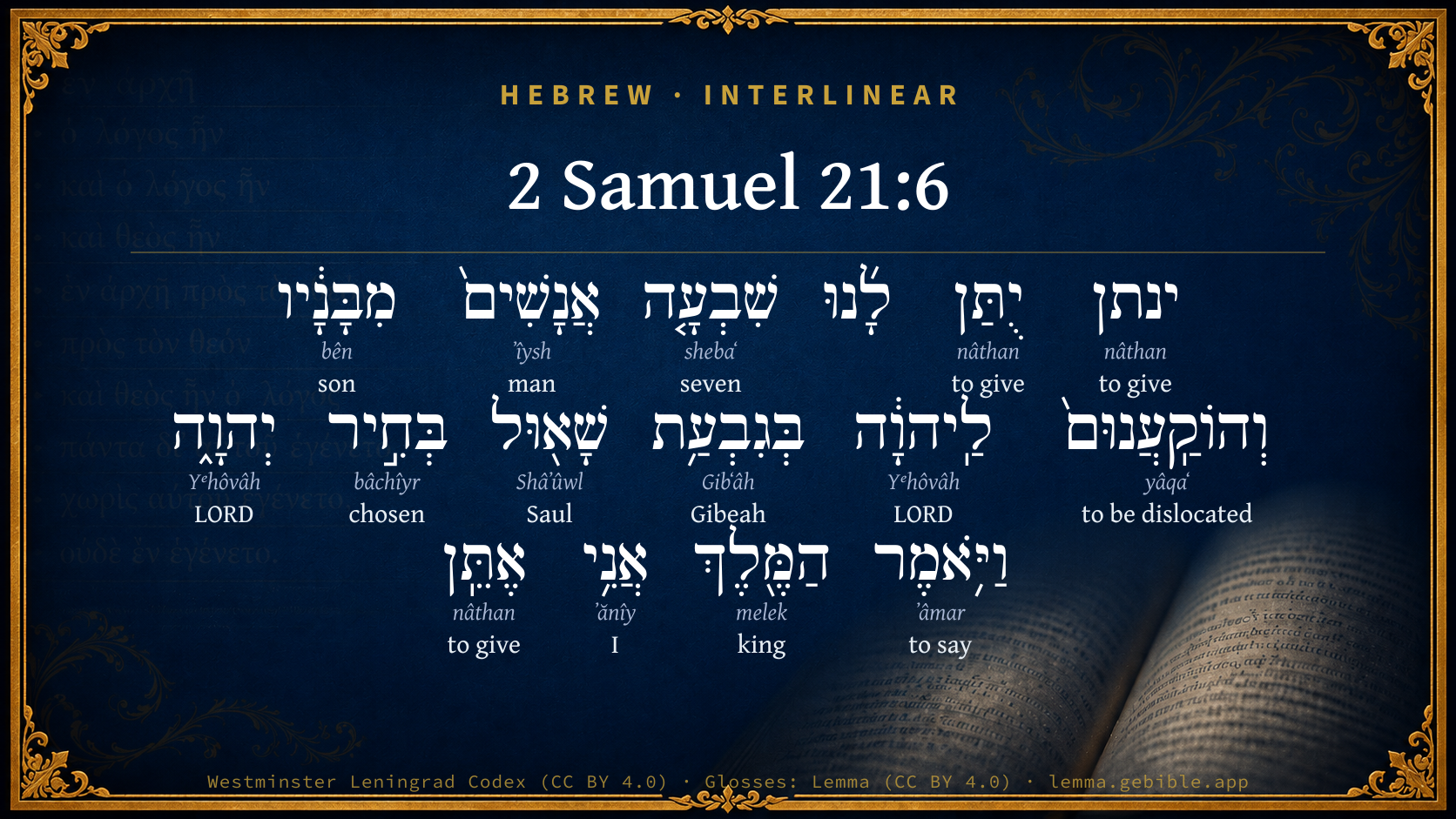
Hebrew (Westminster Leningrad Codex) 2 Samuel 21:6 appears in the Hebrew Old Testament. The text above is from the Westminster Leningrad Codex. Each word links to its Strong’s number, a concise gloss, and parsing drawn from the Open Scriptures Hebrew Bible morphology. Click any word for its full Brown-Driver-Briggs (BDB) entry.
Download image
Cite this verse

2 Samuel 21:6 (World English Bible). Public Domain. Lemma interlinear Bible study tool, https://lemma.gebible.app/v/2-samuel/21/6.

Show BibTeX & RIS
BibTeX
RIS
English Translation
let seven men of his sons be delivered to us, and we will hang them up to Yahweh in Gibeah of Saul, the chosen of Yahweh. The king said, I will give them.
World English Bible · Public Domain
Highlights
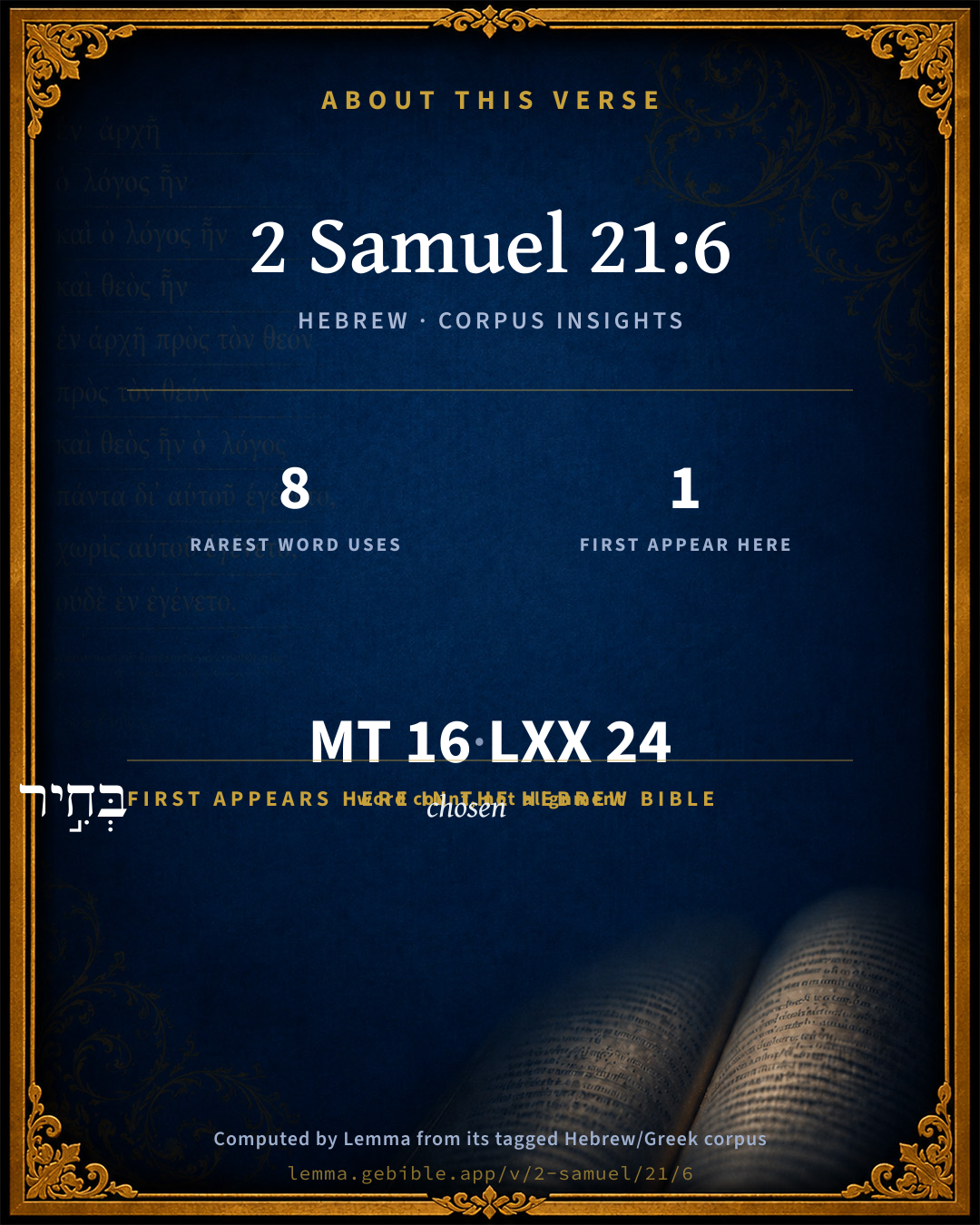
  • 1 first appearance in the Hebrew Bible
Full analysis ↓
Download a study sheet

One document with this verse’s original text, its word-by-word gloss line, the meaning frame, cross-references with their text, attributed commentary, and full source and license credits — printable, and it pastes into notes with its structure intact.

This verse Autodidact and up

Study sheet (.html) Plain text (.txt)

A passage Seminary Student

Up to 50 verses in one chapter. A passage sheet keeps up to 6 commentary sources and 12 cross-references per verse, in the order this page ranks them, and says so on the sheet whenever that leaves anything out. Ask for a single verse and you get the Autodidact verse sheet above.

Everything on this page stays free to read, with no account — the sheet is a download of what is already on screen, not access to it.

Want to remove ads? Support Godless Engineer
Compare translations 3

The same verse in 3 English versions, stacked beneath the original-language interlinear above. Click any original word for its lexicon entry.

Each is an independent rendering of the whole verse — the interlinear is not word-aligned to these translations.

Highlighted words mark where these versions differ — a whole-verse word diff, not a word-by-word alignment.

  • World English Bible Public Domain
    let seven men of his sons be delivered to us, and we will hang them up to Yahweh in Gibeah of Saul, the chosen of Yahweh. The king said, I will give them.
  • King James Version Public Domain
    Let seven men of his sons be delivered unto us, and we will hang them up unto the LORD in Gibeah of Saul, whom the LORD did choose. And the king said, I will give them.
  • unfoldingWord Literal Text CC BY-SA 4.0
    let seven men from his sons be given to us, and we will hang them before Yahweh at Gibeah of Saul, the chosen of Yahweh.” And the king said, “I, I will give.”

unfoldingWord Literal Text — © unfoldingWord, licensed CC BY-SA 4.0. Word-aligned USFM3 via Door43 (git.door43.org/unfoldingWord/en_ult).

Versions to compare (up to 4)

3 of 4 selected

Show all 18 translations

Every available English version of this verse, each an independent rendering of the whole verse.

  • World English Bible Public Domain
    let seven men of his sons be delivered to us, and we will hang them up to Yahweh in Gibeah of Saul, the chosen of Yahweh. The king said, I will give them.
  • Berean Standard Bible Public Domain
    let seven of his male descendants be delivered to us so that we may hang them before the LORD at Gibeah of Saul, the chosen of the LORD.” “I will give them to you,” said the king.
  • Majority Standard Bible Public Domain
    let seven of his male descendants be delivered to us so that we may hang them before the LORD at Gibeah of Saul, the chosen of the LORD.” “I will give them to you,” said the king.
  • King James Version Public Domain
    Let seven men of his sons be delivered unto us, and we will hang them up unto the LORD in Gibeah of Saul, whom the LORD did choose. And the king said, I will give them.
  • American Standard Version (1901) Public Domain
    let seven men of his sons be delivered unto us, and we will hang them up unto Jehovah in Gibeah of Saul, the chosen of Jehovah. And the king said, I will give them.
  • Revised Version (1885) Public Domain
    let seven men of his sons be delivered unto us, and we will hang them up unto the LORD in Gibeah of Saul, the chosen of the LORD; And the king said, I will give them.
  • Geneva Bible (1599) Public Domain
    Let seuen men of his sonnes be deliuered vnto vs, and we will hang them vp vnto the Lord in Gibeah of Saul, the Lordes chosen. And the King said, I will giue them.
  • Douay-Rheims (1899) Public Domain
    Let seven men of his children be delivered unto us, that we may crucify them to the Lord in Gabaa of Saul, once the chosen of the Lord. And the king said: I will give them.
  • Young's Literal Translation Public Domain
    let there be given to us seven men of his sons, and we have hanged them before Jehovah, in the height of Saul, the chosen of Jehovah.' And the king saith, `I do give;'
  • Literal Standard Version CC BY-SA 4.0
    let there be given to us seven men of his sons, and we have hanged them before YHWH, in the height of Saul, the chosen of YHWH.” And the king says, “I give”;
  • Unlocked Literal Bible CC BY-SA 4.0
    let seven men from his descendants be handed over to us, and we will hang them before Yahweh in Gibeah of Saul, the one chosen by Yahweh.” So the king said, “I will give them to you.”
  • unfoldingWord Literal Text CC BY-SA 4.0
    let seven men from his sons be given to us, and we will hang them before Yahweh at Gibeah of Saul, the chosen of Yahweh.” And the king said, “I, I will give.”
  • Darby Bible Public Domain
    let seven men of his sons be given up to us, and we will hang them up to Jehovah in Gibeah of Saul, the chosen of Jehovah. And the king said, I will give [them].
  • World Messianic Bible Public Domain
    let seven men of his sons be delivered to us, and we will hang them up to the LORD in Gibeah of Saul, the chosen of the LORD.” The king said, “I will give them.”
  • Webster's Bible Public Domain
    Let seven men of his sons be delivered to us, and we will hang them up to the LORD in Gibeah of Saul, whom the LORD chose. And the king said, I will give them.
  • Free Bible Version CC BY-SA 4.0
    have seven of Saul's male descendants be handed over to us, and we will hang them in the presence of the Lord at Gibeon of Saul, the Lord's chosen one.” “I will hand them over to you,” said the king.
  • Bible in Basic English Public Domain
    Let seven men of his family be given up to us and we will put an end to them by hanging them before the Lord in Gibeon, on the hill of the Lord. And the king said, I will give them.
  • JPS Tanakh (1917) Public Domain
    let seven men of his sons be delivered unto us, and we will hang them up unto the LORD in Gibeah of Saul, the chosen of the LORD.' And the king said: 'I will deliver them.'

Literal Standard Version (2020), Covenant Press — licensed CC BY-SA 4.0. Text via the HelloAO Bible API (eBible.org). Unlocked Literal Bible (unfoldingWord) — licensed CC BY-SA 4.0. Text via the HelloAO Bible API (eBible.org). unfoldingWord Literal Text — © unfoldingWord, licensed CC BY-SA 4.0. Word-aligned USFM3 via Door43 (git.door43.org/unfoldingWord/en_ult). Free Bible Version, Dr. Jonathan Gallagher — licensed CC BY-SA 4.0. Text via the HelloAO Bible API (eBible.org).

Word by word

More ways to search: Search by grammar → Find every occurrence → Compare this word →

Practice this passage: Drill this verse → Learn its vocabulary →

וְהוֹקַֽעֲנוּם֙
yâqaʻ
H3363
“and · to be dislocated · them”
Conjunction + Verb, Hiphil, Sequential Perfect, 1st Person, Common, Plural + Suffix, Personal, 3rd Person, Masculine, Plural
Part of Speech
Conjunction + Verb
Stem
Hiphil
Form
Sequential Perfect
Person
1st Person
Gender
Common
Number
Plural
Full BDB Definition

Origin: a primitive root

TWOT: 903

to be dislocated, be alienated - (Qal) to be dislocated, be torn away, be alienated - (Hiphil) - to execute slowly (by exposure or impalation) - to hang - (Hophal) to be executed
  1. ינתן nâthan H5414 “to give” Verb, Niphal, Jussive, 3rd Person, Masculine, Singular
  2. יֻתַּן nâthan H5414 “to give” Verb, Qal Passive, Jussive, 3rd Person, Masculine, Singular
  3. שִׁבְעָ֤ה shebaʻ H7651 “seven” Adjective, Cardinal number, Masculine, Singular, Absolute
  4. אֲנָשִׁים֙ ʼîysh H376 “men” Noun, Common, Masculine, Plural, Absolute
  5. מִבָּנָ֔יו bên H1121 “from · sons · his” Preposition + Noun, Common, Masculine, Plural, Construct + Suffix, Personal, 3rd Person, Masculine, Singular
  6. לַֽיהוָ֔ה Yᵉhôvâh H3068 “to/for · LORD” Preposition + Noun, Proper
  7. בְּגִבְעַ֥ת Gibʻâh H1390 “in/at · Gibeah” Preposition + Noun, Proper
  8. שָׁא֖וּל Shâʼûwl H7586 “Saul” Noun, Proper
  9. בְּחִ֣יר bâchîyr H972 “chosen of” Adjective, Adjective, Masculine, Singular, Construct
  10. יְהוָ֑ה Yᵉhôvâh H3068 “LORD” Noun, Proper
  11. וַיֹּ֥אמֶר ʼâmar H559 “and · to say” Conjunction + Verb, Qal, Sequential Imperfect, 3rd Person, Masculine, Singular
  12. הַמֶּ֖לֶךְ melek H4428 “the · king” Particle, Definite Article + Noun, Common, Masculine, Singular, Absolute
  13. אֲנִ֥י ʼănîy H589 “I” Pronoun, Personal, 1st Person, Common, Singular
  14. אֶתֵּֽן nâthan H5414 “to give” Verb, Qal, Imperfect, 1st Person, Common, Singular

About this verse

These counts appear in no published source. They are computed here, from the morphology-tagged text and Lemma’s own curated glosses. What Lemma adds →

16
words
12
distinct lemmas
Historical
section

Notable vocabulary

The rarest word here is וְהוֹקַֽעֲנוּם֙ to be dislocated H3363 — appearing just 8 times in the whole Hebrew Bible.

First appearance in Scripture

This word makes its first canonical appearance in the Hebrew Bible here:

  • בְּחִ֣יר chosen H972

Shared distinctive vocabulary

וְהוֹקַֽעֲנוּם֙ to be dislocated H3363 occurs in 8 verses of the Hebrew Bible. Also found in:

Grammatical profile

  • 5 verbs
  • 7 nouns
  • 2 adjectives
  • 1 pronoun
  • 1 preposition

Verb forms

  • ינתן Niphal · Jussive
  • יֻתַּן Qal Passive · Jussive
  • וְהוֹקַֽעֲנוּם֙ Hiphil · Sequential Perfect
  • וַיֹּ֥אמֶר Qal · Sequential Imperfect
  • אֶתֵּֽן Qal · Imperfect

Repetition

Words recur within this verse — often emphatic in Hebrew:

  • ינתן to give H5414 ×3
  • לַֽיהוָ֔ה LORD H3068 ×2

Hebrew & Septuagint length

In English translation the verse runs 33 words from the Hebrew and 39 from the Septuagint (LXX English) — closely comparable.

A rough comparison of the two English renderings, which tokenize alike — not a word-level alignment.

Word counts can differ between the Hebrew and the Greek without any difference in meaning — e.g. the Hebrew direct-object marker אֵת has no separate Greek word, and Greek often adds the article ὁ.

In the original languages it is 16 Hebrew tokens and 24 Greek tokens — but the two are counted differently (Hebrew bundles its prefixes and suffixes into one token; the Greek is in lemma form), so that isn’t a like-for-like length.

Cross-references

18

Topical passages linked to 2 Samuel 21:6 in the Treasury of Scripture Knowledge — connected by theme and wording, ordered by reader-vote popularity; previews shown in the World English Bible.

  • 1 Samuel 10:24 Samuel said to all the people, "You see him whom Yahweh has chosen, that there is none like him among all the people?" All the people shouted, and said, [Long] live the king.
  • Numbers 25:4–5 Yahweh said to Moses, Take all the chiefs of the people, and hang them up to Yahweh before the sun, that the fierce anger of Yahweh may turn away from Israel.
  • 1 Samuel 10:26 Saul also went to his house to Gibeah; and there went with him the host, whose hearts God had touched.
  • 1 Samuel 11:4 Then came the messengers to Gibeah of Saul, and spoke these words in the ears of the people: and all the people lifted up their voice, and wept.
  • Genesis 40:19 Within three more days, Pharaoh will lift up your head from off you, and will hang you on a tree; and the birds will eat your flesh from off you."
  • Genesis 40:22 but he hanged the chief baker, as Joseph had interpreted to them.
  • Deuteronomy 21:22 If a man have committed a sin worthy of death, and he be put to death, and you hang him on a tree;
  • Joshua 8:29 The king of Ai he hanged on a tree until the evening: and at the going down of the sun Joshua commanded, and they took his body down from the tree, and cast it at the entrance of the gate of the city, and raised thereon a great heap of stones, to this day.
  • Joshua 10:26 Afterward Joshua struck them, and put them to death, and hanged them on five trees: and they were hanging on the trees until the evening.
  • 1 Samuel 9:16–17 Tomorrow about this time I will send you a man out of the land of Benjamin, and you shall anoint him to be prince over my people Israel; and he shall save my people out of the hand of the Philistines: for I have looked on my people, because their cry is come to me.
  • 1 Samuel 10:1 Then Samuel took the vial of oil, and poured it on his head, and kissed him, and said, Isn't it that Yahweh has anointed you to be prince over his inheritance?
  • 2 Samuel 17:23 When Ahithophel saw that his counsel was not followed, he saddled his donkey, and arose, and got him home, to his city, and set his house in order, and hanged himself; and he died, and was buried in the tomb of his father.
  • 2 Samuel 18:10 A certain man saw it, and told Joab, and said, Behold, I saw Absalom hanging in an oak.
  • Ezra 6:11 Also I have made a decree, that whoever shall alter this word, let a beam be pulled out from his house, and let him be lifted up and fastened thereon; and let his house be made a dunghill for this:
  • Esther 9:10 the ten sons of Haman the son of Hammedatha, the Jew's enemy, killed they; but they didn't lay their hand on the spoil.
  • Esther 9:13–14 Then said Esther, If it please the king, let it be granted to the Jews who are in Shushan to do tomorrow also according to this day's decree, and let Haman's ten sons be hanged on the gallows.
  • Matthew 27:5 He threw down the pieces of silver in the sanctuary, and departed. He went away and hanged himself.
  • Acts 13:21 Afterward they asked for a king, and God gave to them Saul the son of Kish, a man of the tribe of Benjamin, for forty years.

Cross-references courtesy of OpenBible.info (CC BY 4.0).

Hebrew and Greek witnesses Masoretic Hebrew ↔ Greek Septuagint

The same verse in the two great witnesses to the Old Testament, shown verse-for-verse.

These are two independent witnesses, not word-aligned to each other, and the Septuagint is shown in lemma (dictionary) form.

Hebrew 2 Samuel 21:6 Masoretic · Westminster Leningrad Codex

ינתן יֻתַּן לָ֜נוּ שִׁבְעָ֤ה אֲנָשִׁים֙ מִבָּנָ֔יו וְהוֹקַֽעֲנוּם֙ לַֽיהוָ֔ה בְּגִבְעַ֥ת שָׁא֖וּל בְּחִ֣יר יְהוָ֑ה וַיֹּ֥אמֶר הַמֶּ֖לֶךְ אֲנִ֥י אֶתֵּֽן

let seven men of his sons be delivered to us, and we will hang them up to Yahweh in Gibeah of Saul, the chosen of Yahweh. The king said, I will give them.

World English Bible · Public Domain

Greek LXX 2 Samuel 21:6 Septuagint · lemma form

δίδωμι ἐγώ ἑπτά ἀνήρ ἐκ ὁ υἱός αὐτός καί ἐξηλιάζω αὐτός ὁ κύριος ἐν γαβαων σαούλ ἐκλεκτός κύριος καί εἶπον ὁ βασιλεύς ἐγώ δίδωμι

Let one give us seven men of his sons, and let us hang them up in the sun to the Lord in Gabaon of Saul, as chosen out for the Lord. And the king said, I will give them.

LXX2012 (modern English Septuagint) · Public Domain

Hebrew: Westminster Leningrad Codex (CC BY 4.0). Greek: Septuagint (public domain); English from LXX2012 (modern English Septuagint) (Public Domain). How the Septuagint differs from the Hebrew →

Targum (Aramaic paraphrase)

1

The Targum is the ancient Jewish Aramaic paraphrase of the Hebrew Scriptures — an interpretive translation, not the Hebrew text itself. Onkelos (literal) and Pseudo-Jonathan (expansive) render the Torah, and Jonathan the Prophets. Coverage is partial: where no permissively-licensed English translation exists for a verse, only the Aramaic is shown. This is verse-level text, not a word-by-word alignment to the Hebrew.

  1. Targum Jonathan Prophets (Joshua–Malachi)
    יִתְיַהֲבוּן לָנָא שַׁבְעָא גַבְרִין מִבְּנוֹהִי וְנַצְלְבִינוּן קֳדָם יְיָ בְּגִבְעֲתָא דְשָׁאוּל בְּחִירָא דַייָ וַאֲמַר מַלְכָּא אֲנָא אֶתֵּן:

    (no public-domain English translation for this verse)

    Targum Jonathan — Aramaic: “Mikraot Gedolot” (public domain). English: “Sefaria Community Translation” (CC0 1.0 (public-domain dedication)); “London "Chaldee Paraphrase," 1871” (public domain). Text via Sefaria.

Commentary

Notes on 2 Samuel 21:6 from classic Christian and Jewish commentators (each source and its license shown beneath its notes). The classic Christian expositions comment on the surrounding passage and are grouped to its opening verse, so a note may address several verses; the Jewish commentaries on the Tanakh (Rashi and others) are per-verse, so they appear only where the commentator wrote on this verse.

Lemma curates 59 commentaries, every one of them public domain or Creative Commons licensed, each selected and text-cleaned for this edition rather than reprinted as found. About our sources →

Trapp's Complete Commentary

John Trapp

2Sa 21:6 Let seven men of his sons be delivered unto us, and we will hang them up unto the LORD in Gibeah of Saul, [whom] the LORD did choose. And the king said, I will give [them].

Ver. 6. Let seven men of his sons.] Saul and some of his sons perished in that last battle of his against the Philistines, for the massacre of God’s priests: and now more of them for his cruel dealing with these Gibeonites. Murder is a crying sin; and albeit mortal judges may not punish the children for the father’s offence, - although the Japanese do so, they say; and it was the cruellest manner of Uladus Prince of Wallachia, together with the offender, to execute the whole family, yea, sometimes the whole kindred, {a} - yet God may justly punish the father in the children, though innocent in that particular, because all are sinners before him: children also are part of their parents’ goods, &c. women from Tekoah confessed that they were all worthy to die. {2Sa 14:14} and Mephibosheth stated. {2Sa 9:8}

Whom the Lord did choose.] And therefore his sin was the greater. As he perished "as though he had not been anointed with oil," {2Sa 1:21} so he sinned as if he had not been elected of God for king of Israel. Junius referreth it to David, and readeth it, "O thou who art the chosen one of the Lord": but the former interpretation seemeth to be the better.

{a} Turk. Hist., 363.

John Trapp, A Commentary or Exposition upon All the Books of the Old and New Testament (1647–1656) — public domain. Text from a community e-Sword module.

Tyndale Open Study Notes

Tyndale Open Resources

21:6 seven of Saul’s sons: Although the law codes of other ancient Near Eastern nations sometimes permitted members of a family to be punished for crimes a guilty individual had committed, Deut 24:16 prohibited such punishment among the Israelites. This penalty was God’s prerogative alone (Deut 5:9). The few instances in the Bible when offspring were punished were not regular criminal cases. Rather, they involved offenses against God, such as violation of the kherem (the taboo on goods in wars of total destruction ordered by God; Josh 7:24-25) or of national oaths (as here). • at Gibeon, on the mountain of the Lord: This probably refers to the high place at Gibeon that Solomon later visited (1 Kgs 3:3-4; 2 Chr 1:3). If the Hebrew reading is correct (see NLT note), the Gibeonites were sarcastically referring to Saul as “the chosen of the Lord.”

Tyndale Open Study Notes — © Tyndale Open Resources, licensed CC BY-SA 4.0. Text via the HelloAO Bible API.

Geneva Bible (1599)

Geneva Bible translators

Of Saul’s kinsmen.

To pacify the Lord.

Geneva Bible (1599) marginal notes — public domain. Text via Bolls.life.

Jamieson, Fausset & Brown

Robert Jamieson, A. R. Fausset & David Brown

Let seven men of his sons be delivered unto us, and we will hang them up unto the Lord in Gibeah of Saul--The practice of the Hebrews, as of most Oriental nations, was to slay first, and afterwards to suspend on a gibbet, the body not being left hanging after sunset. The king could not refuse this demand of the Gibeonites, who, in making it, were only exercising their right as blood-avengers; and, although through fear and a sense of weakness they had not hitherto claimed satisfaction, yet now that David had been apprised by the oracle of the cause of the long-prevailing calamity, he felt it his duty to give the Gibeonites full satisfaction--hence their specifying the number seven, which was reckoned full and complete. And if it should seem unjust to make the descendants suffer for a crime which, in all probability, originated with Saul himself, yet his sons and grandsons might be the instruments of his cruelty, the willing and zealous executors of this bloody raid.

the king said, I will give them--David cannot be charged with doing this as an indirect way or ridding himself of rival competitors for the throne, for those delivered up were only collateral branches of Saul's family, and never set up any claim to the sovereignty. Moreover, David was only granting the request of the Gibeonites as God had bidden him do.

Jamieson, Fausset & Brown — Commentary Critical and Explanatory on the Whole Bible (1871) — public domain (CC PDM 1.0). Text via the HelloAO Bible API.

Adam Clarke's Commentary

Verse 6. Seven men of his sons] Meaning sons, grandsons, or other near branches of his family. It is supposed that the persons chosen were principal in assisting Saul to exterminate the Gibeonites. But where is the proof of this?

Adam Clarke's Commentary on the Bible (1810–1826) — public domain. Text from a community e-Sword/MySword module.

Ellicott's Commentary for English Readers

(6) Let seven men of his sons.—The head of the house and his household were closely identified in all the ideas of antiquity. Saul being dead, his male descendants were considered as standing in his place, representing him, and responsible for his acts, just as is largely the case in legal affairs and matters of property at the present day. The number seven is, doubtless, fixed upon as being first, a considerable and sufficient number; and then, on account of its sacred associations, and as the representative of completeness.

We will hang them up.—The sons of Saul are only to be given up by David; their actual execution is to be by the Gibeonites, and the method is that of hanging or fastening to a stake, either by impaling or by crucifixion, the word being used for both methods of execution.

Unto the Lord—i.e., publicly. (Comp. a similar expression in Num_25:4.) The sin had been outrageous; its punishment must be conspicuous. The place of execution is fitly chosen in the home of Saul. It seems strange that he should be here spoken of as “the Lord’s chosen;” but this and the expression “unto the Lord” go together; what Saul had done he had done as the head of the theocracy, as God’s chosen ruler, and now his family must be punished in the presence of Him against whom he had offended—“before the Lord.” The idea of regarding the execution of these men as a propitiatory human sacrifice is utterly destitute of any shadow of support.

A Bible Commentary for English Readers, edited by Charles John Ellicott (1878–1897) — public domain. Text from a community e-Sword module.

The Cambridge Bible for Schools and Colleges

gen. ed. J. J. S. Perowne

6. seven men] A sacred number, for their execution was to be a solemn religious act of expiation.

we will hang them up] They were to be impaled or crucified, as a public exhibition of the punishment inflicted. In all probability they were put to death first. The practice corresponds to that of hanging a criminal’s body in chains on the scene of his crime, which was once common in England.

unto the Lord] For the punishment was demanded by divine justice. Cp. Num_25:4.

in Gibeah] The home of Saul was to be the scene of the punishment.

whom the Lord did choose] The exact title, the chosen of Jehovah, is nowhere else given to Saul, but is implied by 1Sa_10:24. That it should be thus used by his enemies is strange. Was it from a feeling that the fact of his divine election aggravated his guilt?

The Cambridge Bible for Schools and Colleges (gen. ed. J. J. S. Perowne; Cambridge University Press, 1878–1918) — public domain. Text from a community e-Sword module.

John Gill's Exposition

Let seven men of his sons be delivered unto us,.... They settled upon this number, either because they were seven, and no more of the Gibeonites, whom Saul slew, as the Jew say (i); two hewers of wood, two drawers of water, a keeper (of a synagogue), a scribe, and a servant; but perhaps the true reason was, they knew there were no more besides Mephibosheth, for whom David had a great respect, and therefore required no more:

and we will hang them up unto the Lord; not to gratify a revengeful spirit of theirs, but in honour to the justice of God, and to appease his wrath:

in Gibeah of Saul, whom the Lord did choose; which was Saul's native place, and where he always lived; so that to hang them there was to the greater disgrace of him and his family; and he being chosen of the Lord to be a king of Israel, was an aggravation of his crime in violating the oath made to the Gibeonites

and the king said, I will give them; for though he had sworn to Saul that he would not cut off his seed, yet as he had a divine direction in this case, as appears by the Lord's being pleased with it, and was entreated for the land by it, this oath of his was dispensed with; nor did he cut them off himself but delivered them to others, according to the will of God.

(i) T. Hieros. Kiddushin, fol. 65. 2.

John Gill's Exposition of the Whole Bible (1746–1763) — public domain (CC PDM 1.0). Text via the HelloAO Bible API.

Albert Barnes' Notes on the Bible

Seven men - Seven was a sacred number not only with the Hebrews but with other Oriental nations Num 23:1, Num 23:29, and is therefore brought in on this occasion when the judicial death of the sons of Saul was a religious act intended to appease the wrath of God for the violation of an oath Num 25:4.

Whom the Lord did choose - Rather, “the Lord’s chosen,” or elect. The same phrase is applied to Moses Psa 106:23, to the Israelites Isa 43:20, and to Christ Isa 42:1.

Albert Barnes' Notes on the Bible (1834–1885) — public domain. Text from a community e-Sword/MySword module.

Haydock's Catholic Bible Commentary

Chosen. Some think it improbable that they should give Saul this title; and Castalion would substitute ber, "in the mountain," (ver. 9) instead of bechir, "anointed," a title which Junius, however, refers to David: "O thou anointed," &c. (Calmet) --- But why might not these people recognize this character in Saul, which would make the punishment more disgraceful, as they chose the city of Saul, in preference, for the execution of his unhappy offspring? (Haydock) --- Them, having received an order from God, lest the people might suspect that he was gratifying his private revenge. (Estius) (Josephus, [Antiquities?] vii. 10, 12.)

George Leo Haydock (1774–1849), Haydock's Catholic Family Bible and Commentary, 1859 edition — public domain. Excludes Psalms (Douay-Rheims chapter numbering differs from Protestant) and Deuterocanonical books (Catholic canon only).

Matthew Poole's English Annotations

Unto the Lord; to vindicate his honour, which was injured by Saul’s violation of the oath and covenant of God, and to appease his wrath.

In Gibeah of Saul; Saul’s country, 1Sa 10:26; 11:4, for their greater shame.

Whom the Lord did choose; this is added to aggravate Saul’s offence, that it was committed not only against them, but also against the Lord, who had chosen and advanced him, and therefore did little deserve this from Saul’s hand, to have his laws broken, and his name dishonoured by perjury.

I will give them; having doubtless consulted God in the matter, who as he had before declared Saul’s bloody house to be the causes of this judgment, so now commanded that justice should be done upon it, and that the remaining branches of it should be cut off; as sufficiently appears from hence, that God was satisfied and well pleased with the action; which he would not have been, if David had done it without his command; for then it had been a sinful action of David’s, and contrary to a double law of God, Deu 21:23; 24:16, which none but God himself could dispense with.

Matthew Poole's English Annotations on the Holy Bible (1683–1685) — public domain. Text from a community e-Sword/MySword module.

Whedon's Commentary on the Bible

Daniel D. Whedon

6. Seven men — A sacred number, not only among the Israelites, but among other Oriental nations.

Hang them up — Impale or crucify them. According to the Jewish interpreters the persons were first put to death, and then their bodies were impaled or tied upon a stake. Compare Jos_8:29, note.

Unto the Lord — That is, to expiate his wrath.

Gibeah of Saul — See marginal references. The place of Saul’s residence was chosen to make the punishment of his crimes more signal.

Whom the Lord did choose — Mark the sentiment and the terrible irony. Hang up unto the Lord the sons of him whom the Lord chose!

I will give them — David dared not refuse the demand, for the penal famine pressed upon the land, and the law had said, “The land cannot be cleansed of the blood that is shed therein but by the blood of him that shed it.” Num_35:33. It has been asked why similar satisfaction was not required for the massacre of the priests at Nob. 1Sa_22:9-19. “The answer is, that the people, and even the family of Saul, had no sympathy with or part in this tragedy, which none but an alien (Doeg) could be found to execute. But both the people and Saul’s family had made themselves parties in the destruction of the unhappy Gibeonites by their sympathy, their concurrence, their aid, and, above all, as we must believe, by their accepting the fruits of the crime.” — Kitto.

Daniel D. Whedon (gen. ed.), Commentary on the Old and New Testaments (1874–1909) — public domain. Text from a community e-Sword module.

The Pulpit Commentary

We will hang them. The punishment indicated here really was impalement, but in Num_25:4, where the same verb is used, we find that the criminals were put to death first, and that the impalement was for the purpose of exposing their bodies to view, like the practice a century ago of gibbeting. But the Gibeonites were probably very barbarous, and, when David had delivered the seven lads into their hands, would perhaps wreak upon them a cruel vengeance. Seven were chosen, because it is the perfect number, with many religious associations; and unto the Lord means "publicly." So among the Romans sub Jove meant "in the open air". (Num_25:4) In Gibeah. This was Saul"s native place and home, and was selected by the Gibeonites as the spot where the bodies should be exposed, to add to the humiliation and shame of the fallen dynasty. Saul, whom the Lord did choose. If this reading is correct, the phrase can only be used as a taunt. But in ver. 9 we find bahar, "on the hill," instead of behir, "chosen," and the right reading probably is, "in Gibeah, or, the hill of Jehovah."

The Pulpit Commentary (1880–1919), ed. H.D.M. Spence-Jones & Joseph S. Exell — public domain. Text from a community e-Sword module.

John Wesley's Explanatory Notes

I will - Having doubtless consulted God in the matter; who as he had before declared Saul's bloody house to be the causes of this judgment, so now commanded that justice should be done upon it, and that the remaining branches of it should be cut off; as sufficiently appears from hence, that God was well pleased with the action; which he would not have been, if David had done it without his command; for then it had been a sinful action of David's, and contrary to a double law of God, Deut. xxi, 23; xxiv, 16.

John Wesley, Explanatory Notes Upon the Whole Bible (1754–1765) — public domain. Text via the GEBible commentary corpus.

Rashi

Rabbi Shlomo Yitzchaki (Rashi)

We will hang them. Hanging.

Before God. In the name of God, to publicize His edict.

The chosen one of God. A heavenly voice came forth and said, "The chosen one of God."

Rashi on the Tanakh — English translations: “The Judaica Press complete Tanach with Rashi, translated by A. J. Rosenberg” (CC BY 4.0); “Pentateuch with Rashi's commentary by M. Rosenbaum and A.M. Silbermann, 1929-1934” (public domain); “The Metsudah Tanach series, Lakewood, N.J” (CC BY 4.0); and “The Book of Joshua, Metsudah Publications, 1997” (CC BY 4.0). Text via Sefaria.

Lesson kit

Teaching starters — assembled from the data on this page, not authored interpretation. Every prompt links to the verse data it draws on. Edit before teaching.

2 Samuel, in the Historical, opens this verse with 16 words (12 distinct Hebrew lemmas). Its most distinctive word is yâqaʻ (“to be dislocated”). A historical commentator’s framing appears above. Read the whole chapter for the surrounding context.

Discussion questions

  1. The word yâqaʻ carries the sense “to be dislocated.” How does it shape the verse?
  2. The word “chosen” first appears here in Scripture. What is being introduced at this debut?
  3. Genesis 32:25 shares the word «to be dislocated» with this verse. How do the two illuminate each other?
  4. “to give” occurs 3× in this one verse. What is the effect of the repetition?
  5. These translations render this verse differently; the difference is in the English rendering, not the original. What questions does that raise?
  6. The verb «ינתן» is Niphal Jussive. How does its form color the action?
  7. Reading how Trapp's Complete Commentary and Tyndale Open Study Notes read this verse, where do the two commentators agree and where do they part?

Things to notice

Reading settings

Reading text

Shown beneath each verse's original-language words.

Old Testament
Old Testament edition

Read the OT as the Masoretic Hebrew (MT) or the Greek Septuagint (LXX).

English shown for the Greek Septuagint (in the Hebrew ↔ Greek comparison).

Comparing translations? Open the Compare panel on any verse page to stack up to four side by side.