Genesis 20:14

Hebrew (Westminster Leningrad Codex) Genesis 20:14 appears in the Hebrew Old Testament. The text above is from the Westminster Leningrad Codex. Each word links to its Strong’s number, a concise gloss, and parsing drawn from the Open Scriptures Hebrew Bible morphology. Click any word for its full Brown-Driver-Briggs (BDB) entry.
Download image
Cite this verse

Genesis 20:14 (World English Bible). Public Domain. Lemma interlinear Bible study tool, https://lemma.gebible.app/v/genesis/20/14.

Show BibTeX & RIS
BibTeX
RIS
English Translation
Abimelech took sheep and oxen, men-servants and women-servants, and gave them to Abraham, and restored Sarah, his wife to him.
World English Bible · Public Domain
Download a study sheet

One document with this verse’s original text, its word-by-word gloss line, the meaning frame, cross-references with their text, attributed commentary, and full source and license credits — printable, and it pastes into notes with its structure intact.

This verse Autodidact and up

Study sheet (.html) Plain text (.txt)

A passage Seminary Student

Up to 50 verses in one chapter. A passage sheet keeps up to 6 commentary sources and 12 cross-references per verse, in the order this page ranks them, and says so on the sheet whenever that leaves anything out. Ask for a single verse and you get the Autodidact verse sheet above.

Everything on this page stays free to read, with no account — the sheet is a download of what is already on screen, not access to it.

Want to remove ads? Support Godless Engineer
Compare translations 3

The same verse in 3 English versions, stacked beneath the original-language interlinear above. Click any original word for its lexicon entry.

Each is an independent rendering of the whole verse — the interlinear is not word-aligned to these translations.

Highlighted words mark where these versions differ — a whole-verse word diff, not a word-by-word alignment.

  • World English Bible Public Domain
    Abimelech took sheep and oxen, men-servants and women-servants, and gave them to Abraham, and restored Sarah, his wife to him.
  • King James Version Public Domain
    And Abimelech took sheep, and oxen, and menservants, and womenservants, and gave them unto Abraham, and restored him Sarah his wife.
  • unfoldingWord Literal Text CC BY-SA 4.0
    Then Abimelech took flocks and herds and men slaves and women slaves and gave them to Abraham, and he returned Sarah his wife to him.

unfoldingWord Literal Text — © unfoldingWord, licensed CC BY-SA 4.0. Word-aligned USFM3 via Door43 (git.door43.org/unfoldingWord/en_ult).

Versions to compare (up to 4)

3 of 4 selected

Show all 18 translations

Every available English version of this verse, each an independent rendering of the whole verse.

  • World English Bible Public Domain
    Abimelech took sheep and oxen, men-servants and women-servants, and gave them to Abraham, and restored Sarah, his wife to him.
  • Berean Standard Bible Public Domain
    So Abimelech brought sheep and cattle, menservants and maidservants, and he gave them to Abraham and restored his wife Sarah to him.
  • Majority Standard Bible Public Domain
    So Abimelech brought sheep and cattle, menservants and maidservants, and he gave them to Abraham and restored his wife Sarah to him.
  • King James Version Public Domain
    And Abimelech took sheep, and oxen, and menservants, and womenservants, and gave them unto Abraham, and restored him Sarah his wife.
  • American Standard Version (1901) Public Domain
    And Abimelech took sheep and oxen, and men-servants and women-servants, and gave them unto Abraham, and restored him Sarah his wife.
  • Revised Version (1885) Public Domain
    And Abimelech took sheep and oxen, and menservants and womenservants, and gave them unto Abraham, and restored him Sarah his wife.
  • Geneva Bible (1599) Public Domain
    Then tooke Abimelech sheepe and beeues, and men seruants, and women seruants, and gaue them vnto Abraham, and restored him Sarah his wife.
  • Douay-Rheims (1899) Public Domain
    And Abimelech took sheep and oxen, and servants and handmaids, and gave to Abraham: and restored to him Sara, his wife.
  • Young's Literal Translation Public Domain
    And Abimelech taketh sheep and oxen, and servants and handmaids, and giveth to Abraham, and sendeth back to him Sarah his wife;
  • Literal Standard Version CC BY-SA 4.0
    And Abimelech takes sheep and oxen, and servants and handmaids, and gives to Abraham, and sends back his wife Sarah to him;
  • Unlocked Literal Bible CC BY-SA 4.0
    Then Abimelech took sheep and oxen, and male and female slaves, and gave them to Abraham. Then he returned Sarah, Abraham's wife, to him.
  • unfoldingWord Literal Text CC BY-SA 4.0
    Then Abimelech took flocks and herds and men slaves and women slaves and gave them to Abraham, and he returned Sarah his wife to him.
  • Darby Bible Public Domain
    And Abimelech took sheep and oxen, and bondmen and bondwomen, and gave [them] to Abraham, and restored him Sarah his wife.
  • World Messianic Bible Public Domain
    Abimelech took sheep and cattle, male servants and female servants, and gave them to Abraham, and restored Sarah, his wife, to him.
  • Webster's Bible Public Domain
    And Abimelech took sheep, and oxen, and men-servants, and women-servants, and gave them to Abraham, and restored to him Sarah his wife.
  • Free Bible Version CC BY-SA 4.0
    Then Abimelech gave Abraham gifts of sheep, cattle, and male and female slaves, and returned his wife Sarah to him.
  • Bible in Basic English Public Domain
    Then Abimelech gave to Abraham sheep and oxen and men-servants and women-servants, and gave him back his wife Sarah.
  • JPS Tanakh (1917) Public Domain
    And Abimelech took sheep and oxen, and men-servants and women-servants, and gave them unto Abraham, and restored him Sarah his wife.

Literal Standard Version (2020), Covenant Press — licensed CC BY-SA 4.0. Text via the HelloAO Bible API (eBible.org). Unlocked Literal Bible (unfoldingWord) — licensed CC BY-SA 4.0. Text via the HelloAO Bible API (eBible.org). unfoldingWord Literal Text — © unfoldingWord, licensed CC BY-SA 4.0. Word-aligned USFM3 via Door43 (git.door43.org/unfoldingWord/en_ult). Free Bible Version, Dr. Jonathan Gallagher — licensed CC BY-SA 4.0. Text via the HelloAO Bible API (eBible.org).

Word by word

More ways to search: Search by grammar → Find every occurrence → Compare this word →

Practice this passage: Drill this verse → Learn its vocabulary →

שָׂרָ֥ה
Sârâh
H8283
“Sarah”
Noun, Proper
Part of Speech
Noun
Type
Proper
Full BDB Definition

Origin: the same as H8282

TWOT: None

Sarah = "noblewoman" - wife of Abraham and mother of Isaac
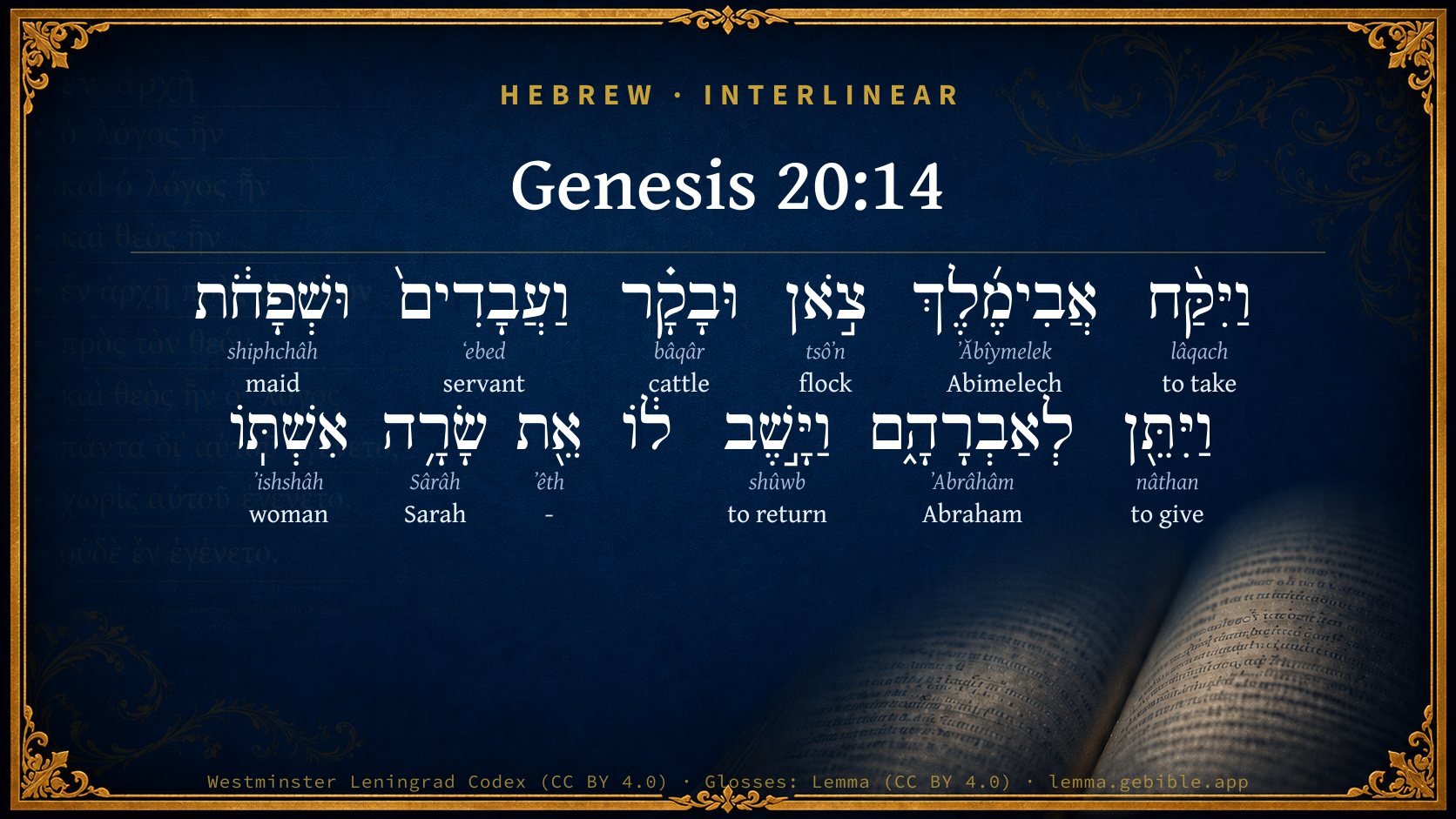
  1. וַיִּקַּ֨ח lâqach H3947 “and · to take” Conjunction + Verb, Qal, Sequential Imperfect, 3rd Person, Masculine, Singular
  2. אֲבִימֶ֜לֶךְ ʼĂbîymelek H40 “Abimelech” Noun, Proper
  3. צֹ֣אן tsôʼn H6629 “flock” Noun, Common, Both, Singular, Absolute
  4. וּבָקָ֗ר bâqâr H1241 “and · cattle” Conjunction + Noun, Common, Both, Singular, Absolute
  5. וַעֲבָדִים֙ ʻebed H5650 “and · servants” Conjunction + Noun, Common, Masculine, Plural, Absolute
  6. וּשְׁפָחֹ֔ת shiphchâh H8198 “and · maids” Conjunction + Noun, Common, Feminine, Plural, Absolute
  7. וַיִּתֵּ֖ן nâthan H5414 “and · to give” Conjunction + Verb, Qal, Sequential Imperfect, 3rd Person, Masculine, Singular
  8. לְאַבְרָהָ֑ם ʼAbrâhâm H85 “to/for · Abraham” Preposition + Noun, Proper
  9. וַיָּ֣שֶׁב shûwb H7725 “and · to return” Conjunction + Verb, Hiphil, Sequential Imperfect, 3rd Person, Masculine, Singular
  10. אֵ֖ת ʼêth H853 “-” Particle, Direct Object
  11. אִשְׁתּֽוֹ ʼishshâh H802 “woman · his” Noun, Common, Feminine, Singular, Construct + Suffix, Personal, 3rd Person, Masculine, Singular

About this verse

These counts appear in no published source. They are computed here, from the morphology-tagged text and Lemma’s own curated glosses. What Lemma adds →

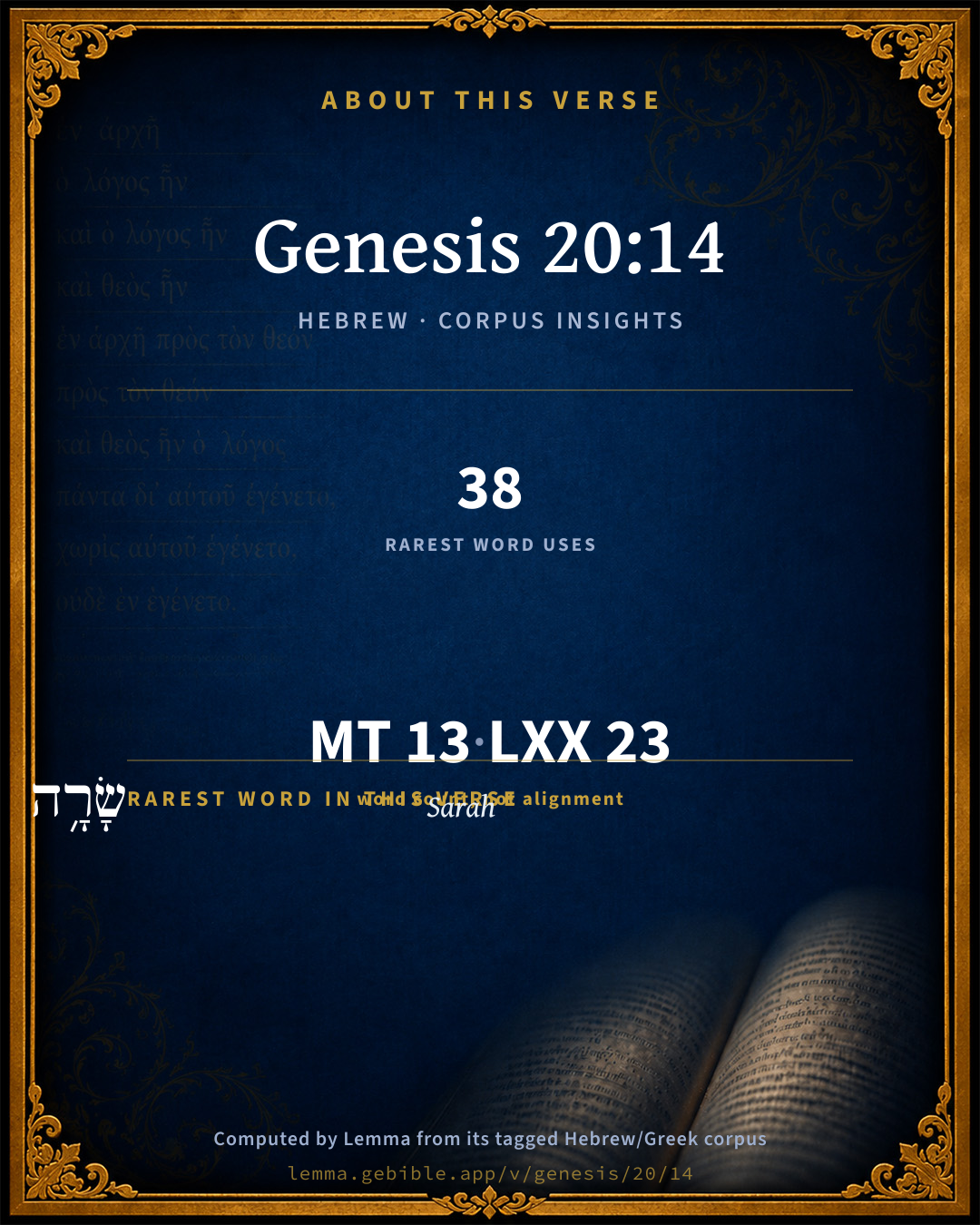
13
words
12
distinct lemmas
Pentateuch
section

Shared distinctive vocabulary

שָׂרָ֥ה Sarah H8283 occurs in 32 verses of the Hebrew Bible. Also found in:

Grammatical profile

  • 3 verbs
  • 8 nouns
  • 1 preposition
  • 1 particle

Verb forms

  • וַיִּקַּ֨ח Qal · Sequential Imperfect
  • וַיִּתֵּ֖ן Qal · Sequential Imperfect
  • וַיָּ֣שֶׁב Hiphil · Sequential Imperfect

Hebrew & Septuagint length

In English translation the verse runs 20 words from the Hebrew and 28 from the Septuagint (LXX English) — the Septuagint runs noticeably longer here. See the side-by-side →

A rough comparison of the two English renderings, which tokenize alike — not a word-level alignment.

Word counts can differ between the Hebrew and the Greek without any difference in meaning — e.g. the Hebrew direct-object marker אֵת has no separate Greek word, and Greek often adds the article ὁ.

In the original languages it is 13 Hebrew tokens and 23 Greek tokens — but the two are counted differently (Hebrew bundles its prefixes and suffixes into one token; the Greek is in lemma form), so that isn’t a like-for-like length.

Cross-references

5

Topical passages linked to Genesis 20:14 in the Treasury of Scripture Knowledge — connected by theme and wording, ordered by reader-vote popularity; previews shown in the World English Bible.

  • Genesis 12:16 He dealt well with Abram for her sake. He had sheep, and oxen, and male donkeys, and men-servants, and maid-servants, and female donkeys, and camels.
  • Genesis 12:19–20 Why did you say, 'She is my sister,' so that I took her to be my wife? Now therefore, see your wife, take her, and go your way."
  • Genesis 20:2 Abraham said about Sarah his wife, "She is my sister." Abimelech king of Gerar sent, and took Sarah.
  • Genesis 20:7 Now therefore, restore the man's wife. For he is a prophet, and he will pray for you, and you will live. If you don't restore her, know for sure that you will die, you, and all who are yours."
  • Genesis 20:11 Abraham said, "Because I thought, 'Surely the fear of God is not in this place. They will kill me for my wife's sake.'

Cross-references courtesy of OpenBible.info (CC BY 4.0).

Hebrew and Greek witnesses Masoretic Hebrew ↔ Greek Septuagint

The same verse in the two great witnesses to the Old Testament, shown verse-for-verse.

Here the Septuagint runs noticeably longer than the Hebrew — LXX2012 (modern English Septuagint) 28 words vs World English Bible 20. A rough length comparison of the two English translations, not a word-level alignment — read both below.

These are two independent witnesses, not word-aligned to each other, and the Septuagint is shown in lemma (dictionary) form.

Hebrew Genesis 20:14 Masoretic · Westminster Leningrad Codex

וַיִּקַּ֨ח אֲבִימֶ֜לֶךְ צֹ֣אן וּבָקָ֗ר וַעֲבָדִים֙ וּשְׁפָחֹ֔ת וַיִּתֵּ֖ן לְאַבְרָהָ֑ם וַיָּ֣שֶׁב ל֔וֹ אֵ֖ת שָׂרָ֥ה אִשְׁתּֽוֹ

Abimelech took sheep and oxen, men-servants and women-servants, and gave them to Abraham, and restored Sarah, his wife to him.

World English Bible · Public Domain

Greek LXX Genesis 20:14 Septuagint · lemma form

λαμβάνω δέ αβιμελεχ χίλιοι δίδραγμον πρόβατον καί μόσχος καί παῖς καί παιδίσκη καί δίδωμι ὁ αβρααμ καί ἀποδίδωμι αὐτός σαρρα ὁ γυνή αὐτός

And Abimelech took a thousand pieces of silver, and sheep, and calves, and servants, and maidservants, and gave them to Abraam, and he returned him Sarrha his wife.

LXX2012 (modern English Septuagint) · Public Domain

On this verse, The Cambridge Bible for Schools and Colleges discusses the Septuagint’s reading. Read the note in Commentary ↓

Hebrew: Westminster Leningrad Codex (CC BY 4.0). Greek: Septuagint (public domain); English from LXX2012 (modern English Septuagint) (Public Domain). How the Septuagint differs from the Hebrew →

Targum (Aramaic paraphrase)

2

The Targum is the ancient Jewish Aramaic paraphrase of the Hebrew Scriptures — an interpretive translation, not the Hebrew text itself. Onkelos (literal) and Pseudo-Jonathan (expansive) render the Torah, and Jonathan the Prophets. Coverage is partial: where no permissively-licensed English translation exists for a verse, only the Aramaic is shown. This is verse-level text, not a word-by-word alignment to the Hebrew.

  1. Targum Onkelos Torah (Genesis–Deuteronomy)
    וּדְבַר אֲבִימֶלֶךְ עָאן וְתוֹרִין וְעַבְדִין וְאַמְהָן וִיהַב לְאַבְרָהָם וַאֲתֵיב לֵהּ יָת שָׂרָה אִתְּתֵהּ

    (no public-domain English translation for this verse)

    Targum Onkelos — Aramaic: “Onkelos Genesis” (public domain); “Onkelos Exodus” (public domain); “Onkelos Leviticus” (public domain); “Onkelos Numbers” (public domain); “Onkelos Deuteronomy” (public domain). English: “Sefaria Community Translation” (CC0 1.0 (public-domain dedication)); “J.W. Etheridge. The Targums of Onkelos and Jonathan Ben Uzziel on the Pentateuch. London: Longmans, Green, 1862” (public domain). Text via Sefaria.

  2. Targum Pseudo-Jonathan Torah (Genesis–Deuteronomy)
    וּנְסֵיב אֲבִימֶלֶךְ עָאן וְתוֹרִין וְעַבְדִין וְאַמְהִין וִיהַב לְאַבְרָהָם וְאָתֵיב לֵיהּ יַת שָרָה אִנְתְּתֵיהּ

    And Abimelek took sheep, and restored Sarah his wife to him.

    Targum Pseudo-Jonathan — Aramaic: “Targum Jonathan on Genesis” (public domain); “Targum Jonathan on Exodus” (public domain); “Targum Jonathan on Leviticus” (public domain); “Targum Jonathan on Numbers” (public domain); “Targum Jonathan on Deuteronomy” (public domain). English: “The Targum of Jonathan ben Uzziel, trans. J. W. Etheridge, London, 1862” (public domain). Text via Sefaria.

Commentary

Notes on Genesis 20:14 from classic Christian and Jewish commentators (each source and its license shown beneath its notes). The classic Christian expositions comment on the surrounding passage and are grouped to its opening verse, so a note may address several verses; the Jewish commentaries on the Tanakh (Rashi and others) are per-verse, so they appear only where the commentator wrote on this verse.

Lemma curates 59 commentaries, every one of them public domain or Creative Commons licensed, each selected and text-cleaned for this edition rather than reprinted as found. About our sources →

Matthew Henry's Commentary

Here is, I. The kindness of a prince which Abimelech showed to Abraham. See how unjust Abraham's jealousies were. He fancied that if they knew that Sarah was his wife they would kill him; but, when they did know it, instead of killing him they were kind to him, frightened at least to be so by the divine rebukes they were under. 1. He gives him his royal licence to dwell where he pleased in his country, courting his stay because he gives him his royal gifts (Gen 20:14), sheep and oxen, and (Gen 20:16) a thousand pieces of silver. This he gave when he restored Sarah, either, [1.] By way of satisfaction for the wrong he had offered to do, in taking her to his house: when the Philistines restored the ark, being plagued for detaining it, they sent a present with it. The law appointed that when restitution was made something should be added to it, Lev 6:5. Or, [2.] To engage Abraham's prayers for him; not as if prayers should be bought and sold, but we should endeavour to be kind to those of whose spiritual things we reap, Co1 9:11. Note, It is our wisdom to get and keep an interest with those that have an interest in heaven, and to make those our friends who are the friends of God. [3.] He gives to Sarah good instruction, tells her that her husband (her brother he calls him, to upbraid her with calling him so) must be to her for a covering of the eyes, that is, she must look at no other, nor desire to be looked at by any other. Note, Yoke-fellows must be to each other for a covering of the eyes. The marriage-covenant is a covenant with the eyes, like Job's, Job 31:1.

II. The kindness of a prophet which Abraham showed to Abimelech: he prayed for him, Gen 20:17, Gen 20:18. This honour God would put upon Abraham that, though Abimelech had restored Sarah, yet the judgment he was under should be removed upon the prayer of Abraham, and not before. Thus God healed Miriam, when Moses, whom she had most affronted, prayed for her (Num 12:13), and was reconciled to Job's friends when Job, whom they had grieved, prayed for them (Job 42:8-10), and so did, as it were, give it under his hand that he was reconciled to them. Note, The prayers of good men may be a kindness to great men, and ought to be valued.

Matthew Henry's Commentary on the Whole Bible (1708–1710) — public domain (CC PDM 1.0). Text via the HelloAO Bible API.

Trapp's Complete Commentary

John Trapp

Gen 20:14 And Abimelech took sheep, and oxen, and menservants, and womenservants, and gave [them] unto Abraham, and restored him Sarah his wife.

Ver. 14. And Ablmelech took sheep and oxen.] Great men should be bountiful to good men. Aeneas Sylvius was wont to say of learning - how much more may it be said of grace? - popular men should esteem it as silver, noblemen as gold, princes prize it as pearls. Arcadius the emperor gave his schoolmaster Arsenes, a holy man, the revenues of all Egypt, desiring him to pray for him. Arsenes promised him his prayers, but refused his rich offer; saying, that he wanted no money, as being long since dead to the world. {a}

{a} Pecunia non egere, quod mundo iampridem mortuus esset . - Parei Hist. Profan. Medul., p. 495.

John Trapp, A Commentary or Exposition upon All the Books of the Old and New Testament (1647–1656) — public domain. Text from a community e-Sword module.

Tyndale Open Study Notes

Tyndale Open Resources

20:14-16 Abimelech secured his reputation as a good man (see study note on 20:4-5) and demonstrated his integrity. He made amends by allowing Abraham to live in the region and by giving him slaves, livestock (cp. 21:27), and 1,000 pieces of silver to compensate . . . for any wrong done to Sarah.

Tyndale Open Study Notes — © Tyndale Open Resources, licensed CC BY-SA 4.0. Text via the HelloAO Bible API.

John Calvin's Commentaries

14. And Abimelech took sheep. Abraham had before received possessions and gifts in Egypt; but with this difference, that whereas Pharaoh had commanded him to depart elsewhere; Abimelech offers him a home in his kingdom. It therefore appears that both kings were stricken with no common degree of fear. For when they perceived that they were reproved by the Lord, because they had been troublesome to Abraham; they found no method of appeasing God, except that of compensating, by acts of kindness, for the injury they had brought on the holy man. The latter difference alluded to flowed hence; that Pharaohs being more severely censured, was so terrified, that he could scarcely bear the sight of Abraham: whereas Abimelech, although alarmed, was yet soon composed by an added word of consolation, when the Lord said to him, He is a prophet, and he shall pray for thee. For there is no other remedy for the removal of fear, than the Lord’s declaration that he will be propitious. It is indeed of little advantage for the sinner to present to God only what fear extorts. But it is a true sign of penitence, when, with a composed mind and quiet conscience, he yields himself, as obedient and docile, to God. And seeing that Abimelech allowed Abraham a habitation in his realm, a blessing of no trivial kind followed this act of humanity; because Isaac was born there, as we shall see in the next chapter (Genesis 20:1.)

John Calvin's Commentaries (1540-1563) — public domain. Text from the Calvin Translation Society English edition (1840s-50s) via the Christian Classics Ethereal Library (ccel.org). Calvin's coverage is partial (roughly two-thirds of the Bible); uncommented books and verses are honest gaps, never fabricated. The 19th-century editor's footnotes and remarks are omitted so the notes are faithfully Calvin's own voice.

Ellicott's Commentary for English Readers

(14) Abimelech. . . . gave them unto Abraham.—Pharaoh’s presents were given when he took Sarah, and though he did not exact them back, yet he bade Abraham “go his way” in displeasure. More generously, the Philistine gives presents on restoring Sarah, and grants her husband permission to dwell in his land wherever it pleased him. He also acknowledges thereby that he had done Abraham a wrong.

A Bible Commentary for English Readers, edited by Charles John Ellicott (1878–1897) — public domain. Text from a community e-Sword module.

The Cambridge Bible for Schools and Colleges

gen. ed. J. J. S. Perowne

14. And Abimelech took] Abimelech’s gift is intended to compensate Abraham for injury to his honour. The head of the household is regarded as embodying the rights of all who belong to him. The LXX and Heb. Sam. insert “a thousand pieces of silver and” before “sheep and oxen.” This is due to a misunderstanding of Gen_20:16.

The Cambridge Bible for Schools and Colleges (gen. ed. J. J. S. Perowne; Cambridge University Press, 1878–1918) — public domain. Text from a community e-Sword module.

John Gill's Exposition

And Abimelech took sheep, and oxen, and menservants, and womenservants, and gave them unto Abraham,.... In a good measure satisfied with what Abraham had said to excuse himself; and these gifts he gave unto him, that he might, as Jarchi observes, pray and intercede for him, that he and his family might be healed, having understood by the divine oracle that he was a prophet, and if he prayed for him he would be restored to health: and these were not given to bribe him to give his consent that Sarah might be continued with him, since it follows:

and restored him Sarah his wife; untouched by him, as he was directed by God to do.

John Gill's Exposition of the Whole Bible (1746–1763) — public domain (CC PDM 1.0). Text via the HelloAO Bible API.

Haydock's Catholic Bible Commentary

Gave, by way of satisfaction, for having detained his wife; as also to shew his respect for him who was a prophet. (1 Kings ix. 7.) (Haydock)

George Leo Haydock (1774–1849), Haydock's Catholic Family Bible and Commentary, 1859 edition — public domain. Excludes Psalms (Douay-Rheims chapter numbering differs from Protestant) and Deuterocanonical books (Catholic canon only).

Whedon's Commentary on the Bible

Daniel D. Whedon

14. Took sheep and oxen — Compare the similar present of the king of Egypt, Gen_12:16.

Daniel D. Whedon (gen. ed.), Commentary on the Old and New Testaments (1874–1909) — public domain. Text from a community e-Sword module.

The Pulpit Commentary

And Abimelech as Pharaoh did, (Gen_12:18) but with a different motive took sheep, and oxen, and men-servants, and women-servants. The LXX and Samaritan insert "a thousand didrachmas" after "took," in order to include Sarah"s present, mentioned in Ver. 16; but the two donations are separated in order to distinguish them as Abraham"s gift and Sarah"s respectively (Rosenm Delitzsch), or the sum of money may indicate the value of the sheep and oxen, &c. which Abraham received (Keil, Knobel, Lange, "Speaker"s Commentary"). ;And gave them unto Abraham. To propitiate his favor for the wrong he had suffered. Pharaoh"s gifts were "for the sake of Sarah". (Gen_12:16) And restored him Sarah his wife.

The Pulpit Commentary (1880–1919), ed. H.D.M. Spence-Jones & Joseph S. Exell — public domain. Text from a community e-Sword module.

Keil & Delitzsch

C. F. Keil & F. Delitzsch

Abimelech then gave him back his wife with a liberal present of cattle and slaves, and gave him leave to dwell wherever he pleased in his land. To Sarah he said, "Behold, I have given a thousand shekele of silver to thy brother; behold, it is to thee a covering of the eyes (i.e., an expiatory gift) with regard to all that are with thee ("because in a mistress the whole family is disgraced," Del.), and with all - so art thou justified." The thousand shekels (about 131) were not a special present made to Sarah, but indicate the value of the present made to Abraham, the amount of which may be estimated by this standard, that at a later date (Exo 21:32) a slave was reckoned at 30 shekels. By the "covering of the eyes" we are not to understand a veil, which Sarah was to procure for 1000 shekels; but it is a figurative expression for an atoning gift, and is to be explained by the analogy of the phrase פּני פ כּפּר "to cover any one's face," so that he may forget a wrong done (cf. Gen 32:21; and Job 9:24, "he covereth the faces of the judges," i.e., he bribes them). ונוכחת can only be the 2 pers. fem. sing. perf. Niphal, although the Dagesh lene is wanting in the ת; for the rules of syntax will hardly allow us to regard this form as a participle, unless we imagine the extremely harsh ellipsis of נוכחת for אתּ נוכחת. The literal meaning is "so thou art judged," i.e., justice has been done thee.

Keil & Delitzsch — Biblical Commentary on the Old Testament (1861–1891) — public domain (CC PDM 1.0). Text via the HelloAO Bible API. (Old Testament only.)

Kretzmann's Popular Commentary

Paul E. Kretzmann

The Plague Removed from Abimelech

v. 14. And Abimelech took sheep and oxen and men-servants and women-servants, and gave them unto Abraham, and restored him Sarah, his wife. The restoration of Sarah with her honor unspotted followed as a matter of course, but the giving of presents in such rich measure was an act of magnanimity on Abimelech’s part, showing that he felt no false resentment.

v. 15. And Abimelech said, Behold, my land is before thee; dwell where it pleaseth thee. To offer to Abraham the choice of pasturage in his land in the circumstances was certainly heaping coals of fire on his head.

v. 16. But unto Sarah he said, Behold, I have given thy brother a thousand pieces of silver; behold, he is to thee a covering of the eyes unto all that are with thee and with all other. Thus she was reproved. The goods which Abimelech had given to Abraham were estimated at this sum. Now Sarah was to know that this (or he) was to her a covering of the eyes and to her entire household and to all men; that is, according to some explanations, she was to look upon the gifts as presents of atonement, also with respect to such people in whose eyes she might be covered with dishonor. Or, if the reference is to Abraham, it means that he had willfully blinded the eyes of Abimelech and all his people in this transaction, and that Sarah should now be reminded, through this present, never again to agree to such a subterfuge. In that way she stood reproved.

v. 17. So Abraham prayed unto God; and God healed Abimelech and his wife and his maid-servants; and they bare children.

v. 18. For the Lord had fast closed up all the wombs of the house of Abimelech because of Sarah, Abraham’s wife. That was the manner in which God’s punishment upon Abimelech had begun, by denying offspring to his entire household, for it is in His hands, as the Creator of the universe, to grant the blessing of children. The entire story shows that the Lord holds His protecting hand over His children in the midst of all the temptations of the world, Psa 105:14-15.

Paul E. Kretzmann, Popular Commentary of the Bible (1921–1924) — public domain. Text from a community e-Sword module.

Rashi

Rabbi Shlomo Yitzchaki (Rashi)

ויתן לאברהם AND GAVE THEM UNTO ABRAHAM, so that he might he mollified and pray for him.

Rashi on the Tanakh — English translations: “The Judaica Press complete Tanach with Rashi, translated by A. J. Rosenberg” (CC BY 4.0); “Pentateuch with Rashi's commentary by M. Rosenbaum and A.M. Silbermann, 1929-1934” (public domain); “The Metsudah Tanach series, Lakewood, N.J” (CC BY 4.0); and “The Book of Joshua, Metsudah Publications, 1997” (CC BY 4.0). Text via Sefaria.

Radak

Rabbi David Kimhi (Radak)

ויקח, He appeased him both with words and money, asking him for forgiveness and urging him to pray on his behalf. He also told him that he was welcome to stay in his country wherever he chose to settle, seeing that he would issue orders that neither he nor Sarah be molested.

Radak on the Tanakh — English translations: “Sefaria Community Translation” (CC0 1.0 (public-domain dedication)); “Eliyahu Munk, HaChut Hameshulash” (CC BY 4.0); “Rabbi Mike Feuer, Jerusalem Anthology” (CC BY 4.0); and “R. David Kimhi on the first book of Psalms, Translated by R.G. Finch, London, 1919” (public domain). Text via Sefaria.

Lesson kit

Teaching starters — assembled from the data on this page, not authored interpretation. Every prompt links to the verse data it draws on. Edit before teaching.

Genesis, in the Pentateuch, opens this verse with 13 words (12 distinct Hebrew lemmas). Its most distinctive word is Sârâh (“Sarah”). The Greek Septuagint runs longer here. A historical commentator’s framing appears above. Read the whole chapter for the surrounding context.

Discussion questions

  1. What does “Sarah” (Sârâh) contribute to the verse as a whole?
  2. How does Genesis 17:15, which shares the word «Sarah», read alongside this verse?
  3. The Septuagint runs longer here than the Hebrew. What might account for the difference?
  4. The translations on this page render this verse differently — a whole-verse word diff, not a word-by-word alignment. What might account for the different wordings?
  5. «וַיִּקַּ֨ח» is a Qal Sequential Imperfect verb. How does that grammatical form shape the action described?
  6. Compare how Matthew Henry's Commentary and Trapp's Complete Commentary read this verse. Where do they agree or differ?

Things to notice

Reading settings

Reading text

Shown beneath each verse's original-language words.

Old Testament
Old Testament edition

Read the OT as the Masoretic Hebrew (MT) or the Greek Septuagint (LXX).

English shown for the Greek Septuagint (in the Hebrew ↔ Greek comparison).

Comparing translations? Open the Compare panel on any verse page to stack up to four side by side.