
Genesis 27:37

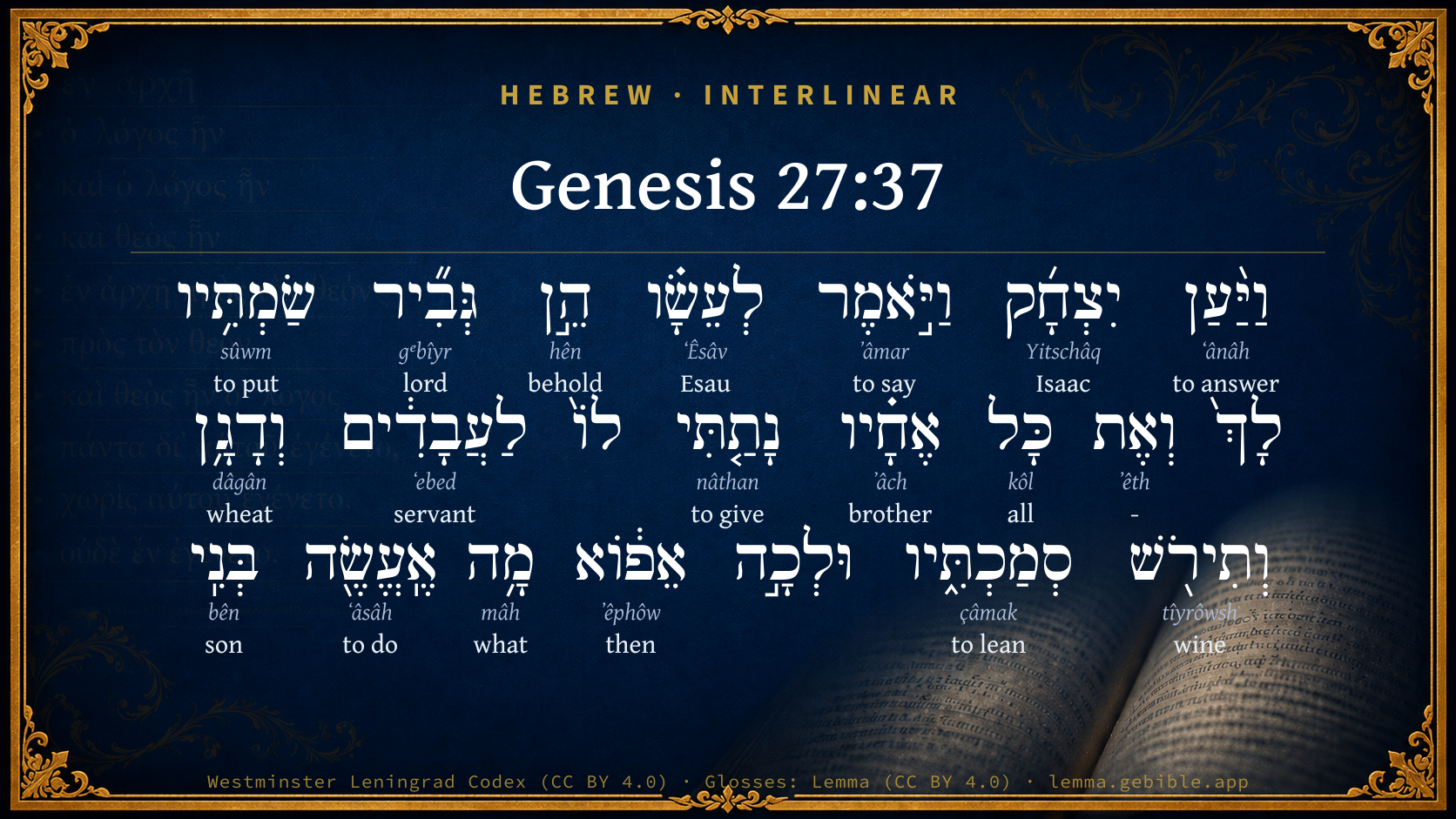
Hebrew (Westminster Leningrad Codex) Genesis 27:37 appears in the Hebrew Old Testament. The text above is from the Westminster Leningrad Codex. Each word links to its Strong’s number, a concise gloss, and parsing drawn from the Open Scriptures Hebrew Bible morphology. Click any word for its full Brown-Driver-Briggs (BDB) entry.
Download image
Cite this verse

Genesis 27:37 (World English Bible). Public Domain. Lemma interlinear Bible study tool, https://lemma.gebible.app/v/genesis/27/37.

Show BibTeX & RIS
BibTeX
RIS
English Translation
Isaac answered Esau, "Behold, I have made him your lord, and all his brothers have I given to him for servants. With grain and new wine have I sustained him. What then will I do for you, my son?"
World English Bible · Public Domain
Highlights
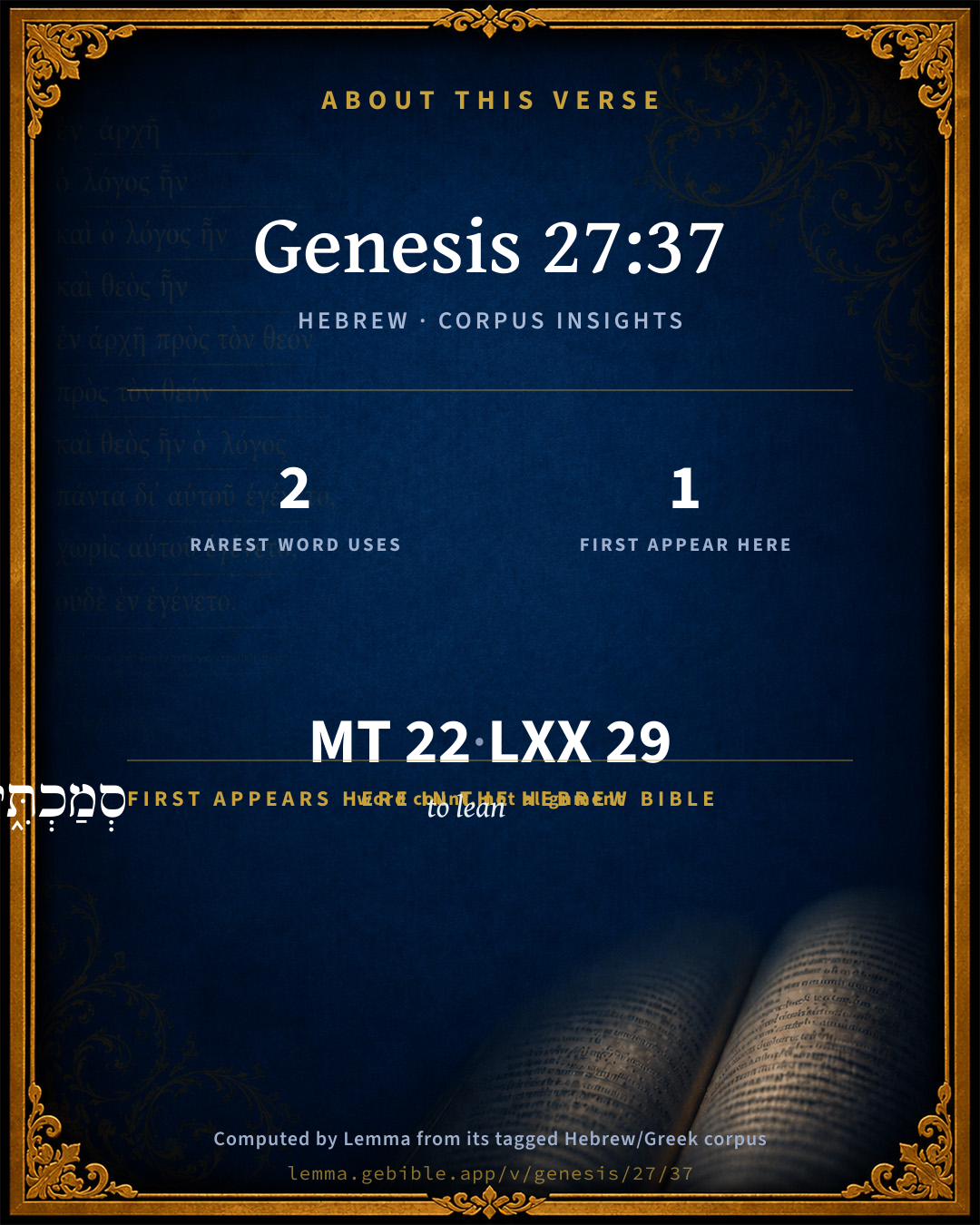
  • 1 first appearance in the Hebrew Bible
Full analysis ↓
Download a study sheet

One document with this verse’s original text, its word-by-word gloss line, the meaning frame, cross-references with their text, attributed commentary, and full source and license credits — printable, and it pastes into notes with its structure intact.

This verse Autodidact and up

Study sheet (.html) Plain text (.txt)

A passage Seminary Student

Up to 50 verses in one chapter. A passage sheet keeps up to 6 commentary sources and 12 cross-references per verse, in the order this page ranks them, and says so on the sheet whenever that leaves anything out. Ask for a single verse and you get the Autodidact verse sheet above.

Everything on this page stays free to read, with no account — the sheet is a download of what is already on screen, not access to it.

Want to remove ads? Support Godless Engineer
Compare translations 3

The same verse in 3 English versions, stacked beneath the original-language interlinear above. Click any original word for its lexicon entry.

Each is an independent rendering of the whole verse — the interlinear is not word-aligned to these translations.

Highlighted words mark where these versions differ — a whole-verse word diff, not a word-by-word alignment.

  • World English Bible Public Domain
    Isaac answered Esau, "Behold, I have made him your lord, and all his brothers have I given to him for servants. With grain and new wine have I sustained him. What then will I do for you, my son?"
  • King James Version Public Domain
    And Isaac answered and said unto Esau, Behold, I have made him thy lord, and all his brethren have I given to him for servants; and with corn and wine have I sustained him: and what shall I do now unto thee, my son?
  • unfoldingWord Literal Text CC BY-SA 4.0
    But Isaac responded and said to Esau, “Behold, I have made him master over you, and I have given all his brothers to him as servants. And I have sustained him with grain and wine. So then, what can I do for you, my son?”

unfoldingWord Literal Text — © unfoldingWord, licensed CC BY-SA 4.0. Word-aligned USFM3 via Door43 (git.door43.org/unfoldingWord/en_ult).

Versions to compare (up to 4)

3 of 4 selected

Show all 18 translations

Every available English version of this verse, each an independent rendering of the whole verse.

  • World English Bible Public Domain
    Isaac answered Esau, "Behold, I have made him your lord, and all his brothers have I given to him for servants. With grain and new wine have I sustained him. What then will I do for you, my son?"
  • Berean Standard Bible Public Domain
    But Isaac answered Esau: “Look, I have made him your master and given him all his relatives as servants; I have sustained him with grain and new wine. What is left that I can do for you, my son?”
  • Majority Standard Bible Public Domain
    But Isaac answered Esau: “Look, I have made him your master and given him all his relatives as servants; I have sustained him with grain and new wine. What is left that I can do for you, my son?”
  • King James Version Public Domain
    And Isaac answered and said unto Esau, Behold, I have made him thy lord, and all his brethren have I given to him for servants; and with corn and wine have I sustained him: and what shall I do now unto thee, my son?
  • American Standard Version (1901) Public Domain
    And Isaac answered and said unto Esau, Behold, I have made him thy lord, and all his brethren have I given to him for servants. And with grain and new wine have I sustained him. And what then shall I do for thee, my son?
  • Revised Version (1885) Public Domain
    And Isaac answered and said unto Esau, Behold, I have made him thy lord, and all his brethren have I given to him for servants; and with corn and wine have I sustained him: and what then shall I do for thee, my son?
  • Geneva Bible (1599) Public Domain
    Then Izhak answered, and sayd vnto Esau, Beholde, I haue made him thy lorde, and all his brethre haue I made his seruants: also with wheate and wine haue I furnished him, and vnto thee now what shall I doe, my sonne?
  • Douay-Rheims (1899) Public Domain
    Isaac answered: I have appointed him thy lord, and have made all his brethren his servants: I have established him with corn and wine, and after this, what shall I do more for thee, my son?
  • Young's Literal Translation Public Domain
    And Isaac answereth and saith to Esau, `Lo, a mighty one have I set him over thee, and all his brethren have I given to him for servants, and `with' corn and wine have I sustained him; and for thee now, what shall I do, my son?'
  • Literal Standard Version CC BY-SA 4.0
    And Isaac answers and says to Esau, “Behold, a mighty one have I set him over you, and all his brothers have I given to him for servants, and [with] grain and wine have I sustained him; and for you now, what will I do, my son?”
  • Unlocked Literal Bible CC BY-SA 4.0
    Isaac answered and said to Esau, “Look, I have made him your master, and I have given to him all his brothers as servants, and I have given him grain and new wine. What more can I do for you, my son?”
  • unfoldingWord Literal Text CC BY-SA 4.0
    But Isaac responded and said to Esau, “Behold, I have made him master over you, and I have given all his brothers to him as servants. And I have sustained him with grain and wine. So then, what can I do for you, my son?”
  • Darby Bible Public Domain
    And Isaac answered and said to Esau, Behold, I have made him lord over thee, and all his brethren have I given to him for servants, and with corn and new wine have I supplied him -- and what can I do now for thee, my son?
  • World Messianic Bible Public Domain
    Isaac answered Esau, “Behold, I have made him your lord, and all his brothers I have given to him for servants. I have sustained him with grain and new wine. What then will I do for you, my son?”
  • Webster's Bible Public Domain
    And Isaac answered and said to Esau, Behold, I have made him thy lord, and all his brethren have I given to him for servants; and with corn and wine have I sustained him: and what shall I do now to thee, my son?
  • Free Bible Version CC BY-SA 4.0
    Isaac replied to Esau. “I have made him ruler over you, and have said that all his relatives will be his servants. I have declared that he will be well supplied with grain and new wine. So what is left that I can do for you, my son?”
  • Bible in Basic English Public Domain
    And Isaac answering said, But I have made him your master, and have given him all his brothers for servants; I have made him strong with grain and wine: what then am I to do for you, my son?
  • JPS Tanakh (1917) Public Domain
    And Isaac answered and said unto Esau: 'Behold, I have made him thy lord, and all his brethren have I given to him for servants; and with corn and wine have I sustained him; and what then shall I do for thee, my son?'

Literal Standard Version (2020), Covenant Press — licensed CC BY-SA 4.0. Text via the HelloAO Bible API (eBible.org). Unlocked Literal Bible (unfoldingWord) — licensed CC BY-SA 4.0. Text via the HelloAO Bible API (eBible.org). unfoldingWord Literal Text — © unfoldingWord, licensed CC BY-SA 4.0. Word-aligned USFM3 via Door43 (git.door43.org/unfoldingWord/en_ult). Free Bible Version, Dr. Jonathan Gallagher — licensed CC BY-SA 4.0. Text via the HelloAO Bible API (eBible.org).

Word by word

More ways to search: Search by grammar → Find every occurrence → Compare this word →

Practice this passage: Drill this verse → Learn its vocabulary →

גְּבִ֞יר
gᵉbîyr
H1376
“lord”
Noun, Common, Masculine, Singular, Absolute
Part of Speech
Noun
Type
Common
Gender
Masculine
Number
Singular
State
Absolute
Full BDB Definition

Origin: from H1396

TWOT: 310d

lord, ruler
  1. וַיַּ֨עַן ʻânâh H6030 “and · to answer” Conjunction + Verb, Qal, Sequential Imperfect, 3rd Person, Masculine, Singular
  2. יִצְחָ֜ק Yitschâq H3327 “Isaac” Noun, Proper
  3. וַיֹּ֣אמֶר ʼâmar H559 “and · to say” Conjunction + Verb, Qal, Sequential Imperfect, 3rd Person, Masculine, Singular
  4. לְעֵשָׂ֗ו ʻÊsâv H6215 “to/for · Esau” Preposition + Noun, Proper
  5. הֵ֣ן hên H2005 “behold” Particle, Demonstrative
  6. שַׂמְתִּ֥יו sûwm H7760 “to put · him” Verb, Qal, Perfect, 1st Person, Common, Singular + Suffix, Personal, 3rd Person, Masculine, Singular
  7. וְאֶת ʼêth H853 “and · -” Conjunction + Particle, Direct Object
  8. כָּל kôl H3605 “all of” Noun, Common, Masculine, Singular, Construct
  9. אֶחָ֗יו ʼâch H251 “brothers · his” Noun, Common, Masculine, Plural, Construct + Suffix, Personal, 3rd Person, Masculine, Singular
  10. נָתַ֤תִּי nâthan H5414 “to give” Verb, Qal, Perfect, 1st Person, Common, Singular
  11. לַעֲבָדִ֔ים ʻebed H5650 “to/for · servants” Preposition + Noun, Common, Masculine, Plural, Absolute
  12. וְדָגָ֥ן dâgân H1715 “and · wheat” Conjunction + Noun, Common, Masculine, Singular, Absolute
  13. וְתִירֹ֖שׁ tîyrôwsh H8492 “and · wine” Conjunction + Noun, Common, Masculine, Singular, Absolute
  14. סְמַכְתִּ֑יו çâmak H5564 “to lean · him” Verb, Qal, Perfect, 1st Person, Common, Singular + Suffix, Personal, 3rd Person, Masculine, Singular
  15. אֵפ֔וֹא ʼêphôw H645 “then” Adverb
  16. מָ֥ה mâh H4100 “what” Particle, Interrogative
  17. אֶֽעֱשֶׂ֖ה ʻâsâh H6213 “to do” Verb, Qal, Imperfect, 1st Person, Common, Singular
  18. בְּנִֽי bên H1121 “son · my” Noun, Common, Masculine, Singular, Construct + Suffix, Personal, 1st Person, Common, Singular

About this verse

These counts appear in no published source. They are computed here, from the morphology-tagged text and Lemma’s own curated glosses. What Lemma adds →

22
words
19
distinct lemmas
Pentateuch
section

Notable vocabulary

The rarest word here is גְּבִ֞יר lord H1376 — appearing just 2 times in the whole Hebrew Bible.

First appearance in Scripture

This word makes its first canonical appearance in the Hebrew Bible here:

  • סְמַכְתִּ֑יו to lean H5564

Shared distinctive vocabulary

גְּבִ֞יר lord H1376 occurs in 2 verses of the Hebrew Bible. Also found in:

Grammatical profile

  • 6 verbs
  • 9 nouns
  • 3 prepositions
  • 1 adverb
  • 3 particles

Verb forms

  • וַיַּ֨עַן Qal · Sequential Imperfect
  • וַיֹּ֣אמֶר Qal · Sequential Imperfect
  • שַׂמְתִּ֥יו Qal · Perfect
  • נָתַ֤תִּי Qal · Perfect
  • סְמַכְתִּ֑יו Qal · Perfect
  • אֶֽעֱשֶׂ֖ה Qal · Imperfect

Hebrew & Septuagint length

In English translation the verse runs 39 words from the Hebrew and 38 from the Septuagint (LXX English) — closely comparable.

A rough comparison of the two English renderings, which tokenize alike — not a word-level alignment.

Word counts can differ between the Hebrew and the Greek without any difference in meaning — e.g. the Hebrew direct-object marker אֵת has no separate Greek word, and Greek often adds the article ὁ.

In the original languages it is 22 Hebrew tokens and 29 Greek tokens — but the two are counted differently (Hebrew bundles its prefixes and suffixes into one token; the Greek is in lemma form), so that isn’t a like-for-like length.

Cross-references

4

Topical passages linked to Genesis 27:37 in the Treasury of Scripture Knowledge — connected by theme and wording, ordered by reader-vote popularity; previews shown in the World English Bible.

  • Genesis 25:23 Yahweh said to her, Two nations are in your womb, Two peoples will be separated from your body. The one people will be stronger than the other people. The elder will serve the younger.
  • Genesis 27:28–29 God give you of the dew of the sky, of the fatness of the earth, and plenty of grain and new wine.
  • 2 Samuel 8:14 He put garrisons in Edom; throughout all Edom put he garrisons, and all the Edomites became servants to David. Yahweh gave victory to David wherever he went.
  • Romans 9:10–12 Not only so, but Rebecca also conceived by one, by our father Isaac.

Cross-references courtesy of OpenBible.info (CC BY 4.0).

Hebrew and Greek witnesses Masoretic Hebrew ↔ Greek Septuagint

The same verse in the two great witnesses to the Old Testament, shown verse-for-verse.

These are two independent witnesses, not word-aligned to each other, and the Septuagint is shown in lemma (dictionary) form.

Hebrew Genesis 27:37 Masoretic · Westminster Leningrad Codex

וַיַּ֨עַן יִצְחָ֜ק וַיֹּ֣אמֶר לְעֵשָׂ֗ו הֵ֣ן גְּבִ֞יר שַׂמְתִּ֥יו לָךְ֙ וְאֶת כָּל אֶחָ֗יו נָתַ֤תִּי לוֹ֙ לַעֲבָדִ֔ים וְדָגָ֥ן וְתִירֹ֖שׁ סְמַכְתִּ֑יו וּלְכָ֣ה אֵפ֔וֹא מָ֥ה אֶֽעֱשֶׂ֖ה בְּנִֽי

Isaac answered Esau, "Behold, I have made him your lord, and all his brothers have I given to him for servants. With grain and new wine have I sustained him. What then will I do for you, my son?"

World English Bible · Public Domain

Greek LXX Genesis 27:37 Septuagint · lemma form

ἀποκρίνω δέ ισαακ εἶπον ὁ ησαυ εἰ κύριος αὐτός ποιέω σύ καί πᾶς ὁ ἀδελφός αὐτός ποιέω αὐτός οἰκέτης σῖτος καί οἶνος στηρίζω αὐτός σύ δέ τίς ποιέω τέκνον

And Isaac answered and said to Esau, If I have made him your lord, and have made all his brethren his servants, and have strengthened him with corn and wine, what then shall I do for you, son?

LXX2012 (modern English Septuagint) · Public Domain

Hebrew: Westminster Leningrad Codex (CC BY 4.0). Greek: Septuagint (public domain); English from LXX2012 (modern English Septuagint) (Public Domain). How the Septuagint differs from the Hebrew →

Targum (Aramaic paraphrase)

2

The Targum is the ancient Jewish Aramaic paraphrase of the Hebrew Scriptures — an interpretive translation, not the Hebrew text itself. Onkelos (literal) and Pseudo-Jonathan (expansive) render the Torah, and Jonathan the Prophets. Coverage is partial: where no permissively-licensed English translation exists for a verse, only the Aramaic is shown. This is verse-level text, not a word-by-word alignment to the Hebrew.

  1. Targum Onkelos Torah (Genesis–Deuteronomy)
    וַאֲתֵיב יִצְחָק וַאֲמַר לְעֵשָׂו הָא רַב שַׁוִּתֵּהּ לָךְ (נ''י עִלַּוָּךְ) וְיָת כָּל אֲחוֹהִי יְהָבִית לֵהּ לְעַבְדִּין וְעִיבוּר וַחֲמָר סְעִדְתֵּהּ וְלָךְ הָכָא מָה אֶעְבֵּיד בְּרִי

    (no public-domain English translation for this verse)

    Targum Onkelos — Aramaic: “Onkelos Genesis” (public domain); “Onkelos Exodus” (public domain); “Onkelos Leviticus” (public domain); “Onkelos Numbers” (public domain); “Onkelos Deuteronomy” (public domain). English: “Sefaria Community Translation” (CC0 1.0 (public-domain dedication)); “J.W. Etheridge. The Targums of Onkelos and Jonathan Ben Uzziel on the Pentateuch. London: Longmans, Green, 1862” (public domain). Text via Sefaria.

  2. Targum Pseudo-Jonathan Torah (Genesis–Deuteronomy)
    וְאָתֵיב יִצְחָק וַאֲמַר לְעֵשָו הָא שַׁלִיט מִינִיתֵיהּ עֲלָךְ וְיַת כָּל אָחוֹי שִׁוִיתִי קוּמוֹי לְעַבְדִין וְעִיבּוּר וַחֲמַר סְעַדְתִּיו וְאָזִיל וְתִיטְרַד מִנִי דְמַה אַעֲבֵיד לָךְ בְּרִי

    And Izhak answered and said to Esau, Behold, I have appointed him a ruler over thee, and all his brethren have I made to be his servants, and with provision and wine have I sustained him: and now go, leave me; for what can I do for thee, my son?

    Targum Pseudo-Jonathan — Aramaic: “Targum Jonathan on Genesis” (public domain); “Targum Jonathan on Exodus” (public domain); “Targum Jonathan on Leviticus” (public domain); “Targum Jonathan on Numbers” (public domain); “Targum Jonathan on Deuteronomy” (public domain). English: “The Targum of Jonathan ben Uzziel, trans. J. W. Etheridge, London, 1862” (public domain). Text via Sefaria.

Commentary

Notes on Genesis 27:37 from classic Christian and Jewish commentators (each source and its license shown beneath its notes). The classic Christian expositions comment on the surrounding passage and are grouped to its opening verse, so a note may address several verses; the Jewish commentaries on the Tanakh (Rashi and others) are per-verse, so they appear only where the commentator wrote on this verse.

Lemma curates 59 commentaries, every one of them public domain or Creative Commons licensed, each selected and text-cleaned for this edition rather than reprinted as found. About our sources →

Trapp's Complete Commentary

John Trapp

Gen 27:37 And Isaac answered and said unto Esau, Behold, I have made him thy lord, and all his brethren have I given to him for servants; and with corn and wine have I sustained him: and what shall I do now unto thee, my son?

Ver. 37. I have made him thy Lord.] {See Trapp on "Gen 27:29"} This Isaac did, as he was the minister and prophet of God.

John Trapp, A Commentary or Exposition upon All the Books of the Old and New Testament (1647–1656) — public domain. Text from a community e-Sword module.

Tyndale Open Study Notes

Tyndale Open Resources

27:37 There was no going back. Isaac had declared an oracle from God, who had made Jacob to be Esau’s master (see Rom 9:11-13).

Tyndale Open Study Notes — © Tyndale Open Resources, licensed CC BY-SA 4.0. Text via the HelloAO Bible API.

Geneva Bible (1599)

Geneva Bible translators

For Isaac did this as he was the minister and Prophet of God.

Geneva Bible (1599) marginal notes — public domain. Text via Bolls.life.

Adam Clarke's Commentary

Verse 37. I have made him thy lord] See Clarke on Ge 27:28.

Adam Clarke's Commentary on the Bible (1810–1826) — public domain. Text from a community e-Sword/MySword module.

John Calvin's Commentaries

37. Behold, I have made him thy Lord. Isaac now more openly confirms what I have before said, that since God was the author of the blessing, it could neither be vain nor evanescent. For he does not here magnificently boast of his dignity, but keeps himself within the bounds and measure of a servant, and denies that he is at liberty to alter anything. For he always considers, (which is the truth,) that when he sustains the character of God’s representative, it is not lawful for him to proceed further than the command will bear him. Hence, indeed, Esau ought to have learned from whence he had fallen by his own fault, in order that he might have humbled himself, and might rather have joined himself with his brother, in order to become a partaker of his blessing, as his inferior, than have desired anything separately for himself. But a depraved cupidity carries him away, so that he, forgetful of the kingdom of God, pursues and cares for nothing except his own private advantage. Again, we must notice Isaac’s manner of speaking, by which he claims a certain force and efficacy for his benediction, as if his word carried with it dominion, abundance of corn and wine, and whatever else God had promised to Abraham. For God, in requiring the faithful to depend on himself alone, would nevertheless have them to rest securely upon the word, which, at his command, is declared to them by the tongue of men. In this way they are said to remit sins, who are only the messengers and interpreters of free forgiveness.

John Calvin's Commentaries (1540-1563) — public domain. Text from the Calvin Translation Society English edition (1840s-50s) via the Christian Classics Ethereal Library (ccel.org). Calvin's coverage is partial (roughly two-thirds of the Bible); uncommented books and verses are honest gaps, never fabricated. The 19th-century editor's footnotes and remarks are omitted so the notes are faithfully Calvin's own voice.

John Gill's Exposition

And Isaac answered and said unto Esau,.... Giving an account of the blessing be had bestowed upon his brother:

behold, I have made him thy lord; the lord of his posterity, who would be subdued and become tributary to his seed:

and all his brethren have I given to him for servants; the Edomites, who sprung from his brother Esau, who, according to this prophetic blessing, became servants to David, who was a son of Jacob's; see Gill on Gen 27:29,

and with corn and wine have I sustained him; promised him a fruitful country, the land of Canaan, abounding with all good things, particularly with corn and wine, which are put for all the rest:

and what shall I do now unto thee, my son? what is there remains? what can be bestowed upon thee? there is nothing left; dominion over others, even over all nations, yea, over thyself and thy posterity, and plenty of all good things, are given already to Jacob; what is there to be done for thee, or thou canst expect?

John Gill's Exposition of the Whole Bible (1746–1763) — public domain (CC PDM 1.0). Text via the HelloAO Bible API.

Haydock's Catholic Bible Commentary

Brethren, or relations; (Menochius) for Isaac had no other children but these two. He never married any other woman but the beautiful and virtuous Rebecca. (Haydock)

George Leo Haydock (1774–1849), Haydock's Catholic Family Bible and Commentary, 1859 edition — public domain. Excludes Psalms (Douay-Rheims chapter numbering differs from Protestant) and Deuterocanonical books (Catholic canon only).

Matthew Poole's English Annotations

The blessing of Abraham is not at my disposal, but God’s, who hath manifested his mind and will by my error; it cannot be divided into several hands, nor imparted to one, who, though my son, yet hath made himself unworthy of it.

Matthew Poole's English Annotations on the Holy Bible (1683–1685) — public domain. Text from a community e-Sword/MySword module.

The Pulpit Commentary

And Isaac answered and said unto Esau (repeating the substance of the Messing already conferred on Jacob), Behold, I have made him thy lord, literally, behold, a lord (vide on ver. 29) have I constituted him to thee; Isaac hereby intimating that in pronouncing the words of blessing he had been speaking under a celestial impulse, and therefore with absolute authorityand all his brethren have I given to him for servants (for the fulfillment vide, (2Sa_8:14) and with corn and wine have I sustained him: i.e. declared that by these he shall be sustained or supported (cf. ver. 28)and what shall I do now unto thee, my son?

The Pulpit Commentary (1880–1919), ed. H.D.M. Spence-Jones & Joseph S. Exell — public domain. Text from a community e-Sword module.

Rashi

Rabbi Shlomo Yitzchaki (Rashi)

הן גביר AND BEHOLD I HAVE MADE HIM THY MASTER — This blessing is the seventh in the series of blessings which Isaac gave to Jacob (cf. w. 28. 29) and yet he (Isaac) singles it out as though it were the chief blessing? But the explanation is, he said to him (Esau): “What benefit will a blessing be to you? If you acquire property, it will belong to him, for “Behold, I have made him thy master״, and whatever a servant acquires becomes the property of his master (Genesis Rabbah 67:5).

ולכה אפוא מה אעשה בני AND WHAT SHALL I DO NOW UNTO THEE [MY SON?] — Where here (איפה) shall I look for something that I can do for you?

Rashi on the Tanakh — English translations: “The Judaica Press complete Tanach with Rashi, translated by A. J. Rosenberg” (CC BY 4.0); “Pentateuch with Rashi's commentary by M. Rosenbaum and A.M. Silbermann, 1929-1934” (public domain); “The Metsudah Tanach series, Lakewood, N.J” (CC BY 4.0); and “The Book of Joshua, Metsudah Publications, 1997” (CC BY 4.0). Text via Sefaria.

Ramban (Nachmanides)

Rabbi Moshe ben Nachman (Ramban / Nachmanides)

AND ALL HIS BRETHREN HAVE I GIVEN HIM AS SERVANTS. This is not the blessing, Be lord over thy brethren, for Isaac had already said, Behold, I have made him thy lord. However, it is possible that Jacob be the lord and they not be his servants, just as the verse says, For Judah ‘gavar’ above his brethren. does not indicate a master and servant relationship. Similarly, the word gvir (lord) does not indicate such a relationship. But the source for his saying, I have given to him as servants, comes from his expression, And let thy mother’s sons bow down to thee, for this refers to the bowing of the servant to his masters, just as he says, Let people serve thee, and then repeats, And nations bow down to thee. The meaning of the expression, And all his brothers, is the same as that of thy brothers and thy mother’s sons. These he mentions in the plural in order to allude to all of Esau’s offspring. And Rabbi Abraham ibn Ezra says that it refers to the children of Abraham’s concubines.

Ramban (Nachmanides) on the Tanakh — English translation: “Commentary on the Torah by Ramban (Nachmanides). Translated and annotated by Charles B. Chavel. New York, Shilo Pub. House, 1971-1976” (CC BY 4.0). Text via Sefaria.

Radak

Rabbi David Kimhi (Radak)

ויען, concerning the exclamation that Yitzchok had not even reserved a small blessing for Esau, he answered: הן גביר שמתיו לך, ואת כל אחיו נתתי לו, seeing that I have appointed him as senior to you and to all his brothers, (compare verse 29) i.e. to Esau’s brothers (kin)

סמכתיו, I have appointed him as central, i.e. have decreed that all his family be close to him for all times (compare the word תסמכני in Psalms 51,14 ורוח נדיבה תסמכני, “let a vigorous spirit sustain me.” This can only be effective if all the relatives are close by. It is also possible that the meaning of the word סמכתיו is סעד, משען support of a financial and psychological type. If so, the prefix ב in the word סמכתיו would be missing, as if Yitzchok had said: ובדגן ותירוש, “and with corn and wine,” instead of ודגן ותירוש.

ולכה איפוא, as for you, now מה אעשה, what can I do? What kind of a blessing remains for you after all this? The formulation is similar to Isaiah 22,16 מה לך איפוא, “what have you here?”

Radak on the Tanakh — English translations: “Sefaria Community Translation” (CC0 1.0 (public-domain dedication)); “Eliyahu Munk, HaChut Hameshulash” (CC BY 4.0); “Rabbi Mike Feuer, Jerusalem Anthology” (CC BY 4.0); and “R. David Kimhi on the first book of Psalms, Translated by R.G. Finch, London, 1919” (public domain). Text via Sefaria.

Lesson kit

Teaching starters — assembled from the data on this page, not authored interpretation. Every prompt links to the verse data it draws on. Edit before teaching.

Genesis, in the Pentateuch, opens this verse with 22 words (19 distinct Hebrew lemmas). Its most distinctive word is gᵉbîyr (“lord”). A historical commentator’s framing appears above. Read the whole chapter for the surrounding context.

Discussion questions

  1. The word gᵉbîyr carries the sense “lord.” How does it shape the verse?
  2. This is the first place “to lean” appears in Scripture (first appears here). What does its debut here establish?
  3. How does Genesis 27:29, which shares the word «lord», read alongside this verse?
  4. These translations render this verse differently. What is at stake in choosing one wording over another?
  5. «וַיַּ֨עַן» is a Qal Sequential Imperfect verb. How does that grammatical form shape the action described?
  6. Compare how Trapp's Complete Commentary and Tyndale Open Study Notes read this verse. Where do they agree or differ?

Things to notice

Reading settings

Reading text

Shown beneath each verse's original-language words.

Old Testament
Old Testament edition

Read the OT as the Masoretic Hebrew (MT) or the Greek Septuagint (LXX).

English shown for the Greek Septuagint (in the Hebrew ↔ Greek comparison).

Comparing translations? Open the Compare panel on any verse page to stack up to four side by side.